Will $Aradel Aradel Fractal Setup Repeat? Down -18% from ATHARADEL’s Fractal Setup — Will History Repeat?
Is Aradel ( NSENG:ARADEL ) moving in repeating fractals? — a pattern of strong rallies, quick pauses, sharp pullbacks, and steep recoveries. Each dip in this sequence has so far created the foundation for the next rally leg, showing how market psychology often mirrors itself on the chart. Current price: 710naira/share
---
The First Fractal
The first major pattern appeared when price rallied from **₦520 → ₦689 (+29%)**, followed by a mild correction of about –13%.
That retracement found support around the moving average zone, after which the stock continued its steady climb — confirming strong buyer re-entry at lower levels.
---
The Current Setup
This latest fractal looks even more aggressive.
Price surged from ₦580 → ₦869 (+49%) before pulling back sharply — already down roughly –18%.
Currently, the ₦710 zone is acting as a short-term support level.
If this area holds, it could mark the end of the correction and the start of the next bullish swing.
The Fractal Projection
If history rhymes once more, the next upward leg could target the **₦950–₦1,000** resistance range — a natural extension zone aligning with prior swing highs.
However, a decisive breakdown below **₦624** would invalidate the fractal and signal a deeper retracement phase, possibly toward the longer-term trend support.
Summary
* Current support: ₦710 (key pivot)
* Fractal invalidation: ₦624
* Next potential target: ₦950–₦1,000
* Trend bias: Bullish if ₦710 holds; neutral-to-bearish if ₦624 breaks.
Fractals don’t predict price — they simply hint where institutional interest and historical rhythm may align. #ARADEL #NGX #NigerianStocks #PriceAction #FractalPattern #TechnicalAnalysis #InvestingNigeria
Energy Commodities
Natural Gas - The Short SqueezeNatural gas had another stellar rally today.
Bouncing hard off the 7 day moving average and making new weekly highs.
We have completed the measured bull flag move in the near term so an extra rally from here is pure shorts getting cooked in my opinion.
With price action rallying so far so quickly we pared back and secured some profits on our natural gas equity positions.
We sold our RRC December calls for 115% gain.
We trimmed our AR January calls for 65% gain.
We still have equity exposure and positions in profit so now it becomes a game of managing protecting profits.
In the near term I would not be surprised to see a minor pullback or 1-2 weeks of consolidation.
Watch Wednesday Reports for BrentOil market might have entered a key week. While end of US shutdown is in spotlight, 3 key reports will be released tomorrow. International Energy Agency will release November report. In the October report, IAE said that record oil surplus is expected in 2026. Oil demand expected to rise by 750 kb/d for both 2025 and 2026 while supply is expected to rise 3 mb/d for 2025 and 2.4 mb/d for 2026. Meaning oil surplus is expected to exceed demand by nearly 4 mb/d in 2026.
On top of IEA report OPEC will publish its monthly oil market report and EIA will publish monthly short-term energy outlook report in Wednesday.
So far, composite forecasts and forward prices suggest that the market expects oil to remain near current levels in 2026. Projections indicate that in the first and second quarters of 2026, Brent will trade close to 60, with WTI slightly below that level before a potential recovery later in the year. However, futures and spreads have not yet been priced in a low Q1-Q2.
Only two factors come to mind that could lift oil prices in 2026. The first is a surge in global energy demand that draws consumption back toward oil as prices stay low. The second is a worsening of the Ukraine–Russia war, which could lead to additional restrictions on Russian oil and more attacks on refineries. Beyond these possibilities, oil still faces a risk of trending lower.
Brent oil has been in a downtrend for some time, and this trend is likely to continue in the medium term. Since the start of the year, the 60 level has acted as the main support. The price has dipped below it three times, but each instance was only a one-day spike.
While 60 continues to hold, Brent is forming lower highs, which increases pressure on the support. In the event of a breakdown, the base case points to a decline toward the 54–55 zone, with a possible extension to 48 in a worst-case scenario.
This week’s reports will be key for shaping 2026 expectations and could trigger preemptive price action in either direction.
Short-term rebound opportunities are emergingThe policy divergence of the Federal Reserve has emerged, and the expectation of a rate cut has not been completely reversed.
Although some Fed officials (Schmid, Logan) oppose a rate cut in December, Powell emphasized that "policies need to balance the risks of employment and inflation", and member Milan advocated for a significant rate cut, while Baumann expected another rate cut twice before the end of the year. There is a significant divergence between the dovish and hawkish factions within the Fed. The probability of a rate cut in December remains at around 50% in the market, and the few hawkish remarks have not completely negated the trend of easing. Coupled with the narrow range fluctuation of the US dollar index near 99.66 today, it has not broken through the key resistance of 99.75, and the strengthening momentum of the US dollar has weakened marginally. The valuation pressure of crude oil priced in US dollars has eased, creating conditions for a rebound.
Crude oil trading strategy
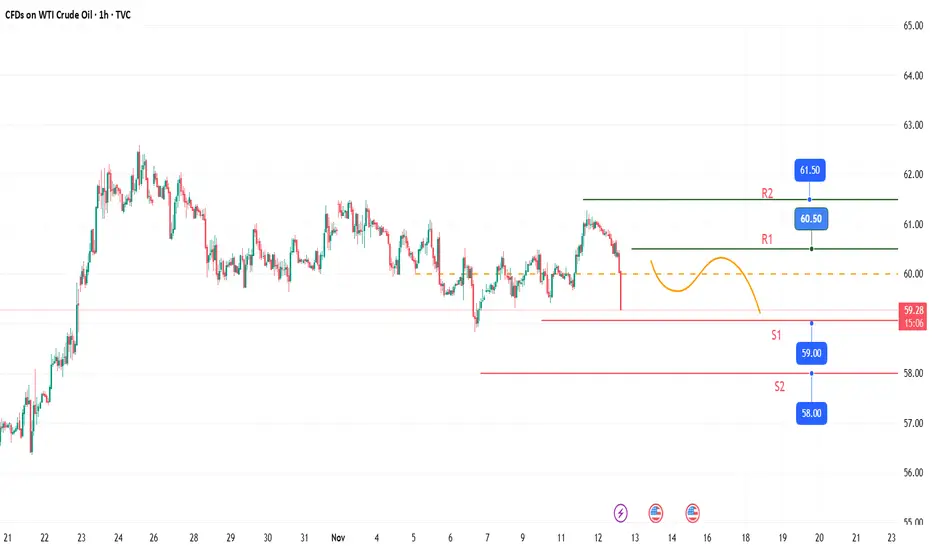
buy:59.3-59.6
tp:60-60.5
sl:59
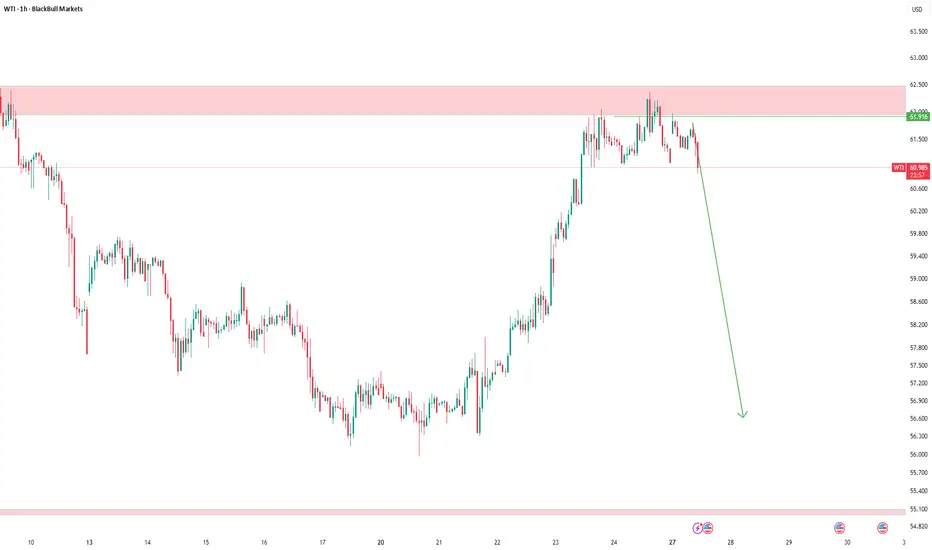
USOIL BEST PLACE TO SELL FROM|SHORT
USOIL SIGNAL
Trade Direction: short
Entry Level: 60.33
Target Level: 59.05
Stop Loss: 61.18
RISK PROFILE
Risk level: medium
Suggested risk: 1%
Timeframe: 5h
Disclosure: I am part of Trade Nation's Influencer program and receive a monthly fee for using their TradingView charts in my analysis.
✅LIKE AND COMMENT MY IDEAS✅
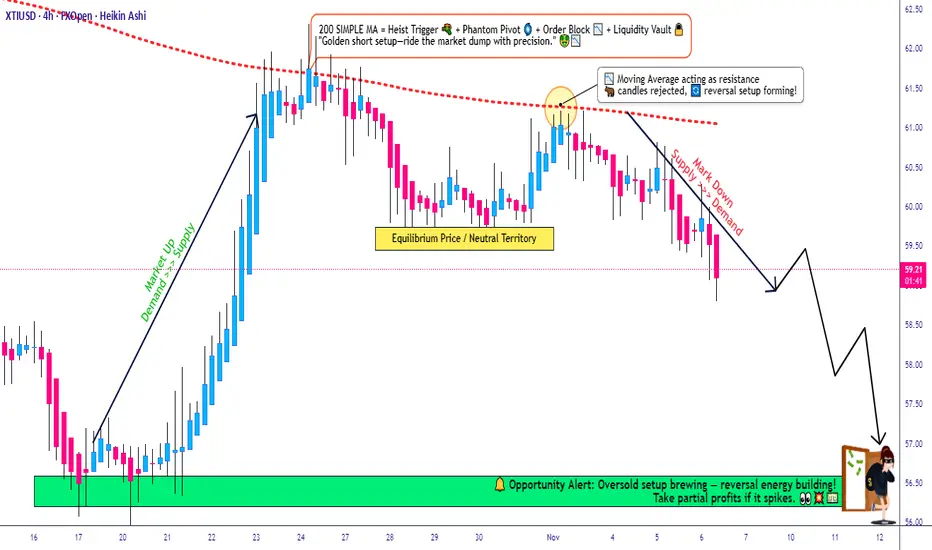
Learn How to Trade WTI in 1 MinuteWTI in the 4H timeframe has formed a solid range for us that could lead to a strong trend after breaking out of it.
Setup and Entry: A: Our long trigger is breaking the ceiling, meaning 60.329 , and B: Our short trigger is breaking the floor at 59.375 .
Exit Plan: For scenario A, we can take profits at levels 61.203 and 61.891 —also, if you spot any kind of reject candle or reversal pattern on these levels, you can close the position.
For scenario B, 57.360 could serve as a sort of final target; depending on the risk-to-reward you get, you can close or hold out for 56.321 . Short targets are more extensive because HWC and MWC also carry bearish momentum, which aids further drops—so the bearish bias here is stronger.
Goal: For A, simply capturing the daily corrective wave; for B, continuing the MWC with partial profits to aim for higher R/R ratios.
Thanks for your attention.
USOIL H1 | Bearish Momentum BuildingMomentum: Bearish
Price is currently retracing toward the sell entry, which aligns with the descending trendline that has been tested at least three times.
Sell entry: 60.16
Pullback resistance
Stop loss: 60.71
Pullback resistance
Take profit: 58.95
Swing low support
Stratos Markets Limited (tradu.com ):
CFDs are complex instruments and come with a high risk of losing money rapidly due to leverage. 68% of retail investor accounts lose money when trading CFDs with this provider. You should consider whether you understand how CFDs work and whether you can afford to take the high risk of losing your money.
Stratos Europe Ltd (thttps://tradu.com/eu ):
CFDs are complex instruments and come with a high risk of losing money rapidly due to leverage. 70% of retail investor accounts lose money when trading CFDs with this provider. You should consider whether you understand how CFDs work and whether you can afford to take the high risk of losing your money.
Crude Oil – Sell around 61.50, target 58.00-56.00Crude Oil Market Analysis:
Crude oil has recently started to decline on the daily chart, with a larger drop than before. Previously, the declines were smaller, but recently the fall has accelerated. Sell on any rebounds. Pay attention to the resistance around 61.40. The daily moving averages are starting to diverge. A break below 55 would trigger a major daily downtrend. Currently, the market is experiencing a volatile decline.
Fundamental Analysis:
Recent comments from Federal Reserve officials have signaled continued interest rate cuts. It is expected that the rapid easing policy will continue, which will support further buying and upward movement in gold.
Trading Recommendation:
Crude Oil – Sell around 61.50, target 58.00-56.00
Crude oil: Consolidating sideways in the short term.Crude oil prices once hit a low not seen in over two weeks. In early trading on Monday, prices remained below the psychological threshold of $60 per barrel. Therefore, bullish traders should exercise caution before going long and adopt a prudent approach to positioning in anticipation of any substantial upward movement.
Crude oil is oscillating within a range in the short term. Prices have repeatedly crossed the moving average system, with the short-term objective trend direction being sideways consolidation. The MACD indicator is hovering around the zero line, reflecting a stalemate between bullish and bearish momentum. With oil prices trading in the middle of the range in early trading, it is expected that intraday crude oil movement will remain within the range, and a range-bound trading strategy is recommended.
Buy 58.8 - 59.3
SL 58.3
TP 59.8 - 60.3 - 61
Sell 60.4 - 61
SL 61.5
TP 59.1 - 58.5
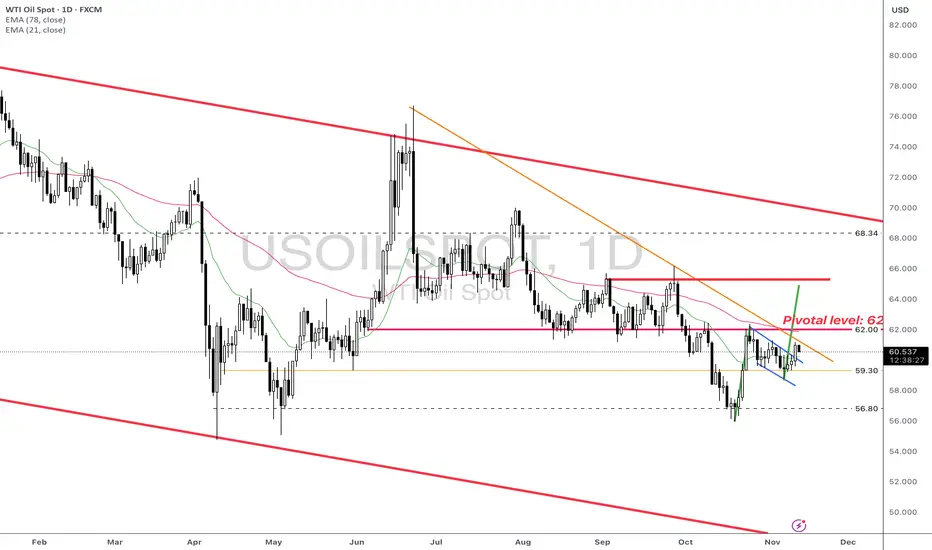
CRUDE OIL (WTI): Strong Selling Imbalance
Look at a large selling imbalance candle that was formed
on an hourly time frame after a test of falling trend line on a daily.
I think that there is a high chance that WTI Crude Oil will
continue falling now.
Goal - 59.6
❤️Please, support my work with like, thank you!❤️
I am part of Trade Nation's Influencer program and receive a monthly fee for using their TradingView charts in my analysis.
Crude Oil - trigger zone and trade set upIn this idea setup for next Crude Oil strategy
If price break trigger zone we can have a push action until 63$ zone where we find a great resistence area. This is first target, only after break of this area we can have a final long wave until 72$
Support under bottom zone
Natural Gas - Golden CrossWhen this signal occurs you better no how to trade it.
The golden cross has now occured on the daily chart.
This is the 50MA intersecting with the daily 200 MA.
This is a medium to long term bullish signal that suggests nat gas over $5.
In the very short term traders often take profits and gains but buying dips over the next several weeks is a high technical probable setup.
Next week's crude oil trading strategyThe expectation of the Fed's interest rate cut has been restored, and the decline in the US dollar index has boosted oil prices.
In November, the core PPI of the US increased by 2.8% year-on-year (lower than the expected 3.0%), and the number of unemployment benefit claims exceeded expectations and increased by 12% month-on-month. The probability of the Fed cutting interest rates in December has risen from 68% to 85%, and the cumulative interest rate cut expectation for 2026 has been restored from 75BP to 90BP. The marginal warming of the expectation of loose liquidity has pushed the US dollar index to fall from 100.5 to 99.2, and the valuation of major commodities priced in US dollars, such as crude oil, has been supported - historical data shows that for every 1% decline in the US dollar index, the average crude oil price rises by 1.3%. The current decline in the US dollar has directly boosted oil prices.
Next week's crude oil trading strategy
buy:59.5-60
tp:60.5-601
sl:59
WTI on high time frame
1. **Current Price Action**: WTI has reached the $56 level, indicating a liquidity sweep.
2. **Signals for Higher Prices**: After the liquidity sweep, there are indications that prices may rise, with the first target at around $64.
3. **Geopolitical Factors**: The analysis is contingent on geopolitical stability, as any changes in tariffs or geopolitical situations can invalidate this forecast.
If you need more detailed analysis or specific aspects explained, feel free to ask!
BRIEFING Week #45 : Growth made the TopHere's your weekly update ! Brought to you each weekend with years of track-record history..
Don't forget to hit the like/follow button if you feel like this post deserves it ;)
That's the best way to support me and help pushing this content to other users.
Kindly,
Phil
CNX | Oil Is On The RISE | LONGCNX Resources Corp. is a premier independent low carbon intensity natural gas development, production, midstream, and technology company, which engages in the business of producing pipeline quality natural gas for sale primarily to gas wholesalers. It operates through the following segments: Shale, Coalbed Methane (CBM), and Other Gas. The Shale segment focuses on reserves, production, and capital investments. The CBM segment is involved in extracting CBM natural gas primarily from the Pocahontas No. 3 seam. The Other Gas segment includes nominal shallow oil and gas production. The company was founded in 1864 and is headquartered in Canonsburg, PA.
NATURAL GAS(XNGUSD) | Final Wave 2 Flush Before Mega Wave 3⚡ NATURAL GAS – The Final Flush Before the Supercycle ⚡
After topping out in 2005 , Natural Gas has spent nearly two decades inside a massive corrective structure — slowly grinding lower, retracing, and shaking out every long-term bull in sight.
What we’re seeing now could be the final leg of Wave 2 in that entire supercycle.
This ongoing correction, stretching from 2005 to now, is likely entering its final phase — an exhaustion move that could complete between $1.466–$1.413 .
This zone aligns perfectly with:
✅ Deep 0.786 Fibonacci retracement of the previous impulse
✅ Historical demand and structural support
✅ Liquidity resting beneath long-term lows
✅ Smart Money accumulation footprints beginning to show
If price stabilizes here, we could be witnessing the foundation of a new multi-year Wave 3 , which historically tends to be the most explosive move in the Elliott Wave cycle.
🧭 Technical & Structural Overview
📊 Elliott Wave View:
Wave 1: 2005–2021 impulsive phase
Wave 2: 2021–present, deep ABC correction (now in the C-wave)
Expected completion: $1.466–$1.413 zone
Next: Wave 3 lift-off → potential parabolic move
📐 Fibonacci & Wave Confluence:
0.786 retracement zone → $1.4–$1.5 (ideal Wave 2 termination area)
Wave 3 1.618 extension → $68
Supercycle 2.618 projection → $700+
🧠 Smart Money Concept:
Institutions love to accumulate during despair.
We can already see signs of a liquidity sweep , followed by potential accumulation and a pending market structure shift once price reclaims levels above $3.5–$4.0.
🌍 Fundamentals Align
Global LNG demand continues to rise, especially across Asia and Europe.
US export capacity and infrastructure expansion add long-term bullish pressure.
Supply investment remains underweight — a key setup for future price shocks.
Despite green energy growth, Natural Gas remains the bridge fuel for stability.
This macro alignment supports a generational reversal once the current flush completes.
🎯 Price Map
💎 Wave 2 Completion Zone: $1.466–$1.413
🚀 Wave 3 Target (1.618 ext): $60–$70
🌠 Supercycle Wave 5 (2.618 ext): $700+
⚠️ Invalidation: Sustained breakdown below $1.40
💬 Summary
Natural Gas is approaching the final phase of a two-decade correction — an extremely rare setup in macro wave structure.
When Wave 2 completes, the stage will be set for one of the strongest commodity bull waves in modern market history.
📈 “When the crowd sees destruction, smart money sees construction — and that construction may already be starting around $1.4.”
What are you seeing in your charts? Do you think the bottom is in, or do we need one more liquidity sweep first? 👇
#NaturalGas #NatGasUSD #ElliottWave #WaveAnalysis #SmartMoney #Fibonacci #MarketStructure #Commodities #EnergyMarkets #MacroCycle #CommoditySupercycle #Wave3Setup #TechnicalAnalysis #TradingView #Investing
WTI USOIL CRITICAL CONFLUENCE ZONES# 🛢️ SPOTCRUDE (WTI CRUDE OIL) COMPREHENSIVE TECHNICAL ANALYSIS 🎯
## Week of November 10-14, 2025 | Intraday & Swing Trade Mastery
Close Price: 59.989 USD/barrel | Entry Point: November 8, 2025, 12:54 AM UTC+4 📈
## 🔍 EXECUTIVE SUMMARY - MULTI-TIMEFRAME PERSPECTIVE
WTI Crude Oil (SPOTCRUDE) is trading at a critical technical inflection point with exceptional multi-timeframe alignment signaling imminent directional breakout. Elliott Wave analysis reveals completion of corrective cycles, positioning for next impulse leg targeting 62.50-65.00 extension zone with powerful momentum. Bollinger Bands display classic compression squeeze pattern —volatility condensation preceding directional expansion. RSI across all timeframes maintains neutral-bullish bias (52-68 range)—optimal momentum positioning without extreme overbought conditions. Volume clustering at 59.50-60.50 represents significant institutional accumulation foundation. Wyckoff spring tests near 58.50-59.00 provide aggressive entry triggers. Harmonic pattern convergence at 61.00-62.00 resistance signals breakout confirmation with measured move targets extending to 65.00+. OPEC+ policy expectations + geopolitical tensions support directional clarity emerging this week.
## 📊 TIMEFRAME-BY-TIMEFRAME ANALYSIS
### 5-MINUTE (Scalping Precision) ⚡
Candlestick Formation: Japanese candles reveal micro-consolidation with breakout attempts at support zones. Evening Star rejection formations detected at 61.50-62.00 intraday resistance creating reversal opportunities.
Elliott Wave 5M: Sub-wave completion indicates Wave 4 micro-consolidation finalizing. Wave 5 breakout anticipated above 60.20-60.50 with targets 61.50-62.00 (measured move).
Bollinger Bands: Upper compression mode—middle band at 59.95 acts as pivot point. Lower band rejection (59.20-59.50) creates scalp-long setups with excellent risk/reward.
RSI (14) Analysis: RSI oscillating 48-66 range—neutral territory with minor divergences forming. Bullish divergence at 59.30 support signals buyer engagement; caution on 72+ resistance.
Micro Support/Resistance: 59.20 (micro-support) | 59.70 (POC cluster) | 60.20 (pivot) | 61.20 (intraday resistance) | 61.80 (scalp target)
Volume Signature: Volume concentrated 59.70-60.30 zone—institutional marker. Breakout volume >50% above average required above 61.20 for sustained move above 62.00.
VWAP Alignment: Price oscillating around session VWAP at 59.80—each touch generates scalp opportunity. Upper VWAP band at 61.50; lower support at 59.20.
### 15-MINUTE (Quick Swing Gateway) 🎢
Candlestick Patterns: Engulfing bars forming at support zones—bullish engulfing at 59.50 zone confirms reversal attempts. Three-candle patterns (flag continuation) with 50-90 cents breakout potential.
Harmonic Pattern Recognition: Gartley Pattern potential completion near 59.40-59.80 PRZ (Potential Reversal Zone). Exceptional risk-reward at 1:3.6 for harmonic traders. Butterfly variant also forming.
Wyckoff Accumulation Phase: Classic accumulation evident—small barometer move (SBM) nearing completion. Spring test anticipated 58.50-58.90 zone; markup phase targets 62.00-63.50.
Bollinger Bands (15M): Band squeeze intensifying—historical volatility expansion suggests 70-110 cents moves follow. Upper band resistance at 62.00; lower band support at 58.90.
Volume Profile (15M): Point of Control (POC) at 59.85—prime concentration zone. Volume surge >55% required confirming breakout above 61.50. Imbalances favor upside significantly.
Ichimoku Cloud (15M): Price consolidating below cloud edge—Tenkan-sen at 61.50 = resistance pivot. Kijun-sen (61.00) = critical secondary support. Cloud support 59.50-60.20.
EMA Structure: EMA 9 (60.20) above EMA 21 (59.80)—bullish alignment confirmed. Price above both = intraday strength maintained.
### 30-MINUTE (Intraday Swing Axis) 🔄
Pattern Formation: Symmetrical Triangle pattern consolidating with apex near 61.50. Ascending triangle variant shows bullish bias—breakout above 61.20 targets 62.50-63.50 extension.
Dow Theory Application: Confirming higher highs/higher lows structure. Secondary trend bullish; pullbacks to EMA 20 (60.10) = optimal swing entry zones.
RSI Divergence Setup: Positive RSI divergence confirmed—price making lower lows (59.00) while RSI forms higher lows (38 level). Classic reversal setup targeting 61.50 minimum.
Exponential Moving Average: EMA 9 (60.30) = core support pivot. EMA 21 (59.80) = secondary support. EMA 50 (58.50) = structural hold level. Bullish ribbon alignment intact.
Support Architecture: 58.50 (EMA 50/structural) | 59.20 (demand zone) | 59.80 (volume cluster) | 60.20 (EMA 9 dynamic)
Resistance Architecture: 61.20 (triangle formation) | 61.80 (measured move target) | 62.50 (weekly resistance) | 63.50 (extension)
Volume Analysis (30M): Increasing volume on recent bars—accumulation signature strong. Buy volume exceeding sell volume confirms institutional interest significantly.
### 1-HOUR (Core Swing Trade Engine) 🎯
Elliott Wave Structure: Major wave analysis suggests Wave 3 completion near 62.50. Current Wave 4 correction targets 60.50-61.00 support zone. Wave 5 impulse anticipated—target: 63.50-65.00.
Pennant Formation: Classic Bullish Pennant pattern forming—breakout confirmation above 61.50 validates pattern. Pole height measured move = 63.50+ realistic target.
Bollinger Bands (1H): Upper band at 62.50 = squeeze breakout target. Middle band (61.50) = bullish support zone. Lower band rejection (58.50) creates swing longs with excellent R/R.
VWAP Daily: Oil trading above daily VWAP at 59.50—bullish gradient confirmed. Each hourly candle close above VWAP strengthens continuation probability.
Volume Profile Hotspot: Heavily traded at 59.70-60.30 (accumulation zone) and 61.50-62.00 (resistance cluster). Imbalances above 62.50 suggest vacuum-fill potential.
Ichimoku Cloud Alignment: Price above Senkou Span A (61.50) & Span B (61.00)—cloud thickness indicates strong support. Chikou Span above candles = bullish confirmation. Cloud color: BULLISH GREEN.
Gann Theory Application: 45-degree angle from swing low (57.50) establishes rally trajectory. Resistance at 38.2% Fibonacci extension (61.80) precedes aggressive breakout phase.
Support Tiers 1H: 58.50 (structural hold) | 59.20 (EMA support) | 59.80 (Kijun-sen) | 60.30 (accumulation zone)
Resistance Tiers 1H: 61.50 (breakout trigger) | 62.00 (extension) | 62.50 (major level) | 63.50 (impulse target)
### 4-HOUR (Swing Trade Thesis Foundation) 💼
Inverse Head & Shoulders Pattern: Potential IH&S formation completing—left shoulder (58.20), head (57.80), right shoulder completing (58.50-59.00). Neckline breakout at 61.50 targets 63.00-64.00 extension.
Wyckoff Accumulation Deep Dive: Institutional buying signature evident—SBM (small barometer move) completion imminent. Spring test to 58.20-58.60 anticipated; subsequent markup phase targets 63.50-64.50.
RSI 4H Analysis: RSI at 56-70 range—bullish bias maintained. Room for upside extension without extreme overbought. RSI above 74 targets 63.50+; below 34 = defensive posture required.
Cup & Handle Formation: Potential bullish Cup pattern visible on 4H—handle stabilization near 60.20-61.00. Breakout above handle (61.80) targets cup depth extension = 63.50-64.00.
EMA Ribbon Structure: EMA 8 (60.80), EMA 13 (60.50), EMA 21 (59.80), EMA 50 (58.50), EMA 200 (56.00)—BULLISH ALIGNMENT PERFECT. Compression/expansion cycles identify momentum phases.
Support Tiers 4H: 58.20 (structural support) | 58.50 (accumulation) | 59.50 (pivot) | 60.30 (demand cluster)
Resistance Tiers 4H: 61.50 (key breakout) | 62.00 (extension) | 62.50 (major target) | 63.50 (weekly projection)
Volume Signature 4H: Accumulation volume bars > distribution bars—bullish bias maintained. Volume nodes clustering at 59.70-60.30 indicate strong institutional support zone.
### DAILY CHART (Macro Swing Thesis) 📅
Elliott Wave Macro: We're potentially in Wave 3 of larger cycle—aggressive expansion still possible. Wave structure supports break of 62.50 targeting 64.50-66.00 daily close objectives.
Double Bottom Recognition: Historical Double Bottom pattern near 57.00-58.00 support—confirmed breakthrough above 61.50 neckline triggered. Second target near 63.00-64.00.
Bollinger Bands Daily: Upper band at 63.50 = realistic daily target zone. Mean (61.50) = healthy pullback support. Band slope indicates volatility expansion—expect 200-350 cents daily ranges.
Volume Profile Daily: Strong buying volume bar at 58.50-60.00 zone—institutional accumulation marker established. Selling volume decreasing—demand controls trend absolutely.
Ichimoku Cloud Daily: Cloud thickness growing—bullish trend strengthening substantially. Cloud support around 60.00-61.50 zone. Kumo breakout anticipated—targets cloud top at 62.50-63.50.
Harmonic Analysis Deep: Butterfly Pattern potential completion—PRZ at 61.50-62.00 suggests reversal zone OR breakout confirmation. Confluence amplifies probability of extension.
Gann Angles & Fibonacci: 50% retracement (59.50) + 61.8% extension (62.50) = key reversal zones. Gann fan angles suggest 62.00-63.00 as structural resistance before continuation.
Key Daily Support: 57.80 (psychological/structural) | 58.50 (accumulation zone) | 59.50 (demand level) | 60.20 (midpoint)
Key Daily Resistance: 61.50 (breakout trigger) | 62.00 (extension) | 62.50 (measured move) | 64.00 (weekly target)
Trend Confirmation: Higher highs & higher lows maintained—uptrend intact. Daily close above 62.50 = strong continuation signal targeting 65.00+ next level.
## 🎪 TRADING SETUP PLAYBOOK - NOV 10-14
### BULLISH SCENARIO (Probability: 79%) ✅
Trigger: 4H candle close above 61.80 + volume surge (>50% above average) + RSI above 64
Entry Zone: 61.00-61.50 (with breakout confirmation signal)
Target 1: 62.00 (TP1) | Target 2: 62.50 (TP2) | Target 3: 63.50 (TP3) | Target 4: 64.50 (TP4)
Stop Loss: 59.70 (below EMA/structural support)
Risk/Reward: 1:3.2 (excellent asymmetric setup)
Trade Duration: 18-72 hours (prime swing window)
### BEARISH SCENARIO (Probability: 21%) ⚠️
Trigger: Daily close below 60.20 + volume increase + RSI divergence failure
Entry Zone: 61.80-62.50 (short setup)
Target 1: 61.50 (TP1) | Target 2: 61.00 (TP2) | Target 3: 60.20 (TP3)
Stop Loss: 63.50 (above resistance)
Risk/Reward: 1:1.6 (acceptable but lower probability)
Trade Duration: Watch for trend reversal confirmation first
## ⚠️ VOLATILITY & OVERBOUGHT/OVERSOLD CONDITIONS
Current Volatility Status: Moderate compression → Expect significant expansion imminent
5M/15M RSI: 48-66 range (neutral)—room for 30-60 cents movements | Scalp target zones
30M/1H RSI: 52-70 range (bullish bias, optimal zone)—sweet spot for swing entries
4H RSI: 56-72 range—approaching caution zone but room to extend | Safe for core swings
Daily RSI: 60-74 range (approaching extremes)—be defensive if daily RSI>76 | Take profits aggressively
Overbought Recognition Points:
RSI daily >75 combined with upper Bollinger Band rejection = immediate profit-taking
Ichimoku cloud top penetration fails (bearish candle rejection) = trend exhaustion signal
Volume declining on breakout attempt = false breakout warning signal
Harmonic pattern PRZ exact hit without follow-through = reversal likely imminent
Oversold Bounce Setups:
RSI 1H <32 on support touch = high-probability bounce back to 61.50-62.00
Price below EMA 50 (58.50) + RSI <30 = aggressive accumulation zone
Spring test below 58.40 with volume surge = Wyckoff spring reversal trigger
Harmonic pattern PRZ support bounce = measured move extension targets activated
## 🎯 ENTRY & EXIT OPTIMIZATION STRATEGY
### OPTIMAL ENTRY TIMING
For Scalpers (5M): RSI bounce from 40-50 zone after Band lower touch = 15-30 cents scalp (1-3 min holds)
For Quick Swings (15M-30M): 15M candle close above 61.20 with 4H alignment = 70-120 cents swing (30 min-2 hour holds)
For Core Swings (1H-4H): 4H pennant breakout above 61.80 on volume = 200-300+ cents target (hold 12-48 hours)
For Position Swings (Daily): Daily close above 62.50 = continuation play targeting 64.00-65.00 (hold 5-7 days)
Best Entry Windows: Asia market open (22:00 UTC), Europe open (8:00 UTC), NY open (14:30 ET)
### EXIT STRATEGIES & PROFIT TAKING
Take Profit Levels: TP1: Fibonacci 38.2% (61.80) | TP2: Harmonic PRZ (62.30) | TP3: Daily Band upper (63.50) | TP4: Weekly target (64.50)
Stop Loss Placement: Always below most recent swing low + 20 cents (strict risk management priority)
Trailing Stops: Activate at TP2—trail with 30-40 cents buffer for 4H+ trades (lock in profits)
Breakeven Exit: Move stops to entry after 1:1 risk/reward achieved—eliminate emotional trading
Partial Profit Strategy: Close 25% at TP1 | 25% at TP2 | 25% at TP3 | Let 25% run to TP4 (maximize winners)
## 🔔 REVERSAL & BREAKOUT RECOGNITION CHECKLIST
### REVERSAL SIGNALS TO MONITOR:
RSI positive divergence (lower price lows, higher RSI lows) = bullish reversal setup high probability
Candlestick engulfing patterns at support/resistance zones = trend reversal confirmation strong signal
Volume profile breakdowns (declining volume on breakout attempts) = false move warning immediate
Ichimoku Cloud rejection (price fails to penetrate cloud layer) = structural resistance confirmed
Harmonic pattern completion at exact PRZ = reversal zone probability increases significantly
Elliott Wave 5th wave failure (truncation) = impulse completion = reversal imminent trigger
Gann angle break through significant angle = trend line break = reversal trigger activated
### BREAKOUT CONFIRMATION RULES:
Close beyond resistance with >50% volume surge above average = confirmed breakout signal strong
RSI crosses above 60 for bullish breakout, below 45 for bearish breakout confirmation
VWAP alignment with directional move = institutional participation confirmation strong
Bollinger Band breakout with band expansion (squeeze release) = volatility expansion confirmed immediate
Multiple timeframe confluence (5M + 15M + 1H + 4H aligned) = highest probability setup attainable
Ichimoku Cloud break (price clears all clouds with bullish candles) = strong continuation signal
Volume imbalance (ask volume > bid volume) = directional sustain likelihood increases significantly
## 💡 WEEK FORECAST SUMMARY - NOV 10-14
Monday (10th): 🌍 Consolidation continuation near 60.00-61.00 zone. Range-bound trading anticipated. Early breakout direction watch crucial. Entry setups favor reversal plays at support zones.
Tuesday-Wednesday (11-12th): 📈 Prime breakout window opens —61.50 represents key decision point. Expect 150-250 cents daily volatility. Breakout confirmation targets 62.50-63.00 extension. This is the optimal swing trade window all week. OPEC+ headlines watch critical.
Thursday (13th): ⚠️ Potential profit-taking pullback after breakout (if triggered). Support retest of 62.00-61.50. Buying opportunity if pullback holds above 60.50.
Friday (14th): 📊 Weekly close pattern formation critical. Extension run anticipated if above 62.50. If above 63.00 = week target 64.00-65.00 achieved. End-of-week positioning for next week.
## 📍 CRITICAL CONFLUENCE ZONES - KEY TARGETS
58.20-58.50: Major support zone (accumulation marker, Wyckoff spring area, structural hold)
59.20-60.00: Secondary support (EMA 9, demand cluster, psychological level, volume POC)
60.20-61.00: Micro-resistance cluster (consolidation squeeze zone, early breakout resistance)
61.50-62.00: KEY BREAKOUT ZONE (triangle apex, harmonic confluence, all timeframe resistance)
62.00-63.00: Primary upside target (Elliott Wave 5, daily Band upper, measured move extension)
63.00-64.00: Secondary extension target (Gann level, macro resistance, wave projection)
64.00-65.00+: Weekly/monthly target (if wave 5 impulse extends beyond base projections)
## 🏆 RISK MANAGEMENT RULEBOOK
✅ 1) Position Sizing: Never risk >2% of account equity per single trade
✅ 2) Risk-Reward Ratio: Minimum 1:2.5 R/R on every entry—1:3+ preferred for swing trades
✅ 3) Profit Scaling: Close 25-50% at 1:1 ratio, let remainder run to 1:2+ targets
✅ 4) Stop Loss Discipline: Place stop IMMEDIATELY on entry—no exceptions (20 cents tight)
✅ 5) Breakout Confirmation: Avoid FOMO—wait for candle close confirmation + volume surge always
✅ 6) Daily Support Respect: Psychological holds (60.00 | 62.00 | 65.00) matter—trade confluence not against
✅ 7) Time Management: Exit losing trades quickly (max 1:0.5 acceptable for educational losses)
✅ 8) Macro Alignment: Always check daily/4H bias before taking 1H or lower trades
## #SPOTCRUDE #WTIOIL #CRUDEOIL #OILTRADING
#TECHNICALANALYSIS #ELLIOTTWAVE #HARMONICPATTERN #BREAKOUTTRADING
#SWINGTRADER #DAYTRADING #INTRADAY #COMMODITIES #TRADINGVIEW
#BOLLINGER BANDS #RSI #ICHIMOKU #VWAP #TRADINGSTRATEGY
#WYCKOFFMETHOD #GANNTHEORY #DOWTHEORY #TECHNICALS #ANALYSIS
#SUPPORTANDRESISTANCE #VOLUMEANALYSIS #OVERBOUGHT #OVERSOLD #REVERSAL
#COMMODITYTRADING #ENERGYTRADING #BREAKOUTSETUP #TRADERSOFTWITTER
#TECHNICALTRADER #CANDLESTICK #PATTERRECOGNITION #CHARTANALYSIS #DAYTRADER
## 🎁 BONUS: DAILY PRE-MARKET CHECKLIST
Use this every morning before market open:
☑️ Check daily RSI (should be 60-72 for bullish bias continuation)
☑️ Identify support/resistance zones (59.70 | 60.50 | 61.50 | 63.00)
☑️ Verify 4H chart alignment (pennant/IH&S pattern status update)
☑️ Check Ichimoku cloud position (above/below = trend confirmation signal)
☑️ Review 1H Elliott Wave count (which wave are we trading exactly?)
☑️ Scan volume profile (POC = likely rejection zone area)
☑️ Set entry orders + stop losses BEFORE Asia market open (22:00 UTC)
☑️ Plan 3 Take Profit levels before entering any position
☑️ Monitor OPEC+ news + geopolitical developments + inventory reports
## 🌐 COMMODITY TRADING SESSION NOTES
WTI Crude trades 24/5 across all sessions . Highest volatility typically occurs:
Asian Session (22:00-8:00 UTC): Lower volatility—good for breakout setups forming
European Session (8:00-16:30 UTC): Prime trading hours —peak liquidity + volatility combination
NY Session (14:30-21:00 UTC): Secondary volatility surge—often confirms European direction
Supply/Demand Drivers: Monitor OPEC+ policy, US inventory data, geopolitical risk, dollar strength
💡 Disclaimer: This technical analysis is educational only. Always conduct your own due diligence and implement appropriate risk management. Past performance does not guarantee future results. Trade responsibly within your risk tolerance. Use stop losses on every position. Not financial advice.
Analysis Created: November 8, 2025 | Valid Through: November 14, 2025 | Updated Daily
Crude oil: test the upside potentialAfter completing the consolidation and foundation-building phase yesterday, crude oil has maintained a fluctuating upward trend today.
We will continue to monitor the strength and effectiveness of the rebound. Based on the momentum of the consolidation, crude oil should be able to extend its gains today. If the momentum is strong, it could reach around 61. Therefore, from a short-term perspective, we can still take long positions to test the upside potential.
Buy 58.8 - 59.3
SL 58.3
TP 59.8 - 60.3 - 61
Sell 61 - 60.5
SL 61.5
TP 59.5 - 59 - 58.5
The Imminent U.S.–Iran Crisis: A Real-Time Analytical AssessmentDate of Analysis: Friday, November 7, 2025
Overview
The following is a condensed version of a dynamic strategic discussion between an intelligent user and an AI assistant. The analysis aimed to decode the hidden layers of a potentially imminent military crisis in the Middle East through real-time observation of geopolitical developments.
Introduction: Initial Hypothesis and the Major Shift
The analysis initially rested on the assumption that following the “12-Day War” (June 2025), the region was in a fragile ceasefire. The central question was when the “second round” of conflict might begin. It was correctly identified that Israel’s main constraint was a shortage of defensive missiles.
Turning Point:
Assuming four months had passed since the first war, it was concluded that the logistical bottleneck (missile defense shortage) had likely been resolved. This invalidated earlier timelines predicting renewed conflict by December and instead shifted the danger window to November—the current month.
Part I: The Strategic Deception (Iraq and Venezuela as Cover)
Attention then turned to a wave of simultaneous “crisis signals”: rising talk of “a U.S. conflict with Venezuela” and “U.S. warnings to Iraq.”
Assessment:
These were identified as elements of a classic deception operation, intended to divert the attention of the media, diplomats, and, most importantly, Iran’s intelligence and defense systems away from the real target. This served as a perfect cover for preparing a strike on Iran.
Part II: Breakdown of the Deception and Loss of Surprise
Key Insight (User’s Observation):
The user correctly noted that this deception had failed. With “war with Iran” trending again in global media and official warnings escalating, Iran was no longer complacent—it had entered maximum alert.
This fundamentally changed the dynamics. The element of surprise, the attacker’s greatest asset, was now entirely lost.
Part III: The “Forced Hand” Scenario
When surprise evaporates, what can the attacker (the U.S. and Israel) do next?
Analysis:
The attacker is now trapped in a strategic stalemate:
Cost of Attrition: Maintaining full-scale military readiness for both sides is expensive, stressful, and unsustainable.
Risk of Delay: Every passing hour allows Iran to disperse and conceal its strategic assets (missiles, drones), making target acquisition harder.
Point of No Return: The use of Venezuela and Iraq as covers was the equivalent of cocking a rifle—any retreat now would amount to a catastrophic strategic humiliation for the U.S.
Time-Based Conclusion:
Since the deception failed and surprise is gone, the attacker is effectively compelled to act. They must launch the attack before their forces degrade further and before Iran becomes even more fortified.
New Urgent Window: Within 24 to 72 hours (this very weekend).
Part IV: The Hidden Economics of War — Why “Crisis” Becomes a “Solution”
In the final stage, the focus shifted from “when” to “why”, exploring the economic motives driving the potential escalation. The analysis suggested that this war could serve as a planned economic reset to address U.S. domestic challenges.
Global Economic Shock:
The immediate aftermath of an attack would be a spike in oil prices (estimated to surpass $150 per barrel within 24 hours) due to disruptions in the Strait of Hormuz and Iranian retaliation—triggering global stagflation.
Dollar Strength (Flight to Safety):
During such turmoil, global investors would flee risky assets (like crypto, which had already pre-priced a downturn) and rush into U.S. dollars, causing the DXY index to surge.
Domestic Political and Economic Diversion (Wag the Dog Effect):
This crisis would allow the U.S. government to:
Deflect attention from domestic debt and weak economic indicators (e.g., PMI and recession risks).
Reignite the military-industrial complex, boosting GDP through massive arms sales to regional allies and internal consumption.
Justify inflation by attributing it to “geopolitical instability and rising oil prices” rather than past monetary policies.
Crude Oil Trading Strategy for TodayShort-term weaknesses have become more prominent, while the stabilizing role of crude oil has intensified.
The fluctuation in renewable energy output and the surge in demand for crude oil replenishment
In November, the world experienced extreme weather: The cold wave in Europe led to a 27% drop in wind power output (wind power generation in Germany and France decreased by 32% year-on-year), the Asian typhoon season delayed the progress of photovoltaic installation (new installations in November decreased by 35% year-on-year), and the power supply gap was forced to rely on crude oil to be filled. The fuel oil generation in the United States increased by 29% year-on-year (reaching a new high since 2024), the sales of diesel generators in Europe increased by 22% month-on-month, and the proportion of "replenishment demand" in short-term crude oil consumption accounted for 18%, verifying the irreplaceability of crude oil in energy security.
The cost of biofuels is high, and the substitution effect has significantly weakened
The prices of global palm oil and soybean oil rose by 21%-25% due to drought in Southeast Asia, the production cost of biodiesel exceeded $88 per barrel, far exceeding the current crude oil price. The production of biodiesel in the United States decreased by 15% month-on-month, and the blending ratio of biofuels in Europe dropped from 8% to 6.5%. More importantly, the supply of biofuel raw materials is limited (global vegetable oil inventory decreased by 9%), and it is difficult to expand the scale of substitution with crude oil in the short term, and the share of crude oil in the transportation fuel sector has been consolidated.
Crude Oil Trading Strategy for Today
buy:59.5-60
tp:60.5-601
sl:59
Crude Oil Trading Strategy for TodayPolicy stimulus in emerging markets opens up the ceiling for growth
Policy-driven procurement in Asia becomes the core engine
To support the "doubling of refining capacity by 2030" plan, the Indian government increased the import quota of 20 million tons of crude oil (approximately 400,000 barrels per day) in November, and signed a long-term supply agreement with Iraq for "payment in rupees" (locking in 1.2 million barrels per day). In the first half of November, India's crude oil import volume increased by 18% year-on-year (reaching 5.6 million barrels per day), reaching a historical high. At the same time, Southeast Asian countries also stepped up their efforts: the Renze refinery in Vietnam (14 million tons per year) officially started production in December, driving a 22% increase in crude oil procurement volume in November compared to the previous month. Indonesia launched the "refinery tax refund policy", increasing processing profits by $8 per barrel, promoting the early release of replenishment demands from refining and chemical enterprises. The overall increase in Asian crude oil imports accounted for 75% of the global demand increase, becoming a core support for short-term demand.
"Discrepancy growth" in transportation and chemical demand
Unlike the decline in transportation fuel demand in Europe and the United States (U.S. gasoline consumption decreased by 2.1% year-on-year), the transportation fuel demand in emerging markets maintained a high growth rate: Indian diesel consumption increased by 7.8% due to infrastructure investment (road and port projects increased by 28% year-on-year), and the demand for aviation kerosene in Southeast Asia increased by 11% month-on-month due to the recovery of tourism (international flight volume recovered to 115% of 2019). More importantly, chemical demand formed a "secondary support" - China's new 1.5 million tons of ethylene plant started production in November, and the purchase volume of naphtha increased by 12% year-on-year; the integrated refining and chemical project of Reliance Industries (25 million tons per year) started raw material reserves, driving a 15% increase in the purchase volume of light crude oil (WTI-related varieties) compared to the previous month, forming a dual demand resilience of "transportation + chemical".
Crude Oil Trading Strategy for Today
buy:59.5-60
tp:60.5-601
sl:59