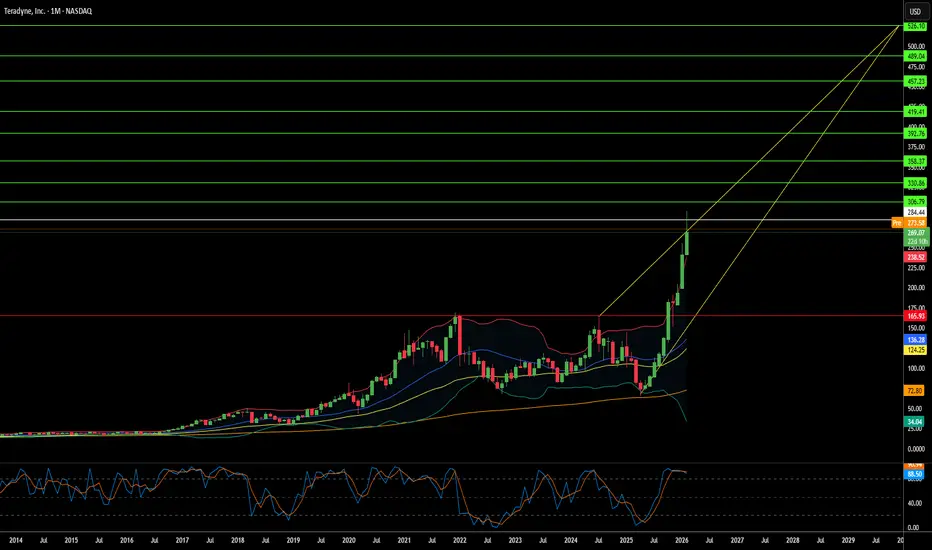
Can a Testing Company Become AI's Hidden Infrastructure?Teradyne has executed one of the semiconductor industry's most dramatic strategic pivots, transforming from a mobile-centric testing company into a dominant force in AI infrastructure validation. With artificial intelligence now driving over 60% of total revenue as of late 2025, the company has positioned itself at the critical junction where cutting-edge chips meet real-world deployment. Management's newly introduced "evergreen" earnings model targets $6 billion in annual revenue and non-GAAP earnings per share between $9.50 and $11.00, reflecting not just incremental growth but a fundamental business model transformation. The Q4 2025 results underscore this shift: record-breaking revenue of $1.083 billion, 41% sequential growth, and 44% year-over-year expansion driven almost entirely by AI tester demand.
The company's technical moat extends far beyond traditional automated test equipment. Teradyne's UltraPHY 224G solution addresses emerging 224 Gb/s data rates critical for next-generation AI clusters, while the Magnum 7H tester targets the upcoming HBM4 memory cycle—a market where testing intensity is 10x that of standard DRAM. The newly formed joint venture with MultiLane positions Teradyne to capture the high-speed interconnect testing market from wafer to data center, moving the company closer to hyperscale infrastructure budgets. Meanwhile, the robotics division is pivoting toward "Physical AI," integrating deep learning models into collaborative robots that adapt to dynamic environments rather than following rigid pre-programmed paths. A strategic Detroit manufacturing hub will support threefold expansion with major e-commerce customers in 2026.
Geopolitical headwinds remain manageable but require vigilant navigation. While China historically represented 25-30% of revenue, the Trump administration's shift from "presumption of denial" to "case-by-case" reviews for advanced computing exports provides regulatory flexibility. However, 25% tariffs on advanced semiconductor components passing through U.S. facilities complicate global supply chains. Teradyne's formidable patent portfolio, comprising over 5,000 patents across 30 jurisdictions, serves as both legal armor and a technological deterrent. The strategic use of Track One rapid examination and Non-Publication Requests helps maintain a competitive advantage. The partnership with TSMC, recognized through the 2025 OIP Partner of the Year award, reinforces leadership in chiplet and 3D stacking methodologies essential for HBM4 and UCIe architectures.
The investment thesis centers on structural market positioning rather than cyclical momentum. Teradyne commands 50% market share in "XPU" testing and targets 30% in GPU testing as merchant GPU customers scale production. While customer concentration (particularly Apple ecosystem exposure), institutional selling pressure, and the inherent "lumpiness" of AI infrastructure spending present near-term risks, management's Q1 2026 guidance of $1.15-$1.25 billion revenue signals a sustained trajectory. The convergence of silicon photonics, HBM4 memory walls, and Physical AI robotics creates multiple expansion vectors. For investors willing to accept premium valuation multiples, Teradyne represents not merely a beneficiary of AI spending but an essential architectural layer enabling the transition from research to production-scale deployment.
Geopoliticalrisk
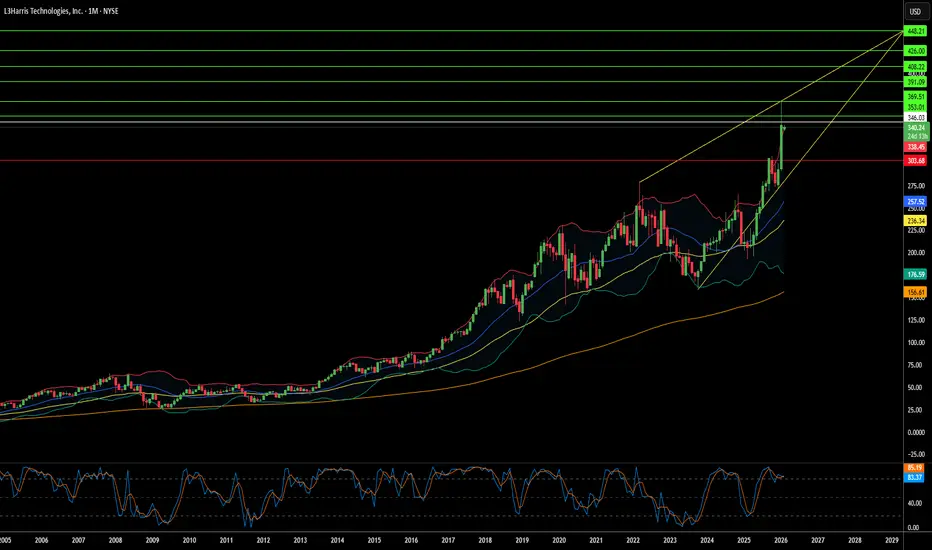
Can L3Harris Justify Its Nearly 40x Price-to-Earnings Premium?L3Harris Technologies has positioned itself as the "Trusted Disruptor" in the global defense landscape, bridging the gap between traditional aerospace giants and agile technology innovators. Operating across space, air, land, sea, and cyber domains, the company aligns with the most critical national security priorities at a time when global defense spending is projected to reach $2.6 trillion by the end of 2026, an 8.1% increase over 2025 levels. The geopolitical tailwinds are substantial: the war in Ukraine has prompted massive European rearmament, with Russia spending nearly $157 billion on defense in 2025 alone and NATO members targeting 5% of GDP for defense by 2035. Meanwhile, China's military expansion is driving unprecedented spending across the Indo-Pacific region, with Asia-Pacific defense budgets now exceeding $530 billion annually. L3Harris is strategically positioned to capture these opportunities through its global reach and technological edge, having recently secured a $2.2 billion contract for Korea's Airborne Early Warning & Control system.
The company reported that 2025 was a "clear inflection point" with full-year revenue of $21.9 billion, a 3% increase and even stronger organic growth of 5%. Its book-to-bill ratio of 1.3x signals a record order pipeline, and the company's aggressive cost management drove adjusted segment operating margins to 15.8% for the full year. However, fourth-quarter results revealed complexities: revenue of $5.6 billion missed forecasts by 2.95% due to a 43-day government shutdown that delayed contract awards and export approvals. Despite this, adjusted EPS of $2.86 beat consensus estimates, reflecting the success of the "LHX NeXt" operational excellence initiative. The stock slipped 3.7% following the earnings announcement, as management's 2026 guidance of $11.30-$11.50 per share fell below analyst expectations of $12.44, raising concerns about supply chain complications and program turbulence.
A transformative development emerged in early 2026 with the Department of War's launch of its "Acquisition Transformation Strategy." L3Harris became the first partner in this novel framework, receiving a $1 billion investment in its Missile Solutions business through a convertible preferred equity structure. The company plans to IPO this unit in the second half of 2026, creating a pure-play missile solutions provider focused on critical programs like PAC-3, THAAD, Tomahawk, and Standard Missile. Beyond munitions, L3Harris continues to advance cutting-edge aerospace and mission systems, including the AERIS next-generation AEW&C platform, the MC-55A Peregrine multi-intelligence aircraft, and autonomous systems ranging from the T7 unmanned ground vehicle to hybrid VTOL aircraft developed with Joby Aviation. With a global patent portfolio of 3,908 patents, over 36% currently active, and deep expertise in cybersecurity, space exploration, and counter-unmanned systems, L3Harris remains a cornerstone of the modern defense industrial base. However, investors must weigh the company's exceptional positioning against its rich valuation of nearly 40x P/E, which suggests the market has already priced in significant future success, leaving little room for execution missteps.
Can Silver Become the Most Critical Metal of the Decade?The iShares Silver Trust (SLV) stands at the convergence of three unprecedented market forces that are fundamentally transforming silver from a monetary hedge into a strategic industrial imperative. The November 2025 designation of silver as a "Critical Mineral" by the USGS marks a historic regulatory shift, activating federal support mechanisms including nearly $1 billion in DOE funding and 10% production tax credits. This designation positions silver alongside materials essential for national security, triggering potential government stockpiling that would compete directly with industrial and investor demand for the same physical bars held by SLV.
The supply-demand equation reveals a structural crisis. With 75-80% of global silver production coming as a byproduct of other mining operations, supply remains dangerously inelastic and concentrated in volatile Latin American regions. Mexico and Peru account for 40% of global output, while China is aggressively securing direct supply lines in early 2025. Peru's silver exports surged 97.5%, with 98% flowing to China. This geopolitical repositioning leaves Western vaults increasingly depleted, threatening SLV's creation-redemption mechanism. Meanwhile, chronic deficits persist, with the market balance projected to worsen from -184 million ounces in 2023 to -250 million ounces by 2026.
Three technological revolutions are creating inelastic industrial demand that could consume entire supply chains. Samsung's silver-carbon composite solid-state battery technology, planned for mass production by 2027, requires approximately 1 kilogram of silver per 100 kWh EV battery pack. If just 20% of the 16 million annual EVs adopt this technology, it would consume 62% of the global silver supply. Simultaneously, AI data centres require silver's unmatched electrical and thermal conductivity for reliability, while the solar industry's shift to TOPCon and HJT cells uses 50% more silver than previous technologies, with photovoltaic demand projected to exceed 150 million ounces by 2026. These converging super-cycles represent a technological lock-in where manufacturers cannot substitute silver without sacrificing critical performance, forcing a historic repricing as the market transitions silver from a discretionary asset to a strategic necessity.
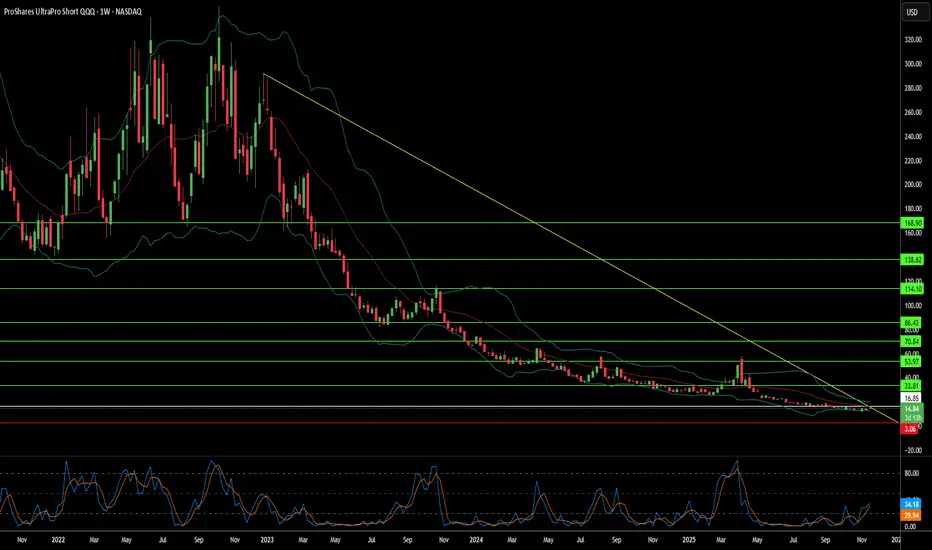
Can Asia's Tensions Triple Your Hedge Returns?How escalating China-Japan geopolitical tensions create a compelling investment case for ProShares UltraPro Short QQQ (SQQQ), a triple-leveraged inverse ETF tracking the Nasdaq-100 Index (NDX). The Nasdaq-100's extreme concentration in technology sectors (61% weighting) and dependence on flawless global supply chains make it uniquely vulnerable to Asia-Pacific instability. SQQQ's triple-inverse structure allows investors to profit from anticipated NDX declines without traditional margin accounts, while its daily compounding mechanism is optimized for capturing the high-volatility, directional downside movements that geopolitical crises typically trigger.
The core vulnerability stems from critical supply chain chokepoints in East Asia. China controls nearly 90% of global rare earth element processing materials essential for EV motors, sensors, and defense systems, and has previously weaponized this dominance against Japan during territorial disputes. Meanwhile, Japan holds a 50% global market share in critical semiconductor materials like photoresists, making any disruption equivalent to halting chip fabrication for NDX companies. With the Nasdaq-100 deriving approximately 10% of revenues directly from Mainland China and nearly 50% internationally, escalating tensions threaten simultaneous revenue losses across multiple major markets while forcing costly supply chain regionalization that compresses profit margins.
Beyond physical supply chains, the analysis identifies state-sponsored cyber operations as the most immediate acute threat. U.S. agencies assess that Chinese cyber actors are pre-positioning themselves on critical infrastructure networks to enable disruptive attacks during major crises, with Japan reporting prior Chinese military cyberattacks against 200 companies and research institutes. Such cyber-induced production halts could generate billions in lost revenue while simultaneously degrading the innovation output that sustains NDX valuations. Geopolitical uncertainty correlates directly with reduced corporate R&D spending and demonstrable declines in patent quality and citation rates.
The convergence of these risks, supply chain weaponization, forced regionalization costs, elevated discount rates from geopolitical risk premiums, and cyber warfare threats creates an optimal environment for SQQQ's triple-inverse exposure. Corporate boards failing to incorporate robust geopolitical risk monitoring into NDX valuations represent a fundamental governance failure, as the structural shift from global efficiency to resilience-focused supply chains necessitates significant capital expenditure that undermines the high-growth valuations supporting current NDX prices.
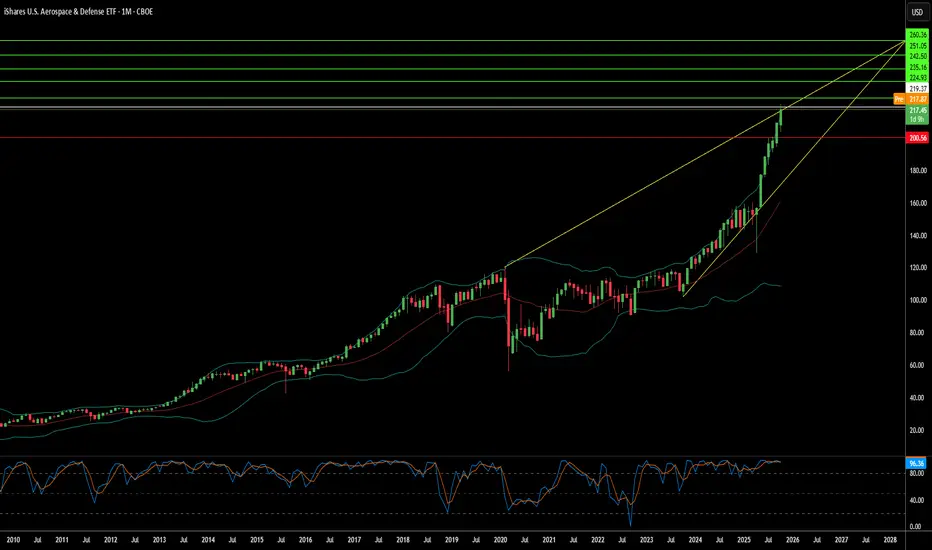
Can Instability Be an Asset Class?Aerospace and Defense (A&D) ETFs have shown remarkable performance in 2025, with funds like XAR achieving a 49.11% year-to-date return. This surge follows President Trump's October 2025 directive to resume U.S. nuclear weapons testing after a 33-year moratorium, a decisive policy shift responding to recent Russian weapons demonstrations. The move signals the formalization of Great Power Competition into a sustained, technology-intensive arms race, transforming A&D spending from discretionary to structurally mandatory. Investors now view defense appropriations as a guaranteed source of funding, creating what analysts call a permanent "instability premium" on sector valuations.
The financial fundamentals supporting this outlook are substantial. The FY2026 defense budget allocates $87 billion for nuclear modernization alone, a 26% increase in funding for critical programs like the B-21 bomber, Sentinel ICBM, and Columbia-class submarines. Major contractors are reporting exceptional results: Lockheed Martin established a record $179 billion backlog while raising its 2025 outlook, effectively creating multi-year revenue certainty that functions like a long-duration bond. In 2023, global military spending reached $2.443 trillion, with NATO allies driving over $170 billion in U.S. foreign military sales, which extended revenue visibility beyond domestic congressional cycles.
Technological competition is accelerating investments in hypersonics, digital engineering, and modernized command-and-control systems. The shift toward AI-driven warfare, resilient space-based architectures, and advanced manufacturing processes (exemplified by Lockheed's digital twin technology for the Precision Strike Missile program) is transforming defense contracting into a hybrid hardware-software model with sustained high-margin revenue streams. The modernization of Nuclear Command, Control, and Communications (NC3) systems and implementation of Joint All-Domain Command and Control (JADC2) strategy require continuous, multi-decade investments in cybersecurity and advanced integration capabilities.
The investment thesis reflects structural certainty: legally mandated nuclear modernization programs are immune to typical budget cuts, contractors hold unprecedented backlogs, and technological superiority demands perpetual high-margin research and development. The resumption of nuclear testing, driven by strategic signaling rather than technical necessity, has created a self-fulfilling cycle that guarantees future expenditures. With geopolitical escalation, macroeconomic certainty through front-loaded appropriations, and rapid technological innovation converging simultaneously, the A&D sector has emerged as an essential component of institutional portfolios, supported by what analysts characterize as "geopolitics guaranteeing profits."
Can the World's Most Critical Company Survive Its Own Success?Taiwan Semiconductor Manufacturing Company (TSMC) stands at an unprecedented crossroads, commanding 67.6% of the global foundry market while facing existential threats that could reshape the entire technology ecosystem. The company's financial performance remains robust, with Q2 2025 revenue reaching $30.07 billion and over 60% year-over-year net income growth. Yet, this dominance has paradoxically made it the world's most vulnerable single point of failure. TSMC produces 92% of the world's most advanced chips, creating a concentration risk where any disruption could trigger global economic catastrophe exceeding $1 trillion in losses.
The primary threat comes not from a direct Chinese invasion of Taiwan, but from Beijing's "anaconda strategy" of gradual economic and military coercion. This includes record-breaking military flights into Taiwan's airspace, practice blockades, and approximately 2.4 million daily cyberattacks on Taiwanese systems. Simultaneously, U.S. policies create contradictory pressures—while providing billions in CHIPS Act subsidies to encourage American expansion, the Trump administration has revoked export privileges for TSMC's Chinese operations, forcing costly reorganization and individual licensing requirements that could cripple the company's mainland facilities.
Beyond geopolitical risks, TSMC faces an invisible war in cyberspace, with over 19,000 employee credentials circulating on the dark web and sophisticated state-sponsored attacks targeting its intellectual property. The recent alleged leak of 2nm process technology highlights how China's export control restrictions have shifted the battleground from equipment access to talent and trade secret theft. TSMC's response includes an AI-driven dual-track IP protection system, which manages over 610,000 cataloged technologies and extends security frameworks to global suppliers.
TSMC is actively building resilience through a $165 billion global expansion strategy, establishing advanced fabs in Arizona, Japan, and Germany while maintaining its technological edge with superior yields on cutting-edge nodes. However, this de-risking strategy comes at a significant cost - Arizona operations will increase wafer costs by 10-20% due to higher labor expenses, and the company must navigate the strategic paradox of diversifying production while keeping its most advanced R&D concentrated in Taiwan. The analysis concludes that TSMC's future hinges not on current financial performance, but on successfully executing this complex balancing act between maintaining technological leadership and mitigating unprecedented geopolitical risks in an increasingly fragmented global order.
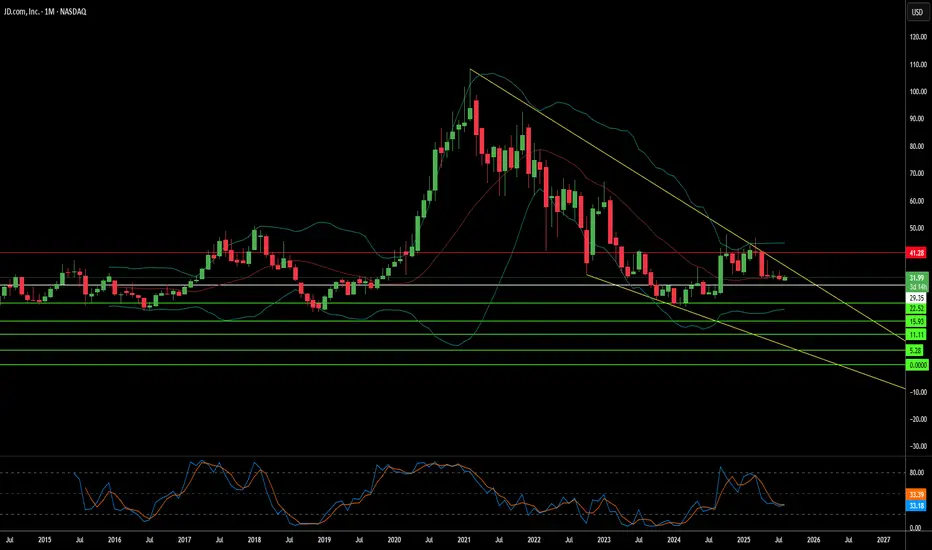
Can Strong Fundamentals Survive Geopolitical Storms?JD.com presents a compelling paradox in modern investing: a company demonstrating robust operational performance while its stock remains volatile due to factors entirely beyond its control. Despite market speculation about decline, JD.com has shown impressive financial resilience with consistent revenue growth—15.8% in Q1 2025 and 22.4% in Q2 2025 - alongside improving operating margins that reached 4.5% for JD Retail in Q2 2025. The company has strategically invested over RMB 75 billion in R&D since 2017, building a sophisticated logistics network spanning over 3,600 warehouses and developing cutting-edge technologies that have reduced fulfillment costs to a world-leading 6.5%.
However, JD.com's strong fundamentals exist within a challenging ecosystem of domestic and international pressures. China's deflationary environment, with CPI rising only 0.2% in 2024, has created subdued consumer demand, while intensifying competition from disruptors like Pinduoduo has reshaped the e-commerce landscape. Rather than engaging in destructive price wars, JD.com has pivoted toward sustainable profitability, leveraging its premium brand reputation and proprietary logistics network as key differentiators in an increasingly crowded market.
The most significant risk facing JD.com - and all US-listed Chinese companies- is geopolitical uncertainty rather than operational weakness. US-China trade tensions, regulatory crackdowns in both countries, and the specter of potential Taiwan conflict scenarios create unprecedented risks for investors. A hypothetical Taiwan invasion could trigger catastrophic sanctions, including SWIFT banking exclusions and forced delistings, potentially rendering these stocks worthless regardless of their underlying business strength. This analysis reveals that Bloomberg Economics estimates such a conflict would cost the global economy $10 trillion, with Chinese companies facing existential threats to their international operations.
The JD.com case study ultimately illustrates a new reality in global investing: traditional financial analysis focusing on revenue growth and operational efficiency may be insufficient when evaluating companies operating across geopolitical fault lines. While JD.com remains operationally strong with clear competitive advantages, investors must recognize they are essentially placing bets on US-China diplomatic stability rather than just corporate performance. This political risk premium fundamentally changes the investment equation.
Can the Dollar Index Predict Global Chaos?In the intricate dance of global finance, the U.S. Dollar Index has emerged as a pivotal player, reaching heights unseen in over two years. This surge, coinciding with Donald Trump's anticipated return to the White House, underscores a market bracing for significant policy shifts. The index's climb is not just a number; it's a beacon reflecting the resilience of the U.S. economy amidst high interest rates and a low unemployment rate, painting a picture of optimism where investors envision a 'goldilocks' scenario under new economic policies.
However, this rise is shadowed by tariff threats, hinting at potential global trade disruptions. The depreciation of European currencies against the dollar signals a market in flux, with investors recalibrating their strategies in light of possible protectionist measures. This scenario challenges us to ponder the broader implications: How will these tariffs reshape international trade dynamics, and what does this mean for the global economic order that has favored open trade for decades?
The Dollar Index's ascent also prompts a deeper reflection on currency as a barometer of geopolitical stability. With the U.S. potentially stepping into a new era of economic policy, the world watches closely. This moment invites investors and policymakers alike to consider global economic relations' immediate impacts and long-term trajectory. Will this lead to a reevaluation of the dollar's role as the world's reserve currency, or will it strengthen its position amidst global uncertainties? This question is not just about economics; it's about understanding the undercurrents of power and influence in a world at a crossroads.