Gold Rally Extends as a Bearish Butterfly Pattern FormsGold (XAUUSD) – Technical Analysis | Daily Timeframe
Gold remains in a primary bullish trend, with price currently advancing toward a potential completion zone of a harmonic reversal structure known as the
Bearish Butterfly Pattern (Under Construction).
📈 The current move is being traded as a buy continuation, targeting the Potential Reversal Zone (PRZ).
🎯 Current upside target: 4500 (PRZ)
⚠️ Important Notes:
The Bearish Butterfly is a bearish reversal pattern and has not completed yet.
The 4500 area represents a decision zone, where selling opportunities will be evaluated upon confirmation.
A strong daily close above 4500 may indicate pattern failure.
📌 Key support levels:
4300 (loss of bullish momentum below)
4200 (scenario invalidation)
📌 Key resistance / potential sell zone:
4450 – 4550
Summary:
The trend remains bullish for now, with buying opportunities focused toward the PRZ, while closely monitoring price behavior for a potential bearish reversal setup at completion.
If the harmonic pattern is completed and the upward target is successfully reached, the pattern will be updated with a clarification of its downward selling targets.
Harmonic Patterns
XAUUSD: Potential Rejection at Resistance – Target 4,421 SupportGold has been on a strong bullish run, but we are now seeing signs of potential exhaustion as price reaches a key psychological and technical resistance zone. The current price action suggests a shift in momentum that could lead to a healthy correction.
Key Technical Levels
Current Price: 4,486.415.
Resistance / Stop Loss Zone: The area between 4,500 and 4,530 is acting as a major supply zone. A break above 4,530.149 would invalidate this bearish outlook.
Immediate Support: Looking for an initial move down toward the 4,465 zone.
Target (Strong Support): The ultimate bearish target sits at the "Strong Support" level near 4,420–4,435.
Trading Strategy
The Setup: I am looking for a rejection at the current local high (approx. 4,497) followed by a lower high to confirm the downward trend.
Risk Management: Keep stops tight above the recent peak. The risk-to-reward ratio on this setup is highly favorable if the price reaches the 4,421 area.
Play on LevelsPSO Analysis
CMP 469 (12-12-2025 03:24PM)
Previous important Resistance (462 - 472) should act
as Important Support now.
However, breaking this zone may bring more selling pressure
taking the price towards 450 & then around 430.
Crossing 490 with Good Volumes will bring new highs around
550 - 560 initially Inshaa ALLAH!
BTC Isn’t Breaking Out — It’s Hunting LiquidityBTC/USD – 1H Quick Read
Bitcoin remains trapped inside a defined range between support and resistance. Price is holding near the range mid, showing balance, not momentum.
Repeated wicks at both extremes confirm liquidity sweeps, not trend acceptance. Buyers defend support aggressively, but upside attempts still lack follow-through.
Key Points
Range market = rotation, not trend
Breakouts are faded, pullbacks are absorbed
Liquidity is prioritized over direction
Outlook
Expect continued chop and false moves until BTC clearly accepts above resistance or loses support.
Bottom Line
No breakout yet.
Trade the range wait for confirmation for direction.
#Nifty Directions and Levels for December 23Good morning, friends! 🌞
Market Directions and Levels for December 23
The global markets are showing a bullish sentiment (based on the Dow Jones), and the Indian market also indicates a bullish outlook. Today, the market may open on a positive note due to GIFT Nifty showing about 50 points up.
What to Expect Today?
The global market structure has a solid bullish bias, and the Indian market also formed a solid candle in the previous session. Sentimentally, it suggests a positive day today as well. In my opinion, the Nifty could move in line with yesterday’s pattern. On the other hand, Bank Nifty is displaying a solid bullish structure, which means that if it breaks the 78% resistance, we can expect a long rally. Let’s look at the charts.
Nifty
Current view:
> If the market opens with a gap-up, it could reach 26,269—a resistance zone. Structurally, it could undergo a minor retracement of 23% to 38% in the current swing. However, if it breaks through without rejection(26269), follow the rally
> Note: if the gap-up does not sustain and declines, we can apply the same sentiment until it breaks the 38% retracement level. If it breaks, we can expect the correctional targets at 50% and 78% in the current swing.
#Banknifty Directions and Levels for December 23Bank Nifty
Current view:
> If the market opens with a gap-up, structurally we could see a long rally that may reach a minimum of 59,545 to 59,651.
Alternate view:
> If the gap-up does not sustain and declines, we can expect a 23% to 38% retracement in the current swing. Structurally, it may fail to break. However, if it breaks, we could expect a range-bound market
$NU:Disrupting Latin American Finance with Digital First ModelNu Holdings (NYSE: NU) has firmly established itself as a standout performer in the fintech investment landscape, capturing significant investor attention with its dramatic 58% year-to-date surge in share price. This exceptional performance is not merely speculative hype but is fundamentally rooted in the company's proven ability to execute a disruptive digital banking model across Latin America—a region historically plagued by financial exclusion and concentrated, high-cost traditional banking. By leveraging a smartphone-native platform, Nu has successfully addressed a massive, underserved market, connecting with tens of millions of customers and building a powerful, scalable business poised for the next phase of monetization and geographic expansion.
1. The Brazilian Disruption: A Blueprint for Success
Nu's origin story is one of radical market transformation. For decades, the Brazilian financial system was an oligopoly, dominated by five major banks that engaged in practices former Finance Minister Paulo Guedes famously labeled a "cartel." This concentration led to exorbitant costs for consumers, with credit card interest rates soaring as high as 160%, effectively locking a significant portion of the population out of affordable financial services.
Nu's neobank model dismantled this status quo. By launching as a digital-only platform, the company bypassed the immense overhead of physical branches and passed the savings directly to customers. Its initial offering of free digital checking accounts and credit cards with no annual fees was revolutionary, rapidly attracting tens of millions of Brazilians who were either unbanked or dissatisfied with incumbent options. Today, Nu serves an astonishing 110 million customers in Brazil, representing approximately 60% of the country's adult population.
The company's evolution from a simple payments facilitator to a full-spectrum financial ecosystem is key to its maturity. It now holds multiple regulatory licenses, allowing it to offer a comprehensive suite of products in payments, credit, investments, and insurance. A pivotal forthcoming milestone is its pursuit of a full Brazilian banking license, which it plans to acquire via the purchase of a small bank in 2025. This license will confer enhanced consumer trust, solidify its brand legitimacy, and, crucially, grant access to interbank markets and more stable funding sources, thereby lowering its overall cost of capital and strengthening its competitive moat.
2. The Monetization Engine: Scaling Profitability Through Cross-Selling
Acquiring a massive customer base is only the first step; the core of Nu's investment thesis lies in its ability to monetize this base efficiently. With 127 million customers across its three markets, Nu views each relationship as a platform for deepening financial engagement. Its strategy centers on cross-selling a broadening portfolio of services, which enhances customer lifetime value and transforms the business from a high-growth user acquisition story into a sustainable, profitable enterprise.
The effectiveness of this strategy is vividly captured by the metric of Average Revenue Per Active Customer (ARPAC). As customers adopt more products—moving from a free account to a credit card, a personal loan, an investment product, or even non-financial services like travel or cellular plans—the ARPAC climbs. In Q3, Nu's overall ARPAC reached $13.40, marking a robust 20% year-over-year increase on a foreign-exchange-neutral basis. The monetization trajectory is even more impressive for mature cohorts: for customers with eight or more years on the platform, the ARPAC was $27.30 as of Q2.
This growing ARPAC demonstrates a powerful flywheel effect: a superior, low-cost user experience attracts customers; trust is built through core products; and that trust then facilitates the efficient introduction of higher-margin services. This internal monetization engine allows Nu to grow profitably without perpetually relying on expensive external marketing for new customer acquisition.
3. The Growth Trajectory: Geographic and Product Expansion
Nu's future growth is supported by powerful secular trends and strategic market expansion:
The Digital Tailwind: The foundational trend across Latin America is the relentless rise in smartphone adoption, projected to reach 400 million users. This digitally native generation increasingly prefers the convenience of mobile apps over the inconvenience of physical branches, perfectly aligning with Nu's low-cost, scalable operating model.
International Expansion – Mexico and Colombia: Having saturated a dominant position in Brazil, Nu is methodically replicating its playbook in Latin America's other major economies. In Mexico, it has already attracted over 13 million customers (about 14% of the adult population) and is on the verge of a major regulatory upgrade: the conversion of its SOFIPO (Popular Financial Society) license into a full banking license. This will enable Nu Mexico to offer a broader portfolio, including payroll accounts, and increase deposit insurance coverage sixteen-fold, making it competitive for attracting higher-value customers. In Colombia, it is approaching 4 million customers, laying the groundwork for similar growth.
The Ambitious U.S. Foray: In a bold strategic move, Nu applied in September for a de novo national bank charter from the U.S. Office of the Comptroller of the Currency. While the competitive landscape is vastly different, a U.S. charter would provide a regulated platform to offer products to the large Latin American diaspora and potentially explore new verticals like digital asset custody, all under a single federal regulator.
Investment Conclusion: A Compelling Blend of Growth and Value
In summary, Nu Holdings presents a compelling investment case that combines a proven disruptive model, a massive and engaged customer base, and a clear path to enhanced profitability through product depth and geographic breadth. The company has moved beyond the initial user-growth phase and is now demonstrating its ability to systematically increase the financial value of each customer relationship.
From a valuation perspective, the stock trades at approximately 20 times next-year earnings estimates. For a company growing its top line at over 50% annually while significantly improving its profit margins, this multiple can be considered attractive relative to its growth profile and the vast, ongoing financial digitization opportunity across Latin America. While execution risks remain in newer markets and regulatory processes, Nu's track record in Brazil provides a credible blueprint. For investors seeking an attractively priced growth stock with a durable competitive advantage in an underpenetrated market, Nu Holdings stands out as a formidable contender.
BTC | DailyCRYPTOCAP:BTC — Quantum Model
Daily Zoom-Out | Advance Projection
As outlined in prior analyses, a Leading Diagonal—identified as a bullish structure in Minor Wave 1, positioned at the origin of the Primary-degree trend—was followed by a relatively deep retracement in Minor Wave 2, marking completion of the broader reversal structure.
Current structure suggests Minor Wave 3 may be initiating, pending continued acceptance above reversal support, projecting an impulsive advance toward the 1.618 Fibonacci extension level, with a Q-Target ➤ 111,111.11 💫.
🔖 This outlook is derived from insights within my Quantum Models framework. Within this methodology, Q-targets represent high-probability scenarios generated by the confluence of equivalence lines. These equivalence lines also function as structural anchors, shaping the internal geometry of the model and guiding the evolution of alternative paths as price action unfolds.
Rivian Automotive: Navigating High Hopes and Market RealitiesShares of Rivian Automotive (NASDAQ: RIVN) have been on a remarkable trajectory, more than doubling in value over the past eight months and currently trading near a two-year high of approximately $22.64. This surge reflects growing investor optimism about the company's path to operational maturity and its strategic positioning within the competitive electric vehicle (EV) landscape. However, as the stock approaches these elevated levels, a nuanced debate emerges between bullish catalysts and significant valuation concerns. This analysis delves into the key drivers behind the rally, the divergent views from Wall Street, and the critical factors that will determine Rivian's performance in 2026 and beyond.
The Bullish Thesis: Strategic Catalysts and Operational Momentum
The optimistic narrative for Rivian is championed by analysts like Dan Ives of Wedbush Securities, who recently maintained his "Outperform" rating and raised his price target to $25. This suggests a further potential upside of about 11% from current levels. Ives's constructive outlook is anchored in several pivotal developments:
The Accelerated Push into Autonomy and AI: A primary catalyst is Rivian's recently unveiled strategy at its inaugural "Autonomy & AI Day." The company announced ambitious plans, including the launch of its proprietary Rivian Autonomy Processor (RAP1) and a forthcoming autonomy subscription service in 2026. According to Ives, this accelerated focus on self-driving technology is not merely a feature enhancement but a strategic move that could unlock new, high-margin revenue streams (via software subscriptions) while simultaneously improving vehicle efficiency and helping to manage long-term manufacturing costs through technological integration.
The Crucial R2 Platform Rollout: The successful launch and ramp-up of the R2 vehicle platform are seen as central to Rivian's growth story in 2026. The R2, targeting a more accessible price point than the flagship R1T and R1S models, is expected to significantly expand Rivian's addressable market. A smooth production and delivery ramp for the R2 is critical for improving volume metrics, achieving economies of scale, and demonstrating the company's ability to execute on its growth roadmap.
The Volkswagen Joint Venture as a Game-Changer: Rivian's multibillion-dollar strategic joint venture with Volkswagen is widely viewed as a transformative partnership. For Rivian, it provides a massive infusion of capital, validates its next-generation electrical architecture and software stack, and offers a pathway to global scale through access to Volkswagen's manufacturing expertise and supply chain. This alliance substantially de-risks Rivian's balance sheet and long-term capital needs, strengthening its competitive moat against both legacy automakers and pure-play EV rivals.
Attractive Relative Valuation and Technical Strength: Despite the sharp rally, proponents argue Rivian remains attractively valued on a relative basis. At approximately 5x forward sales, it trades at a significant discount to Tesla's multiple of over 16x, suggesting room for expansion if execution improves. Technically, the stock is trading decisively above all its major moving averages (50-day, 100-day, 200-day), a pattern that typically signals sustained bullish momentum and indicates buyers are in control across multiple timeframes.
The Cautious Counterpoint: Consensus Skepticism and Lofty Expectations
Despite these compelling drivers, a significant degree of skepticism persists on Wall Street, presenting a stark contrast to the bullish outlook. The broader analyst consensus, as aggregated by services like Barchart, currently sits at a "Hold" rating, with a mean price target of approximately $16. This implies a potential downside of roughly 28% from current levels, highlighting a deep-seated concern that the recent rally may have overshot the company's near-term fundamentals.
The primary concerns underpinning this cautious stance include:
Execution Risk: The automotive industry is notoriously difficult, and Rivian must flawlessly execute the R2 launch, ramp up new production lines, and integrate complex autonomy technology—all while managing cash burn.
Intensifying Competition: The EV market is becoming increasingly crowded, with price wars and rapid innovation from both established giants and new entrants putting pressure on margins and market share.
Macroeconomic and Demand Headwinds: Higher interest rates and potential consumer softening could impact demand for big-ticket items like vehicles, testing Rivian's pricing power and delivery targets.
Valuation Stretch: At current prices, skeptics argue the stock is pricing in a near-perfect execution of its multi-year plan, leaving little room for operational missteps or market disruptions.
Technical Framework and Seasonal Considerations
From a chart analysis perspective, key levels are coming into focus:
Major Support Zone: A critical area of historical buying interest and structural support is identified around the $8.00 level.
Major Resistance Zone: The next significant hurdle and potential profit-taking zone for the current uptrend lies near $28.00.
Additionally, some traders note a seasonal tailwind, with historical data indicating Rivian shares have averaged a gain of over 6% in the month of January. While past performance is no guarantee, this pattern can influence short-term trading sentiment.
Conclusion: A High-Stakes Inflection Point
In summary, Rivian Automotive stands at a high-stakes inflection point as it heads into 2026. The bullish case, led by analysts like Dan Ives, is powerful and forward-looking, built on strategic differentiators in autonomy, a pivotal new vehicle platform, and a landmark partnership that provides financial stability. The stock's technical posture and relative valuation add to this appeal.
However, the substantial gap between the bullish price targets and the conservative consensus "Hold" rating underscores the exceptional execution required to justify current valuations. The market is effectively asking: Can Rivian transition from a promising story to a sustainably profitable, high-volume automaker before the capital runs thin or competition intensifies further?
For investors, the decision hinges on conviction in management's ability to navigate this complex transition. The upcoming year will be critical, with milestones around the R2 launch, autonomy developments, and joint venture progress serving as key catalysts that will either validate the bullish thesis or reinforce the skeptics' caution. The path forward promises significant volatility, with the stock likely oscillating between the forces of high-growth optimism and the gravity of automotive industry realities.
$ANIME has already broken the descending trendline and reclaimed$ANIME has already broken the descending trendline and reclaimed the 50 EMA on the daily. That shifts this from a compression narrative to an early trend reversal. After months of lower highs, price is finally accepting above key structure, which is what real bottoms look like, not one green candle.
Now the question is not “will it break out” but “does it hold above the EMA and former trendline on pullbacks.” If it does, momentum builds and upside expansion becomes the path of least resistance. If it fails, this breakout turns into a classic bull trap.
Breakouts matter. Holds confirm them.
New Highs, No Sell-Off — Smart Money In?Based on the current news backdrop combined with the price structure on the chart , I continue to hold the view that XAUUSD is in a clear and healthy uptrend — not a temporary or emotional spike.
Gold setting a new all-time high around 4,400 shows that the market is strongly pricing in the likelihood of further Fed easing and future rate cuts . More importantly, after making new highs, price did not experience aggressive selling , but instead managed to hold at elevated levels — a clear sign that large capital flows are staying in the market, rather than this being a short-lived FOMO-driven move.
Looking at the chart, gold is moving cleanly along its ascending trendline , with consistent support from the Ichimoku system and dynamic support zones below. The recent pullbacks have been purely technical, allowing the market to “catch its breath” and absorb supply, without breaking the overall structure. This is a market that is moving strong — not overheating.
For me, the 4,380 zone remains a key support level. As long as price holds above this area, the bullish trend remains fully intact. In the short term, my preferred scenario is light consolidation at high levels, followed by a continued push to retest the 4,450 area.
In summary, I continue to favor BUY setups on pullbacks — not chasing price at the highs and never trading against the trend. When both fundamentals and technicals align, the most important skill is patience and discipline to stay with the trend, rather than trying to pick a top in a market that is clearly strong.
$BROS Blending Strong Fundamentals with Strategic Growth LeversDutch Bros Inc. (NYSE: BROS), a leading and culturally resonant drive-thru coffee chain, has delivered exceptional recent performance, with its stock surging +22.1% over the past month. This impressive rally is not a fleeting market anomaly but is underpinned by a robust and multi-faceted growth strategy that is gaining significant recognition from both analysts and investors. Founded in 1992 as a single pushcart in Oregon, the company has evolved into a dynamic national brand, successfully capturing a loyal customer base with its high-energy service and innovative beverages. The core investment thesis for Dutch Bros rests on a powerful combination of consistent operational excellence, a vast and largely untapped expansion runway, and strategic menu initiatives that promise to unlock substantial new revenue streams.
The Core Growth Engine: A Dual-Thrust Model
The bullish case for Dutch Bros is built on two primary, synergistic pillars that work in concert to drive top-line growth and shareholder value:
Sustained Same-Store Sales (SSS) Momentum: In a challenging consumer environment marked by inflationary pressures, Dutch Bros has demonstrated remarkable resilience and brand strength. Over the past two years, the company has averaged a robust 5.7% same-store sales growth. Critically, this growth is being driven by a healthy increase in transactions (up 4.7% last quarter), indicating the company is successfully attracting new customers while maintaining strong frequency among existing ones. This operational excellence is further highlighted by the outperformance of company-operated shops, which posted a stellar 7.4% SSS growth last quarter. Key drivers include continuous menu innovation, effective brand marketing, and the accelerating adoption of its mobile order-ahead platform, which enhances convenience and throughput.
Aggressive and Prudent Unit Expansion: Dutch Bros is still in the early stages of its national footprint build-out. With just under 1,100 stores currently operational, the company has a clearly articulated plan to reach over 2,000 locations by 2029, with a long-term potential for approximately 7,000 stores across the United States. This represents one of the most compelling unit growth stories in the restaurant sector. The economic model is highly attractive: the shops are small-format, drive-thru focused, and relatively inexpensive to build, leading to a quick payback on invested capital. This "land-and-expand" offensive into new and existing markets provides a clear, multi-year visibility into revenue growth.
Strategic Catalysts and Financial Fortitude
Beyond the core engine, Dutch Bros is actively pursuing significant strategic initiatives that serve as potential catalysts for accelerated growth:
The Massive Food Opportunity: A primary area of untapped potential lies in its nascent food program. Currently, less than 2% of Dutch Bros' sales come from food items, a stark contrast to rival Starbucks, where food constitutes roughly 20% of the sales mix. This gap has historically limited Dutch Bros' competitiveness during the crucial morning "daypart," as customers often seek a one-stop shop for both coffee and food. Following a successful pilot program—where test locations saw an approximate 4% lift in sales—the company is now rolling out a permanent hot food menu to three-quarters of its system that can support the infrastructure. As this offering gains broader availability and targeted marketing support, it is poised to become a major driver of increased average ticket size and customer frequency.
Strengthening Financial Foundation: The company's operational efficiency is translating into improved financial health. Over the last year, its free cash flow margin expanded by 5.1 percentage points. This growing reservoir of internally generated capital provides Dutch Bros with enhanced flexibility to fund its aggressive growth plans, invest in technology, and potentially return capital to shareholders, all without over-reliance on external financing.
Analyst Endorsement and Recent Financial Performance
The strength of this narrative has garnered strong Wall Street endorsement. On December 17, KeyBanc analyst Christopher Carril initiated coverage with an Overweight rating and a $77 price target. In his note, Carril highlighted Dutch Bros as "one of the most compelling growth stories," driven by its mid-teens unit growth. He argued that despite the stock's outperformance in 2025, the share price had not yet fully reflected the company's strong fundamentals, especially given the negative sentiment that had weighed on the broader fast-casual segment.
This confidence is backed by solid quarterly results. On November 5, Dutch Bros reported Q3 2025 earnings per share (EPS) of $0.19, beating estimates by $0.02. Revenue soared 25.2% year-over-year to $423.58 million, also surpassing expectations. Furthermore, the company raised its full-year 2025 guidance, now projecting total revenue between $1.61 billion and $1.615 billion (above consensus) and same-shop sales growth of approximately 5%.
Technical Analysis Framework: Support and Profit-Taking Zones
For traders and investors monitoring price action, the stock's chart presents identifiable levels based on Fibonacci retracement and extension analysis:
Key Support Zones: In the event of a broader market or sector pullback, technical analysts would watch for potential buying interest and price stabilization around three Fibonacci retracement levels drawn from a relevant prior swing:
The 0.382 level at approximately $62.35
The 0.50 level at approximately $54.77
The 0.618 level at approximately $47.20
Take-Profit (Resistance) Targets: On the upside, following the current bullish momentum, analysts project several potential resistance and profit-taking zones:
An initial target at the 0.236 Fibonacci extension level near $71.73
A secondary target at $76.00
A more extended bullish target at $84.00
Conclusion: A Compounding Growth Story for the Long Term
In summary, Dutch Bros presents a compelling, long-term growth investment opportunity that transcends short-term market noise. The company successfully blends the defensive qualities of consistent, transaction-driven same-store sales growth with the offensive power of a multi-year, capital-efficient national expansion plan. The upcoming nationwide rollout of its hot food menu represents a major, high-probability catalyst to enhance unit economics and market share. Backed by strong recent financial performance, rising free cash flow, and increasing analyst conviction, Dutch Bros is strategically positioned to compound value for years to come. While the stock may experience volatility and test the identified technical support levels, its fundamental trajectory suggests it is a stock to own for the next five years as it executes on its vision to become a ubiquitous brand in the U.S. drive-thru landscape.
DCRUSDT — Long-Term Downtrend Pressure vs Major Demand ZoneDecred (DCR) on the Weekly timeframe is still trading within a long-term bearish structure, characterized by a clear sequence of lower highs and lower lows since the 2021 peak. However, price is currently sitting inside a major historical demand zone at 14.5 – 11.5, which has repeatedly acted as a strong accumulation base in the past.
This zone is a critical decision area that will determine whether DCR can form a macro reversal or continue its long-term decline.
---
Pattern Explanation
1. Descending Trendline (Primary Resistance)
The descending yellow trendline represents a long-term bearish resistance originating from the 2021 all-time high.
Multiple breakout attempts have failed, with price consistently getting rejected and continuing lower.
2. Base Accumulation / Long-Term Demand Zone
The yellow box at 14.5 – 11.5 marks a strong demand area that:
Previously acted as major resistance
Hosted extended consolidation phases
Has absorbed selling pressure multiple times
This behavior suggests possible long-term accumulation.
3. False Breakout & Strong Rejection
The sharp impulse toward the 39–44 zone was followed by aggressive rejection, indicating a liquidity grab rather than a sustainable bullish breakout.
---
Key Levels
Major Support (Demand Zone): 14.5 – 11.5
Immediate Resistance: 17.5 – 18.5
Mid Resistance: 24.7 – 28.4
Major Resistance: 39.4 – 44.0
Long-Term Bullish Extensions: 67.8 – 104 – 179
---
Bullish Scenario
Price holds firmly above the 14.5 – 11.5 demand zone
A weekly higher low is formed
A confirmed weekly close above the descending trendline
Additional bullish confirmation if:
Price reclaims the 18 – 20 area
Volume expands during the breakout
Bullish Targets (Step by Step):
18.5 → 24.7 → 28.4
Long-term extensions toward 39 – 44, and potentially 67+ if the broader market cycle supports it
---
Bearish Scenario
Price fails to hold the 14.5 – 11.5 zone
A weekly close below 11.5
This breakdown would likely trigger:
Bearish continuation
Potential acceleration toward the 7 – 6 (ATL zone)
A loss of this demand area would confirm that the long-term bearish trend remains dominant.
---
Conclusion
DCRUSDT is currently trading at a make-or-break zone on the macro timeframe.
The 14.5 – 11.5 demand zone is the key level defining the next major move.
Holding above it → macro reversal potential
Breaking below it → bearish continuation risk
Until price breaks and holds above the descending trendline, patience and confirmation remain essential on the weekly timeframe.
---
#DCRUSDT #Decred #CryptoAnalysis #WeeklyChart #MacroAnalysis #Downtrend #DemandZone #SupportResistance #AltcoinAnalysis #PriceAction #MarketStructure #CryptoTrading
SoundHound AI's Recent Performance and Market SentimentShares of SoundHound AI (NASDAQ: SOUN), a prominent developer of voice artificial intelligence and conversational AI technologies, experienced a notable uptick during morning trading, rising approximately 2.7%. This positive movement was directly catalyzed by two significant analyst upgrades from prominent financial institutions: Cantor Fitzgerald and Mizuho Securities. Both firms elevated their ratings for SoundHound AI from their previous levels to a "Buy" rating and concurrently increased their 12-month price targets to $15 per share.
The analyst from Cantor Fitzgerald specifically highlighted the company's strong operational execution as a key driver for the upgrade. Emphasis was placed on SoundHound's demonstrated ability to successfully upsell and cross-sell its product suite, particularly by introducing more advanced voice and conversational AI solutions to its existing enterprise customer base. This indicates a successful expansion of customer relationships beyond initial deployments, which is a critical metric for SaaS and technology companies. Furthermore, the analyst note pointed to the upcoming Consumer Electronics Show (CES) in January 2026 as a near-term potential catalyst. CES is a major global platform for unveiling new technologies, and SoundHound's participation could generate increased visibility, new partnership announcements, and product demonstrations that may positively influence investor sentiment.
This bullish outlook was reflected in the broader analyst consensus, which at the time held a "Moderate Buy" rating for the stock. The aggregate average price target among covering analysts implied a substantial potential upside from the stock's trading price, reinforcing the optimistic narrative surrounding the company's growth prospects. Following the initial surge, the stock's gains moderated slightly, with shares settling at $11.27, still representing a solid 2.4% increase from the previous day's close.
Interpreting the Market's Reaction: Meaningful, but Not Transformative
The market's reaction to this positive analyst news must be contextualized within SoundHound AI's well-documented trading history. The stock is characterized by extreme volatility, having recorded approximately 80 individual price movements exceeding 5% over the preceding year. Within this context, a single-day move of around 2.5% signals that while the market perceives the dual upgrades as a materially positive development, it is not viewed as an event that fundamentally resets the long-term investment thesis for the company. The reaction suggests a reinforcement of existing positive sentiment among some investors rather than a wholesale rush of new capital into the stock.
For perspective, the last significant price move occurred just one week prior when SoundHound's stock declined 6.6%. That drop was part of a broader market sell-off driven by mounting investor apprehension regarding the profitability of massive AI investments. Fears of a potential "AI bubble" were stoked after chipmaker Broadcom issued a warning that surging sales of AI infrastructure systems might come at the expense of compressed profit margins, causing its stock to tumble. This triggered a widespread market recalibration, leading investors to question whether the enormous capital expenditures flowing into semiconductor chips and data centers would yield adequate returns on investment. Consequently, capital rotated out of more speculative, high-growth technology names like SoundHound AI and into assets perceived as more stable or value-oriented. This sector-wide risk-off sentiment overshadowed company-specific fundamentals during that period.
Longer-Term Performance and Key Technical Levels
Despite the recent analyst-driven boost, SoundHound AI's stock performance over a longer horizon reveals significant challenges. The shares are down approximately 44.1% year-to-date and, at the current price of $11.27, trade a substantial 53.5% below their 52-week high of $24.23, which was reached in December 2024. This paints a picture of a stock that has faced considerable selling pressure and de-risking over the course of the year.
However, taking an even longer-term view, investors who participated in the company's initial public offering (IPO) in April 2022 have seen gains. An initial investment of $1,000 at the IPO price would now be valued at approximately $1,502, representing a positive return, albeit one that has been subject to extreme volatility along the way.
From a technical analysis standpoint, monitoring key support and resistance levels is crucial for such a volatile stock. Market technicians and chart analysts identify a critical major support level at $6.00. This price point is viewed as a significant floor where buying interest has historically emerged or is anticipated to materialize, providing a potential baseline in the event of further market downturns or negative sentiment. Holding above this level is often seen as technically important for maintaining a bullish or neutral intermediate-term structure.
In summary, while the recent analyst endorsements provide a clear vote of confidence in SoundHound AI's business execution and near-term catalyst potential, the stock remains ensnared in the volatile tides of the broader AI investment narrative. Its performance continues to reflect a tension between strong company-specific growth metrics and overarching market concerns about tech sector valuations and profitability. Investors are thus navigating a landscape where positive operational updates can drive short-term rallies, but the stock's trajectory remains susceptible to shifts in the macro sentiment toward speculative technology and AI investments.
A Strategic Shift Toward Scale and Stability in Mortgage FinanceIn a comprehensive sector initiation report released Friday, the investment bank Jefferies presented a detailed outlook for the U.S. mortgage finance industry, forecasting a multi-year recovery phase driven by a more favorable interest rate environment. The central thesis is that as the market transitions from the volatility of recent years toward a more normalized level of activity, competitive scale and business model diversification will become the primary determinants of success and shareholder value creation.
Macroeconomic Backdrop: A Gradual Thaw Supporting Volume Recovery
Jefferies' constructive view is anchored in a fundamental shift in the interest rate landscape. The analysts posit that the monetary policy environment has become "less restrictive" for mortgage originators. This gradual easing of financial conditions is expected to thaw the housing market, supporting a steady recovery in mortgage application and origination volumes over the coming years.
The brokerage's financial models are built upon specific forecasts from Fannie Mae, which project:
Total mortgage originations rising to $2.3 trillion in 2026 and $2.5 trillion in 2027. These figures represent a meaningful recovery and are consistent with long-term historical averages for the market.
A parallel decline in borrowing costs, with the 30-year fixed mortgage rate forecast to fall by approximately 40 basis points to 5.9% by the end of 2026, down from around 6.3% at the time of the report.
This dual dynamic of increasing volume and moderating rates forms the foundational pillar for Jefferies' positive stance on the sector.
Investment Thesis: The Primacy of Scale and Diversification
A key differentiator in Jefferies' analysis is its emphasis on business model resilience. The report argues that larger, integrated platforms—particularly those with significant mortgage servicing operations—are strategically positioned to generate more stable and predictable earnings through the cycle. In contrast, companies with a narrow focus solely on origination are seen as more vulnerable to the inherent cyclicality of the mortgage market.
The mortgage servicing rights (MSR) portfolio acts as a critical ballast. Servicing generates recurring, fee-based income that provides cash flow stability even when origination volumes are soft. This diversification allows scaled players to invest in technology and customer acquisition during downturns and then leverage that infrastructure for superior profitability as volumes recover.
Company-Specific Initiations and Rationale
Jefferies applied this framework in initiating coverage on four major players, revealing a clear preference for diversified scale.
Rocket Companies (RKT) - "Buy," PT $25 (Highest-Conviction Call):
Rationale: Jefferies names Rocket as its top pick in the sector, citing its unparalleled scale as the nation's largest originator and servicer. The analysts believe Rocket's massive platform, combined with strategic acquisitions completed in 2025, provides exceptional operating leverage. As industry volumes normalize, this scale should translate directly into a powerful earnings recovery.
Forecast: The firm projects Rocket's EPS to rise from $0.90 in 2026 to $1.23 in 2027, an estimate roughly 12% above the consensus median, reflecting their above-average conviction in the company's execution.
PennyMac Financial Services (PFSI) - "Buy," PT $160:
Rationale: PennyMac is praised for its "diversified business model," which is anchored by one of the industry's largest servicing portfolios and a dominant correspondent lending platform. This structure is seen as enabling the company to produce positive returns across various interest rate environments.
Forecast & Valuation: Jefferies forecasts 2027 EPS of $17.70 and values the stock at approximately 9x that earnings figure, acknowledging the stability of its earnings streams.
Walker & Dunlop (WD) - "Buy," PT $75:
Rationale: The analysts acknowledge that investor concerns over potential loan repurchase obligations (repurchases) related to pandemic-era originations have weighed on the stock. However, they characterize this risk as "limited to specific vintages" and manageable. The investment case centers on Walker & Dunlop's focus on fee-based servicing and advisory revenue within commercial real estate finance, which provides notable earnings resilience.
Forecast & Valuation: A 2027 EPS estimate of $5.55 is paired with a higher target multiple of 14x, reflecting the premium typically assigned to asset-light, fee-oriented business models.
UWM Holdings (UWMC) - "Hold," PT $5:
Rationale: While Jefferies recognizes UWM's strong operating leverage and potential upside in a volume recovery, the "Hold" rating reflects two primary cautions. First, the company has a concentrated exposure to the wholesale mortgage origination channel, making it less diversified than its larger peers. Second, the report cites the company's unique governance structure as a factor in its relative valuation.
Forecast & Valuation: The 2027 EPS estimate is set at $0.59, with a target valuation of about 8x those earnings, indicating a more cautious stance on its ability to command a premium multiple.
Valuation Methodology and Technical Considerations
Jefferies emphasizes that its price targets are not predicated on a return to the euphoric peaks of the recent housing boom. Instead, the firm is applying mid-cycle valuation multiples to its projected "normalized" 2027 earnings. This methodology reflects an expectation of a sustainable recovery in activity, not an assumption of exceptional pricing power. The projected earnings growth is driven primarily by volume normalization and the operating leverage inherent to the scaled platforms.
From a technical analysis perspective, for the sector or a specific constituent like Walker & Dunlop (which has a $75 target and noted support levels), market technicians may identify the following key zones:
Buy Zone: A primary area of interest for new positions is identified near $72.
Support Zones: In the event of broader market pullbacks, subsequent levels of potential support are derived from Fibonacci retracement analysis and key psychological levels. These include:
The 0.382 Fibonacci level at approximately $55.86
The 0.236 Fibonacci level at approximately $49.52
A major psychological and historical support level at $40
Conclusion: A Recovery Play with a Quality Bias
In summary, Jefferies outlines a compelling, multi-year recovery thesis for the mortgage finance sector, catalyzed by easing rates and rising volumes. However, the investment opportunity is not uniform across the industry. The firm strongly advocates for a selective, quality-focused approach, favoring large-scale, diversified operators like Rocket Companies and PennyMac Financial Services, which are seen as best equipped to capitalize on the normalization trend while managing cyclical risks. The "Hold" rating on UWM underscores the perceived premium for business model durability. Investors are thus guided toward companies where scale serves as both an offensive weapon for market share gains and a defensive moat for earnings stability.
Dow Jones – Low Volume Expected During My Trading SessionDuring my trading session tomorrow,
volume is expected to remain very low.
This means patience is required.
I am not expecting meaningful moves
until after the New York Open.
Based on the structure and the schematic I’ve drawn,
the market is more likely to start executing that plan
once real liquidity enters the market.
No rush.
No forcing trades.
Timing and liquidity always come first.
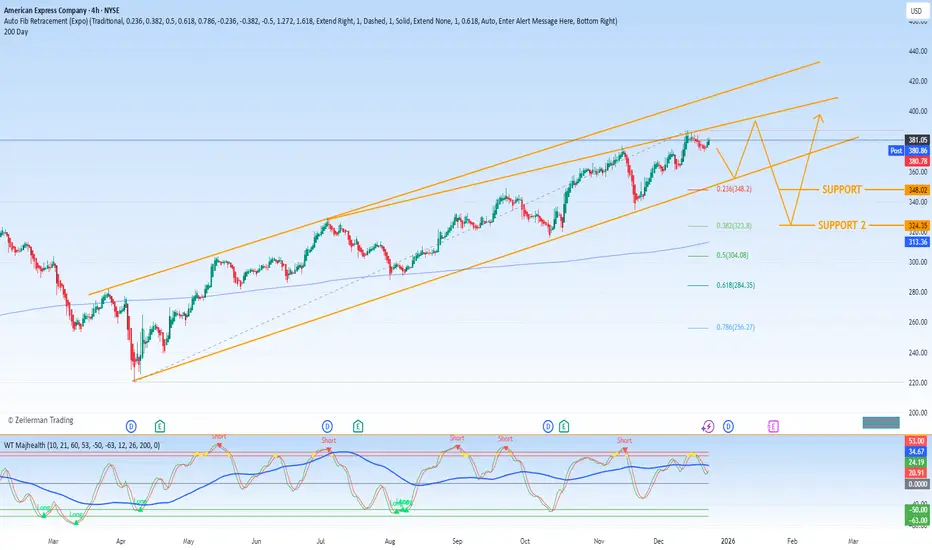
American Express's Growth Engine and Investment OutlookAmerican Express (Amex) has developed and executed a highly effective, multi-pronged growth playbook that has delivered exceptional returns for shareholders. Over the past five years, the financial giant has generated a total return of 238%, dramatically outperforming the broader market. This success is not accidental; it is the result of a clear, repeatable strategy focused on customer acquisition, engagement, and premium pricing power. Looking ahead, there is a strong, evidence-based conviction that Amex’s business will be larger and more profitable five years from now, though its future stock performance faces the dual forces of robust fundamentals and a premium valuation.
The Core Growth Playbook: A Virtuous Cycle
Management’s confidence is reflected in its ambitious long-term financial targets: revenue growth at a compound annual rate of 10% and diluted earnings per share (EPS) rising at a mid-teens percentage annually. This growth is engineered through a straightforward yet powerful cycle:
Aggressive and Strategic Customer Acquisition: The foundation of the playbook is adding high-quality card members. From Q3 2020 to Q3 2025, Amex increased its active card count by 36% to 151.2 million. Critically, the company is successfully attracting younger, digitally-native consumers. Leadership has highlighted that Gen Z and millennial cohorts are showing particularly strong engagement, ensuring the brand's relevance and customer base longevity.
Maximizing Customer Lifetime Value: Acquisition is only the first step. The true driver of revenue is increasing annual spending per cardholder. Amex has excelled here, with average card member spending reaching $6,387 in Q3 2025—a remarkable 58% increase over the past five years. This growth is fueled by a continuous expansion of the card's utility and appeal. Amex aggressively grows its merchant acceptance network worldwide, making the card more practical for daily use. Simultaneously, it forges valuable partnerships (e.g., in travel, entertainment, and retail) and refines its rewards ecosystem, ensuring the value proposition organically encourages higher spending.
The Power of the Premium Brand: Pricing Power as a Moat
Perhaps Amex’s most formidable competitive advantage is its unrivaled pricing power, a direct result of its powerful brand equity. While many financial services compete on low fees, Amex has successfully built a premium model where customers willingly pay for access.
Strategic Fee Increases: The company periodically and deliberately raises annual fees on its flagship products. Recent examples include the Gold Card fee increasing to $325 and the Platinum Card fee rising to $895. Since Q3 2020, the average annual fee per card has surged 72%. This ability to raise prices without significant customer attrition is a classic sign of a strong brand moat.
The Psychology of Premium Status: Amex transcends being a mere payment tool; it functions as a lifestyle accessory and status signal. For its affluent target demographic, possessing and using a Platinum or Centurion card carries perceived social and professional value. The company meticulously cultivates this image through marketing, exclusive benefits, and a focus on high-spending clientele.
Financial Prudence: This focus on a premium, high-spending customer base has a beneficial financial side effect: superior credit quality. Amex's net charge-off rate was a low 1.9% in Q3 2025, well-controlled compared to broader consumer lending averages. This disciplined underwriting keeps credit losses in check and protects profitability even during economic cycles.
Investment Considerations: Growth vs. Valuation
Despite the compelling business narrative, investors must weigh the robust growth trajectory against current market pricing.
The Valuation Headwind: Following a 29% rise in its share price in 2025 (as of the analysis period), Amex trades at a Price-to-Earnings (P/E) ratio of 25.7. This represents its richest valuation multiple in the past three years and is a premium to many of its financial sector peers. This elevated multiple indicates that much of the company's near-term growth is already priced in by the market, potentially limiting short-term upside and increasing sensitivity to any earnings disappointments.
The Endorsement of a Legendary Investor: A significant counterpoint to valuation concerns is the substantial, long-held stake by Berkshire Hathaway, which owns approximately 22% of American Express shares. Warren Buffett, Berkshire's chairman, is renowned for his focus on durable competitive advantages and long-term holding periods. His continued, sizable investment suggests a fundamental belief that Amex's quality—its brand moat and growth runway—justifies its valuation over a multi-decade horizon.
The Technical Perspective: From a market analysis standpoint, the stock's price action identifies two key technical support zones, derived from Fibonacci retracement levels, at approximately $348.20 (the 0.236 level) and $323.80 (the 0.382 level). These levels are watched by traders as potential areas where buying interest may re-emerge during a market pullback.
Five-Year Outlook: Cautious Optimism with Realistic Expectations
The path for American Express stock over the next five years will be shaped by the interplay of two dominant forces:
The Tailwind of Profit Growth: If management successfully executes its playbook and achieves mid-teens annual EPS growth, the underlying earnings power of the company will increase substantially, providing a fundamental lift to the stock price.
The Headwind of Valuation Compression: The current high P/E ratio of 25.7 may not be sustainable indefinitely. A gradual normalization or contraction of this multiple over time could act as a drag on share price appreciation, even as earnings grow.
Conclusion: The thesis that American Express will be a larger, more powerful business in five years is highly credible, supported by its proven growth strategy, pricing power, and brand strength. However, for the stock to significantly outperform the overall market from its current levels, the company will likely need to exceed its already ambitious growth targets to justify and maintain its premium valuation. While the stock is expected to trend higher, its performance may be more aligned with market returns rather than dramatically surpassing them, barring an acceleration in its growth narrative. The confidence of long-term investors like Buffett offers reassurance, but it does not eliminate the mathematical constraints imposed by today's elevated starting valuation.
Update on Gold (XAUUSD)As anticipated in my previous analysis,
the market did not continue straight up.
Sellers stepped in, liquidity was absorbed,
and price needed correction before continuation.
This is exactly how healthy trends behave.
I don’t chase price.
I wait for structure, liquidity, and confirmation.
The market did what it always does —
it followed logic, not emotion.
Experience shows before price moves.
APAC Region Cements Its Role as the Core Growth Engine for $ONONOn Holding AG is experiencing a dramatic geographic shift in its business, with the Asia-Pacific region solidifying its position as the primary driver for the company's next wave of global expansion. The region's explosive growth trajectory was emphatically demonstrated in the third quarter of 2025, marking its fourth straight quarter of net sales growth exceeding 100% on a constant currency basis, reaching 109.2%. This remarkable surge translated into reported net sales of CHF 144.9 million for the quarter, representing a staggering 94.2% increase compared to the same period the previous year.
This growth rate in APAC far outpaces the performance of On Holding's other major geographic segments. For context, the Americas region grew by 21% on a constant currency basis, while the Europe, Middle East, and Africa region grew by 33% during the same period. The result is a significant rebalancing of the company's revenue mix. APAC's contribution to total global net sales leaped to 18.2% in Q3 2025, up sharply from just 11.7% in the prior-year quarter. This trend is consistent over a longer timeframe as well. For the first nine months of the year ending September 30, 2025, APAC net sales soared to CHF 384.6 million, a 106.6% year-over-year increase. With total global net sales at CHF 2,270.2 million for that period, APAC now represents 16.9% of On Holding's overall business, signaling a clear path toward the region contributing a foundational 20% of total sales.
Company management attributes this powerful momentum to robust and sustained demand in its core Asian markets, notably China and Japan, coupled with rapidly accelerating consumer adoption in newer high-potential markets like South Korea and Southeast Asia. Strategic brand-building initiatives are further fueling this growth. The recent opening of a premium flagship store in Tokyo's prestigious Ginza district serves as a physical brand hub, while high-visibility athletic successes, such as those at the World Athletics Championships held in Tokyo, have significantly elevated regional brand awareness and credibility. These combined factors underscore that APAC has evolved beyond a mere high-growth opportunity; it is now an indispensable and fundamental pillar of On Holding's long-term global strategy.
Financial Performance and Market Valuation Context
Despite this outstanding operational performance, On Holding's stock performance and valuation present a more nuanced picture when compared to its industry peers. The company, which competes with giants like Deckers Outdoor Corporation (parent of HOKA) and Wolverine World Wide, Inc., saw its shares appreciate by 17% over the past month. While strong, this trailed the broader industry's rise of 19.9%, as well as the sharper gains of 23.4% and 27.7% for Deckers and Wolverine, respectively.
From a valuation perspective, On Holding trades at a forward price-to-earnings (P/E) ratio of 28.61, which is a substantial premium to the industry average of 18.23. This premium valuation is also evident when compared directly to Deckers (forward P/E of 15.03). Consequently, On Holding receives a Value Score of 'F' from Zacks, indicating it is trading at a premium relative to its intrinsic valuation metrics. Nevertheless, the stock remains one of the most closely watched on the Zacks platform, buoyed by its strong brand momentum. Over the past month, On Holding's stock has delivered a robust return of +13.2%, outperforming the S&P 500's +1% change, though slightly trailing the +18.5% gain of the Zacks Retail - Apparel and Shoes industry.
The Critical Role of Earnings Estimate Revisions in Forecasting Stock Movement
While news and media sentiment can cause short-term price fluctuations, long-term investment decisions are typically dominated by fundamental business factors. At Zacks, the primary focus for evaluating a stock's potential is the trend in earnings estimate revisions by sell-side analysts. The core thesis is that a stock's fair value is intrinsically linked to the present value of its future earnings stream. When analysts collectively raise their earnings estimates for a company, it implies an increase in its perceived fair value. If this new fair value exceeds the current market price, it often attracts investor buying, driving the stock price higher. Empirical research strongly supports a correlation between upward earnings estimate revisions and positive near-term stock price movements.
Currently, On Holding's earnings estimates show a mixed near-term picture but a bullish long-term outlook. For the current quarter, the consensus EPS estimate of $0.26 reflects a significant year-over-year decline of -31.6%, and this estimate has been revised downward by -5.3% over the past 30 days. Similarly, the full-year fiscal 2025 consensus estimate of $0.96 points to a -12.7% decline and has seen a minor downward revision of -0.6%.
However, the outlook for the next fiscal year is dramatically more positive. The consensus EPS estimate of $1.72 forecasts a powerful year-over-year recovery of +79.3%. Despite a -3.9% downward revision to this longer-term estimate over the past month, the overarching growth narrative remains compelling. Based on the magnitude and trend of these revisions, along with other proprietary factors, Zacks awards On Holding a Rank of #1 (Strong Buy), suggesting a high conviction in its near-term price appreciation potential.
Revenue Growth, Execution History, and Valuation Premium
Earnings growth must be supported by top-line expansion, and On Holding excels here. The consensus sales estimate for the current quarter is $894.52 million, indicating year-over-year growth of +29.4%. For the full 2025 and 2026 fiscal years, revenue estimates of $3.72 billion and $4.49 billion point to impressive growth rates of +41.1% and +20.6%, respectively.
The company has a strong track record of exceeding market expectations. In its last reported quarter, On Holding posted revenues of $992.89 million (a +35.1% increase) and EPS of $0.50, surpassing revenue estimates by +5.74% and crushing EPS estimates by a remarkable +47.06%. The company has beaten consensus revenue estimates in each of the last four quarters.
As noted earlier, On Holding's stock trades at a valuation premium, which is reflected in its 'F' Value Score. The shares have rallied 37.5% over the past four weeks to close at $48.14. Despite this run-up, Wall Street analysts see further potential. The mean price target among 21 analysts is $60.71, implying a further upside of 26.1% from current levels. However, the targets exhibit a wide range, from a low of $30.00 to a high of $85.00, with a substantial standard deviation of $10.43, indicating significant disagreement on the stock's precise valuation.
A Balanced Investment Perspective
It is crucial for investors to approach analyst price targets with a degree of skepticism. Academic research suggests that price targets can often be misleading, sometimes inflated by the business incentives of the analysts' firms to generate interest in covered stocks. Therefore, an investment decision should never be based solely on price targets.
A more reliable indicator, supported by empirical evidence, is the trend in earnings estimate revisions. For On Holding, a key positive signal is the significant upward revision for the current fiscal year's estimates over the past 30 days, which have increased by 88.1%. This, combined with the prestigious Zacks Rank #1 (Strong Buy), which places On Holding in the top 5% of all ranked stocks based on earnings estimate trends, provides a more concrete foundation for anticipating near-term stock price strength.
In conclusion, while On Holding's premium valuation warrants caution and its near-term earnings face headwinds, the powerful dual engines of explosive APAC-led revenue growth and a strongly projected earnings rebound for fiscal 2026 create a compelling growth narrative. The positive trend in longer-term earnings estimates and the top Zacks Rank suggest that, despite recent gains and a high valuation multiple, fundamental momentum may support further upside for the stock in the near term.
USDCAD Technical & Order Flow AnalysisOur analysis is based on a multi-timeframe top-down approach and fundamental analysis.
Based on our assessment, the price is expected to return to the monthly level.
DISCLAIMER: This analysis may change at any time without notice and is solely intended to assist traders in making independent investment decisions. Please note that this is a prediction, and I have no obligation to act on it, nor should you.
Please support our analysis with a boost or comment!