USD/MXN: Super Peso Defies Dollar StrengthHere is the revised article with all hyperlinks removed, maintaining the professional formatting and analysis.
The Mexican peso continues to frustrate dollar bulls, maintaining a defiant stability despite broad greenback strength.
Over the last five sessions, the USD/MXN pair moved just 0.4%. This neutrality highlights the peso's formidable resistance. While the U.S. dollar gains ground globally, Mexico’s currency holds the line. Investors call this the "Super Peso" phenomenon. It stems from a unique confluence of high yields and structural economic shifts.
Macroeconomics: The Rate Differential Shield
Mexico’s high interest rates act as a primary defensive wall. The Bank of Mexico (Banxico) set its benchmark rate at 7.25% in November. Conversely, the U.S. Federal Reserve maintains a target of 4.00%. This 3.25% spread creates a massive incentive for carry traders. Investors borrow cheap dollars to buy yielding pesos. This constant demand buoys the currency even when market sentiment sours.
Economics: Inflation and Policy
Inflation in Mexico is cooling, validating Banxico's strategy. October data showed headline inflation dropping to 3.57%. This progress allows policymakers to consider gradual easing. However, aggressive cuts pose a risk. Narrowing the yield spread too quickly could erode the peso's appeal. Banxico must balance growth needs against currency stability.
Geostrategy & Geopolitics: The Nearshoring Fortress
Global trade tensions have inadvertently strengthened Mexico's hand. The U.S.-China decoupling forces corporations to shorten supply chains. Mexico is the logical beneficiary of this "nearshoring" wave. Its geographic proximity to the U.S. market is a supreme strategic asset. This geopolitical realignment drives Foreign Direct Investment (FDI) to record levels. Long-term capital inflows provide a structural floor for the peso, independent of daily speculative flows.
Industry Trends: Manufacturing Renaissance
Industrial parks across Northern Mexico are operating at near capacity. Global manufacturers are relocating essential production lines from Asia to states like Nuevo León. This shifts Mexico’s economy higher up the value chain. We see a transition from simple assembly to complex manufacturing. This industrial depth creates sustained demand for pesos to pay local operational costs.
Technology & Cyber: Digital Finance Evolution
Mexico’s financial sector is undergoing a rapid technological maturation. Fintech adoption is surging, facilitating record remittance flows. Digital platforms now process billions of dollars efficiently and securely. Cybersecurity investment is rising in tandem to protect this digital infrastructure. Robust cyber-defenses build institutional trust, encouraging further capital repatriation.
Science & High-Tech: The Innovation Hub
The narrative of cheap labor is evolving into one of skilled innovation. Hubs like Guadalajara are attracting high-tech R&D centers. This "Silicon Valley of Mexico" fosters a new class of engineering talent. Science-based industries, including medical devices and aerospace, are expanding. This diversification reduces reliance on oil exports and strengthens the currency's fundamental value.
Patent Analysis: Intellectual Property Growth
Patent filings reflect this high-tech shift. International companies are increasingly filing IP protections within Mexico. Patent data indicates growth in automotive and aerospace engineering sectors. This signals a long-term commitment to the market. Companies do not protect IP in transient manufacturing bases. They do so in strategic, long-term hubs. This entrenchment further stabilizes the economic outlook.
Management & Leadership: Central Bank Discipline
Banxico’s leadership has demonstrated exceptional discipline. They moved earlier and more aggressively against inflation than many G7 peers. This assertiveness established deep credibility with global markets. Investors trust the central bank to defend the currency’s purchasing power. Prudent management serves as an intangible but vital asset for the peso.
Outlook: The Dollar Threat
Risks remain despite these strengths. The U.S. Dollar Index (DXY) is rebounding toward the 100 level. A sustained breakout could pressure emerging market currencies. If the DXY reclaims early-2025 highs of 110, the peso will face a severe test. Traders should watch the 18.59 resistance level closely. A break above this could signal a shift in momentum.
Mexico
No U.S. data? No problem The U.S. government shutdown is now entering its second month, delaying crucial trading data. With limited insights coming from Washington, investors might like to pay attention to the data coming from elsewhere to make their trading decisions.
This week, central banks in Mexico, Brazil, England, Sweden, Norway, and Australia are set to announce monetary policy decisions.
Perhaps the most important of the bunch is the Bank of England decision. They are expected to keep their key rate unchanged, but speculation about an upcoming rate cut is growing. The Reserve Bank of Australia follows closely in importance and is also expected to hold rates steady at 3.6%, despite persistent inflation pressures. So, we might see a couple rate cut surprises here.
Additionally, Mexico and Switzerland will release their latest inflation data.
Earnings season continues as well, with reports due from Palantir, Berkshire, AMD, Uber, and McDonald’s.
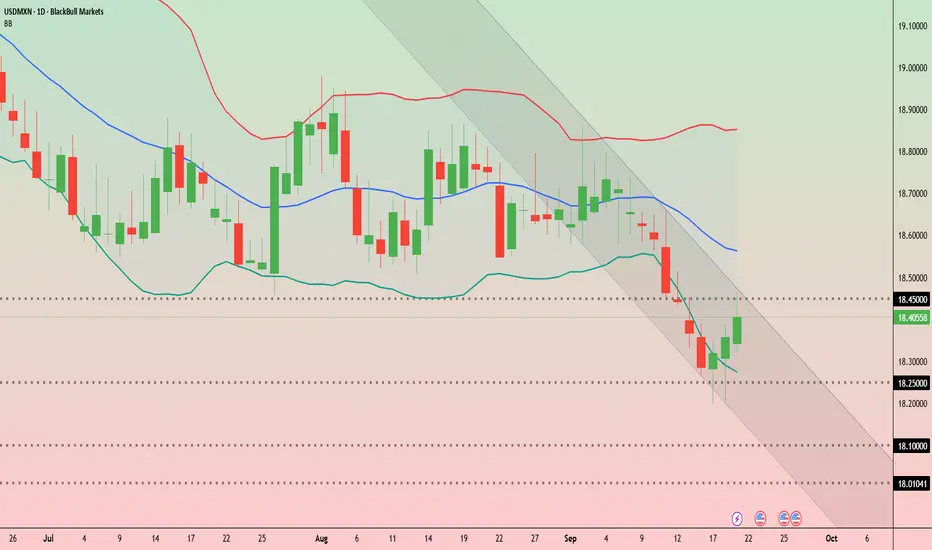
Peso resilience tested ahead of Banxico decision USD/MXN has staged a rebound after sliding to multi-week lows near 18.20. On the daily chart, price bounced off the lower Bollinger Band and is now testing the 18.40–18.45 zone.
This area also aligns with the upper boundary of the short-term descending channel that has guided the selloff through September.
A clean break above 18.45 could be the first sign of momentum shifting, opening the way toward 18.65 and the mid-Bollinger Band near 18.75. The broader trend, however, might still be bearish.
For now, support remains firm at 18.25–18.20. A failure to hold that floor could bring renewed pressure, exposing 18.10 and the psychological 18.00 level.
That technical setup frames the importance of Banxico’s upcoming decision. All 24 analysts surveyed by Reuters expect a 25-basis-point cut to 7.50%. While headline inflation has eased, August CPI data showed that core pressures are proving sticky, limiting the space for more aggressive easing.
Trade policy is also adding uncertainty. Mexico’s Economy Minister confirmed plans to lift tariffs on imported light vehicles and auto parts, raising duties on cars from Asia — particularly China — from 20% to 50%. These measures echo protectionist steps seen under the Trump administration and could complicate Mexico’s trade outlook at a sensitive time, adding volatility to peso trading.
For traders, the key question is whether the peso’s resilience will hold if Banxico delivers a cut as expected. With technical levels tightening around 18.25–18.45, the combination of policy tone and tariff rhetoric could be the catalyst for a decisive breakout or renewed downside.
USD/INR pullback possible, USD/MXN eyes 18.95 USD/INR surged from 86.30 to nearly 87.85 in just over a week, driven by U.S. President Donald Trump announcing plans to impose a 25% tariff on select Indian exports.
The latest 4H candles show signs of exhaustion, with price stalling near the highs and forming small-bodied candles with upper wicks—suggesting weakening bullish momentum. A break below 87.45 could trigger a deeper pullback toward 87.20. However, if price reclaims 87.65, bulls may attempt another push toward 87.85 or new highs.
USD/MXN reversed from its late July low near 18.48 and has been climbing steadily, reaching 18.85 after the U.S. agreed to extend its current trade deal with Mexico by 90 days.
The trend potentially remains bullish on the 4H timeframe, with higher lows and clean upward structure. Price recently broke above short-term resistance near 18.80 and is now retesting the zone. A successful hold above this area could open room for a move toward 18.95. Failure to hold 18.75 could lead to a corrective drop back toward 18.70.
Is Mexico's Peso at the Crossroads?The recent imposition of U.S. sanctions on three Mexican financial institutions - CIBanco, Intercam Banco, and Vector Casa de Bolsa - has ignited a crucial debate over the Mexican peso's stability and the intricate dynamics of U.S.-Mexico relations. Washington accuses these entities of laundering millions for drug cartels and facilitating fentanyl precursor payments, marking the first actions under new anti-fentanyl legislation. While these institutions collectively hold a relatively small portion of Mexico's total banking assets (less than 3%), the move carries significant symbolic weight and prompts a re-evaluation of the peso's outlook. The Mexican government, under President Claudia Sheinbaum, swiftly rejected the allegations, demanding concrete evidence and initiating its investigations, including the temporary regulatory intervention of CIBanco and Intercam to safeguard depositors.
Economically, the peso faces a nuanced landscape. Before the sanctions, the Mexican peso (MXN) demonstrated remarkable resilience, appreciating significantly against the dollar, bolstered by Mexico's comparatively higher interest rates and robust trade flows with the U.S. However, the recent divergence in monetary policy, with **Banxico** easing rates while the U.S. Federal Reserve maintains a hawkish stance, now presents a potential headwind for the peso. While analysts generally suggest limited systemic risk to Mexico's broader financial system from these targeted sanctions, the action introduces an element of uncertainty. It raises concerns about potential capital flight, increased compliance costs for other Mexican financial institutions, and a possible erosion of investor confidence, factors that could exert downward pressure on the peso.
Geopolitically, these sanctions underscore the escalating U.S. campaign against fentanyl trafficking, now intricately linked with broader trade and security tensions. President Donald Trump's past threats of punitive tariffs on Mexican imports - aimed at curbing drug flows - highlight the volatile nature of this bilateral relationship. The sanctions serve as a potent political message from Washington, signaling its resolve to combat the fentanyl crisis on all fronts, including financial pipelines. This diplomatic friction, coupled with the ongoing complexities of migration and security cooperation, creates a challenging backdrop for the USD/MXN exchange rate. While the U.S. and Mexico maintain a strong intergovernmental relationship, these pressures test the limits of their collaboration and could influence the peso's trajectory in the medium term.
2 reasons the peso rally may not be over The USD/MXN has fallen over 2.5% in the past five trading sessions, dropping below 19.9 per USD for the first time since November 2024.
Two key factors could be driving this move:
1.
Investor distrust in the U.S. dollar – Market confidence is weakening due to Trump’s inconsistent tariff threats and other unpopular policies.
In contrast, the Sheinbaum government’s kid-glove handling of Trump is securing favourable trade concessions.
2.
Attractive interest rate differential – With Banxico’s benchmark rate at 9.5%, the peso remains appealing for carry trades.
The Federal Reserve’s decision this week could widen this gap further. Last week’s subdued U.S. inflation data is helping to fuel speculation of earlier Fed rate cuts, which may continue to support the peso despite trade uncertainties.
QUICK LOOK AT A FEW INDICATORS AND INTEREST IN A SERIES?Quick overview testing out the upload from a browser on a ethernet connection computer vs wifi with the desktop downloaded app. Do you find value in this and want to make a regular series? Contact me if so and follow. Esp if your a developer and want to add some videos to your products, free, locked or paid. Im game. Platforms, customization and breaking down analytics is the life. Its what i enjoy and maybe you will too!
Thank you All,
DrawDownKing CME_MINI:ES1!
USD/MXN: Mexico plans response to US tariffs The White House confirmed a one-month exemption for autos under the USMCA (United States-Mexico-Canada Agreement), following President Trump’s 25% tariffs on Mexican imports.
The exemption has significant consequences for Mexico’s economy, with tariffs expected to add billions in costs for automakers that rely on Mexican production.
Mexican President Claudia Sheinbaum plans to discuss tariffs with Trump on Thursday, before her government announces countermeasures on Sunday.
Meanwhile, the MACD indicator initially showed a potential bullish signal as moving averages crossed upward. However, momentum appears to be fading, and the pair has yet to retest its February 3rd highs.
The Tariff War: America, Mexico, Canada, and China
Dear readers, my name is Andrea Russo, and I am a trader. Today, I want to talk to you about a significant shift that is shaking global markets: the United States has decided to freeze tariffs on Mexico and Canada, while China has introduced counter-tariffs. This strategic move is likely to have significant repercussions on international trade and global economic dynamics, with direct effects on currencies and the Forex market.
Freezing Tariffs on Mexico and Canada: A Change in Strategy?
Under the Biden administration, the United States has decided to freeze tariffs on Mexico and Canada, two vital trading partners. This move may seem like a de-escalation in the trade war, but it is actually an attempt to strengthen ties with neighboring countries, thus facilitating trade flow and stimulating the internal economy. With rising commodity prices and the ongoing energy crisis, Washington aims to avoid escalating tariffs that could further aggravate an already fragile economic situation.
A Strategic Choice in an Unstable World
Despite the good intentions, the global context remains uncertain. The decision to suspend tariffs is partly motivated by the need to slow down inflation and mitigate the negative effects on global supply chains, especially in North America. However, this could also be a signal that the United States is focusing on internal challenges before shifting its focus to a larger battle — the one with China.
China’s Response: Counter-Tariffs and Retaliation
On the other side, China has not delayed in responding by imposing new tariffs on U.S. goods, particularly in key sectors such as technology, agriculture, and automotive. These tariffs are expected to have a direct impact on U.S. companies that export to China but may also influence global trade dynamics. China has clearly made a strategic move, one that goes beyond economic revenge: it's a signal that Beijing is not willing to make concessions on an issue that is critical for its geopolitical standing.
Impact on Financial Markets and Forex
Now that we've outlined the key strategic moves, let's take a look at how these developments will affect financial markets, especially the Forex market. The combination of the potential tariff freeze on Mexico and Canada and the tightening tariffs on China will undoubtedly affect currency dynamics, creating both opportunities and risks for traders.
1. Impact on the U.S. Dollar (USD)
The dollar may be influenced in contrasting ways by these developments. On the one hand, the tariff freeze on Mexico and Canada could be positive for the dollar, as it may favor a stronger North American economy, stimulating trade flows and reducing uncertainty. In particular, sectors such as automotive, energy, and agriculture may benefit from lower costs.
On the other hand, tensions with China could continue to create geopolitical uncertainties, which historically have led to greater volatility in the dollar. In the event of escalation, the effect could be an increase in demand for safe-haven assets like gold and the Japanese yen, leading to a temporary weakness in the dollar.
Forex Trading Strategy:
If the tariff freeze leads to economic stabilization in North America, the dollar could appreciate against riskier currencies such as the Mexican peso (MXN) and the Canadian dollar (CAD). However, traders should monitor China's reactions, as an escalation could lead to a more significant dollar rally.
2. Impact on the Mexican Peso (MXN) and Canadian Dollar (CAD)
The tariff freeze on Mexico and Canada will likely have a positive impact on both currencies. These countries will benefit from reduced costs on goods exported to the United States, which could stimulate economic growth and improve the trade balance.
However, the situation remains delicate. If China continues with new tariffs, Mexico and Canada could be indirectly affected, as overall global uncertainty could reduce trade and slow down growth. Nevertheless, both countries could continue to see appreciation in their currencies against emerging market or riskier currencies.
Forex Trading Strategy:
If the Mexican peso and Canadian dollar appreciate, traders might consider going long on these currencies against others like the Brazilian real (BRL) or South African rand (ZAR), which tend to be more volatile and vulnerable to global crises.
3. Impact on the Chinese Yuan (CNY) and Emerging Market Currencies
The escalation of the trade war between the U.S. and China will have a direct impact on the Chinese yuan. If more counter-tariffs are imposed, the yuan could weaken further, particularly against the dollar. This weakening could also increase volatility in emerging market currencies as capital might seek safety in assets like the dollar or Japanese yen.
Another potential effect will be the increase in commodity demand, particularly for metals and energy, which could benefit currencies linked to the export of raw materials, such as the Australian dollar (AUD) and the New Zealand dollar (NZD).
Forex Trading Strategy:
Traders expecting a weakening of the yuan could consider short positions on the CNY against the dollar or other major currencies. Additionally, monitoring commodity price trends will be crucial, as they could provide leading indicators for currencies tied to their export.
Conclusion: A New Chapter in the Tariff War with Forex Impacts
In summary, the tariff war between the United States, Mexico, Canada, and China is entering a new phase that will have long-lasting effects on financial markets, especially on Forex. Currency fluctuations will be influenced by a combination of trade policies, geopolitical uncertainties, and global economic dynamics. Investors and traders need to prepare for a period of high volatility, closely monitoring the moves of key players and their repercussions on the currency markets.
In this environment, adopting a flexible and diversified strategy is crucial, ready to adapt to rapid and unpredictable developments. Forex, as always, offers great opportunities but also significant risks. The key will be to read between the lines of global economic policies and act with timing.
USD/MXN: Trump fears meet Banxico decision The USD/MXN should be an interesting pair to watch in the coming days.
October’s headline inflation in Mexico ticked up after two months of declines, yet analysts expect Banxico to proceed with a 25-basis-point rate cut this week regardless.
Last week’s volatile trading saw USD/MXN reach 20.80, as markets reacted to concerns over a second Trump presidency. His protectionist and immigration policies would place pressure on the peso.
However, for now, the pair’s uptrend may face hurdles. USD/MXN climbed to an intraday high of 20.57, but bullish momentum failed to break the year-to-date peak of 20.80, signaling possible resistance ahead.
USD/MXN: Sheinbaum Era Begins Mexico makes history today as Claudia Sheinbaum becomes the country’s first female president. With nearly 35.5 million votes—representing close to 60% of the electorate—Sheinbaum secured more votes than any president in Mexican history.
Since the election, the Mexican peso has declined by around 13%. Recent price action has moved sideways as markets assess Sheinbaum's economic policies.
However, traders anticipating a sharper selloff in USD/MXN may need to wait, as the pair potentially remains upwardly biased with the 20 Day and 50 Day EMA outlining possibly areas of support.
Peso Pressure Ahead of Major MXN Events Mexico's inflation data will be released Thursday morning, closely followed by the Central Bank of Mexico's interest rate decision in the afternoon.
July's headline inflation in Mexico is expected to have accelerated to its highest level in over a year, according to a Reuters poll. However, the core index is anticipated to continue its moderation.
Rising prices in July could complicate any plans for the central bank to lower its key interest rate this week. In late June, the central bank opted to keep its benchmark interest rate unchanged after a rate cut in March, the first since mid-2021 when it began its tightening cycle.
The Mexican Peso has extended its losing streak to four consecutive days against the US Dollar, marking ten losses in the last eleven sessions.
The currency closed above the psychological 19.00 level for two days, having surpassed the previous year-to-date high of 18.99. Market momentum could favor sellers, with the Relative Strength Index indicating overbought conditions. The immediate resistance might stand at the current year-to-date high of 20.22.
On the downside, a breach of the 19.00 support level could open the path to the August stumble close to 18.50, followed by the 50-day Simple Moving Average at 18.20.
Long on Mexican Pesos: Technical Indicators and Market AnalysisThe Mexican Peso has recently reached a Demand area that we have been monitoring for some time, and it has shown a strong rebound from this level. By examining technical indicators such as the Relative Strength Index (RSI) and Stochastic, we can observe that the Peso is currently in an oversold condition, suggesting a potential upward movement.
Furthermore, by analyzing the Commitment of Traders (COT) data, we see additional support for a bullish outlook. The seasonality trends of the Mexican Peso also align with this perspective, indicating that now is an opportune time to consider a long position.
Given these technical and seasonal indicators, we have decided to open a long position on this futures contract. The confluence of the oversold technical indicators, supportive COT data, and favorable seasonal trends provides a strong foundation for our bullish stance on the Mexican Peso.
✅ Please share your thoughts about Mexican Pesos in the comments section below and HIT LIKE if you appreciate my analysis. Don't forget to FOLLOW ME; you will help us a lot with this small contribution.
Crazy people making crazy claimsRecently news outlets have been reporting in 2 things about the US-Mexico relationship 1st is the super peso. 2nd is the lowering of interest rates in the USA. When looking at the news I saw multiple articles contradicting themselves. Saying things like "the mexican peso got stronger because of the rasing inflation" or as in this one where it says the "the advancment is atributed to the coments of Jerome Powell, which gave hope to rate cuts" as you can see in this one : elmanana.com.mx
Meanwhile you have this one which shows raising inflation in Mexico, which I have to admit it's true, the cost of living in mexico is rising. This means that every day the mexican peso es less able to afford goods or services.
www.msn.com
On the other hand with the united states' recent slight decrease in inflation has prompet the FED to be more inclined to realize a rate cut. This in order to boost the markets before the elections. This is very likely to excite the markets, as money from bonds will likely migrate to the stock market. Contrast this with Mexico where the central bank is claiming to reach it's inflation target by the end of 2025.
www.msn.com
For these people I have some basic economic facts they should be aware of. When you have rasing inflation your currency doen't apreciate it depreciates. Thats because you aren't able to afford buying as much with the same amount. Therefore if the inflation of you currency increases while the inflation on another currency decreases then the most likely outcome is that the decresing inflation currency will apreaciate in contrast to the other one. Aditionally if the US market begins to grow at a faster rate in contrast to the mexican market then the currency will also depreciate. Therefore saysing that the lowering of interest rates in the USA is good for the mexican peso is just insane.
Is the mexican index in danger?Even with great companies conforming this index, it's impossible to ignore the effect that Claudia Sheinbaum's victory had over the markets. It's shocking to see the pessimism of the markets after her victory. Unfortunately, this has now created an infliction point in the BMV:ME index. With no recent clear support, it could be possible for price to drop quite a bit more, opening great buying opportunities.
However, if price does not begin to reverse this trend soon, it's possible that we will test lower lows.
Fed keeps rates steady, Banxico up next The US Federal Reserve has kept interest rates steady at 5.25%-5.50% while continuing its balance sheet reduction as planned since May 2023.
In contrast, the Bank of Mexico (Banxico) might announce a rate cut tomorrow.
It's anticipated that Banxico could decrease its interest rate from 11.25% to 11%, potentially applying pressure on the Mexican peso. This could drive the USD/MXN rate closer to the 17.00 mark, diverging further from its 10-year low. Some Fib levels from its recent swing higher could also be some interesting, more assessable, targets
However, the possibility of a rate cut from Banxico is not guaranteed, given potential divisions within its Governing Council. Recent speeches by officials indicate a 3-2 split, with some members leaning towards a more accommodative approach, while others like Jonathan Heath and Irene Espinosa Cantellano favor a hawkish stance.
Top 7 inflation-induced trading opportunities this weekThis week, the focus of many traders will be on US inflation data, which will provide valuable insights into the Federal Reserve's monetary policy outlook.
The forecasts indicate a potential 0.2% increase in both headline inflation for December and the core rate. On an annual basis, the headline inflation rate is anticipated to rebound to 3.2% from November's five-month low of 3.1%. Meanwhile, the core rate is likely to ease to 3.9%, the lowest since May 2021. This crucial data will be released on Thursday.
In the midst of the US inflation focus, there are noteworthy inflation data releases from other countries, including Switzerland, Australia, Mexico, Brazil, China, India, and Russia. This diverse set of data presents many potential trading opportunities for USD pairs throughout the week:
Monday: Switzerland Inflation Rate
Tuesday: Australia Monthly CPI Indicator
Tuesday: Mexico Inflation Rate
Thursday: Brazil Inflation Rate (before US inflation data)
Thursday: China Inflation Rate (after US inflation data)
Friday: India Inflation Rate
Friday: Russia Inflation Rate
Valero Pipeline // BTFD Thesis:
This is a trade made by Senator Thomas Carper last month. Upon reviewing and doing my research, it seems the volume of one of the pipelines in the gulf of Mexico controlled by Valero Energy has has a significant increase in volume. Looks like a bullish year ahead for Valero!
Here are the levels I will be interested in.
Please note that this is a preliminary research and you should continue to do your own research (DYOR). Information about assets can change rapidly, and it's essential to stay updated with the most recent developments.
Notes on how I personally use my charts/NFA:
Each level L1-L3 and TP1-TP3 (Or S1-S3) has a deployment percentage. The idea is to flag these levels so I can buy 11% at L1 , 28% at L2 and if L3 deploy 61% of assigned dry powder. The same in reverse goes for TP. TP1: 61%, TP2:28% and TP3:11%. If chart pivots between TP's, in-between or in Between Sell levels these percentages are still respected. I like to use the trading range to accumulate by using this tactic.
Just my personal way of using this. This is not intended or made to constitute any financial advice.
This is not intended or made to constitute any financial advice.
FED Macro Situation Consideration:
All TP's are drawn within the context of a return to FED neutral policy. I do not expect these levels to be reached before tightening is over.
NOT INVESTMENT ADVICE
I am not a financial advisor.
The Content in this TradingView Idea is for informational purposes only, you should not construe any such information or other material as legal, tax, investment, financial, or other advice. Nothing contained within this idea constitutes a solicitation, recommendation, endorsement, or offer to buy or sell any securities or other financial instruments in this or in in any other jurisdiction in which such solicitation or offer would be unlawful under the securities laws of such jurisdiction.
All Content on this idea post is information of a general nature and does not address the circumstances of any particular individual or entity. Nothing in the idea/post constitutes professional and/or financial advice, nor does any information on the idea/post constitute a comprehensive or complete statement of the matters discussed or the law relating thereto. You alone assume the sole responsibility of evaluating the merits and risks associated with the use of any information or other Content on the idea/post before making any decisions based on such information.