Axis Bank | Gann Angle Intraday Case Study | 23 Mar 2023This idea demonstrates the Gann Angle (price–degree) method for identifying normal intraday price capacity and potential reversal zones using market geometry.
On 23 March 2023, Axis Bank opened with upward momentum.
The initial intraday low near ₹845 was selected as the 0-degree (0°) reference point, following standard Gann angle principles.
Using the Gann Angle projection, the 45-degree level was calculated at:
45° → ₹860
Price reached this 45-degree level around 10:30 AM, completing its normal intraday price capacity well before the 2:30 PM timing window.
As per Gann’s price–time relationship, early completion of a degree level often signals temporary exhaustion.
From this zone, Axis Bank reacted precisely and moved lower, offering a logical intraday downside move.
This case highlights how price–angle analysis can help traders anticipate reaction zones in advance, instead of responding emotionally to market fluctuations.
📌 Key Gann Angle Levels
0° → 845
45° → 860
🔍 Educational Insights
Gann Angles define price capacity
Time confirms strength or exhaustion
Early degree completion increases reversal probability
Structure > indicators
Disclaimer:
This chart is shared for educational and analytical purposes only and does not constitute trading or investment advice.
Community ideas
Axis Bank | Gann Square of 9 Intraday Case Study | 21 Apr 2023This idea illustrates how WD Gann’s Square of 9 helps identify normal intraday price capacity and high-probability reversal zones using price–time geometry.
On 21 April 2023, Axis Bank started showing downside momentum from the second 15-minute candle.
To measure the expected intraday decline, the day’s high near ₹873.85 was selected as the 0-degree (0°) reference point, following standard Gann methodology.
Using the Gann Square of 9, the stock’s normal intraday downside level was projected at:
45° → ₹858
Price reached the 45-degree level around 1:00 PM, completing its normal price capacity well before the ideal Gann timing window near 2:30 PM.
According to Gann’s time–price principles, early completion of a degree level often signals temporary exhaustion.
From this zone, Axis Bank reacted strongly and reversed upward, offering clean intraday recovery movement.
This case demonstrates how price geometry combined with time awareness can help traders define logical reaction zones, rather than relying on indicators or guesswork.
📌 Key Gann Levels
0° → 873.85
45° → 858
🔍 Educational Takeaways
Square of 9 defines price capacity
Time determines when reactions are likely
Early completion increases reversal probability
Structure > indicators
Disclaimer:
This idea is shared strictly for educational and analytical purposes only. It does not constitute trading or investment advice.
ICICI Bank | Gann Square of 9 Intraday Case Study | 06 Apr 2023This chart presents a classical WD Gann Square of 9 intraday setup, where price completed its normal capacity early in time, leading to a high-probability reversal.
On 06 April 2023, ICICI Bank started gaining upside momentum from the third 15-minute candle.
The intraday low at ₹875 was selected as the 0-degree (0°) reference point, following standard Gann methodology.
Using the Gann Square of 9, the stock’s normal intraday upside level was projected at:
45° → ₹890
Price reached the 45-degree level around 11:15 AM, which is significantly earlier than the ideal Gann time window near 2:30 PM.
As per Gann’s time–price relationship, early completion of a degree level often indicates temporary exhaustion.
The stock reacted precisely from this zone and reversed lower, offering clear intraday downside movement.
This case highlights how price geometry combined with time analysis helps traders identify logical reaction zones, rather than depending on indicators or assumptions.
📌 Key Gann Levels
0° → 875
45° → 890
🔍 Learning Points
Square of 9 defines price capacity
Time determines when that capacity becomes effective
Early completion = higher probability of reaction
Structure > indicators
Disclaimer:
This idea is shared for educational and analytical purposes only. It is not a trading or investment recommendation.
Global Market InsightsUnderstanding Trends, Risks, and Opportunities in a Connected World
Global markets today are deeply interconnected, dynamic, and influenced by a complex mix of economic, political, technological, and psychological factors. Understanding global market insights is no longer optional for investors, traders, policymakers, or businesses—it is essential. Whether one is investing in equities, commodities, currencies, bonds, or alternative assets, global developments shape price movements and long-term trends. This comprehensive overview explores how global markets function, the key drivers behind them, and how market participants can interpret insights to make informed decisions.
1. The Interconnected Nature of Global Markets
Modern financial markets operate as a single ecosystem. Events in one region often have ripple effects across the world. A change in U.S. interest rates can impact emerging market currencies, capital flows into Asia, commodity prices in Latin America, and equity valuations in Europe. Globalization of trade, cross-border capital movement, and digital trading platforms have accelerated this interdependence.
For example, supply chain disruptions in one country can raise inflation globally, affecting central bank policies elsewhere. Similarly, geopolitical tensions in energy-producing regions can trigger volatility across global equity and bond markets. Understanding this interconnectedness is the foundation of global market insight.
2. Macroeconomic Indicators as Market Drivers
Macroeconomic data plays a crucial role in shaping global market sentiment. Key indicators include GDP growth, inflation rates, employment data, trade balances, and consumer confidence. These data points help assess the health of an economy and influence investment decisions.
Inflation trends determine interest rate policies, which directly affect bond yields, equity valuations, and currency strength. Strong economic growth often boosts equity markets but may also raise concerns about overheating and tighter monetary policy. Weak growth, on the other hand, can push investors toward safe-haven assets like gold, government bonds, or reserve currencies.
3. Central Banks and Monetary Policy Influence
Central banks are among the most powerful forces in global markets. Institutions such as the U.S. Federal Reserve, European Central Bank, Bank of England, and Bank of Japan guide monetary policy through interest rates, liquidity measures, and forward guidance.
When central banks tighten policy by raising rates or reducing liquidity, borrowing costs increase, often pressuring equities and risk assets. Conversely, accommodative policies tend to support asset prices and encourage risk-taking. Market participants closely analyze central bank statements, meeting minutes, and policy signals to anticipate future moves.
4. Equity Markets: Regional and Global Perspectives
Global equity markets reflect both local fundamentals and international influences. Developed markets often offer stability, strong governance, and predictable earnings, while emerging markets provide higher growth potential but with increased volatility.
Sectoral trends also play a key role. Technology, energy, healthcare, financials, and consumer sectors respond differently to economic cycles. For instance, technology stocks may benefit from innovation-driven growth, while energy stocks are more sensitive to commodity prices and geopolitical developments. Global market insights require comparing regional performance, sector rotation, and valuation metrics across countries.
5. Commodities and Their Global Significance
Commodities are vital indicators of global economic health. Energy commodities like crude oil and natural gas reflect industrial demand and geopolitical risks. Metals such as copper signal economic expansion, while precious metals like gold act as safe havens during uncertainty.
Agricultural commodities are influenced by weather patterns, global demand, and trade policies. Changes in commodity prices affect inflation, trade balances, and currencies of commodity-exporting nations. Tracking global commodity trends provides insight into both economic momentum and risk sentiment.
6. Currency Markets and Capital Flows
Foreign exchange markets are the backbone of global finance. Currency movements reflect interest rate differentials, trade balances, economic strength, and geopolitical stability. Strong economies with higher interest rates tend to attract capital, strengthening their currencies.
Emerging market currencies are particularly sensitive to global risk appetite. During periods of uncertainty, investors often move capital into safe-haven currencies, while risk-on environments support higher-yielding currencies. Understanding currency dynamics is critical for international investors and businesses engaged in global trade.
7. Geopolitical Risks and Market Volatility
Geopolitical events are unpredictable yet powerful market movers. Trade wars, sanctions, military conflicts, elections, and diplomatic shifts can rapidly alter market expectations. These events often increase volatility and cause sudden repricing of assets.
Markets tend to dislike uncertainty. When geopolitical risks rise, investors reduce exposure to risky assets and increase allocation to safe havens. Long-term global market insights involve evaluating geopolitical risks not just as threats, but also as sources of opportunity when markets overreact.
8. Technology, Innovation, and Structural Change
Technological advancement is reshaping global markets at an unprecedented pace. Digital transformation, artificial intelligence, renewable energy, fintech, and automation are changing business models and investment landscapes. Countries and companies that lead innovation often attract long-term capital and outperform over time.
Structural changes such as demographic shifts, urbanization, and sustainability initiatives also influence long-term market trends. Investors who align with these global themes gain insights beyond short-term market noise.
9. Risk Management in a Global Context
Global markets offer opportunities, but they also carry risks—currency risk, political risk, interest rate risk, and systemic risk. Diversification across regions, asset classes, and sectors is a key strategy to manage uncertainty.
Understanding correlations between assets helps investors reduce downside risk during market stress. Global insights emphasize not only return potential but also resilience and capital preservation.
10. Interpreting Global Market Insights for Decision-Making
Global market insights are most valuable when they are translated into actionable strategies. This requires combining macroeconomic analysis, technical trends, fundamental research, and sentiment indicators. Successful market participants avoid emotional decisions and focus on data-driven, disciplined approaches.
Rather than reacting to headlines, informed investors assess whether global developments are cyclical, structural, or temporary. This perspective helps identify long-term opportunities while navigating short-term volatility.
Conclusion
Global market insights provide a comprehensive framework for understanding how the world’s financial systems operate and interact. In an era of constant information flow and rapid change, the ability to interpret global trends, anticipate risks, and recognize opportunities is a powerful advantage. By analyzing macroeconomic forces, central bank policies, geopolitical developments, and structural transformations, market participants can make smarter, more confident decisions. Ultimately, success in global markets depends not on predicting every move, but on understanding the bigger picture and adapting thoughtfully to an ever-evolving world.
Understanding Currency ConvertibilityWhat is Currency Convertibility?
Currency convertibility refers to the ease with which a country’s currency can be converted into foreign currencies without restrictions imposed by the government or central bank. When a currency is fully convertible, individuals, businesses, and investors can freely exchange it for another currency for any purpose—trade, travel, investment, or capital transfers.
For example, if an Indian exporter earns US dollars, currency convertibility determines whether and how easily those dollars can be converted into Indian rupees or reinvested abroad. Similarly, foreign investors assess convertibility before investing, as it affects their ability to repatriate profits and capital.
Why Currency Convertibility Matters
Currency convertibility is not just a technical financial concept; it has broad economic implications:
Facilitates International Trade
Convertibility allows exporters and importers to settle cross-border transactions smoothly, reducing friction in global trade.
Encourages Foreign Investment
Investors prefer countries where profits and capital can be freely repatriated, making convertible currencies more attractive.
Integrates Economies Globally
Convertibility helps integrate domestic financial markets with global markets, improving efficiency and competitiveness.
Signals Economic Confidence
A convertible currency often reflects confidence in a country’s economic fundamentals and monetary stability.
Types of Currency Convertibility
Currency convertibility is broadly classified into three main types:
1. Current Account Convertibility
This allows free exchange of currency for transactions related to trade in goods and services, remittances, interest payments, and tourism. Most countries, including India, have current account convertibility.
Example:
An Indian student paying tuition fees abroad or an exporter receiving payment in foreign currency falls under current account transactions.
2. Capital Account Convertibility
Capital account convertibility permits free movement of capital across borders for investments such as foreign direct investment (FDI), portfolio investment, real estate purchases, and loans.
This form is more sensitive because unrestricted capital flows can expose economies to volatility. Hence, many developing nations impose partial controls.
Example:
An Indian investor buying foreign stocks without limits would require full capital account convertibility.
3. Full Convertibility
A currency is fully convertible when both current and capital account transactions are unrestricted. Major global currencies like the US Dollar, Euro, British Pound, and Japanese Yen are fully convertible.
Partial vs Full Convertibility
Many emerging economies adopt partial convertibility as a balanced approach. Under this system:
Trade and service-related transactions are liberalized.
Capital flows are regulated through limits, approvals, or sector-specific controls.
This allows countries to enjoy the benefits of globalization while safeguarding against sudden capital flight and financial instability.
Advantages of Currency Convertibility
Boosts Trade and Exports
Easier currency exchange reduces transaction costs and improves competitiveness of exporters.
Attracts Foreign Capital
Convertible currencies signal openness and stability, attracting FDI and portfolio investments.
Improves Resource Allocation
Capital flows to sectors with higher returns, increasing overall economic efficiency.
Enhances Financial Market Development
Convertibility encourages deeper bond, equity, and forex markets.
Strengthens Global Integration
Countries with convertible currencies participate more actively in global financial systems.
Risks and Challenges of Currency Convertibility
Despite its advantages, currency convertibility also carries significant risks:
Capital Flight Risk
Sudden withdrawal of foreign capital during economic or political instability can destabilize the economy.
Exchange Rate Volatility
Free capital flows can lead to sharp currency fluctuations, affecting trade and inflation.
Loss of Monetary Control
Central banks may find it harder to control money supply and interest rates under full convertibility.
Exposure to Global Shocks
Global financial crises can quickly transmit to domestic markets through capital flows.
Speculative Attacks
Weak economies with open capital accounts may face speculative pressure on their currencies.
Currency Convertibility and Developing Economies
For developing countries, currency convertibility is a strategic decision rather than a binary choice. Gradual liberalization is often preferred to ensure:
Strong banking systems
Adequate foreign exchange reserves
Fiscal discipline
Stable inflation
India, for instance, adopted current account convertibility in the 1990s while cautiously liberalizing the capital account. This phased approach helped balance growth with stability.
Role of Central Banks and Governments
Central banks play a vital role in managing currency convertibility by:
Regulating foreign exchange markets
Managing reserves
Monitoring capital flows
Intervening during excessive volatility
Governments complement this by maintaining sound fiscal policies, regulatory oversight, and transparent financial systems.
Currency Convertibility in the Era of Globalization
With globalization, digital payments, and cross-border investments, currency convertibility has become even more relevant. However, recent trends show that even advanced economies may impose temporary controls during crises, highlighting that convertibility is dynamic and policy-driven rather than absolute.
Conclusion
Understanding currency convertibility is essential for grasping how modern economies function in a globalized world. It influences trade, investment, exchange rates, and financial stability. While full convertibility offers greater integration and efficiency, it also exposes economies to external risks. Therefore, the optimal level of convertibility depends on a country’s economic strength, financial maturity, and policy preparedness.
A well-managed convertibility framework—supported by strong institutions, prudent regulation, and sound macroeconomic policies—can serve as a powerful engine for sustainable growth and global economic participation.
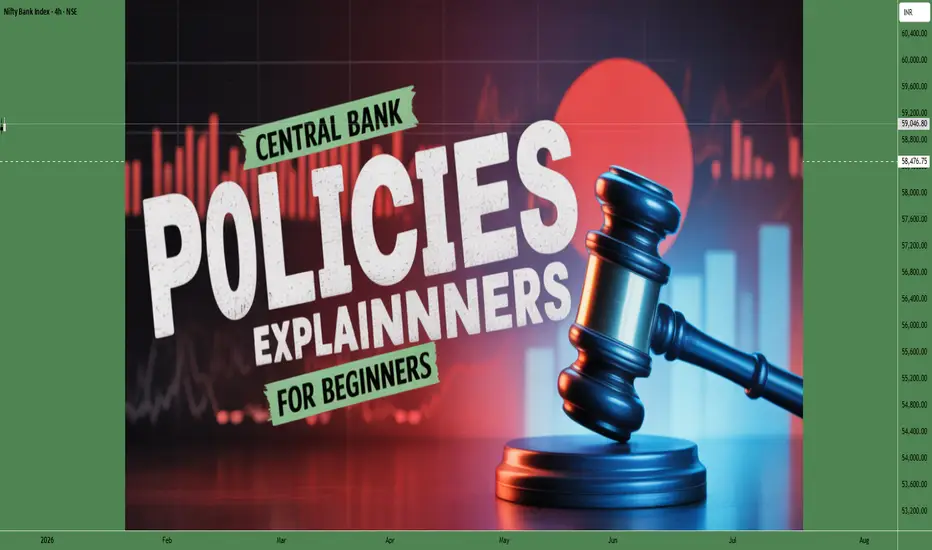
Central Bank Policies Explained for BeginnersWhat Is a Central Bank?
A central bank is the main monetary authority of a country. Examples include the Reserve Bank of India (RBI), Federal Reserve (USA), European Central Bank (ECB), and Bank of England. Unlike commercial banks, central banks do not deal directly with the public. Instead, they regulate banks, manage money supply, and guide the economy through policy decisions.
The central bank’s primary objectives usually include:
Price stability (controlling inflation)
Economic growth
Financial system stability
Employment support (in some countries)
Currency stability
Monetary Policy: The Core Tool
Central bank policies are mainly executed through monetary policy, which controls the supply and cost of money in the economy. Monetary policy is broadly divided into two types:
1. Expansionary Monetary Policy
This policy is used when the economy is slowing down or facing recession. The central bank increases money supply to encourage spending and investment.
Key features:
Lower interest rates
Cheaper loans
Increased borrowing by businesses and consumers
Boost to economic growth
Example: During an economic slowdown, the central bank may reduce interest rates so that businesses invest more and consumers spend more.
2. Contractionary Monetary Policy
This policy is used when inflation is too high. The central bank reduces money supply to control rising prices.
Key features:
Higher interest rates
Costlier loans
Reduced borrowing and spending
Inflation control
Example: When prices of goods rise rapidly, the central bank may increase interest rates to slow down excessive demand.
Key Central Bank Policy Tools
To implement monetary policy, central banks use several important tools:
1. Interest Rates (Policy Rates)
Interest rates are the most visible and powerful policy tool. In India, these include:
Repo Rate: The rate at which banks borrow money from the central bank.
Reverse Repo Rate: The rate at which banks lend excess funds to the central bank.
When the repo rate is reduced, banks can borrow cheaply and pass on lower rates to customers. When increased, borrowing becomes expensive.
2. Open Market Operations (OMO)
Open Market Operations involve buying or selling government securities in the open market.
Buying securities → increases money supply
Selling securities → reduces money supply
This tool helps control liquidity in the banking system.
3. Cash Reserve Ratio (CRR)
CRR is the percentage of deposits that banks must keep with the central bank in cash form.
Lower CRR → banks have more money to lend
Higher CRR → banks have less money to lend
4. Statutory Liquidity Ratio (SLR)
SLR requires banks to maintain a portion of deposits in safe assets like government bonds.
Lower SLR → more lending capacity
Higher SLR → tighter liquidity
5. Moral Suasion
This is an informal method where the central bank persuades banks to follow certain practices, such as reducing risky lending or supporting specific sectors.
Inflation Control and Price Stability
One of the most important roles of a central bank is controlling inflation. Inflation means a continuous rise in prices, which reduces purchasing power.
Central banks usually set an inflation target. If inflation goes above this target, contractionary policies are applied. If inflation falls too low (deflation risk), expansionary measures are used.
Stable inflation:
Protects savings
Encourages investment
Maintains economic confidence
Central Bank and Banking System Stability
Central banks act as the lender of last resort. When banks face liquidity problems, the central bank provides emergency funds to prevent bank failures and protect depositors.
They also:
Regulate and supervise banks
Set capital and risk guidelines
Ensure financial discipline
This role became especially important during financial crises, such as global recessions or banking failures.
Currency and Exchange Rate Management
Central banks manage the country’s currency and foreign exchange reserves. They may intervene in currency markets to prevent extreme volatility.
Strong currency → cheaper imports, controlled inflation
Weak currency → boosts exports but increases import costs
Balanced currency management helps maintain economic competitiveness and investor confidence.
Central Bank Independence
Most modern economies emphasize central bank independence, meaning the central bank can make policy decisions without political pressure. This independence helps ensure long-term economic stability rather than short-term political gains.
However, central banks still coordinate closely with governments, especially during crises.
Impact on Common People
Central bank policies directly affect everyday life:
Home loan and car loan interest rates
Fixed deposit and savings returns
Stock market and bond market movements
Employment and business growth
Inflation and cost of living
For example, when interest rates fall, EMIs become cheaper, but fixed deposit returns may decline.
Why Beginners Should Understand Central Bank Policies
For beginners in finance, trading, or investing, understanding central bank policies is crucial because:
Markets react strongly to policy announcements
Interest rate changes affect asset prices
Currency movements influence global trade
Long-term financial planning depends on monetary conditions
Even non-investors benefit by understanding why prices rise, why loans become expensive, or why the economy slows or accelerates.
Conclusion
Central bank policies may seem technical at first, but they are designed to balance growth, inflation, and financial stability. By adjusting interest rates, managing money supply, and regulating banks, central banks guide the economy through booms and downturns. For beginners, learning the basics of central bank policies builds a strong foundation for understanding economics, making smarter financial decisions, and navigating markets with confidence. Over time, this knowledge becomes a powerful tool in both personal finance and professional growth.
Master Correlation StrategiesTurning Market Relationships into Consistent Trading Edges
Correlation strategies are among the most powerful yet misunderstood tools in trading and investing. While many market participants focus only on price direction, correlation-based traders focus on relationships—how assets move relative to one another. When mastered, correlation strategies help traders reduce risk, improve timing, identify hidden opportunities, and trade with greater confidence across equities, commodities, currencies, bonds, and indices.
This guide explores the concept of correlation, its types, practical applications, advanced strategies, common mistakes, and how professional traders use correlation to gain a sustainable edge.
Understanding Correlation in Financial Markets
Correlation measures the degree to which two assets move in relation to each other. It ranges from +1 to -1:
Positive correlation (+1 to +0.5): Assets move in the same direction
Negative correlation (-1 to -0.5): Assets move in opposite directions
Zero or low correlation: No consistent relationship
For example:
Crude oil and energy stocks often show positive correlation
Gold and the US dollar often show negative correlation
Equity indices within the same country tend to be highly correlated
Correlation is not static. It changes over time due to economic cycles, liquidity conditions, policy decisions, and market sentiment. Master traders continuously monitor and adapt to these shifts.
Why Correlation Strategies Matter
Most traders lose money not because they are wrong on direction, but because they unknowingly take overlapping risk. Buying multiple highly correlated assets is essentially placing the same trade multiple times.
Correlation strategies help in:
Avoiding hidden overexposure
Improving portfolio diversification
Identifying early signals before price moves
Trading relative value instead of pure direction
Managing drawdowns during volatile markets
Professional traders think in terms of risk clusters, not individual trades—and correlation is the foundation of this thinking.
Types of Correlation Strategies
1. Intermarket Correlation Strategy
This strategy studies relationships between different asset classes such as equities, commodities, bonds, and currencies.
Examples:
Rising bond yields often pressure equity valuations
Strong US dollar impacts gold, crude oil, and emerging markets
Equity market weakness can drive capital into bonds or gold
By tracking one market, traders anticipate moves in another before they occur.
2. Pair Trading and Relative Strength Strategy
Pair trading involves taking long and short positions in two correlated assets, betting on the spread between them rather than market direction.
Example:
Long Stock A, Short Stock B when historical correlation breaks temporarily
Long outperformer, short underperformer within the same sector
This strategy works well in sideways or volatile markets and reduces market risk.
3. Sector Correlation Strategy
Stocks within the same sector often move together due to shared fundamentals.
Examples:
Banking stocks correlated with interest rate expectations
IT stocks correlated with currency movements
Metal stocks correlated with global commodity prices
Traders use sector correlation to confirm breakouts or detect false moves.
4. Index-to-Stock Correlation Strategy
Large-cap stocks heavily influence indices. When an index moves without participation from key stocks, the move may lack strength.
Examples:
NIFTY rising while major banking stocks lag
Index breaking resistance but heavyweight stocks failing
This divergence often signals upcoming reversals or consolidation.
5. Lead–Lag Correlation Strategy
Some assets move before others, acting as early indicators.
Examples:
Dow Jones leading global equity sentiment
US bond yields leading equity rotations
Copper leading economic growth expectations
Identifying leaders allows traders to position early with better risk-reward.
Correlation in Risk Management
Correlation is a risk control tool, not just a trade setup.
Key applications:
Avoid taking multiple trades with the same directional exposure
Balance portfolios with negatively correlated assets
Reduce drawdowns during market crashes
Allocate capital more efficiently
A portfolio with five uncorrelated trades is safer than ten correlated trades.
Correlation vs Causation: A Critical Distinction
One of the biggest mistakes traders make is assuming correlation means causation. Just because two assets move together does not mean one causes the other to move.
Correlation strategies must be combined with:
Fundamental context
Macro environment
Liquidity conditions
Technical confirmation
Without context, correlation signals can become misleading.
Advanced Correlation Techniques Used by Professionals
Rolling Correlation
Instead of static correlation, professionals use rolling correlation to track how relationships evolve over time.
Benefits:
Detects breakdowns early
Adapts to changing market regimes
Avoids outdated assumptions
Regime-Based Correlation
Correlations behave differently in:
Risk-on markets
Risk-off markets
Inflationary cycles
Recessionary phases
For example, during market crashes, correlations often increase as everything sells off together.
Volatility-Adjusted Correlation
During high volatility, correlations spike artificially. Adjusting for volatility prevents false signals and improves decision-making.
Common Mistakes in Correlation Trading
Treating correlation as permanent
Ignoring macro and policy shifts
Over-leveraging correlated positions
Using correlation alone without price action
Not updating correlation data regularly
Correlation strategies reward discipline and continuous observation.
How to Build a Master Correlation Trading Framework
Identify core assets you trade
Track historical and rolling correlations
Understand macro drivers behind relationships
Use correlation as confirmation, not prediction
Control position sizing across correlated trades
Reassess correlations during major events
Mastery comes from repetition, review, and adaptability.
Psychological Edge of Correlation Strategies
Correlation trading reduces emotional decision-making. Instead of reacting to noise, traders rely on structure and relationships.
Benefits include:
Increased confidence during volatility
Fewer impulsive trades
Better patience and discipline
Clearer risk assessment
Professional traders don’t chase moves—they wait for correlation alignment.
Conclusion: Correlation as a Market Language
Markets speak through relationships. Price is only one word in the sentence—correlation completes the meaning. Traders who master correlation strategies stop guessing and start interpreting the market.
By understanding how assets interact, lead, lag, diverge, and converge, correlation traders operate one step ahead of the crowd. In an era of global interconnected markets, correlation mastery is no longer optional—it is essential for long-term trading success.
Global Equity Markets Under Pressure: Causes and ConsequencesMacroeconomic Headwinds Driving Market Stress
One of the primary reasons global equities face pressure is the challenging macroeconomic backdrop. High inflation, tighter monetary policy, and slowing economic growth often converge to create an unfavorable environment for stocks. Central banks, led by the US Federal Reserve and followed by institutions such as the European Central Bank and the Bank of England, tend to raise interest rates to control inflation. While necessary, higher interest rates increase borrowing costs for businesses and consumers, reduce corporate profitability, and lower future earnings expectations. Since equity valuations are largely based on discounted future cash flows, rising rates directly weigh on stock prices.
In addition, uneven global growth adds to market uncertainty. While some economies show resilience, others struggle with weak consumption, declining exports, or fiscal constraints. China’s growth fluctuations, Europe’s energy-related challenges, and the cyclical slowdown in parts of the US economy collectively affect global investor confidence. When growth expectations fall, equity markets usually reprice lower.
Geopolitical Tensions and Global Uncertainty
Geopolitical developments play a major role in putting pressure on global equities. Conflicts, trade disputes, sanctions, and diplomatic tensions disrupt supply chains, increase commodity prices, and create uncertainty about future economic stability. Markets dislike uncertainty more than bad news; when the outlook becomes unclear, investors often reduce exposure to risk assets like equities and shift towards safer instruments such as bonds, gold, or cash.
Trade fragmentation and protectionist policies also impact multinational corporations. Many global companies rely on integrated supply chains and international markets for revenue growth. Any disruption or restriction increases costs and reduces margins, leading to downward revisions in earnings forecasts and, ultimately, lower stock prices.
Corporate Earnings Under Strain
Another key factor behind global equity pressure is the strain on corporate earnings. Rising input costs, higher wages, and expensive financing compress profit margins. Even companies with strong revenue growth may struggle to maintain profitability in such an environment. When quarterly earnings fail to meet expectations or forward guidance turns cautious, markets react swiftly and negatively.
Moreover, currency fluctuations add another layer of complexity. A strong US dollar, for example, can hurt companies that earn a significant portion of their revenue overseas, as foreign earnings translate into fewer dollars. Emerging market companies may also face higher debt servicing costs if they have dollar-denominated liabilities, further affecting profitability and investor sentiment.
Liquidity Tightening and Risk Appetite
Global equity markets thrive on liquidity. When central banks reduce liquidity through quantitative tightening or balance sheet reductions, the flow of easy money into financial markets slows down. Lower liquidity means fewer buyers at higher prices, making markets more sensitive to negative news. As a result, even small disappointments can trigger sharp corrections.
Risk appetite among investors also declines during such phases. Institutional investors, hedge funds, and retail participants become more selective, preferring quality stocks with strong balance sheets over speculative or highly leveraged companies. This shift often leads to broad market weakness, especially in high-growth sectors that depend heavily on future earnings.
Sectoral Impact and Market Rotation
Pressure on global equities does not affect all sectors equally. Technology and growth-oriented sectors are usually the most sensitive to rising interest rates because their valuations depend on long-term growth assumptions. Financials may face mixed outcomes, benefiting from higher interest margins but suffering from increased credit risk. Cyclical sectors such as metals, energy, and industrials often reflect concerns about slowing global demand.
At the same time, defensive sectors like healthcare, utilities, and consumer staples tend to outperform during periods of equity market stress. This sectoral rotation reflects investors’ attempts to preserve capital rather than chase high returns. However, even defensive stocks may not be immune if broader market sentiment turns deeply negative.
Emerging Markets and Capital Flows
Emerging market equities often experience amplified pressure during global risk-off phases. Capital tends to flow out of emerging economies and into developed markets perceived as safer. This outflow weakens local currencies, increases inflationary pressure, and forces central banks to maintain higher interest rates, further slowing economic growth.
Despite these challenges, emerging markets with strong fundamentals, improving reforms, and domestic demand-driven growth can show relative resilience. However, in the short term, global equity pressure usually leads to synchronized declines across most regions.
Investor Psychology and Market Volatility
Psychology plays a crucial role when global equities are under pressure. Fear, uncertainty, and negative headlines can create a self-reinforcing cycle of selling. As markets fall, investors worry about further losses and rush to exit positions, increasing volatility. Social media, algorithmic trading, and 24-hour news coverage amplify these reactions, making market moves sharper and faster than in the past.
However, such periods of stress also lay the groundwork for future opportunities. Valuations become more attractive, weak hands exit the market, and long-term investors can gradually accumulate quality assets at discounted prices.
The Road Ahead: Risks and Opportunities
While global equities remain under pressure, the future path depends on several key variables. Inflation trends, central bank policy decisions, geopolitical stability, and corporate earnings growth will determine whether markets stabilize or face further downside. Any sign of easing inflation, rate cuts, or improved global coordination can quickly boost investor confidence.
For investors, the focus should shift from short-term market noise to long-term fundamentals. Diversification across regions and asset classes, disciplined risk management, and patience become especially important during such phases. History shows that periods of equity market pressure, though uncomfortable, are a natural part of market cycles and often precede phases of recovery and growth.
Conclusion
Global equity markets under pressure reflect a complex mix of economic, political, and psychological factors. While the current environment may appear challenging, it is not unprecedented. Understanding the underlying drivers helps investors make informed decisions rather than emotional reactions. Ultimately, equity markets reward long-term discipline, and periods of stress often create the foundation for the next cycle of opportunity.
Why This Support Held | Market Pressure Explained #1🧠 WHO REALLY MOVES THE MARKET? (NZDJPY)
This chart is presented for educational purposes only and illustrates
how price movement can emerge from collective market participation ,
rather than from individual indicators or candlestick patterns in isolation.
📌 In this historical example, increasing market pressure developed through the alignment of multiple forms of participation , including:
• Reactions around support and resistance zones
• Structural price compression and expansion
• Pullback-related participation within existing structure
• Trendline-related price behavior
• Observed changes in participation intensity over time
🔥 When several forms of market participation overlap in the same direction,
price movement may expand as a result of accumulated pressure.
Candlesticks do not cause price movement.
They reflect past interactions between buyers and sellers.
🧠 This content focuses on understanding market structure and participation ,
not on predicting future price movement or suggesting actions.
📘 The instrument shown is used solely for explanatory and visual clarity .
Any application of these concepts should be aligned with individual responsibility, ethical considerations, and applicable religious or legal guidelines.
⚠️ DISCLAIMER
This content is provided strictly for educational and informational purposes only.
It does not constitute financial advice, trading instructions, or a recommendation to engage in any financial activity.
The author does not provide personalized guidance.
Any decisions made based on this material are solely the responsibility of the individual.
Why This Resistance Failed | Market Pressure Explained #1🧠 WHO REALLY MOVES THE MARKET? (CHFJPY)
This chart illustrates how price movement emerges from collective market participation ,
not from candlesticks in isolation.
📌 In this example, strong bullish pressure developed as a result of multiple participant behaviors aligning in the same direction , including:
📐 Participants reacting to support & resistance zones
📊 Participants observing chart formations
📉 Participants referencing Fibonacci-based price areas
🔄 Participants responding to pullbacks within structure
📈 Participants observing moving-average-related price behavior
🔥 When multiple forms of market participation overlap, price movement tends to expand.
Candlesticks do not cause price movement.
They reflect past interactions between buyers and sellers.
🧠 To understand market behavior more clearly, it is useful to focus on
who may be participating at different price areas , rather than treating indicators as standalone signals.
📘 This analysis is intended to explain market structure and price behavior , not to suggest specific actions.
If you’d like to continue exploring how market participation shapes price movement,
you can follow for future educational content.
⚠️ DISCLAIMER
This content is provided strictly for educational and informational purposes only.
It does not constitute financial advice, trading instructions, or a recommendation to engage in any financial activity.
The author does not provide personalized guidance.
Any decisions made based on this material are solely the responsibility of the individual.
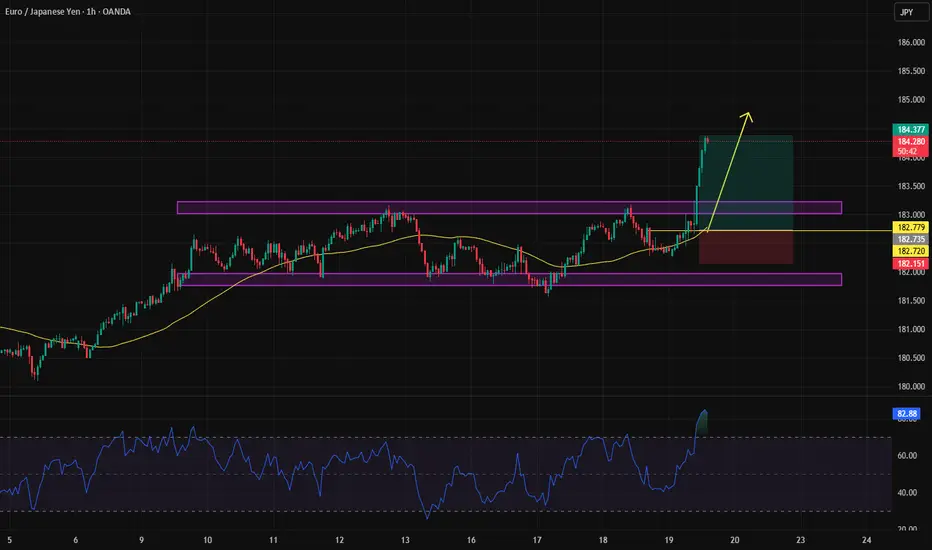
EURJPY-Educational TipEducational Tip: When price stays in a range for a long time, the probability increases that a whale (big player) will break it from one side. Look at this pair— what a great opportunity it was for an earlier entry into the position without missing the move.
The background trend is strongly bullish, and in the end, price couldn't even reach the channel bottom—this in itself is a signal for early entry. If we had entered at the point marked with the yellow line, we wouldn't have missed this move.
You might say, "It's easy to say this now that it's clear," but the truth is: with proper money management, there's no fear of getting stopped out.
Why We Think Retail Trader Exit Their Position | Smart MoneyThis video explains why retail traders often exit their positions early, especially on the first candle. The discussion focuses on how early volatility, emotional reactions, lack of structure clarity, and liquidity-driven price behavior can force premature exits. By observing first-candle behavior and market structure, the video highlights common mistakes that lead traders to exit before the market reveals its true intent.
The purpose of this video is to build awareness around early-session price behavior and help understand why retail traders struggle to hold positions—purely from an educational and price-action perspective.
How to Use Candlesticks in a High-Probability Way | Tutorial #4Candlesticks + Support & Resistance in a Downtrend (Context Matters)
In this part, we move beyond isolated candlesticks and place them into real market context.
This tutorial focuses on combining candlesticks with Support & Resistance within a downtrend , which is where high-probability setups are actually formed.
⚠️ Important note:
This part is slightly more advanced than the previous three tutorials.
If something on the chart is unclear, feel free to ask in the comments — I’ll do my best to answer everyone.
Don’t worry if it feels complex at first.
We are just scratching the surface — from here, the real trading logic begins.
Strongly recommended:
Review Tutorials #1–#3 first.
Each part builds on the previous one, and this structure will continue throughout the series.
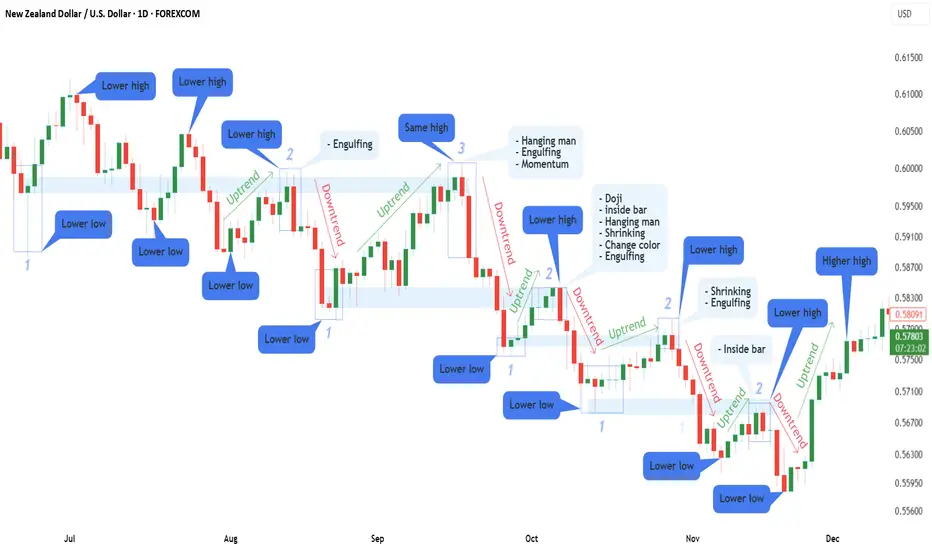
📌 Chart Explanation (NZDUSD Example)
I’m using NZDUSD again , the same pair from Part 1, to keep everything consistent and easier to follow.
On the chart, you can see:
1️⃣ Candlesticks
→ They show price reactions when reversals or rejections occur.
2️⃣ Support & Resistance Zones
→ Key areas where price previously reacted.
3️⃣ Numbers (1–3)
→ Represent multiple touches of support and resistance, increasing their importance.
4️⃣ Market Structure
→ Lower Highs + Lower Lows = Downtrend context
5️⃣ Directional Arrows
→ Visual guidance for trend direction and corrections.
🧠 Why Context Changes Everything
Up to now, we worked mainly with candlesticks and trend direction.
Now we add the most important missing piece for high-probability trading:
👉 Support & Resistance
Candlesticks do not create signals on their own.
They become powerful only when they appear at the right location within market structure.
(If Support & Resistance is not fully clear yet, I’ve already published Part 1 of that tutorial — feel free to ask in the comments, and I’ll gladly make Part 2.)
📈 Finding Trade Opportunities — Step by Step
(Using all 4 tutorials together)
1️⃣ Identify a downtrend
→ Lower highs & lower lows
2️⃣ Draw Support & Resistance zones
3️⃣ Wait for candlestick stacking
→ As explained in previous tutorials (clusters, sequences, pressure buildup)
🔥 Bonus Confirmation
If, after candlesticks stack together, you see:
an Engulfing candle , or
a Momentum candle
that’s a strong sign that buyers or sellers are stepping in aggressively.
This is where probability increases , not because of one candle — but because everything aligns.
🛡 Risk Management Reminder
No setup is guaranteed.
Always apply proper risk management and position sizing.
If you’re still learning or testing these concepts, it is strongly recommended to practice on a demo account first before risking real capital.
Trading is a process, not a shortcut to fast profits.
Focus on consistency, discipline, and execution — not outcomes.
🧠 Continuing the Series
If anything on the chart is unclear, feel free to ask in the comments — I’ll do my best to help.
This tutorial is part of a structured series where each part builds on the previous one.
Following simply helps you keep track of future lessons.
⚠️ DISCLAIMER
This content is for educational purposes only and does not constitute financial advice.
Trading involves risk — always conduct your own analysis.
I am not responsible for any decisions or losses based on this material.
The Hidden Signal of the Rectangle PatternWhat Is the Rectangle Pattern?
The Rectangle Pattern is one of the classic technical analysis patterns. It forms when the market enters a consolidation or ranging phase. Price moves between a horizontal support and a horizontal resistance, and the market hasn’t decided which direction to move yet.
🧠 Simple Concept
Buyers prevent price from dropping below support
Sellers prevent price from rising above resistance
Result: Price oscillates inside a horizontal box 📦
This phase usually happens before a strong move.
📐 Structure of the Rectangle Pattern
For the pattern to be valid, we usually need:
At least 2 touches on resistance
At least 2 touches on support
Lines should be mostly horizontal (not sloped)
🔄 Types of Rectangle Patterns
1️⃣ Continuation Rectangle (Most Common)
Forms after a strong trend
Market takes a breather 😮💨
After the breakout, the previous trend continues
📈 Uptrend → Breakout upward
📉 Downtrend → Breakout downward
2️⃣ Reversal Rectangle (Less Common)
Breakout happens against the prior trend
Requires strong confirmation
🚪 How to Identify a Valid Breakout?
A good breakout should have:
🕯 Candle close outside the range
📊 Increase in volume
🔁 Preferably a pullback to the broken level
⚠️ A wick-only breakout is not valid.
🎯 Price Target of the Rectangle Pattern
Very simple calculation:
Rectangle Height = Resistance − Support
Project the same distance from the breakout point.
📌 Example:
Support: 100
Resistance: 120
Height: 20
🔼 Bullish breakout → Target = 140
🔽 Bearish breakout → Target = 80
🛑 Stop Loss Placement
Bullish breakout 📈 → SL below former resistance
Bearish breakout 📉 → SL above former support
Or:
Behind the last swing high/low inside the rectangle
🧩 Role of Volume
Low volume inside the rectangle → Healthy consolidation ✅
High volume on breakout → Pattern confirmation 💪
Breakout without volume → Suspicious ❌
⏱ Best Timeframes
The pattern appears on all timeframes, but works best on:
1H
4H
Daily
⚠️ Very low timeframes = more fake breakouts
❌ Common Trader Mistakes
Entering before the breakout
Ignoring volume
No stop loss
Trading inside the box 😬
✅ Golden Tips for Success
Be patient and wait for the breakout 🧘
Always confirm with volume
Pullbacks offer the safest entries
Risk-to-reward should be at least 1:2
🧠 Professional Rectangle Trading Strategies
🎯 Entry Methods
1️⃣ Aggressive Entry
Enter immediately after breakout candle closes
Suitable for strong momentum markets
Higher risk, faster profit
📌 Best for experienced traders
2️⃣ Conservative Entry (Recommended)
Wait for pullback to the broken level
Enter after price confirmation
Higher win rate ✅
📌 Best choice for most traders
🧯 What Is a Fake Breakout & How to Avoid It?
A fake breakout happens when price briefly exits the rectangle and quickly returns inside 😵
Warning Signs:
❌ No volume
❌ No candle close outside the range
❌ Breakout against higher-timeframe trend
Professional Solution:
Wait for candle close
Confirm with Volume or RSI
Enter on pullback, not the first impulse
📊 Trade Management
🎯 Multi-Target Strategy
Instead of one target:
TP1 = 50% of rectangle height
TP2 = 100% of rectangle height
Trail the remaining position
📈 This reduces psychological pressure
🛑 Smart Stop Loss Techniques
Advanced methods include:
Above/below breakout candle
Behind VWAP or EMA 20/50
ATR-based stop (volatility-based)
🧩 Combining Rectangle Pattern with Other Tools
📉 With RSI
Bullish breakout + RSI above 50 → Strong confirmation
Divergence inside rectangle → Trend change warning
📈 With EMAs
Price above EMA 50 → Long bias
Price below EMA 50 → Short bias
📊 With Volume Profile
Breakout from High-Volume Area → More reliable
⏳ Higher Timeframe Analysis (Top-Down)
Before entering a trade:
Identify the higher-timeframe trend
Align the rectangle breakout with it
📌 Rectangle against the major trend = higher risk ⚠️
🧪 Real Trade Scenario Example
Overall trend: Bullish
Rectangle forms on 4H
Low volume inside the box
Bullish breakout with volume
Pullback to broken resistance
🎯 Long entry | SL below box | TP = rectangle height
❌ Even Pros Make These Mistakes
Overtrading inside ranges
Drawing the rectangle too wide
Ignoring major news events
Risking more than 1–2% per trade
✅ Golden Pre-Trade Checklist
☑️ At least 2 touches on support & resistance
☑️ Low volume inside the rectangle
☑️ Breakout with candle close
☑️ Aligned with higher-timeframe trend
☑️ Risk-to-reward ≥ 1:2
📌 Final Summary
The Rectangle Pattern means:
“The market is building energy” ⚡️
If you:
Stay patient
Filter fake breakouts
Follow proper risk management
This pattern can become one of the most reliable tools in your trading system 🚀
Risk Management Is Not Protection... It’s Your Edge!!!Most traders treat risk management like a seatbelt.
Something you use just in case.
🧳Professionals treat risk management as their main edge.
Because in trading, you don’t get paid for being right...
you get paid for staying in the game long enough for probabilities to work.
1️⃣ Risk Is Defined Before the Trade Exists
Before you think about entries or targets, one question must already be answered:
Where am I wrong?
If you don’t know where your idea fails,
you’re not managing risk... you’re hoping.
Professionals define risk first.
The trade only exists after invalidation is clear.
2️⃣ Small Risk Creates Big Freedom
When risk is small and predefined:
- hesitation disappears
- emotions calm down
- execution improves
Why?
Because no single trade matters anymore.
You stop needing trades to work, and that’s when trading becomes objective.
3️⃣ Risk Management Turns Losses Into Data
Losses are unavoidable.
Damage is optional.
A controlled loss is not a failure; it’s information.
Every loss tells you:
- the market condition wasn’t right
- the timing was early
- or the structure changed
When risk is managed, losses educate instead of punish.
4️⃣ Consistency Is Built on Risk, Not Wins
Winning streaks feel good.
They don’t build careers.
Surviving losing streaks does.
Proper risk management ensures:
- drawdowns stay shallow
- confidence stays intact
- discipline stays repeatable
That’s how traders last long enough to improve.
💡The Real Truth
You don’t need a better strategy.
You need better control over downside.
Risk management is what allows:
- imperfect strategies to work
- average win rates to grow accounts
- traders to evolve instead of quit
⚠️ Disclaimer: This is not financial advice. Always do your own research and manage risk properly.
📚 Stick to your trading plan regarding entries, risk, and management.
Good luck! 🍀
All Strategies Are Good; If Managed Properly!
~Richard Nasr
How Emotions Sneak Into Your Trades (and How to Catch Them)Because the market doesn’t care how you feel — but your portfolio absolutely does.
Every trader likes to believe they’re rational. Calm. Data-driven. A master of charts and probabilities.
And sometimes that’s true — at least until price starts moving faster than expected, your P&L flickers red, and suddenly you’re “just making a small adjustment.”
Emotions rarely kick the door down in trading. They sneak in quietly, wearing sensible shoes and carrying very reasonable arguments. By the time you notice them, they’ve already rearranged your trade plan.
🕵️ Emotion’s Favorite Disguise: Logic
The most dangerous emotions don’t announce themselves as fear or greed. They show up as logic.
“This breakout looks stronger than usual.”
“I’ll give it a little more room.”
“It’s only falling because of low volume.”
Each sentence sounds responsible. Each one is also a potential emotional leak. By the time the trade goes wrong, it feels like bad luck — not emotional interference.
📉 Losses Hurt More Than Gains Feel Good
Behavioral finance has a name for it: loss aversion. Traders experience losses maybe twice as intensely as equivalent gains.
That’s why a small drawdown can hijack your focus while a string of solid wins rarely registers as a lesson. It’s also why traders hesitate to close losing trades, but happily take profits early.
Emotionally, it feels safer to wait than to admit defeat — even when waiting is the riskier choice, especially if you’re deep into volatile crypto markets .
🧠 The Subtle Art of Revenge Trading
Revenge trading rarely looks dramatic. It doesn’t start with yelling at screens or slamming desks.
It usually begins with a quiet thought: “I’ll win the next one.”
That’s when trades get larger, setups get looser, and discipline takes a coffee break. The trader isn’t angry — they’re determined.
The market, unfortunately, doesn’t reward determination. It rewards discipline . Revenge trading isn’t about making money back. It’s about repairing a bruised ego — and markets have a way of charging interest for that.
🎢 Winning Can Be Just as Dangerous
Emotions don’t only sneak in during losses. They love winning streaks, too.
After a few good trades, confidence creeps up. Position sizes grow. Rules bend “just a little.” Suddenly, the trader isn’t following a system but a feeling.
This is how consistency quietly breaks down. Not in chaos, but in comfort.
🧰 Catching Emotions Before They Trade for You
The goal isn’t to eliminate emotion — that’s impossible. The goal is to spot it early, before it gets a vote.
Professional traders use simple, boring safeguards:
Repeating the same setups
Reviewing decisions away from the screen
Noting why a trade was taken, not just the result
Paying attention to behavior, not just outcomes
Emotion leaves footprints. The more familiar you are with your own patterns, the easier it is to catch them mid-step. “When you're centered, your emotions are not hijacking you.” - Ray Dalio.
🎁 The Takeaway
The real edge in trading comes from awareness — understanding how emotions quietly enter the process, recognizing their disguises, and catching them early before they influence your decisions.
Build that awareness, and emotions stop being obstacles — they become signals you know how to manage.
Off to you : How do you manage your emotions when you're trading? Share your strategy in the comments and let's get talking!
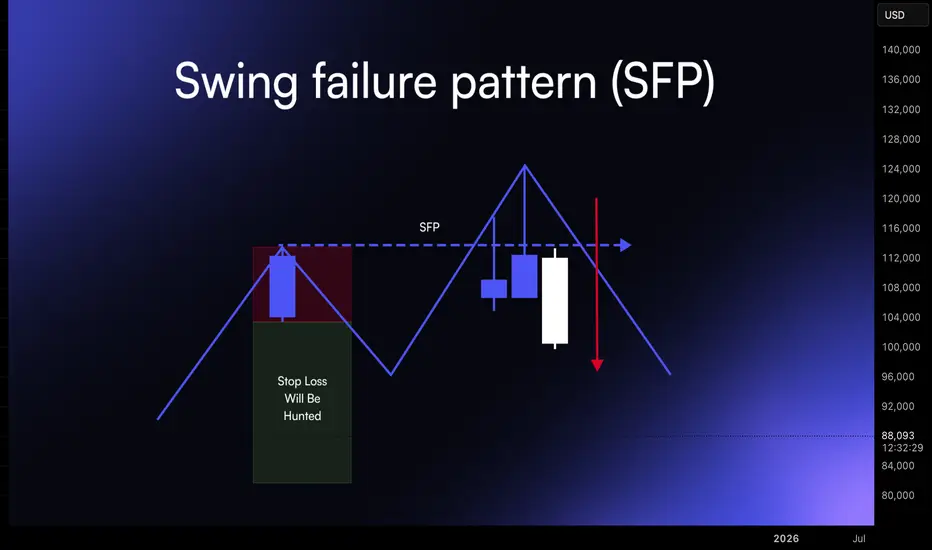
Swing Failure Pattern (SFP): When Price ReversesThe swing failure pattern is a liquidity event, not a candle pattern. It marks the moment when the market reaches for obvious stops, absorbs them, and reveals true intent.
An SFP forms when price trades beyond a well-defined swing high or low and then fails to hold acceptance outside that level. The extension triggers breakout entries and stop losses. The immediate rejection back inside the range confirms that the move was used to collect liquidity rather than to continue.
What the structure tells you
The key information is not the wick itself, but the context around it. The prior high or low must be obvious and widely watched. Equal highs, range extremes, or clean swing points carry the most liquidity. When price briefly breaks that level and closes back inside, the market signals that opposing orders have been filled.
This failure traps late participants. Breakout traders are positioned in the wrong direction, while stop losses from earlier positions have already been taken. That imbalance becomes fuel for the next move.
Why SFPs matter
SFPs often appear at major range boundaries or after extended directional moves. In ranges, they define the edges where reversals are most likely. In trends, they frequently mark local distribution or accumulation before a deeper retracement or full reversal.
The move after the SFP is usually cleaner than the move into it. Once liquidity is taken, price no longer needs to revisit the level. Structure shifts, momentum changes, and expansion follows away from the failed breakout.
How to use SFPs correctly
An SFP is not a signal by itself. It requires confirmation through acceptance back inside the range and alignment with higher-timeframe context. When combined with structure, it provides precise locations where risk can be defined tightly and intent is clear.
The market does not reverse because price touched a level. It reverses because liquidity was collected and the objective at that level was completed. The swing failure pattern is the footprint of that process.
XAU/USD potential breakLet's dive into the gold price analysis. Currently, gold is trading at $4327.27, having bounced off the $4300 support level. The big question is whether there's enough demand to push the price past the next target of $4350
Key Levels to Watch:
- Resistance: $4350 and $4349 as our point of interest
- Support: $4320
*Market Sentiment:
Traders are watching the Fed's rate cut decision, which could impact gold prices. Central banks have been accumulating gold, with over 1,000 tonnes purchased year-to-date, supporting the bullish outlook
Given the current price action, it's possible that gold could break past $4350 and head towards $4400 if the demand remains strong. However, it's essential to monitor the support levels and adjust your strategy accordingly
Market Phases Explained: Accumulation, Expansion, Distribution🔵 Market Phases Explained: Accumulation, Expansion, Distribution, Reset
Difficulty: 🐳🐳🐳🐳🐋 (Advanced)
Markets do not move randomly. They rotate through repeatable phases driven by liquidity, psychology, and participation. Understanding market phases helps traders stop forcing strategies and start trading in alignment with the current environment.
🔵 WHY MARKET PHASES MATTER
Most traders struggle not because their strategy is bad, but because they apply it in the wrong market phase.
Breakout strategies fail in accumulation
Mean-reversion fails during expansion
Trend-following fails in distribution
Reversal trading fails before reset is complete
Market phases explain when a strategy works, not just how .
Price action, indicators, and volume behave differently in each phase.
🔵 THE FOUR MARKET PHASES
Markets move in a repeating cycle:
Accumulation
Expansion
Distribution
Reset
Each phase has unique characteristics, risks, and opportunities.
🔵 1. ACCUMULATION (QUIET POSITIONING)
Accumulation occurs after a decline or prolonged sideways movement.
This is where smart money builds positions quietly.
Key characteristics:
Price moves sideways in a range
Volatility is low
Breakouts frequently fail
Volume is stable or slightly rising
What is really happening:
Large players accumulate positions without moving price too much. Liquidity is absorbed.
Indicator behavior:
RSI oscillates between 40 and 60
MACD hovers near the zero line
Volume spikes are quickly absorbed
Best strategies:
Range trading
Mean reversion
Patience and preparation
🔵 2. EXPANSION (TREND DEVELOPMENT)
Expansion begins when price breaks out of accumulation with conviction.
This is where trends are born.
Key characteristics:
Strong directional movement
Increasing volatility
Pullbacks are shallow
Breakouts follow through
What is really happening:
Accumulated positions are now leveraged. Momentum attracts participation.
Indicator behavior:
RSI holds trend zones (40–80 or 20–60)
MACD expands away from zero
Volume increases during impulse moves
Best strategies:
Trend-following
Pullback entries
Breakout continuation
🔵 3. DISTRIBUTION (QUIET EXITING)
Distribution occurs after an extended trend.
Price may still rise, but momentum starts to weaken.
Key characteristics:
Higher highs with weaker follow-through
Increased wicks and failed breakouts
Volatility becomes unstable
Late buyers get trapped
What is really happening:
Smart money distributes positions to late participants while maintaining the illusion of strength.
Indicator behavior:
RSI diverges or fails to make new highs
MACD histogram shows lower highs above zero
Volume spikes near highs
Best strategies:
Profit protection
Reduced position size
Waiting for confirmation of weakness
🔵 4. RESET (LIQUIDITY CLEARING)
Reset is when the previous trend fully unwinds.
This phase clears excess leverage and weak hands.
Key characteristics:
Sharp moves against prior trend
Stop-loss cascades
Emotional price action
High volatility without clear direction
What is really happening:
Leverage is flushed. Weak positions are forced out.
Indicator behavior:
RSI reaches extreme levels
MACD crosses zero decisively
Volume spikes dramatically
Best strategies:
Capital preservation
Waiting for stabilization
Avoiding prediction
🔵 HOW TO IDENTIFY THE CURRENT PHASE
Ask these questions:
Is price trending or ranging?
Are breakouts succeeding or failing?
Is momentum expanding or contracting?
Are indicators confirming or diverging?
No indicator works in all phases. Phase identification is the real edge.
🔵 COMMON MISTAKES
Forcing trend strategies during accumulation
Chasing breakouts during distribution
Trading reversals before reset completes
Ignoring momentum deterioration
Most losses come from being right about direction but wrong about phase.
🔵 CONCLUSION
Markets move in cycles because human behavior and liquidity move in cycles.
Accumulation builds positions
Expansion rewards patience
Distribution traps late entries
Reset clears the board
When you learn to identify market phases, you stop fighting the market and start working with it.
Which market phase do you find hardest to trade? Accumulation, expansion, distribution, or reset? Share your thoughts below.
Caution: Cash Levels Among Fund Managers Are at Record LowsAccording to the latest Global Fund Manager Survey conducted by Bank of America, the percentage of cash held by fund managers has fallen to 3.3%, the lowest level since 1999. In terms of asset allocation, historically low cash levels among managers have often coincided with peaks in equity markets. Conversely, periods when cash levels reached elevated zones were frequently precursors to major market bottoms and to the end of bear markets.
At a time when S&P 500 valuations are in an overextended bullish zone, this new historical low in cash holdings among managers therefore constitutes a signal of caution. Sooner or later, cash levels are likely to rebound, which would translate into downward pressure on equity markets. This reflects the basic principle of asset allocation between cash, equities, and bonds, with capital flowing from one reservoir to another. It is the fundamental mechanism of asset allocation: the reservoirs represented by cash, equities, and bonds fill and empty at the expense of one another.
This signal is all the more significant because such a low level of cash implies that managers are already heavily invested. In other words, the vast majority of available capital has already been allocated to equities. In this environment, the pool of marginal buyers shrinks considerably, making the market more vulnerable to any negative shock: macroeconomic disappointment, a rise in long-term interest rates, geopolitical tensions, or even simple profit-taking.
Moreover, historically low cash levels reflect an extreme bullish consensus. Financial markets, however, tend to move against overly established consensuses. When everyone is positioned in the same direction, the risk-reward balance deteriorates. In such cases, the market does not necessarily need a major negative catalyst to correct; the mere absence of positive news can sometimes be enough to trigger a consolidation.
It is also important to recall that the rise in the S&P 500 has been accompanied by an extreme concentration of performance in a limited number of stocks, mainly related to technology and artificial intelligence. In such an environment, a simple portfolio rebalancing or sector rotation can amplify downward moves.
Finally, the gradual return of cash typically does not occur without pain for equity markets. It is often accompanied by a phase of increased volatility, or even a correction, allowing a healthier balance to be restored between valuations, positioning, and economic prospects.
In summary, this historically low level of cash among fund managers is not a signal of an imminent crash, but it clearly calls for caution, more rigorous risk management, and greater selectivity within the S&P 500, in an environment where optimism appears to be largely priced in.
DISCLAIMER:
This content is intended for individuals who are familiar with financial markets and instruments and is for information purposes only. The presented idea (including market commentary, market data and observations) is not a work product of any research department of Swissquote or its affiliates. This material is intended to highlight market action and does not constitute investment, legal or tax advice. If you are a retail investor or lack experience in trading complex financial products, it is advisable to seek professional advice from licensed advisor before making any financial decisions.
This content is not intended to manipulate the market or encourage any specific financial behavior.
Swissquote makes no representation or warranty as to the quality, completeness, accuracy, comprehensiveness or non-infringement of such content. The views expressed are those of the consultant and are provided for educational purposes only. Any information provided relating to a product or market should not be construed as recommending an investment strategy or transaction. Past performance is not a guarantee of future results.
Swissquote and its employees and representatives shall in no event be held liable for any damages or losses arising directly or indirectly from decisions made on the basis of this content.
The use of any third-party brands or trademarks is for information only and does not imply endorsement by Swissquote, or that the trademark owner has authorised Swissquote to promote its products or services.
Swissquote is the marketing brand for the activities of Swissquote Bank Ltd (Switzerland) regulated by FINMA, Swissquote Capital Markets Limited regulated by CySEC (Cyprus), Swissquote Bank Europe SA (Luxembourg) regulated by the CSSF, Swissquote Ltd (UK) regulated by the FCA, Swissquote Financial Services (Malta) Ltd regulated by the Malta Financial Services Authority, Swissquote MEA Ltd. (UAE) regulated by the Dubai Financial Services Authority, Swissquote Pte Ltd (Singapore) regulated by the Monetary Authority of Singapore, Swissquote Asia Limited (Hong Kong) licensed by the Hong Kong Securities and Futures Commission (SFC) and Swissquote South Africa (Pty) Ltd supervised by the FSCA.
Products and services of Swissquote are only intended for those permitted to receive them under local law.
All investments carry a degree of risk. The risk of loss in trading or holding financial instruments can be substantial. The value of financial instruments, including but not limited to stocks, bonds, cryptocurrencies, and other assets, can fluctuate both upwards and downwards. There is a significant risk of financial loss when buying, selling, holding, staking, or investing in these instruments. SQBE makes no recommendations regarding any specific investment, transaction, or the use of any particular investment strategy.
CFDs are complex instruments and come with a high risk of losing money rapidly due to leverage. The vast majority of retail client accounts suffer capital losses when trading in CFDs. You should consider whether you understand how CFDs work and whether you can afford to take the high risk of losing your money.
Digital Assets are unregulated in most countries and consumer protection rules may not apply. As highly volatile speculative investments, Digital Assets are not suitable for investors without a high-risk tolerance. Make sure you understand each Digital Asset before you trade.
Cryptocurrencies are not considered legal tender in some jurisdictions and are subject to regulatory uncertainties.
The use of Internet-based systems can involve high risks, including, but not limited to, fraud, cyber-attacks, network and communication failures, as well as identity theft and phishing attacks related to crypto-assets.
A Strategic Approach to Profiting from Market InformationNews Trading Without Noise
In modern financial markets, news travels faster than ever. Economic data releases, central bank statements, corporate earnings, geopolitical developments, and even social media posts can move prices within seconds. While news creates opportunities, it also creates noise—misleading signals, emotional reactions, rumors, and short-term volatility that can trap unprepared traders. News trading without noise is the disciplined practice of extracting high-quality, actionable information from news while filtering out distractions, overreactions, and irrelevant data. This approach allows traders to participate in major market moves with clarity, confidence, and consistency.
Understanding the Difference Between News and Noise
Not all news is equal. Markets react strongly only to information that changes expectations. Noise, on the other hand, consists of repetitive commentary, speculative opinions, exaggerated headlines, and minor developments that do not materially alter fundamentals. For example, a central bank interest rate decision that deviates from expectations is meaningful news, while repeated media debates about possible outcomes before the announcement are often noise. Successful news traders focus on what is new, unexpected, and impactful, rather than what is loud or popular.
Noise is dangerous because it triggers emotional trading—fear of missing out (FOMO), panic selling, or impulsive entries. News trading without noise requires emotional detachment and a rules-based mindset, where decisions are driven by predefined criteria rather than instant reactions.
Focusing on High-Impact News Events
A noise-free news trading strategy begins with selectivity. Traders should focus only on high-impact, scheduled, and well-defined events such as:
Central bank interest rate decisions and policy statements
Inflation data (CPI, PPI), employment reports, and GDP figures
Corporate earnings from market leaders
Major geopolitical events that affect global risk sentiment
Low-impact data releases and speculative breaking news should be ignored unless they directly affect market expectations. By limiting attention to a small set of powerful events, traders reduce cognitive overload and improve decision quality.
Trading Expectations, Not Headlines
Markets move based on the gap between expectations and reality. A positive news headline does not always lead to rising prices if the market had already priced in better outcomes. News trading without noise means understanding consensus forecasts, market positioning, and sentiment before the event.
For instance, if inflation data comes in high but slightly below expectations, markets may rally despite inflation remaining elevated. Traders who focus only on the headline number may misinterpret the move, while those who analyze expectations understand the true driver. This expectation-based approach helps traders align with institutional flows rather than fighting them.
Using Price Action as the Final Filter
Price action is the most reliable filter against noise. Before acting on news, traders should observe how the market reacts in the first few minutes or hours. Strong, sustained moves with high volume often indicate genuine institutional participation, while sharp spikes followed by quick reversals usually signal noise-driven volatility.
News trading without noise does not mean reacting instantly. Instead, it means waiting for confirmation. Breakouts above key resistance levels, breakdowns below support, or continuation patterns after news provide clearer, lower-risk entry points. Letting price validate the news helps traders avoid false signals.
Timeframe Alignment and Patience
Many traders lose money by trading news on timeframes that do not match the event’s significance. Short-term scalping during major news releases is extremely risky due to slippage and whipsaws. Noise-free news traders often prefer higher timeframes—15-minute, 1-hour, or even daily charts—where the true impact of news becomes clearer.
Patience is critical. Not every news event needs to be traded immediately. Sometimes the best opportunity emerges hours or days later, once the market digests the information and establishes a clear trend.
Risk Management Over Prediction
A core principle of news trading without noise is accepting uncertainty. News outcomes are unpredictable, and even correct analysis can result in losses due to unexpected market reactions. Therefore, risk management is more important than prediction.
Traders should use predefined stop-loss levels, conservative position sizing, and avoid overexposure during high-volatility periods. Protecting capital ensures longevity and reduces emotional pressure, making it easier to stay disciplined and ignore noise.
Avoiding Media and Social Media Traps
Financial media and social platforms often amplify noise. Sensational headlines, conflicting expert opinions, and real-time commentary can distort perception and push traders into impulsive decisions. Noise-free traders limit exposure to such inputs, relying instead on primary data sources, official releases, and their own analysis frameworks.
Developing a personal trading plan and sticking to it is the best defense against external influence. When traders know exactly what they are looking for, irrelevant information naturally fades into the background.
Building a Structured News Trading Framework
To trade news without noise, traders should create a structured framework that includes:
A predefined list of tradable news events
Clear rules for pre-news preparation and post-news execution
Specific technical levels for confirmation
Strict risk management guidelines
This structure transforms news trading from reactive gambling into a professional, repeatable process.
Conclusion
News trading without noise is not about being the fastest or reacting to every headline. It is about clarity, selectivity, and discipline. By focusing on high-impact information, understanding expectations, waiting for price confirmation, and managing risk carefully, traders can turn news from a source of confusion into a powerful trading edge. In an age of information overload, the ability to filter noise is not just an advantage—it is a necessity for consistent success in financial markets.
Inflation, Recession Fears, and Geopolitical ConflictsSafe Haven Gold Trading:
Gold has long occupied a unique position in global financial markets as a safe haven asset—a store of value that investors turn to during periods of uncertainty. Unlike equities, which are closely tied to corporate earnings and economic growth, or fiat currencies, which are subject to monetary policy and inflation risk, gold derives its value from scarcity, durability, and universal acceptance. In times marked by rising inflation, looming recession fears, and escalating geopolitical conflicts, gold trading becomes especially significant as investors seek stability, capital preservation, and portfolio diversification.
Gold as a Hedge Against Inflation
Inflation erodes the purchasing power of money, reducing the real value of cash and fixed-income investments. When inflation rises sharply or is expected to remain elevated, investors often shift capital toward assets that historically maintain value over time. Gold is widely perceived as one such hedge. Its supply grows slowly and cannot be expanded easily by central banks, unlike paper currency, which can be created through monetary easing and deficit financing.
During inflationary periods, real interest rates—nominal rates minus inflation—often turn negative. When real yields fall, the opportunity cost of holding non-yielding assets like gold decreases, making it more attractive. Traders closely monitor inflation indicators such as consumer price indices (CPI), producer prices, and wage growth, as well as central bank signals regarding interest rates. Sustained inflation combined with accommodative monetary policy typically supports bullish gold trends.
For traders, inflation-driven gold movements offer opportunities across multiple time frames. Long-term investors may accumulate gold or gold-backed instruments as a strategic hedge, while short-term traders capitalize on volatility around inflation data releases and policy announcements.
Gold During Recession Fears and Economic Slowdowns
Recession fears often trigger risk aversion across financial markets. As economic growth slows, corporate profits decline, unemployment rises, and equity markets tend to weaken. In such environments, investors reduce exposure to risk assets and reallocate capital toward defensive instruments, including gold.
Gold’s appeal during recessions lies in its perceived stability and independence from economic cycles. While demand for industrial commodities may fall during downturns, gold demand often increases due to its role as a monetary and investment asset. Central banks may also respond to recessions with rate cuts, liquidity injections, and quantitative easing—policies that can weaken currencies and further support gold prices.
From a trading perspective, recession-driven gold rallies are often characterized by strong trends and momentum. Technical indicators such as moving averages, trend channels, and momentum oscillators are widely used to identify entry and exit points. Additionally, correlations play a crucial role: gold often shows an inverse relationship with equities and, at times, with the US dollar, making it a valuable tool for portfolio hedging during economic stress.
Geopolitical Conflicts and Crisis-Driven Demand
Geopolitical conflicts—wars, trade disputes, sanctions, and political instability—are among the most powerful drivers of safe haven demand for gold. Such events increase uncertainty, disrupt supply chains, and threaten global economic stability. When traditional financial systems appear vulnerable, gold’s status as a universally recognized asset becomes particularly valuable.
Historically, gold prices tend to spike during periods of heightened geopolitical tension. Even the risk or anticipation of conflict can drive speculative and hedging demand. Traders pay close attention to developments in major geopolitical hotspots, diplomatic breakdowns, and military escalations, as these events can trigger sudden price movements and increased volatility.
In conflict-driven markets, gold trading often requires swift decision-making and robust risk management. Prices may react sharply to news headlines, making stop-loss placement, position sizing, and disciplined execution essential. For experienced traders, such volatility can present lucrative opportunities, while for long-term investors, it reinforces gold’s role as insurance against extreme scenarios.
Role of Central Banks and Global Demand
Central banks are major players in the gold market and significantly influence long-term price trends. In recent years, many central banks—particularly in emerging economies—have increased gold reserves to diversify away from dependence on major reserve currencies. This structural demand provides a strong underlying support for gold prices, especially during periods of global financial fragmentation.
In addition to central banks, physical demand from jewelry, technology, and investment products such as exchange-traded funds (ETFs) shapes the gold market. During crises, ETF inflows often surge as investors seek quick and liquid exposure to gold, amplifying price movements.
Trading Gold as a Safe Haven Strategy
Safe haven gold trading involves more than simply buying during crises. Successful traders integrate fundamental analysis, technical analysis, and macroeconomic awareness. Fundamentals help identify the broader environment—such as inflation trends, monetary policy, and geopolitical risk—while technical tools guide precise trade execution.
Risk management is critical, as gold can experience sharp corrections even in bullish environments, particularly when markets shift toward risk-on sentiment or when interest rates rise unexpectedly. Diversification across instruments—spot gold, futures, options, and gold mining equities—allows traders to tailor exposure according to risk tolerance and market conditions.
Conclusion
Safe haven gold trading plays a vital role in navigating periods of inflation, recession fears, and geopolitical conflicts. Gold’s enduring value, limited supply, and global acceptance make it a powerful hedge against economic instability and financial uncertainty. Whether used as a long-term store of value or actively traded to capitalize on market volatility, gold remains a cornerstone asset in times of crisis. In an increasingly interconnected and unpredictable world, understanding the dynamics of safe haven gold trading is essential for investors and traders seeking resilience, protection, and strategic advantage in global markets.
Global Soft Commodity Trading: Dynamics and StrategiesUnderstanding the Global Soft Commodity Market
Soft commodity markets operate on a global scale, with production concentrated in specific regions and consumption spread worldwide. For example, coffee production is dominated by Brazil, Vietnam, and Colombia, while cocoa largely comes from West African nations such as Ivory Coast and Ghana. Sugar production is led by Brazil and India, whereas wheat and corn are heavily produced in the United States, Russia, and parts of Europe.
This geographical imbalance between producers and consumers makes international trade essential. Prices are generally discovered on major commodity exchanges such as the Chicago Board of Trade (CBOT), Intercontinental Exchange (ICE), and Euronext. These exchanges provide standardized futures and options contracts that allow producers, consumers, traders, and investors to hedge risk or speculate on price movements.
Key Drivers of Soft Commodity Prices
Soft commodity prices are influenced by a wide range of interconnected factors:
Weather and Climate Conditions
Weather is the single most important factor affecting soft commodities. Droughts, floods, cyclones, frost, and changing rainfall patterns can significantly impact crop yields. Climate phenomena such as El Niño and La Niña often cause global supply disruptions, leading to sharp price volatility.
Supply and Demand Dynamics
Changes in population, income levels, dietary habits, and industrial usage directly affect demand. For instance, rising coffee consumption in Asia or increased ethanol production boosting corn demand can alter global price trends.
Government Policies and Trade Regulations
Export bans, import duties, subsidies, and minimum support prices play a crucial role, especially in emerging economies. Policies in major producing countries like India, Brazil, or the United States can influence global supply availability and price stability.
Currency Movements
Since most soft commodities are priced in U.S. dollars, fluctuations in currency exchange rates impact international trade. A weaker dollar generally supports higher commodity prices, while a stronger dollar can suppress demand.
Logistics and Geopolitical Factors
Transportation costs, port congestion, trade routes, and geopolitical tensions can disrupt supply chains. Conflicts, sanctions, or shipping bottlenecks often translate into sudden price spikes.
Market Participants in Soft Commodity Trading
The global soft commodity market includes diverse participants, each with different objectives:
Producers and Farmers use futures contracts to hedge against adverse price movements and protect their income.
Processors and End Users such as food manufacturers and textile companies hedge to stabilize input costs.
Traders and Merchants act as intermediaries, managing storage, transportation, and arbitrage opportunities.
Speculators and Investors, including hedge funds and institutional investors, aim to profit from price movements and market trends.
Retail Traders increasingly participate through online platforms offering commodity derivatives and ETFs.
Trading Instruments and Strategies
Soft commodities can be traded through several financial instruments:
Futures Contracts are the most common, providing standardized exposure to commodity prices.
Options allow traders to manage risk with limited downside.
ETFs and ETNs offer indirect exposure for investors who do not wish to trade futures directly.
Spot and Physical Trading is mainly used by large commercial participants.
Successful soft commodity trading often relies on a blend of strategies:
Fundamental Analysis, focusing on crop reports, weather forecasts, acreage data, and inventory levels.
Technical Analysis, using price charts, trends, support-resistance levels, and momentum indicators.
Seasonal Trading, which takes advantage of recurring patterns related to planting and harvesting cycles.
Spread Trading, involving the price difference between related commodities or different contract months.
Risks and Volatility in Soft Commodity Markets
Soft commodities are known for high volatility due to their dependence on uncontrollable natural factors. Sudden weather changes or policy announcements can cause rapid price movements. Additionally, leverage in futures trading can amplify both profits and losses. Effective risk management through position sizing, stop-loss strategies, and diversification is essential for long-term success.
Another key risk is market uncertainty due to climate change, which has increased the frequency of extreme weather events. This has made price forecasting more challenging, increasing both risk and opportunity for traders.
Role of Emerging Markets and Sustainability
Emerging markets play a growing role in global soft commodity trading, both as producers and consumers. Rising incomes in Asia and Africa are driving demand for food commodities, while technological advancements are improving agricultural productivity.
Sustainability and ESG (Environmental, Social, and Governance) considerations are also reshaping the market. Ethical sourcing, carbon footprints, and sustainable farming practices increasingly influence investment decisions and trade flows. Certifications such as Fair Trade and organic labeling are becoming important price differentiators in global markets.
Future Outlook of Global Soft Commodity Trading
The future of global soft commodity trading is expected to be shaped by several long-term trends: climate variability, population growth, technological innovation in agriculture, and digitalization of trading platforms. Data analytics, satellite imagery, and AI-driven weather models are enhancing market transparency and decision-making.
At the same time, increased financial participation is likely to keep volatility elevated, offering both risks and opportunities. Traders who can combine strong fundamental understanding with disciplined technical execution will be better positioned to navigate these evolving markets.
Conclusion
Global soft commodity trading is a dynamic and multifaceted market that reflects the intersection of nature, economics, and finance. From coffee and cocoa to grains and sugar, these commodities are essential to everyday life and global trade. While the market carries significant risks due to volatility and uncertainty, it also offers substantial opportunities for informed and disciplined traders. A deep understanding of global supply chains, weather patterns, policy impacts, and market behavior is essential for success in the ever-evolving world of soft commodity trading.