Psychology
Learning from the losses.Hello, in this series i am going over all my losing trades and study each case to become a better trader! Feel free to join me.
GU: CSFR - poor (candle:size:flow:ratio)
GU: impatience,
USDCHF: Fib less than 50, CSFR poor
GBPCHF: narrow focus, long in short market, calling the bottom
EURUSD: CSFR poor, no engulfing, 61.8 disrespected - last fib in bullish trend.
Trusting Your System After a Losing StreakTrusting Your System After a Losing Streak
Welcome everybody to another educational article.
Today we are covering one of the hardest moments every trader, beginner, novice or pro will face:
“Trusting your system after a losing streak.”
This is where most traders ditch profitable systems not because the system failed, but because emotion took control and said “I am Losing with this”
Trusting your system after a losing streak is not about blind belief.
It is about understanding probability, psychology, and discipline.
What Is a Trading System?
A trading system is a set of clearly defined rules that control:
• Entries
• Exits
• Risk management
• Trade management
A system removes emotion and replaces it with structure.
An EDGE that works best for you.
What Is a Losing Streak?
A losing streak is a series of losing trades that occur within normal probability.
Losing streaks are not failure, they are a statistical reality in trading. (They are needed)
Profitable system experience drawdown.
Gaining Trust in a System:
Trust is not given it is built.
You build trust in a system by:
• Clearly defining system rules
• Back testing across different market conditions
• Forward testing in demo or small size
• Tracking performance over a large sample size
Testing proves that losses are part of the system not a sign is not broken.
When you have seen the data, losses stop feeling personal.
Losing Trust in a System
Traders lose trust in their system when emotion overrides logic.
This often happens when:
• A losing streak appears unexpectedly
• Results don’t match recent performance
• Social media shows others “winning”
• Patience runs out
Instead of reviewing data, traders:
• Change strategies weekly
• Mix systems together
• Add random indicators
• Chase the next “better” setup
This strategy-hopping resets progress and prevents mastery.
Maintaining Trust After a Losing Streak
Maintaining trust is purely mental.
You must control the urge to react emotionally.
Even when trades lose, you still benefit.
Every loss provides:
• More data
• More clarity
• More understanding of system strengths and weaknesses
Losing streaks often occur because:
• Market conditions change
• Volatility shifts
• Structure transitions
These periods allow you to adapt, refine, and improve your strategy.
Trading Is Not Judged Only by Money
We live in a world where success is measured by money.
Trading is different.
A trade is not defined by profit or loss, it is defined by execution.
As mentioned in previous posts:
Positive Wins vs Negative Wins
A positive win:
• Making money while following the plan
• Hitting a target and stopping for the day
A negative win:
• Hitting stop loss
• Accepting it
• Closing the platform
• Being done for the day
It may feel frustrating —
but discipline is strengthened.
That frustration is growth.
Losses Are Data, Not Failure
By following your rules even when you lose, you strengthen your system.
You did not receive a money return you received a data return.
That data:
• Refines your edge
• Improves your entries
• Strengthens your confidence
• Leads to long-term profitability
Every losing trade is an investment in future performance.
Losing streaks do not mean your system is broken.
They mean the system is being tested.
Trust is built through:
• Data
• Discipline
• Consistency
• Emotional control
Traders who survive losing streaks grow.
Traders who react emotionally reset themselves.
Trust the process.
Respect the data.
Stay disciplined.
That’s how profitable traders are made.
Are you trading price zones or just guessing lines?Ever watched price slam into some line on your chart, bounce like a rubber ball, and thought: “What kind of witchcraft is this?”
Relax, that “witchcraft” has a boring name - support and resistance.
In human words:
Support - zone below price where buyers usually wake up and say “cheap, I’m in”. Price often stops falling or bounces from there.
Resistance - zone above price where sellers say “enough, too expensive”. Price often stops rising or pulls back from there.
Key word here - zone. Not an exact pixel line you worship like a religion.
Let me give you 5 simple principles of trading from levels that I wish someone had yelled at me when I started.
1) Levels are crowds, not lines
A level is just a place where many traders are watching the same price. Limit orders, stop losses, take profits - all parked there. That’s why price reacts.
So don’t draw 10 lines like a spider web. Mark the area where reactions happened before and think in zones.
2) The stronger the history, the stronger the level
Good level has a backstory:
- price reversed there several times
- there were strong candles away from that zone
- it’s visible on higher timeframes (H4, D1)
One tiny bounce on M5 doesn’t make it “iron support”. That’s like calling someone your soulmate after one date.
3) Trade reaction, not prediction
Classic beginner mistake:
“Price is near support - I buy.”
My logic:
“Price is near support - I watch.”
I don’t care that price is approaching the level, I care how it behaves there:
- sharp wick and fast rejection
- volume spike
- several failed attempts to break
No reaction - no trade. Level is not a button, it’s just a potential battle zone.
4) Trend + level = your best friend
Buying support in an uptrend - you’re with the smart money.
Buying support in a downtrend - you’re that hero trying to catch a falling knife with bare hands.
Same level, totally different probabilities. I use levels with the trend for main entries, and against the trend only for small, tactical trades with tight stops.
5) Levels break - don’t marry them
Biggest trap: “It bounced 3 times, it MUST bounce again.”
No, it doesn’t. Sometimes level breaks, eats all stops, and keeps going.
I always have a simple plan:
- if level holds - I trade bounce
- if level breaks and fixes behind it - I trade in new direction
Price doesn’t “betray” you. It just doesn’t owe you anything.
Maybe I’m wrong, but most traders don’t lose on levels because “levels don’t work” - they lose because they fall in love with one line and ignore the actual price behavior.
Support and resistance are just places where crowd psychology leaves footprints. Learn to read those footprints - and suddenly the chart stops looking random and starts looking like a story. And that’s when trading levels becomes fun.
The Missing Skill After Entry: Staying AlignedMost traders learn how to enter.
Few learn how to stay aligned.
Entries are technical.
Execution is psychological.
What breaks most traders isn’t their strategy — it’s what happens after they’re in a trade:
• second-guessing
• over-managing
• fear of giving back profits
• impatience when price pauses
• breaking rules to “fix” discomfort
Alignment is what keeps execution clean:
• timeframe agreement
• session context
• predefined risk
• acceptance of outcome
When alignment is present, discipline becomes natural — not forced.
This chart isn’t about predicting price.
It’s about recognizing when you are aligned enough to execute your plan without interference.
Trade well.
Stay aligned.
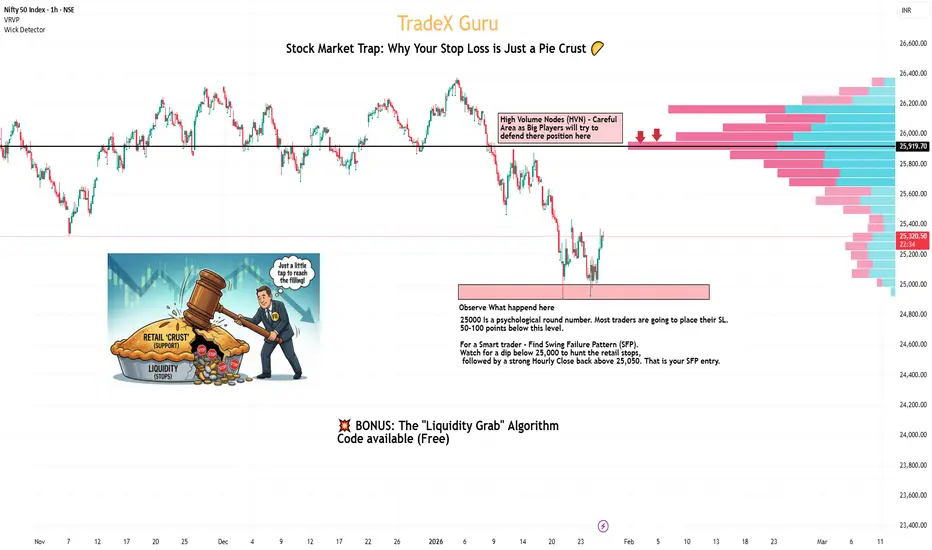
Stock Market Trap: Why Your Stop Loss is Just a Pie CrustIn the global theater of financial markets, many retail traders feel like protagonists in a psychological thriller. You identify a pristine support level, set your stop loss with surgical precision, and wait.
Suddenly, a violent candle "hunts" your level, triggers your exit, and—as if by magic—the market reverses and rallies in your original direction.
You feel watched. You feel targeted by "Operators."
This is not a conspiracy; it is the Sovereign Reality of Liquidity.
1. The Institutional Paradox: The "Big Fish" Problem
To understand why you are being hunted, you must understand the Inertia of Size.
Imagine a massive Institution (FII) attempting to deploy huge capital. They are like a Blue Whale in a shallow pond.
The Constraint: If they execute a market order, they will exhaust all available sellers and drive the price up against themselves (Slippage).
The Requirement: To enter a massive LONG position without slippage, they require an equally massive pool of Sell Orders at a specific price.
The Trap:
Your Stop Loss (on a Long position) is technically a Sell Market Order.
When thousands of retail traders place their stops at a predictable level, they create a Liquidity Cluster.
The Big Players don’t "see" your account; they see a concentrated pool of liquidity. They utilize algorithmic precision to drive price into that pool, "harvesting" your sell orders to fill their massive buy orders at a wholesale price.
2. The Analogy: The Fragile Crust
Think of Market Structure like a Pie or Samosa.
The "Support Level" is the golden, crispy crust. It appears solid.
But for the Smart Money, the crust is merely an obstacle to the filling (The Liquidity) inside.
They must break the crust (trigger the stops) to access the liquidity that fuels their move. Once the crust is shattered and the liquidity is absorbed, the shell is discarded, and the market rallies.
3. Engineering Your Edge
To evolve from "Retail Prey" to "Institutional Aligned," you must stop trading the lines and start trading the volume.
A. The Ceiling (High Volume Node) When price approaches a massive volume shelf from below, do not buy the breakout immediately. The trapped buyers from the past will sell to exit at breakeven. This is often a Shorting Zone.
B. The Floor (Liquidity Trap) When price drops into a historical volume cluster, do not panic sell.
The Professional Reaction: Wait for the "Crust" break (a dip below the level to hunt stops).
The Trigger: Watch for a strong 1-hour candle close back ABOVE the level. This is the Swing Failure Pattern (SFP).
🏛 Case Study: Nifty 50 Index
(Please refer to the chart image above)
We can see this mechanic playing out live on the Nifty 50:
The Operator's Fortress: Note the massive Volume Shelf (HVN) at the top. This acts as a supply zone.
The Psychological Level (25,000): This is a round number where most retail stops are hiding.
The Plan: We do not blind buy 25,000. We wait for the "Stop Hunt" into the 24,900 zone, followed by a sharp reclamation. That is the Institutional Entry.
💻 BONUS: The "Wick Detector" Script (Free)
I have written a custom Pine Script tool for the TradeX Guru community. This tool automatically highlights candles that "break the crust" (long lower wicks) and reject price.
@version=6
indicator("Wick Detector", overlay=true)
// Calculate the size of the lower wick relative to the body
wickRatio = (math.min(open, close) - low) / (high - low)
// Identify if the lower wick is > 50% of the candle (The Liquidity Grab)
isLiquidityGrab = wickRatio > 0.50
plotshape(isLiquidityGrab, title="Grab", location=location.belowbar, color=color.teal, style=shape.diamond)
// —————————————————————————————————————————————————————————————————————————————
// BRAND MARK
// —————————————————————————————————————————————————————————————————————————————
var table wMark = table.new(position.top_center, 1, 1)
if barstate.islast
table.cell(wMark, 0, 0, "TradeX Guru", text_color=color.new(#f5a733, 20), text_size=size.huge)
The Math: It measures the lower wick (the tail) of every candle.
The Trigger: If the lower wick is larger than 50% of the total candle size, it prints a Teal Diamond (💎) below that candle.
How to Learn Trade With It (The Strategy)
Do not buy every diamond you see. Use this 3-step filter:
Step 1: Check the Location (Context) Only look at the Diamond if it appears at a Key Level:
Is price at a strong Support zone?
Is price near a round number (like 25,000 on Nifty)?
If a diamond appears in the middle of nowhere, ignore it.
Step 2: The Signal
Wait for the candle with the Teal Diamond to close.
This confirms the "Stop Hunt" is finished. The "Whale" has absorbed the sellers.
Step 3: The Entry & Stop Loss
Entry: Buy on the next candle if it stays above the diamond candle's low.
Stop Loss: Place your SL just below the Low of the diamond candle. (If price breaks this low, the setup failed).
The Meaning: A long lower wick means sellers tried to push the price down (breaking the crust), but buyers aggressively pushed it back up. This is a classic Liquidity Grab.
The Axiom: The market is not a charitable organization. It is an efficiency engine designed to transfer capital from the Impatient to the Disciplined.
Disclaimer: This analysis is for educational purposes only and does not constitute financial advice. Trading involves significant risk.
The Investment Hierarchy: Focus On What Truly MattersThe Investment Hierarchy is my personal approach to investing in the market, and I want to share it with you today.
Many investors/traders mistakenly prioritize technical analysis, but that should actually come last.
The foundation of successful investing is trading psychology (patience and emotions), risk management, and fundamental analysis. These are what truly determine success.
🤔 Most people lose money investing… How do you avoid becoming one?
Without solid risk management, even the best technical analysis is useless. Poor risk strategies lead to big losses, which impatience and emotional trading make even worse.
Over 90% of short-term traders lose money. But long-term investors who focus on fundamental analysis significantly increase their profitability.
That's what my Investment Hierarchy is about: making decisions based on psychology, risk management, fundamental analysis, and technical analysis—in that order.
Master these, and you'll become a winning investor.
Henrique Centieiro Investment Hierarchy
😀😖 Patience and Emotions:
Be patient and aggressive only when it's time
Never revenge trade—stick to your strategy
Don't follow the crowd (if everyone won, everyone would be rich)
Keep emotions in check - don't trust your gut
Protect your emotional capital with a strategy that lets you sleep at night
Invest in businesses, don't trade them
⚠️ Risk Management:
Follow trends early, never bet against them
Longer time horizons = lower risk
Use position sizing as your best stop-loss
Diversify across at least 15 different investments
Understand risk/reward ratios and prioritize asymmetric bets
Rebalance and take profits regularly
🧑🏻💻 Fundamental Analysis:
Build a standardized research framework
Analyze quantitative factors
Research qualitative factors
Know the difference between price and value-invest in undervalued assets
📈 Technical Analysis:
Use TA as a supplementary tool only
Apply momentum indicators and moving averages to spot good entry/exit points
Understand market cycles through patterns and indicators
🧠 Conclusion
The Investment Hierarchy prioritizes psychology, risk management, and fundamentals before technical analysis.
Jumping straight to charts ignores market complexity. Real success comes from multiple factors, not just historical data.
This approach empowers you to make informed decisions, minimize losses, and optimize long-term gains.
Build your ship of knowledge to weather the storms! 🌊⛵🏝️
Behavioral Biases: Why Most Traders Make the Same MistakesHello, traders! 😎
Crypto markets may look chaotic, but they are driven by a single force: human psychology — the core of trading psychology. Every pump and dump is fueled by cognitive biases, fear and greed, and distorted decision-making under uncertainty, which is exactly why most traders end up repeating the same costly mistakes.
Fear-Driven Herding in a Sideways Market
Since late 2025, Bitcoin has spent months grinding sideways between roughly $80K and $97K, frustrating trend followers and wearing down traders who were betting on a clean breakout to new highs. Retail traders who bought panic dips often ended up selling into relief rallies — a textbook fear-and-greed cycle — while more seasoned players quietly rotated into BTC as a relative safe haven amid rising macro stress.
This wasn’t random price action; it was market psychology on full display . Those caught on the wrong side struggled to stay disciplined, letting emotion override their plans, chasing tops and dumping into support instead of executing a strategy.
Overconfidence and Risk Neglect Bias
Throughout 2025, futures markets were pushed to historic leverage extremes, only to be repeatedly wiped out by relentless volatility. Retail traders running 50× or even 100× got steamrolled when minor pullbacks triggered cascading liquidations. It was a brutal display of cognitive bias — especially overconfidence and optimism — as traders underestimated risk while wildly overestimating their edge, often blowing up their accounts in the process.
Hype-Driven Narrative Bias
The 2025–26 cycle has been littered with fiascos like the sudden collapse of “NYC Token” after its high-profile launch, wiping out speculative holders almost overnight. It wasn’t just a fundamental failure — it was a textbook case of behavioral finance bias: herd chasing and narrative addiction , where traders bought the story and ignored the absence of real underlying value.
Smart Money Anchoring Bias
From mid-2025 into 2026, institutional demand — driven largely by Bitcoin and altcoin ETFs — became one of the dominant forces shaping market structure. Record XRP ETF inflows pulled sidelined capital back into risk assets, pushing momentum traders to chase relief rallies without any real risk framework.
The irony is that professional money doesn’t chase highs the way retail does — but retail trader psychology tends to shadow institutional headlines, magnifying every move. Once ETF flows hit the mainstream narrative, FOMO breeds crowded positioning , turning yet another behavioral bias into a market-moving force.
News-Driven Anchoring Bias
Every macro headline — inflation prints, regulatory noise, or the latest Senate drama — becomes fuel for biased interpretation, amplified by emotions in trading and flawed decision making under uncertainty. Anchoring bias makes traders cling to whatever narrative they heard last: “Bitcoin is a safe haven” one week, “crypto is collapsing” the next.
When markets stop trending cleanly, traders swing between these extremes instead of relying on probability, structure, and risk management .
This macro-crypto feedback loop exposes how psychology drives risk appetite in often contradictory ways. Patterns keep repeating because people repeat the same mental errors — chasing price, overleveraging, anchoring to headlines, and letting emotion overrule strategy. Understanding that behavior is a far more powerful edge than any indicator.
This material is for informational purposes only and does not constitute trading or investment advice.
Finding Edge Where Others Aren't Looking
The Best Traders Aren't Just Looking at Charts Anymore
While most traders stare at the same charts, indicators, and news feeds...
A new breed of traders is counting cars in parking lots from space, tracking shipping containers across oceans, and analyzing millions of social media posts.
This is alternative data - and it's changing who has the edge.
What Is Alternative Data?
Definition:
Alternative data is any data used for investment decisions that isn't traditional financial data (price, volume, earnings, etc.).
Traditional Data:
Price and volume
Financial statements
Earnings reports
Economic indicators
Analyst ratings
Alternative Data:
Satellite imagery
Social media sentiment
Web traffic and app usage
Credit card transactions
Geolocation data
Weather patterns
Job postings
Patent filings
And much more...
Types of Alternative Data
1. Satellite and Geospatial Data
What It Tracks:
Retail parking lot traffic
Oil storage tank levels
Crop health and yields
Shipping and logistics
Construction activity
Example:
Count cars in Walmart parking lots before earnings.
More cars = more sales = potential earnings beat.
Edge: Information before it appears in financial reports.
2. Social Media and Sentiment Data
What It Tracks:
Brand mentions and sentiment
Product buzz
Consumer complaints
Viral trends
Influencer activity
Example:
Track sentiment around a new product launch.
Negative sentiment spike = potential sales disappointment.
Edge: Real-time consumer reaction before sales data.
3. Web Traffic and App Data
What It Tracks:
Website visits
App downloads and usage
Search trends
E-commerce activity
User engagement
Example:
Track app downloads for a gaming company.
Declining downloads = potential revenue miss.
Edge: Usage data before quarterly reports.
4. Transaction Data
What It Tracks:
Credit card spending
Point-of-sale data
E-commerce transactions
Consumer behavior patterns
Example:
Aggregate credit card data shows spending at restaurants declining.
Restaurant stocks may underperform.
Edge: Spending patterns before earnings.
5. Employment and Job Data
What It Tracks:
Job postings
Hiring trends
Layoff announcements
Glassdoor reviews
LinkedIn activity
Example:
Company suddenly posts many engineering jobs.
Could indicate new product development.
Edge: Corporate strategy signals before announcements.
6. Supply Chain Data
What It Tracks:
Shipping container movements
Port activity
Supplier relationships
Inventory levels
Logistics patterns
Example:
Track shipping from key suppliers to Apple.
Increased shipments before product launch = strong demand.
Edge: Supply chain signals before sales data.
How AI Processes Alternative Data
Challenge:
Alternative data is:
Massive in volume
Unstructured (images, text, etc.)
Noisy
Requires specialized processing
AI Solutions:
1. Computer Vision
Analyzes satellite imagery
Counts objects (cars, ships, tanks)
Detects changes over time
2. Natural Language Processing
Processes social media text
Extracts sentiment
Identifies trends and topics
3. Machine Learning
Finds patterns in transaction data
Predicts outcomes from alternative signals
Combines multiple data sources
4. Time Series Analysis
Tracks changes over time
Identifies anomalies
Forecasts future values
Alternative Data in Practice
Case Study 1: Retail Earnings
Satellite data shows parking lot traffic up 15% vs last year
Social sentiment for brand is positive
Web traffic to e-commerce site increasing
Prediction: Earnings beat
Result: Stock rises on earnings
Case Study 2: Oil Prices
Satellite shows oil storage tanks filling up
Shipping data shows tankers waiting to unload
Prediction: Supply glut, prices may fall
Result: Oil prices decline
Case Study 3: Tech Company
App download data shows declining engagement
Job postings show layoffs in key division
Social sentiment turning negative
Prediction: Guidance cut coming
Result: Stock falls on earnings
Alternative Data Challenges
Cost - Quality alternative data is expensive. Satellite data: $10,000-$100,000+/year. Transaction data: $50,000-$500,000+/year. Not accessible to most retail traders.
Signal vs Noise - Most alternative data is noise. Requires sophisticated processing. Easy to find false patterns. Overfitting risk is high.
Alpha Decay - As more traders use the same data, edge disappears. Popular datasets become crowded. Unique data sources are key.
Legal and Ethical Issues - Some data collection is questionable. Privacy concerns. Data sourcing legality. Regulatory scrutiny increasing.
Integration Complexity - Combining alternative data with trading is hard. Different formats and frequencies. Requires specialized infrastructure.
Alternative Data for Retail Traders
Accessible Options:
1. Social Sentiment Tools
Free or low-cost sentiment indicators
Twitter/X trending analysis
Reddit sentiment trackers
2. Google Trends
Free search trend data
Track interest in products/companies
Identify emerging trends
3. Web Traffic Estimators
SimilarWeb, Alexa (limited free tiers)
Estimate website traffic
Compare competitors
4. App Store Data
App Annie, Sensor Tower (limited free)
Track app rankings and downloads
Monitor mobile trends
5. Job Posting Aggregators
Indeed, LinkedIn trends
Track hiring patterns
Identify company direction
Building an Alternative Data Framework
Step 1: Identify Your Edge
What information would give you an advantage?
What do you trade?
What drives those assets?
What data could predict those drivers?
Step 2: Find Data Sources
Free sources first (Google Trends, social media)
Low-cost aggregators
Premium sources if justified
Step 3: Process and Analyze
Clean and structure the data
Look for correlations with price
Backtest any signals
Step 4: Integrate with Trading
How will you use the signal?
What's the trading rule?
How do you size positions?
Step 5: Monitor and Adapt
Track signal performance
Watch for alpha decay
Continuously improve
Key Takeaways
Alternative data provides information before it appears in traditional sources
Types include satellite imagery, social sentiment, web traffic, transactions, and more
AI is essential for processing unstructured alternative data at scale
Challenges include cost, noise, alpha decay, and integration complexity
Retail traders can access some alternative data through free or low-cost tools
Your Turn
Have you used any alternative data sources in your trading?
What unconventional information do you think could provide edge?
Share your thoughts below 👇
Why BTC Won't Crash to $50k (The 138.2% Rule)I want to share my full-view analysis of BTC today. Usually, I try to simplify my charts or translate them into standard Elliott Wave terms, but I feel like we might be at a 'moment of truth' here, so I’m going to stick to pure NeoWave and Ichimoku for this one, This idea tries to connect most of my previous ideas
It’s likely going to be a long read, and honestly, if you aren't interested in wave theory, this might not be for you. But for those who want to see what the deeper structure could be suggesting, let’s take a look.
The Big Picture: Supercycles
First, let's zoom all the way out. Based on the structure, it looks like Bitcoin has likely completed two major "Supercycles."
• Supercycle 1: Started way back in Nov 2011 and topped out around April 12, 2021.
• Supercycle 2: This was the corrective phase that followed which ended in November 2022
From my perspective, Supercycle 2 was a bit tricky. It actually failed the Time Similarity rule (it was too fast, lasting less than 1/3 of the time of the first wave). However, it passed on Price Similarity comfortably. The retracement was around 78%, which is well above the minimum needed. Because the price ratio is strong, I view this wave as acceptable despite the short duration.
The confirmation is seen November 2022. That’s when we broke the 2-4 trendline, which officially signaled that the Supercycle 1 correction (an Expanded Flat) was finished.
So, what does this mean for today? It suggests the rally we've seen since late 2022 is likely the start of Supercycle 3—specifically, we are looking at internal waves 1 and 2 of this new giant cycle.
Before we jump into the current setup, we need to quickly look at the popular Elliott Wave count that most people are following. I want to briefly explain why I think it might be flawed. We'll keep this part fast and short, just to clear the way for the actual analysis.
Let’s briefly test the common scenario most people are charting right now. The common view marks the move from Nov 2022 to Mar 2024 as a massive Extended Wave 1, followed later by Wave 3.
But when we look closer, the market physics tell a different story.
• Wave 1: Climbed roughly $58k, but it took a long 69 candles to do it.
• Wave 3: Climbed around $56k, but did it in just 25 candles.
Do you see the contradiction? Wave 3 covered almost the same ground but was nearly 3x more powerful in terms of speed and intensity. If Wave 1 was truly the "extended" leader, it shouldn't be outperformed so drastically by Wave 3.
The "Litmus Test" for a wave to be considered extended, it typically needs to dwarf the others—usually by at least 161.8%. Here, Wave 1 and Wave 3 are essentially the same size. When your motive waves are equal like this, it strongly suggests we aren't looking at a standard impulse pattern. The math simply doesn't support it.
Does that massive "Wave 1" actually subdivide into a clean 5-wave impulse? I checked the daily chart, and it fails the Degree Test.
• Wave 2: Lasted 23 candles.
• Wave 4: Lasted 153 candles.
Wave 4 took nearly 7x longer to correct the same amount of price. You cannot connect two waves with such a massive time imbalance and call them partners. The "impulse" theory simply breaks down when you zoom in.
Sticking to My Previous Analysis
I’m not trying to reinvent the wheel here. This is the exact same count I proposed in my previous analysis, and I haven't seen anything yet that changes my mind.
While the popular view has its merits, I’m sticking with this count simply because it passes the strict internal structure tests without having to force the rules.
• Wave 1: Nov 21, 2022 → Apr 10, 2023
• Wave 2: Apr 10, 2023 → Sep 11, 2023
• Wave 3: Sep 11, 2023 → Mar 11, 2024
• Wave 4: Mar 11, 2024 → Sep 02, 2024
• Wave 5: Sep 02, 2024 → Jan 20, 2025
• Major Correction: Jan 20, 2025 → Ongoing (Flat correction)
Unlike the other scenario, this count passes the Internal Structure Test. The waves are balanced, and the subdivisions are clean.
Why Jan 20, 2025 Was the Top ,The confirmation here is the 2-4 Trendline. We broke this line decisively around March 2025, once that line breaks, it confirms the entire 5-wave pattern is finished. This proves the subsequent rally to $126k wasn't a new impulse—it was just a corrective B-Wave in a flat pattern, also I reviewed the rally to 126k on 1D chart, from my view it’s a corrective pattern and not an impulse.
Ichimoku Evidence If you doubt the wave theory, look at the Ichimoku Base Line (Kijun-sen) on the weekly chart. It tells the real story of that rally to $126k.
From April to October 2025, the Base Line went completely flat.
• The Stat: It remained horizontal for 22 out of 27 weeks (81% of the time).
• The Reason: The calculation was "anchored" to the A-wave low ($74,434).
What This Means: In Ichimoku, a flat Kijun means the market is stuck in a range or equilibrium. Even though the price was rallying up to $126k, the math showed that the median equilibrium wasn't rising—it was pinned to the lows.
My view, that’s Flat behavior (specially B-wave). In a real trend, the equilibrium lifts with the price. Here, the price went up, but the structure stayed flat.
Combined with the fact that the upward speed (Velocity) was much slower than the drop in Wave A, this a major red flag, this was a corrective rally, not a new bull run.
This is where we have to look at the physics of the move.
• The Drop (Wave A): Fast, sharp, and velocity higher.
• The Rally (Wave B): Slower, grinding, and taking more time with a slower velocity.
Why This is a Major Red Flag In market theory, the "real" trend is usually the direction with the most speed. Impulse waves (the true trend) tend to move fast because everyone is rushing to the same side. Corrections (the counter-trend) tend to be slower and choppier because they are fighting the dominant flow.
While it is not a "god-given rule" that B-waves must be slower, when you see a rally that is significantly more lethargic than the drop that preceded it, it is a massive warning sign. It tells you that despite the green candles, the sellers are still stronger than the buyers. The "true" direction is likely still down.
The Million Dollar Question: How Deep?
Everyone seems worried that we are going to crash back down to $50k or $55k. But if we stick to the rules, I don't think that's happening.
I admitted before that was possible. But I need to make a correction.
What changed my mind? TIME. This drop moved too fast. Deep crashes usually drag out with a heavy feeling. This felt rushed. That intuition forced me to re-check.
The "138.2%" Rule The difference between a crash and a shallow bottom is the strength of the rally (Wave B).
• If Wave B is massive (> 138.2% of A), the pattern upgrades to an "Irregular Failure flat"
The Result: Our rally smashed that limit. This means the market is technically too strong to break the old lows. So, the $74,434 floor should hold. I am dropping the $50k target for now. Instead, I’m looking for a shallow bottom right here between $79k – $76.2k.
The Psychology of the pattern:
"Irregular Failure flat" sounds like a bad thing, but in reality, it is a sign of extreme strength.
Think of it like a Black Friday sale for a wildly popular product. You are standing in line waiting for the price to drop 50% so you can buy in cheap. But the demand is so crazy that people start buying the moment the price drops just 5%.
The crowd is so "hungry" that they don't let the price hit the clearance rack. They step in early.
That is exactly what a "Running Flat in elliott terms" is. It’s not just a chart pattern; it’s a map of impatience. It tells us the buyers are so aggressive that they aren't willing to wait for the deep discount everyone else is expecting.
A Final Word of Caution
However, let’s be real: These are not God's rules.
Markets are living things. Patterns break and structures shift all the time. If a major black swan event happens tomorrow—like a global conflict—and we smash through that $74k floor, the analysis changes. The whole rally from 2022 might turn into a complex correction (like a W-X-Y), and that is okay.
As traders, we don't predict the future with 100% certainty; we manage risk based on the structure we have right now. And right now, the structure says the bottom is close.
Summary & The Game Plan
So, to wrap this all up, here is what we are watching:
• The Target: We are waiting for C-5 for a bottom between $79k – $76.2k (Also there is a scenerio that C-5 might get truncated)
• The Invalidations: The absolute floor is $74,434 (Wave A low). If we break that or even wick near it, this specific "irregular failure flat" theory is dead, and we are likely dealing with a much larger, messier structure.
Where are we now?
We are currently forming a Running Triangle (Wave C-4). This typically signals the end is near—just one last leg down to go.
It looks like it's going to finish soon, unless it develops into something darker.
What Comes Next? The signal I am waiting for is a break of the 2-4 trendline (That’s when C-4 is confirmed finshed).
That might be the finish line. Once we smash through that line, it might confirm downtrend is over, But remember the break must be impulsive. It needs to be fast, strong, and convincing.
I will update you guys as soon as that breakout happens. If it doesn't... well, pretend you never saw this and just forget I exist.
A Note on Volatility (The BBWP Warning)
I also want to address the massive Weekly BBWP contractions I’ve flagged in most of my previous ideas.
I am sticking with the Supercycle theory. To me, this BBWP contractions is simply the "calm before the storm" right before Supercycle 3 kicks off. I fully agree with this outlook. it's coiling up for the next major move.
Also Technically, extreme contractions can signal a dangerous, higher-degree triangle or diagonal. That is the "darker" possibility, but I don't want to overcomplicate things today—that is a story for another time and I am not even considering it at the moment.
Drawdown Psychology: How to Survive When Everything Goes WrongEvery Trader Will Face Drawdowns. Most Won't Survive Them Psychologically.
You've been trading well. Account is growing. Confidence is high.
Then it starts. One loss. Then another. Then a streak.
Suddenly you're down 15%. Then 20%. The strategy that was working isn't anymore.
This is the moment that defines your trading career. Not the wins - the drawdowns.
What Is a Drawdown?
Definition:
A drawdown is the decline from a peak in your account equity to a subsequent low.
Calculation:
Drawdown % = (Peak - Trough) / Peak × 100
Example:
Account peaks at $100,000
Falls to $80,000
Drawdown = ($100,000 - $80,000) / $100,000 = 20%
Key Insight:
Drawdowns are inevitable. Every strategy, every trader, every fund experiences them.
The Psychology of Drawdowns
Stage 1: Denial
"This is just a normal losing streak. It'll turn around."
Behavior: Continue trading normally, maybe even increase size to "make it back."
Stage 2: Frustration
"Why isn't this working? What's wrong with the market?"
Behavior: Start questioning strategy, looking for external blame.
Stage 3: Desperation
"I need to make this back. I'll try something different."
Behavior: Abandon strategy, chase trades, increase risk.
Stage 4: Capitulation
"I can't do this anymore. Trading doesn't work."
Behavior: Stop trading entirely, often at the worst possible time.
Stage 5: Recovery (If You Survive)
"I understand what happened. I can rebuild."
Behavior: Return to process, reduced size, systematic approach.
The Math of Recovery
The Brutal Truth:
10% drawdown → Need 11% to recover
20% drawdown → Need 25% to recover
30% drawdown → Need 43% to recover
40% drawdown → Need 67% to recover
50% drawdown → Need 100% to recover
60% drawdown → Need 150% to recover
70% drawdown → Need 233% to recover
80% drawdown → Need 400% to recover
90% drawdown → Need 900% to recover
The Implication:
Large drawdowns are nearly impossible to recover from.
A 50% drawdown requires 100% gain just to break even.
This is why drawdown management is more important than profit maximization.
Drawdown Survival Framework
Rule 1: Expect Drawdowns
Before you start trading, know:
What is the maximum historical drawdown of your strategy?
What drawdown can you psychologically handle?
What drawdown would make you stop trading?
If your strategy's expected max drawdown exceeds what you can handle, reduce size until it doesn't.
Rule 2: Pre-Define Your Response
Write down BEFORE drawdowns happen:
At 10% drawdown, I will: ___________
At 20% drawdown, I will: ___________
At 30% drawdown, I will: ___________
Example responses:
Reduce position size by 25%
Take a 1-week break
Review all trades for pattern
Consult accountability partner
Rule 3: Separate Process from Outcome
During drawdowns, ask:
Am I following my rules?
Is my execution correct?
Is this normal variance or something broken?
If process is correct, the drawdown is just variance. Stay the course.
If process is broken, fix the process - not by chasing.
Rule 4: Reduce Size, Don't Increase
The instinct during drawdowns: "I need to make it back, so I'll size up."
This is the path to ruin.
The correct response: Reduce size during drawdowns.
Smaller losses = slower bleeding
Less emotional pressure
More time to assess and adjust
Rule 5: Take Breaks
Continuous trading during drawdowns leads to:
Emotional exhaustion
Revenge trading
Poor decision making
Scheduled breaks allow:
Emotional reset
Objective review
Fresh perspective
AI-Assisted Drawdown Management
1. Automatic Size Reduction
AI reduces position sizes when drawdown thresholds are hit.
10% drawdown → 75% normal size
20% drawdown → 50% normal size
30% drawdown → 25% normal size or pause
2. Strategy Performance Monitoring
AI tracks whether drawdown is:
Within historical norms
Exceeding expected parameters
Showing signs of strategy breakdown
3. Emotional State Detection
AI monitors trading behavior for signs of tilt:
Increased trade frequency
Larger position sizes
Deviation from rules
4. Automated Circuit Breakers
AI enforces:
Daily loss limits
Weekly loss limits
Mandatory cooling-off periods
Drawdown Mistakes
Increasing Size to Recover - "I need to make it back faster." Result: Larger losses, deeper drawdown, potential ruin. Reduce size during drawdowns, not increase.
Abandoning Strategy Mid-Drawdown - "This strategy doesn't work anymore." Result: Switch to new strategy at worst time, miss recovery. Evaluate strategy on full cycle, not during drawdown.
Revenge Trading - "I'll show the market." Result: Emotional trades, poor decisions, deeper losses. Take breaks, follow rules, reduce size.
Hiding from the Numbers - "I don't want to look at my account." Result: No awareness, no adjustment, continued bleeding. Face the numbers, but with a plan.
Comparing to Others - "Everyone else is making money." Result: FOMO, strategy hopping, emotional decisions. Focus on your process, not others' results.
Drawdown Recovery Protocol
Phase 1: Stabilize (Immediate)
Reduce position sizes by 50%
Take 2-3 day break from trading
Review recent trades objectively
Phase 2: Assess (Week 1)
Is drawdown within historical norms?
Are you following your rules?
Is the strategy still valid?
Phase 3: Adjust (Week 2)
If process issue: Fix the process
If market issue: Adapt or wait
If strategy issue: Consider modifications
Phase 4: Rebuild (Ongoing)
Gradually increase size as performance improves
Don't rush back to full size
Celebrate process adherence, not just profits
Drawdown Checklist
During any drawdown:
Is this drawdown within expected parameters?
Am I following my trading rules?
Have I reduced position sizes?
Have I taken a break to reset emotionally?
Do I have a written plan for this drawdown level?
Am I avoiding revenge trading?
Have I talked to an accountability partner?
Key Takeaways
Drawdowns are inevitable - every trader experiences them
The math of recovery makes large drawdowns nearly impossible to overcome
Pre-define your response to drawdowns BEFORE they happen
Reduce size during drawdowns, never increase
Separate process from outcome - if process is correct, stay the course
Your Turn
What's the largest drawdown you've experienced?
How did you handle it psychologically?
Share your drawdown survival strategies below 👇
Why Every Profitable Trader Keeps a JournalThe Difference Between Traders Who Improve and Those Who Don't? A Journal.
Every professional trader I've met keeps a journal.
Every struggling trader I've met doesn't.
This isn't coincidence. It's causation.
A trading journal transforms random experiences into systematic improvement. Without it, you're just gambling with extra steps.
Why Journaling Works
The Problem Without a Journal:
Same mistakes repeated
No idea what actually works
Feelings override facts
No feedback loop for improvement
The Solution With a Journal:
Patterns become visible
What works is documented
Data replaces feelings
Continuous improvement becomes possible
The Science:
Writing forces clarity. Reviewing creates awareness. Data enables optimization.
What to Track
Essential Data (Every Trade):
1. Trade Details
Date and time
Symbol
Direction (long/short)
Entry price
Exit price
Position size
2. Risk Parameters
Stop loss level
Take profit target
Risk amount ($)
Risk percentage (%)
3. Results
Profit/Loss ($)
Profit/Loss (%)
R-multiple (profit ÷ initial risk)
Win/Loss
4. Setup Information
Strategy/setup name
Timeframe
Market conditions
Reason for entry
Advanced Data (Recommended):
5. Execution Quality
Did you follow your rules?
Entry timing (early/on-time/late)
Exit timing
Slippage
6. Psychological State
Confidence level (1-10)
Emotional state before trade
Emotional state during trade
Any urges to deviate from plan
7. Market Context
Overall market direction
Volatility level
News/events
Sector performance
8. Screenshots
Chart at entry
Chart at exit
Annotated analysis
Journal Metrics to Calculate
Performance Metrics:
Win Rate = Winning Trades / Total Trades
Average Win = Total Profits / Winning Trades
Average Loss = Total Losses / Losing Trades
Profit Factor = Gross Profits / Gross Losses
Expectancy = (Win Rate × Avg Win) - (Loss Rate × Avg Loss)
Average R-Multiple = Total R / Total Trades
Process Metrics:
Rule Adherence = Trades Following Rules / Total Trades
Execution Score = Trades with Good Execution / Total Trades
Emotional Deviation Rate = Emotional Trades / Total Trades
Journal Analysis Framework
Weekly Review:
Total trades taken
Win rate for the week
Total P&L
Best and worst trades
Rule adherence score
Lessons learned
Monthly Review:
Performance vs expectations
Strategy breakdown (which strategies worked?)
Time analysis (best/worst times to trade)
Psychological patterns
Areas for improvement
Goals for next month
Quarterly Review:
Overall performance assessment
Strategy evaluation (keep/modify/discard)
Risk management review
Goal progress
Major lessons
Plan adjustments
AI-Enhanced Journaling
1. Automatic Data Capture
AI can automatically log:
Trade executions from broker
Entry/exit prices
Position sizes
Timestamps
2. Pattern Recognition
AI analyzes your journal to find:
Which setups perform best
What times you trade best
Which market conditions suit you
Emotional patterns affecting performance
3. Performance Attribution
AI breaks down returns by:
Strategy
Time of day
Market condition
Position size
Holding period
4. Predictive Insights
AI identifies:
When you're likely to make mistakes
Which trades to avoid
Optimal position sizing based on conditions
Performance degradation signals
5. Automated Reporting
AI generates:
Daily summaries
Weekly performance reports
Monthly analytics
Custom dashboards
What Your Journal Reveals
Pattern 1: Time-Based Performance
"I lose money in the first hour of trading."
→ Solution: Don't trade the first hour.
Pattern 2: Setup Performance
"Breakout trades have 30% win rate, pullback trades have 60%."
→ Solution: Focus on pullback trades.
Pattern 3: Emotional Patterns
"After a big win, my next trade is usually a loss."
→ Solution: Take a break after big wins.
Pattern 4: Size Impact
"Larger positions have worse performance."
→ Solution: Reduce position sizes.
Pattern 5: Market Conditions
"I perform well in trending markets, poorly in ranging."
→ Solution: Reduce trading in ranging markets.
Journaling Mistakes
Only Logging Winners — Selective memory makes you feel good but teaches nothing. Log every trade, especially losers.
Not Reviewing — A journal you never read is just a diary. Schedule weekly and monthly reviews.
Too Much Detail — Overwhelming detail leads to abandonment. Start simple, add complexity gradually.
Only Tracking Results — P&L alone doesn't tell you why. Track process metrics, not just outcomes.
Inconsistent Logging — Gaps in data make analysis impossible. Log immediately after every trade.
Getting Started
Week 1: Basic Logging
Log every trade with essential data
Don't worry about analysis yet
Build the habit
Week 2-4: Add Context
Include screenshots
Note emotional state
Record market conditions
Month 2: Begin Analysis
Calculate basic metrics
Do first weekly review
Identify one pattern
Month 3+: Optimize
Refine based on findings
Add advanced metrics
Implement AI tools if available
Key Takeaways
A trading journal transforms random experience into systematic improvement
Track both results (P&L) and process (rule adherence, emotions)
Review regularly — weekly, monthly, quarterly
AI can automate data capture and reveal hidden patterns
The journal is only valuable if you actually use it to change behavior
Your Turn
Do you currently keep a trading journal?
What's the most valuable insight you've discovered from reviewing your trades?
Share your journaling approach below 👇
How Overconfidence Destroys Profitable TradersHow Overconfidence Destroys Profitable Traders
Understanding Overconfidence in Trading
Welcome everyone to another article.
One of the most dangerous stages a trader can walk into is not fear… but overconfidence. (EGO)
Overconfidence in trading is essentially ego.
However, there is still an important difference:
- Confidence is a real belief built on proof, statistics, and discipline.
- Overconfidence is an inflated belief in your ability beyond the proof. This is driven by ego.
Many traders do not fail because they do not know enough.
They fail because at some point, they believe they know enough or know “everything.”
What Overconfidence appears as in Trading:
A trader builds a system. ( yay! )
They go on a clean winning streak maybe 10, 12, even 15 profitable trades in a row.
At this point, the trader begins to think and assume:
“ I’ve cracked the code. ”
- Risk gets increased .
- Position sizes get bigger .
- Rules start to bend .
Confidence continues grow until it crosses a dangerous path where belief is no longer supported by data, statistics and proof.
Reality eventually steps in.
You will never again feel as confident as you did during your first major winning streak when it looked like the market finally made sense and success was “ figured out. ”
That feeling is exactly what traps traders.
Overconfidence WILL break Risk Management
Overconfidence destroys a trader by slowly dismantling their risk management, their system, their discipline, their psychology and their consistency.
It rarely happens all at once.
First:
- “ I’ll just risk a little more this time. ”
- “ This setup looks perfect. ”
- “ I’m on a winning streak. ”
Over time, the trader begins to:
• Ignore position sizing rules ( Too many LOTS or contracts )
• Move stop losses (Increases risk)
• Add to losing trades ( Does not accept the original loss )
• Trade larger to “maximize opportunity” (Stick to what you can afford to lose )
The trader thinks and believes the system will continue to work, because it worked before.
But markets do not reward belief, they reward discipline. (I have mentioned this many times in my previous posts.)
Once risk management breaks, even a profitable system becomes dangerous and can lead to zero profits, or even down to negatives.
Overconfidence Blocks Positive criticism and continuous Learning
There is no such thing and there will never be a 100% perfecto trading system/strategy.
Losses are part of the game.
Overconfident traders struggle when reality does not meet their expectations.
Instead of adapting to the market by adjusting their strategy they:
- Resist feedback (Or consider any feedback as hate/negative criticism)
- Ignore changing market conditions (Consolidation, flat lining, barcoding etc)
- Refuse to admit the system is underperforming (Bad performance & results)
- Believe the problem can’t be them (“It’s not the system, it’s the computer!”)
But Why…?
Well because… their mind keeps rewinding the dopamine high from when everything worked perfectly and the win rate was 99%
They only remember the wins, and “ GREEN ” $$$ %%% not the probability.
The exact moment a trader believes they “can’t be wrong,” learning comes to a halt.
And in trading, when learning stops, losses accelerate, revenge trading increase, risk management collapses, and consistency becomes scrambled.
Overconfidence changes Traders into > Gamblers
Overconfidence does not just cause losses it can also change behavior.
Frustration from unexpected losses turns into:
- Anger
- Impatience
- Forced trades
- Revenge trading
Rules get ignored.
Emotions take control.
The trader may still look like a trader, but they are acting like a gambler.
The most dangerous part?
They still believe they are right…
Example: How Overconfidence Destroyed a Profitable Trader
Let’s look at Bobby.
Bobby was a profitable trader. A very successful one in his 4th year of trading.
He discovered what he believed was a 99% win-rate system.
The first month was incredible.
The second month was just as good. Cash flowing in, heaps of green.
By the third month, losses started to appear.
Instead of falling back, taking a breather and reassessing , Bobby doubled down.
Continuing to trade the same system despite clear signs of underperformance.
He was no longer focusing on perfect executions and setups, he was chasing the high.
Losses turned into frustration .
Frustration turned into anger .
Anger turned into impatience .
Soon Bobby was:
• Forcing trades
• Revenge trading
• Ignoring risk management
Bobby refused to take responsibility.
“It was my internet.”
“My computer lagged.”
“My family distraccted me.”
The excuses piled up, but the account kept shrinking.
Bobby did not fail because of the system.
Bobby failed because ego stopped him from adapting to the market and adjusting his system.
Markets Will Always Humble Ego
Markets will humble traders in ways they never expect.
No matter how experienced you are, there is always something else to learn.
Trading is not a destination, it is a constant process of adaptation towards the market. Traders who believe they “know everything” will always be reminded by the market that They. Do. Not.
Overconfidence doesn’t end trading careers immediately.
But it slowly erodes them trade by trade turning it into mental torture.
Final Thoughts
Confidence is necessary to trade.. But Ego is fatal!
The very moment a trader believes they have cracked the code is often the moment their decline begins.
Stay humble.
Respect risk.
Let statistics, not emotion, guide your decisions.
Because in trading, the market doesn’t punish ignorance it punishes ego.
Risk Management: The Art of Long-Term Survival
Risk Management
Imagine a hero standing at a crossroads with three paths.
If he takes the road to the right, he will face a serious challenge with a difficulty level of 100. At the end of this path, however, he will be rewarded with five gold bars.
The middle road leads to ten gold bars, but the hero will encounter not one, but three challenges along the way. Each of them is no less difficult than the one on the right-hand road. Taken together, their total difficulty amounts to 300.
The left road involves a less demanding challenge with a difficulty of 60, but the reward is modest — only one gold bar.
Which path would you choose if you were in the hero’s place?
Now suppose the hero chose a balanced level of risk, but along the way he was bitten by a snake and never even reached the challenge.
This is exactly what risk-taking in financial markets looks like.
In the real world, risk is first and foremost the probability of loss.
Risk is an inevitable consequence of the fact that the future is unknown. At any given moment, there are far more possible outcomes than those that ultimately materialize. It is precisely this gap — between the range of potential outcomes and the single realized result — that gives rise to risk. The future cannot be viewed as a predetermined or predictable script; it is a spectrum of possibilities that includes both favorable and unfavorable outcomes.
An investor may estimate the range of the most likely scenarios and base their expectations of the future on them. However, even the most probable event offers no guarantee that it will actually occur.
Risk comes in many forms, and the probability of loss is only one of them. Another important type is the risk of missed opportunities — the risk of taking too little risk. Staying on the sidelines can cause an investor to miss a recovery or a growth phase and ultimately drop out of the investment process altogether.
Particularly destructive is the risk of selling at the bottom. In this case, the investor not only locks in losses but also forfeits the chance to participate in the subsequent recovery, which often leads to a permanent exit from the market.
There are also risks associated with rare but catastrophic events. These risks may remain hidden for a long time, creating the illusion that a strategy is safe — until they suddenly materialize with severe consequences, as in the example of the hero and the snake.
Risk has a contradictory and deceptive nature. It depends not only on the asset or the market itself, but also on the behavior of market participants. When people feel safe and confident, they tend to act less cautiously, and actual risk increases.
Conversely, when risk is recognized and perceived as high, behavior becomes more restrained, and risk may decrease.
Paradoxically, rising prices often increase risk, while falling prices can make an asset safer — even though most people intuitively perceive the opposite.
Risk management is not a one-time action or a reaction to a crisis; it is a continuous process.
Since it is impossible to know in advance when adverse events will occur, risk control must be present at all times, not only during periods of obvious threat.
The essence of a sound approach is not the complete avoidance of risk, but its conscious acceptance, analysis, and limitation. An investor takes on risks they understand, can diversify, and are adequately compensated for.
Ultimately, the investor’s task is to build an asymmetric outcome profile: to participate in upside when events unfold favorably, and to lose less when negative scenarios materialize.
Such asymmetry is a hallmark of true skill and reflects a deep understanding of probability distributions, hidden risks, and acceptable loss limits.
How to Form Your Own Risk Assessment in a Specific Situation
To address this question, it is useful to turn to the work of Ed Seykota. One of his core ideas can be summarized as follows:
Risk is not the size of a potential loss in itself, but the probability of that loss occurring given the current market structure.
An important implication follows from this:
The profit-to-loss ratio (risk/reward) is not an independent criterion of trade quality.
The risk of a specific trade is determined by two key factors:
the market environment,
the distribution of profits and losses.
However, the decisive element is not the absolute size of the potential profit, but the probability of achieving it, as defined by the market context
Consider a situation where the potential profit is relatively small compared to the possible loss. From a formal risk/reward perspective, such a trade appears unattractive. But if the market conditions suggest that the probability of a positive outcome is high — for example, around 90% — the risk no longer appears unreasonable. In this case, the trade is justified not by the magnitude of the payoff, but by the stability of the probabilistic edge.
An individual trade, taken in isolation, is meaningless. What matters is how similar situations play out over a large sample size.
Even with a very high probability of success, risk becomes unjustified if:
a negative scenario is capable of destroying a significant portion of the capital;
or a single rare loss outweighs the cumulative result of many successful trades.
This is why, within any robust system, probability and loss control must always go hand in hand. High probability without loss limitation is not trading — it is gambling.
Unjustified Risk
Suppose a trader manages to earn 5% on their account over the course of a month , while the benchmark — for example, the Nasdaq — delivers a return of 8% over the same period. What does this imply?
To answer this, we turn to the concept of alpha .
Alpha is a metric that measures how much a strategy’s or trader’s performance deviates from the benchmark return, after accounting for the level of market risk taken.
If a trader engages in active intraday trading — assuming operational, market, behavioral, and tail risks — yet achieves a return lower than that of the benchmark, this indicates that risk was taken without adequate compensation . The critical issue is not the mere presence of risk, but the relationship between risk and outcome.
By its nature, intraday trading involves high engagement, frequent decision-making, exposure to market noise, commissions, slippage, and psychological pressure. All of these factors increase the strategy’s total risk profile. If, despite this, the final result underperforms a passive benchmark, alpha becomes negative. This means that each unit of risk taken was not only unrewarded, but actually worsened the overall financial outcome.
In such a case, alpha does more than simply indicate “underperformance relative to the market.” It highlights the inefficiency of the risk taken . The trader is effectively performing a more complex and uncertain task while achieving a result that could have been matched — or exceeded — through passive exposure, without active trading and its associated risks.
This is precisely what constitutes unjustified risk: risk that does not increase expected returns and does not improve the distribution of outcomes.
Thus, intraday trading with returns below the benchmark is an example of risk-taking without economic rationale. Alpha here serves not as a goal, but as a diagnostic tool. If alpha is negative, it indicates that the trading risk is not merely unjustified — it is value-destructive relative to a passive alternative.
Integration into Trading
1. Market Context Comes Before the Trade
In real trading, the first object of analysis is not the entry, not the stop, and not the take-profit — it is the state of the market itself.
The key question you must answer is:
Is there a recurring market situation here that historically shifts the probability in my favor?
If the situation is not repeatable and lacks a clear internal logic, the trade is not considered at all — regardless of how attractive the risk/reward ratio may look.
2. Probability Matters More Than Potential Profit
Once the situation has been identified, the focus shifts not to profit, but to the probability of the scenario playing out.
In practical terms, this means:
You must understand why the market is more likely to continue the move rather than reverse.
The reason for entry should explain why continuation is more probable, based on the logic of market participants’ behavior — not merely be the result of a formal signal.
Even if the potential profit is relatively small, a trade may still be justified if:
The probability of success is consistently above random;
The situation is reproducible over a large sample size.
3. Loss Is Defined in Advance — and Rigidly
A loss is not something to “figure out along the way.”
It is defined before entering the trade and is not revised in the hope that the market will “come back.”
The core integration rule is simple:
No single loss should be capable of damaging the integrity of the system
This implies:
Strictly limited risk per trade;
No scenarios in which one unfavorable outcome wipes out the results of many successful trades.
4. Serial Thinking Instead of Evaluating Individual Trades
True integration happens at the mental level. You stop evaluating trades in terms of “profit or loss.”
Each trade is viewed as:
One element within a series;
One roll of the dice with a known probability bias.
In practice, this leads to:
No emotional reaction to a single loss;
No euphoria from a single winning trade.
5. Trade Selection Instead of Increased Activity
Integrating this approach almost always reduces the number of trades.
You enter the market only when:
The market provides a readable context;
The scenario has a statistical edge;
The risk is clearly defined in advance.
If the market does not offer these conditions, you do not “look for trades” — you wait.
6. Evaluating Results by Process, Not by Money
In real trading, success is not measured by daily PnL, but by:
Adherence to the logic of situation selection;
Discipline in loss limitation;
Consistency of execution.
A losing day can be a perfect day if all decisions were made within the framework of the system.
Risk Management Framework in Investing
Risk should be distributed not only across trading instruments, but also across sources of returns.
A portfolio composed of assets dependent on a single growth scenario creates an illusion of diversification while remaining structurally fragile. True diversification implies exposure to different sectors, asset classes, and underlying economic processes.
An important element of risk management is time diversification. Entering positions in stages reduces the risk of poor timing and mitigates the impact of short-term market fluctuations. Investing the full amount at a single price point turns an investment into a timing bet rather than a conviction in the underlying idea.
Liquidity risk must also be taken into account. An asset that cannot be sold without a significant discount carries hidden danger. Liquidity matters not during calm periods, but during times of stress, when exiting a position may become critically important.
Diversification also means being willing to keep part of the capital out of the market. Holding free liquidity reduces decision-making pressure and allows the investor to respond to opportunities that arise during periods of panic. Full capital deployment increases the risk of forced actions.
Risk reduction becomes necessary when uncertainty rises. Increasing correlations between assets, changes in macroeconomic conditions, growing leverage, or excessive market optimism are signals to reassess portfolio structure. In such periods, capital preservation takes precedence over returns.
An increase in investment risk is acceptable only when there is a sufficient margin of safety. Expanding exposure to higher-risk assets is justified when capital is growing, the investment horizon is long, and acceptable losses are clearly defined. An investor does not increase risk in an attempt to “catch up with the market.”
Portfolio structure should reflect not only the investor’s expectations, but also their ability to withstand unfavorable periods. There is no universal allocation; however, practical guidelines help keep risk within manageable limits.
Portfolio Structure Guidelines
Low-risk allocation serves as the foundation and stabilizer of the portfolio.
Typically, it represents 50–70% of total capital . This segment includes highly liquid assets with relatively predictable behavior. Its purpose is not to maximize returns, but to preserve capital and reduce overall portfolio volatility.
Moderate-risk allocation usually accounts for 20–40% of the portfolio. These are assets with growth potential but without critical dependence on a single scenario. They generate the core long-term returns and absorb part of the market’s fluctuations.
High-risk allocation is limited to 5–15% of capital. This segment includes assets with high volatility, asymmetric payoff potential, and an elevated probability of deep drawdowns. Losses in this zone must never threaten the integrity of the entire portfolio. If an asset can go to zero, its position size must be small enough for that outcome to be non-critical.
Rebalancing and Capital Discipline
Rebalancing is a mandatory component of risk management. As high-risk assets appreciate, their weight increases automatically, and part of the gains should be reallocated toward more stable segments. During market declines, the portfolio structure is reviewed based on changing conditions rather than emotional reactions.
Increasing exposure to high-risk assets is appropriate only when capital is growing, the investment horizon is long, and potential losses are clearly understood. Reducing exposure becomes necessary during periods of heightened uncertainty, macroeconomic shifts, or declining personal risk tolerance.
A portion of the portfolio should be held in cash. Cash is not inactivity or a missed opportunity — it is an asset that serves both defensive and strategic functions.
Typically, cash represents 10–30% of the portfolio , depending on market conditions and uncertainty. During stable growth phases, it may sit near the lower end of this range. In periods of elevated volatility, uncertainty, or after prolonged market rallies, increasing the cash allocation becomes prudent.
A cash position reduces overall portfolio risk and alleviates psychological pressure.
Free liquidity allows decisions to be made calmly, without the need to sell assets under unfavorable conditions.
The key principle lies not in finding the perfect percentage, but in maintaining the chosen structure . Discipline in risk allocation is more important than precision in initial calculations.
A Risk Management Framework in Trading
Risk management in trading does not begin with entering a trade; it begins with accepting the fact that any trade can end in a loss. A trader who is not internally aligned with this reality will inevitably violate their own rules. Accepting losses as a legitimate outcome is a fundamental condition for survival in the market.
Position sizing is more important than the entry point. Even a strong idea loses its value if its size is disproportionate to potential adverse scenarios. A trader is not required to predict direction perfectly, but they are obligated to control the consequences of being wrong.
Every trade must be “paid for” in advance. The potential loss must be known and psychologically accepted before entry. For one trader, an acceptable risk may be one percent of capital; for another, five percent. These figures are not universal truths — they reflect individual tolerance for uncertainty, trading style, and time horizon. What matters is not the number itself, but strict adherence to it.
For a beginner trader, an acceptable risk per trade is typically a loss of no more than one to two percent of the account. This level of risk allows the trader to endure a series of losing trades without causing critical damage to capital and, just as importantly, to psychological stability. Under these conditions, the risk-to-reward ratio should be no less than 1:2 and, in more favorable setups, should approach 1:3. This means that the potential profit of a trade should be at least twice, and preferably three times, greater than the potential loss. With such an approach, a trader maintains a positive mathematical expectancy even when a portion of trades ends in losses.
No single trade is decisive. The market is a sequence of attempts, not a single trial. Focusing on the outcome of an individual trade undermines discipline and distorts risk perception.
Refusing to exit is also a decision — and it carries risk. Holding a losing position in the hope of a reversal is not a neutral action; it is an active choice to increase uncertainty.
Periods of growth require no less caution than periods of decline. Confidence reinforced by a streak of successful trades often becomes the source of the largest losses. Growth in capital is a reason to reduce risk, not to increase it.
The best kind of risk is one that allows for error. A strategy that leaves no room for mistakes is doomed in the long run. Resilience matters more than precision.
The goal of risk management is not to eliminate losses, but to preserve the ability to continue trading. A trader wins not when losses are avoided, but when losses do not deprive them of the ability to take the next step.
This post is based on our own experiences and research we've gathered from books and various platforms.
Enjoy!
Where You Trade Matters More Than You ThinkWhere do you trade?
At a café?
At university?
Between tasks at work?
Or inside your own office?
Today I want to talk about something many traders underestimate — and end up hurting themselves, others, and their accounts because of it.
Let’s assume you trade in a café. 🍵
High or inappropriate background noise reduces focus, increases stress, and disrupts financial decision-making — especially in tasks that require precision, such as chart analysis or risk management.
Research shows that background noise negatively affects cognitive performance and alters risk perception (Payzan-LeNestour & Doran, 2021, Scientific Reports).
Now add a stop loss to that situation — which is completely normal.
You get frustrated.
Your mood shifts.
And that emotional state often spills over to the people around you.
Eventually, this can even lead to isolation — because most people around you don’t understand what a stop loss, drawdown, or trading emotion actually means.
Now imagine the opposite.
You trade in a space you fully control — your own office. 💻
No noise.
No distractions.
No emotional spillover to others.
Whether you hit a stop loss or a target, the emotional load stays contained.
Your awareness increases.
Your confidence improves.
And the overall quality of your trades goes up.
What do I do?
I only allow myself to trade at my personal workstation, inside my office, following my trading plan.
If I’m outside — at a café, a gathering, anywhere — and an alert goes off, I simply ignore it.
I don’t open trades.
There are rare exceptions, like managing a partial take profit at a predefined level — but nothing beyond that.
Believe it or not, this simple rule — controlling your trading environment — can improve both your win rate and trade quality.
That’s it.
By the way — I’m Skeptic , founder of Skeptic Lab.
I focus on long-term performance through psychology, data-driven thinking, and tested processes.
If this was useful, feel free to support it 🩵
NIFTY Moved EXACTLY As Analyzed | Live Entries, SL & Target Hit
Today’s video has been recorded live during market hours —> no hindsight, no edited stories.
I tracked the price action candle-by-candle, explained the structure as it was forming, and shared the exact trades I took.
You will see:
• My stop-loss getting hit (full transparency)
• My targets getting hit
• Why the analysis played out perfectly
• How to adjust your plan when the market shifts
• How I manage trades in real time
This is pure live price action + real psychology.
If you follow the whole breakdown, you’ll understand exactly why the market moved the way it did and how I planned the next setups.
Let me know if you want more live breakdowns like this.
The Psychology of Letting AI Trade for YouThe Hardest Part of AI Trading Isn't the Code - It's Letting Go
You can spend months building the perfect system.
You backtest it. Tweak it. Optimize it.
And then, the first time it takes three losses in a row, you override it.
In the era of AI and automation, the battlefield has shifted. The challenge is no longer just "Can I build a system?" — it's "Can I trust it enough to let it work?"
The New Psychological Game: Humans vs Their Own Bots
We tell ourselves we want robots to remove emotion.
What actually happens is more subtle:
We stop being emotional about individual trades
We start being emotional about the system itself
Instead of:
"Should I exit this trade?"
you think:
"Is the bot broken?"
"Should I turn it off?"
"Why did it take this trade? I wouldn't have."
The emotions don't vanish. They just move up a level.
The 5 Stages of AI Trading Psychology
Euphoria – Early wins, "this thing is a money printer."
Doubt – First real drawdown, "maybe it's not as good as I thought."
Intervention – You start skipping signals, closing early, or adding your own trades.
Confusion – You can no longer tell if results are from the system or from your meddling.
Integration (or Abandonment) – Either you learn your role vs the system… or you conclude "AI doesn't work" and go back to pure manual trading.
Most traders get stuck between stages 2–4. The goal is to move to stage 5 with eyes open .
Calibrated Trust: Between Blind Faith and Total Control
Two extremes kill AI trading:
Blind Trust – "The bot knows best, I'll never question it."
Zero Trust – "I'll override whenever I feel like it."
You want calibrated trust :
You understand how the system makes decisions
You know its expected win rate, drawdown, and losing streaks
You have written rules for when you will and won't intervene
Think of it as a partnership: the AI follows the rules; you manage the environment and the risk.
Designing Your Role Before You Turn the Bot On
Before you ever hit "start", write down:
Which signals you will take without second‑guessing
Which situations require human review (major news, tech issues, extreme volatility)
Your hard stop conditions:
Max daily loss
Max drawdown
Max number of consecutive losses
Your review schedule (weekly, monthly) for performance and logic
If your rules only live in your head, your emotions will rewrite them in real time.
Emotional Hacks for the AI Era
Trade Smaller Than You Think You Should
If you can't sleep, size is too big. No psychology trick beats position sizing.
Check Less Often
Every peek at P&L triggers a reaction.
Schedule times to review, rather than watching every tick.
Journal Your Urges, Not Just Your Trades
Write down: "Wanted to stop the bot after 3 losses, didn't."
Or: "Overrode this signal, why?"
Separate Process From Outcome
Good process + bad short‑term outcome is still a win .
Bad process + good short‑term outcome is a landmine.
Your Mind Is Still the Edge
AI can:
Scan faster
Execute cleaner
Track more variables than you ever could
But only you can decide:
What risk you are truly willing to take
When a drawdown is "normal" vs unacceptable
Whether the system still makes sense in the current regime
In the AI trading era, the real edge is a calm, knowledgeable person who knows when to trust the system - and when to step back.
How to Break Out of the Cycle of Blowing Your Trading AccountIf you’ve been trading for over two years and still keep blowing your account, unless you do what I outline below, you’ll stay trapped in the same cycle.
Why You’re Still Blowing Your Account
There are two main reasons:
You’re overrisking or overleveraging.
You’re in a sustained losing streak caused by a bad trading plan or not following one at all.
But the real reason runs much deeper than that.
The Root of the Problem
Most people get into trading because they have a rebellious streak. you want to break away from social norms and create a life that gives you freedom. You want freedom to travel, to provide for your family your way, to buy what you want, when you want.
Somewhere along the way, you tied freedom to rebellion. You believe that to be free, you must resist rules and do things your own way.
That mindset is the same one that leads you to:
Overtrade or revenge trade.
Ignore your trading rules.
Blow your account, again and again.
Break commitments in other areas of life too.(relationship, debt, laws)
Freedom vs. Rebellion
Here’s the truth: freedom and rebellion are opposites.
Think about it.
When has a rebellious nation ever enjoyed the kind of freedom that comes with security, access, prosperity, and opportunity?
Compare Sudan, a country in constant conflict, with Switzerland, which has enjoyed peace and stability for decades.
Where do people live better, freer lives?
So, if you want true freedom, you must break the paradigm by seeing the contradiction between what you believe and what actually works.
What True Freedom Requires
To be free, you need the very things you’ve been avoiding:
Structure
Rules
Regulation
Obedience
That’s where discipline, respect for authority, and consistency begin.
In trading:
The market is the authority.
Your trading plan is the law.
Only through obedience to both will you ever achieve real trading freedom.
Build Discipline from the Ground Up
How you do anything is how you do everything.
Start with the small things:
Make your bed every morning.
Keep your home tidy.
Follow a schedule.
Track your income and expenses like a business owner.
When you build discipline in everyday habits, it naturally extends to how you trade.
Eventually, you’ll see how ridiculous it is to trade without a solid plan or to keep breaking your own rules.
That’s the moment your paradigm shifts and you finally break the cycle of blowing your account.
God bless and wishing you profitability in 2026
When Fear Meets Fundamentals: 5 Lessons for Crypto Traders1. Price controls your feelings, not the other way around 📉🧠
When the chart bleeds, everyone suddenly feels “certain” the future is bad. That’s just emotion chasing price. The fix: write your plan (entry, invalidation, size) *before* volatility hits, and follow that instead of your mood.
2. Stop worshipping one narrative 📊🧩
Halving cycles, “4‑year patterns,” single catalysts, none of them fully explain today’s market. Crypto is now tied to macro, flows, leverage, and tech themes all at once, so treat narratives as tools, not as gospel.
3. The Fed is the real boss 🏦⚙️
Unclear Fed policy and politics keep all risk assets on edge, so good news barely helps and bad news hits extra hard. If you trade crypto, you are indirectly trading interest‑rate expectations and liquidity too
4. Most experiments will die (and that’s normal) 💀🚀
DATs, tokens, new structures, think of them like IPOs or startups: the majority fail, a few become monsters. Don’t read every blow‑up as “crypto is dead”; focus on the handful of scaled, well‑run players that actually survive the shakeout.
5. Don’t use yesterday’s logic on tomorrow’s platforms 📱🔗
Saying “L2s and stablecoins don’t help Ethereum because fees are low” is like saying “mobile won’t help Facebook because it’s free.” Big platforms often let usage explode first and only later change the business model to capture value, your edge comes from seeing that shift *before* the old‑regime experts do.
The Psychology of Trading in ProgressOver time, I’ve realized that having a 'great' strategy doesn’t automatically translate into money making. Focusing on strategies, tweaking rules, and searching for better setups may help, but that alone never solved the problem.
➡ BIAS
What made a bigger difference for me was understanding market bias.
Building a bias is no rocket science until we keep it simple.
In my case it is 'the simplest'.
If the market is making higher highs and higher lows, I treat my bias as bullish.
If it’s making lower highs and lower lows, I treat it as a bearish bias.
Once I started respecting this bias, trade identification became clearer- planning entries in the direction of the trend, defining my stop loss, and knowing where my targets should be. Although this part is structured, logical and I had learned to trust it, the real struggle began after that.
➡ WAITING
I have personally found waiting to be the hardest part of trading. When a few good setups pass-by without me getting filled, the mind starts forcing trades. I begin seeing opportunities that don’t fully meet my criteria, just to stay involved.
I have taken trades with wider stop losses or weaker candle structures simply because I didn’t want to miss the next move. Looking back, those trades usually weren’t necessary.
I’ve also experienced how difficult it is to sit tight once I’m in a trade. Every new candle seems to tell a different story. Small pullbacks trigger fear, and the brain’s safety mechanism kicks in, urging me to exit early or interfere with the plan.
What this experience has taught me is that every part of trading carries its own importance-building bias, planning entries, defining stop loss and targets.
But equally important is something far less visible and often ignored: the psychological side.
➡ THE PSYCHOLOGY
From my own experience, I have learnt that the psychology is often where the real edge and the real struggle actually lie.
◻ What helped me first was accepting that this problem doesn’t disappear by finding a better strategy. I tried that. Each new strategy gave temporary confidence, but the same mistakes kept repeating- early exits, forced trades, hesitation, and over-management. That’s when it became clear that the issue wasn’t on the chart, but in my response to it.
◻ One thing I consciously started doing is pre-defining everything before the trade. Once I enter, the decision-making part is already over. My stop loss and target are fixed, and I remind myself that the market is now in control, not me. This doesn’t eliminate emotions, but it reduces the damage emotions can do.
◻ I have also learnt to treat waiting as part of the strategy, not as idle time. Earlier, waiting felt unproductive, almost like I was missing out. Now, I try to see it as a filter. Every trade I don’t take is capital and mental energy preserved for a better opportunity.
◻ Another shift for me was changing how I look at missed trades. Missing a move used to feel painful, like a mistake. Over time, I’ve started telling myself that I didn’t miss the trade- the trade simply didn’t meet my conditions. This small mental reframe has helped reduce the urge to chase the next setup.
◻ During open trades, I’ve realized how noisy candles can be. Every candle can suggest a different outcome if you stare at it long enough. To deal with this, I have stopped micro-managing trades candle by candle. Instead, I focus only on invalidation levels. If price has not hit my stop or target, nothing has changed.
◻ Finally, I have learnt that psychological strength doesn’t mean being emotionless. Fear, doubt, and excitement still show up, and they probably always will. The improvement comes from not acting on them immediately. Even a short pause before making a decision has helped me stick to my plan more often than not.
In my humble opinion we all keep on working on this part, and I don’t see it as something to 'solve' once and for all. But with time, repetition, and awareness, we may learn that managing ourselves is as important as reading the market and most of the times, that’s where the real progress happens.
Have you also faced these problems in past or still struggling with them. Share your experiences in the comment section.
Why Consistency Beats Talent in TradingWelcome all to another post! In today's post we will review the difference between Talented trading and consistent trading.
Why Consistency Beats Talent in Trading
Many new traders usually enter trading believing that success belongs to the most intelligent individuals, the most analytical, or the most “naturally gifted.” In any field.
When in reality, the market only rewards something that is far less glamorous, and that is.. consistency.
Talent can help you understand charts faster and/or grasp concepts a lot quicker, but it is consistency that determines and shows whether you survive long enough to become profitable and make a positive return.
Talent Creates Potential | Consistency Creates Results
Talent shows up early, like in the first week or two.
You might spot patterns instantly, win a few trades, or feel like trading “just makes sense” to you.
Consistency shows up later and it’s far rarer.
The market does not care how smart you are.
It only responds to:
- How often you follow your rules and system.
- How well you manage risk ( or gamble it. )
- How disciplined you are under pressure and stress
- A talented trader who trades emotionally will eventually lose, ( always lose. )
- A consistent trader with average skills can compound them steadily over time.
Why Talented Traders Often Struggle
Ironically, talent can be a disadvantage ( keep on reading )
Talented traders often:
- Rely on intuition instead of their own rules or the games rules ( or common sense. )
- Take trades outside their plan ( like above, not following their rules. )
- Increase risk after a few wins ( again, not following RM rules. )
- Ignore data because “ they feel confident ”
This leads to inconsistency big wins followed by bigger losses. ( Gambling )
The market eventually punishes anyone who treats probability like certainty.
Consistency Turns Probability into an Edge
Trading is not about being right it’s about commencing the same process over and over.
Consistency means:
- Taking only the setups you’ve defined. (Defined what A+ is)
- Risking the same amount per trade. (Risk Management)
- Accepting losses without deviation. (Moving on after a loss)
- Following your plan even after losing streaks. (Maintaining consistency)
One trade means nothing.
A hundred trades executed the same way reveal your edge.
Consistency allows probability to work for you, not against you.
The Market Rewards Discipline, Not Brilliance
The best traders in the world are not constantly trying to outsmart the market.
They:
- Trade fewer setups
- Keep their approach simple
- Protect capital first
- Let time and repetition do the work
- They understand that survival is the first goal.
- You can’t compound an account you’ve blown.
Consistency Is Boring and That’s the Point
Consistencty lacks excitement.
There are no adrenaline rushes, no heroic trades, no all-in moments.
Just repetition, patience, and restraint. This is why most people fail.
The market filters out those who chase excitement and rewards those who treat trading like a business, not entertainment.
Talent Without Consistency Is Temporary
Many traders experience early success.
Very few maintain it.
Short-term success often comes from:
- Favorable market conditions
- Random luck
- Overconfidence
Long-term success comes from:
- Process
- Risk control
- Emotional discipline
Consistency is what turns a good month into a sustainable career.
How to Build Consistency as a Trader
Consistency is a skill not a personality trait.
You build it by:
- Defining clear trading rules
- Using fixed risk per trade
- Journaling every trade honestly
- Reviewing performance regularly
- Trading less, not more
Your goal isn’t to be impressive.
Your goal is to be repeatable.
Final Thoughts
Talent may get you interested in trading.
Consistency keeps you in the game.
In a profession driven by uncertainty, the trader who shows up the same way every day will always outperform the one chasing brilliance.
In trading, consistency doesn’t just beat talent > it replaces it.
Thank you all so much for reading, I hope everyone enjoys it and that it benefits you all!
Let me know in the comments below if you have any questions or requests.
Surviving this market for 10 years taught me thisI’ve been trading this market for over 10 years.
In the beginning, all I cared about was how much I could make.
That’s what most people focus on.
What I learned the hard way is this:
If the account doesn’t survive, nothing else matters.
No funds means no next trade.
No next trade means no edge, no learning, no comeback.
There were long periods where I wasn’t making money.
But I was protecting my ability to stay in the game.
That mattered more than being right.
This chart isn’t about profits.
It’s about still being here.
The Wall of Worry That Climbed 70% This chart should be framed and hung in every investor’s office.
From 2021 → late 2025 the S&P 500 went from ~4,000 → 6,886 (+70%+), while the entire way up we were bombarded with:
“SELL” – Michael Burry
“Worst crash since 1929” – John Hussman
“86% drop coming” – Harry Dent
“Biggest crash in history has started” – Robert Kiyosaki
“Third most expensive market ever, recession imminent” – David Rosenberg
…and literally dozens more “100% certain” doomsday calls
Every single red bubble on this chart = a famous expert screaming that the sky was falling.
And every time the market just… kept climbing.
Here's what's important to understand: "experts" produce lots of noise.
Waiting on the sidelines for the “all-clear” from the gurus is the riskiest move of all.
The opportunity cost is brutal.
Missing the best days (which usually come right after the scariest headlines) destroys returns more than any crash ever could.
Stay invested is much better than trying to time the experts.
Time in the market still beats timing the market.
You better save this chart the next time someone sends you another “crash is coming” article!