Post-upgrade review: what’s next for Ethereum?Ethereum’s network keeps evolving
When the ethereum network enabled withdrawal of staked Ether (ETH) and related rewards on 12 April 2023, several upgrades were made into the blockchain. Many investors wonder why the ‘Shanghai upgrade’ was rebranded as ‘Shapella upgrade’. This was due to the fact that software upgrades were made both on the execution layer of the blockchain (the Shanghai upgrade) and on the consensus layer of the blockchain (Capella upgrade). The execution layer is an environment where applications and smart contracts reside and where transactions within and between applications are processed. The consensus layer, on the other hand, is a place where the network rules are enforced. This layer became active with the introduction of Proof-of-Stake (PoS) consensus mechanism. The combination of these upgrades is called ‘Shapella’. It is typical for the Ethereum network that it keeps evolving and improving. In fact, Ethereum’s inventor, Vitalik Buterin, has stated that after the completion of the Merge, the network is only 50% complete.
Staking yield varies
On 30 May 2023, Ethereum’s annual staking yield was estimated at 5.6%1. The estimated yield varies depending on the amount of validators, the amount of transactions, whether maximum extractable value (MEV) technology is used, and how ETH is staked: via solo home staking, staking-as-a-service, via liquid staking pools or via centralised exchanges. The number of validators has increased to a total of almost 593,000 validators2. One could assume that when the validator number increases, the annual percentage yield (APY) might go down, but transaction fees and MEV technology, on the other hand, might increase the yield. MEV is about prioritising the transactions and outsourcing the block production to third parties to maximise the yield. As more use cases are being developed, and more ETH is being used, the transaction portion of the yield might increase.
Number of validators keeps increasing, making the network more secure
The more validators there are the more secure the network is, although there comes a point when additional validators no longer add value in terms of security but add to the cost of securing the network. In fact, Ethereum developers are planning to cap the number of validators to make sure they do not overpay for economic security and to have plenty of new ETH for staking and for collateral purposes behind decentralised stablecoins. It also appears necessary to restrict the growth of validators as some future upgrades on Ethereum, such as single slot finality, require every validator to respond in seconds. To have a million validators might make this process technically challenging3.
The largest individual new validators since the unstaking event come from liquid staking providers Lido Finance (19%) and Rocketpool (4%) and centralised exchange provider Coinbase (7%). Over 50% of new validators are unidentified4.
Validators wanting a full exit has dropped significantly
After withdrawal of staked ETH and related rewards were allowed, the Ethereum network limited the number of full validator exits to maintain the stability and security of the network. The number of full exits was limited to seven validators per epoch, which is 6.4 minutes, meaning that a maximum of 1,575 validators could exit the network per day5.
Although there was an initial flurry of exits, on 30 May 2023, just 53,028 ETH or approximately $101 million of ETH was waiting for a full exit. This number is down 6x from early May when over 350,681 ETH was waiting for a full exit from the network. The number of validators that have exited fully so far is approximately 10% and, at the moment, the number of validators waiting for a full exit is just 1,642, down from 10,920 validators in early May6. A big part of exited validators come from Kraken, and was expected, as Kraken has settled a lawsuit with the Securities and Exchange Commission in the US and promised to stop offering its staking-as-a-service product to US customers. Other large exits have come from Binance, Coinbase, and Huobi7. It also looks as though 50% of ETH waiting for withdrawal has come from Kraken8.
The feared downside price pressure on ETH did not materialise and, in fact, the price of ETH has not changed much since unstaking. The price is flat since 12 April 2023, although the price has varied somewhat during this time period. ETH, however, has had a meaningful run since the beginning of 2023, and is up by more than 50% this year9.
Increasing amount of staked ETH shows the attraction of staking yield for investors
Since the Merge in September of last year, the amount of ETH staked has increased by 60% to a total of over 21.6 million from 13.5 million of ETH staked last September. This number includes the ETH rewards10 and is close to 16% of the total ETH in circulation. The number of validators has increased as well by 40% since the Merge last September to 593,000 from 420,000. We expect the staking ratio to increase further and to at least double in the next year or so. Increased amount of staking activity and the increasing number of validators are positive signs for the Ethereum network and show that staking yield is part of the attraction for investing in Ethereum.
Slow transaction processing and high costs remain to be resolved
The Shapella upgrade does not solve the problem of network congestion or high gas/transaction fees, which became a problem during the last bull market of 2021-2022. Several other layer 1 networks, such as Solana, were actively developed and promoted during this time, because Ethereum’s gas fees rose to exceedingly high levels during high demand periods. For the moment, the network’s ability to handle transactions remains limited to 15-30 transactions per second.
Up until recently, to address the capacity limitation problem, the Ethereum developers have talked about implementing sharding later this year. Sharding is a term whereby the network is split into smaller ‘shards’ to increase capacity. What seems to have taken precedence recently, instead, is to work together with layer 2 networks and to increase the Ethereum’s network capacity via Proto-Danksharding.
Short-term scalability is expected to be achieved via Proto-Danksharding
Proto-Danksharding is a way to address the scalability problem on the Ethereum blockchain. It uses layer 2 rollups (optimistic rollups, zero-knowledge rollups) to move transactions off-chain, bundle them up, and verify them back as a single transaction on the Ethereum’s layer 1 blockchain. If there is a problem with a transaction, this transaction can be reconstructured on Ethereum’s layer 1 network. This need to post the transaction data back to the layer 1 network is expensive because data is posted on all Ethereum nodes and is expected to live on the chain forever.
Proto-Danksharding aims to solve this problem by attaching data ‘blobs’ into the network temporarily. Blobs would be large portable bundles that could contain cheap transaction data. These blobs would not be accessible to Ethereum Virtual Machine’s (EVM) environment and would be automatically deleted after a fixed time period. This would enable layer 2 rollups to send transaction data back to layer 1 much more cheaply and pass these savings on to users resulting in cheaper transactions.
Sources
1 Source: Ethereum
2 Source: Ethereum
3 Source: Tim Beiko & Justin Drake, Ethereum Foundation, April 2023.
4 Source: Nansen
5 Source: Ethereum
6 Source: Nansen
7 Source: Rated Network Explorer.
8 Source: Nansen
9 Source: Nansen
10 Source: Nansen
Security

Binance coin - BNB in trouble The least worst case scenario for Binance exchange token will be losing support from the descending triangle forming already many months back,, the SEC could be merely the catalyst to the capitulation for another leg down after bouncing off the $200 range of support *


Cardano is going to $0.02 (2 cents)Cardano is going to $0.02 (2 cents)
The bear market has not begun. Charles Hoskinson is a scammer. The FED confirmed this and 99% of other cryptocurrencies as securities.
There is no hope left. Abandon all hope!!


$ATDS: Potential Bullish DragonWe have Bullish Divergence at the second low of a Potential Double Bottom within a Bullish Dragon pattern and if it plays out we could see it go up to as high as 89 cents.


$RPD: 3 Rsing Valleys at the PCZ of a Bullish BatRPD has formed a 3 Rising Valleys pattern at the PCZ of a Bullish Bat Harmonic and is backtesting the Moving Averages as the 55 and 200 SMAs attempt to confirm a Golden Cross at the 0.886 PCZ.


Something big is brewing with ETH?Ethereum has outperformed bitcoin in the bear market and has outperformed btc since 2020.
The price of eth-btc pair has gone sideways while bitcoin has seen a decline of over 70-75% in the last year or so.
So what is going on with ETH? On- chain statistics say a story that is quite remarkable.
A networks ability to survive does depend on its transactions , because if no one using a crypto currency for transactions - it will die.
While bitcoin's everyday transaction count on average has remained stable for over 4 years at an average of 250k transactions a day, Ethereum has continued to out perform bitcoin by 4x the number. Ethereum transaction count during the same period has sky rocketed from 300k transactions to averaging over 1.2 million transactions per day for the last 2 years. Ethereum use in every single crypto product out there speaks its own value. source : glassnode.
Thus my opinion despite the bad news is that Ethereum is not to be under-estimated.
Bitcoins current world Marketcap is 384 billion dollars.
Ethereum is valued at almost 167 billion dollars.
Ethereum is already half as valuable as bitcoin, But Ethereum is still a risky bet - It is CENTRALIZED - its product has depended on the leadership and skills of Vitalik since its inception. The SEC can declare ETHEREUM a SECURITY at any time - which makes it a risky bet still. If Ethereum is recognized as such it will create a host of problems for the entire crypto economy.
It remains to be seen what happens next - If ETHER is OFFICIALLY recognized as a security by the SEC we can forget the flippening ever happening.
Whether this sideways movement is DISTRIBUTION or further accumulation, only time will tell. I own some small amount of Ethereum in case it ever moons, but not too much to be up at night worrying about the price.
What are your thoughts? do you think Ethereum will flip bitcoin or will ether be recognized as a security which will doom a much broader crypto eco system?


$JASMY was GOOD SELL close to top, 3 of fewSitting on some cash as we took SOME #crypto longs off as we clearly posted that $BTC was looking weak
Will look for new positions, sticking with what works
Sold a lot of "risks" did recently
Good sell on $JASMY
Doesn't look anywhere near as bad as $MKR
1Hr oversold
Keeping an eye on 30 Min to verify
#IOT #Security #jasmy #crypto


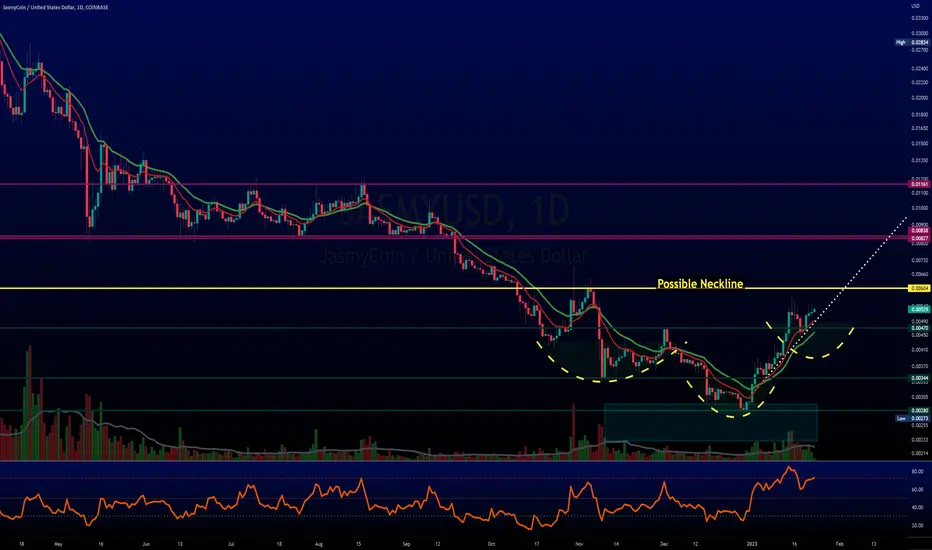
Time for $JASMYBeen following this forever, NEVER spoken on it
Bout time to start digging in $JASMY
Ex #SONY $SONY individuals
Fully diluted market cap is VERY GOOD
#JASMY has been CRUSHED
Goes to ATH, that's HUGE
BKYI | Nice Oversold Condition | LONGBIO-key International, Inc. develops and markets fingerprint identification biometric technology and software solutions, and enterprise-ready identity access management solutions for commercial, government, and education customers in the United States and internationally. The company offers BIO-key PortalGuard and PortalGuard IDaaS solutions, a customer-controlled and neutral-by-design cloud-based identity platform that allows customers to integrate with any cloud or on-premises SaaS application, as well as windows device authentication through IAM platform. Its solutions enable its customers to secure their workforces and student populations; and make their partner networks more collaborative. In addition, it provides BIO-key VST and WEB-key products; and Civil and Large-Scale ID Infrastructure solutions that develops finger-based biometric technology. Further, it offers finger scanners for enterprise and consumer markets under SideSwipe, EcoID, and SidePass brand names. The company was formerly known as SAC Technologies and changed its name to BIO-key International, Inc. in 2002. BIO-key International, Inc. was founded in 1993 and is headquartered in Wall, New Jersey.


SNT | Very Oversold Conditions | LONGSenstar Technologies Ltd. develops, manufactures, markets, and sells perimeter intrusion detection sensors, physical barriers, video analytics and management systems, and security video observation and surveillance systems. The company offers Perimeter Intrusion Detection Systems (PIDS), fence mounted, buried, and free standing; PIDS fence sensor with intelligent perimeter LED based lighting; common operating platform for video management software, including intelligent video analytics applications, PIDS, and electronic access control systems; security thermal imaging observation and surveillance systems; and life safety or duress alarm systems. The company's products are used to protect borders and sensitive facilities, including military bases, power plants, air and sea ports, prisons, industrial sites, large retailer organizations, banks, and oil and gas facilities; sporting events, including athlete villages and stadiums, and municipalities from intrusion, terror, crime, sabotage or vandalism to infrastructure, assets and personnel. Senstar Technologies Ltd. sells its products through system integrators and distribution channels. The company was formerly known as Magal Security Systems Ltd. and changed its name to Senstar Technologies Ltd. in September 2021. Senstar Technologies Ltd. was incorporated in 1984 and is based in Ramat Gan, Israel.


Layer 0 Blockchains ExplainedHello everybody.
Today i will explain What is Layer Zero Blockchains and How it work
and whats the difference betweem L1 and L0 ?
Lets go...
First take a look at The Scalability Trilemma :
the scalability trilemma is a series of trade-offs between decentralization, speed/scalability, and security
that one must make when designing a blockchain and constructing rules for its on-chain governance.
Centralization = Increased Speed, Decreased Security & Censorship Resistance
Decentralization = Decreased Speed, Increased Security & Censorship Resistance
It is very difficult , if not impossible, to achieve perfect decentralization without compromising scalability, and vice versa.
This is especially true on a monolithic blockchain where all the critical functions like transaction execution, consensus and data availability
(the ability to verify that all the data from new blocks has been published) are managed by a single network,
increasing the likelihood of congestion and making it much more difficult to scale.
A workaround to the scalability trilemma is to delegate the primary responsibility for these 3 functions to different independent blockchains.
This design ensures that the execution chain can be optimized for handling high TPS dapps like a DEX or play-to-earn game without worrying about decentralization.
A second chain can then be optimized for decentralization and serve as a final consensus layer for the execution chain to enable withdrawals to and anchor its data.
When it comes to scalability, layer 0 networks can help blockchain scale by increasing transaction throughput.
While transaction speed is typically measured in terms of TPS (transactions per second), transaction throughput looks at the total number of transactions that a network can handle at one time.
The Problem with Layer 1s
As the demand for Dapps increases and more capital flows into the space to support development, we are beginning to see the growing pains of layer 1 networks as they struggle to meet the needs of developers and end users who have opposing views on whether dapps should prioritize scalability, security or decentralization.
Layer 1 networks are built with a monolithic architecture. This means that the execution, consensus and data availability layers are all functioning within a single blockchain network. This stacked design places a strain on the system and results in the need for blockchains to comprise decentralization for security, or scalability for decentralization.
In addition, the lack of control over the underlying infrastructure that dapp developers build on top of has also been a cause of much frustration. Rising gas fees on the Ethereum network make all ethereum dapps too expensive to use, while unexpected downtime on the Solana network similarly makes all dapps on Solana also go offline.
Dapp developers must also make compromises in how they design their dapps in order to remain compatible with these L1 networks, and lack the ability to explore different consensus mechanisms or to experiment freely with token incentive models because consensus is a primary function of the L1 infrastructure layer. The overdependence on L1’s and difficult tradeoffs imposed by the scalability trilemma can only be remedied by creating a new base infrastructure that empowers developers to launch their own independent blockchains that can be optimized for different aspects of the scalability trilemma.
This base infrastructure is called layer 0, and it is the single most important component for helping blockchains and decentralized applications achieve limitless scalability while maintaining the highest possible levels of decentralization and censorship resistance.
What is a Layer 0 Blockchain?
A layer 0 is a type of protocol that enables developers to launch multiple layer 1 blockchains that can be designed to each serve a specific purpose and cater to 1 or 2 dimensions of the scalability trilemma as opposed to all 3.
These L1 networks can also be made to communicate with each other such that the end user can have the experience of using one blockchain while they are in fact using multiple.
Layer 0 (L0) networks are equipped with software development tool kits or SDKs that allow developers to launch their own blockchains, known as Layer 1s or L1s or sidechains, that are connected to the L0 mainchain but operate independently.
Diffrences Between Layer-0 vs. layer-1 blockchains
You can see some main differences between L0 and L1 blockchains in picture below:'
I hope you enjoy this Article
please share me your opinion in comments.
Good Luck...

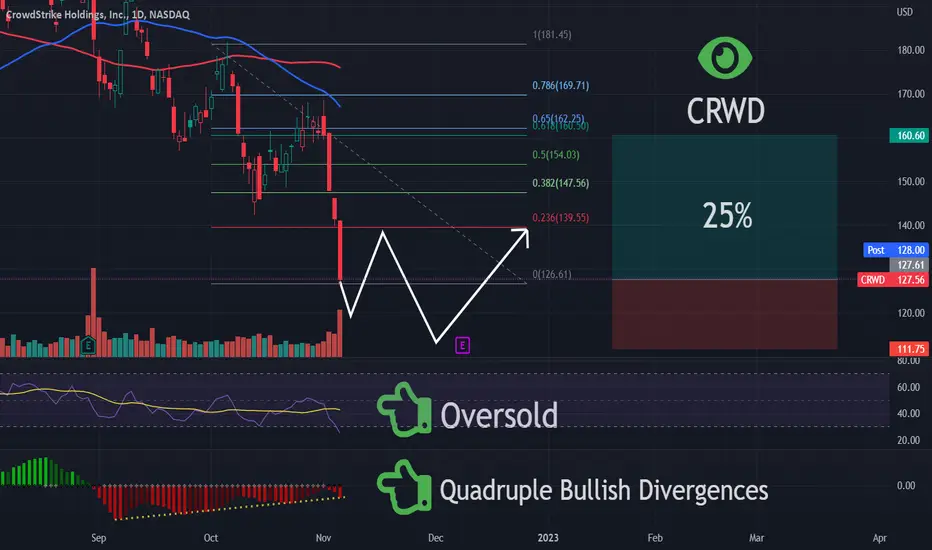
CRWD | Good Entry Point | Swing TradeCrowdStrike Holdings, Inc. provides cloud-delivered protection across endpoints and cloud workloads, identity, and data. It offers threat intelligence, managed security services, IT operations management, threat hunting, Zero Trust identity protection, and log management. The company primarily sells subscriptions to its Falcon platform and cloud modules through its direct sales team that leverages its network of channel partners. It serves customers worldwide. The company was incorporated in 2011 and is based in Austin, Texas.

GEO: Shorts are showing weaknessLast weak Tuesday GEO was shorted, 8/22, then bounced back up on Thursday 8/25 the day before the need to cover positions, Friday. What appears to be happening is shorts opening new shorts early into the weak on Tuesday and then covering their old shorts on Thursday which results in the price raise. The issue with that is the fact that we are closing at higher price levels, and especially, where I place an arrow, we are going into Friday with way more momentum (as you can see from the MACD indicator) which tells me shorts are losing control on holding this stock down.
There are more shares shorted than in free float. That indicates a squeeze. Days to cover increased from 9 to 9.5 which also indicates that shorts have only exposed themselves even more than actually covering and eating the small loss, now they will eat a HUGE loss for being greedy and stubborn. Institutional shorts are the dumbest beings I have ever seen.
According to Barrons.com, on 8/15, which would underestimate the short exposure being these shorts have no brain and think shorting more will fix their problem.
Short Interest 18.6M (08/15/22)
Percent of Float 15.82%
Shares Outstanding 124.09Million
Float 116.51M
124.04-116.51 = 7.53 Million shares at a minimum created for the purpose solely created to dilute share prices.
If the short interest is 15.82% of the float, this means 18.431882 Million (Barrons 18.6M) shares are shorted and these positions need to be covered.
If shorts were to cover their entire position, they couldn't without a MAJOR spike in price levels, as even if they chose to cover, not only would price levels increase due to demand, but also SUPPLY of shares would be reduced, those 7.53 million extra shares would be gone, individually making every share that much more "rare" and additionally due to current price levels, a huge influx of forced buying will occur at these high prices. Minimum price target 16-18
THIS IS A FUNDAMENTAL PLAY. INTEREST RATES HAVE GONE UP. GEO GROUP HAS RESTRUCTURED ITS DEBT, CHEAP DEBT FROM PREVIOUS LOW-INTEREST RATE YEARS, AND SPREAD IT OUT OVER THE LONG RUN TO BETTER MATCH ITS NET INCOME CASH FLOW. IT IS BECOMING INCREASINGLY MORE EXPENSIVE TO SHORT (borrow naked) DUE TO THE INTEREST RATE SPIKE AND WE ARE IN FOR A SQUEEEEEEEZE. THIS COMPANY HOLDS PUBLIC CONTRACTS FROM THE GOV FOR HANDLING HIGH-LEVEL SECURITY FACILITIES, UNLIKE AMC WHICH HAS ACTUAL FUNDAMENTAL LONG-TERM VALUE, I WAS IN AMC AT 3$ AND SOLD AT 22 BECAUSE COME ON ITS A MOVIE THEATER COMPANY WITH ZERO FUNDAMENTALS, I JUST IMAGINE WHAT THIS COULD DO HONESTLY.


Quantum cryptography and Post-Quantum cryptographyHello guys
today i want to explain Quantum cryptography and Post-quantum cryptography
and how they can affect blockchain security and whats the solution.
lets start with a brief explanation of cryptography:
Cryptography is the process of encrypting data, or converting plain text into scrambled text
so that only someone who has the right “key” can read it.
NOW what is quantum cryptography?
Quantum cryptography simply uses the principles of quantum mechanics
to encrypt data and transmit it in a way that cannot be hacked.
and what is Post-Quantum cryptography?
Post-quantum cryptography refers to cryptographic algorithms (usually public-key algorithms)
that are thought to be secure against an attack by a quantum computer.
These complex mathematical equations take traditional computers months or even years to break.
However, quantum computers running Shor’s algorithm will be able to break math-based systems in moments.
How Quantum Cryptography Works?
Quantum cryptography, or quantum key distribution (QKD), uses a series of photons (light particles)
to transmit data from one location to another over a fiber optic cable.
By comparing measurements of the properties of a fraction of these photons,
the two endpoints can determine what the key is and if it is safe to use.
The sender transmits photons through a filter (or polarizer) which randomly gives them one of four possible polarizations
and bit designations: Vertical (One bit), Horizontal (Zero bit), 45 degree right (One bit), or 45 degree left (Zero bit).
The photons travel to a receiver, which uses two beam splitters (horizontal/vertical and diagonal) to “read” the polarization of each photon.
The receiver does not know which beam splitter to use for each photon and has to guess which one to use.
Once the stream of photons has been sent, the receiver tells the sender which beam splitter
was used for each of the photons in the sequence they were sent, and the sender compares that information with the sequence of polarizers used to send the key.
The photons that were read using the wrong beam splitter are discarded, and the resulting sequence of bits becomes the key.
If the photon is read or copied in any way by an eavesdropper, the photon’s state will change.
The change will be detected by the endpoints. In other words, this means you cannot read the photon and forward it on or make a copy of it without being detected.
The Solution We Need Now for Tomorrow!
The need for unbreakable encryption is staring us in the face.
With the development of quantum computers looming on the horizon, the integrity of encrypted data is at risk now.
Fortunately, quantum cryptography, through QKD, offers the solution we need to safeguard our information well into the future – all based on the complex principles of quantum mechanics.
In January 2022 a team at Sussex University spin-out company Universal Quantum published research on transit attacks
which calculated that it would require a quantum computer with a 1.9 billion qubit-capacity to break Bitcoin’s encryption in the required ten-minute window
(this is the time taken for a Bitcoin to be mined). Even at 317 million qubits it would take an hour and 13 million qubits for a day.
For context, IBM’s superconducting quantum computer currently has a 127-qubit processor.
REFRENCES:
www.investmentmonitor.ai
www.quantumxc.com
www.techtarget.com
Hope you enjoy this article.
please share me your opinion about Quantum computing in comments.
can they break BITCOIN???!!!

VSBLTY Groupe VSBGF Continues Growing$VSBGF recently took a dip, not only because of the broader "risk-off" environment and economic headwinds... recently announcing 16.7 million shares at a $0.30 offering with a warrant for additional purchase of common stock at $0.50 as well as private sale of 10 mil units for $3 million USD.
Market response was bearish, on the surface this is seemingly bad as shareholders are diluted... however, peeling back the layers reveals Jay (CEO) and team are continuing to land big partnerships and agreements in the retail space.
DYOR and you'll find tremendous building tailwinds and a company delivering against a bullish impermanent plan and a very bright future.
Their tech is innovative and a significant value add to the market. Don't lose sight of what they're doing and don't fall asleep as the delivery begins yielding more revenue and in short order, profits.


Controversial Trade Idea: $GWW sells metal detectorsI'll do my best to leave the politics out of this.
Mass shootings are in the spotlight again, and it would be obvious in hindsight to see a boost in demand and sales for security systems such as metal detectors.
NYSE:GWW , who just teamed up with The Mom Project, had $13 billion in sales in 2021 and is a leading distributor with operations in North America, Japan, and the UK. They also provide services like repair, maintenance, and other solutions.
$GWW is consolidated, allowing for both directional entry upon a breakout north or south (breakout levels $530 and $450, respectively). I will trade in the direction of the break with a bullish personal bias.
See products (security, metal detectors, scanners): www.grainger.com


HAPI Bottomed?HAPI/USD (Weekly)
- Seem to have found Support at approx. the $15-16 area and range-bound for a while.
- MACD/Signal and Histogram reversing
- Volume increasing over the last 3 weeks
- RSI low reversing
- Looks to be closing above the 50MA on the daily
- Resistance levels marked out by the fib extension (String Resistance will be at $50 and approx $72 area. If we can break above with strength, we should be forming a new high.
- Strong Resistance at the $50 level shown by the Volume Profile

ADT Inc (USA: $ADT) Revealing Bullish Divergence on RSI! 📈ADT Inc. provides security, automation, and smart home solutions to consumer and business customers in the United States. It provides a range of fire detection, fire suppression, video surveillance, and access control systems to residential, commercial, and multi-site customers. The company primarily offers monitored security and automation solutions, including the installation and monitoring of security and premises automation systems designed to detect intrusion, control access, sense movement, smoke, fire, carbon monoxide, flooding, temperature, and other environmental conditions and hazards; and address personal emergencies, such as injuries, medical emergencies, or incapacitation. It also provides interactive and smart home solutions that allow customers to use their smart phones, tablets, and laptops to arm and disarm their security systems, adjust lighting or thermostat levels, and view real-time video of their premises; and creates customized and automated schedules for managing lights, thermostats, appliances, garage doors, cameras, and other connected devices, as well as offers monitoring and maintenance services. The company offers its products under the ADT, ADT Pulse, Protection 1, ADT Commercial, and Blue by ADT names. It operates through a network of approximately 250 sales and service offices, as well as three regional distribution centers, which are supported by 17 multi-use sales, customer, and field support locations housing its nine UL-listed monitoring centers and four national sales centers. The company was formerly known as Prime Security Services Parent, Inc. and changed its name to ADT Inc. in September 2017. ADT Inc. was founded in 1874 and is headquartered in Boca Raton, Florida.


Macro Perspective on QuantStamp ValuationWith all what's happening in the world and in particular the Crypto Space, there is big demand for security and protecting the Blockchain smart contracts from cyber attacks.
The elevation of threats are rising with high potential of a strike from hackers around the world. Chaos is something can come without prior alarms. Here they come the blockchain security projects to rise.
As you can see in the charts, I remind you that when we go into lower time frame it looks choppy and ugly while the broader perspective and macro look of the chart says it all.
QuantStamps looks healthy as far as the chart tells, Plus QuantStamp is really performing great with their projects, from Metaverse to institutional level partnerships and deals to audit to monitoring their blockchains and smart contracts. Although the market still under BTC dominance yet what we are witnessing here is a major move from the Alts in general.
This 2nd Quarter and 4th Quarter from this year will be likely a resume to the upside with QuantStamp and similar security projects to rise due to the alarming global Cyber Attacks potential.
My Idea that I presented awhile ago still intact and valid. Can't wait for April as it is one volatile month of the year for many AltCoins.

$NLOK: Putopia HedgeRegardless of what deals are made regarding forces, long NLOK offers a pretty solid hedge against any impending cybercrimes that may linger as a result of the current geopolitical conflict and the citizen's reactions there of. This company is also much less exposed to the drains of inflation compared to numerous other stocks on the market.

BlockWallet - Reclaim your Financial Privacy on the BlockchainDid you know, you leave a trail of digital information on the blockchain. Anyone can find it and see what DApps you’ve used, transfers you’ve made, and the crypto assets you hold?
Privacy is a fundamental human right. With BlockWallet , it’s protected by default.
Your finances are a personal matter
With BlockWallet (BLANK) you don’t have to reveal your balance and transaction history when making bank transfers. The same fundamentals should apply to blockchain. Render your funds untraceable to everyone but you.
Unlock the full potential of Web 3.0
BlockWallet is your gateway to the decentralized web. Explore Web 3.0 with privacy-enhancing smart contracts at your fingertips. Connect to any DApp, across multiple chains.
Take back control of your data
BlockWallet empowers users by giving them full control of their digital assets. As a non-custodial wallet that collects no data whatsoever, you’re always in the driver’s seat.
Privacy without Compromise
BlockWallet uses battle-tested privacy-enhancing technology to protect your financial data. Cryptographic proofs (zk-SNARKs) allow users to make deposits and withdrawals using smart contracts that render funds untraceable. You can use BlockWallet to transfer funds to an address with no links to your history on the blockchain.
The smoothest user experience
Privacy solutions of the past are often difficult to use for the average user. BlockWallet brings the latest privacy-preserving technology to the mainstream by packaging it with a seamless user experience. Reclaiming your financial privacy shouldn’t be complicated, and with BlockWallet it isn’t.

ETH New Trading Range!When taking a look at the chart we can see that ETH has broken through a resistance, retested support, and is now trading above the s/r zone. This leads me to believe that the next push to 3.2k is very likely to happen as long as BTC remains bullish. We need ETH to stay above the red line to show that the bulls are still in control. If we do break below the white line represents the next support.
Love it or hate it, hit that thumbs up and share your thoughts below!
Don't trade with what you're not willing to lose. Safe Trading, Calculate Your Risk/Reward & Collect!
This is not financial advice. This is for educational purposes only.

$CTK/USDT 4h (#BinanceFutures) Falling channel near breakoutCertiK seems to be ready for short-term recovery, let's enter here with low leverage.
Current Price= 1.145
Buy Entry= 1.147 - 1.097
Take Profit= 1.287 | 1.422 | 1.618
Stop Loss= 0.998
Risk/Reward= 1:1.33 | 1:2.42 | 1:4
Expected Profit= +29.42% | +53.48% | +88.42%
Possible Loss= -22.10%
Fib. Retracement= 0.382 | 0.5 | 0.786
Margin Leverage= 2x
Estimated Gain-time= 2 weeks
www.certik.com www.shentu.technology

