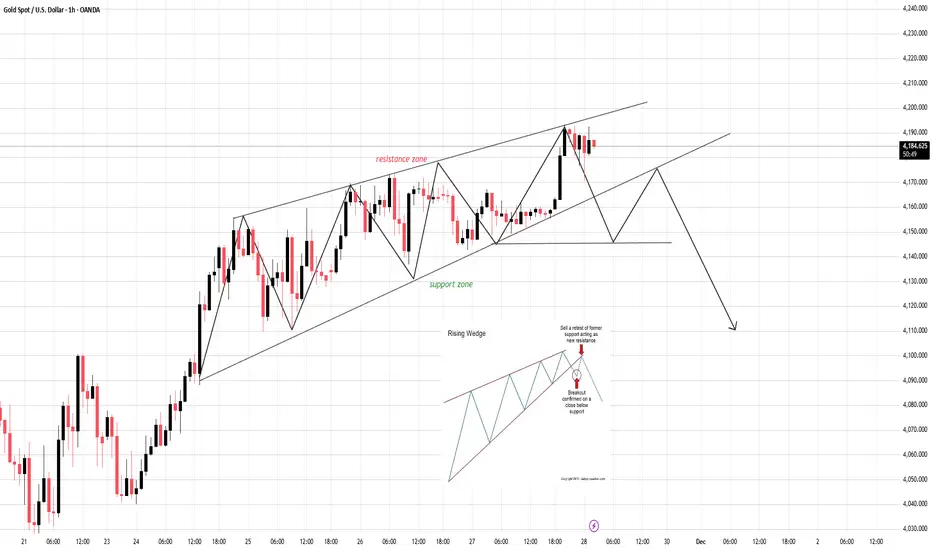
XAU/USD – Holds Its Range, Preparing for a Year-End Expansion🔍 Market Context
Friday’s New York session closed with a two-sided liquidity sweep, yet gold managed to hold its structural balance, maintaining the same rhythm seen over the past two weeks — sideways to mildly bearish, but firmly supported.
This behavior shows that buyers are still defending key zones, especially around 3,940$ – 3,980$, which MMFLOW highlighted multiple times last week as the decisive liquidity floor.
From a macro lens, the Fed’s cautious tone has slowed expectations for aggressive rate cuts — but the probability of another reduction before Q1 2026 remains alive.
As we move toward the final stretch of the year, thinner liquidity and seasonal safe-haven flows could help gold establish a mid-term bottom, setting the stage for the next impulsive leg.
📊 Technical Structure (H4)
The current chart presents a clear 5-wave recovery structure within a tightening range — a classic setup before expansion.
Key Technical Zones:
• 💎 Support Zone: 3,942$ – 3,982$ (liquidity base + strong absorption area)
• 🎯 Wave 3 Target: 4,072$ – 4,133$ (first reaction zone)
• ⚙️ Extended Target / Wave 5: 4,189$ – 4,201$ (Fibo 1.618 projection)
• ⚠️ Invalidation: Below 3,940$ → loss of short-term structure, possible re-accumulation lower.
The structure remains sideways but constructive, and a confirmed breakout of the descending trendline could act as the catalyst for a year-end bullish continuation.
🎯 MMFLOW TRADING View
Smart money continues to accumulate within equilibrium zones, with every liquidity sweep appearing more like preparation than rejection.
As long as gold stays above 3,970$, the bullish bias remains valid — with a 60%+ probability of a move toward 4,130$+ in the short to mid-term.
Historically, November–December often brings portfolio rebalancing and policy easing cycles, both of which may serve as fuel for a potential gold rally into Q1 2026.
⚜️ MMFLOW Insight:
“Accumulation isn’t waiting — it’s when big money quietly builds the next wave.”
Technical Analysis
XAUUSD Eyes 4000$ Breakout as Accumulation Phase Near Completion🔍 Market Context
After a week of sideways consolidation within a broad range, gold (XAU/USD) is showing the first signs of structural recovery.
The market is gradually carving a potential short-term bottom, hinting that the corrective phase may be ending — and a breakout from the range could be imminent.
Despite the lack of new macro catalysts, sentiment remains underpinned by renewed safe-haven flows and expectations that the Fed will maintain its easing stance through early 2026.
Traders are now watching closely whether the 4,000$ handle will finally give way — a key inflection zone that could trigger aggressive momentum buying if reclaimed.
📊 Technical Structure (H1–H4)
Gold is currently trading above the intraday demand zone 3,969$–3,982$, maintaining a short-term bullish structure while compressing under resistance.
The descending trendline and Fibo confluence near 4,019$–4,048$ act as the next critical reaction area for breakout confirmation.
Key Technical Zones:
• 💎 Demand Zone: 3,969$ – 3,982$ (liquidity base + ascending trendline confluence)
• 🎯 Primary Resistance: 4,019$ – 4,048$ (trendline + Fibo 1.272/1.618)
• ⚙️ Bullish Target: 4,046$ → 4,052$ → 4,090$ (extended range liquidity)
• ⚠️ Invalidation: Below 3,960$ → risk of a deeper correction toward 3,940$.
🎯 MMFLOW Outlook
Smart money appears to be absorbing liquidity within the 3,970$ zone, suggesting accumulation before expansion.
If gold can break and sustain above 4,000$, the bias flips decisively bullish — opening the door for a range expansion toward 4,050$+.
This could mark the beginning of a new impulse phase following weeks of compression.
⚜️ MMFLOW Insight:
“When volatility sleeps, liquidity quietly builds the next trend.”
RISK MANAGEMENT – How Pros Stay AliveIf you’ve traded long enough, you’ll realize this:
Nobody blows up their account because of a bad prediction — they blow it up because they don’t know when to stop.
1. The First Survival Rule: Set a FIXED RISK Per Trade
Choose a fixed risk percentage that you’re comfortable with — 1%, 2%, or a maximum of 3% per trade.
That means:
If you have a $1,000 account and risk 2%, you can only lose $20 per trade .
Even if you lose 5 trades in a row, you still have 90% of your account to keep fighting.
Never increase your lot size because of a “gut feeling.”
Traders don’t lose because they analyze wrong — they lose because they increase risk when they feel too confident.
2. Set STOP LOSS with Logic, Not Emotion
Don’t place your stop loss “just to have one.”
Your stop loss should be at the point where, if price hits it, your idea is truly invalidated — not because you’re afraid of getting stopped out early.
Example:
If you’re buying in an uptrend, your SL should be below the last higher low , not just below the last red candle.
If your SL is 30 pips and you want to risk 2%, then your position size = 2% of your account ÷ 30 pips.
This formula keeps your trades balanced and prevents those small, annoying blow-ups.
If you don’t know exactly how much you’re risking per trade — you’re not really trading. You’re gambling.
3. No Overloading, No Revenge Trading
One of the fastest ways to blow up an account is adding more trades while losing .
The market doesn’t care how much you’re down — it only cares how much you still have left to lose.
Pro traders do the opposite:
When the trade moves in their favor → they trail the stop and lock profits.
When the trade goes wrong → they cut it quickly, no questions asked.
That’s why they last longer — they trade small when uncertain and go big only when the odds are clearly on their side.
4. Emotional Control = The Extension of Risk Management
Risk management isn’t just about numbers — it’s about discipline.
If you just took a loss and still want to “jump back in to make it back” — stop immediately.
No analysis, no revenge trade.
Just close the chart, grab a drink, take a walk, or hit the gym.
Because once emotions take over, no system in the world can save you .
5. Turn Risk Management into a Strategic Weapon
When you have your risk under control, you trade with a cold mind.
That’s when you can actually take advantage of big opportunities .
Example:
You risk 2% per trade and find a setup with R:R = 1:4.
If it wins, you make +8%. If it loses, you only lose -2%.
Even if you’re right just 3 out of 10 times — you’re still profitable.
That’s how pro traders make a living.
They don’t need an 80% win rate — they just need consistency and control.
💬 A Simple Drill for You:
For every trade, write this down:
“How much % am I willing to lose if I’m wrong?”
If you can’t answer within 5 seconds → don’t take that trade.
If you’re still losing because of discipline issues → restart by focusing only on limiting risk before thinking about profit.
PYPL Range: Bounce or Breakdown Toward 75/61PYPL on the 1D chart remains a textbook rectangle, coiling after months of sideways trade. Price is back at the lower boundary near $65.50 with short-term momentum tilted bearish and all key MAs overhead. The MA20/60/120 are tightly clustered around $68.57–$70.63, reinforcing a heavy supply band. Volatility has contracted after October’s spike, so a decisive move from this squeeze looks close.
Primary path: neutral-to-range bias with a tactical bounce off the $65.50–$66.50 demand zone. A daily close back above the MA20 (≈$68.60) would be the first tell, while a daily close >$68.90 strengthens the case for a push into the $69.00–$70.50 cluster and a retest of $75.00. A sustained break and hold above $75.00 would transition the structure toward a fresh up-leg.
Alternative: failure at support. A decisive daily close <$65.20 would confirm a range breakdown and open $61.00. For positioning, keep the line in the sand tight: long ideas are invalid below $64.70; short ideas lose edge above $79.50. Until a break, respect the range—fade extremes and be disciplined with size, as volume on any breakout should be the confirmation cue.
This is a study, not financial advice. Manage risk and invalidations
AUD/USD Slips: Heading Towards 0.64400?AUD/USD is currently in a downtrend after failing to break through the resistance at 0.65000. Latest data from the RBA and the weakening of the USD have created resistance for the AUD. With the Federal Reserve not planning to cut interest rates immediately, the stronger USD is putting pressure on the AUD.
With the next support level at 0.64400, this pair could continue its decline in the short term. If this support level is broken, the downtrend may extend further.
Traders should closely monitor these support and resistance levels to optimize trading opportunities, especially with the market being influenced by interest rate policies and global economic factors.
EUR/USD Is Recovering: Breaking 1.1570, Heading Toward New HighsEUR/USD is currently in the process of recovering after hitting strong support at 1.1500. This is a positive sign as the price is bouncing back from the lows and beginning to build upward momentum. While it is still within a descending channel, the price breaking the 1.1530 resistance level indicates a potential continuation of the upward trend in the short term.
The next key resistance level is 1.1570. If the price can break through this level and hold above it, EUR/USD could continue its strong upward move, opening up opportunities to reach new highs. However, if the price fails to stay above 1.1500, the possibility of a pullback to that support level remains high.
Given the current trend, if EUR/USD successfully breaks through 1.1570, the pair could continue to move higher, creating favorable long-term trading opportunities for investors.
The Last Chance to Own 4-Digit Bitcoin?💥 The Last Chance to Own 4-Digit Bitcoin?
On the daily chart, Bitcoin’s RSI is around 35, showing no bullish divergence and price still below the 21 EMA.
I’m personally waiting for the $60K area — it might take months… or maybe it’ll drop even lower.
Either way, this could be the last time we ever see 4-digit Bitcoin.
#Bitcoin #BTC #Crypto #Trading #Investing #RSI #EMA #CryptoMarket #TechnicalAnalysis
XAU/USD | Gold Rejected Again! Mid-Term Target Could Reach $3550By analyzing the Gold chart on the 2-hour timeframe, we can see that after the previous analysis, price started to rise but faced strong selling pressure when it entered the supply zone between $4016 and $4020.
Recently, Gold dropped to around $3978 and is now trading near $3990. The previous analysis remains valid — as long as Gold doesn’t break above $4040, the main scenario is still bearish, and we could even see a deeper correction toward $3550 in the mid-term.
This analysis will be updated soon — stay tuned for some powerful trade setups!
Please support me with your likes and comments to motivate me to share more analysis with you and share your opinion about the possible trend of this chart with me !
Best Regards , Arman Shaban
GBPUSD: trend broken, channel breakout — sellers stay in controlFor a long time the pair was moving inside an ascending channel, with the upper boundary acting as resistance. Now we see a trendline breakdown and a confirmed exit from the channel. Price is below EMA 50 / EMA 100 / EMA 200, confirming bearish structure. After a strong impulse down, price is pulling back into the Fibonacci zone 0.382–0.705 (1.3330–1.3165) — this is a potential area to look for a short entry. Main target remains 1.2740, which aligns with the next strong support zone. Strategy: waiting for a pullback → weakness confirmation → entering short on price action signal. Invalidation = breakout and consolidation above 1.3520.
BOE remains dovish, rate cut expectations for 2026 are rising. USD remains supported by stronger macro data and higher yields, while divergence between monetary policies continues. As long as this divergence persists, GBPUSD bias stays bearish.
Charts don’t care about hopes. Wait for a pullback, stick to the plan, execute the setup — not the emotions.
NMR/USDT | Institutional Order Flow Analysis (ICT Perspective)Price recently delivered a sharp move down from the upper bearish Order Block (OB) around the 14.0 region, filling previous imbalances (-iFVG) and confirming a short-term Market Structure Shift (MSS) to the downside.
Currently, NMR is reacting within a bullish Fair Value Gap (+iFVG) zone, but liquidity beneath the recent low remains uncollected. This indicates the probability of another liquidity sweep toward the lower OB (~11.0-11.2 zone), where multiple confluences align
Old demand zone + OB
+FVG (Fair Value Gap)
Institutional Discount Zone
Potential Inducement setup (SMT and IDM levels marked)
After liquidity is taken and we see displacement with bullish intent, price could retrace back toward the 13.8-14.0 OB, which aligns with premium re-pricing.
Execution Plan:
Watch Zone: 11.0–11.3 → Look for bullish confirmation (MSS + displacement).
Target Zone: 13.6–14.0 OB.
Invalidation: Clean break below 10.8 with no bullish displacement.
Note: Stay patient & DYOR — let liquidity form first. Reaction at the 11.0 handle will define the next leg.
XAUUSD: Bullish Structure Shift Targeting Liquidity Above OB ?Break of Structure (BOS): There's a clear "BOS" labeled, indicating that the price has broken above a previous lower high. This is typically interpreted as a shift from a short-term downtrend (or consolidation) to an uptrend (or a structural move higher).
Order Block (OB): An "OB" (Order Block) is highlighted. This is a zone where a significant number of buy orders are believed to have been placed, making it a potential support area where price might retrace before moving higher.
Sell-Side Liquidity (BOS/$$$): The areas labeled "$$$" above the recent high represent liquidity. These are points where stop-loss orders from short sellers or pending sell orders are clustered, making them attractive targets for institutional traders to drive the price toward, often causing a quick move through that level.
Bearish Divergence (SMT): The "SMT" (Smart Money Technique) is marked, which often refers to a divergence between two correlated assets (like Gold and a US Dollar index) or a specific pattern where the low of one asset failed to reach the low of another, suggesting institutional manipulation or a short-term reversal (in this case, preceding the BOS).
Projected Move: The arrows illustrate a common trading hypothesis: the price is expected to retrace to the Order Block (OB), find support there, and then rally to take out the Sell-Side Liquidity ($$$) above the previous highs.
AUDJPY: Bullish Movement Confirmed?! 🇦🇺🇯🇵
AUDJPY has a high chance to bounce from a key daily support.
An occurrence of a bullish imbalance on a 4H time frame
suggests a truing buying pressure.
Expect a pullback at least to 99.99
❤️Please, support my work with like, thank you!❤️
I am part of Trade Nation's Influencer program and receive a monthly fee for using their TradingView charts in my analysis.
Macroeconomics and Investor Psychology Driving Gold PricesFirstly, macroeconomic policies , particularly monetary policy moves by the U.S ., will continue to have a significant impact on gold prices. Specifically, the upcoming decisions by the Federal Reserve (Fed) regarding interest rate cuts are expected to create positive momentum for gold, as investors turn to gold as a safe-haven asset in a low-interest-rate environment.
Secondly, the independence of the Fed is a key factor, not only directly influencing confidence in the USD but also strongly affecting trust in U.S. institutions. The stability and transparency of the Fed's policy decisions will continue to create significant market volatility, directly impacting gold prices.
In addition, gold is becoming increasingly attractive to investors due to the combination of two key factors. First, the increasing national debt in many countries is becoming a major risk, as global fiscal sustainability is in question, making gold a more reliable safe-haven asset. Second, the erosion and weakening of international systems and standards have led to diminishing confidence in financial systems and international approaches. This has further strengthened gold's position as a safe asset in the eyes of investors.
Another important factor influencing gold prices is the psychology of seeking global risk hedging . In the context of concerns about "bubbles" in the AI technology sector , if AI technology proves to be a bubble and bursts, gold and other assets will become even more attractive as strategic safe-haven assets.
With all these factors in play, gold is not only an attractive investment choice but also a strategic asset during times of financial and global economic instability.
Vintage Coffee & Beverages: Rectangle Pattern Swing Trade SetupBUY Setup ☕
Entry: ₹168-169 (Current Level)
Target 1: ₹172-173
Target 2: ₹174-176
Target 3: ₹180+ (Breakout Extension)
Stop Loss: ₹164
Technical Rationale:
Rectangle consolidation pattern (160-169) visible on 1-hour chart (blue shaded zone)
Holding strong at upper range of consolidation
Volume spike highlighted (blue arrow) - showing buying interest
Strong uptrend from 144 to current levels
Trading above rising EMA - bullish trend intact
RSI trending upward around 70 - strong momentum
Small-cap F&B stock showing resilience
Volume at 1.31M - decent for 1H timeframe
Multiple resistance levels clearly marked: 172, 174, 176
Support well-established at 164-165 zone
Coiling pattern - compression before expansion
Risk-Reward: Good 1:3+ ratio
Pattern: Rectangle consolidation on 1H chart - typically a continuation pattern after strong uptrend
Strategy: Intraday to short-term swing (1-3 days)
Book 40% at T1 (172.50), 30% at T2 (175), trail remaining with SL at 169 after T1
Aggressive traders can add on break above 169.50 with volume
Key Levels:
Breakout Zone: 169-170 (upper rectangle boundary)
Strong Resistance: 172, 174, 176
Critical Support: 164, 162, 160 (rectangle base)
Timeframe: 1-hour chart - suitable for intraday/swing traders
Volume Analysis: Recent volume spike (highlighted) suggests accumulation at upper range - bullish sign
Sector: F&B/FMCG - relatively defensive sector
Note: Currently showing strength with +0.36% gain. Watch for breakout above 169.50 with volume for confirmation.
Disclaimer: For educational purposes only. Not SEBI registered.
GBPUSD Eyes 1.31000 Rejection as Fed Cut Bets Look Overstated!Hey Traders,
In today’s trading session, we’re monitoring GBPUSD for a selling opportunity around the 1.31000 zone. The pair remains within a broader downtrend and is currently in a correction phase, approaching a key resistance area where previous sell-side momentum originated.
Structure:
GBPUSD has been struggling to sustain any meaningful rebound, with each rally meeting renewed selling interest. The 1.31000 zone aligns with both structural resistance and the descending trendline, making it a crucial level to watch for potential downside continuation.
Fundamentals:
The likelihood of a December rate cut from the Fed remains high. The ADP employment report came in solid, and ISM Services showed continued strength, suggesting that the labor market and service sector remain resilient.
As these stronger readings filter through, the market could begin to gradually price out that December rate cut expectation, reinforcing USD strength and pressuring GBPUSD further.
Next move:
Watching for price rejection near 1.31000 — sustained bearish pressure here could open the door toward a deeper retracement in the coming sessions.
💬 What’s your take on the Fed pricing dynamic? Drop your thoughts below!
Trade safe,
Joe.
UP 1W-business jet without autopilot, but the runway looks clearTechnically, Wheels Up (UP) broke out of a long falling wedge and returned to the wide demand zone around $1.00–$1.30, where weekly support has formed. Volume expansion and bullish divergence signal that accumulation is taking shape. As long as price stays above $1.05, the structure remains constructive with initial upside targets at $1.60 and $1.80, while a breakout above $2.00 could open the door toward $6.00.
Fundamentally , the company continues its transformation after the liquidity crisis and strategic partnership with Delta Air Lines. Management has shut down unprofitable low-margin programs, refocused on high-yield corporate and frequent-flyer clients, and introduced a leaner “asset-light” model by outsourcing part of its fleet to partner operators. Q3 2025 results showed revenue near $185 million with solid gross bookings growth and improved operational efficiency - 99 % flight completion and 89 % on-time performance mark the best metrics since restructuring began. Losses and negative cash flow remain, but cost discipline is improving, and the Delta integration is slowly turning into a real commercial synergy. If corporate demand keeps strengthening and free cash flow moves toward breakeven, UP may turn into a rare small-cap comeback story in the aviation sector.
Tactically , the plan remains simple - hold above $1.05, look for movement toward $1.60 and $1.80, take partial profits near $2.00, and re-enter on retests around $1.20–$1.30 if volume confirms. A weekly close below $0.95 would invalidate the bullish scenario.
The market has heard “we’re taking off” before but this time, there’s at least a real runway under the wheels.
UAIUSDT.P: short setup from daily support at 0.1160UAIUSDT.P initially attempted to move higher after listing, but now the price is at the 0.116 support level.
This level is based solely on the initial listing price, making it critically important — a move below it could trigger an uncontrolled drop.
The asset is consolidating directly above the level, which often precedes a downward breakout.
This creates a potential short setup: low volatility, no signs of recovery, and no visible buying pressure.
The only possible bullish case is if the asset gets “rescued” once it dips below the listing price, though that seems unlikely.
I’d wait for the daily candle to close, and ideally — for the price to remain hovering just above the level tomorrow, showing no buyer strength.
Key factors for this scenario:
Global & local trend alignment
Price void / low liquidity zone beyond level
Volatility contraction on approach
Repeated precise tests of the level
Closing near the level
Closing near the bar's extreme
Factors that contradict this scenario:
Lack of consolidation
Was this analysis helpful? Leave your thoughts in the comments and follow to see more.
QQQ Bearish Pullback: Retest Toward 590–595 ZoneQQQ on the 1D chart has been trending higher for months, but the latest session printed a clean Bearish Engulfing with a ~1.86% drop and a break below the 20-day (around 614.50). That rejection left fresh supply near the recent high at 635 and flipped 610–615 into near-term resistance. Momentum has shifted short-term to the downside even as the broader structure remains bullish.
Primary path: a corrective leg toward the 590–595 demand zone. That area aligns with prior polarity and the 60-day moving average, with the lower Bollinger Band near 588 adding confluence. A sustained break below 610 would likely unlock that move, where buyers can attempt to stabilize price and rebuild trend structure.
Alternative: if buyers reclaim 622 on a daily close, the bearish signal is invalidated and the door reopens for a retest of 635. Conversely, if 590 fails decisively, the correction can extend toward the 120-day region around 570–575, signaling a deeper, medium-term reset.
This is a study, not financial advice. Manage risk and invalidations
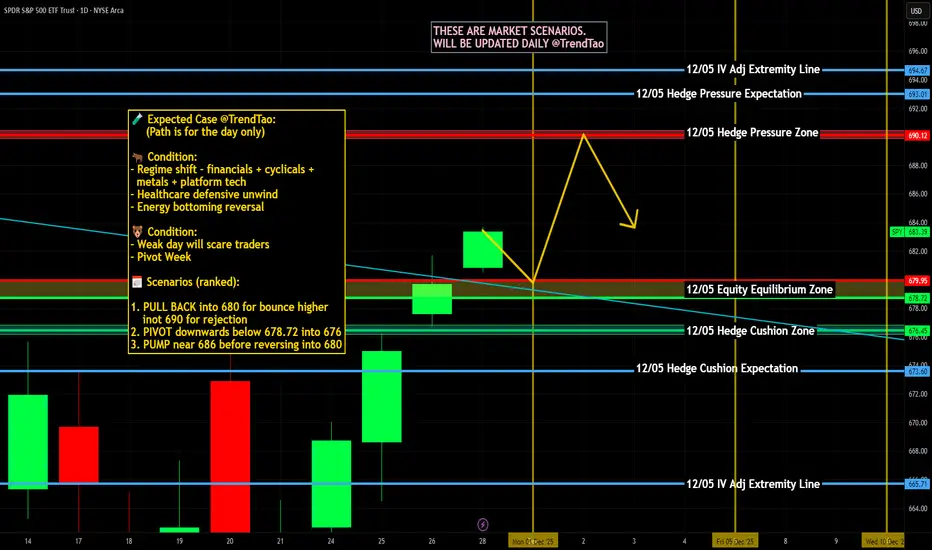
$SPY $SPX Scenarios — Friday, Nov 7, 2025🔮 AMEX:SPY SP:SPX Scenarios — Friday, Nov 7, 2025 🔮
🌍 Market-Moving Headlines
🚩 Jobs Day: The October Employment Report headlines Friday, with payrolls expected at -60,000 and the unemployment rate rising to 4.5% — signaling labor market cooling.
📉 Policy implications: A weak print would reinforce expectations for multiple rate cuts in early 2026, while upside surprises could stall the dovish momentum.
💬 Fed watch: Morning remarks from Williams and Jefferson set the tone before the data drop; Miran rounds out the week with a late-day speech.
⚠️ Shutdown delays: The Employment Report and related labor metrics are at risk of delay pending government data releases, adding uncertainty to Friday’s open.
📊 Sentiment & credit check: U-Mich Consumer Sentiment and Consumer Credit round out the macro picture.
📊 Key Data and Events (ET)
⏰ 3:00 AM — John Williams (NY Fed) speech
⏰ 7:00 AM — Philip Jefferson (Fed Vice Chair) speech
⏰ 🚩 8:30 AM — U.S. Employment Report (Oct) — subject to delay
• Nonfarm Payrolls: -60,000
• Unemployment Rate: 4.5%
• Hourly Wages (MoM): 0.3%
⏰ 10:00 AM — UMich Consumer Sentiment (Prelim, Nov) | 53.0 expected
⏰ 3:00 PM — Consumer Credit (Sept) | $10.0B expected
⏰ 3:00 PM — Stephen Miran (Fed Gov) speech
⚠️ Note:
The Employment Report, Unemployment Rate, and Wage Data are flagged at risk of delay due to the government shutdown. All other releases are expected on time. Market volatility will hinge on whether the data prints or is postponed.
⚠️ Disclaimer: Educational and informational only — not financial advice.
📌 #trading #stockmarket #SPY #SPX #JobsReport #NFP #Fed #Jefferson #Williams #inflation #yields #macro #shutdown
XAUUSD – Gold Holds Its Momentum, Targeting 4,150 USDAfter a period of volatility, gold is gradually regaining its upward momentum as investors shift toward safe-haven assets despite strong U.S. employment data. This indicates that defensive capital flow continues to support the bullish outlook for the precious metal.
On the 4H timeframe, price remains well-supported along the ascending trendline, showing that buyers are still in control. Currently, gold is approaching the 4,100 USD zone, and if a breakout occurs, the next target will be around 4,150 USD — a key resistance area that aligns with the previous highs, where potential profit-taking could emerge.
Conversely, the 3,970 USD level remains a crucial support zone. As long as price holds above this level, buyers will maintain their short-term advantage.
Gold continues to show strength and resilience — a positive sign for its journey toward new highs.
Gold Rebounds Before the Big Drop?Hello traders,
Gold prices edged slightly higher in the mid-week session despite stronger-than-expected U.S. employment data. However, this rise appears to be just a technical pullback, as capital continues to flow into safe-haven assets like the USD.
The ADP report showed that the U.S. private sector added 42,000 jobs, well above the forecast of 32,000, while the ISM Services PMI came in at 52.4, higher than expectations. These figures reinforce the view that the U.S. economy remains resilient, making it harder for the Fed to cut interest rates soon — a factor that puts pressure on gold.
From a technical perspective, gold remains below the descending trendline, with the $4,000 level acting as strong resistance. Each touch of this trendline has led to sharp rejections.
The current scenario suggests gold may retrace slightly to $4,000, then turn lower toward $3,950, where temporary dip-buying interest could emerge.
BTCUSDT: shorv or long today?BINANCE:BTCUSDT.P is currently “grinding” around the key 107,500 level, which, in my view, is critical for the market.
Whatever happens around this level will determine the next directional move not only for BTC but for most assets as well. Yes, the crypto market generally follows Bitcoin, but this time the setup looks locally significant — the level is strong.
On the chart, we can see that the price has repeatedly tested it from both sides — above and below — meaning this range is where some participants will lose heavily while others will profit. Such situations usually trigger strong market movements.
I’m waiting for resolution.
I remain focused on short scenarios. If I manage to act before the market moves, I’ll publish today’s watchlist. However, on days like this, it’s not always possible — the number of active assets usually increases, and the priority shifts toward trade preparation, while public analysis takes a back seat.
Was this analysis helpful? Leave your thoughts in the comments and follow to see more.
USDJPY (4H) – Bearish Divergence & Rising Wedge Breakdown Ahead4-hour chart of ICMARKETS:USDJPY is showing a clear bearish divergence on RSI, signaling potential exhaustion in the recent bullish leg. Price has formed a rising wedge pattern, now testing the lower trendline support — a key inflection point for the pair.
A confirmed breakdown below the recent Higher Low (HL) will invalidate the bullish structure and could trigger a shift in market sentiment, marking the beginning of a new bearish phase with price starting to print Lower Highs (LH) and Lower Lows (LL).
📉 Bearish Outlook:
A decisive break close bewlow–152.750 could accelerate downside momentum.
Next downside target sits near 151.550, aligning with the recent high low 0.5 FIB retracement.
Further below, an unfilled price gap between 149.000–147.400 may attract price to fill before any meaningful reversal.
📈 Invalidation:
If price breaks and closes above 154.500, the bearish scenario will be invalidated and momentum may resume new higher.
BIAS support a bearish unless bulls reclaim control above key resistance.