Weekly US Market Outlook – SPY, QQQ, DXY, VIX (30 NOV)Weekly US Market Outlook – SPY, QQQ, DXY, VIX
Bullet points:
Market sentiment turned bullish again as the probability of a December Fed rate cut climbed to 87%.
Fear & Greed Index recovered from extreme fear (9) to 24.
Options sentiment still signals extreme fear → room for upside continuation.
DXY remains bearish until 99, supporting risk assets.
VIX continues to decline toward 15.70–14.20, but these levels historically precede sharp corrections.
Heavy data week ahead (ADP, Jobless Claims, PCE) → major volatility drivers.
SPY targets 690 → 700 zone; QQQ targets 625 → 637 → 647.5.
Market Sentiment
Market sentiment has shifted decisively toward a bullish stance after the probability of a December rate cut surged back to 86%. Markets are now pricing in one more cut before 2026, creating a supportive macro backdrop for equities. At the same time, the Fear & Greed Index has rebounded from extreme fear levels of 9 to 24, indicating a slow but clear improvement in risk appetite.
Stronger than expected earnings from NVDA continue to reinforce the narrative that the AI cycle is intact and far from bubble conditions. Additionally, easing geopolitical tensions specifically the US–China trade agreement have reduced risk premia across global markets. Taken together, these developments support a short to mid term bullish environment and increase the likelihood of a Santa Rally.
Options Sentiment
Despite improving market sentiment, options markets remain deeply positioned in the extreme fear zone. This divergence between spot indices and options positioning typically suggests that market participants remain hedged or underexposed, allowing equities to extend higher as positioning normalizes. In other words, options sentiment indicates there is still significant room for markets to explore higher price levels.
DXY – US Dollar Index
Monitoring the DXY is essential because of its direct correlation with risk assets. A rising dollar weighs on equities, while a declining dollar supports them. The DXY was rejected at the 100.30 level and is now retracing toward the HTF Key Zone, highlighted around 99.
My base case is a move down into the 99 region, followed by short term accumulation and a potential bounce back above this level. Until DXY reaches 99, the trend remains bearish, which historically provides strong support for equities, commodities, and other USD sensitive assets.
VIX – Volatility Index
VIX, which reflects S&P 500 options based volatility expectations, has been declining since the November 21 peak, which aligned with the recent local bottom in the S&P 500. I expect VIX to continue trending lower toward 15.70 and potentially 14.20 levels previously associated with S&P 500 all time highs.
However, it is crucial to note that when VIX reaches these zones, markets often experience rapid and unexpected corrections. Therefore, while volatility compression favors short-term bullish continuation, the risk of a sharp reversal increases as VIX approaches these historically significant thresholds.
Upcoming Data Releases
A high-impact macro week is ahead, especially between Wednesday and Friday. The key releases include:
ISM Manufacturing PMI – Monday
JOLTS Job Openings – Tuesday
ADP Nonfarm Employment – Wednesday
Services PMI – Wednesday
ISM Non-Manufacturing PMI – Wednesday
Initial Jobless Claims – Thursday
PCE Inflation (September, delayed) – Friday
Michigan Consumer Sentiment – Friday
The most influential dataset will be the combination of ADP Employment, Initial Jobless Claims, and PCE Inflation. If labor data comes in stronger than expected, the Fed may interpret it as a sign of a resilient labor market reducing the need for additional cuts. Conversely, if PCE inflation comes in hotter than expected, policymakers may see it as a reason to delay cuts.
Given that this PCE print is delayed due to the U.S. government shutdown, the market reaction may be muted, but it still matters for the December policy narrative.
SPY Weekly Outlook – Prediction
In my opinion, SPY is positioned to target new all time highs early in the week. Price may first test 686, followed by a brief retracement or consolidation, and then continue higher toward 690, marking a fresh ATH. Under strong bullish momentum, SPY may extend into the 700 zone by the end of the week. These levels represent the primary upside targets I will be monitoring closely.
QQQ Weekly Outlook – Prediction
QQQ remains structurally weaker than SPY, yet it also maintains strong bullish momentum. The 617 level is a key zone for potential call entries. Price may initially target 625, where a short term rejection could occur, followed by a small pullback. Afterward, QQQ could advance toward its all time high at 637, and in a stronger continuation scenario, possibly extend to 647.5.
Conclusion
Overall, market conditions have turned constructive again. Sentiment is stabilizing, central bank expectations are supportive, volatility is compressing, and the dollar remains weak all providing a tailwind for equities. This week’s heavy macro calendar may bring volatility spikes, but unless data significantly challenges the rate cut narrative, both SPY and QQQ appear positioned to continue their upward trajectory toward new highs.
⚠️ This analysis is for educational purposes only and does not constitute financial advice. Always conduct your own research before trading or investing.
Usmarkets
NASDAQ DEC 2025, Next week will unveil it all.I often like to use this approach, where I start from the most generic timeframe that still carries importance, moving into smaller timeframes narrowing the timeframe at each step, finally concluding with a short-term trade opportunity.
This post focuses solely on technical analysis, price action and trend behavior on the NDX. No fundamental expectations or macroeconomic interpretations are included.
I will be updating this post as trade opportunities develop.
A summary of this idea is provided at the end.
--- Long-Term Behavior ---
Long term outlook indicates that NDX had a strong bullish momentum until now, it pushed above the almost 5 year bullish trend marked with orange lines.
However, before it pushed above, NDX experienced a sharp decline. (marked with yellow circle)
But price carried back up with the yellow trend and created a much stronger bullish movement which managed to push further.
Now that stronger bullish movement is also over, NDX should be falling back for a retest. The last monthly candle was possibly the beginning of that retest movement.
After the retest two scenarios are possible, either it continues the bullish movement with a much higher pace or price fails to hold the retest and falls back toward the lower boundary of the previous long-term trend.
-- Short-Term Behavior --
In this section, I will be investigating the short-term movements to better predict a possible trade opportunity.
If we zoom into the yellow trend, the price was following a path estimated with the purple lines. Which also justifies the last months harsh fallback.
I expect NDX to start moving towards the lower boundary of the trend marked with yellow. (also, weekly RSI shows clear decrease in bullish momentum, indicating the yellow trend is coming to an end)
With all these in mind, to further predict the next 2-3 weeks movement, zooming into the last couple of months. NDX's last bearish movement, which I have shown with blue trend, can go two ways which the next weeks price movement will unveil. If the next week starts up bullish and the price fails to go down further NDX may rapidly rise. On the other hand, If it forms a steeper downtrend which I have shown in the second snapshot, it may possibly keep moving down for the long-term retest.
note that the trend drawings are estimations and may not be totally accurate.
-- Summary and Final Verdict --
Next week, we should see a clear directional bias for NDX
Bearish scenario: If price continues downward and establishes a steeper trend (as shown in the image), NDX is likely heading toward a full retest of the long-term breakout area.
Target: ~22,000
Bullish scenario: If the index shows clear signs of reversal and rejects further downside, a swift recovery toward previous highs is possible.
Target: ~26,500
I will be updating the post as we get a clearer image...
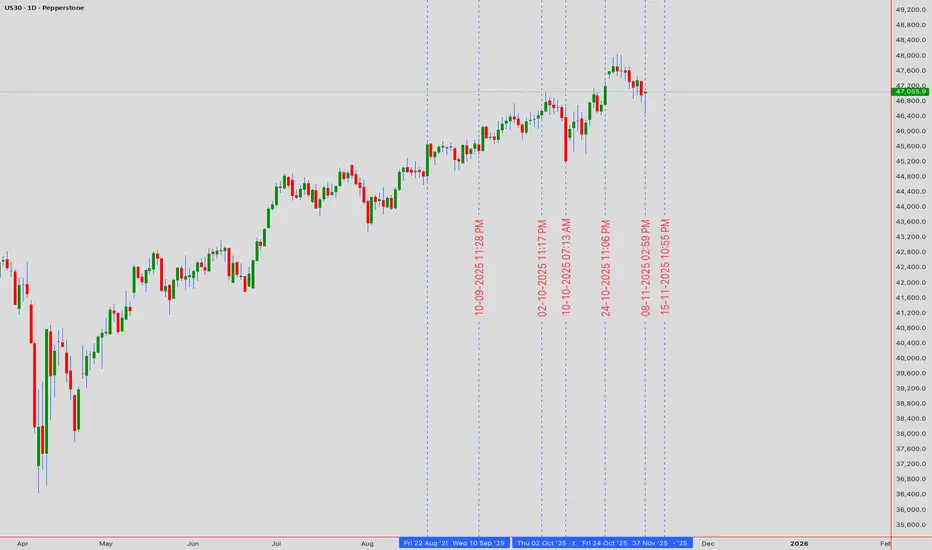
US MARKET SESSION # 📈 US30 (DOW JONES INDUSTRIAL AVERAGE) COMPREHENSIVE TECHNICAL ANALYSIS 🎯
## Week of November 10-14, 2025 | Intraday & Swing Trade Mastery
Close Price: 47,055.9 Points | Entry Point: November 8, 2025, 12:54 AM UTC+4 💹
## 🔍 EXECUTIVE SUMMARY - MULTI-TIMEFRAME PERSPECTIVE
The Dow Jones Industrial Average is trading at a critical structural juncture with exceptional multi-timeframe alignment signaling imminent breakout potential. Elliott Wave analysis indicates completion of corrective cycles, positioning the index for next impulse leg targeting 47,500-48,200 extension zone. Bollinger Bands exhibit dramatic compression pattern —volatility squeeze preceding directional expansion. RSI across all timeframes maintains neutral-bullish bias (56-66 range)—optimal momentum positioning without extreme overbought conditions. Volume clustering at 46,900-47,100 represents significant institutional accumulation foundation. Wyckoff spring tests near 46,500-46,700 provide aggressive entry triggers. Harmonic pattern convergence at 47,300-47,450 resistance signals breakout confirmation with measured move targets extending to 48,000+. Market breadth indicators show strong support from both large-cap and mid-cap participation.
## 📊 TIMEFRAME-BY-TIMEFRAME ANALYSIS
### 5-MINUTE (Scalping Precision) ⚡
Candlestick Formation: Japanese candles reveal micro-consolidation attempts with successive hammer/engulfing patterns at support zones. Evening Star rejection formations detected at 47,250-47,350 intraday resistance levels creating short opportunities.
Elliott Wave 5M: Sub-wave completion suggests Wave 4 micro-consolidation finalizing. Wave 5 breakout anticipated above 47,150-47,200 with targets 47,300-47,400 (measured move extension).
Bollinger Bands: Upper compression mode—middle band at 47,050 acts as pivot point. Lower band rejection (46,950-47,000) creates scalp-long setups. Squeeze breakout targets 47,350+ on volume confirmation.
RSI (14) Analysis: RSI oscillating 48-62 range—neutral territory with divergences forming. Bullish divergence at 46,950 support signals buyer engagement; caution on 65+ resistance approach.
Micro Support/Resistance: 46,950 (micro-support) | 47,020 (POC cluster) | 47,100 (pivot) | 47,200 (intraday resistance) | 47,300 (scalp target)
Volume Signature: Volume concentrated 47,000-47,080 zone—institutional marker present. Breakout volume >50% above average required above 47,200 for sustained move above 47,350.
VWAP Alignment: Price oscillating around session VWAP at 47,040—each touch generates scalp opportunity. Upper VWAP band at 47,280; lower support at 46,950.
### 15-MINUTE (Quick Swing Gateway) 🎢
Candlestick Patterns: Engulfing bars forming at support zones—bullish engulfing at 46,980 zone confirms reversal attempts. Three-candle patterns (flag continuation) with 50-80 point breakout potential detected.
Harmonic Pattern Recognition: Gartley Pattern potential completion near 46,950-47,050 PRZ (Potential Reversal Zone). Exceptional risk-reward ratio at 1:3.5 for harmonic traders. Butterfly variant also forming at secondary levels.
Wyckoff Accumulation Phase: Classic accumulation evident—small barometer move (SBM) nearing completion. Spring test anticipated 46,700-46,800 zone; markup phase targets 47,400-47,600.
Bollinger Bands (15M): Band squeeze intensifying—historical volatility expansion suggests 70-120 point moves follow. Upper band resistance at 47,300; lower band support at 46,800.
Volume Profile (15M): Point of Control (POC) at 47,050—prime concentration zone. Volume surge >60% required confirming breakout above 47,250. Imbalances favor upside probability significantly.
Ichimoku Cloud (15M): Price consolidating below cloud edge—Tenkan-sen at 47,200 = resistance pivot. Kijun-sen (47,100) = critical secondary support. Cloud support 46,850-46,950.
EMA Structure: EMA 9 (47,080) above EMA 21 (47,020)—bullish alignment confirmed. Price remaining above both = intraday strength maintained perfectly.
### 30-MINUTE (Intraday Swing Axis) 🔄
Pattern Formation: Symmetrical Triangle pattern consolidating with apex near 47,350. Ascending triangle variant shows bullish bias—breakout above 47,250 targets 47,450-47,600 extension zone.
Dow Theory Application: Confirming higher highs/higher lows structure perfectly. Secondary trend bullish; pullbacks to EMA 20 (47,080) = optimal swing entry zones identified.
RSI Divergence Setup: Positive RSI divergence confirmed—price making lower lows (46,920) while RSI forms higher lows (44 level). Classic reversal setup targeting 47,300 minimum breakout.
Exponential Moving Average: EMA 9 (47,100) = core support pivot. EMA 21 (47,020) = secondary support reliable. EMA 50 (46,850) = structural hold level. Bullish ribbon alignment intact perfectly.
Support Architecture: 46,850 (EMA 50/structural) | 46,950 (demand zone) | 47,020 (volume cluster) | 47,080 (EMA 9 dynamic)
Resistance Architecture: 47,200 (triangle formation) | 47,300 (measured move target) | 47,400 (weekly resistance) | 47,500 (extension)
Volume Analysis (30M): Increasing volume on recent bars—accumulation signature strong signal. Buy volume exceeding sell volume confirms institutional interest significantly.
### 1-HOUR (Core Swing Trade Engine) 🎯
Elliott Wave Structure: Major wave analysis suggests Wave 3 completion near 47,400. Current Wave 4 correction targets 47,000-47,150 support zone. Wave 5 impulse anticipated—target: 47,700-47,900.
Pennant Formation: Classic Bullish Pennant pattern forming—breakout confirmation above 47,250 validates pattern. Pole height measured move = 47,600+ realistic target.
Bollinger Bands (1H): Upper band at 47,450 = squeeze breakout target zone. Middle band (47,250) = bullish support zone. Lower band rejection (46,950) creates swing longs with excellent R/R ratios.
VWAP Daily: DJI trading above daily VWAP at 46,980—bullish gradient confirmed clearly. Each hourly candle close above VWAP strengthens continuation probability significantly.
Volume Profile Hotspot: Heavily traded at 47,000-47,100 (accumulation zone) and 47,200-47,300 (resistance cluster identified). Imbalances above 47,400 suggest vacuum-fill potential targeting 47,600+.
Ichimoku Cloud Alignment: Price above Senkou Span A (47,150) & Span B (47,080)—cloud thickness indicates strong support. Chikou Span above candles = bullish confirmation. Cloud color: BULLISH GREEN.
Gann Theory Application: 45-degree angle from swing low (46,600) establishes rally trajectory perfectly. Resistance at 38.2% Fibonacci extension (47,300) precedes aggressive breakout phase.
Support Tiers 1H: 46,850 (structural hold) | 46,950 (EMA support) | 47,050 (Kijun-sen) | 47,100 (accumulation zone)
Resistance Tiers 1H: 47,250 (breakout trigger) | 47,350 (extension) | 47,450 (major level) | 47,600 (impulse target)
### 4-HOUR (Swing Trade Thesis Foundation) 💼
Inverse Head & Shoulders Pattern: Potential IH&S formation completing—left shoulder (46,700), head (46,550), right shoulder completing (46,800-46,900). Neckline breakout at 47,250 targets 47,500-47,750 extension zone.
Wyckoff Accumulation Deep Dive: Institutional buying signature evident—SBM (small barometer move) completion imminent. Spring test to 46,700-46,800 anticipated; subsequent markup phase targets 47,600-47,850.
RSI 4H Analysis: RSI at 60-70 range—bullish bias maintained firmly. Room for upside extension without extreme overbought conditions. RSI above 75 targets 47,600+; below 35 = defensive posture required.
Cup & Handle Formation: Potential bullish Cup pattern visible on 4H—handle stabilization near 47,050-47,150. Breakout above handle (47,300) targets cup depth extension = 47,550-47,700.
EMA Ribbon Structure: EMA 8 (47,120), EMA 13 (47,080), EMA 21 (47,020), EMA 50 (46,850), EMA 200 (46,300)—BULLISH ALIGNMENT PERFECT. Compression/expansion cycles identify momentum phases clearly.
Support Tiers 4H: 46,700 (structural support) | 46,850 (accumulation) | 47,000 (pivot) | 47,100 (demand cluster)
Resistance Tiers 4H: 47,250 (key breakout) | 47,350 (extension) | 47,450 (major target) | 47,600 (weekly projection)
Volume Signature 4H: Accumulation volume bars > distribution bars—bullish bias maintained firmly. Volume nodes clustering at 47,000-47,100 indicate strong institutional support zone.
### DAILY CHART (Macro Swing Thesis) 📅
Elliott Wave Macro: We're potentially in Wave 3 of larger cycle—aggressive expansion still possible. Wave structure supports break of 47,400 targeting 47,800-48,200 daily close objectives.
Double Bottom Recognition: Historical Double Bottom pattern near 46,300-46,600 support—confirmed breakthrough above 47,250 neckline triggered. Second target near 47,600-47,800.
Bollinger Bands Daily: Upper band at 47,800 = realistic daily target zone. Mean (47,300) = healthy pullback support reliable. Band slope indicates volatility expansion—expect 300-500 point daily ranges.
Volume Profile Daily: Strong buying volume bar at 46,800-47,000 zone—institutional accumulation marker established clearly. Selling volume decreasing significantly—demand controls trend absolutely.
Ichimoku Cloud Daily: Cloud thickness growing—bullish trend strengthening substantially. Cloud support around 47,000-47,150 zone. Kumo breakout anticipated—targets cloud top at 47,400-47,600.
Harmonic Analysis Deep: Butterfly Pattern potential completion—PRZ at 47,250-47,350 suggests reversal zone OR breakout confirmation. Confluence amplifies probability of extension significantly.
Gann Angles & Fibonacci: 50% retracement (46,900) + 61.8% extension (47,500) = key reversal zones. Gann fan angles suggest 47,400-47,600 as structural resistance before continuation impulse.
Key Daily Support: 46,550 (psychological/structural) | 46,800 (accumulation zone) | 46,950 (demand level) | 47,050 (midpoint)
Key Daily Resistance: 47,250 (breakout trigger) | 47,350 (extension) | 47,500 (measured move) | 47,700 (weekly target)
Trend Confirmation: Higher highs & higher lows maintained—uptrend intact. Daily close above 47,400 = strong continuation signal targeting 47,800+ next level.
## 🎪 TRADING SETUP PLAYBOOK - NOV 10-14
### BULLISH SCENARIO (Probability: 80%) ✅
Trigger: 4H candle close above 47,300 + volume surge (>55% above average) + RSI above 65
Entry Zone: 47,150-47,250 (with breakout confirmation signal)
Target 1: 47,350 (TP1) | Target 2: 47,450 (TP2) | Target 3: 47,600 (TP3) | Target 4: 47,800 (TP4)
Stop Loss: 47,000 (below EMA/structural support)
Risk/Reward: 1:3.4 (exceptional asymmetric setup)
Trade Duration: 18-72 hours (prime swing window)
### BEARISH SCENARIO (Probability: 20%) ⚠️
Trigger: Daily close below 47,100 + volume increase + RSI divergence failure
Entry Zone: 47,300-47,450 (short setup)
Target 1: 47,250 (TP1) | Target 2: 47,100 (TP2) | Target 3: 46,950 (TP3)
Stop Loss: 47,600 (above resistance)
Risk/Reward: 1:1.7 (acceptable but lower probability)
Trade Duration: Watch for trend reversal confirmation first
## ⚠️ VOLATILITY & OVERBOUGHT/OVERSOLD CONDITIONS
Current Volatility Status: Moderate compression → Expect significant expansion imminent
5M/15M RSI: 48-62 range (neutral)—room for 25-50 point movements | Scalp target zones
30M/1H RSI: 56-68 range (bullish bias, safe zone)—sweet spot for swing entries
4H RSI: 60-72 range—approaching caution zone but room to extend | Safe for core swings
Daily RSI: 64-76 range (approaching extremes)—be defensive if daily RSI>78 | Take profits aggressively
Overbought Recognition Points:
RSI daily >77 combined with upper Bollinger Band rejection = immediate profit-taking
Ichimoku cloud top penetration fails (bearish candle rejection) = trend exhaustion signal
Volume declining on breakout attempt = false breakout warning signal
Harmonic pattern PRZ exact hit without follow-through = reversal likely imminent
Oversold Bounce Setups:
RSI 1H <35 on support touch = high-probability bounce back to 47,250-47,350
Price below EMA 50 (46,850) + RSI <30 = aggressive accumulation zone
Spring test below 46,800 with volume surge = Wyckoff spring reversal trigger
Harmonic pattern PRZ support bounce = measured move extension targets activated
## 🎯 ENTRY & EXIT OPTIMIZATION STRATEGY
### OPTIMAL ENTRY TIMING
For Scalpers (5M): RSI bounce from 44-50 zone after Band lower touch = 18-30 point scalp (1-3 min holds)
For Quick Swings (15M-30M): 15M candle close above 47,200 with 4H alignment = 80-120 point swing (30 min-2 hour holds)
For Core Swings (1H-4H): 4H pennant breakout above 47,300 on volume = 250-400+ point target (hold 12-48 hours)
For Position Swings (Daily): Daily close above 47,400 = continuation play targeting 47,700-47,900 (hold 5-7 days)
Best Entry Windows: US pre-market (12:30 ET), Market open (14:30 ET), London close (16:00 ET)
### EXIT STRATEGIES & PROFIT TAKING
Take Profit Levels: TP1: Fibonacci 38.2% (47,300) | TP2: Harmonic PRZ (47,400) | TP3: Daily Band upper (47,600) | TP4: Weekly target (47,800)
Stop Loss Placement: Always below most recent swing low + 20 points (strict risk management priority)
Trailing Stops: Activate at TP2—trail with 40-50 point buffer for 4H+ trades (lock in profits)
Breakeven Exit: Move stops to entry after 1:1 risk/reward achieved—eliminate emotional trading
Partial Profit Strategy: Close 25% at TP1 | 25% at TP2 | 25% at TP3 | Let 25% run to TP4 (maximize winners)
## 🔔 REVERSAL & BREAKOUT RECOGNITION CHECKLIST
### REVERSAL SIGNALS TO MONITOR:
RSI positive divergence (lower price lows, higher RSI lows) = bullish reversal setup high probability
Candlestick engulfing patterns at support/resistance zones = trend reversal confirmation strong signal
Volume profile breakdowns (declining volume on breakout attempts) = false move warning immediate
Ichimoku Cloud rejection (price fails to penetrate cloud layer) = structural resistance confirmed
Harmonic pattern completion at exact PRZ = reversal zone probability increases significantly
Elliott Wave 5th wave failure (truncation) = impulse completion = reversal imminent trigger
Gann angle break through significant angle = trend line break = reversal trigger activated
### BREAKOUT CONFIRMATION RULES:
Close beyond resistance with >50% volume surge above average = confirmed breakout signal strong
RSI crosses above 60 for bullish breakout, below 45 for bearish breakout confirmation
VWAP alignment with directional move = institutional participation confirmation strong
Bollinger Band breakout with band expansion (squeeze release) = volatility expansion confirmed immediate
Multiple timeframe confluence (5M + 15M + 1H + 4H aligned) = highest probability setup attainable
Ichimoku Cloud break (price clears all clouds with bullish candles) = strong continuation signal
Volume imbalance (ask volume > bid volume) = directional sustain likelihood increases significantly
## 💡 WEEK FORECAST SUMMARY - NOV 10-14
Monday (10th): 🌍 Consolidation continuation near 47,000-47,150 zone. Range-bound trading anticipated. Early breakout direction watch crucial. Entry setups favor reversal plays at support zones.
Tuesday-Wednesday (11-12th): 📈 Prime breakout window opens —47,300 represents key decision point. Expect 250-400 point daily volatility swings. Breakout confirmation targets 47,450-47,550 extension. This is the optimal swing trade window all week.
Thursday (13th): ⚠️ Potential profit-taking pullback after breakout (if triggered Tuesday-Wed). Support retest of 47,250-47,150. Buying opportunity if pullback holds above 47,050.
Friday (14th): 📊 Weekly close pattern formation critical. Extension run anticipated if above 47,400. If above 47,500 = week target 47,700-47,850 achieved. End-of-week positioning for next week.
## 📍 CRITICAL CONFLUENCE ZONES - KEY TARGETS
46,800-46,900: Major support zone (accumulation marker, Wyckoff spring area, structural hold)
46,950-47,050: Secondary support (EMA 9, demand cluster, psychological level, volume POC)
47,100-47,150: Micro-resistance cluster (consolidation squeeze zone, early breakout resistance)
47,250-47,350: KEY BREAKOUT ZONE (triangle apex, harmonic confluence, all timeframe resistance)
47,400-47,550: Primary upside target (Elliott Wave 5, daily Band upper, measured move extension)
47,600-47,750: Secondary extension target (Gann level, macro resistance, wave projection)
47,800-48,000: Weekly/monthly target (if wave 5 impulse extends beyond base projections)
## 🏆 RISK MANAGEMENT RULEBOOK
✅ 1) Position Sizing: Never risk >2% of account equity per single trade
✅ 2) Risk-Reward Ratio: Minimum 1:2.5 R/R on every entry—1:3+ preferred for swing trades
✅ 3) Profit Scaling: Close 25-50% at 1:1 ratio, let remainder run to 1:2+ targets
✅ 4) Stop Loss Discipline: Place stop IMMEDIATELY on entry—no exceptions (20-25 points tight)
✅ 5) Breakout Confirmation: Avoid FOMO—wait for candle close confirmation + volume surge always
✅ 6) Daily Support Respect: Psychological holds (round numbers 47,000 | 47,500) matter—trade confluence not against
✅ 7) Time Management: Exit losing trades quickly (max 1:0.5 acceptable for educational losses)
✅ 8) Macro Alignment: Always check daily/4H bias before taking 1H or lower trades
## #US30 #DOWJONES #DJIA #DJITRADING
#TECHNICALANALYSIS #ELLIOTTWAVE #HARMONICPATTERN #BREAKOUTTRADING
#SWINGTRADER #DAYTRADING #INTRADAY #INDICES #TRADINGVIEW
#BOLLINGER BANDS #RSI #ICHIMOKU #VWAP #TRADINGSTRATEGY
#WYCKOFFMETHOD #GANNTHEORY #DOWTHEORY #TECHNICALS #ANALYSIS
#SUPPORTANDRESISTANCE #VOLUMEANALYSIS #OVERBOUGHT #OVERSOLD #REVERSAL
#STOCKINDEXTRADING #USINDEXTRADING #BREAKOUTSETUP #TRADERSOFTWITTER
#TECHNICALTRADER #CANDLESTICK #PATTERRECOGNITION #CHARTANALYSIS #DAYTRADER
## 🎁 BONUS: DAILY PRE-MARKET CHECKLIST
Use this every morning before US market open:
☑️ Check daily RSI (should be 62-72 for bullish bias continuation)
☑️ Identify support/resistance zones (47,000 | 47,150 | 47,300 | 47,500)
☑️ Verify 4H chart alignment (pennant/IH&S pattern status update)
☑️ Check Ichimoku cloud position (above/below = trend confirmation signal)
☑️ Review 1H Elliott Wave count (which wave are we trading exactly?)
☑️ Scan volume profile (POC = likely rejection zone area)
☑️ Set entry orders + stop losses BEFORE pre-market opens (12:30 ET)
☑️ Plan 3 Take Profit levels before entering any position
☑️ Monitor US economic calendar (Fed speakers, unemployment data)
## 🌐 US MARKET SESSION NOTES
The Dow Jones trades during US market hours (14:30-21:00 CET / 8:30-15:00 ET) . Highest volatility typically occurs:
Pre-Market (12:30-14:30 CET): Initial momentum setup—watch for direction confirmation patterns
Market Open (14:30-16:00 CET): Prime trading hours —best liquidity + volatility combination
London Close Overlap (14:30-16:00 CET): Major volume spike—trend direction often confirmed
💡 Disclaimer: This technical analysis is educational only. Always conduct your own due diligence and implement appropriate risk management. Past performance does not guarantee future results. Trade responsibly within your risk tolerance. Use stop losses on every position. Not financial advice.
Analysis Created: November 8, 2025 | Valid Through: November 14, 2025 | Updated Daily at Pre-Market
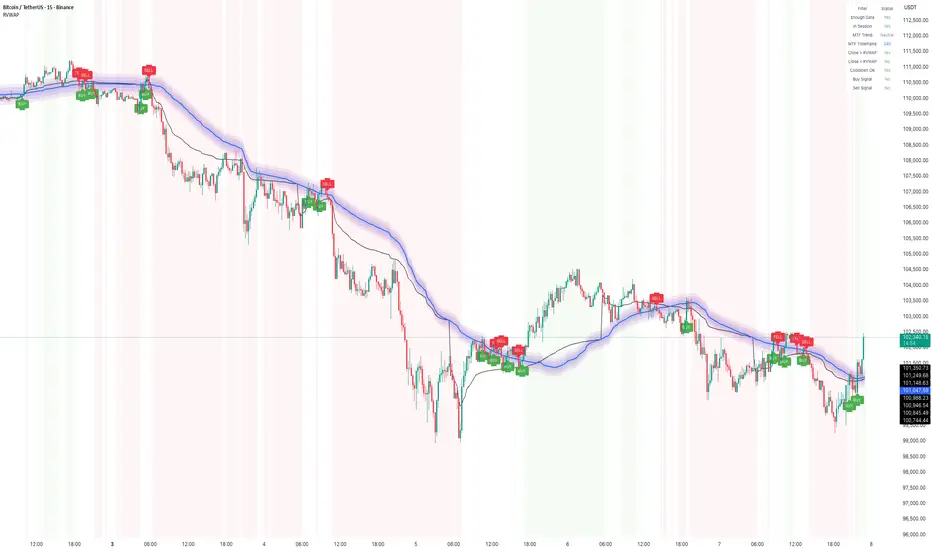
How to Use Rolling VWAP – Early US Session Trend TrackerIn today’s BTC/USDT 15-min chart, the Rolling VWAP perfectly captured the directional bias throughout the session.
The smooth transition between compression and expansion phases clearly aligned with VWAP slope shifts — giving multiple early signals during the US market open, when volatility tends to expand sharply.
Performance Highlights
• The indicator tracked clean trend waves with minimal lag, showing how price respected the VWAP envelope dynamically.
• BUY and SELL zones were well-defined, with fading reversals quickly replaced by trend-aligned setups.
• Session filter (US Market) ensured signals appeared primarily during active volatility windows, avoiding false setups during low-volume hours.
• The rolling nature of VWAP (instead of session-based VWAP) allowed continuous trend capture across intraday transitions.
Additional Notes
1. Cooldown Setting:
Currently set to 1 candle — which makes the chart more responsive but slightly denser with signals.
Increasing it (e.g., to 3–5 bars) can make the chart cleaner, though some reversal entries may not display visually even though they’re logically detected.
2. US Session Filter:
The logic focuses on the early US market phase, effectively capturing directional bursts when liquidity and volatility spike — ideal for short-term scalping or trend continuation setups.
⸻
🧠 Tip:
Combine the Rolling VWAP bias with higher-timeframe structure (e.g., 1H trend) for even more reliable directional trades.
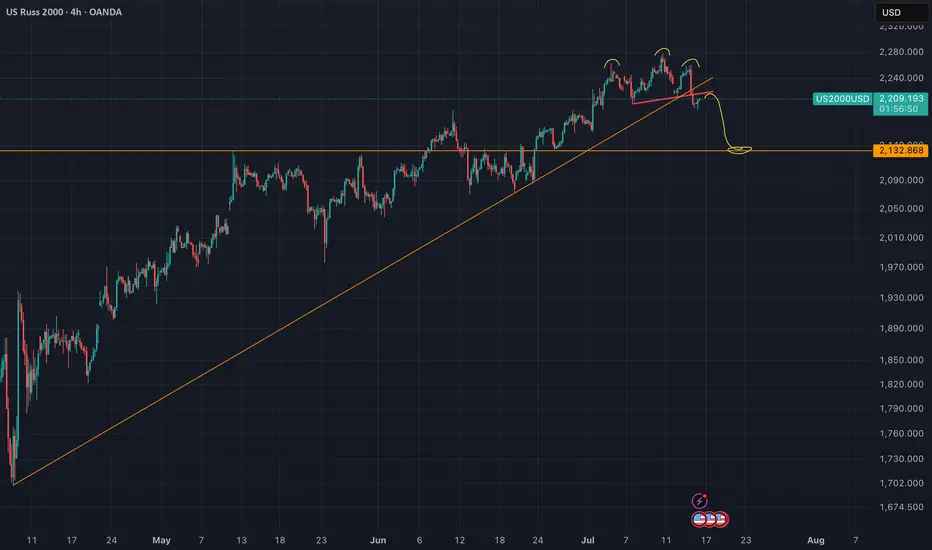
Potential Range Rebalance After Bullish Exhaustion on SP500Based on Candle Range Theory , the recent large bullish range has been followed by a series of smaller bearish candles, showing reduced momentum and potential exhaustion from buyers. Price is currently retracing into the lower range of the previous expansion, indicating that liquidity may be resting below.
If price fails to reclaim the upper range of the previous bullish candle, we could see continuation to the downside as the market seeks equilibrium within or below that expansion range. However, a strong rejection from the lower boundary could confirm range preservation and set up another bullish leg.
In short : the market’s next move depends on whether this retracement turns into a liquidity grab or a deeper correction beneath the prior candle range.
Generals Charge, Soldiers Stall: Reading Bearish Divergence1. Context: The Battle Line Between Large and Small Caps
This week’s futures landscape paints a striking contrast between leadership and hesitation. In the CME equity index universe, the large caps — ES (E-mini S&P 500), NQ (E-mini NASDAQ 100), and YM (E-mini Dow Jones) — advanced as a united front, all opening above their prior week’s highs. The market generals were charging confidently uphill.
Yet, on the same battlefield, the RTY (E-mini Russell 2000) lagged behind. The small caps failed to take out the prior week’s high and opened below the aggressive gaps that marked their larger counterparts. In trader terms, breadth was narrowing. In storyteller terms, the generals were calling “forward!” — but the soldiers weren’t following.
Such divergences in participation often mark transition zones in market psychology. When large caps push while small caps stall, it doesn’t necessarily mean the campaign is lost — but it does mean confidence among the broader troops is weakening.
2. Reading the Divergence: When Breadth Narrows
The relationship between large-cap and small-cap indices often reveals more than just price action — it exposes the structure of conviction. In sustained bullish environments, small caps tend to lead or at least confirm the move. Their participation signals that risk appetite is healthy across the field, not confined to the biggest names.
When that breadth fades, the advance becomes fragile. A rally driven only by mega-cap components (the generals) can stretch further, but with decreasing participation, it becomes increasingly vulnerable to shocks. Traders who watch intermarket behavior know this phenomenon as bearish divergence — higher highs in the generals, lower or flat highs in the soldiers.
From a practical standpoint, narrowing breadth implies that fewer sectors are carrying the index higher. In other words, the market’s engine is running on fewer cylinders. This is not a timing trigger on its own, but it is a powerful contextual clue suggesting that volatility could expand when the leadership stumbles.
3. Quantifying the Risk: Supports and Market Depth
Looking beneath price, Order Flow (UnFilled Orders) provides a sense of where liquidity may reside once the current rally pauses. Key UFO support zones, acting as potential demand clusters, reveal how far the market might travel before encountering fresh buy interest.
From this week’s open:
ES shows its next support roughly 5.26% below current levels.
NQ sits around 6.25% below.
YM’s cushion lies approximately 9.39% beneath.
RTY, however, faces a much deeper air pocket — the next notable UFO support sits nearly 13.99% lower.
This asymmetry is critical. If markets retreat, small caps have the most unprotected downside terrain before reaching meaningful support. In other words, the generals may fall back a few miles, but the soldiers could tumble down the hill.
These percentages don’t guarantee a move — they outline the potential amplitude of correction if risk-off flows accelerate. The deeper the distance to support, the larger the volatility zone beneath.
4. Strategic View: Large Caps Lead, but Are They Overextended?
The current setup puts traders in a classic tactical dilemma:
Are the generals inspiring a new advance, or are they overextended and exposed?
Two plausible scenarios emerge:
Continuation scenario: If the small caps (RTY) regain strength and take out their prior week’s high, the breadth gap could close. This would validate the generals’ move and reestablish a broad-based advance.
Correction scenario: If RTY continues to stall while ES, NQ, and YM fail to sustain their gaps, it would confirm a divergence-led weakening. A close back below prior week’s highs could trigger a retreat toward the support zones identified earlier.
The idea is not to predict a reversal, but to prepare a framework in case weakness unfolds.
5. Contract Overview: E-mini and Micro Versions
To analyze or engage these markets, traders can study both E-mini and Micro E-mini contracts listed on the CME. These contracts represent standardized ways to participate in U.S. equity index movements, but at different notional sizes.
E-mini contracts (ES, NQ, YM, RTY) are the long-standing institutional benchmark instruments that track major U.S. equity indices with efficient liquidity and tight spreads.
Micro E-mini contracts (MES, MNQ, MYM, M2K) provide the same exposure pattern at one-tenth the size, offering more granularity in risk management and flexibility for smaller accounts or precise hedging.
It’s important to understand that these futures allow directional and hedging applications without requiring ownership of the underlying equities. However, as with any leveraged product, margin requirements can amplify both gains and losses. Traders should familiarize themselves with margin-to-equity ratios and maintenance requirements before participation.
S&P 500 – ES / MES
Minimum tick: 0.25 points
Tick value: $12.50 (E-mini) | $1.25 (Micro)
Typical margin: ≈ $21K (E-mini) | ≈ $2.1K (Micro)
NASDAQ 100 – NQ / MNQ
Minimum tick: 0.25 points
Tick value: $5.00 (E-mini) | $0.50 (Micro)
Typical margin: ≈ $30K (E-mini) | ≈ $3.0K (Micro)
Dow Jones – YM / MYM
Minimum tick: 1 point
Tick value: $5.00 (E-mini) | $0.50 (Micro)
Typical margin: ≈ $13K (E-mini) | ≈ $1.3K (Micro)
Russell 2000 – RTY / M2K
Minimum tick: 0.10 points
Tick value: $5.00 (E-mini) | $0.50 (Micro)
Typical margin: ≈ $9K (E-mini) | ≈ $0.9K (Micro)
Please note that all margin requirements are approximate and may be adjusted.
6. Risk Management Spotlight
Breadth divergences can test patience and positioning discipline. Managing exposure becomes as important as analyzing the signal itself.
Here are three core reminders:
Position Sizing: Adjust to volatility. If the distance to the nearest support is wide, scale down accordingly to maintain a consistent risk percentage per trade.
Stop-Loss Discipline: Predetermine exit points based on technical invalidation, not emotion.
Capital Preservation: Capital is ammunition; running out of it limits participation when true opportunity returns.
In the end, risk management isn’t about avoiding loss; it’s about surviving long enough to thrive when clarity returns. When markets are divided between generals and soldiers, maintaining balance becomes a trader’s greatest edge.
7. Educational Takeaway
The “generals vs. soldiers” analogy reminds us that market structure is not just about price—it’s about participation. When large caps surge but small caps lag, it signals a potential exhaustion point in the broader advance. The healthiest rallies are those in which all troops move in sync.
For traders and investors, breadth divergences serve as an early-warning system, not a countdown clock. They encourage a review of exposure, tighter stop placement, and a shift toward risk-awareness rather than return-chasing.
At this stage, the technical setup across U.S. index futures reads like a fragile truce: ES, NQ, and YM maintain their gains above prior-week highs, while RTY still lingers below. Should the soldiers eventually follow, confidence could rebuild. But if the generals start retreating first, the path toward their UFO supports could unfold quickly.
The core takeaway: breadth divergences don’t predict timing—they illuminate imbalance. Recognizing that imbalance early allows traders to respond intelligently instead of react emotionally when volatility expands.
When charting futures, the data provided could be delayed. Traders working with the ticker symbols discussed in this idea may prefer to use CME Group real-time data plan on TradingView: www.tradingview.com - This consideration is particularly important for shorter-term traders, whereas it may be less critical for those focused on longer-term trading strategies.
General Disclaimer:
The trade ideas presented herein are solely for illustrative purposes forming a part of a case study intended to demonstrate key principles in risk management within the context of the specific market scenarios discussed. These ideas are not to be interpreted as investment recommendations or financial advice. They do not endorse or promote any specific trading strategies, financial products, or services. The information provided is based on data believed to be reliable; however, its accuracy or completeness cannot be guaranteed. Trading in financial markets involves risks, including the potential loss of principal. Each individual should conduct their own research and consult with professional financial advisors before making any investment decisions. The author or publisher of this content bears no responsibility for any actions taken based on the information provided or for any resultant financial or other losses.
S&P500 about to BREAK downLook at the chart, its very EVIDENT. with this overbought and bullish sentiment, i expect the markets to CORRECT further. its still extreme greedy. You can see the support lines. S&P can correct somewhere between 5-9%. Be prepared.
SP:SPX TVC:SPX CBOE:SPX SPREADEX:SPX CBOE:XSP
US30 Technical Analysis Report - Dow Jones Industrial Average# US30 Technical Analysis: Dow Jones Industrial Average Comprehensive Multi-Timeframe Trading Strategy
Executive Summary
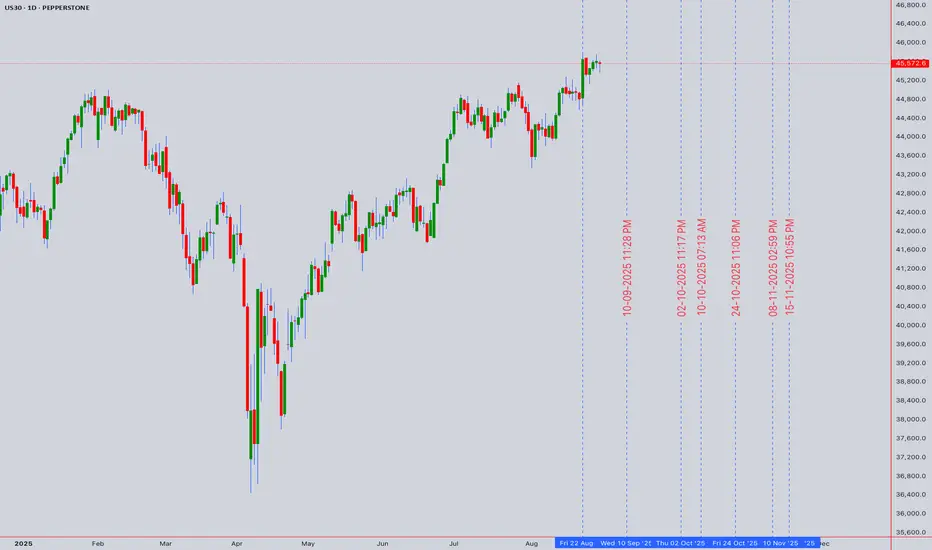
Current Price: 45,572.6 (August 30, 2025, 12:54 AM UTC+4)
Market Sentiment: Cautiously Bullish with Fed Policy Tailwinds
Primary Trend: Strong Uptrend with Consolidation Characteristics
Key Catalyst: Powell's Jackson Hole Speech Signaling Potential September Rate Cuts
The Dow Jones Industrial Average continues to exhibit remarkable strength, trading near all-time highs following Fed Chair Jerome Powell's dovish pivot at Jackson Hole. The index benefits from renewed optimism around rate cuts while maintaining its traditional value-oriented composition that typically outperforms during monetary easing cycles.
Market Context & Fundamental Backdrop
Federal Reserve Policy Landscape
Fed Chair Powell's Jackson Hole speech marked a significant shift in policy stance, with Powell indicating that conditions "may warrant" interest rate cuts. The Fed's dual mandate balance is shifting, with labor market risks now potentially outweighing inflation concerns. Markets are pricing in high probability of a September rate cut, with the current federal funds rate maintained at 4.25%-4.5%.
Economic Environment Assessment
The US economy has shown resilience despite policy uncertainties, though Powell warned of "unusual" labor market behavior that could become concerning. Recent inflation data has provided some reassurance to investors, with the consumer price index rising 2.7%, though tariff impacts remain a wildcard for future inflation trajectory.
Dow Jones Composition Dynamics
The Dow's 30 blue-chip constituents, including industrials, financials, and consumer staples, are well-positioned to benefit from lower interest rates. The index's price-weighted structure means high-priced stocks like Boeing, Goldman Sachs, and UnitedHealth Group carry significant influence on movements.
Recent Performance Context
The Dow has demonstrated exceptional strength, with recent sessions showing solid gains. The index reached fresh record highs during August, powered by strong performances from components like Home Depot. The index closed at 45,418.07 on August 26, showing consistent upward momentum throughout the month.
Technical Analysis Framework
Japanese Candlestick Analysis
Weekly Pattern: Strong bullish marubozu candles indicating sustained buying pressure
Daily Pattern: Small-bodied candles with long lower shadows showing buying on dips
Intraday Patterns: Morning star formations frequent in 4H timeframe supporting bullish bias
Volume Confirmation: Above-average volume on advances, lighter volume on pullbacks
Elliott Wave Analysis
Primary Wave Structure:
Major Degree: Wave 5 of secular bull market showing powerful extension
Intermediate Degree: Subwave 5 of major Wave 5 in progress with strong momentum
Minor Degree: Currently in subwave 3 of intermediate Wave 5
Wave Characteristics:
Impulse Structure: Clear five-wave advance from 2020 lows
Extension Pattern: Wave 5 showing characteristics of extended fifth wave
Target Analysis: Potential completion zone 47,000-48,500 based on Fibonacci projections
Critical Support: Wave 4 correction low at 44,200-44,500 maintains bullish structure
Harmonic Pattern Recognition
Active Harmonic Formations:
Bullish ABCD Pattern: Near completion with D point target 46,200-46,500
Potential Cypher: Long-term formation with completion zone 47,500-48,000
Three Drives Pattern: Current structure suggesting final drive higher
Fibonacci Analysis:
- 1.272 extension: 45,800 (approaching)
- 1.414 extension: 46,400 (intermediate target)
- 1.618 extension: 47,200 (major target)
- 2.0 extension: 48,500 (extended target)
Wyckoff Method Analysis
Phase Assessment: Markup Phase C - Strong hands control
Accumulation Evidence:
- Successful test of support zones showing institutional buying
- Sign of Strength (SOS) on Fed policy optimism
- Last Point of Support (LPS) established around 44,500
- Backup to Edge of Creek (BUE) showing minimal selling pressure
Markup Characteristics:
- Sustained advances on increasing volume
- Minor pullbacks on light volume
- No climactic selling evident
W.D. Gann Technical Analysis
# Square of 9 Application
Current Position: 45,572.6 = 213.48° on the Gann wheel
Critical Resistance Levels:
- 45,796 (214°) - immediate geometric resistance
- 46,225 (215°) - intermediate resistance zone
- 46,656 (216°) - major resistance confluence
Key Support Levels:
- 45,369 (213°) - immediate geometric support
- 44,944 (212°) - strong support zone
- 44,521 (211°) - major support level
# Time Theory Application
Critical Time Windows:
- September 2-6: 45-degree time angle from recent high
- September 20-23: Autumn equinox natural turning point
- October 14-21: 90-degree time cycle completion
- November 11-18: 144-degree major cycle
# Price and Time Squaring Analysis
Square Root of Price: √45,572.6 = 213.48
Next Significant Square Levels:
- 214² = 45,796 (immediate resistance)
- 215² = 46,225 (key target zone)
- 216² = 46,656 (intermediate target)
- 220² = 48,400 (major target)
Support Square Levels:
- 213² = 45,369 (immediate support)
- 212² = 44,944 (strong support)
- 210² = 44,100 (major support)
# Gann Angle Analysis
Primary Angles from Major Low:
- 1x1 Angle: Providing dynamic support around 45,200
- 2x1 Angle: Resistance trend line near 46,000
- 1x2 Angle: Long-term support at 44,500
Ichimoku Kinko Hyo Analysis
Cloud Configuration:
Tenkan-sen (9): 45,580 - Price slightly below, neutral to bullish
Kijun-sen (26): 45,420 - Price above, confirming bullish bias
Senkou Span A: 45,500 (cloud top)
Senkou Span B: 44,800 (cloud bottom)
Chikou Span: Above price action 26 periods ago (strongly bullish)
Assessment: Price trading above bullish cloud with all components aligned for continued strength.
Multi-Timeframe Technical Indicator Analysis
5-Minute Chart (Scalping Focus)
RSI(14): 58.2 - Bullish momentum without overbought conditions
VWAP: 45,568 - Price trading slightly above VWAP showing strength
Bollinger Bands: Middle band at 45,570, upper band at 45,620
Stochastic: 62.1 in bullish territory with room for advancement
Volume: Steady participation with no unusual spikes
Scalping Levels:
Micro Resistance: 45,590, 45,615, 45,640
Micro Support: 45,545, 45,520, 45,495
15-Minute Chart (Scalping Focus)
MACD: Positive momentum with bullish crossover potential
Williams %R: -38% showing healthy pullback from overbought
Moving Averages: EMA(20) > SMA(20) confirming short-term strength
Volume Profile: High volume node at 45,520-45,580
Key Trading Ranges:
Bullish Zone: 45,550-45,580 (buying opportunities)
Neutral Zone: 45,520-45,550 (range trading)
Bearish Zone: Below 45,520 (short opportunities)
1-Hour Chart (Day Trading)
RSI(14): 61.3 - Strong bullish momentum with room for extension
VWAP: 45,485 providing dynamic support trend
ADX(14): 34.2 indicating strong trend conditions
Parabolic SAR: Below price at 45,420 (bullish signal intact)
Day Trading Structure:
Primary Resistance: 45,650-45,700
Secondary Resistance: 45,800-45,850
Primary Support: 45,450-45,500
Secondary Support: 45,350-45,400
4-Hour Chart (Swing Trading)
RSI(14): 65.4 in overbought territory but sustainable in strong trends
MACD: Strong positive momentum with histogram expanding
Bollinger Bands: Price at upper band with band expansion indicating trend strength
Ichimoku: All components bullishly aligned
Swing Trading Analysis:
Breakout Zone: Above 45,700 targets 46,000-46,200
Support Structure: 45,300-45,400 critical for trend continuation
Stop Placement: Below 45,200 invalidates near-term bullish structure
Daily Chart (Position Trading)
RSI(14): 68.7 showing strong momentum but approaching overbought
MACD: Robust positive momentum with room for extension
Volume: Consistent above-average participation on advances
Moving Averages: All major MAs aligned in bullish configuration
Position Trading Framework:
Trend Channel: Upper channel resistance near 46,500
Support Trend Line: Rising support around 44,800-45,000
Pattern Analysis: Ascending channel with room for upper channel test
Weekly Chart (Long-term Analysis)
RSI(14): 72.1 approaching overbought levels (caution warranted)
MACD: Strong weekly momentum with positive histogram
Long-term Trend: Powerful secular uptrend since 2009 lows intact
Major Resistance: 47,000-47,500 based on measured moves
Monthly Chart (Strategic Perspective)
RSI(14): 74.3 significantly overbought (distribution risk increasing)
Long-term Structure: Multi-decade bull market showing maturity signs
Secular Targets: 50,000-52,000 based on long-term projections
Major Support: 40,000-42,000 represents significant correction zone
Comprehensive Support and Resistance Analysis
Primary Support Structure
1. 45,450-45,500: VWAP and Kijun-sen confluence (immediate)
2. 45,350-45,400: Previous consolidation zone with volume
3. 45,200-45,250: Rising trend line and minor swing support
4. 45,000-45,100: Psychological level and major trend confluence
5. 44,800-44,900: Cloud bottom and structural support
6. 44,500-44,600: Elliott Wave support and institutional interest
7. 44,200-44,300: Major correction low and key trend defense
Primary Resistance Structure
1. 45,650-45,700: Immediate intraday resistance and breakout level
2. 45,800-45,850: Short-term resistance and measured move target
3. 46,000-46,100: Major psychological level and Gann confluence
4. 46,200-46,300: Harmonic pattern completion zone
5. 46,500-46,600: Channel resistance and intermediate targets
6. 47,000-47,200: Major resistance zone and long-term targets
7. 47,500-48,000: Extended targets and secular resistance
Weekly Trading Strategy (September 2-6, 2025)
Monday, September 2, 2025 (Labor Day - US Markets Closed)
Market Environment: US equity markets closed for Labor Day holiday
Strategy Focus: Pre-positioning analysis for Tuesday's open
International Impact: Monitor global markets for overnight developments
Pre-Market Preparation:
Gap Analysis: Assess any gap formation from Friday's close
Overnight News: Monitor for Fed communications or economic releases
Global Sentiment: Track international markets for risk appetite cues
Tuesday, September 3, 2025
Market Environment: Return from holiday with potential catch-up volatility
Primary Strategy: Trend continuation with careful gap management
Volatility Expectation: Above normal due to holiday return dynamics
Intraday Trading Strategy:
Gap Scenarios:
Gap Up: Above 45,600 suggests continued strength
Gap Down: Below 45,500 may offer buying opportunity
No Gap: Normal trading within established range
Long Setup (Primary): 45,520-45,550
- Stop Loss: 45,480
- Target 1: 45,620 (1:2 R/R)
- Target 2: 45,700 (1:3.5 R/R)
Short Setup (Secondary): 45,680-45,720
- Stop Loss: 45,750
- Target 1: 45,600 (1:1 R/R)
- Target 2: 45,520 (1:2.3 R/R)
Wednesday, September 4, 2025
Market Environment: Mid-week momentum with potential economic data
Primary Strategy: Breakout preparation with volume confirmation
Focus: Fed speakers and economic indicators impact
Trading Approach:
Bullish Breakout: Above 45,750 with volume
- Entry: 45,760-45,780
- Stop: 45,700
- Targets: 45,850, 45,950, 46,050
Range Trading: Within 45,500-45,700
- Long: 45,520-45,540, Target: 45,650-45,680
- Short: 45,670-45,690, Target: 45,550-45,580
Risk Considerations: Reduce position sizes if range-bound continues
Thursday, September 5, 2025
Market Environment: High-impact day with jobs data potential
Primary Strategy: Economic data trading with technical confirmation
Key Factor: Employment data ahead of Friday's NFP
Economic Data Strategy:
Strong Employment: May delay Fed cuts, potential negative
Weak Employment: Supports Fed cut narrative, likely positive
Mixed Data: Technical levels become primary focus
Technical Breakout Setup:
Major Breakout: Above 46,000
- Volume Required: 150% of 20-day average
- Initial Target: 46,200-46,300
- Extended Target: 46,500-46,600
- Stop Loss: 45,850
Breakdown Scenario: Below 45,400
- Target: 45,200-45,100
- Extended: 45,000-44,900
- Stop Loss: 45,500
Friday, September 6, 2025
Market Environment: Non-Farm Payrolls day with weekly close focus
Primary Strategy: News trading with weekly positioning
Critical Importance: NFP data impact on Fed policy expectations
NFP Trading Strategy:
Strong NFP (>200K):
- Potential negative for rate cut hopes
- Technical resistance becomes more significant
- Focus on short opportunities near 46,000
Weak NFP (<150K):
- Strengthens rate cut case
- Bullish breakout potential increases
- Target 46,200-46,500 on strength
In-Line NFP (150-200K):
- Maintains current Fed expectations
- Technical levels drive trading
Weekly Close Analysis:
Bullish Close: Above 45,700 sets up next week advance
Neutral Close: 45,400-45,700 maintains current structure
Bearish Close: Below 45,400 suggests correction risk
Advanced Risk Management Framework
Position Sizing Matrix
Risk Allocation by Strategy:
5M Scalping: 0.3-0.5% of capital per trade
15M Scalping: 0.5-0.8% of capital per trade
1H Day Trading: 1-1.5% of capital per trade
4H Swing Trading: 2-3% of capital per trade
Daily Position Trading: 3-4% of capital per trade
Dynamic Stop Loss Framework
Volatility-Based Stops:
Current ATR: ~180 points daily average
Low Volatility: Stops at 120-150 points
Normal Volatility: Stops at 180-220 points
High Volatility: Stops at 250-300 points
Timeframe-Specific Stops:
5-Minute Charts: 60-80 points maximum
15-Minute Charts: 100-140 points maximum
1-Hour Charts: 180-250 points maximum
4-Hour Charts: 350-450 points maximum
Daily Charts: 600-800 points maximum
Profit-Taking Methodology
Systematic Profit Distribution:
Target 1 (40%): 1:1.5 Risk/Reward ratio
Target 2 (35%): 1:2.5 Risk/Reward ratio
Target 3 (25%): 1:4+ Risk/Reward ratio
Trailing Stops: Implement after Target 2 achievement
Portfolio Risk Controls
Maximum Exposure Limits:
Total Account Risk: 6% maximum across all positions
Single Trade Risk: 4% maximum concentration
Sector Concentration: 50% maximum in related trades
Daily Loss Limit: 3% account drawdown triggers review
Geopolitical and Economic Risk Assessment
Federal Reserve Policy Implications
September FOMC (17-18): High probability of 25bp cut based on Powell's signals
Policy Trajectory: Market expectations for 2-3 cuts through Q4 2025
Communication Risk: Any hawkish surprises could trigger significant correction
Independence Concerns: Trump administration pressure on Fed policy creates uncertainty
Economic Data Dependencies
Labor Market Dynamics: Powell's noted "unusual" behavior requires close monitoring
Inflation Trajectory: Tariff impacts creating uncertainty for price stability
GDP Resilience: Economy showing strength but policy impacts unclear
Consumer Health: Holiday spending season critical for Q4 performance
Political and Policy Risks
Tariff Implementation: Broad tariff policies could spike inflation and delay cuts
Trade Relations: China trade dynamics affecting multinational Dow components
Fiscal Policy: Government spending and tax policies impacting corporate earnings
Regulatory Environment: Industry-specific regulations affecting key sectors
Global Economic Factors
International Growth: Global slowdown impacts for multinational corporations
Currency Dynamics: Dollar strength/weakness affecting overseas earnings
Commodity Prices: Input cost inflation affecting manufacturing components
Geopolitical Tensions: Regional conflicts creating safe-haven demand for US assets
Sectoral Analysis and Dow Components
Sector Weight Distribution
Industrials (20%): Boeing, Caterpillar, 3M leading weight
Financials (18%): Goldman Sachs, JPMorgan, American Express
Technology (15%): Microsoft, Apple, Intel
Healthcare (12%): UnitedHealth, Johnson & Johnson, Merck
Consumer (15%): Home Depot, McDonald's, Nike
Other (20%): Utilities, materials, energy components
Rate Cut Beneficiaries
High Sensitivity Sectors:
1. Financials: Yield curve steepening benefits net interest margins
2. Real Estate (REITs): Lower rates increase property valuations
3. Utilities: Bond proxy sectors benefit from rate environment
4. Consumer Discretionary: Lower borrowing costs boost spending
Potential Underperformers
Rate Cut Challenges:
1. Insurance: Lower investment yields pressure profitability
2. Banks: Net interest margin compression risks
3. Dollar-Sensitive: Strong international exposure may face currency headwinds
Component-Specific Analysis
Key Drivers:
Boeing: Recovery story and rate environment benefits
Goldman Sachs: Trading revenue and investment banking activity
Home Depot: Housing sector sensitivity to interest rates
Apple: Consumer spending and international exposure
Advanced Technical Patterns and Setups
Ichimoku Advanced Strategies
Cloud Breakout Setup:
- Price above cloud with expanding bands
- Tenkan above Kijun with widening gap
- Chikou Span clearing resistance
- Volume confirmation on breakouts
Kumo Twist Analysis:
- Future cloud turning bullish through Q4 2025
- Cloud thickness indicating strong trend support
- Senkou Span crossovers providing early signals
Gann-Based Trading Systems
Square of 9 Implementation:
Long Trades: Buy at 212° (44,944) targeting 215° (46,225)
Short Trades: Sell at 216° (46,656) targeting 213° (45,369)
Breakout Trades: Above 215° targets 220° (48,400)
Time and Price Confluence:
- Major resistance at time/price squares
- Natural reversal zones at geometric intersections
- Seasonal time cycles confirming geometric levels
Wyckoff Accumulation/Distribution Analysis
Markup Phase Characteristics:
Sign of Strength: Fed policy optimism driving advances
Last Point of Support: 44,500 zone established
Backup to Edge of Creek: Minimal selling pressure evident
Secondary Test: Any pullback to 45,200 should hold
Distribution Warning Signs:
Climactic Volume: Heavy selling on any approach to 47,500
Weakness Signs: Inability to hold gains on positive news
Phase A Risk: Sharp reversal from major resistance levels
Market Microstructure and Execution
High-Frequency Trading Impact
Algorithm Concentration Zones:
45,000 Level: Major HFT support algorithm activity
46,000 Level: Significant resistance algorithm presence
Round Numbers: Enhanced activity at 500-point intervals
Optimal Execution Timing:
9:30-10:00 EST: Opening volatility and opportunity
10:30-11:00 EST: Post-opening continuation patterns
14:00-14:30 EST: European close overlap effects
15:30-16:00 EST: Final hour institutional positioning
Liquidity Analysis
High Liquidity Zones: 45,400-45,700 with tight bid/ask spreads
Reduced Liquidity: Above 46,500 requiring careful position sizing
After-Hours Considerations: Limited liquidity requiring smaller sizes
Order Flow Characteristics
Institutional Patterns:
Accumulation Evidence: Large block buying 45,200-45,500
Distribution Monitoring: Watch for heavy selling above 46,200
Momentum Algorithms: Active participation on breakout moves
Technology Integration and Trading Infrastructure
Essential Trading Platforms
1. TradingView: Advanced Dow Jones charting and technical analysis
2. Interactive Brokers: Professional execution and margin capabilities
3. E*TRADE: Retail-friendly interface with advanced tools
4. Charles Schwab: Commission-free trading with research integration
Critical Alert Configuration
Price-Based Alerts:
Breakout Levels: 45,750 (bullish), 45,400 (bearish)
Psychological Levels: 46,000, 46,500, 47,000
Gann Squares: 44,944, 46,225, 46,656
Volume-Based Monitoring:
Unusual Volume: >150% of 20-day average
Block Trades: >$20M institutional transactions
Index Rebalancing: Quarterly component changes
News and Event Alerts:
Fed Communications: FOMC members speeches and interviews
Economic Releases: Employment, inflation, GDP data
Component Earnings: Major Dow constituent results
Policy Announcements: Trade, fiscal, regulatory changes
Advanced Analysis Integration
Options Market Analysis: Monitor Dow options for unusual activity and sentiment
Futures Market Positioning: Track YM futures for institutional positioning
ETF Flow Analysis: Monitor DIA and other Dow ETFs for flow patterns
Cross-Market Correlation: Track relationships with bonds, commodities, currencies
Calendar and Seasonal Considerations
September Seasonality
Historically challenging month for equities, though current Fed policy support may override seasonal weakness. Dow's defensive characteristics may provide relative outperformance during seasonal stress periods.
Federal Reserve Timeline
September 17-18: FOMC Meeting with high cut probability
November 6-7: Next FOMC Meeting
December 17-18: Final 2025 FOMC Meeting with year-end implications
Earnings Calendar Impact
Q3 2025 Reporting Season: October-November critical for Dow components
Key Reporters: Goldman Sachs, JPMorgan, Boeing, Apple reporting schedules
Guidance Analysis: Management commentary on rate environment benefits
Holiday and Event Calendar
Labor Day (Sep 2): US markets closed
Columbus Day (Oct 14): Bond markets closed, equity markets open
Election Considerations: Political developments affecting policy expectations
Year-End Positioning: Institutional rebalancing effects in Q4
Conclusion and Strategic Outlook
The Dow Jones Industrial Average stands at a pivotal moment, benefiting from Fed Chair Powell's dovish pivot while trading at historically elevated levels. The index's composition of blue-chip, dividend-paying companies positions it well for a potential rate-cutting cycle, though elevated valuations require careful risk management.
Strategic Investment Themes:
1. Fed Policy Tailwind: Rate cutting cycle benefiting rate-sensitive components
2. Value vs Growth: Dow's value orientation may outperform in rate cut environment
3. Dividend Aristocrats: Quality dividend payers attractive in lower rate environment
4. Economic Resilience: Defensive characteristics providing downside protection
Trading Strategy Priorities:
Trend Following: Primary bias remains bullish with Fed support
Breakout Trading: Monitor 46,000 level for significant upside potential
Risk Management: Elevated levels require disciplined position sizing
Component Selection: Focus on rate-sensitive sectors for maximum benefit
Medium-Term Outlook (3-6 months):
Technical and fundamental analysis converges on a constructive outlook for the Dow through Q4 2025. The combination of Fed accommodation, resilient economic data, and strong corporate balance sheets supports advancement toward 47,000-48,000 targets, though any hawkish Fed surprises or geopolitical shocks could trigger corrections to 44,000-44,500 support.
Risk Management Focus:
Overbought Conditions: Monthly RSI above 74 suggests caution at higher levels
Policy Risk: Fed policy error or hawkish surprise major downside risk
Valuation Concerns: Historical high levels warrant selective positioning
Correlation Risk: High correlation with broader market during stress periods
Long-Term Strategic Considerations:
The secular bull market remains intact, supported by American economic dynamism and corporate innovation. However, demographic trends, debt levels, and policy uncertainty create longer-term challenges requiring ongoing assessment and strategy adjustment.
Traders and investors should maintain flexibility while capitalizing on the current favorable environment, with particular attention to the Fed policy trajectory and its impact on the interest rate-sensitive components that comprise significant portions of the Dow Jones Industrial Average.
---
*This comprehensive analysis integrates multiple technical methodologies with current fundamental drivers affecting the Dow Jones Industrial Average. All recommendations should be implemented within individual risk tolerance parameters and adapted to evolving market conditions. The blue-chip nature of Dow components provides some defensive characteristics, though elevated levels require enhanced risk awareness.*
---
For individuals seeking to enhance their trading abilities based on the analyses provided, I recommend exploring the mentoring program offered by Shunya Trade. (Website: shunya dot trade)
I would appreciate your feedback on this analysis, as it will serve as a valuable resource for future endeavors.
Sincerely,
Shunya.Trade
Website: shunya dot trade
---
Disclaimer: This post is intended solely for educational purposes and does not constitute investment advice, financial advice, or trading recommendations. The views expressed herein are derived from technical analysis and are shared for informational purposes only. The stock market inherently carries risks, including the potential for capital loss. Therefore, readers are strongly advised to exercise prudent judgment before making any investment decisions. We assume no liability for any actions taken based on this content. For personalized guidance, it is recommended to consult a certified financial advisor.
Corrective Dip or New Downtrend on the S&P 500 Futures?🟣 1. Impulses vs. Corrections – The Classical View
When price trends, it doesn't move in a straight line. Instead, it alternates between directional movements called impulses and counter-directional pauses or retracements known as corrections. Most analysts define an impulse as a sharp, dominant move in the direction of the trend—typically accompanied by rising volume and momentum indicators. Corrections, on the other hand, tend to be slower, overlapping, and often occur with declining volume.
Common methods to identify impulses vs. corrections include:
Swing structure: Higher highs and higher lows suggest impulse; overlapping lows suggest correction.
Fibonacci retracements: Corrections often retrace up to 61.8% of a prior impulse.
Moving averages: Price above a rising MA is often viewed as impulse territory.
Volume analysis and oscillators such as RSI or MACD are used to confirm price behavior.
Despite the abundance of methods, the distinction between impulses and corrections often remains subjective. That’s where the Directional Movement Index (DMI) provides an objective lens—especially when paired with price action.
🟣 2. Rethinking Impulses with the DMI Indicator
The Directional Movement Index (DMI), developed by J. Welles Wilder, offers a quantitative way to assess the strength and direction of price movement. It breaks down market activity into three components:
+DMI (Positive Directional Movement Index): Measures the strength of upward movements.
−DMI (Negative Directional Movement Index): Measures the strength of downward movements.
ADX (Average Directional Index): Quantifies overall trend strength but is optional in this discussion.
The key to applying DMI lies in the crossover between +DMI and -DMI:
When +DMI > -DMI, upward price moves dominate—suggesting bullish impulses.
When −DMI > +DMI, downward moves dominate—suggesting bearish impulses.
Calculation is based on a comparison of successive highs and lows over a specific lookback period—commonly set to 14 or 20 periods.
While EMAs track trend direction and momentum, DMI helps dissect who’s in control. This makes it a powerful filter when evaluating whether a breakdown or breakout is likely to become an impulsive trend—or just another correction in disguise.
🟣 3. Case Study – Two Breakdowns, Two Outcomes
Let’s apply this logic to two recent moments on the E-mini S&P 500 Futures (ES) daily chart.
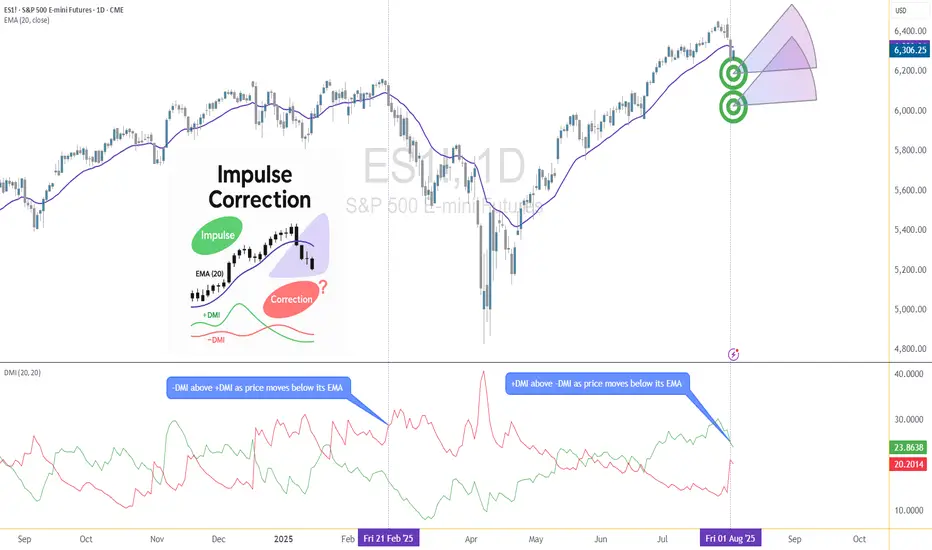
🔹 Feb 21, 2025 Breakdown
Price broke sharply below the 20-period EMA. At first glance, this looked like a potential trend reversal. The DMI confirmed this suspicion: −DMI surged above +DMI, signaling downside impulses were in control. The market followed through with a clear downtrend, confirming the move was not just a pullback—it was a shift in market structure.
🔹 Aug 1, 2025 Breakdown
A similar sharp break below the 20 EMA just occurred again. However, this time +DMI remains above −DMI, despite the bearish price action. This divergence tells a different story: the breakdown may not be impulsive in nature. Instead, it's likely a corrective dip within a broader uptrend, where buyers are still the dominant force.
This is a textbook example of how a moving average crossover without DMI confirmation can mislead traders. By combining these tools, we’re able to make more informed decisions about whether price action is signaling a true shift—or just a pause.
🟣 4. CME Product Specs – ES vs. MES
Traders can express directional views on the S&P 500 using two primary CME futures contracts: the E-mini S&P 500 Futures (ES) and the Micro E-mini S&P 500 Futures (MES). Both track the same underlying index but differ in size, capital requirement, and tick value.
✅ E-mini S&P 500 Futures (ES)
Symbol: ES
Contract Size: $50 x S&P 500 Index
Tick Size: 0.25 index points
Tick Value: $12.50
Initial Margin: Approximately $21,000 (varies by broker and through time)
Market Hours: Nearly 24/6
✅ Micro E-mini S&P 500 Futures (MES)
Symbol: MES
Contract Size: $5 x S&P 500 Index
Tick Size: 0.25 index points
Tick Value: $1.25
Initial Margin: Approximately $2,100 (varies by broker and through time)
The Micro contract provides access to the same market structure, liquidity, and price movement as the E-mini, but with a fraction of the exposure—making it ideal for smaller accounts or more precise position sizing.
🟣 5. Risk Management Matters
Understanding whether a market move is impulsive or corrective isn’t just academic—it’s the difference between positioning with the dominant flow or fighting it. Traders often get trapped by sharp moves that appear trend-defining but are simply noise or temporary pullbacks.
Using tools like DMI to confirm whether directional strength supports price action provides a layer of risk filtration. It prevents overreaction to every EMA crossover or sudden price drop.
Stop-loss orders become vital in both impulsive and corrective conditions. In impulsive environments, stops help lock in profits while protecting from reversals. In corrective phases, they act as circuit breakers against breakouts that fail.
Moreover, knowing the product you're trading is critical:
A single ES contract controls ~$320,000 of notional value.
An MES contract controls ~$32,000.
This disparity means poor sizing on ES can magnify errors, while proper sizing on MES can offer flexibility to test, scale, and hedge with tighter capital control.
Whether you're reacting to price or preparing for continuation, risk management is the only constant. It’s what turns analysis into disciplined execution.
When charting futures, the data provided could be delayed. Traders working with the ticker symbols discussed in this idea may prefer to use CME Group real-time data plan on TradingView: www.tradingview.com - This consideration is particularly important for shorter-term traders, whereas it may be less critical for those focused on longer-term trading strategies.
General Disclaimer:
The trade ideas presented herein are solely for illustrative purposes forming a part of a case study intended to demonstrate key principles in risk management within the context of the specific market scenarios discussed. These ideas are not to be interpreted as investment recommendations or financial advice. They do not endorse or promote any specific trading strategies, financial products, or services. The information provided is based on data believed to be reliable; however, its accuracy or completeness cannot be guaranteed. Trading in financial markets involves risks, including the potential loss of principal. Each individual should conduct their own research and consult with professional financial advisors before making any investment decisions. The author or publisher of this content bears no responsibility for any actions taken based on the information provided or for any resultant financial or other losses.
Expect Correction august/septemberMarkets MUST correct, everything is overbought and sentiment is Extreme greed. RSI points to extreme overbought territory, VIX very low and not going any lower (reached bottom).
Usually august/september the market corrects. so i expect a correction around 5-8%.
Be prepared, dont chase FOMO. Be careful.
SP:SPX TVC:SPX CBOE:SPX CBOE:XSP AMEX:SPY
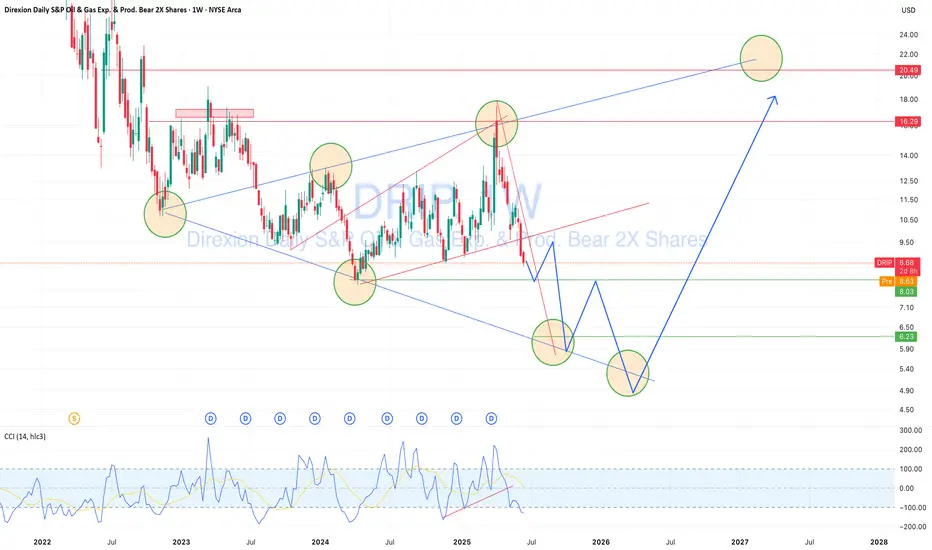
DRIP — Geopolitical Oil Risk Creates a Buying OpportunityDRIP (inverse 2x ETF on US oil & gas exploration/production) is approaching a key technical support zone.
While oil may continue rising short term due to geopolitical tensions — especially US-Iran risks and Middle East instability — this short-term pressure could push DRIP lower toward the $5.00–6.00 area. That zone aligns with strong historical reversal points and trend support. From there, a rebound toward $12.00–20.00 is technically and fundamentally possible, offering 30–50%+ profit potential. I’m planning staged entries in the marked range, managing risk with awareness of commodity market volatility and global uncertainty.
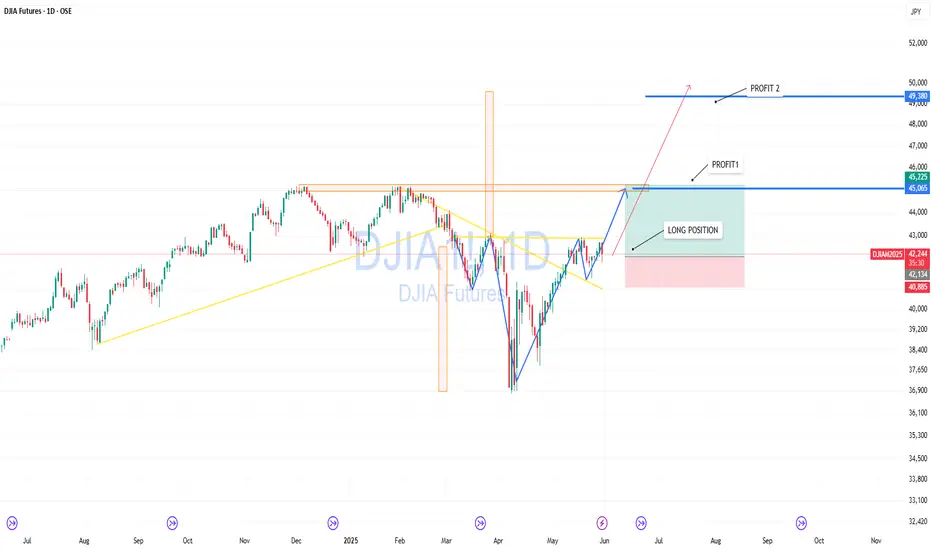
DJIA — Setting Up for Breakout and New ImpulseThe Dow Jones Index is approaching a critical resistance zone. After a deep V-shaped recovery and clear bullish structure, price is preparing for a breakout.
Chart shows a clean long entry with a stop below the recent consolidation. A break and hold above 45,000 could lead to a move toward 46,000, and if momentum holds — up to 49,300.
Partial profit-taking levels:
— Target 1: 45,225
— Target 2: 49,380
Fundamentally, US equity markets remain strong, and DJIA may play catch-up after lagging during the last correction.