NQ1/Nasdaq Daily Trade SetupsIn this update we review the recent price action in the e-mini Nasdaq futures and identify the next high-probability trading opportunities and price objectives to target. To review today's video analysis, click here!03:44by Tickmill1
NQ - ShortNQ Short Day close red, forming a C2 candle - confirmed by a 1hr change in state of delivery - anticipating short from 1hr FVG - only if proper C2 and C3 candles form. Shortby BaseX3Updated 1
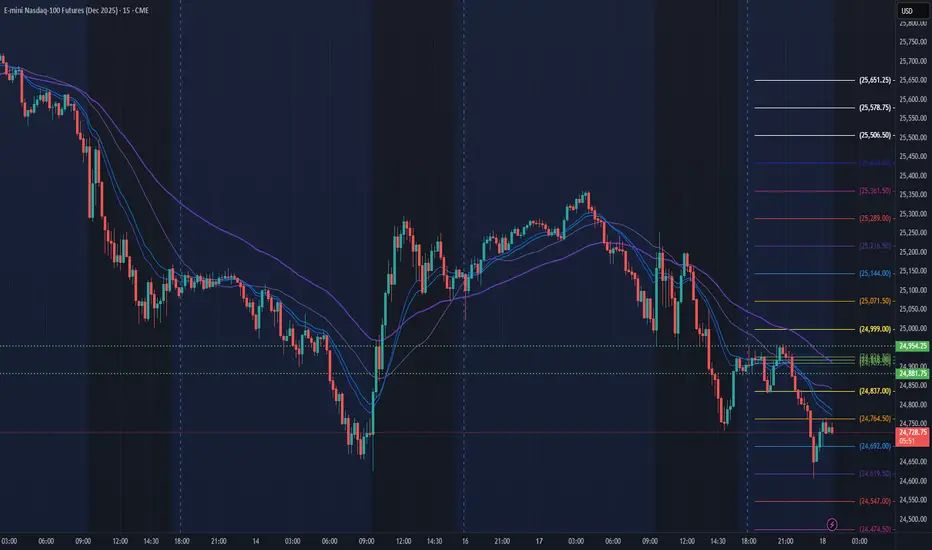
NQ Power Range Report with FIB Ext - 11/18/2025 SessionCME_MINI:NQZ2025 - PR High: 24954.50 - PR Low: 24882.00 - NZ Spread: 162.25 No key scheduled economic events Session Open Stats (As of 12:35 AM) - Session Open ATR: 475.50 - Volume: 67K - Open Int: 291K - Trend Grade: Long - From BA ATH: -6.3% (Rounded) Key Levels (Rounded - Think of these as ranges) - Long: 26636 - Mid: 25410 - Short: 24039 Keep in mind this is not speculation or a prediction. Only a report of the Power Range with Fib extensions for target hunting. Do your DD! You determine your risk tolerance. You are fully capable of making your own decisions. BA: Back Adjusted BuZ/BeZ: Bull Zone / Bear Zone NZ: Neutral Zone Shortby mv3trader50
NQ Daily Outlook | November 18, 20251H timeframe — 50 EMA (black) for trend, 5 & 10 EMAs (white) for momentum/BOS. Quick read: Still under the 50 EMA after a bounce. Whites are curled down; structure is lower‑high/lower‑low. Two scenarios I’m watching Bearish trend (favored): Stay under the whites and reject the 50 → print BOS down → ride impulse down, sell pops into the whites. Bullish trend: Reclaim the whites, push and hold over the 50 → print BOS up → impulse > shallow correction > continuation higher. Bias: Leaning bearish while we’re below the 50 with no upside BOS. I flip long only after we clear a lower high and hold above the 50 EMA.by icixbt1
NQ UpdateClosed out most of my puts, but did not go long. NQ hasn't hit oversold yet, look at the MFI. Gap direction will depend on FDAX which is oversold and at support. If it breaks support, indicators won't mean much. NVDA earnings Wed AH, jobs report THU premarket, Fed minutes Thu.by hungry_hippo2
Tuesday NQ looks good for big trades againIn following the HTF on previous post. If downside is going to continue, we have these 2 options for today. 1st is the 80% trade to fill yesterday's open VA, which keeps us inside the area of not invalidating the downside trade. With the way Vol has been, it will probably happen overnight, and we will miss the upside. For the downside the .5 entry with TP at .25 being a must to protect profit from another bounce out of the support zone. Hold runners and hope this is the time we crack it. Prefer this way of breaking the support. 2nd is the pdVAL holds us down, and we break through the support. If this happens, prefer it happens around RTH open. Otherwise, safer to wait for a solid closes below that level to not get trapped. Top of fib pull invalidates. Shortby Johnnymkool0
Buried Treasure MapPicture Buy the Dip areas as not so hidden pirate treasure. Here is one of this trader's favorite BTD setups. A bounce: 1.In a green shaded BTD area aka accumulation/distribution area 2.Exhaustion Candle: 5m chart, 10:05 candle 3.White bullish candle,10:10 candle 4.@ prior day's close 5.@ prior vpoc 6.Double Bottom 7.9:30 White Tail with bigger than usual volume 8.As you can see, the more supports the better chance of success. His Buy the Dip Trade Plan 1.Buy 1 MNQ contract @ top of BTD area 25145 2.Buy 1 MNQ contract every 5 points - 25140, 25135, 25130... all the way down to the low of the BTD area 25070. 3.21-point target per entry 4.No stop loss 5.If some entries fx and the 21-point exit doesn't, he simply holds until it does. Ultimately, in this bull market, nearly all hit their targets. His goal is five a day. Somedays he gets none. Somedays twenty or more. This year he has far exceeded that goal. On a good setup like the one above you will find that nearly 100% will be round trips - meaning they will hit their profit targets. Make it your own. Buy 1 every 10 points. If you want to buy the most successful zone of the BTD area, divide the area into thirds and buy only the middle third. Caveat: that middle third is simply his experience. It is not a result of a scientific study. Perhaps someone more skilled with such a study will do a back test and provide us with the results. If you want to use a stop by all means use one. Always be careful. Sometimes the Px will continue to fall. Always save dry powder for that event because it does happen. The above setup is far less likely to fall than others. Always trade with an ear to the news. News events can and do turn markets. Most importantly of all - use your good common sense.by Sidgate0
Macro trade again, trading view laggingA buy of 20 points, which worked but tradingview didn't put it on.06:40by kianogrady210
NQ – Today’s High-Probability Setup 11/17/2025Market popped, got smacked, and is bleeding right back into imbalance, classic setup. I’m looking for it to run stops first before giving the real bounce. Any little pullback is just ammo for the next push down. Let it flush, then we sniper the reversal.Shortby NancyPelosis1
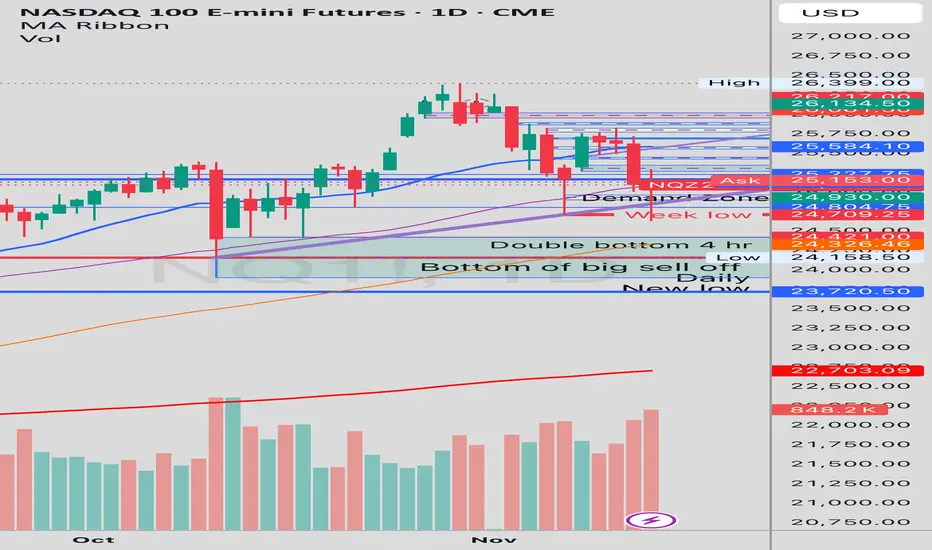
NQ Long Setup at 24,765: Strong Buyer ZoneNQ created a strong support at 24,765 after a sharp rejection of lower prices. A heavy volume cluster formed right where buyers stepped in, and a wide fair value gap confirms strong buying aggression. The beginning of this FVG marks the key reaction level. Waiting for a pullback into 24,765 offers a clean long setup with solid confluence.by Trader_Dale11
Bullish Continuation After Strong Rebound From FVG DemandCME_MINI:NQ1! has successfully rebounded from the Fair Value Gap (FVG) demand zone at 25,150–25,220, confirming this area as a strong short-term base for buyers. The earlier sweep of multiple SSS (sell-side liquidity) levels around 24,850–24,900 seems to have cleared out weak hands, allowing the market to rebuild a bullish structure. With the FVG now acting as a defended demand zone, bullish momentum is beginning to form. The recent rejection from the lows and the shift back above short-term structure indicate that buyers are reclaiming control. As long as NQ holds above the FVG demand, price is well-positioned to extend higher toward: 25,450 (first reaction point) 25,600 (continuation target) 25,750–25,820 (major supply zone + previous rejection area) A higher low above the FVG would further strengthen the bullish outlook and signal continuation toward the upper supply. Current flow favors a sustained push upward as long as demand continues to hold.Longby DUOMIJUN112
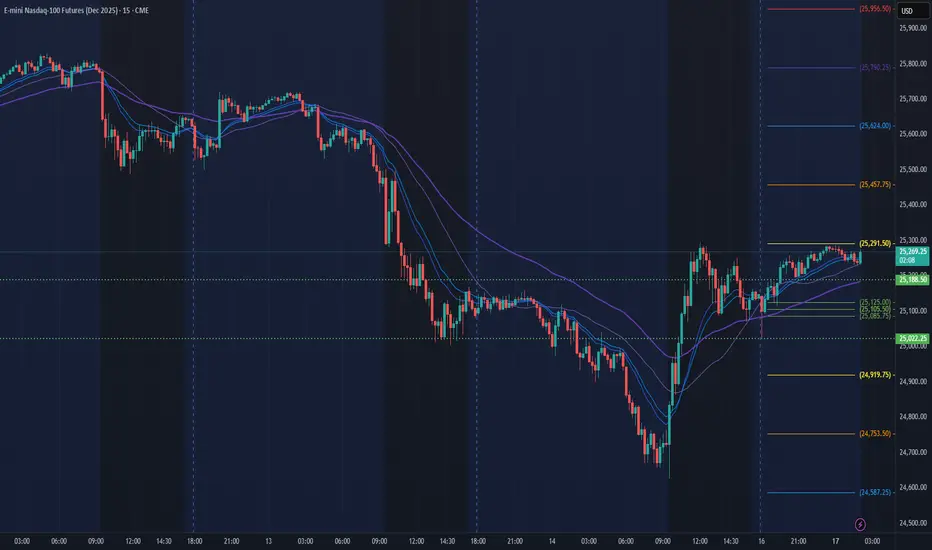
NQ Power Range Report with FIB Ext - 11/17/2025 SessionCME_MINI:NQZ2025 - PR High: 25188.25 - PR Low: 25022.00 - NZ Spread: 372.0 No key scheduled economic events Session Open Stats (As of 12:35 AM) - Session Open ATR: 458.87 - Volume: 48K - Open Int: 290K - Trend Grade: Long - From BA ATH: -4.2% (Rounded) Key Levels (Rounded - Think of these as ranges) - Long: 26636 - Mid: 25410 - Short: 24039 Keep in mind this is not speculation or a prediction. Only a report of the Power Range with Fib extensions for target hunting. Do your DD! You determine your risk tolerance. You are fully capable of making your own decisions. BA: Back Adjusted BuZ/BeZ: Bull Zone / Bear Zone NZ: Neutral Zone by mv3trader50
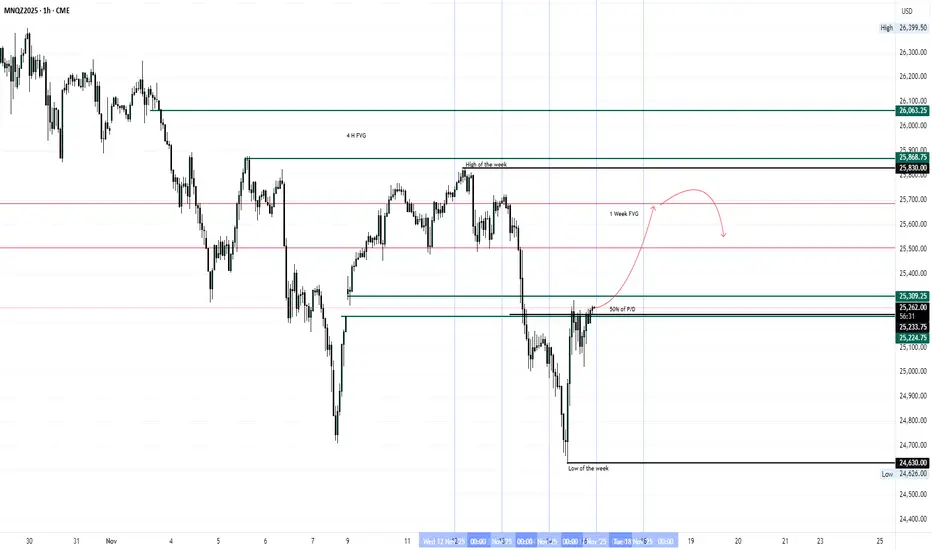
POSSIBLE FORECAST MNQZ2025 17-21 NOV 25 This week will probably have a very good opportunities 25700 and 25300 we have to see if it's possible to reach the high of the week 25900 search for the bullish scenarios by jmatehus901
NQ UpdateAlgos pumping futures despite all other markets being red. A bit surprised they can do that. I don't think the market selloff is over, maybe we just repeat last week? Not sure how much trading I'm gonna do this week, feeling too bearish maybe. You get yourself in trouble if you lean too much in either direction.by hungry_hippo2
NQ Long - 17/11/2025Candle 2 formed on daily timeframe, confirmed by 1hr CISD. Looking for expansion in candle 3; targeting internal fair value gap. Longby BaseX3Updated 2
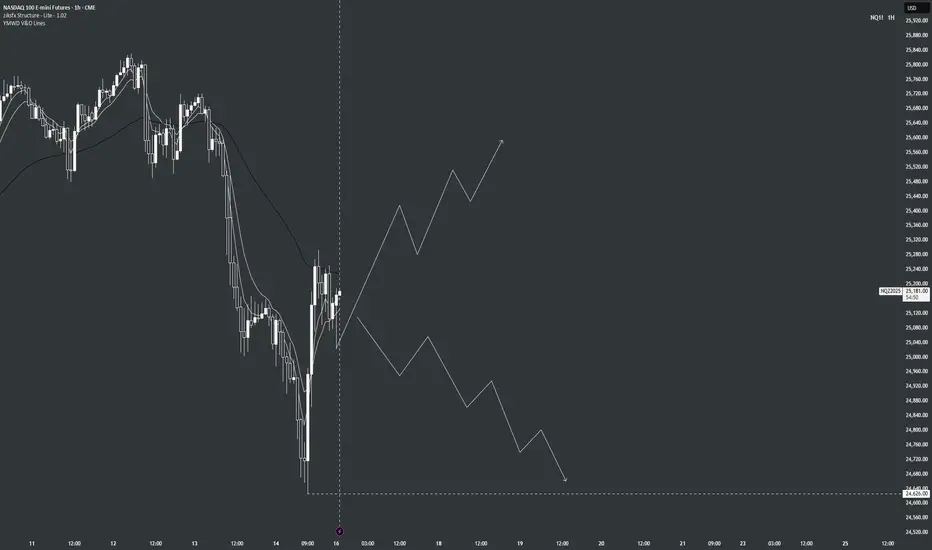
NQ Weekly Outlook | November 17–21, 20251H timeframe — 50 EMA (black) for trend, 5 & 10 EMAs (white) for momentum. Two scenarios I’m watching Upper path (bullish): Hold above the white EMAs, reclaim and stay over the black 50, print BOS up → ride impulse > shallow correction > continuation higher. Lower path (bearish): Reject at/under the black 50, lose the whites, print BOS down → impulse down > corrective pop into the whites > continuation lower. Bias: Leaning bullish if we reclaim/hold above the 50 with an upside BOS. If we stay capped under it and BOS down prints, I’ll follow shorts.by icixbt1
Bitcoin Is Crashing… Nasdaq Still at Highs. Who’s Lying?For years, Bitcoin and the Nasdaq 100 have shown consistently high correlation, driven by the same macro forces: • global liquidity cycles, • risk appetite, • real-rate expectations, • and flows into high-beta growth assets. Both are classic risk-on instruments—they benefit when liquidity expands and suffer when uncertainty rises. However, the chart above shows a significant decoupling over the past weeks: 🔻 BINANCE:BTCUSDT : Deep Correction & Negative YTD • Down more than 25% from the highs • Trading –5% YTD in USD terms • Volatility expanding and long liquidations accelerating • Risk sentiment turning sharply lower within crypto 🔺 LSE:NQ11 : Near All-Time Highs • Still hovering close to ATH levels • Posting +16% YTD in USD • Supported by strong earnings, mega-cap tech flows, and continued growth leadership ⚠️ This divergence is unusual — and historically meaningful BTC and Nasdaq rarely disconnect to this magnitude without one of two outcomes: 1️⃣ Bitcoin Is Leading the Next Risk-Off Move Crypto often reacts faster to changes in liquidity conditions and risk appetite. If this is another leading signal, equities (especially high-beta tech) may follow with a lag. 2️⃣ Correlation Break Is Temporary If the move was primarily crypto-specific (liquidations, funding resets, derivatives unwinds), BTC could mean-revert upward as flows stabilize. 📌 Our View Historically, when divergences of this scale have appeared: Bitcoin leads, equities follow. The magnitude of BTC’s correction vs the Nasdaq’s resilience suggests that: 👉 BTC may be pricing in a shift in risk conditions ahead of equities, not the opposite. The key question for the next weeks: Is the Nasdaq ignoring a message that crypto is already discounting?Shortby OrbisInvestment2
#202546 - priceactiontds - weekly update – nasdaq e-miniGood Evening and I hope you are well. comment: Again, not much difference to dax. Also in a triangle and for now I highly doubt we will see a big range expansion out of 24600 - 25500. We had two weeks where the bears showed strength but what do they have to show for? We closed above 25000 in both weeks. That’s still as bullish as it gets. Only a bearish daily close below 24600 could change my outlook. current market cycle: trading range 24000 - 26500 / 4h chart it’s a triangle 24700 - 25500 key levels for next week: 24500 - 25500 bull case: Bulls bought 24700 heavily again and closed the week above 25000. Bears can have no confidence in shorts when we rally for 667 points after a 1095 point drop. Problem for the bulls is that they also have to be very careful with buying high again since the downside can be huge. Which will likely mean that we won’t see much interest in buying above 25400ish. Even longing 25000 when we can drop down to 24600 or lower, is a tough trade. Invalidation is below 24709. bear case: Every dip is heavily bought. Has not changed. Can only become more bearish with a daily close below 24000 and that’s far. 25830 is likely the stop, most bears have to have for most shorts next week. That’s a big range and it any short below 25300 from being decent imo. We are making lower highs and lower lows but the lower lows just barely. Until that changes, we will most likely continue sideways in the given range. Invalidation is above 25830. short term: Neutral around 25000. Short closer to 25700 and longs closer to 25600. medium-long term - Update from 2024-11-02: Market went further in the wrong direction so my targets become increasingly unrealistic. Right now the 50% retracement is 21750 and would mean a 18% drop. That’s a bit too much to ask for as of now. 24150 is the breakout-retest of the prior ath from 2024-12 and a more realistic target. by priceactiontds2
Weekly outlook on NQ, ES and Dow. Index Triad NYSEThis week will be a tricky one. I need more data to understand about the expansion on the weekly. We will take it on a day to day basis after each daily closures08:12by Tra3er_NeXuS1
Would you consider this a H&S break on NQ?Would you consider this a H&S break? I know things are volitile and wierd right now...which makes me think that this could be a weird looking H&S. Remember, the patterns show us an idea, a story. Does this tell the story to you? It shows what an H&S shows. It is just sloppy because of volitile movements...Shortby PremHunter1
Ascending triangle gaps end of earnings (just about) correction?All the earnings releases and positive impact of business investment in AI gave the market anther move higher, but what now everything is so stretched gaps appearing and a negative pattern suggest a correction, the question how far ?by MarkLangleyUpdated 3
Global Energy Dynamics and Geopolitical Trade Routes1. The Foundation: Why Energy Shapes Global Power Energy is the engine behind transportation, manufacturing, digital infrastructure, agriculture, and military strength. Nations with abundant energy—like Saudi Arabia, Russia, or the U.S.—carry global influence. Nations dependent on imports—like India, Japan, or most of Europe—must secure safe trade routes and diplomatic relationships. There are three major categories in global energy dynamics: 1. Fossil Fuels (Oil, Gas, Coal) Still dominate global energy consumption (over 75%). Key for transportation (oil), heating & power (gas), and bulk energy (coal). Controlled by resource-heavy nations (Middle East, U.S., Russia, Australia). 2. Renewables (Solar, Wind, Hydro, Green Hydrogen) Growing rapidly because of climate goals and cost reduction. Countries compete to become renewable technology leaders (China, Europe, U.S., India). 3. Nuclear Energy Provides long-term stable baseload power. Geopolitically sensitive because of dual uses (civilian + military). Every country strategizes to ensure energy security—meaning energy should be affordable, accessible, and uninterrupted. 2. Major Players Controlling Global Energy Middle East – Oil & Gas Superpower Home to the largest oil reserves (Saudi Arabia, Iraq, UAE, Iran, Kuwait). The region influences global prices via OPEC+ production decisions. Any tension—war, blockade, sabotage—instantly impacts global markets. United States – Shale Revolution Leader World's largest oil and gas producer. Controls energy diplomacy through production capacity, sanctions, and technology. LNG exports from the U.S. influence European and Asian markets. Russia – Energy Leverage Over Europe Major exporter of natural gas and crude oil. Controls pipelines into Europe. Has used energy as a strategic bargaining tool. China – World’s Largest Energy Consumer Dominates solar, battery, and rare earth markets. Heavy dependence on Middle East oil and foreign natural gas. Secures maritime routes via the Belt and Road Initiative (BRI). India – Fastest-Growing Energy Market Heavy importer of crude oil (~85%). Diversifying import partners to avoid over-dependence. Expanding renewables and strategic petroleum reserves. 3. Key Geopolitical Trade Routes in Global Energy Energy moves through oceans, pipelines, and chokepoints. Any disruption impacts global prices and supply security. 1. Strait of Hormuz (Persian Gulf) Most important oil chokepoint in the world. ~20% of global oil and ~25% of LNG passes through. Surrounded by Iran and U.S.-allied Gulf states—very sensitive region. Even a minor conflict can cause oil prices to spike. 2. Strait of Malacca (Between India, China, Southeast Asia) China, Japan, South Korea heavily depend on this route for fuel imports. Any disruption forces tankers to take longer, costly paths. India’s presence in the Indian Ocean gives it strategic leverage. 3. Suez Canal & SUMED Pipeline (Egypt) Connects Middle East oil to Europe. Blockages increase transportation time around Africa. Critical for LNG shipments too. 4. Panama Canal Important for U.S. LNG trade to Asia. Climate change–driven drought affects capacity. 5. Russia-Europe Pipelines Nord Stream, Druzhba, TurkStream, and others. Pipeline sabotage or sanctions immediately affect European power prices. 6. Africa’s West & East Coast Routes West Africa exports crude to Europe and Asia. East Africa emerging as LNG route (Mozambique). If these routes are disrupted due to war, piracy, sanctions, or blockades, global energy markets react instantly. 4. How Geopolitics Shapes Energy Decisions Sanctions as Weapons Nations use sanctions to punish rivals. U.S. sanctions on Iran and Russia reduced their oil exports. These sanctions shift global trade flows—India, China, and Turkey buy discounted oil. Energy as Diplomatic Leverage Energy-rich nations influence global politics: Russia pressures Europe through gas supply. Saudi Arabia adjusts production to stabilize or shock global markets. Qatar’s LNG gives it major diplomatic importance. Military Presence Protects Trade Routes Countries place naval forces near key chokepoints: U.S. Fifth Fleet in the Persian Gulf. India in the Indian Ocean. China near the South China Sea. Technology & Supply Chain Power China dominates: Solar module production. Battery manufacturing. Rare earth mining. This gives China a new form of energy leverage similar to OPEC’s oil power. 5. The Shift Toward Renewables and New Geopolitics The world is moving toward clean energy, creating new winners and losers. Winners Countries with abundant sun/wind (India, Australia, Middle East). Nations leading in battery and EV technology (China). Nations rich in critical minerals like lithium, cobalt, nickel (Chile, DRC, Indonesia). Losers Countries dependent solely on oil exports. Nations slow in clean-tech investments. Green Hydrogen Trade Routes Future trade routes will shift from crude oil tankers to hydrogen carriers. Major exporters expected: Saudi Arabia UAE Australia India (later stage) Importers: Japan South Korea Europe 6. Energy Security Strategies Countries Use Countries globally adopt 6 major strategies: 1. Diversification of Suppliers Don’t depend too much on one country. India buys from Gulf, Russia, U.S., Africa. 2. Strategic Petroleum Reserves (SPR) A buffer against supply shocks. India, China, U.S., Japan maintain large SPRs. 3. Building New Pipelines & Ports Example: India’s west coast LNG terminals. EU’s pipelines from Norway and Caspian region. 4. Building Alliances QUAD, OPEC+, IEA—energy diplomacy groups. 5. Investing in Renewables Reduces fossil fuel dependence and price volatility. 6. Securing Maritime Routes Stronger navy, anti-piracy operations, trade agreements. 7. The Future of Global Energy Dynamics The next decade will be shaped by: 1. Multipolar Energy World Energy power shifting from the Middle East–U.S.–Russia triangle to: India China Africa Renewable superpowers 2. Electrification Era EVs, solar parks, energy storage systems reduce oil demand long-term. 3. Digital and AI-driven Energy Systems Smart grids, demand forecasting, AI optimization. 4. New Vulnerabilities Cyberattacks on power plants and pipelines. Supply chain dependencies on minerals and chips. Conclusion Global energy dynamics and geopolitical trade routes form the backbone of global economic stability. They decide fuel prices, industrial growth, inflation levels, and even military strategies. As the world transitions from oil dominance to renewable energy leadership, the geopolitical map will evolve. New trade routes, new alliances, and new energy powers will emerge. In short, understanding energy geopolitics means understanding the future of global power balance.Educationby GlobalWolfStreet1
Market Maker Buy ModelMarket Maker Buy Model in the making for NQ: - Weekly low triggered; - Inversion FVG creation; - Swing high broken; - Targeting 0.705 of the Dealing Range; - Entry at the highest FVG with Swing low for stop placement; - Leap trade; Longby TheMatrix-1