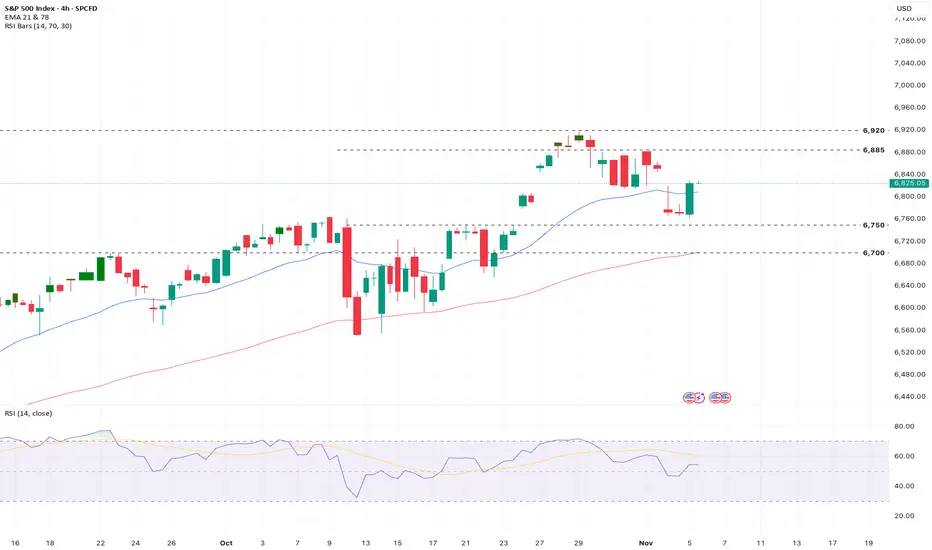
SPX updated for Friday 7th NovemberNot quite a break of trend as yet Ya really wants into 6700 and below to scare of the bulls Lrts see what happensby Dentalfloss12360
Understanding Different Types of Global Assets1. Equities (Global Stocks) Equities represent ownership in a company and are one of the most popular asset classes worldwide. When investors buy shares of a company listed on a stock exchange, they become partial owners and are entitled to a share of profits through dividends and capital appreciation. Global equity markets include major stock exchanges such as the New York Stock Exchange (NYSE), London Stock Exchange (LSE), Tokyo Stock Exchange (TSE), and National Stock Exchange of India (NSE). Each region offers exposure to different industries and economic cycles. Developed Market Equities: These include companies from economically stable nations like the U.S., Japan, the U.K., and Germany. They are considered safer but often yield moderate returns. Emerging Market Equities: Countries like India, Brazil, and China offer higher growth potential but with increased volatility and political risk. Frontier Market Equities: These are smaller, less developed economies (such as Vietnam or Kenya) with higher risk but potential for exponential growth. Equity investors often use exchange-traded funds (ETFs) or mutual funds to gain diversified exposure across multiple markets without the need to directly buy international stocks. 2. Fixed-Income Securities (Global Bonds) Bonds are debt instruments issued by governments, corporations, or financial institutions to raise capital. In return, investors receive periodic interest payments and the principal upon maturity. Global bond markets are vast and serve as a backbone of the financial system, providing stability and predictable income. There are several types of global bonds: Sovereign Bonds: Issued by national governments (e.g., U.S. Treasury Bonds, German Bunds, Indian Government Bonds). They are often seen as low-risk investments. Corporate Bonds: Issued by multinational companies to fund operations or expansion. These carry higher yields but greater default risk. Municipal and Supranational Bonds: Issued by local governments or institutions like the World Bank or IMF for development projects. Investors in global bonds must consider interest rate differentials, currency fluctuations, and credit risk. For instance, a bond issued in Japanese yen might perform differently when converted back to U.S. dollars depending on exchange rate movements. 3. Commodities Commodities are physical goods such as metals, energy resources, and agricultural products that serve as essential inputs in global production. They are traded on exchanges like the London Metal Exchange (LME), Chicago Mercantile Exchange (CME), and Multi Commodity Exchange (MCX) in India. The main commodity categories include: Energy Commodities: Crude oil, natural gas, and coal dominate global trade. Oil prices, in particular, affect inflation, production costs, and currency values worldwide. Precious Metals: Gold, silver, and platinum are seen as “safe-haven” assets that investors flock to during economic uncertainty. Industrial Metals: Copper, aluminum, and zinc are key materials for manufacturing and construction. Agricultural Commodities: Wheat, corn, coffee, and cotton play crucial roles in global food supply chains. Commodity prices are highly sensitive to geopolitical tensions, supply-demand imbalances, and natural events like droughts or hurricanes. Investors can access commodities through futures contracts, ETFs, or commodity-focused mutual funds. 4. Currencies (Foreign Exchange or Forex Market) The foreign exchange (forex) market is the largest financial market in the world, with daily trading volumes exceeding $7 trillion. Currencies are traded in pairs, such as EUR/USD or USD/JPY, reflecting the relative value of one currency against another. Forex trading allows investors to speculate on currency movements or hedge international investments against exchange rate risk. For example, a U.S. investor with European assets may buy euros to protect against a weakening dollar. Major currency pairs include: Major Pairs: USD/EUR, USD/JPY, GBP/USD — most liquid and widely traded. Minor Pairs: Non-USD combinations like EUR/GBP or AUD/JPY. Exotic Pairs: Combine a major currency with one from an emerging economy, such as USD/INR or EUR/THB. Forex markets are influenced by interest rates, inflation, trade balances, and political stability. Central banks also play a crucial role in currency valuation through monetary policies and interventions. 5. Real Estate (Global Property Markets) Real estate is another essential global asset class that provides income through rent and appreciation in property value. Investors can access real estate directly (by buying physical property) or indirectly (through Real Estate Investment Trusts – REITs). Global real estate markets vary greatly by region: Developed Markets: Properties in cities like New York, London, or Singapore offer stability but are expensive. Emerging Markets: Cities in India, Vietnam, or Brazil provide higher yields but with greater risk due to economic and legal uncertainties. Real estate investments are influenced by interest rates, urbanization trends, and government policies. REITs make it easier for investors to diversify globally without the challenges of direct ownership. 6. Alternative Assets Alternative investments include asset classes outside traditional stocks and bonds. These are often less liquid but can provide diversification and high returns. Common types of alternatives include: Private Equity: Investments in privately held companies before they go public. Hedge Funds: Pooled funds using complex strategies like long/short positions or arbitrage. Venture Capital: Early-stage investments in startups with high growth potential. Infrastructure Assets: Investments in public utilities, transportation, and renewable energy projects. Collectibles: Art, wine, or rare coins can also serve as alternative assets with niche market value. Institutions and high-net-worth investors use alternatives to hedge market volatility and achieve uncorrelated returns. 7. Digital Assets (Cryptocurrencies and Tokenized Assets) In the last decade, digital assets have revolutionized global investing. Cryptocurrencies like Bitcoin, Ethereum, and Solana are decentralized digital currencies that operate on blockchain technology. They allow peer-to-peer transactions without intermediaries like banks. Beyond crypto, tokenization enables real-world assets such as real estate, art, or stocks to be represented digitally on blockchain networks. This enhances liquidity, transparency, and accessibility. However, digital assets carry high volatility and regulatory uncertainty. Governments and financial institutions are gradually shaping frameworks to integrate them into mainstream finance through Central Bank Digital Currencies (CBDCs) and regulated exchanges. 8. Derivatives Derivatives are financial instruments whose value derives from an underlying asset such as stocks, bonds, commodities, or currencies. Common derivatives include futures, options, swaps, and forwards. They are used primarily for hedging (risk management) or speculation. For instance, a company importing oil may use futures contracts to lock in prices and protect against future price increases. Traders, on the other hand, may speculate on these price changes for profit. Derivatives markets are essential for global financial stability, allowing participants to manage exposures effectively, though misuse can amplify systemic risk. 9. The Importance of Diversification Across Global Assets Diversification is the cornerstone of smart investing. By spreading investments across multiple asset classes and geographies, investors reduce exposure to regional downturns or sector-specific risks. For example, when global equities face a correction, safe-haven assets like gold or U.S. Treasuries often rise, cushioning overall portfolio losses. A balanced global portfolio might include: 40% equities (across regions), 30% bonds, 10% commodities, 10% real estate, 10% alternatives or digital assets. This mix provides both growth and stability in an uncertain global environment. Conclusion Understanding the different types of global assets is fundamental for building a resilient and diversified portfolio. Each asset class — equities, bonds, commodities, currencies, real estate, alternatives, digital assets, and derivatives — behaves differently under various economic conditions. The key to successful global investing lies in recognizing the interconnections among these assets, managing risks intelligently, and adapting to market shifts driven by globalization, technology, and geopolitics. As financial markets evolve, investors who understand the structure and behavior of global assets will be better positioned to capture opportunities and weather uncertainties with confidence.Educationby GlobalWolfStreet2
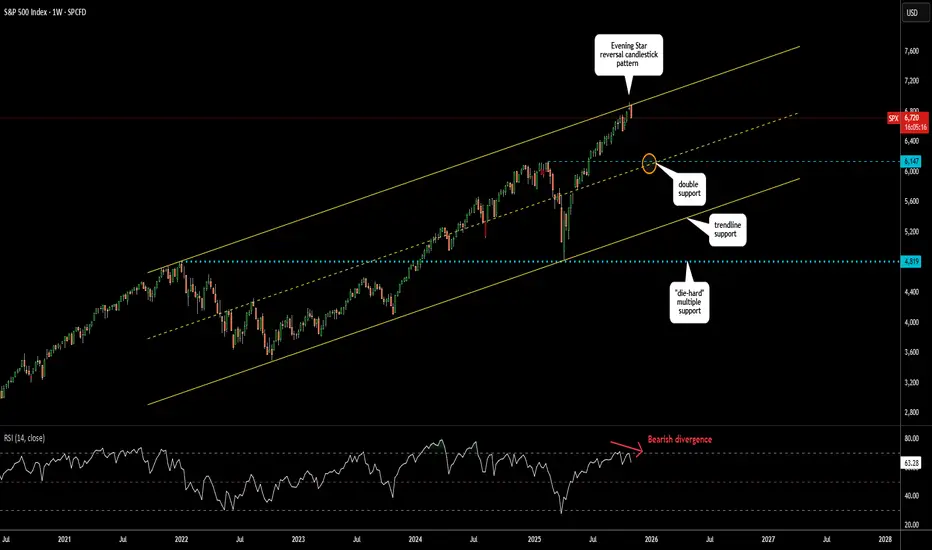
S&P 500: Multiple Bearish Signals AlignS&P 500 index chart shows multiple bearish signals on the weekly time frame 1. The price has hit the upside of the long-term uptrend and it was rejected 2. Bearish Reversal Evening Star Candlestick pattern appeared on the top 3. RSI has built the Bearish Divergence as it did not confirm the new peak There are 3 support levels: 1. Double support of trend channel's mid-line and previous top around $6,147 2. Bottom of the channel between $5,300 and $5,400 3. "Die-hard" multiple support that was built since 2021 around $4,819 What are your thoughts? Shortby aibek5
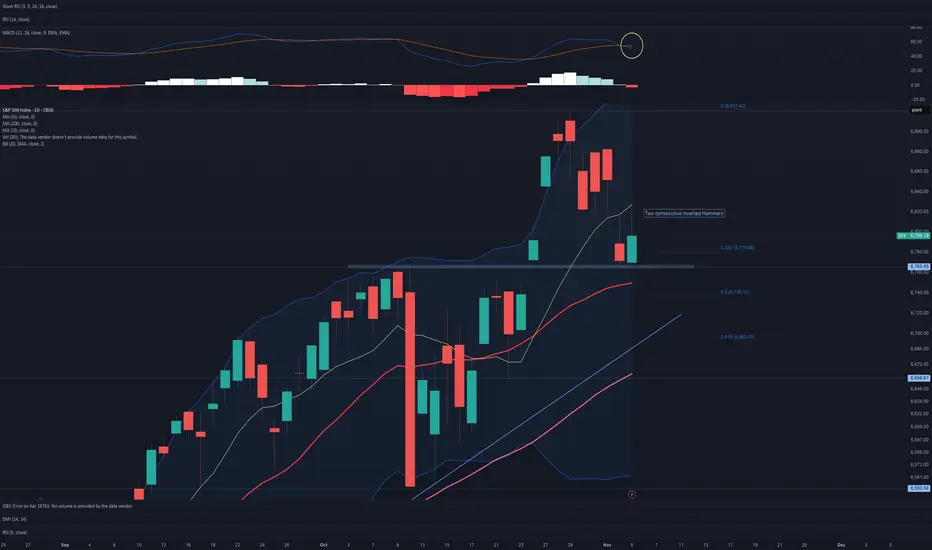
$SPX: MACD NEARING A SELL SIGNAL With one day left in the week, the candlestick pattern appears unfavorable. We will see if the 20-week SMA, which has upheld the narrow upward channel, continues to serve as support. The MACD is approaching a sell signal.Shortby OLIV20200
S&P 500 ROAD TO 7000 $SPX1. Executive Summary: Following a significant correction from the 5000 level, the S&P 500 showed initial signs of stabilization on April 7th, 2025. The index had previously been rejected from a major resistance zone near the psychologically significant 7000 mark, having peaked around 6900. The current technical structure suggests a period of consolidation or pullback is underway. Critical support is identified in a layered zone between 6600 and 6200. A key finding from Fibonacci retracement analysis indicates that a hold above the 0.236 level (6428.21) could provide the necessary momentum for a renewed bullish assault, with the ultimate objective of retesting and breaking the 7000 level. 2. Recent Price Action & Market Structure: Bullish Regeneration (7th April): The price action on this date is technically significant as it represents the first meaningful attempt to "regain" footing after a sustained drop. This could indicate that the initial wave of selling has exhausted itself, allowing buyers to step in. Key Resistance & Rejection: The prior rejection from the ~6900 zone is a pivotal event. The failure to break through 7000 created a clear ceiling, establishing this area as a major resistance level that the market must now overcome to resume a long-term bullish trend. 3. Support Zone & Fibonacci Analysis: The market has defined a clear hierarchy of potential support levels that will be critical in determining the next major directional move. Layered Support Levels: Immediate Support (6600): This is the first line of defence for the bulls. A bounce from here would indicate underlying strength and suggest the pullback is shallow. Primary Support (6400): This level converges closely with the key Fibonacci level and is therefore a high-priority zone for buyers. Significant Support (6200): A breach below 6400 would make this the next critical floor. A hold here is essential to prevent a deeper correction. Fibonacci Retracement Context: The Fibonacci tool has been applied to the most relevant upward move (likely from the 5000 low to the 6900 high). 0.236 Fibonacci Level (6428.21): This level is critically important. It represents a shallow retracement of the prior uptrend. The fact that it aligns with the identified 6400 support zone adds significant technical confluence. Bullish Implication: A successful "bounce" from this ~6400/6428 confluence zone would be a strongly bullish signal. It would indicate that the broader uptrend remains intact and that the drop from 6900 is merely a healthy correction within a larger bull market. This would be the confirmation needed to project a move back towards the 7000 resistance. Deeper Retracement Scenario (0.382 at 6123.76): Should the 0.236 level fail, the next major support resides at the 0.382 Fib level (6123.76), which aligns with the 6200 support. A bounce from this deeper level would still be constructive but would indicate a longer and more significant period of consolidation before a new high can be attempted. 4. Synthesis and Forward Projection: The technical picture presents two primary scenarios: Bullish Scenario (High Probability if 6400 Holds): The index finds strong support at the 6400/6428 confluence zone. The bounce initiated on April 7th accelerates, pushing the price back through the 6600 level and setting the stage for a retest of the 6900-7000 resistance area. A breakout above 7000 would then open the door for further all-time highs. Consolidation Scenario (If 6400 Breaks): A break below the 0.236 Fib support shifts focus to the 6200/6123 zone. The market would likely enter a longer period of range-bound trading between ~6100 and ~6800 before gathering enough momentum for its next sustained move. Conclusion: In summary, while the S&P 500 faces clear overhead resistance following its rejection near 7000, the pullback is currently testing a critical support confluence near 6400. The bullish thesis for a "bounce back to 7000" is technically valid, but it is entirely contingent upon the index defending the 0.236 Fibonacci retracement level (6428.21) and the 6400 support zone. A trader should watch for confirmed bullish reversal signals (e.g., strong bullish engulfing candles, positive RSI divergence) at this level as the potential trigger for the next leg up.Longby KalaGhazi4
stock market wave 3 top in imowave 3 for the stock market in, potential multi-year wave 4 down incomingShortby Bat8861
S&P500 index weekly logarithmic chart hitting 2,618 extensionI have meticulously tagged every turn and twist since 2009 on this chart. Using elliottwave theory I believe that this structure is ending. Bear market next? I do not know, what I do know is that it's been a fabulous run since 2009. I'm short NQ futures December contract. Good luckShortby ulrichniederhausser3
Nov 6 - a move down is likely, but not certainOn SPX we're at double resistance. If we sell off here, we could have another C down, in which case, another bear trap may form (see chart at end of video). The market is very choppy and probably will continue to be for some time. Gold looks like it will test it's lows. BTC looks like it may test it's lows. Oil is still holding the 18ma, but it's running out of time to do something else. Short08:24by rsitradesUpdated 5
S&P500 resilient US data reignited riskRisk appetite returned to markets over the last 24 hours, with the S&P 500 rising +0.37% as stronger US data and optimism over a potential end to the government shutdown lifted sentiment. The ADP private payrolls report surprised to the upside at +42k (vs. +30k expected), while the ISM Services index jumped to 52.4 (vs. 50.8 expected) with new orders at a 12-month high, easing fears of an economic slowdown after Monday’s weak manufacturing data. The improved tone triggered a broad risk-on rally: US HY spreads tightened (-9bps) for the first time in a week. Bitcoin rebounded (+3.38%) after recent losses. Asian equities followed through overnight, with the Nikkei up +1.48% and Hang Seng +1.61%. Despite solid data, Treasuries rallied as markets priced a higher chance of a December Fed rate cut, sending the USD to its biggest 3-week drop. In corporate news, SpaceX agreed to buy EchoStar’s AWS-3 spectrum licenses for $2.6bn in stock, while EchoStar booked a $16.5bn non-cash charge tied to its 5G network wind-down. However, some valuation concerns are re-emerging — the “Buffett Indicator” now shows US equities worth over twice GDP, with total market cap around $72tn, underscoring stretched levels after a +36% rally since April lows. Bottom line: The S&P 500 regained momentum as resilient US data reignited risk appetite and rate-cut hopes, though extended valuations remain a potential headwind. This communication is for informational purposes only and should not be viewed as any form of recommendation as to a particular course of action or as investment advice. It is not intended as an offer or solicitation for the purchase or sale of any financial instrument or as an official confirmation of any transaction. Opinions, estimates and assumptions expressed herein are made as of the date of this communication and are subject to change without notice. This communication has been prepared based upon information, including market prices, data and other information, believed to be reliable; however, Trade Nation does not warrant its completeness or accuracy. All market prices and market data contained in or attached to this communication are indicative and subject to change without notice.by Trade Nation1
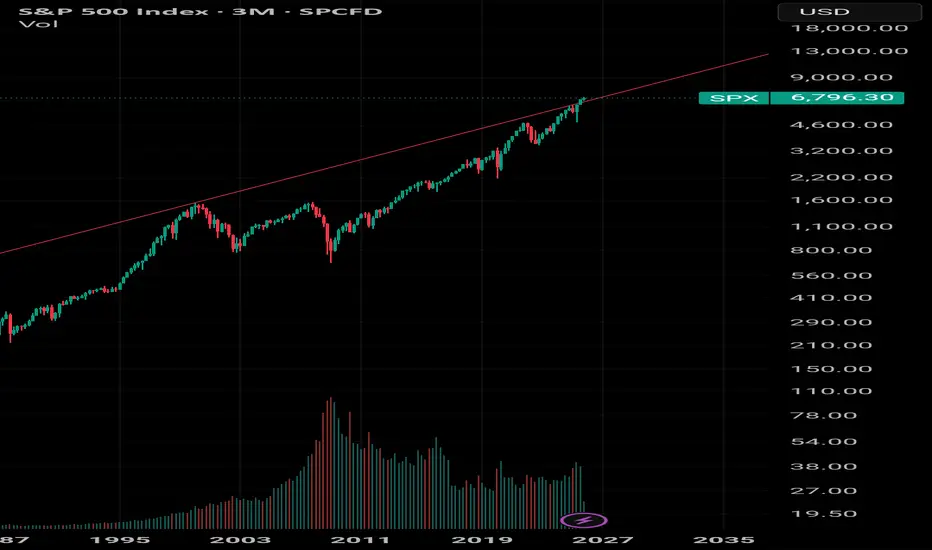
The amazing 100 year S&P log chartI love going back to this chart which tells us everything we need to know when asking the question why is buffet sitting in so much cash. It's an amazing chart and you can see what will Happen, what needs to happen but not when. Needless to say we are still above the red line. Shortby garethhallster3
SPX500 – Bullish Momentum Holds Above 6812 | Eyeing 6877 NextSPX500 – MARKET OVERVIEW | Bullish Bias Above 6812 The SPX500 index continues to show bullish momentum, holding firm above the pivot zone (6812–6797). As long as price action remains above 6812, upside movement is expected toward 6842 and 6877, with a potential extension toward 6915 if bullish sentiment strengthens. However, a sustained move below 6796 would weaken the current trend and open the way for a short-term bearish correction toward 6769 and 6754. Key Technical Levels Pivot Zone: 6812 – 6797 Resistance: 6842 · 6877 · 6915 Support: 6769 · 6735 · 6705 Outlook: SPX500 remains bullish while above 6812, but a close below 6796 could trigger a corrective decline toward 6769–6754.Longby SroshMayi10
S&P 500 Is moving downthe overall sentiment of the latest news are not very good , a lot of traders are expecting a crash due to market overvaluation take this as an advice Shortby thetradinglord281
I'm just marking support and resistance day 3 learning trading Just started, don't wait to really get my first 100 dollars. Just excited to really learn and start trading.by ns0570171110
$SPX: MACD has triggered a sell signal. SP:SPX : While today's bounce started off promising, it ultimately fell short. It was unable to break above and reclaim the 10-day moving average, and today, the MACD generated a sell signal. However, before drawing any definitive conclusions, it’s essential to keep things in perspective. So far, this downward movement could be seen as a simple pullback. The S&P 500 has reached the 0.382 retracement level, and it's crucial to note that the 20-day simple moving average would need to be breached to increase the likelihood of a further decline.by OLIV20200
Markets Looking SOFT at highs - Correction Underway (Key Levels)October 10th candle is a very important low for all US Markets -S&P -Nasdaq -Dow -Russell The rally from that Oct 10 candle low (Friday) was met with aggressive support but was only showing rallies in Mag 7 and AI related plays Earnings for the most part are coming in meeting or exceeding expectations, but price action is certainly looking soft with the market making lower highs and lower lows for now We have plenty of technical support, but given the longest US Government Shutdown in history with dot.com like valuations (there is bubble and non-bubble evidence), sentiment and elevated volatility are taking their toll and dragging the markets lower I've closed a lot of open positions and de-risked the portfolio pretty severely this week with the intention of finding ways to participate in a cautiously bullish environment. As I mention in the video, markets tend to V bottom, but round out the tops so the longer we stall at these highs and the more "rounded" look we have near these highs, the more fragile and support can be if we eventually see a break lower - TBD Day to day, we continue to do good work carving out short-term winners and properly position for what is next - good or bad Thanks for watching. See you in the live markets -Chris24:05by ChrisPulver6
Possible WXYIf this is an expanding ending diagonal we may see WXY correction in wave (4).Shortby Supergalactic1
Update at 4pmAlthough the trade did not go my way today, I still expect a further move down. I'm incorrect if they get over the high from today. Gold also looks ready to test it's lows. Oil still consolidating above it's 18ma. BTC looks like a pullback is also coming, a further low is expected still. Short06:11by rsitrades118
SPX moneyPrice make a foundation low then pullback creating short term uptrend eventually coming to an end. Following price fell and make a new external low. Waited for price to come back to the last time buyers were in control and in discount to take us to the external low. Same play... continuation. by Noitw000
V Pattern In SPX/USDHey fellow traders and followers! Look what I found on the 8hr SPX chart. Looks like a developing V pattern so far. What could that mean ? Means up to me. Here are the numbers; We need to break and hold above the Break Line of 6873.1 area to solidify a long position to Target 1) 6939.7 Target 2) 6966.7 I can't stress enough the importance of the Break Line area being a solid support in order for the trade to have a 8 out of 10 chance to make you money. This move if reached fetches a nice profit $$$ Just look at the points you can gain where I posted it on the chart. Ok, let's see how things play out... See you at the starting gate $$$Longby Trade-Farmer1
US500 maintains inherently bullish structureFundamental Analysis US500 maintains an inherently bullish structure, trading above both EMAs. Q3 earnings were strong, with 83% of companies beating expectations and delivering 13.8% blended EPS growth, largely thanks to megacap tech/AI. However, the forward P/E ratio is high at 23.1x (above the 5-year average of 19.9x), signaling elevated valuations. The recent profit taking in high growth names like AMD and Nvidia due to margin concerns and macro headwinds (high rates/inflation) exposes this valuation sensitivity. Technical Analysis The index is currently pulling back from all time highs near 6,900, consolidating in a short term support zone of 6,750. Momentum is neutralizing with RSI approx 51.6, indicating a pause rather than a reversal. Key technical battleground: Resistance at 6,885 and 6,920 versus support at 6,750 and the EMA at 6,700. Consolidation is the most probable short term path. Sentiment Analysis Sentiment is cautious to slightly negative. The sharp correction in AI leaders (AMD, NVDA) has fueled "AI bubble" fears, overriding fundamentally strong earnings reports. There is a clear, broad sector rotation occurring as investors de-risk and take year end profits from high growth tech toward defensive/value plays. The market is currently driven by nervousness about sustaining premium valuations against persistent macro uncertainty. Outlook The near term outlook is moderately cautious. While the long term bullish trend remains supported by healthy corporate earnings, the market faces an inflection point driven by overvaluation concerns in the tech sector. Further short term volatility is expected as the market digests earnings nuances (like margin guidance) and awaits clearer signals on US monetary policy and inflation. A decisive break of the 6,750 support or 6,885 resistance will likely define the next directional move. Analysis is by Terence Hove, Senior Financial Markets Strategist at ExnessLongby WiseLeoTrading1
SP500 Consolidated Bullish range because rebounded stronglyThe SP 500 is currently consolidating within a bullish range after price action recently tested key support levels and rebounded strongly. This suggests that buyers are defending the lower boundary of the range, maintaining the broader bullish momentum. On Wednesday, U.S. equities gained, led by a rebound in technology-related shares. Additionally, U.S. private payrolls data came in stronger than expected, signalling continued labour market resilience and supporting investor sentiment. Meanwhile, the U.S. dollar extended its gains from last week, reflecting confidence in the U.S. economy. If bullish momentum continues and the current support holds, we could see further upside potential, with the SP 500 possibly targeting the 6,900–6,980 range in the near term. You may find more details in the chart. Trade wisely best of Luck buddies. Ps; Support with like and comments for better analysis Thanks for Supporting.Longby MrMartin_11339
SPX Breaks Down: Tech Momentum Cools as Risk-Off Sentiment BuildThe S&P 500 just broke below its short-term descending channel — confirming selling pressure is building. High-valuation tech and AI names like NASDAQ:NVDA , NASDAQ:MSFT , NASDAQ:GOOGL , NASDAQ:MU , and NASDAQ:PLTR are leading the pullback as investors rotate out of crowded trades. Macro headwinds — Fed uncertainty, stretched valuations, and global weakness — are weighing on sentiment. Near-term bias stays bearish unless SP:SPX can reclaim 6,850.07:09by Alchemy Markets1
S&P 500 at Critical Support – Last Line of Defense?Since the S&P 500 index( SP:SPX ) is one of the key indicators in the financial markets, and it’s been highly correlated with parallel markets recently, it's always a good idea to keep an eye on its analysis. Now, for example, Bitcoin ( BINANCE:BTCUSDT ) started to decline as the S&P 500 index dropped, and right now the S&P 500 index is at a pretty critical Support zone($6,774_$6,689) and Support lines. It's essentially moving right around its last line of hope. From an Elliott Wave theory perspective, in this current zone, the S&P 500 index could be completing the Triple Three Correction(WXYXZ)=main wave 4. Looking ahead, we might expect the S&P 500 index to climb up toward its Resistance zone($6,894_$6,859). And given the current positioning, the risk-to-reward ratio looks quite favorable—as long as you keep a reasonable stop loss in place and practice good risk management. Note: if these Support lines break downward, we could see further declines in the S&P 500 index and in those correlated markets as well. So it's definitely something to monitor closely. Please respect each other's ideas and express them politely if you agree or disagree. S&P 500 Index Analyze (SPX500USD), 1-hour time frame. Be sure to follow the updated ideas. Do not forget to put a Stop loss for your positions (For every position you want to open). Please follow your strategy and updates; this is just my Idea, and I will gladly see your ideas in this post. Please do not forget the ✅' like '✅ button 🙏😊 & Share it with your friends; thanks, and Trade safe.Longby pejman_zwinUpdated 5531