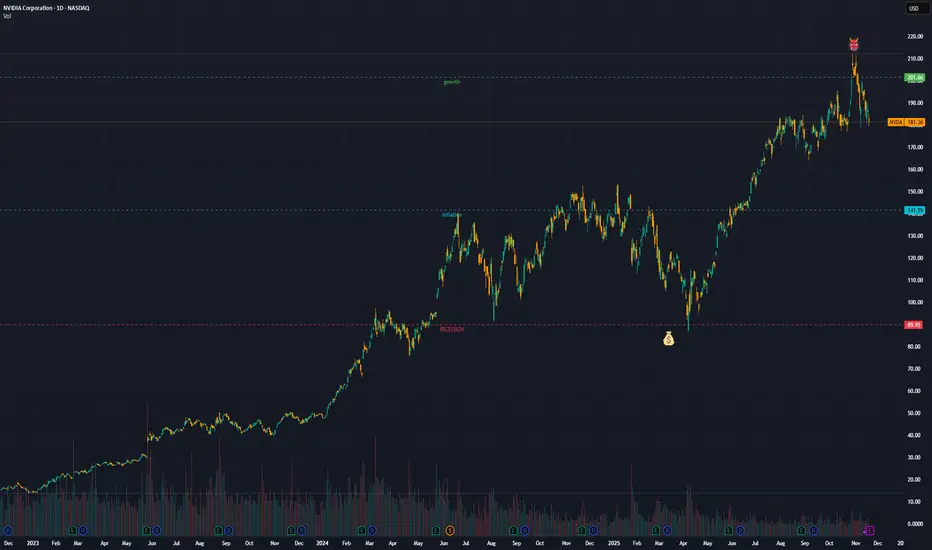
NVDA down MVP SYSTEM MOMENTUM: RSI Broke down from widening wedge VOLUME: to downside PRICE ACTION: big red engulfing at the lower border of the widening wedge I don’t hold positions in NVDA. I use it as a barometer for the market. Shortby MVPsystem3
Nvidia Bearish Engulfing Candle at 100 DMAIf this breaks through the 100DMA and has a sustained drop, expect it to go to the next support level of $150 to $152.Shortby RidgeHavenCapital2
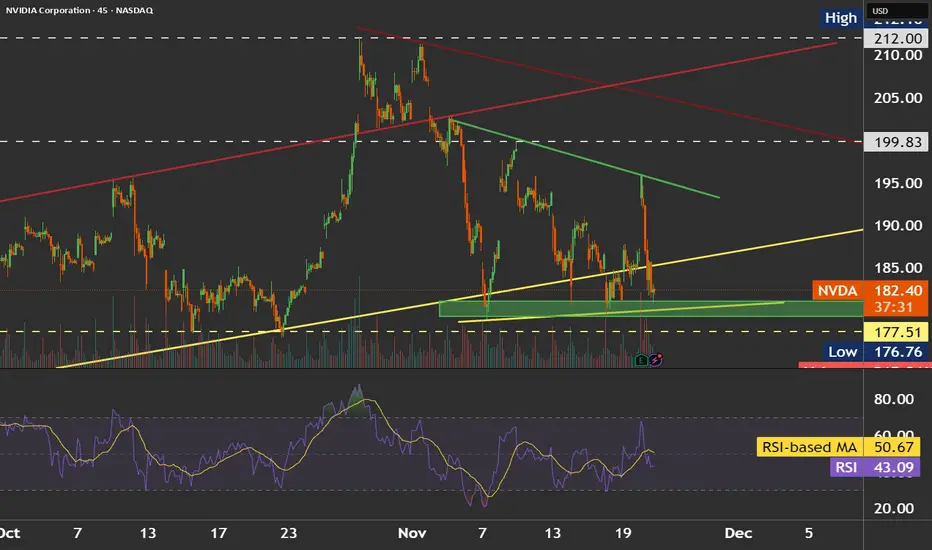
How dip can this get ?,bulls needs to defend 181-180 rangeNASDAQ:NVDA bears pushed market lower from a high of 196 ;looking at the chart we see price breaking-through our channel and price trading below our 50 day moving Average ,bulls have to defend 181-180 range a break will signal more selling pressure with remediate support at 177 and 164 Shortby KlenamCapital1
Nvidia Erases Post-Earnings RallyShortly after publishing its earnings, shares of tech giant Nvidia jumped more than 5% at the start of the session; however, a new bearish sentiment quickly took hold of the market, and the stock fell over 7% in the final trading hours, wiping out the gains seen after the results. The company reported strong figures, with revenue of $57 billion, above the expected $54 billion, and projected fourth-quarter sales near $65 billion. Despite the positive numbers, selling pressure began weighing on the price, mainly because the optimism was likely already priced in, prompting short-term profit-taking. In addition, growing concerns about emerging competition have fueled ongoing weakness in the stock. If market confidence fails to recover soon, selling pressure could intensify in the coming sessions. Uptrend Losing Momentum Since November 11, indecisive price action has led to a break of the long-standing upward trendline that had been guiding the stock’s movement. This uncertainty has created a short-term sideways range, with a ceiling at $196 and a floor at $179 per share. As long as these levels hold, a neutral and sideways phase is likely to dominate, indicating lack of clear direction in the short term. RSI The RSI remains slightly below the neutral 50 level, suggesting that selling momentum slightly outweighs buying pressure, though not strongly enough to establish a consistent short-term trend. As long as the RSI stays near 50, neutrality in price movement is likely to persist. TRIX The TRIX indicator shows a downward slope, moving closer to the zero line, indicating a balance in the strength of the exponential moving averages. This reinforces the indecision in the stock’s short-term behavior. Key Levels to Watch: $196 – Main Resistance: Corresponds to the most recent upward retracement zone. A break above this level could revive the bullish bias and reactivate the long-term uptrend. $188 – Nearby Barrier: Area aligned with the 50-period simple moving average. Price moves near this level could support the formation of a more defined sideways range. $179 – Key Support: Represents the lowest area from the past two months and serves as the most critical bearish barrier. A drop below this level could trigger a stronger selling bias and mark the start of a short-term downtrend. Written by Julian Pineda, CFA, CMT – Market Analystby FOREX.com3
NVDA | Post-Earnings Exhaustion Near Recent Highs – What’s Next?NVIDIA delivered another exceptional quarter, with revenue surging and demand for AI infrastructure remaining firm. Yet the market’s reaction was notably muted, signalling that expectations may already be stretched in the short term. Technical Lens: The share price gapped higher after earnings but struggled to break above its recent peak. It slipped back toward the pre-announcement zone, which suggests fatigue after months of strong momentum. The anchored VWAP from the last significant swing remains an important reference point below current prices, acting as fair-value support throughout the year. Scenarios: • If the anchored VWAP continues to draw price lower, the shares may drift into that support zone before sentiment resets and buyers return. • If the post-earnings gap is reclaimed and price pushes through prior highs, it would indicate that momentum is re-energising sooner than expected. Catalysts: Upcoming macro data, broader equity market sentiment, and any fresh commentary on AI demand or supply constraints may influence whether NVIDIA consolidates or attempts another move toward new highs. Takeaway: The fundamentals remain strong, but the technical picture hints at a near-term pause. The anchored VWAP zone sits as the key decision point for the next phase of the trend.by Alchemy Markets1
NVDA | Long | R/S Flip at 172 + 0.5 Fib | Nov 20, 2025NVDA | Long | R/S Flip at 172 + 0.5 Fib + VWAP Support in Rising Channel | Nov 20, 2025 🔹 Thesis Summary NVIDIA remains the S&P 500’s largest single weight and the AI-infrastructure bellwether. After a fast shakeout to channel support, the chart sets up a defined-risk long as risk sentiment sits at Extreme Fear—a backdrop that historically favors mean reversion and leadership rebounds. 🔹 Trade Setup Bias: Long Entry Zone: 172–182 (R/S flip and ~0.5 retrace inside the ascending channel) Stop Loss: 152–156 (below VWAP/structure and prior base) Take-Profits: TP1: 188–192 (channel mid / prior supply) TP2: 205–208 (upper-mid channel) TP3: 214–220 (channel top / measured move) Max Target: 230–246 (channel extension if trend resumes) R:R (from ~175): ~1.5–3.0 depending on exit path and scaling. 🔹 Narrative & Context Structure: Daily up-channel intact; recent spike down tagged the lower rail and immediately reclaimed the R/S band near 172. That zone aligns with ~0.5 Fib of the prior impulse and anchored VWAP support—classic “shakeout-and-go” anatomy. Flow: Pullbacks within strong secular trends often pivot when broader risk metrics hit extremes. Current readings show Extreme Fear across equities and crypto (dashboard needles in single-digits/low-teens), consistent with forced-de-risking rather than trend change. Leadership: Info Tech is 34% of the S&P 500 by weight. NVDA itself sits at ~8.06% of the index’s top-25 weight table—structurally important for passive flows. Re-risking tends to bid the heaviest weights first, providing tailwinds if indices stabilize. Correlations to watch: NQ strength, breadth stabilization in SOX, and dollar drift lower typically amplify NVDA recovery legs. 🔹 Valuation & Context (Pro Metrics, Framed Simply) Forward P/E: ~35–45x vs Semi/Tech peers typically ~20–25x → Market pays a premium per $1 of next-12-mo earnings → Premium reflects dominant AI compute share and visibility; multiple compression risk is why we anchor to defined stop. P/FCF: High-teens to 20s vs peers in low-teens → Investors pay up for cash conversion → Acceptable so long as AI DC demand/ASP mix persists. Quality (ROE/ROIC): Very high (well above typical large-cap tech) → Capital turns + software stack (CUDA) lift returns → Supports buying pullbacks, not chasing verticals. Growth: EPS growth well above sector on AI data-center ramps → Outlier growth justifies trend-following bias. Risk (Debt/Equity): Low/Conservative → Balance sheet flexibility if cycle wobbles. 🔹 Contrarian Angle (Your Edge) Consensus fixates on “too expensive” optics and headline sentiment. The technical reaction at 172–182 with fear gauges at extremes argues for a positioning reset, not a trend break. With channel structure intact and flows concentrated in megacap AI, we see a credible path toward 214–220 first, then 230–246 on continuation. 🔹 Risks Positioning/Multiple Risk: Any guide-down or supply hiccup can compress the premium multiple. Sector Rotation: A sharp unwind in AI/semis or factor shift to defensives. Macro Shock: Dollar spike/real-yield jump or regulatory headlines impacting export mix. 🔹 Macro Considerations Sentiment: Equity & crypto Fear & Greed dials show Extreme Fear (single-digit/low-teens) — fuel for relief rallies when flows turn. Index Mechanics: Tech at 34% of S&P weight; NVDA among top index constituents (~8.06% of top-25 weight list). Stabilization in SPX/NQ mechanically supports NVDA. Flow Triggers: SOX breadth thrust, NQ reclaim of prior breakdown area, and any cooling in rates/FX volatility would accelerate the upside path. 🔹 Bottom Line NVDA’s premium is real, but so are its cash generation and AI demand drivers. The 172–182 buy-zone offers a clean, conviction long with 152–156 as invalidation. Manage in tranches toward 188 / 205 / 214–220, leaving a runner for 230–246 if momentum and macro confirm. 🔹 Forward Path If this gains traction (10+ likes), I’ll post: (1) a weekly/time-frame add-on with updated channel math, (2) live notes on any break/retest of 205 and 214–220, and (3) Q&A on risk management. Like & Follow for structured ideas, not signals. I post high-conviction setups here before broader narratives play out. ⚠️ Disclaimer: This is not financial advice. Do your own research. Levels derived from the attached chart; sentiment and index weights from the referenced images. Charts/visuals may include AI enhancements. 🔹 Footnote Forward P/E: Price divided by expected earnings over the next 12 months. Lower = cheaper relative to profits. P/FCF (Price-to-Free-Cash-Flow): Price vs. the cash left after investments. A measure of efficiency. FCF Yield: Free cash flow per share ÷ price per share. Higher = more cash returned for each dollar invested. ROE (Return on Equity): Net income ÷ shareholder equity. Shows management efficiency with investor capital. ROIC (Return on Invested Capital): Net income ÷ all invested capital (equity + debt). A purer profitability gauge. Debt/Equity: Debt divided by equity. <1 usually means balance sheet is conservative. R:R (Risk-to-Reward): Ratio of expected upside vs. downside. 3:1 = you risk $1 to make $3.Longby Risk_Adj_Return337
NVDA LongBroader Market Structure NVDA has been in a short-term bullish corrective structure after forming a BOS at $179.91, which marked the end of the prior bearish leg. Since that break, price has been forming higher lows and higher highs on the intraday structure. However, the most recent swing into the $194–$195 supply produced a sharp rejection, showing that the bullish structure is still counter-trend relative to the larger bearish swing from the $202–$205 highs. No new CHoCH has printed yet, but the aggressive selloff from $195 signals a potential short-term shift in control back toward sellers unless demand holds. Supply & Demand Zones The upper supply zone at $194–$195 remains strong; price dropped sharply from this level with long-bodied bearish candles, showing active institutional selling and low willingness from buyers to absorb orders. The deeper supply above, between $199–$202, is an even stronger zone because it originated the major downside impulse that broke structure. On the buy side, the demand at $185–$183 previously showed clear strength—buyers stepped in aggressively and pushed price upward with momentum—which tells us the zone still carries validity. The lower demand between $181–$178 is even more important, as it’s the origin of the BOS at $179.91 and represents the last confirmed defensive line for bulls. Price Action Within the Marked Region Price is currently falling from the $195 rejection and heading toward the $185–$183 demand you marked. Candles show increasing wick size on the way down, suggesting early signs of selling exhaustion but not yet a reversal. As price enters this demand, we should see either absorption or continuation. If buyers defend the zone as they did previously, a corrective bounce toward $192–$194 is likely. If demand fails, price will unwind quickly into the deeper $181–$178 liquidity pocket. Expectation, Bias & Invalidation Trade bias: short-term bullish, expecting price to dip into demand and bounce into the lower supply. Expected direction: a pullback into $185–$183, followed by a rally into $192–$194. Invalidation: a clean close below $183, which would signal sellers have regained full control and shift the outlook to bearish continuation toward $181–$178. Momentum & Candle Behavior Momentum currently favors sellers, given the fast drop from supply, but the decline is becoming more controlled—suggesting momentum is fading as price approaches demand. No confirming reversal candles have appeared yet; we will need to see a long-wick rejection, engulfing candle, or clear absorption footprint at demand to confirm the bounce scenario.Longby ProSignalai225
NVDA Swing Trade Today✅ Positives / Bull Case Strong recent earnings + guidance: NVIDIA beat in Q3 and the commentary is upbeat for Q4 (“crazy good” according to CEO Jensen Huang). StockAnalysis +4 Fox Business +4 Investors +4 Wall-Street bullish consensus: Analyst average target ~$243 from current ~$185-$195, suggesting ~30% upside in the medium term. TipRanks +1 Strong fundamental backdrop: Dominance in AI chips, data-centers, large TAM (total addressable market) etc. Makes for a good “momentum” swing candidate if you believe the thesis. ⚠️ Risks / Bear Case Valuation & expectations are already very high: With consensus expecting big growth, there’s little margin for error. If guidance disappoints or general tech/macro weakens, it could pull back. Sector/market risk: AI stocks are in “expectation land” to a large extent. Some analysts caution about a possible bubble. MarketWatch +1 Very volatile: As a swing trade you’ll need good risk control. Big moves both ways possible. Short-term catalysts may be thin: Some notes (e.g., Goldman Sachs) suggest lack of new catalysts for near term. Business Insider 🎯 Setup for a Swing Trade Here’s how you might structure a swing trade given your approach: Entry Current price ~ US$195.67 (per latest) You could wait for a pullback into a support zone (for example around US$180-190) to improve risk/reward. Or if momentum is strong and you want to ride it you could enter near current levels—but expect higher risk. Stop-Loss For example, a stop could be placed just below a recent support: say US$175-180 zone (depending on your risk tolerance). Given high volatility, a tighter stop may lead to getting whipsawed. Target Given the ~30% upside to ~$243 (consensus target) you could set a medium swing target around US$235-250. That gives about +20-30% upside. Alternatively, for a shorter swing you may aim for +10-15% (US$215-225) and then re-evaluate. Time Horizon Since you said “swing trade”, perhaps 1-4 weeks depending on catalyst flow. If using until next earnings/guidance or sector move, keep flexible. Risk/Reward Suppose you enter at US$195, stop at US$175 (≈10% risk) and target US$235 (≈20% reward) → ~2:1 R/R, decent. But if you enter higher, risk increases quickly. Market/Context Conditions Ensure broad market tech/AI risk isn’t spiking down (i.e., avoid entering if tech is breaking down). Watch for macro/interest-rate cues, since growth stocks are sensitive. Keep an eye on news related to export rules (China), chip supply constraints, large customer guidance — any negative shock could hit. 🔍 My Verdict I like NVDA as a swing trade candidate if you: enter with risk control (stop in place), accept the volatility, have conviction in the AI/data-centre tailwinds. However, I’d be somewhat cautious on entering right at the high unless you see a fresh catalyst or a strong pullback to reduce risk. If you’re more conservative, waiting for a retest of support or slight consolidation might be wiser. If I were making a call today: enter around current levels or after a modest pull-back, stop-loss at ~$175-180, target ~$235 for the swing, and be ready to adjust if market tech sentiment weakens.Longby SwingTraderKev3
NVDA: The Bubble Beneath the Brilliance A deep dive into Nvidia’s AI-fueled rally — and the cracks forming under the surface. 🐺 Hello Traders 🐺 Nvidia’s been the poster child of the AI revolution — no doubt about it. But every time a narrative gets “too perfect,” I hit pause… and zoom out. Because NVDA’s been here before. And every time, the chart whispered the truth long before the headlines caught up. So let’s ask the real question: Not “Is Nvidia a great company?” — we already know it is. But rather: “Are we pricing in a future that might not arrive fast enough?” That’s where things get interesting. 🔹 The Hidden Cost of the AI Boom AI is revolutionary — but it’s also a cash furnace. Training, inference, datacenters, energy, hardware… it all comes with a brutal price tag. And if returns don’t scale fast enough, guess where the market cuts first? Hardware. Which puts NVDA right at the heart of the risk zone. Great company ≠ infinite valuation. 🔹 NVDA’s History of Hype & Hangovers Let’s zoom out and look at the cycles: 1️⃣ Dot-Com Era (2000–2002) Nvidia rode the internet wave hard. Then the bubble popped — and NVDA got crushed. Narrative > fundamentals… until reality showed up. 2️⃣ 2006–2007 GPU Mania Gaming hype sent NVDA vertical. Then came 2008 — and wiped the slate clean. 3️⃣ 2015–2018: Growth Meets Hype This one was different. Real growth + real hype. Drivers included: - 4K gaming and esports explosion - AI research adoption - Tesla’s self-driving push - Crypto mining boom - Datacenter demand - Explosive revenue and margin growth Outcome? A solid run with a mini-bubble at the tail end — which corrected during the crypto winter. 4️⃣ 2018 Crypto Crash Mining demand collapsed. NVDA dropped over 50%. 5️⃣ 2023–2024 AI Supercycle The biggest rally in NVDA’s history. Parabolic. Vertical. Narrative-fueled. But here’s the thing: Every vertical move in history cools off when expectations outrun execution. 🔹 Why This Cycle Feels Fragile This isn’t just hype — it’s built on massive capex from Big Tech. But capex isn’t infinite. And the ROI of AI? Still foggy. Here’s what’s brewing beneath the surface: - Monetization is early - Margins could shrink - Custom chips are rising - Spending could slow And when it does, NVDA feels it first. That’s why calling this an “unstoppable cycle” is dangerous. 🔹 My Technical View I treat parabolic charts with caution — always. - Strong trend ≠ invincible - Steeper slope = weaker base - Euphoria = warning sign - Breaks are rarely gentle NVDA still looks bullish long-term… But no parabolic trend lasts forever. I’m watching: The price is currently reacting very well to the parabolic curves. Every time it hits the top, a downtrend begins, and the price crashes hard before retesting the support curve! If AI spending slows even a little, NVDA will be the first domino. 🔹 Final Takeaways Nvidia isn’t in trouble. It’s one of the strongest tech players on the planet. But history doesn’t care about greatness — it cares about gravity. And every time NVDA flew too close to the sun, it came back down hard. This cycle checks all the bubble boxes: - Parabolic price - Euphoric narrative - Crowded positioning - Sky-high expectations - Capex dependence As long as the slope holds, momentum traders run the show. But when it breaks… it breaks fast. That’s the bubble beneath the brilliance. 🎯 Why This Post Matters Because most traders only see the surface. They chase hype. They follow headlines. But they ignore the deeper forces — the ones that actually move the chart. This post is a reminder: Stay sharp. Stay skeptical. And never treat any narrative — even AI — as invincible. 🐺 Discipline is rarely enjoyable, but almost always profitable 🐺 🐺 KIU_COIN 🐺 Shortby Kiu_Coin9
Breaking: Nvidia ($NVDA) Crush Q3 Earnings Nvidia ( NASDAQ:NVDA ) stock saw a noteworthy uptick of 5% in early Thursday premarket trading albeit market turmoil. The asset reported earnings yesterday after market close sparking bullish sentiment. The asset is approaching the $200 resistant as the RSI is at 47 giving room for massive upside. The Shares of Nvidia popped in premarket trade after the U.S. firm beat expectations in third-quarter results after the closing bell on Wednesday. Shares were last trading 5.5% higher at 4:15 a.m. ET. Nvidia topped forecasts for revenue, which jumped 62% to $57.01 billion year-on-year, and issued stronger-than-expected fourth-quarter sales guidance. “There’s been a lot of talk about an AI bubble,” Nvidia CEO Jensen Huang told investors on an earnings call, as the firm set out its view of the industry. “From our vantage point, we see something very different.” Financial Performance In 2024, NVIDIA's revenue was $130.50 billion, an increase of 114.20% compared to the previous year's $60.92 billion. Earnings were $72.88 billion, an increase of 144.89%. Financial Performance In 2024, NVIDIA's revenue was $130.50 billion, an increase of 114.20% compared to the previous year's $60.92 billion. Earnings were $72.88 billion, an increase of 144.89%. About NVDA NVIDIA Corporation, a computing infrastructure company, provides graphics and compute and networking solutions in the United States, Singapore, Taiwan, China, Hong Kong, and internationally. The Compute & Networking segment includes its Data Centre accelerated computing platforms and artificial intelligence solutions and software; networking; automotive platforms and autonomous and electric vehicle solutions; Jetson for robotics and other embedded platforms; and DGX Cloud computing services. Longby DEXWireNews8
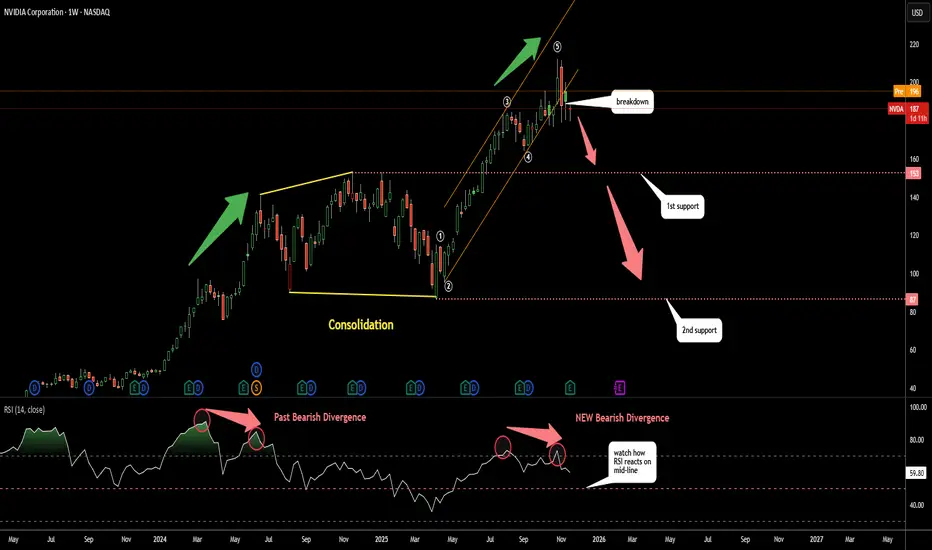
Nvdia (NVDA): How Deep It Can Dip?The RSI is not buying the hype as it shows clear Bearish Divergence This aligns with the current impulse wave count suggesting the 5 wave structure may now be complete and the orange uptrend has been broken Last year a similar Bearish Divergence triggered a large consolidation phase marked in yellow It may repeat again First support is at 153 the top of the previous consolidation Second support is at 87 the bottom of that consolidationShortby aibek3
Nvidia Earnings Finally Ease Market Jitters. Are AI Bulls Back?It’s confirmed. This is Nvidia’s stock market and we all live in it. Nvidia NASDAQ:NVDA reported yet another record-breaking quarter, instantly soothing market nerves after a week filled with talks of “AI bubble,” “valuation fever,” and “maybe Michael Burry is right again.” It was the cherry of the earnings season . The chipmaking giant announced $57 billion in sales during the most recent quarter. The figure is up 62% year-over-year and way above estimates. In other words, Nvidia didn’t just calm the market. It kicked the door open and shouted: “Get in losers, we’re going shopping.” CEO Jensen Huang was even more enthusiastic, declaring that “AI is going everywhere, doing everything, all at once.” In classic Huang fashion, you could almost smell the leather jacket. 💽 Data Center Demand: Still Insatiable Let’s cut to the headline number: $51.2 billion in data-center revenue. Analysts expected $49 billion. Nvidia delivered more. The company’s new Blackwell GPUs, described by Huang as “off the charts” when it comes to demand, continue to fly off the production line the moment they’re made. Quarterly net income hit a whopping $31.9 billion, up 65% from the year prior. At a time when most companies celebrate single-digit percentage growth, Nvidia is casually stacking double and triple digits. 📈 Markets Exhale, Futures Soar The relief was immediate and widespread. You could say that Nvidia’s earnings are not just earnings anymore, but a macro signal. Here’s what the picture looked like after the release: CoreWeave NASDAQ:CRWV jumped 10% Futures tied to the Nasdaq NASDAQ:IXIC climbed 2% Every Magnificent Seven stock flashing green Investors had been waiting for confirmation that the AI boom still had room. And Nvidia delivered enough reassurance to light up the entire tech complex. “Okay. Maybe we don’t need to rotate into utilities just yet,” every tech bro, probably. 😬 The Stakes Were High. Really High. The reaction, though, must be taken within the current context. Over the past few weeks, tech stocks were hit by deep selloffs as markets fretted over the same question: “Is AI too expensive?” Between skyrocketing capital expenditures, absurdly ambitious data-center budgets, and the kind of spending plans that would make even sovereign wealth funds blush, investors wondered whether Big Tech was building an AI future or an AI money pit. Even Michael Burry stepped in, revealing positions betting against Nvidia NASDAQ:NVDA and Palantir NASDAQ:PLTR . That move alone sent pockets of the market into a philosophical crisis. After all, that’s the guy from “The Big Short” and he’s hedged against your favorite trade. 🤖 So… Are the Bulls Back? Maybe. For now at least. But with conditions. Nvidia’s stock more than doubled between April and late October, only to slide in recent weeks as bubble fears thickened. Year to date, the stock is still up about 30%. Nvidia’s numbers prove that AI spending is still accelerating. But the broader question remains: Can companies actually turn those massive AI investments into profit? Nvidia’s blowout quarter just reset the narrative: AI demand is still real Spending is justified The cycle is still “virtuous,” in Huang’s words After this earnings print, the bull case has something it desperately needed: momentum. And momentum is a powerful thing, especially in a market that had started to doubt its favorite story. Off to you : Do you still see room for growth in the AI space? Or is that rebound a short-term reflex? Share your views in the comments! by TradingView3030278
#NVIDIA $NVDA The new leader!Nvidia is the world's number one after passing $MSFT. -Valuation soars to $3.34 trillion. Nvidia completed a 10-for-1 stock split on June 7. The chipmaker last month posted yet another blockbuster quarter, noting a 262% increase in revenue and a 462% increase in profits year-over-year. I'm not going to write to much here. The market sentiment is clearly bullish and here are my projections for $NVDA. The chart should speak for itself. Targets zone is shown on the chart. Short term, expect price to consolidate withing the red projection marker based on divergences and anomalies in the relative strength index followed by a continuation of the upwards trend (green projection marker). Targets: (-128),146,160,200 |----Range-----| (alfa) I will take a bullish longer term stand on NASDAQ:NVDA from where we currently sit. Short term, expect a pullback/consolidation at the current level before a possible continuation. (Can add more intraday targets if requested).Longby BaseLineTradersUpdated 26
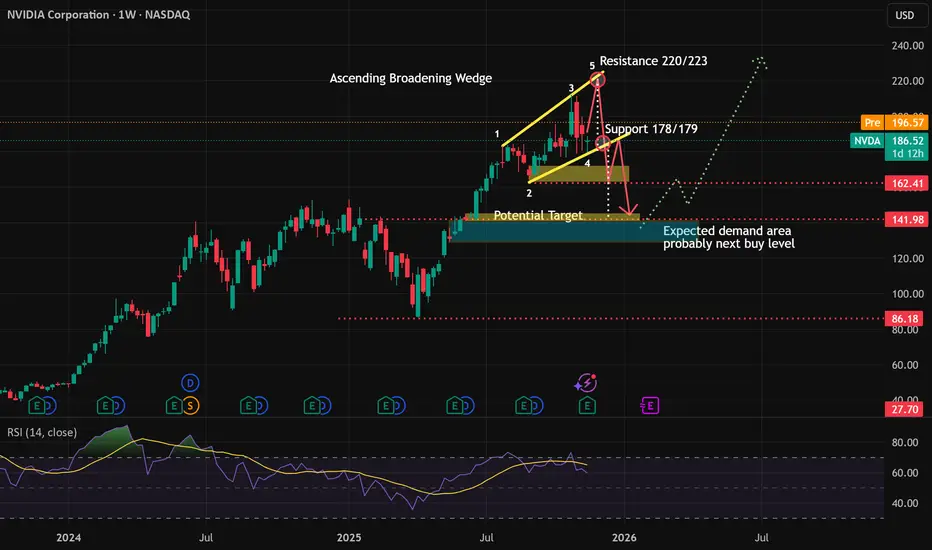
Ascending Broadening Wedge for NVIDIA Weekly ChartThe downtrend probably won't be happen in the near term, but the rebound alson have limited upside. But at least there are 2 possibilities ahead of the price. I suspect Ascending Broadening Wedge is in process in weekly chart for Nvidia. The concern is the potensial downtrend pressure, especially if support trendline break. I devide it on 2 scenario : 1. Rebound to 220/223 first. This mean no immediate breakout support anytime soon based on the count. The price will have to raise first with maximum target 220/223 before followed with rejection. But the raise don't have to be exactly 220/223. It can also retest the previous high (3) before rejected and fall. 2. No rebound, support 177/178 immediately broken, the downtren continues to the target area. There area possibilities to go up first if Santa Claus Rally succeed to push the price above or near resistance, then after the seasonal trade for Santa Claus or January effect will face the profit taking and underpressure through the supportline. After the pressure, we probably will see some demand on blue area to push the price back on the uptrend..that ofcourse..if no "AI-buble" coming in coming months DISCLAIMER Do with your own risk! This is not suggestion! This is my personal view on the opportunities that could happen to Nvidia.by irpansupiandi4
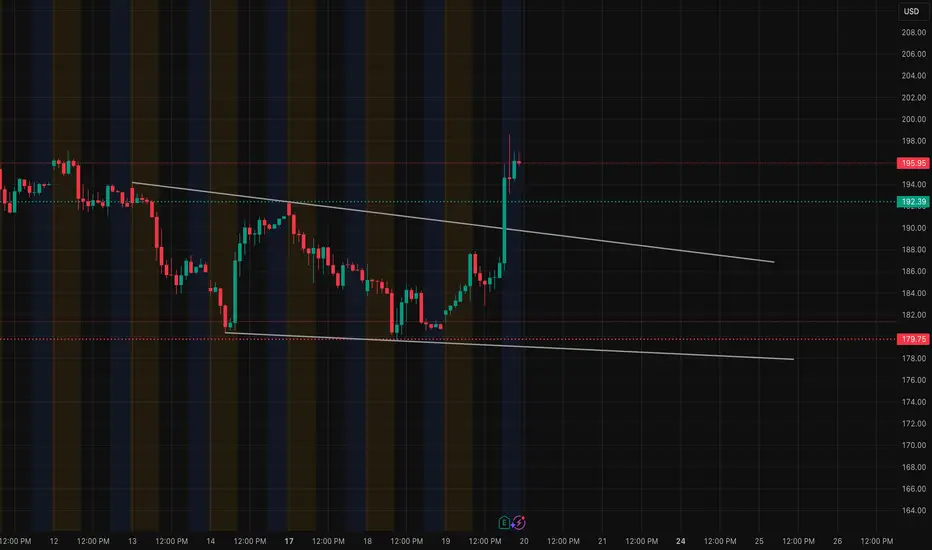
NVDA – Breakout or Pullback Setup? Nov. 20 Trade Plan1-Hour Outlook (Main Bias) NVDA broke out of a multi-day descending channel and pushed straight into the 195.50–196 zone, which previously acted as heavy resistance on the 1-hour chart. The impulse was strong, reclaiming several key structure levels in one move. 1H Structure * NVDA printed a strong bullish BOS after breaking the channel trendline. * Price is currently consolidating near 195.95, right under the 200 psychological level. * Momentum remains strong, with MACD expanding upward after a fresh crossover. * Stochastic is elevated but not rolling over yet. Buyers still in control. 1H Key Levels Breakout trigger: above 196 Upside targets: * 200.00 (major psychological + GEX resistance) * 202.50–203 (thin liquidity zone) Support zone: 187.50–188 Bears gain control only below: 182.80 1H Trading Idea Bullish scenario: If NVDA holds above 192.50–193.00 and reclaims 196 cleanly, momentum favors an extension toward the 200–202.50 zone. Break above 200 opens the next leg of gamma pressure. Bearish scenario: Valid only if price rejects 196 with a full-body reversal candle. Downside magnets sit at 192 and 188. 15-Minute Outlook (Execution Timeframe) NVDA is consolidating after a strong vertical impulse. Price formed a BOS on the 15M and is now pulling back slightly into the minor supply zone at 195–196. 15M Structure * Clean sequence: CHoCH → BOS → impulsive breakout → consolidation. * EMAs are stacked bullish and acting as dynamic support. * The recent FVG at 191.50–192.20 held well, confirming bullish continuation structure. 15M Trading Setups Bullish entry: * Prefer retrace into 193.80–194.30 * Look for bullish engulfing or a wick rejection * Targets: 196 → 200 * Stop: below 192.70 Breakout entry: * Enter on clean break of 196 * Stop below last swing low * Targets: 198.50 → 200–202 Bearish scalp: * Only valid if NVDA repeatedly rejects 196 * Target: 193.50 * Invalid if price breaks 196 GEX Confirmation Based on the NVDA GEX chart: Bullish Signals * Highest positive NETGEX sits at 200, creating a natural upside magnet. * Large call walls at 196, 200, 202.50, supporting upward drift. * Positive GEX blocks (GEX9, GEX10) align with continuation toward 200–203. * Put walls are weak above 188 — little downside defense for bears. Interpretation GEX strongly favors upside continuation as long as NVDA remains above 192–193. A break above 196 triggers dealer hedging, pushing price toward 200. Options Trading Plan (GEX-Based) Bullish Plan If price breaks above 196 with momentum: Contracts to consider: * 197.5C * 200C Targets: * 198.50 → 200 → 202.50 Reason: Above 196, market makers are forced to hedge upward, accelerating price toward the strongest GEX cluster at 200. Bearish Plan Only valid if NVDA rejects 196 with strong selling: Contracts to consider: * 193P * 190P Targets: * 193.50 → 192.00 Reason: Below 193, GEX becomes lighter and liquidity flows toward 188. Final Bias for Nov. 20 NVDA is showing strong bullish structure after breaking the descending channel. As long as price holds above 192–193, the probability of testing 196 and pushing toward 200 remains high. Bearish setups only activate with a clean rejection at 196. Disclaimer This analysis is for educational purposes only and not financial advice. Always perform independent research and manage risk appropriately. by BullBearInsights4429
Nvidia (NASDAQ: $NVDA) Smashes Q3 Expectations on AI Demand Nvidia (NASDAQ: NASDAQ:NVDA , XETRA:NVD) posted another blockbuster quarter as its fiscal Q3 results exceeded Wall Street expectations, powered almost entirely by explosive demand for its AI-focused data center chips. Revenue reached $57.01 billion, beating the $55.19 billion consensus and climbing 62% year-over-year. Adjusted EPS came in at $1.30, up 60% from last year and 24% sequentially. The data center division once again carried the quarter with $51.2 billion in revenue, outperforming analyst estimates of $49.34 billion and rising 66% from a year ago. Nvidia highlighted record demand for its Blackwell platform, which delivers industry-leading performance and 10x throughput per megawatt compared to previous generations. CEO Jensen Huang said AI compute demand continues to accelerate across both training and inference, calling it a “virtuous cycle of AI.” Other business segments posted mixed results. Gaming revenue grew 30% year-over-year to $4.3 billion but dipped slightly from the previous quarter. Professional visualization revenue increased 56% to $760 million, and automotive revenue rose 32% to $590 million, reflecting steady diversification outside core AI markets. Nvidia reported adjusted operating income of $37.75 billion and adjusted net income of $31.77 billion, both well above expectations. Free cash flow hit $22.09 billion, and the company returned $37 billion to shareholders through dividends and buybacks in the first nine months of fiscal 2026. For Q4, Nvidia guided revenue of $65 billion, well above the $61.98 billion consensus, and projected gross margins around 75%. The company expects global AI adoption to accelerate further as more startups, enterprises, and countries ramp up model development. Shares rose 3.7% in after-hours trading following the earnings release.Longby DEXWireNews10
Nvidia: Downside Pressure Nvidia has recently faced notable downward pressure, but so far has managed to hold above the support level at $176.21. As a result, we continue to anticipate an imminent rally as part of the beige wave V, which should lift the stock into the now-red Target Zone between $227.38 and $260.60. However, if the stock immediately drops below the $176.21 mark, we would expect a new low for the beige wave alt.IV, with the lower $145.50 level still likely to hold. Long00:46by HKCM_Global3
NVDA Earnings Trade LevelsThe story of NVIDIA is one of unprecedented growth and valuation for perfection. Analysts forecast earnings of $1.25 per share on revenue of approximately $54.9 billion—a near 60% year-over-year jump. However, simply beating these numbers may not be enough to satisfy the market; the true focus is on the Q4 guidance. The street is looking for guidance above $61.57 billion to fuel the next leg up. The market is currently expecting a massive post-earnings swing, with options pricing implying the stock could move approximately ±7.7% in either direction. This makes the technical trendlines provided the ultimate risk management map . Bullish Scenario (The "Beat and Raise"): A significant beat on revenue (above $55 billion) and strong guidance (above $61.57 billion) would confirm the massive multi-year backlog for the Blackwell and Rubin architectures and likely trigger a rally. Ultimate Target$206 - $221Targeting the Upper light Pink Trend Line and the confluence of recent analyst price targets (ranging from $230 to $275). Bearish Scenario (The "Disappointment")A miss on guidance or an indication of slowing Data Center demand (which makes up nearly 90% of revenue) could lead to a sharp correction, challenging the current bullish structure. $186 break below the Pink Trend line Trend Line would indicate a major technical break and might pause at $173 and ultimately go to $148 signaling a high-conviction short position is valid and that the aggressive AI trend may be over. This is for educational purposes only and is not financial advice. Trading involves substantial risk, and you could lose money. Always consult with a qualified financial professional.by GoldenTraderz_20251
NVDA Earnings Play: Bullish Calls Despite Katy Neutral BiasNVDA QuantSignals V3 — Earnings Play (2025-11-19) Direction: BUY CALLS Confidence: 68% (Medium Conviction) Risk Level: Moderate 🎯 Trade Setup Strike: $180 Expiry: 2025-11-21 Entry Range: $9.30 – $9.40 Target 1: $18.60 Target 2: $27.90 Stop Loss: $4.65 Position Size: 3% 📈 Key Metrics Current Price: $185.06 Implied Move: $13.15 (7.1%) PCR: 0.46 (Bullish) 24h Move: +0.48% RSI: 31.3 Support: $180.52 🧠 Analysis Snapshot Katy AI Prediction: Neutral → slight bearish drift toward $183.56–184.20 Technical Indicators: Mixed (MACD bullish, ROC bearish) News Sentiment: Strongly Bullish $100B AI infra deal w/ Brookfield Presidential endorsement AI chip testing breakthroughs Options Flow: Heavy call activity; institutional size at higher strikes Volatility: VIX 23.25 — elevated ⚡ Why This Trade Works Bullish news + strong call flow overpowers Katy’s neutral/slightly bearish modeling Earnings volatility + catalysts create a favorable upside skew 0.63 delta strike gives balanced risk/reward ⚠️ Notes Moderate confidence → consider smaller sizing Expect heavy volatility due to 7.1% implied earnings move Low pre-earnings volume → scale entries if possibleLongby quantsignals7
Pop and drop part deuxLooks like that is possible, although right now it definitely feels more bullish than not. I think the market will be choppy the next few days at least. Gold is at resistance. VIX looks like an ABC forming. Oil falling but likely a test of the bottom before a rally. BTC could get to 92500 but it will find resistance there. Good luck!07:06by rsitrades2
NVIDIA is CISCO 2.0 NVIDIA is a $20-$30 Stock without the Data Centers. There is zero demand for Data Centers. We are seeing the second Dot.com Bubble. NVIDIA is CISCO 2.0. CISCO dropped 80-90% after the Dot.com price discovery happened. This is coming in 2026.Shortby grumpa06334
Pre-Nvidia Q3 2025 EARNINGS - Two Scenarios to WatchNVDA is sitting right on the Anchored VP POC with an oversold Stoch RSI and price trading under the EMA-20 Bollinger band (1 std). That’s the same setup that has triggered reversion bounces multiple times this year. Scenario 1 — Bounce and Band Chop (Green Path) If NVDA holds the POC, the most natural move is a bounce back into the EMA-20 band's high. From there, expect price to whip around inside the band because that’s been its early 2025 behaviour: revert → chop → retest. The upper band sits just under $200, a psychological and structural resistance. This is the high-probability scenario if earnings are neutral or strong. Scenario 2 — Break Below POC and Turn It into Resistance (Red Path) If earnings disappoint and NVDA gaps below the POC tomorrow, that same level becomes a potential resistance on any intraday bounce. But — and this is the part many people miss — Scenario 1 is still valid unless we get a clear rejection from the underside of POC. Meaning: A break below POC is not automatically a trend shift A failed reclaim with a clean rejection is the real confirmation Only then do we look toward the next structural level at the Jan Top zone around 155–160. NVDA is at a decision point. Earnings drop after today’s close — the real move will be at tomorrow’s open. Whether we bounce into the band or reject off the POC will tell you everything about the next leg.by Alchemy Markets4
The Hidden Truth Behind Buybacks & Cash Flow 🔥 The Hidden Truth Behind Buybacks & Cash Flow: What Investors Miss in NVIDIA’s Numbers Why RSUs and Working Capital can distort the real story Most investors see two big numbers and get excited: ✔ huge buybacks ✔ huge operating cash flow But rarely do they understand what’s actually happening behind the scenes. Let’s break down NVIDIA’s latest filings in simple, real numbers. 🔹 1. RSUs Inflate Share Count — Buybacks Don’t Always Reduce It Everyone loves to hear “the company is buying back shares.” But here’s what most investors don’t realize: RSUs (employee stock awards) create new shares → dilution. Buybacks must first neutralize that dilution before reducing total shares. Let’s look at NVIDIA’s own numbers (Q1 FY2026 – Apr 2025): ▶ Shares Issued from Stock Plans: +50M ▶ Shares Withheld for Taxes (RSU taxes): –13M ▶ Shares Repurchased: –126M 📌 Net share reduction = 126 – 50 + 13 = 89M This means: Although NVIDIA spent $14.5B on buybacks, the true reduction was only 89M shares. And the cost? ▶ “Issuance (Retirement) of Stock, Net” = –$13.725B (Q1) ▶ Q2: –$23.445B ▶ FY: –$33.216B This is not real reduction — it’s a treadmill: RSUs add shares the company buys back shares RSUs add more the company buys back again If NVIDIA ever stopped buybacks for even one quarter, shares outstanding would jump instantly. 🔥 Simple Example (for investors): Start of quarter: 1,000M shares RSUs issued: +40M → 1,040M Buybacks: –50M → 990M The investor thinks they bought back 50M shares. In reality? ➡ True reduction = only 10M. ➡ 80% of buybacks were just neutralizing dilution. This happens every quarter. 🔹 2. Working Capital Boosted Cash Flow — Not Operations Look at NVIDIA’s operating cash flow (OCF): Q1 FY2026 OCF: +$27.414B But the key line is this: Changes in Working Capital: +$8.654B This means: $8.6B of the operating cash flow came from timing of receivables, payables, and inventory — NOT from actual operations. This is crucial because: ✔ It’s cyclical ✔ It’s temporary ✔ It reverses next quarter Example from the next periods: Q2 FY2026 “Changes in WC”: –$2.368B FY2025: –$9.383B Q4 FY2025: –$3.520B Working capital swings can boost or crash cash flow without any change in real profitability. 🔥 Why This Matters Investors often misinterpret: 🚫 A jump in Operating Cash Flow = “Strong business performance” But many times: ✔ It’s just Working Capital cycling ✔ Not improved EBITDA ✔ Not improved margins ✔ Not better demand ✔ Not better efficiency It’s accounting timing, not operational strength. 🔹 3. The Combination Can Mislead Investors In a single quarter, NVIDIA showed: ✔ +8.6B boost from WC ✔ $14.5B spent on buybacks ✔ Net true share reduction only 89M This creates the illusion of: higher OCF higher EPS fewer shares But much of this stems from: accounting timing (WC) neutralizing dilution (RSUs) Not from: organic profitability sustainable improvements 🔥 Conclusion: What Every Investor Should Watch If you want to understand the real strength of a company, focus on: ✔ Net Shares Change (after RSUs) Not just “buybacks.” ✔ OCF minus Changes in Working Capital Not the headline OCF. ✔ True organic cash generation Not timing effects. ✔ SBC (Stock-Based Compensation) Because SBC = dilution = more future buybacks. 📌 Final Wake-Up Call RSUs inflate share count. Buybacks only offset them. Working capital inflates cash flow. Neither guarantees stronger fundamentals. If you want to see the real story, you must look beneath the headline numbers.Shortby giorgalexis114