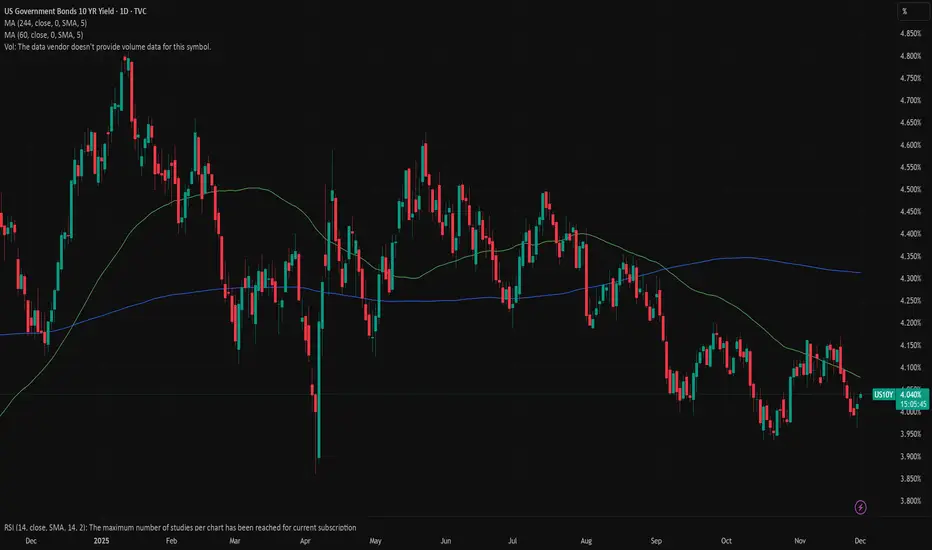
US 10Y TREASURY a 25bps cut – decision weekSeptember's PCE data came just a bit lower than anticipated. The data showed inflation at 2,8%, while the market was expecting a figure of 2,9%. Easing inflation heated market expectations that the Fed will cut interest rates by 25 basis points at their meeting on Wednesday, December 10th. Odds for
US Government Bonds 10 YR Yield
No trades
Related bonds
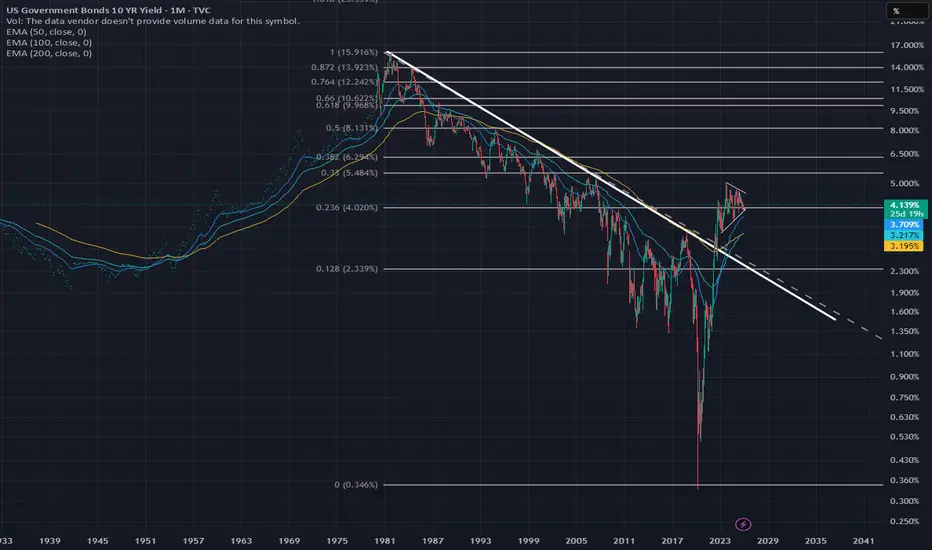
10 Year Yield primed for explosive break outAs the Japanese carry trade unwinds with BOJ having no alternative than to raise rates after decades of real negative rates we expect over 1.3 trillion dollars of Japanese holdings of US treasuries to hit the market along with another 800 Billion Chinese holdings. The 10 Year note is consolidating
10 Year 2.4% 2028-2029 10 Year Yields
Using a double curve and a flipped forecast to track this. 2028-2029 yields could be around 2.4%
fed funds in blue
points used dashed lines to market it
3/6/20
12/20/21
11/1/22
1/14/25
keep in mind this can change depending on the global economy and macro events
The Bond Markets Effect on the Stock MarketThe trend shown here is what helped me derisk prior to sustained market pullbacks seen during the Covid crash and in early 2022. When the 10Y rises sharply, the stock market usually pulls back in the days / weeks to follow. The major 10Y trend can be seen in my previous post which uses the blue lin
US 10Y TREASURY: aligning to a Feds cutWeaker inflation and economic output data increased investors sentiment of a potential Fed rate cut at December's FOMC meeting. The 10Y US Treasury benchmark yields reacted to these expectations, pushing yields further to the lower side. The 10Y yields started the week around 4,04%, but reached the
Swap Trading Secrets1. What Is a Swap?
A swap is a contract between two parties to exchange cash flows or financial obligations for a specified period. These exchanges typically involve interest rates, currencies, commodities, or credit risks.
Think of a swap like this:
You have one type of cash flow.
I have anothe
Digital Dominates the Market & Old Methods Fall Behind1. Digital Transformation: Speed, Scalability, and Efficiency
Digital systems offer lightning-fast operations that traditional methods cannot match.
Where old systems depend on manual processes, paperwork, or physical presence, digital models operate instantly across the globe.
Speed
Transactions
US10Y - move downAt the end of October 2023, we finished the upward move and entered a correction phase.
The higher-level corrections are coming to an end, and in the medium term a deeper move downward is expected.
For a short period, we may still see some upside (or fluctuations) within the correction, but compared
Economic Future at Risk in the Trading Market1. Heightened Market Volatility and Unpredictability
Market volatility is not new, but its frequency, magnitude, and drivers have changed. Previously, volatility was largely triggered by economic data or company earnings. Today, geopolitical shocks, pandemic-like events, cyber-attacks, and supply c
See all ideas
A graphical representation of the interest rates on debt for a range of maturities.
Frequently Asked Questions
The current yield rate is 4.192% — it's increased by 1.34% over the past week.
The current yield of United States 10 Year Government Bonds is 4.192%, whereas at the moment of issuance it was 3.520%, which means 19.09% change. Over the week the yield has increased by 1.34%, the month performance has showed a 1.91% increase, and it has fallen by −1.90% over the year.
Maturity date is when a debt comes due and all principal and/or interest must be repaid to creditors. For example, the United States 10 Year Government Bonds maturity date is Nov 15, 2035.
You can buy United States 10 Year Government Bonds through brokers — choose the one that suits your needs and go ahead. You can also purchase bonds directly from the issuing organization. Closely track the price dynamics and market news before making any decision.
A bond is a debt security issued by a corporation or a government. By buying bonds, investors loan the issuer money in return for an interest rate. By issuing bonds, the state receives funds that can then be injected into the economy, and corporations raise funds for new research or other operational activities. The alphanumeric code of government bonds represents the abbreviated name of the issuing state, as well as its time to maturity. For example, United States 10 Year Government Bonds is the US government bonds with the maturity of 10 years.
Bonds can be of various maturities, e.g. short-term (less than three years), medium-term (four to 10 years), or long-term ones (more than 10 years). So United States 10 Year Government Bonds are medium-term bonds — they have the maturity of 10 years.