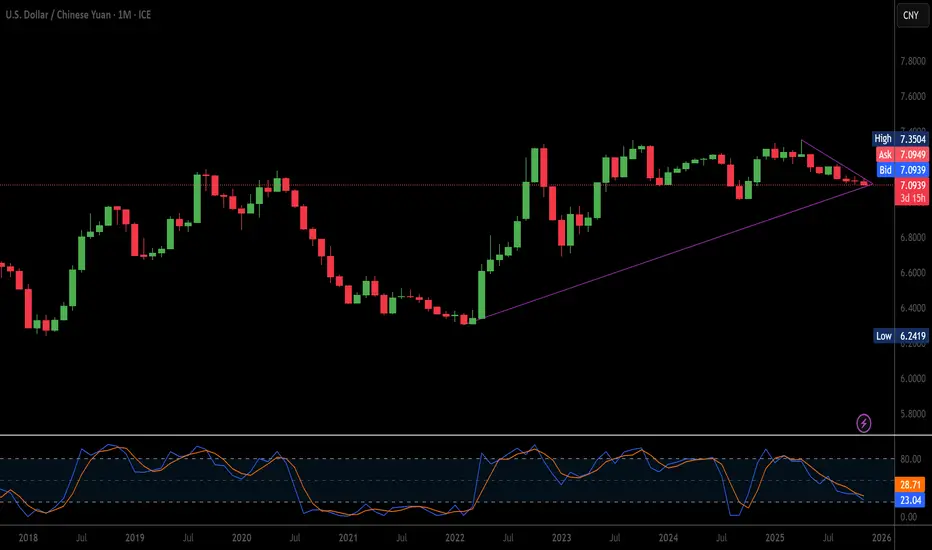
The Strategic Rise of the RenminbiAgainst a backdrop of economic headwinds, the Chinese renminbi is defying market logic. We analyze the geopolitical, strategic, and industrial drivers powering the currency’s 2025 ascent.
A Currency Defying Headwinds
In 2025, the **USD/CNY** exchange rate has shifted significantly, with the renminbi posting a nearly 3% annual gain against the dollar. This performance stands in stark contrast to the 5% depreciation seen during the 2018 trade tensions. What makes this valuation remarkable is the severe disconnect from traditional macroeconomic fundamentals. China currently faces weak domestic consumption, record-low interest rates, and a massive $281 billion capital account deficit.
Typically, such indicators would trigger a sell-off. Yet, the currency has appreciated. This divergence points to a singular, powerful causal force: tight, strategic state management by the People’s Bank of China (PBoC). Beijing is prioritizing stability over market freedom to project economic resilience.
Geostrategy: The 15th Five-Year Plan
The controlled rise of the renminbi is not accidental; it is a calculated geostrategic move. The **15th Five-Year Plan**, released in October 2025, signals a major pivot in Beijing's approach to global finance. The document omits previous cautious language like "prudently promote," replacing it with assertive directives for currency internationalization.
Market analysts interpret this as a clear signal: currency strength is now a central policy goal. By engineering a stable rise, China aims to mirror its strategy during the 1998 Asian Financial Crisis. The goal is to establish the renminbi as a regional anchor and a reliable store of value, countering the dominance of the US dollar.
Management & Leadership: The PBoC’s Aggressive Defense
Central bank leadership has deployed a sophisticated "reference rate strategy" to guide the market. Since November 2024, the PBoC has consistently set the daily midpoint rate significantly higher than market forecasts. The average spread between the PBoC’s fix and market expectations has reached 327 basis points—an historically high gap.
This is a masterclass in market signaling. By aggressively managing expectations, leadership creates a one-sided bet that deters speculative short-selling. This proactive management forces market participants to align with state objectives rather than economic fundamentals.
Business Models: State Banks as Market Makers
China’s unique financial business model allows for direct intervention through state-owned banks. These institutions have acted as proxies for the central bank, executing discreet USD sales and CNY purchases to cap volatility. This "engineered calm" has reduced the three-month volatility of the pair to near decade-lows.
The stability has altered corporate behavior. Exporters, previously hoarding dollars, are now unwinding holdings of over $1 trillion stored in domestic banks. This creates a self-reinforcing loop: state intervention stabilizes the price, and corporate flows then validate that price, generating real demand for the renminbi.
Innovation & Industry Trends: The High-Tech Backstop
While financial engineering plays a role, the renminbi’s strength is also underpinned by China’s evolving industrial base. The decline in low-margin manufacturing is being offset by a surge in high-tech exports. Trade competitiveness remains robust despite currency appreciation.
This resilience is rooted in the country's pivot to high-value sectors like electric vehicles, green energy, and advanced machinery. Patent analysis of Chinese firms reveals a massive accumulation of IP in these domains. This technological leverage allows Chinese exporters to absorb exchange rate costs better than their low-tech predecessors, sustaining the trade surplus.
Cyber Finance & Global Adoption
The strategy is yielding tangible results in global markets. Daily trading volume in the CNY–USD pair has surged 60% to $781 billion. The renminbi now accounts for over 8% of global FX turnover.
This growth is driven by institutional investors and central banks diversifying their reserves. China is leveraging this trend by integrating the renminbi into cross-border digital payment systems. This "Cyber Finance" approach bypasses traditional SWIFT rails, further insulating the currency from geopolitical sanctions and US dollar liquidity crunches.
Conclusion: A Political Asset
The 2025 rise of the renminbi is a political project as much as an economic one. It challenges the standard "Impossible Trinity" of economics by maintaining a stable exchange rate and independent monetary policy through strict capital controls. For global investors, the message is clear: the PBoC will prioritize currency strength as a tool of soft power, regardless of domestic economic pain.