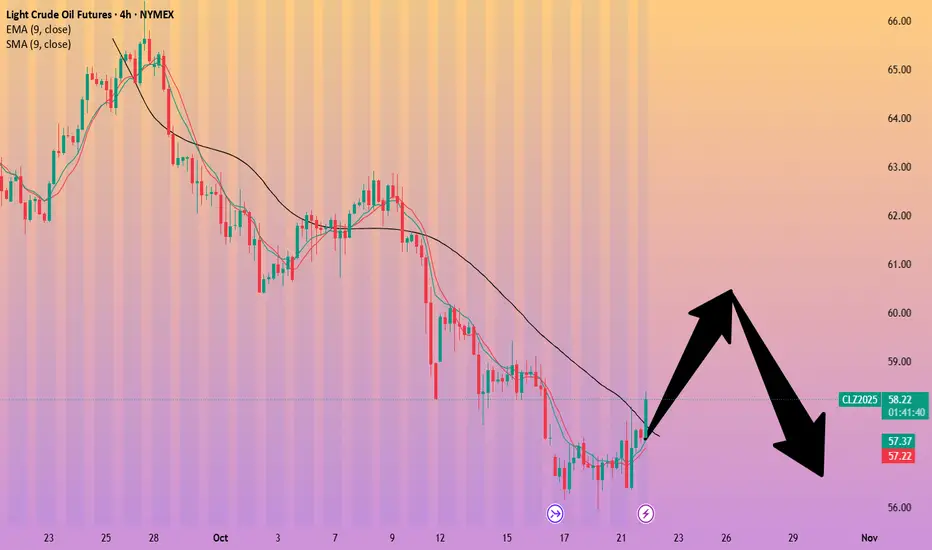
WTI bullish swing setupRSI divergence Bullish chart pattern Wait for trend reversal red line is previous major level Entry on trend reversal RRR 1:2 Longby snail_stepsUpdated 2
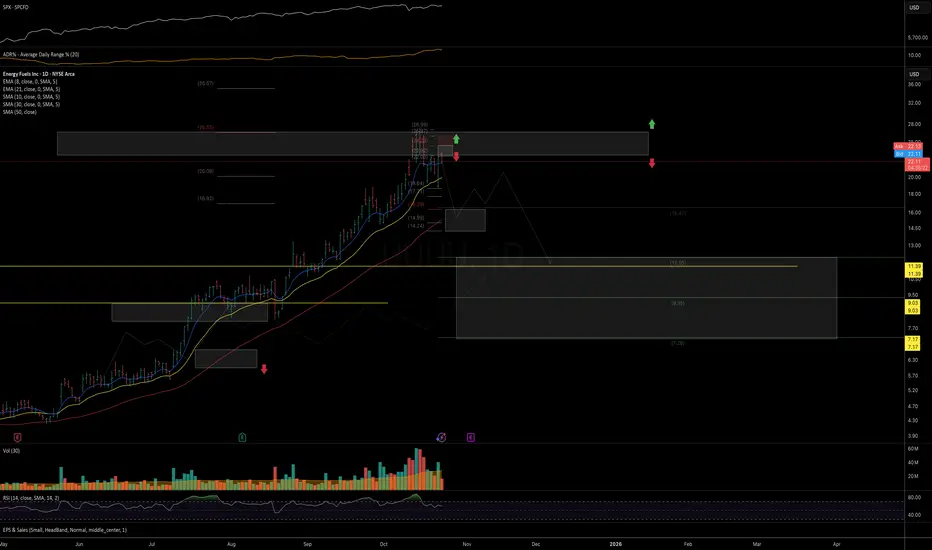
UUUU expecting more downside As long as price remains within the 24–26 local zone, the odds, in my view, favor a continuation lower in the coming weeks — first toward the 16–14 area and potentially later toward 12. Chart: Weekly view: Previously: • On upside potential (Jul 16): Link: www.tradingview.com • On bullish trend structure (Jun 6): Link: www.tradingview.comShortby artemfedorov225
USOIL : Full analysisHello friends Well, considering the sharp decline we had, the price has entered a descending channel and is slowly going down in this channel. Now the price has reached a critical point, namely the bottom of the channel. We need to see if buyers will support the price at the bottom of the channel like the previous two times or not? If we do not see support from buyers and the channel is broken, we can expect lower prices. 56.30 and 53 dollars respectively. But we will most likely see buyers' support in this area and the price could even reach the channel ceiling. *Trade safely with us*Longby TheHunters_CompanyUpdated 7
Oil (CL) SellsThis is a 4H perspective, may get here with CPI data releasing tomorrow. Short00:55by IAmTheDisciplinedTrader5
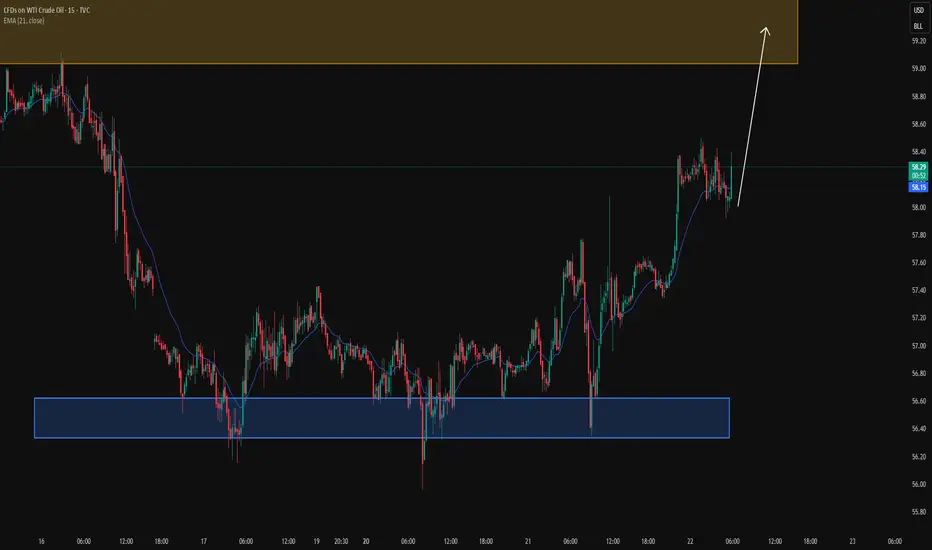
Oil - Expecting Bullish Continuation In The Short TermM15 - Strong bullish momentum. No opposite signs. Until the two Fibonacci support zones hold I expect the price to move higher further. If you enjoy this idea, don’t forget to LIKE 👍, FOLLOW ✅, SHARE 🙌, and COMMENT ✍! Drop your thoughts and charts below to keep the discussion going. Your support helps keep this content free and reach more people! 🚀 -------------------------------------------------------------------------------------------------------------------- Longby VladimirRibakov2
LNG Week 43: 92 BCF Storage Surge Signals Weather-Driven Shift*Due to the platform's features, the charts are arranged in sequence from left to right, from the first to the Eighth chart. The charts were created by our team and based on an analysis from Bloomberg and the EIA data. This analysis was conducted in cooperation with Anastasia Volkova, analyst of LSE. The natural gas market enters Week 43 with a robust storage uplift, as reserves are projected to rise 92 BCF during Week 42 (October 13-20), hitting 3,813 BCF-53 BCF above last year and well above the 5-year median of 74 BCF. The NGX25 contract swings to the upper end of the interquartile range with heightened volatility, while 2026 winter contracts stay above the range, fueled by growth momentum. Weather shifts, with HDD+CDD nearing 30-year averages and a 15-20 point uptick forecast, hint at rising demand. We analyze these trends below. Current prices compared to price dispersion 10 days before expiration, by month since 2010 The NGX25 contract changed direction and is trading at the upper end of the IQR 10 days before expiration, demonstrating increased volatility. Quotes for 2026 winter contracts supported growth and remain above the upper limit of the interquartile range. Forward curve compared to 2020-2025 The shape of the forward curve in 2025 shows a steady convergence and is even closer to the configurations recorded in 2023 and 2024 for comparable dates. This trend is particularly evident in contracts with delivery in three years or more, where prices are steadily converging towards historical levels. Current stocks and forecast for next week compared to 2019-2024 According to the forecast for week 42 (October 13-20), gas reserves in underground storage facilities will increase by +92 BCF, reaching 3,813 BCF, which is 53 BCF higher than the figure for the same period last year. Last week's inventory growth was supported by high production volumes and mild weather conditions. 15-day sliding sum HDD+CDD based on current NOAA data and forecast for the next two weeks compared to 1994-2024 The current values of HDD+CDD accumulated over 15 days have reached the average range for 1994–2024. The forecast for the next two weeks suggests that the values will exceed the average by 15–20 points, which may be a significant driver of growth in the near-term contract. Accumulated HDD+CDD for 15 days based on current NOAA data and forecast compared to 1994-2024 by region The current values of HDD+CDD accumulated over 15 days are within the average range for 1994–2024. The forecast for the next two weeks suggests a departure from the current mild weather trend in all regions except WS CENTRAL, WN CENTRAL, MOUNTAIN, and PACIFIC. Weekly total supply/demand difference compared to 2014-2024 This week, the difference between supply and demand in 2025 continues to be below the average values for 2014–2024, indicating weaker demand or excess supply. Number of days for delivery from warehouses The graph shows the number of days of supply from storage alone, based on current consumption levels. In the second half of October 2025, reserves will last for approximately 35 days, which is below the lower limit of the interquartile range. With such moderate reserves, even minor disruptions in production or spikes in demand could cause sharp price reactions, especially in late winter and early spring. Anomalies in weather (HDD+CDD) and fundamental factors Overall, fundamental factors and weather anomalies are within the expected range, with the exception of consumption in the residential and commercial sectors, caused by the start of the heating season.by igorisaev0
XTI/USD : Oil Prices Rise Following Trump’s Sanctions DecisionXTI/USD Chart Analysis: Oil Prices Rise Following Trump’s Sanctions Decision According to the XTI/USD chart, WTI crude is now trading above the key psychological level of $60, marking a sharp rebound of over 3% from October’s lows. The surge came after U.S. President Donald Trump announced sanctions against major Russian oil producers Rosneft and Lukoil, which together account for more than 5 million barrels of oil per day. The move is expected to reduce global oil supply; however, media outlets point out that: → there is no certainty that China and India will refrain from purchasing Russian crude; → previous sanctions introduced under the Biden administration — targeting companies such as Gazprom Neft and Surgutneftegaz — had little impact on Russian oil exports. What could happen next? Technical Analysis of the XTI/USD Chart On 20 October, we noted that two descending channels had formed: → Red channel – a long-term pattern that developed following the Middle East escalation in June; → Purple channel – indicating accelerated downside pressure driven by rising OPEC+ output and hopes for a U.S.–China trade accord. Our earlier assumption that the market was oversold and that the Falling Wedge pattern might trigger a bullish reversal proved correct (as shown by the arrow). Following the formation of an inverted head and shoulders pattern, oil prices climbed towards the median line of the purple channel. At this stage, consolidation appears the most likely scenario, as supply and demand may stabilise around the channel’s median. Much will depend on statements from the White House, since higher oil prices could threaten U.S. inflation objectives. However, if bullish momentum persists, WTI may continue to rise towards the next resistance area, defined by: → the upper boundary of the purple channel; → the 8–9 October highs, where a false breakout similar to the bear trap seen on 26 September cannot be ruled out. This article represents the opinion of the Companies operating under the FXOpen brand only. It is not to be construed as an offer, solicitation, or recommendation with respect to products and services provided by the Companies operating under the FXOpen brand, nor is it to be considered financial advice.by FXOpen115
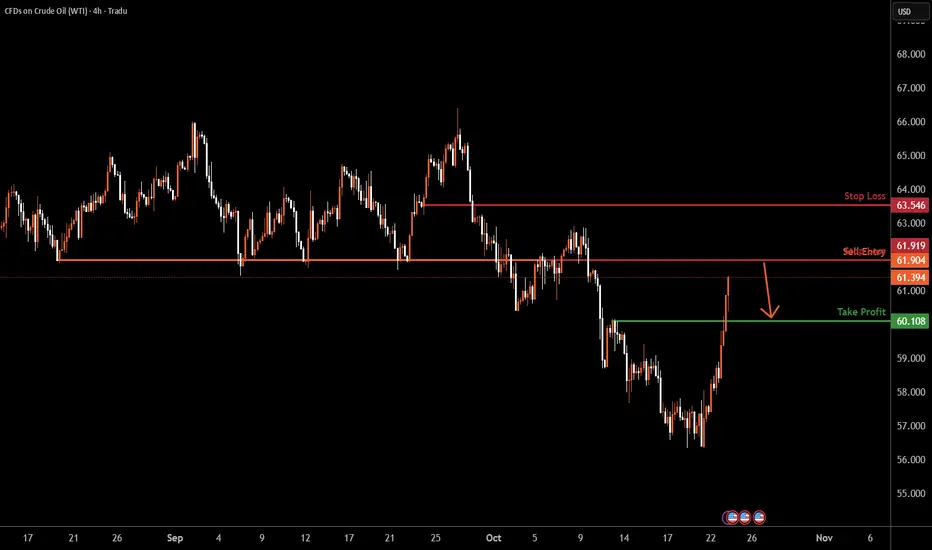
USOIL H4 | Approaching Major Resistance LevelBased on the H4 chart analysis, we could see the price rise to the sell entry which is an overlap resistance and could reverse from this levle to the take profit. Sell entry is at 61.90, which is an overlap resistance. Stop loss: 63.54, which is a pullbakc resistance. Take profit is at 60.10, which is a pullback support. Stratos Markets Limited (tradu.com ): CFDs are complex instruments and come with a high risk of losing money rapidly due to leverage. 68% of retail investor accounts lose money when trading CFDs with this provider. You should consider whether you understand how CFDs work and whether you can afford to take the high risk of losing your money. Stratos Europe Ltd (tradu.com ): CFDs are complex instruments and come with a high risk of losing money rapidly due to leverage. 70% of retail investor accounts lose money when trading CFDs with this provider. You should consider whether you understand how CFDs work and whether you can afford to take the high risk of losing your money. Shortby Tradu1
OIl rised.OIL moved as we had analyzed. Possibly could rise more before rhe markets closed this week.Longby SETLifeTrading0
Trading Crude Oil and the Geopolitical Impact on PricesIntroduction Crude oil is one of the most strategically significant commodities in the global economy. It fuels transportation, powers industries, and serves as a critical input for countless products ranging from plastics to fertilizers. Because of its universal importance, crude oil trading is not just a financial endeavor—it is a reflection of global political stability, economic growth, and international relations. The price of crude oil is highly sensitive to geopolitical events, including wars, sanctions, alliances, and policy changes. Understanding how geopolitical dynamics affect oil trading and pricing is vital for traders, investors, and policymakers. 1. The Fundamentals of Crude Oil Trading Crude oil trading involves the buying and selling of oil in various markets, primarily through futures contracts on exchanges such as the New York Mercantile Exchange (NYMEX), Intercontinental Exchange (ICE), and Dubai Mercantile Exchange (DME). These contracts allow traders to speculate on the future price of oil, hedge against risks, or facilitate physical delivery. Two main benchmark grades dominate the market: West Texas Intermediate (WTI) and Brent Crude. WTI Crude Oil is primarily sourced from the U.S. and traded in dollars per barrel. Brent Crude Oil is produced in the North Sea and serves as the global benchmark for pricing. Oil prices are influenced by multiple factors, including supply and demand fundamentals, global economic growth, production levels, inventory data, transportation costs, and geopolitical events. Among these, geopolitical tensions often have the most immediate and dramatic impact. 2. Geopolitics as a Determinant of Oil Prices The global oil market is uniquely vulnerable to geopolitical developments because a significant portion of reserves and production is concentrated in politically sensitive regions such as the Middle East, North Africa, and Russia. Around 60% of proven oil reserves lie in OPEC (Organization of Petroleum Exporting Countries) member nations, many of which have experienced conflict, sanctions, or regime instability. Geopolitical risk refers to the potential disruption in oil supply or transportation routes due to international conflicts, political upheaval, or policy decisions. When such risks escalate, traders often bid up oil prices in anticipation of supply shortages—even before any actual disruption occurs. 3. Historical Perspective: Major Geopolitical Events and Oil Prices a. The 1973 Arab Oil Embargo One of the earliest and most significant examples of geopolitically driven oil price shocks occurred in 1973 when Arab OPEC members imposed an oil embargo against the United States and other nations supporting Israel during the Yom Kippur War. Oil prices quadrupled within months, leading to inflation, recession, and a global energy crisis. The embargo demonstrated the power of oil as a political weapon and the vulnerability of consumer nations. b. The Iranian Revolution (1979) The overthrow of the Shah of Iran and the subsequent decline in Iranian oil production reduced global supply by nearly 5%. This shortage, coupled with the Iran-Iraq War (1980–1988), sent prices soaring again. The resulting volatility highlighted how political instability in a single oil-producing nation could ripple through the entire global economy. c. The Gulf War (1990–1991) Iraq’s invasion of Kuwait disrupted nearly 5 million barrels per day of oil production. The U.S.-led coalition’s response and the ensuing war created massive uncertainty in the Middle East, briefly pushing oil prices above $40 per barrel—a significant level for that time. d. The Iraq War (2003) The U.S. invasion of Iraq reignited geopolitical fears about supply disruptions. Although global production eventually stabilized, the war contributed to sustained higher oil prices in the early 2000s, further compounded by rapid industrialization in China and India. e. The Arab Spring (2010–2011) The wave of protests across the Middle East and North Africa led to regime changes and unrest in key producers such as Libya and Egypt. The civil war in Libya, in particular, cut oil output by over one million barrels per day, causing Brent crude prices to exceed $120 per barrel. f. Russia-Ukraine Conflict (2014 and 2022) Russia’s annexation of Crimea in 2014 and its full-scale invasion of Ukraine in 2022 significantly disrupted global energy markets. As one of the world’s largest oil and gas exporters, Russia faced Western sanctions that restricted exports, insurance, and financing. In early 2022, Brent crude spiked above $130 per barrel, reflecting fears of prolonged supply shortages and energy insecurity across Europe. 4. Channels Through Which Geopolitics Impacts Oil Prices Geopolitical events influence oil prices through several interconnected channels: a. Supply Disruptions Conflicts or sanctions can directly reduce oil supply by damaging infrastructure, limiting production, or restricting exports. For example, sanctions on Iran in 2012 and again in 2018 led to significant declines in its oil exports, tightening global supply. b. Transportation and Shipping Risks Chokepoints such as the Strait of Hormuz, Suez Canal, and Bab el-Mandeb Strait are vital for global oil transportation. Any military conflict or threat in these areas immediately raises concerns about shipping disruptions, leading to higher prices. Nearly 20% of global oil passes through the Strait of Hormuz daily. c. Speculative Reactions Traders and hedge funds respond quickly to geopolitical news, often amplifying price movements. Futures markets price in expected risks, causing volatility even when actual supply remains unaffected. d. Strategic Reserves and Policy Responses Nations often release oil from strategic reserves or negotiate production increases through OPEC to stabilize markets. For example, the U.S. and IEA (International Energy Agency) coordinated strategic reserve releases in 2022 to offset supply disruptions caused by the Russia-Ukraine conflict. e. Currency Movements Since oil is traded in U.S. dollars, geopolitical tensions that weaken the dollar or create global uncertainty can influence oil prices. A weaker dollar often makes oil cheaper for non-U.S. buyers, boosting demand and raising prices. 5. OPEC and Geopolitical Strategy The Organization of Petroleum Exporting Countries (OPEC), formed in 1960, and its extended alliance OPEC+, which includes Russia, play a pivotal role in determining oil supply and prices. The organization uses coordinated production quotas to manage global prices, often aligning decisions with geopolitical interests. For instance: In 2020, during the COVID-19 pandemic, OPEC+ cut production by nearly 10 million barrels per day to support collapsing prices. In 2023, Saudi Arabia and Russia announced voluntary cuts to maintain price stability amid slowing demand and Western sanctions. OPEC’s policies are inherently geopolitical, balancing the economic needs of producers with the political relationships among member states and major consumer nations. 6. Energy Transition and the New Geopolitics of Oil The growing global emphasis on renewable energy and decarbonization is reshaping the geopolitical landscape of oil trading. As nations transition to cleaner energy, oil-producing countries face the challenge of maintaining revenue while managing political stability. However, this transition also introduces new geopolitical dependencies—for example, on lithium, cobalt, and rare earth metals used in electric vehicle batteries. While demand for oil may gradually plateau, geopolitical risks remain as nations compete over new energy supply chains. Additionally, U.S. shale production has transformed the country from a net importer to a major exporter, reducing its vulnerability to Middle Eastern geopolitics but also introducing new market dynamics. Shale producers can ramp up or scale down production relatively quickly, acting as a “shock absorber” to global price swings. 7. The Role of Technology and Market Transparency Technological advancements in trading—especially algorithmic and data-driven models—have increased market liquidity but also heightened sensitivity to news. Real-time tracking of geopolitical developments via satellites, social media, and analytics platforms allows traders to react instantly. For example, satellite data showing tanker movements or refinery fires can trigger immediate price adjustments. The intersection of AI, big data, and geopolitics now defines modern oil trading strategies, with traders assessing both quantitative signals and qualitative geopolitical intelligence. 8. Managing Geopolitical Risk in Oil Trading Professional oil traders and corporations employ various strategies to manage geopolitical risks: Diversification: Sourcing oil from multiple regions to minimize reliance on unstable producers. Hedging: Using futures, options, and swaps to lock in prices and reduce exposure to volatility. Scenario Analysis: Running stress tests based on potential geopolitical outcomes (e.g., war, sanctions, embargoes). Political Risk Insurance: Protecting investments against losses due to government actions or conflict. Strategic Reserves: Governments maintain emergency stockpiles to stabilize supply during crises. In addition, diplomatic engagement and international cooperation—such as IEA coordination or U.N.-mediated negotiations—can help mitigate disruptions and maintain market balance. 9. The Future Outlook: Geopolitics and the Oil Market As of the mid-2020s, the global oil market faces a new era of geopolitical uncertainty. Key issues shaping the future include: The U.S.-China rivalry, which may influence energy trade routes and technological access. Middle Eastern realignments, including normalization of relations between former rivals and shifting alliances. Climate policy conflicts, as nations balance carbon reduction commitments with economic growth needs. Sanctions regimes on Russia, Iran, and Venezuela, which continue to restrict global supply flexibility. The digitalization of trading, which increases speed and transparency but also amplifies volatility. Although long-term demand growth may slow due to renewable energy adoption, oil will remain a central geopolitical and economic asset for decades. The world’s dependence on energy ensures that geopolitics will continue to shape price trends, investment decisions, and market psychology. Conclusion Crude oil trading is not merely a reflection of supply and demand; it is a barometer of global stability and geopolitical tension. From the 1973 oil embargo to the ongoing Russia-Ukraine conflict, political decisions have repeatedly proven capable of reshaping energy markets. For traders and policymakers alike, understanding the geopolitical dimensions of oil is crucial for navigating price volatility and maintaining economic resilience. As the energy transition accelerates, the nature of geopolitical risk will evolve—but it will not disappear. The intersection of oil, politics, and global economics will continue to define international relations and financial markets, ensuring that crude oil remains one of the world’s most geopolitically sensitive and closely watched commodities.Educationby GlobalWolfStreet2
480 soon, then 900?It's a buy if it hits 480. Most likely it will reach 900. Happy trading!! Not a financial advice. Longby babu_trader0
Today's crude oil strategy, hoping to be helpful to you.Although the current broader context of the international crude oil market is "excess supply and weak demand", from the perspective of short-term and potential opportunities, there are three key points that support us to attempt a long position. We should not be deterred by the broader "weak market" trend: Potential "Flashpoints" in Geopolitical Conflicts Ukraine has not stopped using drones to attack Russia's oil facilities, and Russia's oil refining volume has now hit its lowest level in over two years. If key pipelines are attacked next, or if conflicts between Israel and Qatar in the Middle East escalate further, affecting crude oil transportation, the market will definitely rush to buy oil out of panic. In this case, oil prices will most likely surge suddenly. For example, back in June, when Israel launched an air strike on Iran's nuclear facilities, oil prices rose by 6.9% in a single day. We must seize such opportunities. Possible "Hitches" in OPEC+ Production Increase Although OPEC+ plans to increase supply by an additional 137,000 barrels per month in October and November, many oil-producing countries actually have little extra oil to produce. As early as May, the actual production increase was more than half lower than the planned amount. If OPEC+ announces "no more production increases" in subsequent meetings, or even resumes production cuts, the pressure from excess supply will be reduced significantly, and oil prices will naturally be able to hold steady or even rise. Crude Oil Trading Strategy for Today usoil @buy 57.50-58.00 pt:58.50-59 sl:57Longby Ryan_Lewis15
WTI OIL Strong long-term rebound incoming.Over a month ago (September 17, see chart below), we gave a strong Sell Signal on WTI Oil (USOIL) as the price was again rejected on its 1W MA50 (blue trend-line) and was headed towards the inner Higher Lows trend-line, easily hitting our $59.50 Target in the process: Yet again we consult the more reliable long-term time-frames, now making a bullish call as the price is already rebounding this week on the Higher Lows. Given also the identical 1W RSI pattern with 2023, we expect a bounce towards at least the 0.618 Fibonacci retracement level at $69.50, same as the December 2023 - March 2024 rally. ------------------------------------------------------------------------------- ** Please LIKE 👍, FOLLOW ✅, SHARE 🙌 and COMMENT ✍ if you enjoy this idea! Also share your ideas and charts in the comments section below! This is best way to keep it relevant, support us, keep the content here free and allow the idea to reach as many people as possible. ** ------------------------------------------------------------------------------- 💸💸💸💸💸💸 👇 👇 👇 👇 👇 👇Longby TradingShot3320
USOIL: Uptrend strengthens after multiple support tests * Trend: assessed using at least three trend indicators, with market structure as the primary guide. ** Weak or Reversal Signals: Assessed based on one of our criteria for trend reversal signals. *** Support/Resistance: Selected from multiple factors – static (Swing High, Swing Low, etc.), dynamic (EMA, MA, etc.), psychological (Fibonacci, RSI, etc.) – and determined based on the trader’s discretion. **** Our advice takes into account all factors, including both fundamental and technical analysis. It is not intended as a profit target. We hope it can serve as a reference to help you trade more effectively. This advice is for informational purposes only and we assume no responsibility for any trading results based on it. George Vann @ ZuperViewLongby ZuperView4
USOIL BEARISH BIAS RIGHT NOW| SHORT USOIL SIGNAL Trade Direction: short Entry Level: 58.02 Target Level: 57.01 Stop Loss: 58.69 RISK PROFILE Risk level: medium Suggested risk: 1% Timeframe: 2h Disclosure: I am part of Trade Nation's Influencer program and receive a monthly fee for using their TradingView charts in my analysis. ✅LIKE AND COMMENT MY IDEAS✅Shortby EliteTradingSignals112
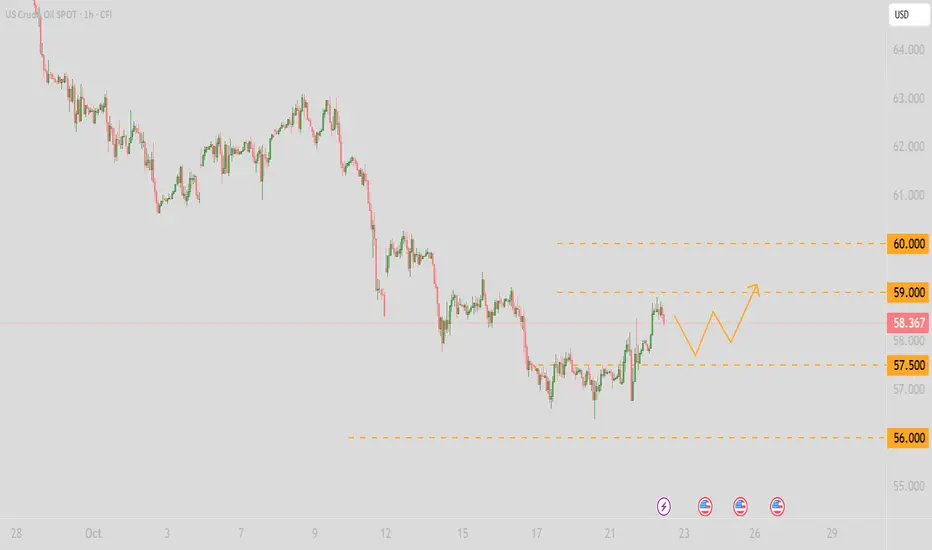
USOIL fluctuates higher💡The situation for USOIL today is relatively optimistic, showing a fluctuating and moderately strong trend. Here is the detailed analysis: 📈Price Trend: As of midday in the Asian session on October 22, WTI crude oil prices have edged higher in the short term, trading around $58.1, up from the previous day's closing price. WTI crude closed 1.14% higher at $57.962 the previous day. ♦Influencing Factors: Supply Side: The U.S. Department of Energy announced a tender to purchase 1 million barrels of crude oil to replenish the Strategic Petroleum Reserve. This news boosted sentiment in the energy sector and provided support for oil prices. ♦Demand Side: API data showed a decline in U.S. inventory levels last week, which improved market sentiment toward demand and also supported higher oil prices. ♦Macroeconomy: Expectations of a Federal Reserve rate cut continue to rise, with a 98.9% probability of a 25-basis-point rate cut in October. Capital has been flowing back into risk assets, providing some impetus to crude oil prices. ♦Geopolitics: Europe and Ukraine have drafted a 12-point ceasefire plan. Expectations of eased geopolitical tensions temporarily weakened safe-haven demand, indirectly supporting a stronger U.S. dollar and thus exerting some pressure on oil prices. However, factors such as the U.S. oil purchase news and the drop in API crude inventories have provided more significant support for oil prices. ♦Technical Analysis: Short-term moving averages show signs of flattening, indicating that the crude oil price trend may be stabilizing. Oil prices are inclined to fluctuate with moderate strength in the short term today. The short-term resistance level above is around 59.0-60.0, while the short-term support level below is around 56.0-55.0. 💎Trading Strategy: Sell 58.00 SL 58.60 TP 57.00 Buy 57.5 SL 56.8 TP 58.5 Daily-updated accurate signals are at your disposal. If you run into any problems while trading, these signals serve as a reliable reference—don’t hesitate to use them! I truly hope they bring you significant assistanceLongby Clarke_analysis4
Market Analysis: WTI Crude Oil Attempts ReboundMarket Analysis: WTI Crude Oil Attempts Rebound WTI Crude oil is now attempting to recover after sliding toward $56.00. Important Takeaways for WTI Crude Oil Price Analysis Today - WTI Crude oil prices extended losses below the $60.00 support zone. - It cleared a key bearish trend line with resistance at $57.50 on the hourly chart of XTI/USD. WTI Crude Oil Price Technical Analysis On the hourly chart of WTI Crude Oil, the price struggled to continue higher above $62.00 against the US Dollar. The price formed a short-term top and started a fresh decline below $61.20. There was a steady decline below the $60.00 pivot level. The bears even pushed the price below $58.50 and the 50-hour simple moving average. Finally, the price tested $56.00. The recent swing low was formed near $55.94, and the price is now correcting losses. There was a move above the 23.6% Fib retracement level of the downward move from the $62.45 swing high to the $55.94 low. The price cleared a key bearish trend line with resistance at $57.50. On the upside, immediate resistance is near the 50% Fib retracement at $59.20. The main hurdle is $59.95. A clear move above $59.95 could send the price toward $62.45. The next stop for the bulls might be $64.00. If the price climbs further, it could face sellers near $65.00. Immediate support is $57.50. The next major level on the WTI crude oil chart is $55.95. If there is a downside break, the price might decline toward $55.00. Any more losses may perhaps open the doors for a move toward the $52.00 zone. This article represents the opinion of the Companies operating under the FXOpen brand only. It is not to be construed as an offer, solicitation, or recommendation with respect to products and services provided by the Companies operating under the FXOpen brand, nor is it to be considered financial advice.by FXOpen116
Crude oil - Sell around 59.60, target 58.00-56.00Crude Oil Market Analysis: Gold's significant moves haven't impacted crude oil, which is still recovering. Consider selling after today's rebound to 59.50. The overall trend is bearish, and the short-term outlook is bearish as well. However, the short-term volatility is quite strong, so don't sell. Crude oil needs to wait for opportunities. If there's a position, buy; if not, wait. Recent crude oil inventory data is also disappointing, which is likely to suppress crude oil prices. Fundamental Analysis: Watch the EIA crude oil inventory data today. Trading Recommendations: Crude oil - Sell around 59.60, target 58.00-56.00Shortby GoldenSpaceship2
EOSE: macro trend structure Price has reached an important mid-term resistance zone and may be setting up for a pullback and consolidation in the coming weeks. As long as price remains below 21, I’m watching for further downside toward the 13–10 support zone, followed by a potential base formation before the next swing move higher into the high 30s (possibly in 2026). Chart: Macro view: by artemfedorov3
Potential Oil Shorts If we see more bearish demand, this is a qualified short.Shortby IAmTheDisciplinedTrader1
$Conoil Conoil price currently devalued - Over 45% Retracement!NSENG:CONOIL Conoil PLC is a leading downstream energy company in Nigeria, active in marketing refined petroleum products, lubricants and LPG. Latest data shows: Revenue (TTM) of ~ ₦286.2 billion, net income ~ ₦1.65 billion, P/E approximately 88.7×. The main risk: margins are under pressure, cost of sales rising, and recent performance has disappointed in short-term horizon. Conoil main strength: strong brand, wide distribution network, and established business in Nigeria’s energy sector. After a strong parabolic rally, CONOIL is now in a corrective phase of about 45%. I’m preparing to accumulate gradually—not all at once—as price approaches long-term value areas. The Plan: Dollar-cost averaging (DCA) slowly into weakness, targeting the 200 EMA as my final support zone. This approach reduces risk and smooths my entry cost over time. Buy Zones: ₦230–₦200: Light entries (early DCA) ₦180–₦160: Moderate accumulation ₦160–₦145: Heavy accumulation (near 200 EMA) Each tranche increases exposure as price nears fair value. Why the 200 EMA? The 200 EMA often acts as the “fair value” line—after strong trends, price tends to return here before establishing a new base. It’s where patient money usually steps back in. Planned Targets After Reversal: TP1 → ₦314: Retest of structural resistance TP2/TP3 → ₦403 / ₦501: Full cycle recovery / momentum expansion. Once the trend turns, these are the resistance zones I’ll be watching. Risk Management: Idea invalidation if weekly candle closes below ₦145, that’s a break of structure. I’ll pause or sell off accumulation until price stabilises or forms a clear base. Not Financial Advice!!Longby Ifiok-Trades9
Hellena | Oil (4H): SHORT to support area of 54.00.As I continued to watch oil I realized that the structure I built in the last forecast is still in place. I think we should expect a correction in wave “4” to the 59.3 area, then a continuation of the downward movement at least to the 54.00 support area. This will be the completion of the downward impulse. I do not exclude the probability of lengthening of wave “3” and in this case there will be no correction and the price will immediately reach the target. Fundamental context The oil market remains under pressure as supply continues to outpace demand, raising the risk of a surplus. Forecasts for 2025-2026 indicate higher production growth while consumption slows. Rising inventories and a shift in the futures curve into contango suggest growing storage levels and weaker near-term demand. Under these conditions, downside pressure persists, keeping the probability of a further decline high. Manage your capital correctly and competently! Only enter trades based on reliable patterns!Shortby Hellena_Trade7716
Crude oil: Sell around 58.60, target 56.00-55.00Crude Oil Market Analysis: Crude oil has been declining recently and has reached strong support near 55. A break of this level would open up further downside. Today's outlook for crude oil remains bearish. Continue selling on minor rebounds, focusing on selling opportunities around 58.90. The new contract also bearishly suggests no buying opportunities. This selling strategy has persisted for a long time. Fundamental Analysis: The Federal Reserve has once again implemented loose monetary policy, and with the added support of CPI, market uncertainty is high, prompting a surge in gold prices. Trading Recommendations: Crude oil: Sell around 58.60, target 56.00-55.00Shortby GoldenSpaceship1