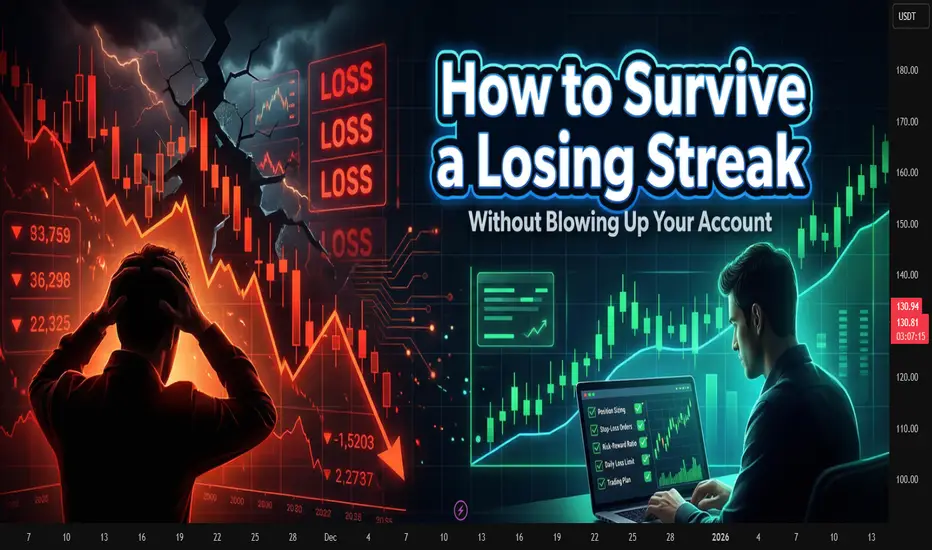
How to survive a losing streak without blowing up your accountHow to survive a losing streak without blowing up your account
Drawdown hits the account, but the real damage lands in your head.
A real trading career always includes stretches of pure red. Five, seven, even ten losses in a row can appear without anything "being wrong" with the setup. At that point the market stops looking like candles and levels, and starts looking like a personal enemy. Without a plan written in advance, the usual reaction is to increase size and "win it back."
The drawdown itself is not the main threat. The danger sits in what happens inside the drawdown: revenge trades, oversized positions, random entries just to feel in control again.
Turn the losing streak into numbers
The feeling "everything goes wrong" is vague and dangerous. Numbers are less emotional.
Simple tracking is enough:
Current drawdown in percent from the equity peak
Number of losing trades in a row
Total hit of the streak in R (risk units per trade)
Example: risk per trade is 1%, and you take five consecutive stops. That is -5%. With a personal limit of 10% drawdown, the account is still alive, but the mind is already tense. At that point the numbers matter more than mood. They show whether there is still room to act or time to stop and regroup.
Why losing streaks bend your thinking
The market does not change during a streak. The trader does.
Typical thoughts:
"The strategy is dead" after only a few stops
Desire to prove to the market that you were right
Sudden shift from clear setups to anything that "might move"
In reality it is normal distribution at work. Losses cluster. Most traders know that in theory, but very few accept it in advance and prepare a plan for that specific phase.
Build a risk frame for bad runs
Risk rules for streaks should live in writing, not in memory.
For example:
Define 1R as 0.5–1% of account size
Daily loss limit in R
Weekly loss limit in R
Conditions for a mandatory trading pause
A simple version:
1R = 1%
Stop trading for the day once -3R is reached
Stop trading for the week once -6R is reached
After a weekly stop, take at least two market sessions off from active trading
This does not make performance look pretty. It simply keeps one emotional spike from turning into a full account blow-up.
A protocol for losing streaks
Rules are easier to follow when they read like a checklist, not a philosophy.
Sample protocol:
After 3 consecutive losses: cut position size in half for the rest of the day
After 4 consecutive losses: stop trading for that day
After 5 or more consecutive losses: take at least one full day off and do only review and backtesting
Return to normal size only after a small series of well-executed trades where rules were respected
Printed rules next to the monitor work better than "mental promises." In stress the brain does not recall theory, it reads whatever sits in front of the eyes.
A drawdown journal
A regular trade log tracks entries and exits. During drawdowns you need an extra layer dedicated to the streak.
For each drawdown period, you can record:
Start date and equity at the beginning
Maximum drawdown in percent and in R
Main source of damage: risk, discipline, setup quality, or flat market conditions
Any mid-streak changes to the original plan
Outside factors such as sleep, stress, or heavy workload
After some months, the journal starts to show patterns. Many discover that the deepest drawdowns came not from the market, but from trading while tired, distracted, or under pressure outside the screen.
Coming back from a drawdown
The drawdown will end. The key part is the exit from it. Jumping straight back to full size is an easy way to start a new streak of losses.
You can describe the return process in stages:
Stage 1. One or two days off from live trading. Only review, markups, statistics.
Stage 2. Half-size positions, only the cleanest setups, strict cap on trade count.
Stage 3. Back to normal risk after a short series of trades where rules were followed, even if the profit is modest.
The drawdown is over not when the equity line prints a new high, but when decisions are again based on the plan instead of the urge to "get it all back."
Where tools and indicators help
A big part of the pressure in a streak comes from the mental load: levels, trend filters, volatility, news, open positions. That is why many traders rely on indicator sets that highlight key zones, measure risk to reward, send alerts when conditions line up, and reduce the need to stare at the screen all day. These tools do not replace discipline, but they take some of the routine off your plate and give more energy for the hard part: staying calm while the equity curve is under water.
Learningforex
A daily trading plan: stop trading your moodA daily trading plan: stop trading your mood and start trading your system
Most traders think they need a new strategy. In many cases they need a clear plan for the day.
Trading without a plan looks very similar across accounts. The platform opens, eyes lock onto a bright candle, the button gets pressed. Then another one. The mind explains everything with words like “intuition” or “feel for the market”, while the journal in the evening shows a pile of unrelated trades.
A daily plan does not turn trades into perfection. It removes chaos. The plan covers charts, risk, loss limits, number of trades and even the trader’s state. With that in place, the history starts to look like a series of experiments instead of casino slips.
Skeleton of a daily plan
A practical way is to split the day into five blocks:
market overview from higher timeframes
watchlist for the session
risk and limits
scenarios and entry checklist
post-session review
The exact form is flexible. The important part is to write it down instead of keeping it in memory.
Market overview: higher timeframe sets the background
The day starts on the higher chart, not on the one-minute screen. H4, D1 or even W1. That is where major swings, large reaction zones and clear impulses live.
A small template helps:
main asset of the day, for example BTC or an index
current phase: directional move or range
nearest areas where a larger player has strong reasons to act
Descriptions work best when they are concrete. Not “bullish market”, but “three higher lows in a row, shallow pullbacks, buyers defend local demand zones”. A month later these notes show how thinking about trend and risk evolved.
Watchlist: stop chasing every ticker
Next layer is a focused list of instruments. With less experience, a shorter list often works better. Two or three names are enough for the day.
Selection can rely on simple filters:
recent activity instead of a dead flat chart
structure that is readable rather than random noise
enough liquidity for clean entries and exits
Once the list is fixed, outside movement loses some emotional grip. Another coin can fly without you, yet the plan keeps attention on the few markets chosen for that day.
Risk and limits: protection from yourself
This block usually appears only after a painful streak. Until then the brain likes the story about “just this one time”.
Minimal set:
fixed percentage risk per trade
daily loss limit in R or percent
cap on number of trades
For example, 1% per trade, daily stop at minus 3R, maximum of 5 trades. When one of these lines is crossed, trading stops even if the chart shows a beautiful setup. That stop is not punishment. It is a guardrail.
Breaking such rules still happens. With written limits, each violation becomes visible in the journal instead of dissolving in memory.
Scenarios and entry checklist
After the bigger picture and limits are set, the plan moves to concrete scenarios. Clarity beats variety here.
For every instrument on the list, write one or two scenarios:
area where a decision on price is expected
direction of the planned trade
SEED_ALEXDRAYM_SHORTINTEREST2:TYPE of move: breakout, retest, bounce
[*stop and targets in R terms
Example: “ETHUSDT. H4 in an uptrend, H1 builds a range under resistance. Plan: long on breakout of the range, stop behind the opposite side, target 2–3R with partial exit on fresh high.”
An entry checklist keeps emotions in check.
$ trade goes with the higher-timeframe narrative
$ stop stands where the scenario breaks, not “somewhere safer”
$ position size matches the risk rules
$ trade is not revenge for a previous loss
If at least one line fails, entry is postponed. That small pause often saves the account from “just testing an idea”.
Post-session review: where real learning sits
The plan lives until the terminal closes. Then comes the review. Not a long essay, more like a short debrief.
Screenshots help a lot: entry, stop, exit marked on the chart, with a short note nearby.
was there a scenario beforehand
did the market behave close to the plan
which decisions looked strong
where emotions took over
Over several weeks, this archive turns into a mirror. Profitable setups repeat and form a core. Weak habits step into the light: size jumps after a loss, early exits on good trades, stop removal in the name of “room to breathe”.
Where indicators fit into this routine
None of this strictly requires complex tools. A clean chart and discipline already move the needle. Many traders still prefer to add indicators that highlight trend, zones, volatility and risk-to-reward, and ping them when price enters interesting regions. That kind of automation cuts down on routine work and makes it easier to follow the same checklist every day. The decision to trade still stays with the human, while indicators quietly handle part of the heavy lifting in the background.
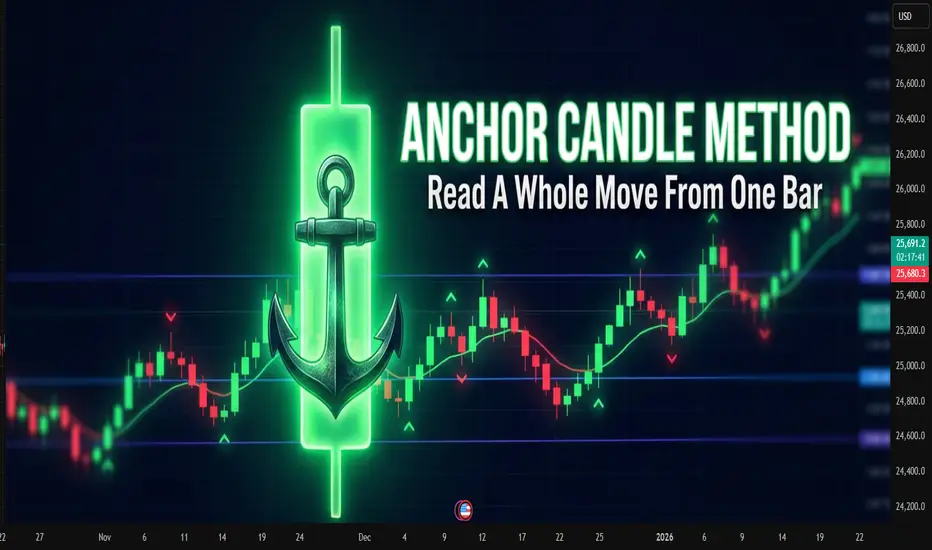
Anchor Candle MethodAnchor Candle Method: How To Read A Whole Move From One Bar
Many traders drown in lines, zones, patterns. One simple technique helps simplify the picture: working around a single “anchor candle", the reference candle of the pulse.
The idea is simple: the market often builds further movement around one dominant candle. If you mark up its levels correctly, a ready-made framework appears for reading the trend, pullbacks and false breakouts.
What is an anchor candle
Anchor candle is a wide range candle that starts or refreshes an impulse. It does at least one of these:
Breaks an important high or low
Starts a strong move after a tight range
Flips local structure from “choppy” to “trending”
Typical traits:
Range clearly larger than nearby candles
Close near one edge of the range (top in an up impulse, bottom in a down impulse)
Comes after compression, range or slow grind
You do not need a perfect definition in points or percent. Anchor candle is mostly a visual tool. The goal is to find the candle around which the rest of the move “organizes” itself.
How to find it on the chart
Step-by-step routine for one instrument and timeframe:
Mark the current short-term trend on higher timeframe (for example 1H if you trade 5–15M).
Drop to the working timeframe.
Find the last strong impulse in the direction of that trend.
Inside this impulse look for the widest candle that clearly stands out.
Check that it did something “important”: broke a range, cleared a local high/low, or started the leg.
If nothing stands out, skip. The method works best on clean impulses, not on flat, overlapping price.
Key levels inside one anchor candle
Once the candle is chosen, mark four levels:
High of the candle
Low of the candle
50% of the range (midline)
Close of the candle
Each level has a function.
High
For a bullish anchor, the high acts like a “ceiling” where late buyers often get trapped. When price trades above and then falls back inside, it often marks a failed breakout or liquidity grab.
Low
For a bullish anchor, the low works as structural invalidation. Deep close under the low tells that the original impulse was absorbed.
Midline (50%)
Midline splits “control”. For a bullish anchor:
Holding above 50% keeps control with buyers
Consistent closes below 50% shows that sellers start to dominate inside the same candle
Close
Close shows which side won the battle inside that bar. If later price keeps reacting near that close, it confirms that the market “remembers” this candle.
Basic trading scenarios around a bullish anchor
Assume an uptrend and a bullish anchor candle.
1. Trend continuation from the upper half
Pattern:
After the anchor candle, price pulls back into its upper half
Pullback holds above the midline
Volume or volatility dries up on the pullback, then fresh buying appears
Idea: buyers defend control above 50%. Entries often come:
On rejection from the midline
On break of a small local high inside the upper half
Stops usually go under the low of the anchor or under the last local swing inside it, depending on risk tolerance.
2. Failed breakout and reversal from the high
Pattern:
Price trades above the high of the anchor
Quickly falls back inside the range
Subsequent candles close inside or below the midline
This often reveals exhausted buyers. For counter-trend or early reversal trades, traders:
Wait for a clear close back inside the candle
Use the high of the anchor as invalidation for short setups
3. Full loss of control below the low
When price not only enters the lower half, but closes below the low and stays there, the market sends a clear message: the impulse is broken.
Traders use this in two ways:
Exit remaining longs that depended on this impulse
Start to plan shorts on retests of the low from below, now as resistance
Bearish anchor: same logic upside-down
For a bearish anchor candle in a downtrend:
Low becomes “trap” level for late sellers
High becomes invalidation
Upper half of the candle is “shorting zone”
Close and midline still help to judge who controls the bar
The structure is mirrored, the reading logic stays the same.
Practical routine you can repeat every day
A compact checklist many traders follow:
Define higher-timeframe bias
On working timeframe, find the latest clear impulse in that direction
Pick the anchor candle that represents this impulse
Mark high, low, midline, close
Note where price trades relative to these levels
Decide: trend continuation, failed breakout, or broken structure
This method does not remove uncertainty. It just compresses market noise into a small set of reference points.
Common mistakes with anchor candles
Choosing every bigger-than-average candle as anchor, even inside messy ranges
Ignoring higher timeframe bias and trading every signal both ways
Forcing trades on each touch of an anchor level without context
Keeping the same anchor for days when the market already formed a new impulse
Anchor candles age. Fresh impulses usually provide better structure than old ones.
A note about indicators
Many traders prefer to mark such candles and levels by hand, others rely on indicators that highlight wide range bars and draw levels automatically. Manual reading trains the eye, while automated tools often save time when many charts and timeframes are under review at once.
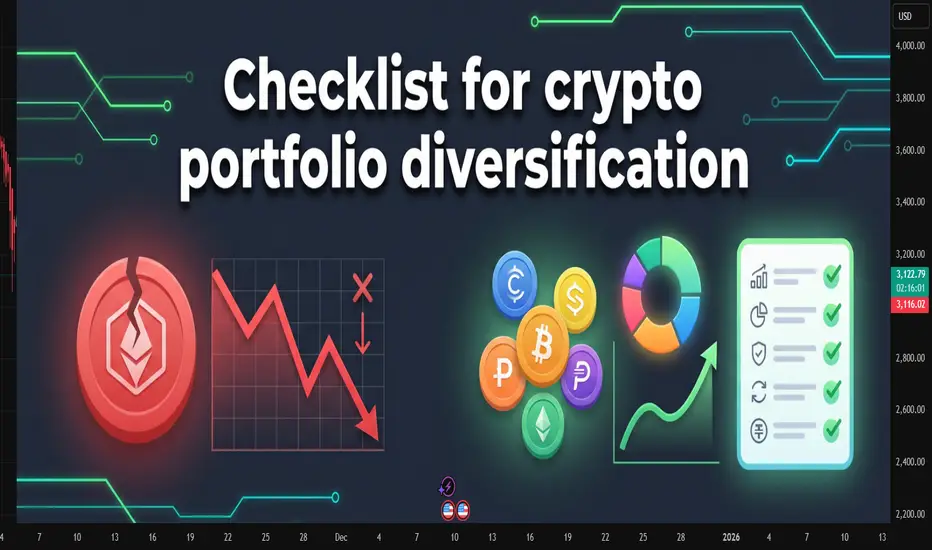
Crypto diversification checklist for your portfolioCrypto diversification checklist for your portfolio
When the market runs hot, it feels tempting to dump all capital into one coin that moves right now. The story usually ends the same way. Momentum fades, the chart cools down, and the whole account depends on one or two tickers. Diversification does not make every decision perfect. It simply keeps one mistake from breaking the account.
What a diversified crypto portfolio really means
Many traders call a mix of three alts and one stablecoin a diversified basket. For crypto it helps to think in a few clear dimensions:
asset type: BTC, large caps, mid and small caps, stablecoins
role in the portfolio: capital protection, growth, high risk
sector: L1, L2, DeFi, infrastructure, memecoins and niche themes
source of yield: spot only, staking, DeFi, derivatives
The more weight sits in one corner, the more the whole portfolio depends on a single story.
Checklist before adding a new coin
1. Position size
One coin takes no more than 5–15% of total capital
The total share of high risk positions stays at a level where a drawdown does not knock the trader out emotionally
2. Sector risk
The new coin does not fully copy risk you already have: same sector, same ecosystem, same news driver
If the portfolio already holds many DeFi names, another similar token rarely changes the picture
3. Liquidity
Average daily volume is high enough to exit without massive slippage
The coin trades on at least two or three major exchanges, not on a single illiquid venue
The spread stays reasonable during calm market hours
4. Price history
The coin has lived through at least one strong market correction
The chart shows clear phases of accumulation, pullbacks and reactions to news, not only one vertical candle
Price does not sit in a zone where any small dump is enough to hurt the whole account
5. Counterparty risk
Storage is clear: centralized exchange, self-custody wallet, DeFi protocol
Capital is not concentrated on one exchange, one jurisdiction or one stablecoin
There is a simple plan for delisting, withdrawal issues or technical outages
6. Holding horizon
The time frame is defined in advance: scalp, swing, mid term, long term build
Exit rules are written: by price, by time or by broken thesis, not only “I will hold until it goes back up”
Keeping the structure stable
Diversification helps only when the rules stay in place during noise and sharp moves. A simple base mix already gives a frame:
core: BTC and large caps, 50–70%
growth: mid caps and clear themes, 20–40%
experiments: small caps and new stories, 5–10%
cash and stablecoins for fresh entries
Then the main routine is to rebalance back to these ranges every month or quarter instead of rebuilding the whole portfolio after each spike.
A short note on tools
Some traders keep this checklist on paper or in a spreadsheet. Others rely on chart tools that group coins by liquidity, volatility or correlation and highlight weak spots in the structure. The exact format does not matter. The key is that the tool makes it easy to run through the same checks before each trade and saves time on charts instead of adding more noise. Many traders simply lean on indicators for this routine work because it feels faster and more convenient.
Chasing the last train: how late entries ruin good trendsChasing the last train: how late entries ruin good trends
The picture is familiar.
The asset has already made a strong move, candles line up in one direction, chats are full of profit screenshots.
Inside there is only one thought: "I am late".
The buy or sell button is pressed not from a plan, but from fear of missing out.
This is how a classic "last train" entry is born.
This text breaks down how to spot that moment and how to stop turning each impulse into an expensive ticket without a seat.
How the last train looks on a chart
This situation has clear signs.
Long sequence of candles in one direction with no healthy pullback.
Acceleration of price and volatility compared to previous swings.
Entry happens closer to a local high or low than to any level.
Stop is placed "somewhere below" or moved again and again.
The mind focuses on other people’s profit, not on the original plan.
In that state the trader reacts to what already happened instead of trading a prepared setup.
Why chasing the move hurts the account
The problem is not just "bad luck".
Poor risk-reward .
Entry sits near an extreme. Upside or downside left in the move is small, while a normal stop needs wide distance. In response there is a temptation to push the stop further just to stay in.
Large players often exit there .
For them the trend started earlier. Where retail opens first positions, they scale out or close a part of the move.
Strategy statistics get distorted .
A system can work well when entries come from levels and follow a plan. Once late emotional trades appear in the mix, the math changes even if the historical chart still looks nice.
How to notice that the hand reaches for the last train
Knowing your own triggers helps.
This symbol was not in the morning watchlist, attention appeared only after a sharp spike.
The decision comes from news or chat messages, not from calm chart work.
There is no clear invalidation level, the stop sits "somewhere here".
Many timeframes blink at once, the view jumps from 1 minute to 15 minutes and back.
Inner talk sounds like "everyone is already in, I am the only one outside".
If at least two of these points match, the trade is most likely not part of the core system.
Simple rules against FOMO
Work goes not with the emotion itself, but with the frame around trades.
No plan, no trade .
A position opens only if the scenario existed before the spike. Fresh "brilliant" ideas during the impulse are placed into the journal, not into the order book.
Move distance limit .
Decide in advance after what percentage move from a key zone the setup becomes invalid.
For example: "if price travels more than 3–4 percent away from the level without a retest, the scenario is cancelled, next entry only after a pause and new base".
Trade from zones, not from the middle of the impulse .
Plans are built around areas where a decision makes sense, not around the fastest part of a candle.
Time filter .
After a sharp move, add a small pause.
Five to fifteen minutes with no new orders, only observation and notes.
What to do when the move has already gone
The smart choice is not "grab at least something".
Better to:
save a screenshot of the move;
mark where the trend started to speed up;
write down whether this symbol was in the plan and why;
prepare a setup for a pullback or the next phase, where entry comes from a level, not from the middle of noise.
Then the missed move turns into material for the system instead of three revenge trades in a row.
A short checklist before pressing the button
Was this symbol in the plan before the run started.
Do I see the exact point where the idea breaks and is the stop parked there.
Is the loss size acceptable if this trade repeats many times.
Can I repeat the same entry one hundred times with the same rules.
If any line sounds weak, skipping this "train" often saves both money and nerves.
The market will send new ones. The task is not to jump into every car, but to board the ones that match the timetable of the trading plan.
How to choose what to invest inHow to choose what to invest in: a practical checklist for traders and investors
Many beginners start with the question “What should I buy today?” and skip a more important one: “What role does this money play in my life in the next years?”
That is how portfolios turn into random collections of trades and screenshots.
This text gives you a compact filter for picking assets. Not a magic list of tickers, just a way to check whether a coin, stock or ETF really fits your time horizon, risk and skill level.
Start from your life, not from the chart
Asset selection starts before you open a chart. First, you need to see how this money fits into your real life.
Three simple points help:
When you might need this money: in a month, in a year, in five years.
How painful a 10, 30 or 50 % drawdown feels for you.
How many hours per week you truly give to the market.
Example. Money is needed in six months for a mortgage down payment. A 15 % drawdown already feels terrible. Screen time is 2 hours per week. In this case, aggressive altcoins or heavy leverage look more like a stress machine than an investment tool.
Another case. Ten-year horizon, regular contributions, stable income from a job, 30 % drawdown feels acceptable. This profile can hold more volatile assets, still with clear limits on risk.
Filter 1: you must understand the asset
First filter is simple and strict: you should be able to explain the asset to a non-trader in two sentences.
The label is less important: stock, ETF, coin or future. One thing matters: you understand where the return comes from. Growth of company profit. Coupon on a bond. Risk premium on a volatile market. Fees and staking rewards in a network.
If your explanation sounds like “price goes up, everyone buys”, this is closer to magic than to a plan. Better to drop this asset from the list and move on to something more clear.
Filter 2: risk and volatility
The market does not care about your comfort. You can care about it by choosing assets that match your stress level.
Key checks:
Average daily range relative to price. For many crypto names, a 5–10 % daily range is normal. Large caps in stock markets often move less.
Historical drawdowns during market crashes.
Sensitivity to events: earnings, regulator news, large players.
The sharper the asset, the smaller its weight in the portfolio and the more careful the position size. The same asset can be fine for an aggressive profile and a disaster for a conservative one.
Filter 3: liquidity
Liquidity stays invisible until you try to exit.
Look at three things:
Daily traded volume. For active trading, it is safer to work with assets where daily volume is many times larger than your typical position.
Spread. Wide spread eats money on both entry and exit.
Order book depth. A thin book turns a big order into a mini crash.
Filter 4: basic numbers and story
Even if you are chart-first, raw numbers still help to avoid extremes.
For stocks and ETFs, it helps to check:
Sector and business model. The company earns money on something clear, not only on a buzzword in slides.
Debt and margins. Over-leveraged businesses with thin margins suffer in stress periods.
Dividends or buybacks, if your style relies on cash coming back to shareholders.
For crypto and tokens:
Role of the token. Pure “casino chip” tokens rarely live long.
Emission and unlocks. Large unlocks often push price down.
Real network use: transactions, fees, projects building on top.
Build your personal checklist
At some point it makes sense to turn filters into a short checklist you run through before each position.
Example:
Time. I know the horizon for this asset and how it fits my overall money plan.
Risk. Risk per position is no more than X % of my capital, portfolio drawdown stays inside a level I can live with.
Understanding. I know where the return comes from and what can break the scenario.
Liquidity. Volume and spread allow me to enter and exit without huge slippage.
Exit plan. I have a level where the scenario is invalid and levels where I lock in profit, partly or fully.
Connect it with the chart
On TradingView you have both charts and basic info in one place, which makes this checklist easier to apply.
A typical flow:
Use a screener to find assets that match your profile by country, sector, market cap, volatility.
Open a higher-timeframe chart and see how the asset behaved in past crashes.
Check liquidity by volume and spread.
Only then search for an entry setup according to your system: trend, level, pullback, breakout and so on.
Before clicking the button, run through your checklist again.
Common traps when choosing assets
A few classic traps that ruin even a good money management system:
Blindly following a tip from a chat without knowing what the asset is and why you are in it.
All-in on one sector or one coin.
Heavy leverage on short horizons with low experience.
Averaging down without a written plan and clear risk limits.
Ignoring currency risk and taxes.
This text is for educational purposes only and is not investment advice. You are responsible for your own money decisions.
Reading market regime: trend, range or chaos on a single chartReading market regime: trend, range or chaos on a single chart
Many traders treat every chart the same. Same setup, same stop, same expectations. Then one week the pattern works, the next week it bleeds the account.
In practice, the pattern rarely is the real problem. The problem is that the same pattern behaves differently in different market regimes.
First read the regime. Then trust the pattern.
This article focuses on a simple way to classify any chart into three regimes and adjust entries, stops and targets to match the environment.
What “market regime” really means
Forget academic definitions. For a discretionary trader, market regime is simply how price usually behaves on this chart in the recent swings.
A practical split into three buckets:
Trend: price prints higher highs and higher lows, or lower highs and lower lows. Pullbacks respect moving averages or previous structure. Breakouts tend to continue.
Range: price bounces between clear support and resistance. False breaks are frequent. Mean reversion works better than breakouts.
Chaos: candles with long wicks, overlapping bodies, fake breaks in both directions, no clear structure. Liquidity is patchy, stop hunts are common.
The goal is not perfect classification. The goal is to avoid trading a “trend playbook” in a chaotic zone and a “range playbook” in a strong trend.
Three quick checks for any chart
Before opening a trade, run three very simple checks on the last 50–100 candles.
1. Direction of swings
Mark the last 3–5 swing highs and lows with your eyes.
If highs and lows step clearly in one direction, you have a trend.
If highs and lows repeat in the same zones, you have a range.
If swings are messy and overlap, you are closer to chaos.
2. How price reacts to levels
Pick obvious zones that price touched several times.
Clean tests with clear rejection and follow through support the range idea.
Small pauses and then continuation support the trend idea.
Spikes through levels with no follow through point to chaos.
3. Noise inside candles
Look at wicks and bodies.
Moderate wicks and healthy bodies often belong to a stable trend.
Many doji-like candles and long wicks on both sides are classic noisy conditions.
After these three checks, label the chart in your journal: trend, range or chaos. Do not overthink it. One clear label is enough for each trade.
How to adapt the trade to the regime
Same signal, different execution.
Trend regime
Direction: trade only with the main direction of recent swings.
Entry: focus on pullbacks into previous structure or into dynamic zones like moving averages, not on chasing the breakout spike.
Stop: behind the last swing or behind the structure that invalidates the trend.
Target: allow more distance, at least 2R and more while the trend structure holds.
Range regime
Direction: buy near support, sell near resistance. Ignore mid-range.
Entry: wait for rejection from the edge of the range. Wick rejection or failed breakout is often better than a blind limit order.
Stop: behind the range boundary, where the range idea clearly dies.
Target: either the opposite side of the range or a “safe middle” if volatility is low.
Chaos regime
Size: cut risk per trade or stay flat.
Timeframe: either move to higher timeframe to filter noise or skip the instrument.
Goal: defense, not growth. The main job here is to avoid feeding the spread and slippage.
Use a journal to find your best regime
Add one extra column to your trading journal: “regime”. For each trade, assign one of three labels before entry.
After 30–50 trades, group the results by regime. Many traders discover that:
Trends give the main profit.
Ranges give small but stable gains.
Chaos slowly eats everything.
Once this pattern becomes visible in numbers, discipline around regimes stops being an abstract rule. It turns into a very practical filter.
Conclusion
A setup without a regime filter is half a system.
Start every analysis with a simple question to the chart: trend, range or chaos. Then apply the playbook that fits this environment, instead of forcing the same behaviour from the market every day.
How I Managed To Achieve 13.83% By Improving My Win Loss RatioThe SMC model that I used provided a beautiful mechanical system for me but did not provide a win loss ratio. The account balance would keep going down inspite of the great RRR.
I added the classical school and the Stochastic to see if I can get better results by those filters. What happened is that the daily stochastic became my major indicator and all the others, including the SMC model, became support confirmations.
The last thing that I added was the opening trades mechanism. I would open multiple trades during the day and once I am satisfied of the positive result I would close all trades. I might close all on the same day of opening.
In four weeks of testing this methodology I was able to turn my win loss ration from a disaster to even the wins exceeding the losses, and not one single batch was closed negative. All trade batches were closed on the positive.
This is a great method not only to increase my balance but also to increase my confidence.
I am not preaching that my plan is great, what I want to concentrate on is the value of education and continuous learning.
Currency Derivatives in International MarketsIntroduction
Global trade, cross-border investments, and multinational business operations depend heavily on currencies. Whenever goods, services, or capital cross borders, transactions often involve exchanging one currency for another. Because exchange rates constantly fluctuate, this creates both risks and opportunities for businesses, investors, and traders.
To manage these risks or speculate on currency movements, international financial markets provide a sophisticated set of instruments known as currency derivatives.
Currency derivatives are financial contracts whose value is derived from the exchange rate of two currencies. For example, a contract tied to USD/INR, EUR/USD, or JPY/CNY is a currency derivative. These instruments enable market participants to hedge against foreign exchange (forex) volatility, arbitrage between markets, or speculate on price trends.
This article will provide a comprehensive exploration of currency derivatives in international markets, covering their types, mechanisms, uses, risks, regulatory aspects, and global market trends.
1. The Need for Currency Derivatives
1.1 Exchange Rate Volatility
Currencies fluctuate due to factors like interest rate changes, inflation, trade balances, geopolitical events, and capital flows. For instance, when the US Federal Reserve raises interest rates, the US dollar typically strengthens, impacting emerging market currencies.
A European exporter selling machinery to India and receiving payment in Indian Rupees (INR) faces the risk that the INR might depreciate against the Euro before payment, reducing profit margins. Currency derivatives help hedge such risks.
1.2 Globalization and Trade
With the rise of global supply chains, companies constantly deal with multiple currencies. Currency risk can materially impact revenues and costs. Derivatives are necessary tools for financial planning, pricing, and budgeting.
1.3 Capital Flows and Investments
Portfolio investors and institutional funds investing abroad face currency exposure. For instance, a US-based investor holding Japanese equities will see returns influenced not only by the performance of Japanese stocks but also by the movement of USD/JPY.
1.4 Speculation and Arbitrage
Not all currency derivative participants are hedgers. Many are speculators (betting on movements for profit) or arbitrageurs (exploiting price inefficiencies across markets). This mix ensures liquidity and efficient pricing in derivative markets.
2. Types of Currency Derivatives
Currency derivatives exist in both over-the-counter (OTC) and exchange-traded markets. The most common types are:
2.1 Currency Forwards
A forward contract is a private agreement between two parties to exchange a fixed amount of one currency for another at a predetermined exchange rate on a future date.
OTC product: Customized in terms of amount, maturity, and settlement.
Commonly used by corporations for hedging.
Example: An Indian company expects to pay $1 million to a US supplier in 3 months. It enters a forward contract to lock the USD/INR rate at 84.50, ensuring certainty regardless of market fluctuations.
2.2 Currency Futures
Futures are standardized contracts traded on organized exchanges, obligating the buyer and seller to exchange currencies at a specific price and date.
Exchange-traded: Offers liquidity, transparency, and margin requirements.
Example: An investor on the CME (Chicago Mercantile Exchange) may buy a Euro futures contract against the USD, betting on Euro appreciation.
2.3 Currency Options
Options give the right (but not the obligation) to buy (call) or sell (put) a currency at a specified strike price before or at maturity.
Useful for hedgers who want downside protection but retain upside potential.
Example: A US importer buying goods from Japan may purchase a call option on USD/JPY to guard against Yen appreciation.
2.4 Currency Swaps
A currency swap involves exchanging principal and interest payments in one currency for those in another, often for long durations.
Used by corporations and governments to secure cheaper debt or match cash flows.
Example: A European company needing USD may swap its Euro-based loan obligations with a US company holding dollar liabilities.
2.5 Exotic Currency Derivatives
Beyond plain vanilla products, international markets also use structured derivatives:
Barrier options (knock-in, knock-out)
Basket options (linked to multiple currencies)
Quanto derivatives (currency-linked but settled in another currency)
These instruments cater to advanced hedging and speculative needs.
3. Mechanism of Currency Derivatives Trading
3.1 Pricing and Valuation
Forward Rate = Spot Rate × (1 + Interest Rate of Domestic Currency) / (1 + Interest Rate of Foreign Currency)
Futures prices are influenced by forward rates, interest rate parity, and market demand-supply.
Options pricing uses models like Black-Scholes or Garman-Kohlhagen (an extension for forex options).
3.2 Clearing and Settlement
Exchange-traded derivatives use central counterparties (CCPs) to guarantee settlement.
OTC derivatives often settle bilaterally, though post-2008 reforms require central clearing for many contracts.
3.3 Participants
Hedgers: Exporters, importers, MNCs, institutional investors.
Speculators: Traders betting on short-term price swings.
Arbitrageurs: Exploit mispricing between spot, forward, and derivative markets.
4. Role of Currency Derivatives in Risk Management
4.1 Corporate Hedging
Companies hedge to reduce earnings volatility. For example, Apple Inc. uses currency forwards and options to manage exposure to sales in Europe and Asia.
4.2 Portfolio Diversification
Fund managers hedge international portfolios to ensure returns are not eroded by currency losses.
4.3 Central Bank Intervention
Some central banks use derivatives indirectly to manage currency volatility without outright market intervention.
5. Risks in Currency Derivatives
While derivatives mitigate risk, they carry their own risks:
Market Risk – Adverse movements in exchange rates.
Credit Risk – Counterparty default in OTC forwards/swaps.
Liquidity Risk – Difficulty in exiting contracts, especially in exotic currencies.
Operational Risk – Errors in execution, valuation, or reporting.
Systemic Risk – Excessive derivative speculation (as seen in 2008 crisis) can amplify global financial instability.
6. Regulatory Framework in International Markets
US: Commodity Futures Trading Commission (CFTC) regulates currency futures/options.
Europe: European Securities and Markets Authority (ESMA) oversees derivatives under EMIR (European Market Infrastructure Regulation).
Asia: Singapore (SGX), Hong Kong (HKEX), India (SEBI) have their own frameworks.
Global: Bank for International Settlements (BIS) coordinates reporting and risk control.
Post-2008, G20 reforms emphasized:
Mandatory central clearing of standardized OTC contracts.
Reporting of derivatives trades to trade repositories.
Higher capital requirements for banks dealing in derivatives.
7. Major International Markets for Currency Derivatives
7.1 Chicago Mercantile Exchange (CME)
World’s largest market for currency futures and options (USD, Euro, Yen, GBP, CAD, etc.).
7.2 London
Global hub for OTC forex and currency swaps due to deep liquidity and time-zone advantages.
7.3 Asia-Pacific
Singapore Exchange (SGX): Growing hub for Asian currency derivatives.
India’s NSE/BSE: Offers USD/INR, EUR/INR, GBP/INR contracts.
China: Restricted but gradually opening with RMB futures and offshore CNH markets.
7.4 Emerging Markets
Increasing participation as trade volumes grow (e.g., Brazil, South Africa).
8. Case Studies
Case Study 1: Indian IT Companies
Infosys and TCS earn over 70% of revenue in USD/EUR but report in INR. To stabilize earnings, they actively use currency forwards and options.
Case Study 2: European Sovereign Debt
During the Eurozone crisis (2010–2012), several governments used swaps to manage currency-linked borrowings, highlighting both utility and hidden risks of derivatives.
Case Study 3: Hedge Fund Speculation
George Soros’ famous bet against the British Pound in 1992 (Black Wednesday) used massive currency derivative positions, forcing the UK out of the ERM (Exchange Rate Mechanism).
9. Current and Future Trends in Currency Derivatives
Rising Use in Emerging Markets: As Asia, Africa, and Latin America expand global trade.
Digital Platforms: Algorithmic and high-frequency trading dominate currency futures/options.
Clearing Reforms: Push for greater transparency in OTC markets.
Crypto and Digital Currencies: Bitcoin futures/options and central bank digital currencies (CBDCs) are reshaping forex risk management.
Geopolitical Tensions: Currency derivatives are increasingly used to hedge risks from wars, sanctions, and supply-chain disruptions.
ESG-linked derivatives: Growing alignment with sustainable finance trends.
10. Advantages and Criticisms
Advantages:
Hedging reduces business uncertainty.
Enhances global trade and investment flows.
Provides liquidity and efficient price discovery.
Criticisms:
Over-speculation can destabilize economies.
Complex derivatives can hide risks (as seen in 2008 crisis).
Dependence on clearing houses may concentrate systemic risks.
Conclusion
Currency derivatives are the backbone of modern international financial markets, enabling businesses, investors, and governments to manage risks associated with exchange rate fluctuations. They enhance global trade, promote investment flows, and ensure efficient allocation of capital.
However, they are double-edged swords. When used responsibly, they stabilize earnings, reduce volatility, and promote growth. But when misused, they can fuel financial crises.
As globalization deepens and financial technology advances, currency derivatives will only grow in importance. Regulators, corporations, and investors must balance innovation, risk management, and systemic stability to ensure that these instruments continue to support — rather than destabilize — the global economy.
Pattern and Structure This image provides a visual guide to key chart patterns and market structures in Forex trading. It emphasizes the importance of understanding how these patterns form and how price action influences market movements. The chart showcases several common patterns:
1. Bearish Channel: Traders are advised to buy at the retest after a breakout from the channel.
2. Double Bottom: This reversal pattern suggests buying after the confirmation of the second bottom or the breakout.
3. Rising Wedge: A bearish continuation pattern where selling is recommended after a breakout.
4. Flag Pattern: This continuation pattern typically occurs after a strong price move. The image suggests buying after the breakout.
5. Inverted Head and Shoulders (H&S): A reversal pattern signaling a potential bullish move, with a buying opportunity after the breakout.
6. Symmetrical Triangle: This pattern can break either way, but the focus is on buying at the retest after an upward breakout.
The psychological level plays a significant role, as it represents critical zones where market sentiment often shifts. The chart encourages re-entry after successful retests in bullish patterns. This comprehensive structure helps traders enhance their technical analysis skills and make informed decisions.
Fundamental Analysis in Forex
In forex trading, fundamental analysis looks at the outlook of a whole economy to determine the actual value of a currency. The value is then compared with the value of other currencies to assess whether it will strengthen or weaken relative to those currencies.
This post will further discuss how fundamental analysis is used in forex, what to look out for, and how you can incorporate it into your trading.
What is Fundamental Analysis?
Fundamental analysis is a way of looking at the forex market by analysing economic, social, and political forces that may affect currency prices. The idea behind this type of analysis is that if a country’s current or future economic outlook is good, its currency should strengthen due to an increase in demand for that specific currency.
The better shape a country’s economy is in, the more attractive it is, which will lead to foreign businesses and investors investing in that country. This results in the need to purchase that country’s currency to obtain those assets. There are a multitude of factors that determine the intrinsic value of a country’s currency. Factors covering a whole range of economic data, social trends, and political developments come together to generate a broad view of the outlook for the country. This will subsequently drive the outlook for the currency.
Due to this, forex fundamental analysis allows traders and speculators to take a longer-term view of whether the current value of a currency will likely increase or decrease towards its actual worth.
Fundamental Analysis Information
So, what information is used in the fundamental analysis of forex markets? There are several fundamental factors and components that analysts use to value a currency. From an economic perspective, the most important data are interest rates, inflation, economic growth, homes, and employment.
Central banks and governments will use all of this information to formulate their monetary policy and fiscal policy, respectively. Changes to interest rates will impact the outlook that fundamental analysts have on a currency. As such, central bank policy decisions and governments' fiscal policy decisions are critical factors in the valuation of a currency. (More on this later.)
Key Fundamental Data
Let’s go into further detail on some of the most important fundamental data and how they impact the valuation of a currency:
Interest rates
Interest rates are a tool that central banks use to control an economy. Depending on how a country's economy is performing, central banks will adjust the general interest rate level to bring the economy back towards its respective targeted levels.
When the level of one country’s interest rates is compared to another, this is a driver of the relative attractions of the currencies. A higher interest rate level will generate a better return for the holder of assets in that currency since higher interest rates draw capital from around the world as money seeks a higher rate of return, thereby increasing the demand for the currency as foreigners convert their domestic currency into the investment. Thus, the currency will strengthen relative to the other currency. Additionally, government bond yields are an indicator of the market’s outlook for central bank interest rates. Bonds pay a fixed income, so fluctuations in a bond’s price will determine its yield. If a central bank raises the interest rate, traders can get a better return on their money at the bank; therefore, the fixed-income government bond will likely be sold.
So, if yields reflect the expectation of interest rate moves, fundamental analysts can compare the government bond yields of various countries to assess the relative valuation of the currencies. That is why fundamental analysts will look at interest rate differentials in their valuation to determine whether a currency is mispriced.
Inflation
Inflation is caused by an excess supply of money in a country's economy. This then leads to more spending, which then leads to an increase in prices. If the inflation rate is higher in one country than in another, then the relative value of its currency will decline. It is possible for inflation to get completely out of control, and in fact, there are some countries that print so much money that their currency becomes almost worthless as money. Because money has such an important function in all societies, people will often find substitutes when the domestic currency becomes worthless—even using the currency of another country, in what is also known as 'dollarization.'
Inflation is a crucial driver of central bank interest rates. High levels of inflation eat away at the underlying value of an individual's assets or even savings. Furthermore, if inflation is too low or negative (deflation), it will lead people not to currently spend, and this can cause a downward economic spiral. Why would people buy something today if they think it will be cheaper tomorrow?
Every month, inflation measures such as the Consumer Price Index (CPI) and Purchasing Price Index (PPI) are assessed by traders and speculators to judge a country's inflation outlook.
Central banks use inflation targeting as they set interest rates. Higher inflation levels require higher interest rates to prevent continued price rises. Therefore, if one country has a higher level of inflation, it is likely that the interest rate will also need to be higher, which will also impact the currency’s value.
Gross Domestic Product
Economic growth is measured almost universally by changes in Gross Domestic Product (GDP). Gross domestic product is a measure of the size and health of a country’s economy over a period of time (usually measured quarterly or yearly). It is also used to compare the size of different economies at different points in time. GDP is the most commonly used measure for the size of an economy. The GDP is the total of all value added created in an economy. Value added means the value of goods and services that have been produced minus the value of the goods and services needed to produce them. The biggest drivers for GDP calculation are:
Consumer spending: Also known as personal consumption expenditures, this is the measure of spending on goods and services by consumers.
Government spending: It’s everything that is spent from a government’s budget within a public sector on items such as education, healthcare, defence, and more, depending on the country.
Business investment: Any spending by private businesses and nonprofit companies on assets to produce goods and services is considered business investment.
Balance of trade: The difference in value between a country’s imports and exports is what constitutes the balance of trade. If exports exceed imports, the country is in a trade surplus. On the contrary, if imports exceed exports, it’s a trade deficit.
Homes
The data on homes is very important due to the sole reason that one of the main aims for most people in life is to own a home. Additionally, a home is most likely the most expensive item a person will ever buy. So most people will work hard for a large part of their lives to own one. Because of this, housing forms an important part of the worldwide GDP calculation, so if a country's housing data is strong, this tends to also show in the country's economic performance. The biggest drivers in housing data are:
Pending home sales: This number shows the number of home sales where a contract between the seller and the buyer has been signed.
Existing home sales: This number measures the number and value of transactions of existing homes that were sold in a given month.
New home sales: This number measures the new homes that were sold in a given month. In a strong economy, the number of new home sales tends to keep rising.
Employment
A country's employment rate is very important in gauging a country's economic strength. The reason is that employment is very important to a country's economic output. If people have jobs, they will spend money and contribute to economic growth.
If employment is low, companies will have a shortage of workers. This will lead to lower productivity and then lower company revenues, which will then lead to companies not being able to pay back loans and even fewer jobs being available because companies can no longer sustain themselves. Also, consumer spending will decrease, and the never-ending cycle continues.
The US Nonfarm Payroll employment figure is one of the most important figures that comes out on the first Friday of every month. The figure is an estimate of the number of payroll jobs at all nonfarm businesses and government agencies, the average number of hours worked per week, and the average hourly and weekly earnings. Because labour is an important economic factor of production, the unemployment rate is a good indicator of how closely economic output is to potential output, which measures economic efficiency. A falling unemployment rate is a good indicator of economic growth, while an increasing unemployment rate indicates economic decline.
Fiscal and Monetary Policy
Monetary policy is very important in fundamental analysis. Central banks vary in philosophy and economic stance; some central banks are 'hawkish, meaning that they prefer higher interest rates to encourage saving and investing, whereas others are 'dovish, meaning that they prefer lower interest rates to encourage consumer spending and borrowing. Economic data can help a central bank formulate its monetary policy, but there is another aspect to consider. Fiscal policy (government spending and taxation) is also relevant to the fundamental economic outlook of a country.
While governments and central banks tend to be independent, they are not mutually exclusive. The fiscal actions of a government can have implications for the central bank (for example, the response of the Bank of England to the unfunded spending cuts of the UK Government in September 2022). Therefore, politics are also important. The type of government ruling a country can affect its economic outlook and, more importantly, its perception of future prospects for the country’s economy. A government that favours high spending might be seen as fiscally irresponsible. However, if the view is that this will generate more growth and a larger economy, it might be viewed positively.
How fundamental analysis is used in forex trading
Fundamental analysis is widely used to generate potential bull and bear markets in forex trading. Technical analysts will discuss trends; however, the medium- and longer-term fundamental outlook mostly, if not all of the time, generates the source of those trends. Fundamental traders will generally position themselves according to where they see a big trend. There might be some near-term fluctuations within the trend that can be taken advantage of using technical analysis. However, broadly speaking, a currency will move in a particular direction due to an economy’s longer-term prospects and interest rates.
How traders perceive fundamental economic data is very important. On a longer-term basis, it is all about what the data means for the future outlook of the country's economy. Is a central bank on a path of raising or tightening interest rates? Does a country's government have to raise or cut taxes? Is consumer borrowing and spending too high?
For short-term trading, it is all about expectations. Day traders usually look at the economic data for their signals. How did the data perform relative to market expectations? Did it beat the consensus forecast? Fundamental traders will examine how data announcements compare to the market’s estimates. Better-than-expected data should drive a stronger currency; if the data is less than expected, it tends to lower its value.
Dangers when trading using fundamental analysis
Though fundamental analysis can be useful in predicting the direction of currency prices, there are dangers that you need to be aware of. First, important figures like the nonfarm payroll and interest rate announcements are extremely volatile and can wipe your account instantly if you end up on the wrong side of the market. Additionally, there are times when markets are 'priced in', meaning that the move has already happened in anticipation before the fundamental data or announcement; therefore, the market is already priced in, and the market tends to go the opposite way. For example, if traders have been strongly anticipating that a country's central bank will cut interest rates, they will short the markets all the way prior to the central bank actually confirming the interest rate cut, so now the market is priced in and the market will tend to go the other way due to those traders exiting their early short positions.
Forex fundamental analysis can sometimes be very complex and time-consuming. However, a general understanding of its principles will not only help you in your journey to finding consistency in the markets but will also improve your economic knowledge and awareness.
BluetonaFX
gbpusd fake out set up gbpusd has the potential to form a fake out set up, this is still wishful thinking, I think, because I'm still learning this method, it's a good idea to re-analyze this
1.33778 is a resistance area with a support area at 1.31605 , the price is expected to move up first and fall on fake resistance at least one time and make a fake out
Support and Resistance is the name of the gameHi all, below is an article that I learned years ago and that has contributed massively to my trading success over the years and I would like to share with you. Due to the rules at tradingview, I cannot post the link so I will write it here.
When it comes to trading support and resistance is the name of the game and support and resistance comes right off the chart. Name any indicator you can imagine, any concept of data crunching you think of, they all use the Open, High, Low, or Close from whatever time frame they are analyzing. In short, they get their data from the chart.
Every indicator, algorithm, volume analysis, Market Profile, or Fib level, all seek to do the same thing, “FIND SUPPORT OR RESISTANCE”! Moving averages, traders try to use them for support and resistance. Bollinger bands, Keltner Channels, MA Envelopes, they use them to try to find support and resistance.
No matter what, all methods ultimately seek to find the support or resistance from which traders will enter, manage, and exit their trades.
Contrary to popular belief, indicators, if used correctly, DO NOT identify support or resistance. Indicators DO NOT time your trades. Indicators if used correctly are “TRADE FILTERS”. They merely give us permission to buy or sell support or resistance once WE have identified it, not a piece of software.
It does not matter what you put on the bottom of your chart if you don’t know how to read the top half of the chart you will not make it in this business. That is our focus and that is what we teach, how to correctly get a “READ” on the market by understanding how Market Structure works.
Key Points:
All trading is about support and resistance: Indicators DO NOT identify support or resistance or time your trades.
The majority of traders use indicators to find support or resistance, the majority of traders lose
Indicator do not identify support or resistance, they are merely trade filters
If you don’t know how to properly read the top half of the chart, then it does not matter what you put at the bottom of the chart.
Trading at its basic essence is about knowing with a high probability where buyers are most likely to come in so we can buy, or where sellers are most likely to come in so we can sell, with a level of confidence that the trade will produce some form of profits while we manage our trades to longer term targets.
If you don’t know how to spot support or resistance, how will you know when the market is testing it? If you don’t know where the market is most likely to go, how will you know when it gets there? How will you know where the best exit is in real time?
Therefore, every day when you check the market opening. Do not ask yourself if you could trade today. Ask yourself if you could find support and resistance today.
Remember, BUY AT SUPPORT & SELL AT RESISTANCE.
ADA/USDADA/USD
. There is a possibility of temporary retracement to the suggested support line (1.7387).
. if so, traders can set orders based on Price Action and expect to reach short-term targets."
Technical analysis:
. ADAUSD is in a range bound, and the beginning of an uptrend is expected.
. The price is above the 21-Day WEMA, which acts as a dynamic support.
. The RSI is at 60,.
EURJPYAs I said last weeks...exactly as I said, EJ closed above 129700 and has already made 70 pips!
Even if EJ will test the 130,600 area again, I will continue to bet on SELL because the 1-month candle closed under a very strong resistance from 130,100.
THIS WEEK...EJ makes a dangerous range in this area! Even if I still bet on SELL because on the 1 month chart EJ is overbought and formed W but only up to area 128700-128200 where I think EJ will force the climb back to 132,600 which is the Fibonacci level 786!
however ... a close even for 4 hours over 130,700 will force me to think of BUY at least 200 pips!
Please, give a LIKE if you find this idea useful!
GREAT ATTENTION:
Our analyzes have an accuracy of over 91% but due to market manipulations during this period we will avoid putting exact values on SL!
We also recommend avoiding short-term trades during this period because news can appear at any time that can destabilize the market.
*This information is not a Financial Advice.
Why most people fail as retail traders?I see two main reasons which complement each other for the high rate of failure.
First and foremost, the media and the industry promote this idea that it’s easy to become a profitable trader and anybody can go it. This is, of course, not true. Theoretically, anybody can do it if willing to put the effort and approach it as a business. Practically almost nobody approaches trading with the same rigorousness as any other professional endeavor.
Let’s put aside the first reason, about which there is not much we can do. A big chunk of the industry relies on peoples being naive and we’re not going to change that. On top of the first reason, we have a second reason related to people themselves. Most of those who try trading financial markets simply don’t manage their emotions and risk well enough to survive the learning curve.
Managing your own emotions turns out to be a complex endeavor and constantly changing market conditions lengthen the learning curve. One of the things that makes this business so attractive is also the main thing that makes it so difficult to master.
The direct and sometimes violent feedback you receive from the market, after each trading decision, has an astonishing impact on a human’s ability to keep his psychological well being in check and control his own reactions. It has the potential to disrupt executive functions and trigger instinctual “fight or flight” responses. This leads to emotional trading or trading on tilt which quickly generates more losses than any other mistake you could make in this business.
Most other jobs have a protective buffer zone between usual day to day work decisions and the ultimate feedback — end of the month paycheck. This profession doesn’t. Every little call you make has an immediate impact on your capital. Every little mistake can take a portion of your capital away and every good decision can bring it all back and more. This kind of psychological exposure is heavily distressful and being aware of its mechanisms makes a huge difference.
So … psychology differentiates the pro. Don’t get me wrong … professional discretionary traders are not emotionless but are much more aware and in control of their reactions. The successful pro deeply understands that trading is mainly about people's perceptions and the rest are just details.
You may ask yourself how can such a level be reached? A starting point is to stay away from any market, financial instrument, time frame, trading technique, or any combination of those that doesn’t fit who you are deep inside. The least the exposure to triggers that can awake the demons within, the best.
Always seek strategies that you understand and match your inner self. For example … if you are impatient trade shorter time frames, if you are very risk-averse don’t use huge margin, if you are risk-averse but you don’t have enough capital use margin with a tight risk management (maybe options), if you have a statistical mind try quantitative approaches etc. There are infinite possibilities to adapt to yourself and is a must to do it if you want to have a chance.
It always amuses me to see the vast majority of educational resources geared towards what market does when most of the success in this business is knowing how you adapt to the market, whatever it may do. And, of course, the market is, more or less, the other traders.
Possible Long Entry on EURGBP
List of confirmations:
1. Price has broken through the weekly downwards trend line.
2. Price reversed at my dynamic support and resistance level.
3. A strong bullish engulfing candle was presented on the weekly time frame.
4. Price is above my 14 EMA on the daily chart which means that price has formed a new bullish trend.
5. Price has been forming higher highs and higher lows.
*Do keep in mind that there is a strong presence of bullish divergence on the 4H time frame but we have to wait for price to reach my other S/R level in order to see if price bounces from it to confirm my price action analysis.
USDJPY - Strong Long Sell (Daily Time Frame) with SL and TPHi dear, I think #USDJPY will be going a long sell.
Trade_ID: #0000024
=> USDJPY: Sell (Long Trade) <=
=> Entry: 108.555
=> 1st SL: 111.111
=> 2nd SL: 112.999
=> 1st TP: 108.355 (short)
=> 2nd TP: 108.000
=> 3rd TP: 106.666
=> 4th TP: 105.000 (Long)
=> 5th TP: 102.000
©Learning Forex
NZDUSD trade idea
Thought I’d poss up some Forex trading snacks!
The NZDUSD is coming into a short term risk reward zone and up against a falling channel trend line. I see this as an opportunity to short some mainly because the price action is heading into multiple technical resistance zones and the back story is one of one of the most dovish central banks VS one central bank that is reluctantly becoming dovish. Also set into the mix, with a risk off stance currently entering the markets—the stronger of the two currencies is the USD just on it’s safe haven status.
On this 4 hour chart you can see the falling channel and current price action hovering around the upper channel around 0.6450
Using the last daily high price around 0.6470 as a stop zone, which is also above the falling trend line for some more possible added resistance. The pair would need to break what has been a stronger trend of late to invalidate this setup. My target for entry is 0.6440-50 , my targets would be the recent years low around 0.6300-50
Recap; short trade entry 0.6440-50
Stop. 0.6470
Total risk. 20-30 pips
Target 0.6300-50 or 100-150 pips
Risk reward Better then 1-3
Trade idea is only for education and training. Should you trade any idea the assumption of risk is all yours.
In trading you either make dust or you eat dust.
Plan your trade and trade you own plan.
All the best