CRM - Minor Downtrend Line Broken!CRM - CURRENT PRICE : 260.57
CRM previously entered a downtrend following a double-top reversal , which pushed the stock into a prolonged bearish trend. However, current price action shows early signs of trend change as CRM successfully breaks above the minor downtrend line with strong momentum.
Momentum indicators are confirming the shift:
⚡RSI has turned bullish and moved decisively above 50
⚡MACD shows a bullish crossover with improving histogram
With improving trend structure and bullish indicators, CRM may continue its upward recovery. Price may extend toward 278.00 and 296.00 as long as it stays above 242.00 (near EMA 50).
ENTRY PRICE : 260.57
FIRST TARGET : 278.00
SECOND TARGET : 296.00
SUPPORT : 242.00
Oscillators
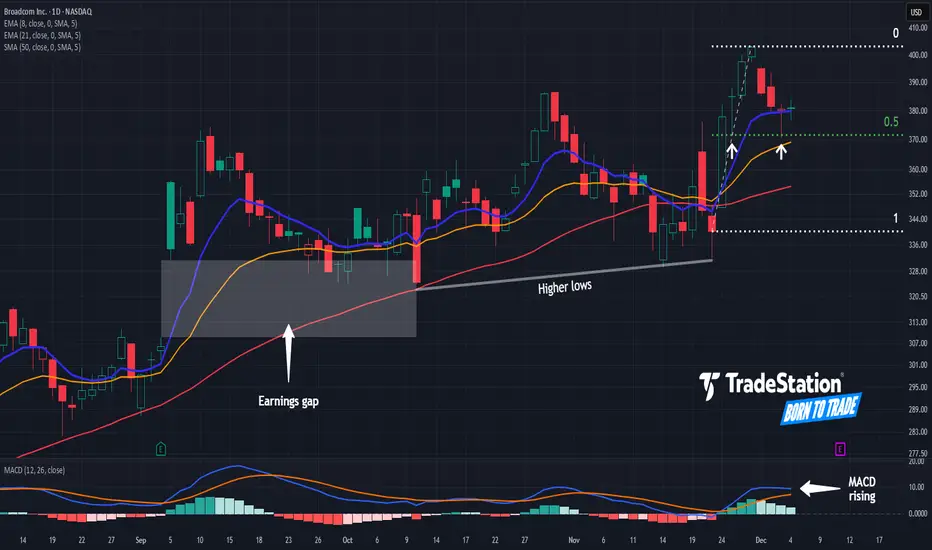
Uptrend in Broadcom? Broadcom hit a new all-time high last week, and some traders may think the chipmaker will continue to advance.
The first pattern on today’s chart is the rally between Friday, November 21, and Friday, November 28. AVGO retraced half the move and bounced, which may suggest its direction remains bullish.
Second, the 8-day exponential moving average (EMA) is above the 21-day EMA. MACD is also rising. Those signals may reflect a positive short-term trend.
Third, strong quarterly results propelled the stock upward on September 5. AVGO never filled the bullish gap, which may suggest buyers outnumber sellers.
Next, you have the series of higher lows in October and November. That could also reveal accumulation of the stock.
Finally, AVGO is an active underlier in the options market. (Its average volume of 260,000 contracts ranks 14th in the S&P 500, according to TradeStation data.) That may help traders take positions with calls and puts.
TradeStation has, for decades, advanced the trading industry, providing access to stocks, options and futures. If you're born to trade, we could be for you. See our Overview for more.
Past performance, whether actual or indicated by historical tests of strategies, is no guarantee of future performance or success. There is a possibility that you may sustain a loss equal to or greater than your entire investment regardless of which asset class you trade (equities, options or futures); therefore, you should not invest or risk money that you cannot afford to lose. Online trading is not suitable for all investors. View the document titled Characteristics and Risks of Standardized Options at www.TradeStation.com . Before trading any asset class, customers must read the relevant risk disclosure statements on www.TradeStation.com . System access and trade placement and execution may be delayed or fail due to market volatility and volume, quote delays, system and software errors, Internet traffic, outages and other factors.
Securities and futures trading is offered to self-directed customers by TradeStation Securities, Inc., a broker-dealer registered with the Securities and Exchange Commission and a futures commission merchant licensed with the Commodity Futures Trading Commission). TradeStation Securities is a member of the Financial Industry Regulatory Authority, the National Futures Association, and a number of exchanges.
Options trading is not suitable for all investors. Your TradeStation Securities’ account application to trade options will be considered and approved or disapproved based on all relevant factors, including your trading experience. See www.TradeStation.com . Visit www.TradeStation.com for full details on the costs and fees associated with options.
Margin trading involves risks, and it is important that you fully understand those risks before trading on margin. The Margin Disclosure Statement outlines many of those risks, including that you can lose more funds than you deposit in your margin account; your brokerage firm can force the sale of securities in your account; your brokerage firm can sell your securities without contacting you; and you are not entitled to an extension of time on a margin call. Review the Margin Disclosure Statement at www.TradeStation.com .
TradeStation Securities, Inc. and TradeStation Technologies, Inc. are each wholly owned subsidiaries of TradeStation Group, Inc., both operating, and providing products and services, under the TradeStation brand and trademark. When applying for, or purchasing, accounts, subscriptions, products and services, it is important that you know which company you will be dealing with. Visit www.TradeStation.com for further important information explaining what this means.
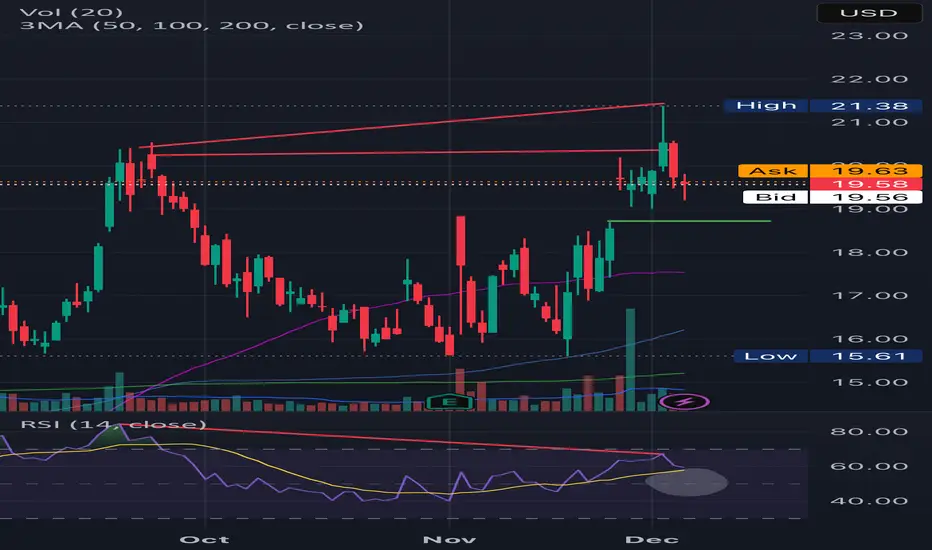
CUP AND A HANDLE - DAILY(For some reason, my published idea chart was blank… so I’m sharing it again)
As you can see there is a cup and a handle pattern forming.
At the same time RSI showing bearish divergence a strong one from the tops, and and weak one from the bodies, and price is showing a gap.
Now simply put, I can try and snipe it by waiting for a better entry after filling the gap, and perhaps cut losses at 18.15
OR as the last red candle has been denied by buyers (denied a lower price (wick)), you can enter now but tread lightly.
To me, with current market conditions, maybe I'll buy a little position, incase it went up, and add to the position to complete a full lot size (from cost basis amount) once it fills the gap.
Remember, the target price from a text books rule says it's the cup and a handle depth but from endpoint of the handle.
But to me, I'm a little worried with current market volatilities, mostly I'll take profit before it reaches full price target.
Te 2 Biggest Problems When Buying Stock Options My body is in pain.
Because I have been exercising.
Also I did yard work.
Determining the whether is not easy.
Just when you think it's raining.
It doesn't rain.
When you think it won't rain.
Then it rains.
Look at this chart.
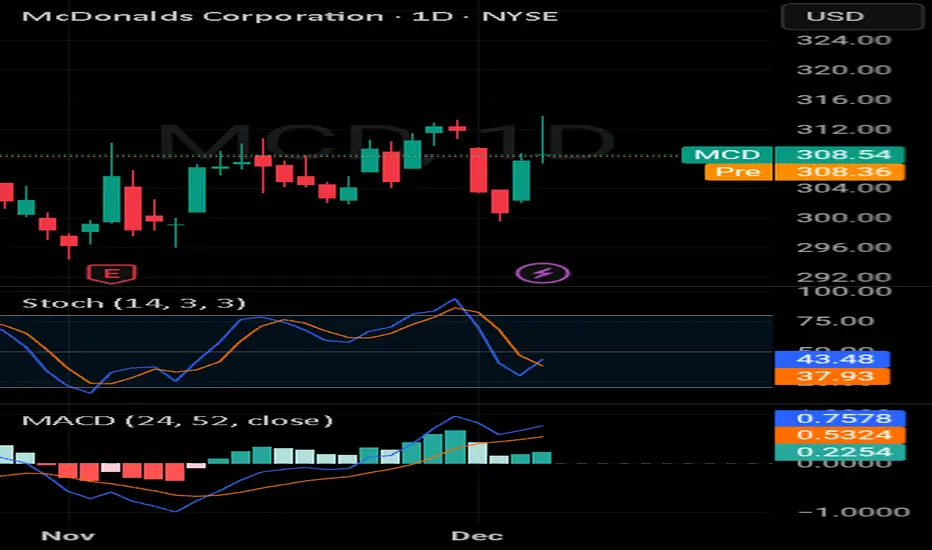
The stochastic has crossed.
The %k above the %d
Below the 50 level.
The MACD Histogram is green.
This green is on the weekly time.
Finally the 4h entry.
The sentiment analysis is green.
This shows you that buying pressure.
The pressure is building.
This gives you a good support.
You will need support.
This support will help your broker.
How?
You see the problems are these:
⚠️ Buying on a breakout
⚠️ Brokers poor execution during a breakout.
This is what you are avoiding.
When you enter on 4hour time frame sentiment.
Will you ever be right when predicting the weather?
Will you ever be right when predicting the market sentiment analysis?
These are some questions to 🤔 about.
Rocket boost 🚀 this content to learn more.
Disclaimer ⚠️ Trading is risky please learn about risk management and profit taking strategies.
Also feel free to use a simulation trading account before you use real money.
CUP AND A HANDLE - DAILYAs you can see there is a cup and a handle pattern forming.
At the same time RSI showing bearish divergence a strong one from the tops, and and weak one from the bodies, and price is showing a gap.
Now simply put, I can try and snipe it by waiting for a better entry after filling the gap, and perhaps cut losses at 18.15
OR as the last red candle has been denied by buyers (denied a lower price (wick)), you can enter now but tread lightly.
To me, with current market conditions, maybe I’ll buy a little position, incase it went up, and add to the position completing a full lot size on cost basis amount once it fills the gap.
Remember, the target price from a text books rule says it’s the cup and a handle depth but from endpoint of the handle. But to me, I’m a little worried with current market volatilities, mostly I’ll take profit before it reaches full price target.
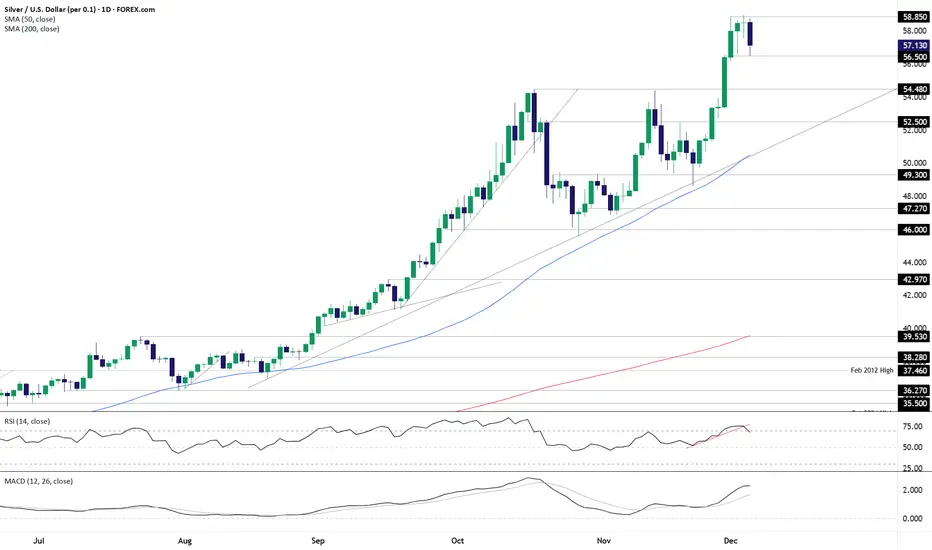
Three candles, one message: Bulls bewareSilver has completed a three-candle evening star pattern following a sharp run higher, warning of bearish reversal risk. However, before acting on the signal, it would be preferable to see the price push below $56.50 before considering short setups, providing a level where a stop could be placed above it for protection against reversal.
Downside targets to consider include $54.48, $52.50 or August uptrend support/50DMA, the latter found today at $50.48.
RSI (14) has broken its uptrend and is curling over but remains above the neutral 50 level, indicting waning upside strength. MACD provides a similar message, beginning to curl over towards the signal line while remaining firmly in positive territory. It’s not a bearish picture being provided by the oscillators, but it does provide a reason for bulls to be cautious around these levels.
While the option is there to act immediately on the bearish signal and initiate shorts at current levels, given the bullish frenzy seen in silver over recent months, risk management looms as particularly important for anyone considering bearish setups.
Good luck!
DS
EURAUD to find buyers at current market price?EURAUD - 24h expiry
The selloff is close to an exhaustion count on the intraday chart.
We expect a reversal in this move.
Risk/Reward would be poor to call a buy from current levels.
A move through 1.7650 will confirm the bullish momentum.
The measured move target is 1.7800.
We look to Buy at 1.7600 (stop at 1.7525)
Our profit targets will be 1.7750 and 1.7800
Resistance: 1.7650 / 1.7700 / 1.7750
Support: 1.7600 / 1.7550 / 1.7525
Risk Disclaimer
The trade ideas beyond this page are for informational purposes only and do not constitute investment advice or a solicitation to trade. This information is provided by Signal Centre, a third-party unaffiliated with OANDA, and is intended for general circulation only. OANDA does not guarantee the accuracy of this information and assumes no responsibilities for the information provided by the third party. The information does not take into account the specific investment objectives, financial situation, or particular needs of any particular person. You should take into account your specific investment objectives, financial situation, and particular needs before making a commitment to trade, including seeking, under a separate engagement, as you deem fit.
You accept that you assume all risks in independently viewing the contents and selecting a chosen strategy.
Where the research is distributed in Singapore to a person who is not an Accredited Investor, Expert Investor or an Institutional Investor, Oanda Asia Pacific Pte Ltd (“OAP“) accepts legal responsibility for the contents of the report to such persons only to the extent required by law. Singapore customers should contact OAP at 6579 8289 for matters arising from, or in connection with, the information/research distributed.
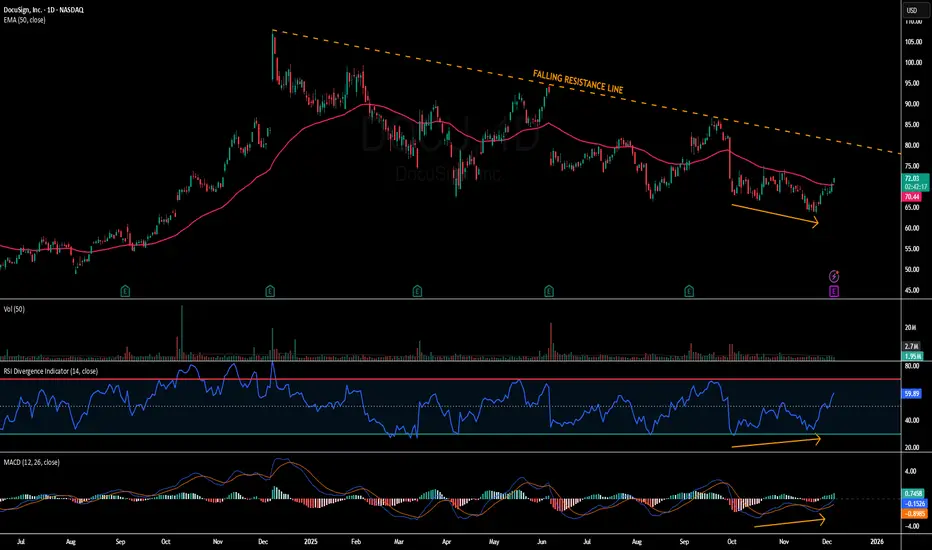
DOCU - Trendline Resistance in FocusDOCU - CURRENT PRICE : 71.87
Short-term outlook for DOCU is bullish as price moves above the EMA50, supported by RSI holding above 50 and bullish divergence in both RSI and MACD (look at orange arrows). Momentum continues to improve with a MACD bullish crossover, positioning DOCU for a move toward the long-term downtrend line. First target is $79 near trendline resistance, with a potential extension to $85, while $65 remains the key support and invalidation level.
ENTRY PRICE : 70.00 - 71.87
FIRST TARGET : 79.00
SECOND TARGET : 85.00
SUPPORT : 65.00
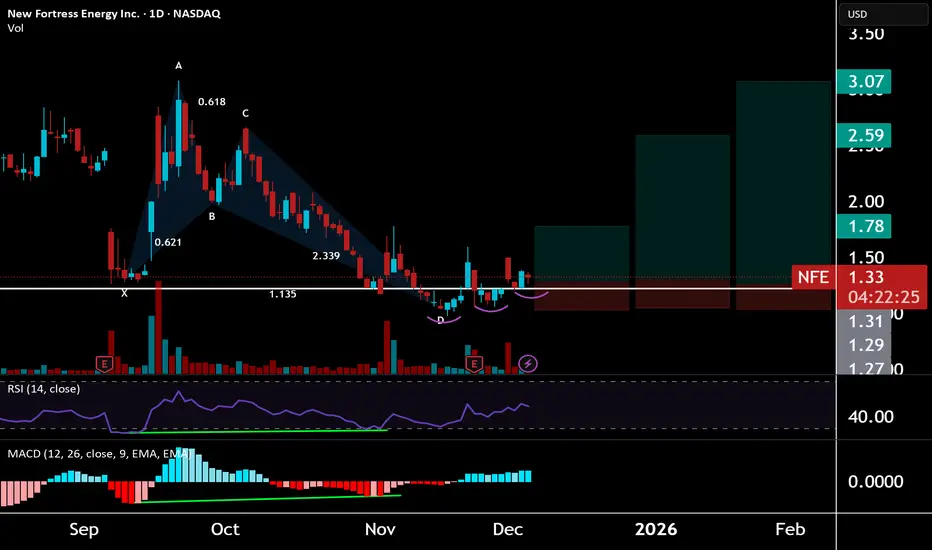
Bullish 0.618B Alternate Bat + Three Rising Valley AccumulationPattern Identified: Bullish Alternate Bat variant (0.618 B-point / 1.13 XA extension) with strong confluence at Potential Reversal Zone (PRZ).
Key Confluence:
Harmonic PRZ: D aligns with 1.13 XA extension
Price Action: Three rising valleys forming at PRZ - showing accumulation and higher low structure
Momentum: Bullish divergence present on MACD and RSI
Confirmation Needed:
Bullish breakout on the third valley + Volume increase on breakout
PATH - Price Reclaims 50-EMA and 200-EMAPATH - CURRENT PRICE : 14.50 - 14.70
PATH is gaining traction after reclaiming both the 50-EMA and 200-EMA, signalling a shift back into short-term bullish momentum 📈. Price strength is supported by rising RSI and an improving MACD cross, suggesting buyers are regaining control.
🔥 Bullish Points
Price reclaimed 50-EMA and 200-EMA
RSI trending above 50 → bullish momentum returning
MACD turning positive with increasing histogram
Volume uptick on recent green candles = buyers active
ENTRY PRICE : 14.50 - 14.70
FIRST TARGET : 16.00
SECOND TARGET : 17.30
SUPPORT : 13.00
BTC : Channel Breakdown RetestPrice has come back to retest the broken channel and is being rejected again. What matters now is to see if buyers can sustain follow‑through, because that will decide if this is just a relief bounce or the start of a real reversal. For now, it still looks like nothing more than a bounce.
Historically, when Bitcoin reaches oversold territory on the daily RSI, it often forms a bullish divergence rather than reversing immediately on the first oversold tag, price makes a lower low while RSI prints a higher low.
My scenario anticipates another push down in price while RSI refuses to make a new low, creating a classic bullish divergence that frequently precedes strong relief rallies.
This price action still fits my broader strategy, as the current rejection and potential bullish divergence keep the scenario alive for another leg up in December, with upside potential toward at least the 115k
EUR/AUD cracks 200DMA as bears circleDownside risks for EUR/AUD look to be building.
For the first time in 2025, the pair closed beneath the 200DMA on Wednesday, adding to the bearish signals delivered over the past week. With RSI (14) and MACD indicating building downside pressure, the message from price action and momentum indicators favours bearish setups over longs.
While its interactions with the level have been fleeting in recent times, of those that have occurred, it’s clear from the price action that traders pay attention to the 200DMA. As such, it can be used to build trade setups around.
Should the bearish break of the 200DMA stick, shorts could be established with a stop above for protection. 1.7670 saw buying over the past two days, so keep that on the radar should the price stall around the level again. If it does, consider nixing the trade. But if the bearish unwind extends, 1.7600, 1.7465 or 1.7400 provide target levels depending on your desired risk-reward.
While longs are not favoured right now, the 200DMA could also be used to build bullish setups should Wednesday’s break prove false, allowing for longs to be established above it with a stop below, targeting either 1.7750, the 50DMA or 1.7945 initially.
Good luck!
DS
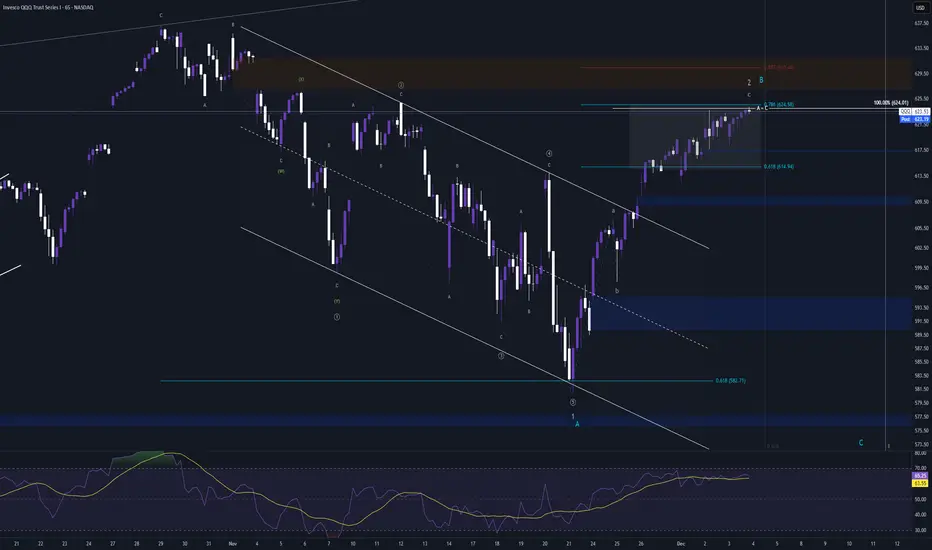
QQQ Rally Finished? A = C reachedIf the previous leading diagonal is accurate, QQQ is currently in my target zone. It was Just shy of the 78% retracement today, but in supply. If last Tuesday (11/25) was a really quick wave B then QQQ also hit A = C in the last hour of trading today and closed below it. SPY went over A=C and closed on it.
Also have bearish divergence. Time wise, we are at 61.8% of the leading diagonal.
The last 3 Thursdays before Thanksgiving were all down days, lets see if we get a repeat tomorrow!
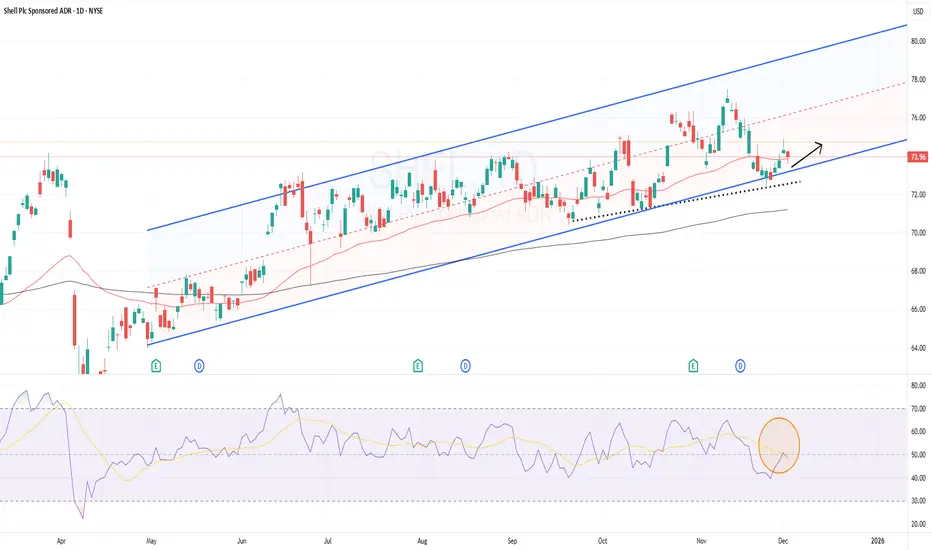
$SHEL offers a good entry point
I’m watching Shell closely — its Q3 2025 results showed strong cash flow: adjusted earnings of $5.4 billion and operating cash flow over $12 billion.
Meanwhile, the company just kicked off a fresh $3.5 billion share buyback, and continues to pay a healthy dividend, which signals confidence in its cash-generation.
On the chart — assuming technical structure holds — the setup looks attractive: price is near the lower end of its ascending channel, 50EMA remains above 200EMA, and dips have tended to bounce off support.
That said, I’m keeping an eye on oil-price volatility and macro headwinds; those could test sentiment if commodity prices slide or demand softens.
Bottom line: Shell looks like a solid dividend-plus-value play right now — I’d consider entry on a dip, with a medium-term horizon.
Possible Long Trade in USDJPY 1 HR TimframeReading raw price action has given us an impression that Buyers have taken control of the market. Advance Technical Analysis tools used.
1. Price Action Reading
2. Pitchforks
3. Market Manipulation techniques
4. Relative Strength Index
5. Frequency Shifting
USD/NOK bears on wedge watchUSD/NOK finds itself coiling within a rising wedge following a prolonged downtrend earlier this year, fitting the textbook definition of a bearish continuation pattern. With the pair now testing uptrend support, traders should be alert to the risk of a bearish breakdown that may open the door to lower levels.
While an eventual bearish break is favoured, traders may want to wait for confirmation of the breakdown before entry, with support at 10.1000 and the important 50DMA located just beneath. The preference would be to wait for a close beneath the latter before considering the setup, allowing for a stop to be placed above the 50DMA or 10.1000 to protect against reversal.
The psychologically important 10.0000 level looms as a key nearby hurdle for bears, with 9.9525 support another level to keep on the radar. Should the pair eventually clear the June low of 9.8650, the September lows would loom as the eventual trade target.
There is no definitive signal from RSI (14) and MACD when it comes to directional bias, other than upside strength is waning quickly, placing more emphasis on price action and signals to determine how to proceed.
Good luck!
DS
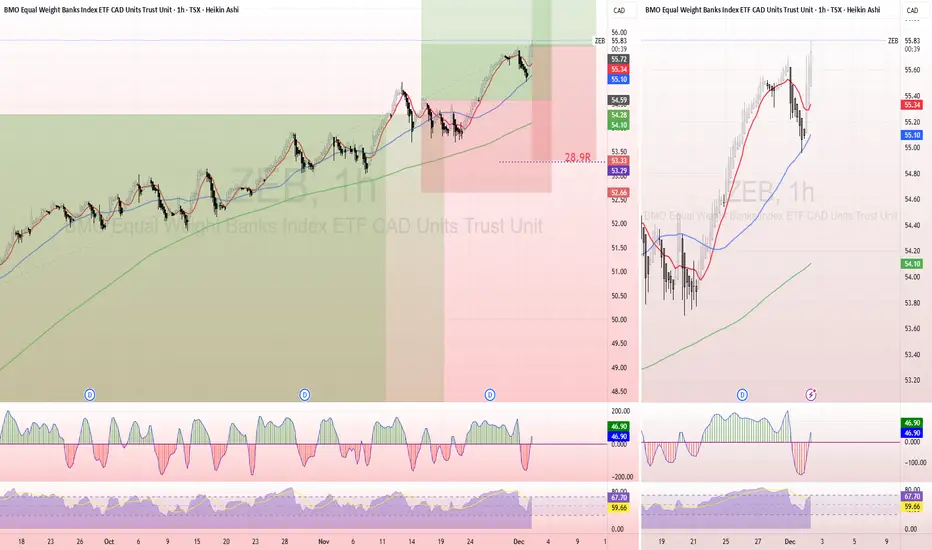
ZEB – Trend Structure Intact - 3rd Entry Following Strategy RuleRe-entered ZEB for the 3rd time as it rotated cleanly back into strength. Price respected the trend structure again- higher lows, higher highs- and reclaimed both the 20MA and 50MA on the 1h.
This entry follows my system rules exactly:
Trend confirmed (20MA > 50MA, both rising).
Pullback held structure inside the model’s “buy window.”
Heikin-Ashi flip back into momentum.
RSI + CCI reset without breaking the broader trend.
Risk stays constant by placing the stop below the structural invalidation.
This ETF doesn’t move fast, but it respects structure exceptionally well. I’m treating it as a slow, steady trend trade with compounding opportunity.
Trade Plan
Entry: Current reclaim of the trendline and MA cluster
Stop: Below the previous structural low (invalidates the setup)
Risk: Kept identical to prior entries 1% total account
If the trend continues, I’ll trail the stop behind Daily 50 MA and keep adding only when structure supports it.
Sticking to the plan > feelings.
#ZEB #TSX #Banks #ETF #TrendFollowing #HeikinAshi #RiskManagement
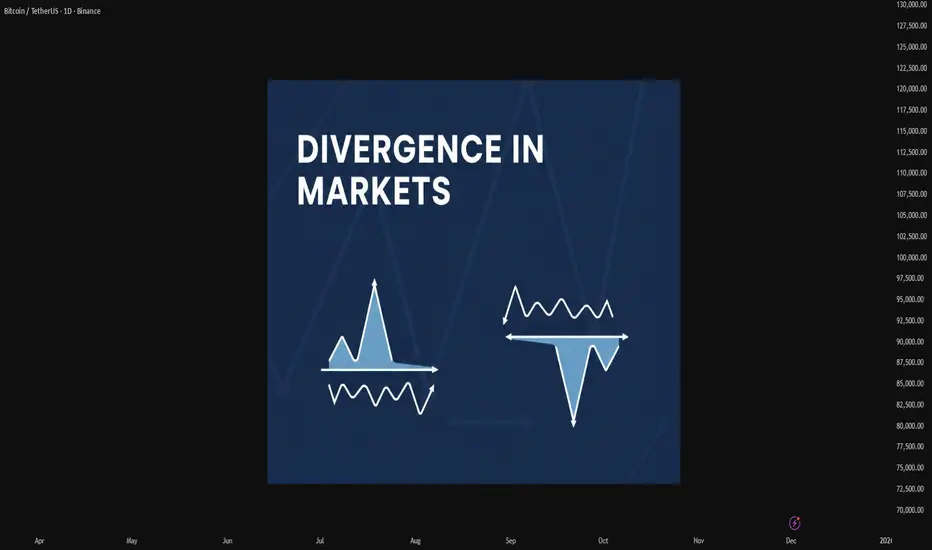
Mastering Divergence in Technical AnalysisIn technical analysis, a divergence (also called a “momentum divergence” or “price/indicator disagreement”) is one of the most powerful early warning signals available to traders. In simple terms, divergence occurs when price and a momentum indicator (such as RSI, MACD, or Awesome Oscillator etc.) move in opposite directions.
This disagreement often signals that the current trend is losing strength and that a pause, pullback, or full reversal may be approaching.
1. What Is Divergence?
Normally, in a healthy trend:
In an uptrend, price makes higher highs and momentum indicators also make higher highs.
In a downtrend, price makes lower lows and momentum indicators also make lower lows.
A divergence appears when this alignment breaks.
Typical example with RSI or MACD:
Price makes a higher high,
But the indicator makes a lower high.
This tells us that, although price has pushed to a new extreme, the underlying momentum is weaker. Smart money may be taking profits, and the late participants are driving the final leg of the move.
2. Types of Divergence
There are two main families of divergence:
Regular (classic) divergence – often associated with potential trend reversals.
Hidden divergence – often associated with trend continuation after a correction.
Within each family, we have bullish and bearish versions.
2.1 Regular Bullish Divergence – Potential Trend Reversal Up
This suggests that sellers are still pushing price to new lows, but momentum is no longer confirming the strength of this selling pressure. The downtrend is weakening and a bullish reversal may develop.
Context where it’s most powerful:
After a prolonged downtrend.
At or near a higher-timeframe support level (daily/weekly support, major demand zone, trendline, or Fibonacci confluence).
2.2 Regular Bearish Divergence – Potential Trend Reversal Down
This signals that buyers are still able to push price higher, but each new high is supported by less momentum. The uptrend is aging, and a bearish reversal or deeper correction becomes more likely.
Context where it’s most powerful:
After a strong, extended uptrend.
Around major resistance levels, supply zones, or upper trendlines.
2.3 Hidden Bullish Divergence – Trend Continuation Up
Here, price structure still shows an uptrend (higher lows), but the indicator has overshot to the downside. This often appears during pullbacks within an uptrend, suggesting that the correction is driven more by short-term emotion than by real structural weakness.
Interpretation:
Hidden bullish divergence indicates trend continuation. Bulls remain in control, and the pullback may provide an opportunity to join the uptrend at a better price.
2.4 Hidden Bearish Divergence – Trend Continuation Down
Price structure still favors the bears (lower highs), but the indicator has spiked higher, often due to a sharp counter-trend rally. This suggests that the bounce is corrective rather than the start of a new uptrend.
Interpretation:
Hidden bearish divergence favors continuation of the downtrend and often appears before the next impulsive bearish leg.
3. Which Indicators to Use?
Divergence can be spotted on many oscillators, but the most commonly used are:
RSI (Relative Strength Index) – very popular for spotting overbought/oversold zones and divergences.
MACD (and its histogram) – useful for trend and momentum, especially on higher timeframes.
Stochastic Oscillator – often used in range-bound environments.
Awesome Oscillator, CCI, etc. – alternative momentum tools, depending on your preference.
The concept is the same: price and indicator should generally confirm each other. If not, you have a divergence.
4. Timeframes and Reliability
Divergences can be found on all timeframes, but their reliability increases with higher timeframes:
On M5–M15, divergences are frequent but often short-lived. Better for scalpers.
On H1–H4, signals have more weight and can lead to multi-session moves.
On Daily/Weekly, divergences can mark major tops and bottoms, but they may take longer to play out.
A good practice is to:
Identify major divergences on higher timeframes (H4, Daily).
Refine entries on lower timeframes (M15, M30, H1) using structure and price action.
5. How to Trade Divergences (Practical Framework)
Divergence by itself is not a complete trading system. It is a signal of potential imbalance, which should be combined with:
Key levels (support, resistance, supply/demand zones).
Trend structure (higher highs/lows or lower highs/lows).
Price action confirmations (reversal candles, break of structure, etc.).
Risk management (position sizing, stop loss, invalidation level).
6. Common Mistakes When Using Divergences
- Trading every divergence blindly.
Not every divergence leads to a big reversal. Many will result in only minor pullbacks.
- Ignoring the trend.
Regular divergences against a strong trend can fail multiple times before a real top or bottom forms. Hidden divergences are often more reliable in trending markets.
- Forcing divergences where they don’t exist.
Only connect clear, obvious swing highs and lows on both price and indicator. If you have to “stretch” the lines, the signal is probably weak.
- No risk management.
A divergence is just a probability edge, not a guarantee. Always define invalidation and manage position size accordingly.
7. Best Practices
Combine divergence with market structure (trendlines, channels, higher highs/lows).
Use higher-timeframe context and drop to lower timeframes for refined entries.
Pay attention to confluence:
Divergence + key level + candlestick signal is stronger than any single factor.
Keep a trading journal of divergence setups, including screenshots from your charts. Over time, you will see which conditions work best for your style.
Divergences are not magic, but they are one of the cleanest ways to see when price and momentum disagree. Used correctly, they can:
Help you avoid entering late in a trend,
Alert you to potential reversals before they are obvious to the crowd, and
Provide high-probability continuation entries via hidden divergences within strong trends.
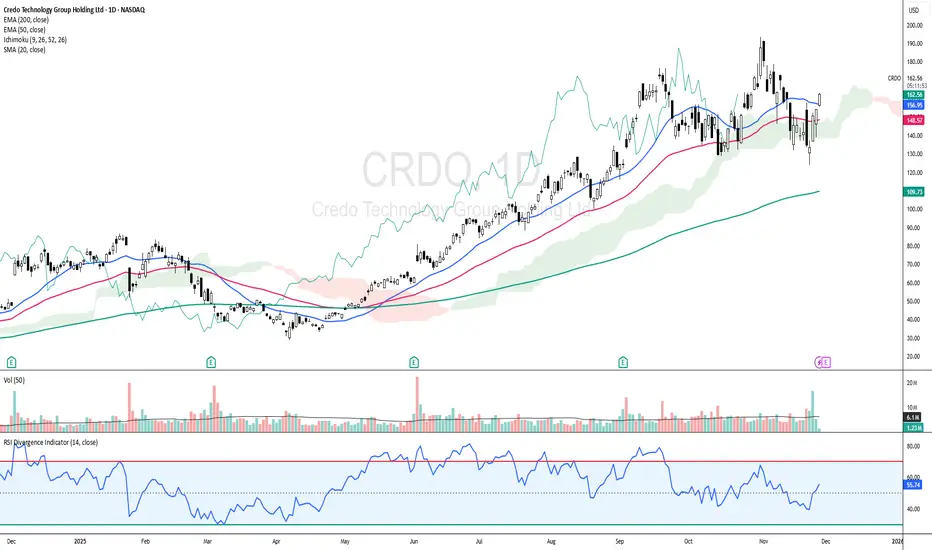
CRDO: Cloud + EMAs Aligning for Upside ContinuationCRDO - CURRENT PRICE : 162.95
CRDO is showing a bullish reversal setup as price rebounds and closes back above the EMA50 while holding firmly above the Ichimoku Cloud , signaling the major trend remains intact. Momentum is improving with RSI rising above 50 and not yet overbought, supported by increasing volume on the recent bullish white candlestick.
Today’s move above the 20-day SMA adds a positive layer to the short-term trend structure. Short term targets are 175.00 and 185.00 while support is 148.00.
ENTRY PRICE : 160.00 - 162.95
FIRST TARGET : 175.00
SECOND TARGET : 1.85
SUPPORT : 148.00
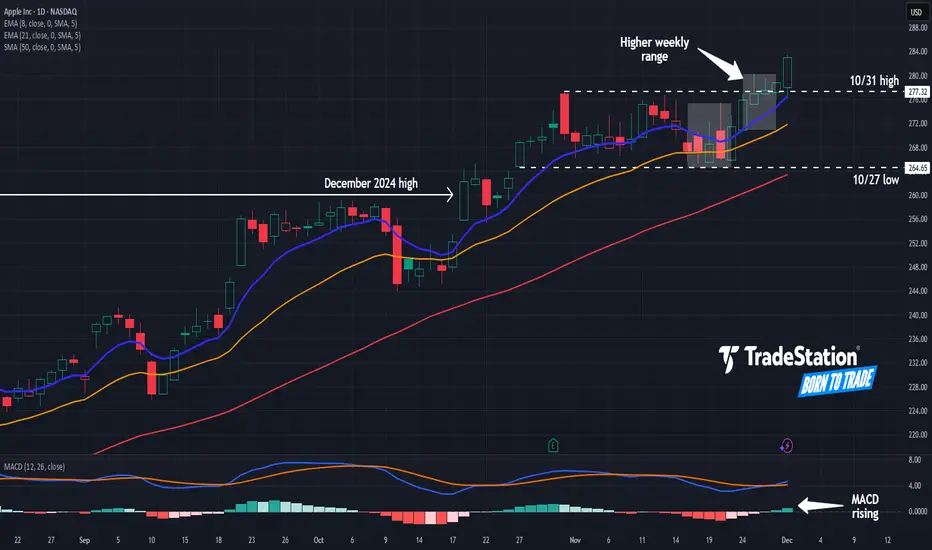
Apple May Be AcceleratingApple spent November quietly consolidating, and it may be accelerating in December.
The first pattern on today’s chart is the $260.10 level, a previous all-time high from December 2024. AAPL crossed above that price in late October and has remained there since, which could mean old resistance has broken.
Second, the smartphone giant made a weekly low of $264.65 on October 27. It’s remained above that level since. That may suggest that new support has been established.
Third, last week’s range featured a higher high and a higher low relative to the previous week. The stock also closed above a previous high of $277.32 from October 31.
Such price action is potentially consistent with a gradual breakout.
Next, the stock is above its 50-day simple moving average and its 8-day exponential moving average (EMA) is above its 21-day EMA. MACD is also rising. Those signals may reflect a bullish trend.
Finally, AAPL is a highly active underlier in the options market. (Its average daily volume of 808,100 contracts ranks fifth in the S&P 500, according to TradeStation data.) That may help traders take positions with calls and puts.
TradeStation has, for decades, advanced the trading industry, providing access to stocks, options and futures. If you're born to trade, we could be for you. See our Overview for more.
Past performance, whether actual or indicated by historical tests of strategies, is no guarantee of future performance or success. There is a possibility that you may sustain a loss equal to or greater than your entire investment regardless of which asset class you trade (equities, options or futures); therefore, you should not invest or risk money that you cannot afford to lose. Online trading is not suitable for all investors. View the document titled Characteristics and Risks of Standardized Options at www.TradeStation.com . Before trading any asset class, customers must read the relevant risk disclosure statements on www.TradeStation.com . System access and trade placement and execution may be delayed or fail due to market volatility and volume, quote delays, system and software errors, Internet traffic, outages and other factors.
Securities and futures trading is offered to self-directed customers by TradeStation Securities, Inc., a broker-dealer registered with the Securities and Exchange Commission and a futures commission merchant licensed with the Commodity Futures Trading Commission). TradeStation Securities is a member of the Financial Industry Regulatory Authority, the National Futures Association, and a number of exchanges.
Options trading is not suitable for all investors. Your TradeStation Securities’ account application to trade options will be considered and approved or disapproved based on all relevant factors, including your trading experience. See www.TradeStation.com . Visit www.TradeStation.com for full details on the costs and fees associated with options.
Margin trading involves risks, and it is important that you fully understand those risks before trading on margin. The Margin Disclosure Statement outlines many of those risks, including that you can lose more funds than you deposit in your margin account; your brokerage firm can force the sale of securities in your account; your brokerage firm can sell your securities without contacting you; and you are not entitled to an extension of time on a margin call. Review the Margin Disclosure Statement at www.TradeStation.com .
TradeStation Securities, Inc. and TradeStation Technologies, Inc. are each wholly owned subsidiaries of TradeStation Group, Inc., both operating, and providing products and services, under the TradeStation brand and trademark. When applying for, or purchasing, accounts, subscriptions, products and services, it is important that you know which company you will be dealing with. Visit www.TradeStation.com for further important information explaining what this means.
Gold Continued Support Feasible - Next Target for $4500? I believe if the oscillators play out, we can have another trendline support, even with aroon down, it could be quite minimal and a retracement for $4500 support per oz is possible. Gold as an asset and commodity seems to be getting scarcer and the demand for Gold including even in electronics is something I expect will increase. As always, none of this is investment or financial advice. Please do your own due diligence and research.