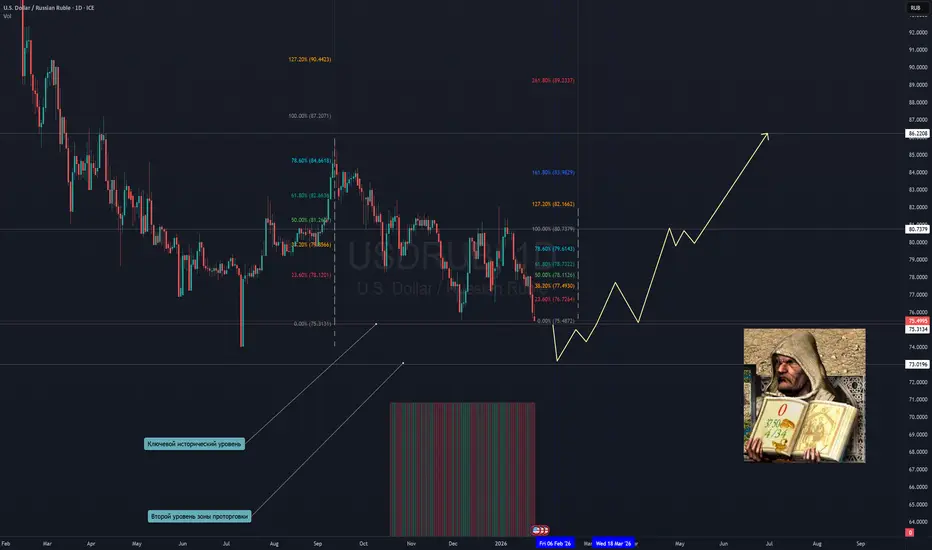
USDRUB — Current Thoughts — 01/25/2026 — What's Next?Good day, friends.
Today we'll analyze the USDRUB pair and try to predict where the ruble is heading.
Obviously, the exchange rate is currently under manual control, but still.
Let's start with the big picture
We can observe that the price is at a key historical level — roughly the same level as before the conflict began.
The second level of interest lies in key accumulation zones. In this zone, we can expect potential consolidation if the regulator continues pumping the market with foreign currency.
Now, let's zoom in — the price is being pushed toward a key level.
Why is that?
Let's look at the news. The main points:
CMASF (Center for Macroeconomic Analysis and Short-term Forecasting) — an analytical center close to the Russian government — warns of a high probability of a banking crisis in the second half of 2026 and a possible recession by October 2026 (due to loan servicing problems among households and businesses, as well as rising delinquencies).
NWF (National Wealth Fund)
The Fund is injecting one trillion rubles into state banks following warnings about an impending banking crisis.
Information about NWF injections into state banks fully corresponds to official data from Russia's Ministry of Finance, published on January 20, 2026.
NWF Injections into State Banks:
• VEB.RF — 1,319.0 billion RUB (deposits and subordinated deposits)
• VTB — 293.2 billion RUB (subordinated deposits)
• Gazprombank — 204.1 billion RUB (subordinated deposits)
• Sberbank — 94.2 billion RUB (subordinated deposit)
• Sovcombank — 29.6 billion RUB (subordinated deposit)
Earlier, Bloomberg reported that executives of Russia's largest banks discussed the possibility of seeking government support due to rising bad loans.
But the devil is in the details, and the name of that detail is — the Central Bank's Fiscal Rule.
What It Is and How It Works
The CBR Fiscal Rule is a mechanism that directly links government spending (including from the NWF) to the exchange rate through automatic liquidity sterilization.
Simplified scheme:
When the Ministry of Finance spends NWF money to support banks, it pumps rubles into the economy.
This creates excess liquidity, which can cause inflation and weaken the ruble.
The Central Bank sells foreign currency from its reserves on the domestic market to absorb excess rubles and ease pressure on the exchange rate.
Simultaneously, the CBR could raise interest rates (making credit more expensive) to sterilize excess liquidity.
💥 Why the Fiscal Rule Is Currently Working Against the Ruble
Problem #1: Depletion of Foreign Currency Reserves
In January 2026, the CBR sharply increased currency sales — by 17.42 billion rubles daily. This is twice as much as at the end of 2025.
The paradox: The more the NWF spends on bank support, the faster the CBR is forced to dump currency to prevent inflation. But currency reserves are finite — according to the data above, the liquid portion of the NWF has shrunk to 4.08 trillion rubles (~1.9% of GDP).
Problem #2: The Cost of Money Trap
• CBR sells currency → USD supply increases → Weakens ruble ↓ • CBR raises rates → Attracts investment → Strengthens ruble ↑ • MinFin spends NWF → Pumps rubles into economy → Weakens ruble ↓
Problem #3: Loss of Rate Maneuverability
Currently, the CBR is in a contradictory position: • Upward pressure on rates: NWF spending generates excess rubles and inflationary pressure, requiring higher rates. • Downward pressure on rates: Banks are in crisis and need lower rates for debt servicing.
Expected trajectory: The CBR plans to reduce the average key rate from the current ~19% to 13% in 2026.
When rates start to decline, this will directly undermine the attractiveness of ruble-denominated assets for foreign investors, creating additional pressure on the currency.
Current Situation (January 2026)
The Ministry of Finance is actively increasing currency sales under the fiscal rule:
• In January–early February, the volume of gold and currency sales will increase.
• This has led to temporary ruble strengthening below 78 RUB/USD.
• However, this is a short-term effect.
🎯 Conclusions on the Fiscal Rule's Impact on USD/RUB
Final assessment: The fiscal rule in this context is not a panacea but a delaying mechanism. It buys time but simultaneously accumulates risks through NWF depletion. If the banking crisis hits (H2 2026) and even larger injections are needed, the system could quickly collapse, causing sharp ruble depreciation.
📊 Current NWF Liquidity Level (as of January 1, 2026)
NWF liquid assets totaled:
• 4.085 trillion rubles or 52.2 billion USD
• This is ~1.9% of GDP (for comparison: at the beginning of 2024, it was ~7% of GDP)
NWF Structure (end of December 2025):
• Total volume: 13.42 trillion rubles (6.2% of GDP)
• Liquid portion: 4.08 trillion rubles (30% of total)
• Illiquid portion: 9.34 trillion rubles (stocks, gold, real estate)
Depletion Rate: Critically High
Over one year (2025), the liquid portion decreased by approximately 1.5–2 trillion rubles due to:
Injections into state banks: 1.02 trillion rubles
Budget deficit financing: unofficially another ~0.5–0.7 trillion rubles
Currency revaluation losses: foreign currency depreciates when the ruble weakens
The currency position is particularly vulnerable: • Chinese yuan reserves fell to 209.15 billion yuan — the lowest since the fund's creation. • This indicates maximum currency sales to support the ruble exchange rate.
🚨 Budget Pressure in 2026
Planned budget deficit: 3.8 trillion rubles
Officially approved by the State Duma:
• Revenue: 40.3 trillion rubles
• Expenditure: 44 trillion rubles
• Deficit: 3.8 trillion rubles (1.8% of GDP)
• From NWF: only 38.5 billion rubles (officially)
The NWF was created as a buffer for rainy days, but it is currently being spent to maintain the current economy. This means there is no safety cushion, and the first serious shock (banking crisis, oil price collapse, new sanctions) will lead to an uncontrolled crisis in late 2026 – early 2027.
Some may beat their chest and claim that sanctions don't work, but...
The treasury is running dry, milord.
⏰ Depletion Forecast: 3 Scenarios (assuming current sanctions persist)
Scenario 1: BASELINE (1.5–2 trillion RUB/year spending from NWF)
At the 2025 pace:
• Jan 1, 2026 — 4.08 trillion RUB — Current state
• Jan 1, 2027 — 2.0–2.5 trillion RUB — Critical level
• Jan 1, 2028 — 0.5–1.0 trillion RUB — Rock bottom
Scenario 2: ACCELERATED (2.5–3 trillion RUB/year spending)
This scenario develops if:
• The banking crisis starts earlier (Q2 2026 instead of H2 2026)
• Bank injections increase from 1.02 trillion to 2+ trillion rubles per year
• The budget deficit expands (due to military operations, sanctions, revenue decline)
Timeline:
• Jan 1, 2026 — 4.08 trillion RUB
• Jul 1, 2026 — 2.5–2.8 trillion RUB — Crisis begins
• Jan 1, 2027 — 1.5–1.8 trillion RUB — Panic begins
• Jul 1, 2027 — ~0 trillion RUB
Scenario 3: OPTIMISTIC (replenishment from oil & gas revenues)
Conditions:
• Brent oil price stable at 70–72 USD/barrel
• IMF forecasts 62.13 USD/barrel average for 2026
• Current prices: 66–70 USD/barrel
Calculation:
If oil holds at 70 USD/barrel, annual oil & gas revenues will be ~10–10.5 trillion rubles. With planned NWF spending of 38.5 billion rubles (per the official 2026 budget), the fund:
• Will be replenished by approximately 1–2 trillion RUB per year
• Depletion will be postponed by 5–7 years
(However, news about the seizure of the shadow fleet doesn't add much optimism here.)
📈 Key Monitoring Checkpoints
• Jan 1, 2026 — 4.08 trillion — Current state
• Apr 1, 2026 — 3.2–3.5 trillion — Q1: budget & bank support
• Jul 1, 2026 — 2.5–2.8 trillion — Possible crisis onset
• Oct 1, 2026 — 1.8–2.2 trillion — Panic begins (new injections)
💥 What Happens When the NWF Is Depleted
Short-term effect (1–3 months before depletion):
Markets will panic:
• Speculation on ruble weakening → massive capital outflow
• Accelerating inflation → CBR forced to raise rates despite the crisis
• Chaos in the currency market — CBR may introduce exchange controls
Scenarios (from most to least likely):
Introduction of currency controls
Sharp ruble depreciation (110–130 RUB/USD)
Depositor panic, bank runs
Bank defaults (payment failures)
Devaluation, restructuring
Related Conclusion
To negotiate sanctions relief in the context of a Russia-Ukraine ceasefire, there are approximately 3 years left.
Otherwise, things will get very tough.
To cover the budget deficit, our government officials, out of love for the people and economic necessity, will invent even more taxes and fees. The one-party system will easily pass any law.
Raising the retirement age, pension points, VAT increases — these are just flowers.
📉 Forecast Thoughts
If the CBR continues currency sales — ruble strengthening to 73 RUB.
A spike down to 72 is possible.
Keep in mind that they need to push the rate to a level where there's enough buffer when rates are cut.
Consolidation is possible amid Q1 injections, followed by expected growth.
First growth target: 80.70
Second target: 87–90
Possible scenario breaker: Progress in negotiations.
On positive news with official confirmation, the ruble could strengthen sharply (which isn't great for business, but that's another story).
What do you think?
With Respect to Everyone, Your #SinnSeed
Sanctions
Nasdaq crashes but recovering: Buy the dip or sell the break?The NASDAQ has taken a serious hit, dropping 1.6% to test 25,280 after failing to break the double top at 25,900. The market is caught in a crossfire of 25% AI chip tariffs, China export bans, and tensions in Iran. But technically, we might be forming an ascending triangle that suggests a breakout to 27,500 is still possible.
Read as we analyse the clash between bearish headlines—US-China escalation and the Iran crisis—and bullish technicals. We break down the ascending triangle pattern with higher lows at 23,860, 24,660, and now 25,170, and explain why the 50 RSI reset on the daily chart could signal a perfect "buy the dip" opportunity.
Key topics covered:
Trade war escalation: How 25% tariffs on AI chips and China’s retaliatory bans on dual-use items and cybersecurity companies are hitting tech giants.
Iran tensions: The impact of Trump's remarks and their effect on investor confidence and "risk-off" sentiment.
Technical setup: The critical ascending triangle formation. A hold at 25,200 keeps the bullish bias alive for a measured move to 27,500 (100% Fib extension).
Two scenarios:
Bullish : De-escalation in Iran/trade war + triangle hold = breakout to 26,500 and 27,500.
Bearish : Escalation + break below 25,200 = failure of the triangle, targeting 24,650 and lower.
Are you buying the triangle dip or shorting the double top? Let us know in the comments!
This content is not directed to residents of the EU or UK. Any opinions, news, research, analyses, prices or other information contained on this website is provided as general market commentary and does not constitute investment advice. ThinkMarkets will not accept liability for any loss or damage including, without limitation, to any loss of profit which may arise directly or indirectly from use of or reliance on such information.
Can WTI’s 8% Rally Hold After Trump-Putin Summit Collapse?WTI just staged its biggest two-day rally since June, as hopes for a Trump-Putin summit were dashed, leading to new US sanctions on Russian oil exports.
Here’s what’s fuelling the move and what traders should watch next:
- US sanctions on Russia’s top oil producers after failed Budapest summit trigger supply fears and spike prices
- Trump escalates rhetoric to maintain leverage as Zelensky signs military deals with Sweden, raising geopolitical stakes
- WTI reclaims key $61 resistance, with daily RSI momentum signalling room to run and a possible cup & handle breakout toward $68
- Supply glitch fears (India, OPEC’s slow reaction) and technicals all support continued upside if the current environment holds
Watch for buy the dip signals, respect $61 support, and target the $65–68 channel top if current drivers persist.
Stay tuned!
This content is not directed to residents of the EU or UK. Any opinions, news, research, analyses, prices or other information contained on this website is provided as general market commentary and does not constitute investment advice. ThinkMarkets will not accept liability for any loss or damage including, without limitation, to any loss of profit which may arise directly or indirectly from use of or reliance on such information.
Crude Oil Spikes - Russia / Ukraine / USA sanction? Concerns about the possibility of tighter global oil supplies are supporting crude prices after President Trump warned of "secondary sanctions" if Russia fails to reach a ceasefire in Ukraine within 10 to 12 days.
These sanctions have absolutely burned the shorts in oil and can cause a 3 bar surge on the daily chart if crude breaks this channel.
Keep you eye on the daily 200 MA...if it holds above we should push higher on crude.
FOMC RATE DECISION TOMORROW - Tune into our live stream.
Is Mexico's Peso at the Crossroads?The recent imposition of U.S. sanctions on three Mexican financial institutions - CIBanco, Intercam Banco, and Vector Casa de Bolsa - has ignited a crucial debate over the Mexican peso's stability and the intricate dynamics of U.S.-Mexico relations. Washington accuses these entities of laundering millions for drug cartels and facilitating fentanyl precursor payments, marking the first actions under new anti-fentanyl legislation. While these institutions collectively hold a relatively small portion of Mexico's total banking assets (less than 3%), the move carries significant symbolic weight and prompts a re-evaluation of the peso's outlook. The Mexican government, under President Claudia Sheinbaum, swiftly rejected the allegations, demanding concrete evidence and initiating its investigations, including the temporary regulatory intervention of CIBanco and Intercam to safeguard depositors.
Economically, the peso faces a nuanced landscape. Before the sanctions, the Mexican peso (MXN) demonstrated remarkable resilience, appreciating significantly against the dollar, bolstered by Mexico's comparatively higher interest rates and robust trade flows with the U.S. However, the recent divergence in monetary policy, with **Banxico** easing rates while the U.S. Federal Reserve maintains a hawkish stance, now presents a potential headwind for the peso. While analysts generally suggest limited systemic risk to Mexico's broader financial system from these targeted sanctions, the action introduces an element of uncertainty. It raises concerns about potential capital flight, increased compliance costs for other Mexican financial institutions, and a possible erosion of investor confidence, factors that could exert downward pressure on the peso.
Geopolitically, these sanctions underscore the escalating U.S. campaign against fentanyl trafficking, now intricately linked with broader trade and security tensions. President Donald Trump's past threats of punitive tariffs on Mexican imports - aimed at curbing drug flows - highlight the volatile nature of this bilateral relationship. The sanctions serve as a potent political message from Washington, signaling its resolve to combat the fentanyl crisis on all fronts, including financial pipelines. This diplomatic friction, coupled with the ongoing complexities of migration and security cooperation, creates a challenging backdrop for the USD/MXN exchange rate. While the U.S. and Mexico maintain a strong intergovernmental relationship, these pressures test the limits of their collaboration and could influence the peso's trajectory in the medium term.
Is Erdogan’s Gambit Destabilizing Turkey’s Future?Erdogan’s administration continues to engage in high-stakes geopolitical maneuvers by maintaining direct and indirect ties with groups designated as terrorist organizations. His government’s strategic alliances, notably with Hayat Tahrir al-Sham (HTS), serve immediate military and political goals in Syria, despite significant international controversy and longstanding terrorist designations by the U.S. and other global actors.
This risky strategy has had a pronounced impact on the Turkish economy. Investors have increasingly shifted their capital from the Turkish Lira to the U.S. dollar, leading to a notable rise in the USD/TRY rate. Fears of further economic isolation and the looming threat of sanctions—which could cut off Turkey from critical European banking and trade services—have only intensified market instability.
The growing strains within NATO and shifting regional alliances are compounding these economic challenges. Erdogan’s pragmatic yet contentious foreign policy raises serious questions about Turkey’s future role within the alliance, as Western partners deliberate potential sanctions and other measures. Meanwhile, evolving dynamics with regional powers such as Russia and Iran add further uncertainty to Turkey’s strategic position and economic prospects.
Will Russia’s New Dawn Reshape Global Finance?As the Russo-Ukrainian War edges toward a hypothetical resolution, Russia stands poised for an economic renaissance that could redefine its place in the global arena. Retaining control over resource-laden regions like Crimea and Donbas, Russia secures access to coal, natural gas, and vital maritime routes—assets that promise a surge in national wealth. The potential lifting of U.S. sanctions further amplifies this prospect, reconnecting Russian enterprises to international markets and unleashing energy exports. Yet, this resurgence is shadowed by complexity: Russian oligarchs, architects of influence, are primed to extend their reach into these territories, striking resource deals with the U.S. at mutually beneficial rates. This presents a tantalizing yet treacherous frontier for investors—where opportunity dances with ethical and geopolitical uncertainties.
The implications ripple outward, poised to recalibrate global economic currents. Lower commodity prices could ease inflationary pressures in the West, offering relief to consumers while challenging energy titans like Saudi Arabia and Canada to adapt. Foreign investors might find allure in Russia’s undervalued assets and a strengthening ruble, but caution is paramount. The oligarchs’ deft maneuvering—exploiting political leverage to secure advantageous contracts—casts an enigmatic shadow over this revival. Their pragmatic pivot toward U.S. partnerships hints at a new economic pragmatism, yet it prompts a deeper question: Can such arrangements endure, and at what cost to global stability? The stakes are high, and the outcomes remain tantalizingly uncertain.
This unfolding scenario challenges us to ponder the broader horizon. How will investors weigh the promise of profit against the moral quandaries of engaging with a resurgent Russia? What might the global financial order become if Russia’s economic ascent gains momentum? The answers elude easy resolution, but the potential is undeniable—Russia’s trajectory could anchor or upend markets, depending on the world’s response. Herein lies the inspiration and the test: to navigate this landscape demands not just foresight, but a bold reckoning with the interplay of economics, ethics, and power.
Is Russia's Financial Fortress Built on Shifting Sands?The transformation of Russia's financial system has been nothing short of seismic. Once deeply integrated with global markets, Moscow's monetary landscape now finds itself in a state of radical reconfiguration, navigating the turbulent waters of international isolation. This shift carries profound implications, not just for Russia, but for the very foundations of the global financial order.
At the heart of this evolution lies the Russian Central Bank, whose Governor, Elvira Nabiullina, has found herself at the center of an unprecedented storm. Tasked with controlling inflation amid soaring interest rates, Nabiullina faces a growing chorus of dissent from Russia's business elite - a rare and significant development in a country where corporate voices have long remained muted. This internal conflict underscores the delicate balance the Central Bank must strike, as it seeks to stabilize the ruble and safeguard economic growth in the face of crippling Western sanctions.
Russia's financial system has demonstrated remarkable adaptability, forging new international partnerships and developing alternative payment mechanisms. Yet, these adaptations come at a cost, as increased transaction costs, reduced transparency, and limited access to global markets reshape the country's economic landscape. Consumer behavior, too, has evolved, with Russians increasingly turning to cash transactions and yuan-denominated assets, further signaling the shift away from traditional Western financial systems.
As Russia navigates this uncharted territory, the implications extend far beyond its borders. The reconfiguration of its financial architecture is shaping new models for sanctions resistance, the emergence of parallel banking networks, and a potential realignment of global currency trading patterns. The lessons learned from Russia's experience may well influence the future of international economic relationships, challenging long-held assumptions about the resilience of the global financial order.
#OIL UpdateWith this flash crash, presumably caused by US-Iran news about a possible swap of nuclear program for oil sanctions , we're back to the scenario where wave [ 2] is already complete and we're in a leading diagonal formation. The nefarious option of an expanding diagonal remains, but it is less likely.
What Would Happen to Henry Hub NG if China Attacks Taiwan?Since last week the media has published videos and Chinese politicians' statements about the Chinese military drills near Taiwan. Taiwan has also conducted military exercises and preparatory work with the civilian population in the event of an attack. On August 3, the NYT, quoting Chinese state media, published an article about the following Chinese military drills scheduled on August 4 and a place of exercises. Chinese media offered five swaths of the sea surrounding Taiwan. If true, it can be a hostile act, possibly igniting conflict between China and unrecognized Taiwan. Both countries are essential for the world economy, meaning the conflict would affect markets. I hope it will not happen . However, this risk urged me to start a series of posts ' What would happen to asset_name if China attacks Taiwan? '
A brief: China is the second economy in the world by nominal GDP. China is the main trading party for the US, Europe, and many other countries and regions. The country is also a giant gas consumer and LNG importer. According to the EIA, the US was the fourth LNG supplier in China in 2021.
Henry Hub natural gas is a local benchmark. However, its price partly depends on the US LNG trade achievements and obstacles.
In case of a conflict, it would halt LNG export to Taiwan. I estimate Henry Hub participants would also wait for sanctions on Chinese banks or even prohibition of gas trade with China. These would drive expectations of short-term oversupply in the US local market resulting in a sharp price drop of natural gas in America.
In the end, some LNG exporters would change their export from China and Taiwan to other Asian countries, e.g., South Korea, Japan, and India. Other LNG sellers would divert shipments to Europe, suffering from high continent natural gas prices , bringing relief to Europe in terms of volumes and price.
The main shock could happen later. Possible export and import prohibitions between China and the US with Allies would bring manufacturing decline, pushing gas demand lower and cutting its price. It would get a more sustained bearish effect on Henry Hub prices than temporary shipment redirection.
With the technical analysis help, I estimate a first bearish move could put prices down to a support level of $6.4/MMBtu . Then, in case of sanctions, it would go down to the next support of $5.5/MMBtu . It is hard to forecast how long Taiwan can fight and what sanctions will be imposed. I doubt that sensitive restrictions would be imposed during the first days. I also doubt that the US will impose harsh O&G sanctions if China takes over Taiwan quickly. I expect it could happen a month after the start of the conflict. Breaking $5.5/MMBtu through, it would drop to the last winter's $4/MMBtu .
Put options are the best instruments for shorting HH on the potential conflict. For the first target of $6.4/MMBtu , the option with the corresponding strike and expiration in September could suit well. For the following targets of $5.5/MMBtu and $4/MMBtu , I suppose corresponding strikes with October and November expiration.
For futures traders, I guess a stop-loss is $8.5/MMBtu . The stop-loss is ugly and huge in today's Henry Hub Volatility environment. Timing for the trade matters much. I believe that options with an end-of-month expiration date could be good. The position holding period is 7 days to next Thursday. If the bad doesn't happen, it is better to close the long put or futures short position. However, we do not know the date. Solely China knows the exact date if the plan exists. The risk could realize during the next 7 days or be postponed to next month or even later. If the risk realizes later, I expect the same effect on the market, and only target adjustments could be needed.
I wish you peace!
Thank you for your reading, and have profitable trading! Comment your thoughts!
What Would Happen to Gold if China Attacks Taiwan?Since last week the media has published videos and Chinese politicians' statements about the Chinese military drills near Taiwan. Taiwan has also conducted military exercises and preparatory work with the civilian population in the event of an attack. On August 3, the NYT, quoting Chinese state media, published an article about the following Chinese military drills scheduled on August 4 and a place of exercises. Chinese media offered five swaths of the sea surrounding Taiwan. If true, it can be a hostile act, possibly igniting conflict between China and unrecognized Taiwan. Both countries are essential for the world economy, meaning the conflict would affect markets. I hope it will not happen . However, this risk urged me to start a series of posts 'What would happen to asset_name if China attacks Taiwan?'
A brief: China is the second economy in the world by nominal GDP. China is the top producer and buyer of gold in the world. It is the sixth largest gold holder, owning 1948 MT at the end of Q1 2022.
A possible conflict would drive the gold price to break the last resistance of $1790/oz t and move to the middle of the May-June range to $1840/oz t in the short term. The longer the conflict exists, the more sanctions I expect. I can't predict how long Taiwan can fight and what sanctions will be imposed. If the conflict lasts several months, developed nations could prohibit Chinese gold, as they have done with Russian gold. You could see it as a bullish sign. However, China could probit gold imports. The action will decrease demand and weigh on the price.
The position holding period is 7 days to next Thursday. Unfortunately, I do not see a good level for stop-loss. If the bad doesn't happen, it is better to close the long. However, we do not know the date. Solely China knows the exact date if the plan exists. The risk could realize during the next 7 days or be postponed to next month or even later. If the risk realizes later, I expect the same effect on the gold price, and only target adjustments could be needed.
I wish you peace!
Thank you for your reading, and have profitable trading! Comment your thoughts!
What Would Happen to Bitcoin if China Attacks Taiwan?Since last week the media has published videos and Chinese politicians' statements about the Chinese military drills near Taiwan. Taiwan has also conducted military exercises and preparatory work with the civilian population in the event of an attack. On August 3, the NYT, quoting Chinese state media, published an article about the following Chinese military drills scheduled on August 4 and a place of exercises. Chinese media offered five swaths of the sea surrounding Taiwan. If true, it can be a hostile act, possibly igniting conflict between China and unrecognized Taiwan. Both countries are essential for the world economy, meaning the conflict would affect markets. I hope it will not happen . However, this risk urged me to start a series of posts ' What would happen to asset_name if China attacks Taiwan? '
A brief: China is the second economy in the world by nominal GDP. Taiwan is the heart of semiconductor manufacturing for all industries across the globe.
In my opinion, Bitcoin today is a risk appetite indicator, which regularly mimics or outpaces changes in the notable stock indexes, e.g., S&P 500 and Nasdaq Composite. The risk realization would trigger risk aversion pushing the BTC price to the last local support level of $19000. The stop-loss is the previous local high of $24500. However, the level can slightly differ from the spot price. The main risk is conflict duration. The longer the conflict exists, the more sanctions I expect. I can't predict how long Taiwan can fight and what sanctions will be imposed. I doubt that sensitive restrictions would be imposed during the first days. I also doubt that the US will impose harsh sectoral sanctions if China takes over Taiwan quickly. If the conflict would last several months, I suppose bitcoin could drop significantly to $14000. The position holding period is 7 days to next Thursday. If the bad doesn't happen, it is better to close the short position. However, we do not know the date. Solely China knows the exact date if the plan exists. The risk could realize during the next 7 days or be postponed to next month or even later. If the risk realizes later, I expect the same effect on the BTC, and only target adjustments could be needed.
Additionally, the potential conflict would seriously weigh on crypto mining activity because of semiconductor manufacturing termination in Taiwan. A probable semiconductors' deficit leads to the rise of GPU's price in the midterm, elevating mining costs. Miners would have to adapt to the new reality.
I wish you peace!
Thank you for your reading, and have profitable trading! Comment your thoughts!
OSC issues sanctions against Bybit and KuCoinCanadian regulatory body, Ontario Securities Commission (OSC), has announced financial sanctions against two crypto exchanges. According to the details of the statement, the regulator leveled these sanctions against Bybit and KuCoin. In its statement, the regulatory body mentioned that both entities were guilty of running an unregistered crypto entity while providing services to residents of the country and violating some of the securities laws.
The exchanges were slammed with financial charges
In the announcement made available some hours ago, OSC mentioned that it had explicitly prayed a court to grant an order to remove KuCoin from the capital market. In addition to that sanction, the regulator also said it had fined the crypto exchange over $1.5 million for misdeeds. In the same vein, the regulator also mentioned that it was able to come to a gentleman’s agreement with Bybit, but the exchange also released more than $2 million in disgorgement.
In addition, the exchange was also levied with a payment of more than $7000 for all the efforts and financial resources that OSC used during the investigations. Although both firms were said to have gone against the rule of the securities commission, the body mentioned that Bybit was the only one out of the two that wanted to correct its error. During the investigation, it opened a direct line to talk to the body and discussed how it could go about the registration process.
Bears Controlling Dumping To 40K!!Weekly Time-frame
We are currently sitting in the breakout area of the double bottom. If we don't hold this area we can expect more to the downside. If we hold this area we can expect a massive pump again but this has little to no probability at all. Bearish has more bearing to happen than the bullish scenario as we can see the SPX Russel 2000 stocks are dropping. Bitcoin is just following the bigger market.
1D Time-frame
We have a bearish Engulfing in daily time-frame which we can expect more to the downside. To be bullish we need to go above $44,270 to $44,723 and make it as base then we can expect a rally base rally. For now where the pump started is now going back from it $40,972. Today is weekend so do not expect much volume. I suggest to trade alt coins during weekend.
4H Time-frame
We are having a drop base drop at the moment. Expect a retest to $43,118 before it drops again but if the trend is strong We might bounce only up to $42,769. AO is bearish still. RSI is also bearish.
1H Time-frame
How to trade
Entry $42,769, $43,249, $43,746
SL 1-5% from whole portfolio $47,186
Leverage 10x-11x
Use 1% from whole portfolio.
TP 1 $42,527
TP 2 $42,089
TP 3 $41,106
TP 4 $40,881
TAYOR
DYOR
NFA
We will discuss more on the possibility on our Live. Stay tune and check with us!
Want more insights before US market open? Hit Like, Share, and Subscribe for more daily trading tutorial & cryptocurrency news
Trade Scholar, the best cryptocurrency educational community online!
Find the content above difficult to understand?
Feeling lost about how to trade?
Want to learn how to do your Own Price Prediction?
We endeavour to share you our investment knowledge & experience in order to help you starting your path to financial freedom. Follow, Subscribe & Join our Community to trade together!
Disclaimer: Above Technical Analysis is pure educational information, not Investment Advice. The information provided on this post does not constitute investment advice, financial advice, trading advice, or any other sort of advice and you should not treat any of the website's content as such. Do conduct your own due diligence and consult your financial advisor before making any investment decisions.
Brent Crude May Form a Big Bullish TriangleA few days ago, America announced the uncapping of strategic oil reserves, which are now at the lowest level in the last 20 years - about 570 million barrels. Regular sales of 1 million barrels per day of oil will lead to their reduction by another third.
But today oil quotes are getting more expensive again, as the sale of oil from the US strategic reserve will not compensate for the Russian oil that has fallen out if the calls of French President Emmanuel Macron are heard and EU countries impose an embargo on imports from Russia.
These new sanctions should target coal and oil, Macron said. Some European governments insist on imposing additional sanctions against Russia.
I will not claim that Europe is hearing Ukraine to provocations and has already chosen Russia in advance as the culprit. The problem is that governments do not want to admit to themselves that the rejection of Russia's hydrocarbons is a big damage to the EU. Russian gas accounts for about 40% of natural gas imports to the EU, and oil accounts for about 25%, Sky News writes.
The Germans have revised their views on "green energy" (abandoning nuclear power plants, switching to wind power). According to many economists, the ban on Russian energy supplies will lead to a reduction in German GDP by more than 5%. This decline will be the second largest since the Second World War.
The German Economic Institute stated that the imposition of an embargo on oil and gas would lead to incalculable risks.
In my opinion, the chances of introducing new sanctions are quite high, which means that oil prices will not only not fall, but may also continue to grow in the medium term. I assume the formation of a large bullish triangle on the daily chart with the stability of the growing trend, which started from the beginning of December 2021.
A breakthrough for the maximum on March 24 will be an unambiguous signal for further price growth. Although the first signal to increase will be received if the triangle resistance line is overcome, which falls in the area of $ 117-118 per barrel.
PS Does America really want to suppress the rise in gasoline prices? or is she confused about her plans?
OLong
ZEC Continues upward in wedge about to breakoutWatch ZEC continue to rise as the Russians use ZEC to bypass sanctions. ZECs anonymous transactions make it a preferred crypto currency for the Oligarchs looking to work around the sanctions (also Pirate Chain is the other). Over the next 18 days I see ZEC going up another 20+% and then it will cross over the upper resistance and continue upward to $300. UNLESS sanctions are lifted. If the sanctions are lifted get out of the privacy cryptos at least for a little while as the Oligarchs pull their money out as they won't need to use it any longer.
Bears Are Giving Up Already?Weekly Time-frame
Awesome Oscillator is already bullish we printed green volume for weekly volume. We are about to test the supply area were we always get a rejection, if we hold this time it can flip it and turn it to base and start another rally to the upside.
1D Time-frame
Greed and Fear index is now #31 which is fear only. seems like we are holding on this area and we are gonna start pumping again as we have printed a bullish engulfing candle pattern.
RSI is also bullish above its Moving Average (MA). We are currently resting in the demand zone that is why we are bouncing as we touch the $42,000. Supply Area that needs to turn as Demand Area is in $43,000 - $46,000. If we touch the demand area we can expect more to the upside.
4H Time-frame
Our signal last night is now in profit. We just hit the entry in $42000 now its starting to be profitable. We are hoping that this base demand area holds so we can pump and break another Supply Area. RSI and AO are all bullish.
Long position liquidated reach up to $66M which cleared the way to the upside.
We will discuss more on the possibility on our Live. Stay tune and check with us!
Want more insights before US market open? Hit Like, Share, and Subscribe for more daily trading tutorial & cryptocurrency news
Trade Scholar, the best cryptocurrency educational community online!
Find the content above difficult to understand?
Feeling lost about how to trade?
Want to learn how to do your Own Price Prediction?
We endeavour to share you our investment knowledge & experience in order to help you starting your path to financial freedom. Follow, Subscribe & Join our Community to trade together!
Disclaimer: Above Technical Analysis is pure educational information, not Investment Advice. The information provided on this post does not constitute investment advice, financial advice, trading advice, or any other sort of advice and you should not treat any of the website's content as such. Do conduct your own due diligence and consult your financial advisor before making any investment decisions.
ZEC is in a wedge, but should break through the top resistanceIf you look at what PirateChain is doing after the sanctions were placed on Russia, you will see privacy crypto is in high demand. As the war drags on and the sanctions continue to strangle the Russian Oligarchs they will continue to use Privacy CryptoCoins to move money. ZEC has already had good upward movement after the sanctions were put in place. Even if they move toward the top resistance line that is a good return, but I believe it will break through that resistance if the sanctions are still in place. Just watch the news and get out if it looks like sanctions are going to be lifted. Yes I know this isn't the way to play the wedge, but with real world events I believe this is the time to get in and maximize profits.
JPOW, Fed rates, and New Signs of Life in the Crypto Space!The Fed has threatened to raise interest rates two more times this year. But will they? That and news signs of life on the charts. For the first time since November, I am starting to see small indications that the bulls are about to make some moves!
Will sanctions on Russia backfire on the U.S.? What about crypto- Sanctions, led by the U.S. in hopes of punishing Russian aggression may NOT have the impact the U.S. is hoping for? Could they actually backfire?
- Saudi Arabia rejects Biden's request for talks on increasing oil production and instead announces that they are considering accepting Yuan instead of dollars for Chinese Oil sales (per house rules, links to sources are not allowed)
- India's move to "explore" alternative payment channels with Russia to avoid sanctions (per house rules, links to sources are not allowed)
- With official inflation numbers running at 8% and climbing the Federal Reserve is being forced to raise interest rates for the first time since 2018 (per house rules, links to sources are not allowed). Multiple rate hikes are projected. The last time rates were raised markets crashed and the Fed quickly reversed course. This leads many to say that the Fed won't really raise rates as much as projected, because the market won't let them, but what these people don't seem to get is that in order to finance the U.S. national debt, new debt has to be sold every year. As inflation rises countries like Saudi Arabia become more and more inclined to invest in assets that show a return or at least hold their value. This means that unless you raise the rates to a level that offsets inflation many investors will move elsewhere and you won't be able to take on new debt. Central banks are cornered. Once they start raising rates government budgets will quickly hit a wall as interest payments on existing debt become unmanageable.
- This may devastate the dollar along with the U.S. economy, but it may be great for crypto
The US Markets Have Not Fallen yet
It's make me angry! All this situation around Ukraine. I'm from Russia and I'm not ashamed of it. Although there has come a period that it is not safe to be Russian now. And I'm worried about my kids because their mama is Russian. My husband from Germany and we live in Germany now and it is here that anti-Russian sentiments are especially strong!
I always considered myself intelligent and thoughtful, it's not for nothing that I work as a financial analyst. But now I feel confused.
If I would stay in my country I believe that I will have more opportunities to use this situation but I'm here. I'm sure that european governments understand what they doing. And also they represent what kind of reverse effect sanctions against Russia will give them.
The United States has imposed a ban on the import of oil, a number of petroleum products, liquefied natural gas (LNG) and coal from the Russian Federation. The British Foreign Ministry called on Europe to extend sanctions on oil and gas from Russia.
I will not say that many people will lose their jobs in Russia because of sanctions, and life in general will become more expensive. But it will be hard in Europe, too.
Have you seen gasoline prices yet? In Germany, the cost of 1 liter has increased to 2.30 euros, in the Netherlands it is already 2.5 euros. Ads appeared in stores stating that there are restrictions on buying products in one hand. And it is only beginning…
If you ask how did the sanctions affect me? I will answer that for the third week my work has been frozen because there are no traiding in russian stock markets. Some of the clients I work with are also from Russia, their accounts are also blocked, my bank card is disconnected from SWIFT and I can no longer use it until I return to Russia.
What else? Oh, yes, the dollar and euro exchange rates against the ruble have increased by 38% and 30% over the past two weeks.
The news that I read and analyze in Russia and Europe differ as black and white. I will not say who is right, the truth is in the middle. But why does everyone forget and do not want to admit that this whole situation in Ukraine happened thanks to the support of America? And that the Russians have been oppressed for 8 years? And that in general, the United States has always benefited from war on the territory of other countries and it is convenient to write off miscalculations and failures in the economy under this idea.
I apologize for this post, but I can't stay silent anymore. I want other people to think about what is really happening and that Russia is not the first country to face an economic blockade, there were Iran and Venezuela. So the point, as always, is who benefits from it!
The US markets have not fallen yet, look at the weekly chart of the S& P500 and remove all illusions, the nearest target is 3600-3800 points.