Netflix (NFLX) - Bearish Earnings Options Action TradeOn Friday's Options Action, the crew analyzed the performance of Netflix (NFLX) stock. NFLX has recently broken out to the upside of a 10 year ascending wedge formation, which is extremely bullish. That bullish trend has however turned parabolic, which suggests that there are greater risks to the downside and primed for a possible correction. Coupled with a double top formation and earnings this week, the stock would need a signifcant beat to continue it's bullish trend. Expecting NFLX to possibly pull back on earnings, Michael Khouw suggests buying an Aug 350/370/395 Put Butterfly for a $5.00 Debit. As of Friday's close, this spread is trading at $5.00.
We've structured this trade in OptionsPlay so you can analyze and view this trade along with the supporting technical chart at your convenience.
View this OptionsPlay on AXP - app.optionsplay.com
Cost: $500
Max Reward: $2,000
Max Risk: $500
POP: 26.45%
B/E: $350.00, $390.00,
Days to Expiry: 33
Search in ideas for "OPTIONS"
Options day trade example. Swing trade entry.When the $DJI was up 200pts this afternoon, I was skeptical it could stay that high so I started looking at DIA. I also have a bearish bias right now on the markets. I prefer options on DIA vs SPY because SPY options are wilder and more volatile. People using gamma and delta strategies make it harder for "simple" long option traders like me. I only trade this index when I have a strong setup.
DIA was around 365 and I saw this as a resistance area. I bought weekly 364 puts for a day trade and as I started creating this chart the index dropped fast. I have exited most of my puts and will close the rest today.
In general, you should have a consistent set of indicators/signs that you use with success. Then you can spot a good setup quickly. The charts show you what I saw. I am leaning bearish on the daily chart, and RSI supports my idea (reversal under 65 after dip below 33.33).
Daily stochastic gave a warning sign (red arrow), so after the strong reversal rally I am looking for price to move below the channel, back to 355. If you use 365 for a swing trade entry and the index continues up to the top of the channel, the stop losses would be between 365.20 and 366, so this is a low-risk options trade.
For today's trade I used the 30m and 5m charts. Many traders (me too) get stuck watching price action and forget to sell at identified targets. 362.80-362.50 was my range to exit puts, and I held some for more downside or to exit green before end of day.
*** As I post this, 363.50 is also a good swing put entry on 30m chart, but I would use a smaller position and hold through price swings.
OPTIONS TIP: HOW TO PLAY EARNINGS (PT I)Traditionally, AA's earnings announcement marks the beginning of the earnings season for me, and it announces earnings on Monday after market close. Naturally, there are tons of plays you can make, but, unfortunately, not all are ideal for premium selling or, for that matter, other options strategies that rely on a firm directional assumption (like Super Bulls/Super Bears).
Here's a short checklist for what to play and what not to play with options, with an emphasis on what to look for in premium selling setups, as well as a few guidelines as to what to do once you're in the trade:
1) High Liquidity. Look for average daily volume in the underlying of at least 2 million shares. If volume of the actual shares is less than that, in all likelihood you'll be staring at wide bid/ask spreads in the options, which means you're less likely to get filled on any options order for a "fair price" (i.e., a price at or slightly above the mid price). Even if the underlying trades more than 2 million shares, pass on trades where the options' bid/ask spread is grotesquely wide.
2) No Weeklies, No Go. Truth be told, I have, on occasion, played earnings for underlyings that only have monthly expiries available; most of the time I've regretted it. They're a pain and offer less flexibility with rolls than with underlyings that have weekly expiries. Premium selling earnings plays are meant to be quick and dirty; the sooner you can get out of the play and redeploy the capital elsewhere, the better, and being stuck in a play with only monthlies can prolong the process. Additionally, having weekly expires are a hallmark of greater market interest in the options.
3) Both High Implied Volatility Rank/High Implied Volality. Look to enter trades where both the implied volatility rank is greater than 70th percentile and the implied volatility is greater than 50% (i.e., where the implied volatility is high now as compared to where its been and where the implied volatility is currently high). Keep in mind that you're looking for a volatility contraction when selling premium around earnings, so it's obviously better if the implied volatility percentage is higher, since there's "more to contract from."
As an example of this, IBM, which announces earnings shortly, meets the "rank test" (its rank is greater than 70), but fails the implied volatility percentile test (<30%). It's just one of those underlyings that is never all that volatile, so I generally pass it over for premium selling.
4) Don't Force Setups. All of my short strangle/iron condored earnings plays are set up the same way, with the short option strikes in the 80-85% probability out-of-the-money strikes. With iron condors, I can naturally fiddle with the width of my wings' spreads, but I don't monkey with tightening the short options in order to get a particular credit out of the setup. If a setup doesn't offer the credit you would like to see, pass the play over entirely.
(Continued in Part II).
Options Data forecasting turning points and key levelsOptions are major weapon (if properly used) in toolset of Trader. Billions of dollars each day are floating on market and speculation here is an art. Art performed by Big Guys (aka Smart Money), where funds are often significantly higher in comparison to Futures Market. With help of Machine Learning algorithms, I load Options Flow data, parse and analyse it and extract to Quandl Dataset. From there, I load it via API to Tradingview and display results in indicators. And I trade with edge instruments from Futures Market.
This data doesn't need to be always used on Intraday timeframes. We can't forget about Big Picture aka Context. From D1 timeframe alongside with properly parsed Options Data, we're able to identify real key levels (not by using Price Action but by using Balance Points, where Volume of CALL options is equal to Volume of PUT options) - marked on DAX chart with red horizontal lines. Those are close prices of candles, on which indicator identified Balance Points (blue background on indicator). Demand always is trying to reach balance with Supply - therefore that's why it's even more important to observe such levels. I personally love to play retests of those levels and breakouts - especially when they happen after at least few days since initial Balance Point.
We can't forget about Pressure. Who is dominating at the market? This is the question that traders are asking themselves each session. Based on multiple factors, like: Put/Call Ratio, Strike Prices and Expirations of Options, Volume put on Options, Type of Options (ATM, ITM or OTM) - Machine Learning is allocating weigh ratio to those factors and return result identified on indicator by green/red area. Bigger Area show stronger Imbalance on market (aka one side dominates the market).
We have so many data around us, sorry - tons of data! We are unable to parse it and get insights manually. Here Machine Learning comes handy. I encourage you to deep dive into Options Market and combine it with picture, that Market draws you via chart. Market is based on emotions, so play what you see from moves of Big Players - which in majority believe me - are present on Options market.
Options flow as early call forecast in Intraday TradingOptions flow gives big edge on market, very often predicting moves before they happen on Futures instruments. By applying custom indicators reading Options flow data, it is possible to receive levels that can play important and leading role in Intraday Trading. When we add to this basic understanding of market mechanics, then we can have significant edge in trading. Still this is not Holy Grail, but though accurate strategy. All potential moves are explained and described on charts. Enjoy!
Options flow gives ideas for Intraday Trading - daily projectionOptions flow gives big edge on market, very often predicting moves before they happen on Futures instruments. By applying custom indicators reading Options flow data, it is possible to receive levels that can play important and leading role in Intraday Trading. When we add to this basic understanding of market mechanics, then we can have significant edge in trading. Still this is not Holy Grail, but though accurate strategy. All potential moves are explained and described on charts. Enjoy!
Options Prices Prediction - GMEHello everyone, to anyone who is not already familiar with the Chobotaru Indicator V1, it takes the implied volatility currently priced in GME options and gives a probability location cloud.
As you can see, for the next 44 days, this is what the market thinks that this stock should do (move within the probability cloud).
Options Sellers give a 20% probability that the price will touch $320 before JUN 18.
You can use the indicator yourself and see if they update their prediction...
MEANING ---> if you see the stock starts to move and they raise prices (and hence implied volatility increase), the market believes that price could go further.
OPTIONS TIP: ALWAYS BE AWARE OF AND READY FOR ASSIGNMENT RISKOne of the many wonderful things about trading short options is "assignment risk," particularly with naked shorts. (You're not subject to this risk if you're long; if you want the stock at your long strike, you have to "exercise" those options, which is a whole different animal). Being aware of this risk and planning for the possibility that you will be assigned shares of the underlying is part of the game, so it's important to understand you're at risk and what the implications of that risk are. Let me give you an example.
On 2/23, I sold a short strangle in CRM, looking to take advantage of the ordinary volatility contraction that occurs post earnings. The original setup involved a 70 short call and a short put somewhere below (the put side isn't particularly important in this example, since everything is currently fine and dandy with the put side). Although price was below the 70 strike as the setup was approaching expiry, I decided to roll the short call out another week to the 71 short call to give the trade a little more time and room to work out.
Last Friday, CRM's price breached my 71 short call strike (it reached a high of 72.18), but settled just .08 north of my strike at 71.08 by the end of the day. Nevertheless, my short call strike is in breach, and presently I'm at risk of assignment. In this particular case, I'm at risk of being assigned 100 shares per option contract of short CRM at $71 per share (since I'm short the $71 call; when price breaches your short put strike, you're at risk of being assigned long stock at the price of your short put strike).
The question now becomes: (1) Do I mind being potentially assigned $71 short shares in CRM?; (2) Do I have the buying power to accommodate the assignment?; (3) Would I prefer having the assignment risk on the put side, if anything (i.e., would I prefer being long CRM at some price below to being short CRM here)?; or (4) Do I not want to be assigned at all (long or short shares)?
The answer to these questions will obviously influence your decision as to what to do with the setup. If, for example, I didn't care about being assigned short CRM shares at this price point, then I would probably just let the setup ride and see what happens with it as expiry approaches. Naturally, if I've placed myself in a position of not having enough buying power to accommodate any assignment here, my hands are tied; I've got to do something with the short call side to "get it out of danger."
Similarly, if I would prefer having the assignment risk on the put side or just don't feel like owning CRM shares long or short (it ties up buying power after all), I still might need to do something if price doesn't quickly retreat below my short call, as I could be potentially assigned shares at virtually any time. If I would prefer having the risk on the put side, I may roll the call side out, but skew the put side to suck in more credit there by selling a put at a strike closer to current price than the call side is.
Point in fact, it is a rare occurrence to be assigned in advance of expiration; less than 10% of long options are actually exercised, with the vast majority being sold. Out of the hundreds if not thousands of options trades I did last year, I was only assigned a total of two times. Nevertheless, the assignment of shares is considered "random" and represents a risk of some measurable value.
Getting assigned is rarely "the end of the world" unless you are not mentally prepared for it and your portfolio is not able to accommodate it with the necessary buying power (in this case, you'll need to have about $7100 free to accommodate the assignment of 100 shares of CRM at $71). If assigned short shares, sell puts against your short shares; if assigned long, sell calls against your underlying stock ... .
OPTIONS TIP -- "SCALING" THE BUYING POWER EFFECT OF YOUR TRADESA good, fundamental rule-of-thumb for options setups (and here I am generally talking about premium selling setups such as short strangles, iron condors, and credit spreads) is that you should limit the buying power involved in each trade to approximately 5% of your total available buying power. Naturally, some folks have more buying power than others, and there are a wide variety of techniques to "scale up" the buying power size of your trade to fit your account and/or risk tolerance.
Undefined risk strategies such as short strangles have the greatest buying power effect, and you can scale up from those by merely increasing the number of contracts utilized in the strangle.
With iron condors, however, you can scale the buying power effect by either (1) increasing the number of contracts; (2) widening the width of the wing spreads; or (3) a combination of the two.
Purely by way of example, a Feb 26th TLT 115/118/130/133 1 contract iron condor has a buying power effect of about $245. If you widen the wings from 3 strikes to 5, however, to a 113/118/130/135, the buying power effect increases to about $430 (the max profit increases as well). (Notice that by "widening," I mean moving the long options out farther from the short ones; the "shorties" remain in the same place, i.e., around the 84% probability of out of the money strike).
As with all things, there are practical limitations with certain instruments and/or underlyings as to how wide you can go with your wings. If you play with these setups at all, you'll start to notice that at some point distant from current price, the long options approach virtually worthless and/or there may be a "no bid" for those strikes, indicating a lack of buying interest in that particular strike, and you may have difficulty getting a fill for that wide of a setup.
Additionally, limiting buying power effect also has the unfortunate effect of limiting maximum profit. Naturally, if you limit the buying power effect to too great a degree, the maximum profit potential of the setup will not be attractive after fees and commissions, particularly if you -- like I do -- take a lot of these setups off at 50% maximum profit (e.g., a $25 maximum profit potential setup taken off for 50% max profit = $12, all if not a major portion of which will be eaten up by commissions/fees).
OPTIONS TIP: HOW TO PLAY EARNINGS (PT II)5) Look at Setups in Expiries in the Friday Immediately Following the Announcement or the Friday Thereafter. I mechanically set these up in options that expire the week following the announcement, as it gives me a little more time for the setup to work out.
6) Avoid ADR's and/or Underlyings That Aren't Scheduled to Announce on a Particular Date/Time. Next week, STX earnings are scheduled "for some time on April 15th." If STX doesn't know at this point in time whether it's going to be before market or after or even on the 15th at all, don't play it; they could occur on the 15th or some other date or time that isn't currently known to the market. You're looking for volatility contraction immediately post announcement for premium selling plays, and if you don't know when that announcement will be, you certainly can't be expected to know when the contraction will occur.
7) Go Small. Limit these plays to, at most, 5% of your total buying power. These plays do go awry on occasion, so it's important not to go "crazy big" from the get go, keeping buying power available for the plays you want to do going forward in the season.
8) Look for 50% Max, Get Out, and Redeploy. These plays are meant to be quick and dirty, take the money and run affairs. After getting a fill for the setup, immediately set up a GTC order to have it taken off at 50% max.
9) Don't Panic On Breach/Familiarize Yourself With Rolling Methodology. On occasion, the move in the underlying is greater than anticipated by the Black Scholes model, and a side your setup will be breached. It is important not to panic in these circumstances, allow the setup to play out, and then roll the tested side if you have to for duration as expiry approaches to allow the setup additional time to work itself out. Knowing how to mechanically address these breaches is critical to these trades. (See Rolling Posts, Below).
OPTIONS TIP: THE "POOR MAN'S COVERED CALL"As I'm waiting to dry some powder out between earnings seasons, I'm boning up on options setup fundamentals (doesn't hurt to go over them now and again), new potential trading setup ideas and the like ... .
I like this one where I just don't feel like tying up the buying power on an ordinary covered call ... . It's basically an uber long diagonal: www.dough.com
A "poor man's covered call" (PMCC) could potentially be a better, long-term background trade than iron condors in index ETFs since you basically set it up and largely just manage the front month short call. That being said, it ain't cheap to put on (even though it's cheaper than a regular covered call) ... .
Emerging Markets BreakoutAs COVID-19 Cases start to ease globally, markets are responding with a breakout higher. EEM (MSCI World Index ETF) has recently broken out above its $41 resistance level and consolidating today, providing a good risk/reward for a long position. With a Weekly Chart that has broken above its channel resistance and Daily Chart breaking higher, we are targeting $44 and $47 to the upside. The trade that we are using to play this breakout with limited risk is a Call Debit Vertical Spread: Buy to Open 1 EEM Aug 21, 2020 42/46 Call Vertical @ $1.54 Debit
BUY TO OPEN Aug 21, 2020 $42 CALL @ $1.88
SELL TO OPEN Aug 21, 2020 $46 CALL @ $0.34
Click to Track Trade with OptionsPlay: app.optionsplay.com
TSLA Bearish Earnings Options Action TradeOn Friday's Options Action, the crew analyzed the performance of Tesla stock. Tesla (TSLA) has recently started to underperform after a failed breakout higher earlier in the year. TSLA has broken below a bullish trendline just a few days ago and reports earnings next week. Coupled with the need to borrow more capital and questionable sales and manufacturing guidance provides additional downside risks. Expecting TSLA to move lower on earnings, Michael Khouw suggests selling a Sept 310/340 Call Spread for a $10.40 Credit. As of Friday's close, this spread is trading at $10.00.
We've structured this trade in OptionsPlay so you can analyze and view this trade along with the supporting technical chart at your convenience. You can also view the Options Action's video by clicking on the following link: TSLA Options Action
View this OptionsPlay on TSLA - app.optionsplay.com
Cost: $1,000 Credit
Max Reward: $1,000
Max Risk: $2,000
POP: 67.75%
Breakeven: $320.00
Days to Expiry: 54
Micron Tech (MU) – Bearish Options Action Earnings TradeOn Friday's Options Action, the crew analyzed the performance of the semiconductor sector. Semis have reached it's dot-com peak while underperforming the technology sector over the past few months. Micron reports earnings next week and recently failed to make a new high while underperforming the tech sector. Coupled with Micron's sell-off after last quarter's earnings beat suggests another move lower on earnings. Expecting MU to trade lower, Michael Khouw suggests buying a July 57.5/50 Put Vertical for a $2.70 Debit. As of Friday's close, this option is trading at $2.42.
We've structured this trade in OptionsPlay so you can analyze and view this trade along with the supporting technical chart at your convenience. You can also view the Options Action's video by clicking on the following link: MU Options Action
View this OptionsPlay on MU - app.optionsplay.com
Cost: $242
Max Reward: $508
Max Risk: $242
POP: 39.75%
Breakeven: $55.08
Days to Expiry: 32
NASDAQ Biotech ETF (IBB) - Bullish Breakout Options TradeOn Friday's Options Action, the crew analyzed the performance of the biotech sector. The NASDAQ Biotech ETF (IBB) that tracks the large cap names have underperformed the overall sector recently. IBB has recently formed both a long term cup & handle formation and an inverted head & shoulders, a bullish setup. Coupled the largest 5 names in this ETF reporting earnings this week, provides a potential catalyst for the ETF to break higher. Expecting IBB to breakout to the upside, Michael Khouw suggests buying a Sept 113/119/125 Call Spread Risk Reversal for a $0.70 Debit. As of Friday's close, this spread is trading at $0.65.
We've structured this trade in OptionsPlay so you can analyze and view this trade along with the supporting technical chart at your convenience.
View this OptionsPlay on IBB - app.optionsplay.com
Cost: $65
Max Reward: $535
Max Risk: $11,365
POP: 43.18%
Breakeven: $119.65
Days to Expiry: 61
Bullish Options Action Trade for June 4th, 2018On Friday's Options Action, the crew analyzed the performance of the biotech sector. Large cap biotech stocks have underperformed small cap over the past few years and started to show signs of outperformance lately. Many of the larger cap biotech names have very cheap valuations and have bottomed over the past few weeks. Coupled with the bullish channel on IBB suggests a bounce higher to the upper trendline. Expecting IBB to trade higher, Michael Khouw suggests buying a July 103/110/117 Call Vertical Risk Reversal for a $1.25 Debit. As of Friday's close, this spread is trading at $1.60.
We've structured this trade in OptionsPlay so you can analyze and view this trade along with the supporting technical chart at your convenience.
View this OptionsPlay on IBB - app.optionsplay.com
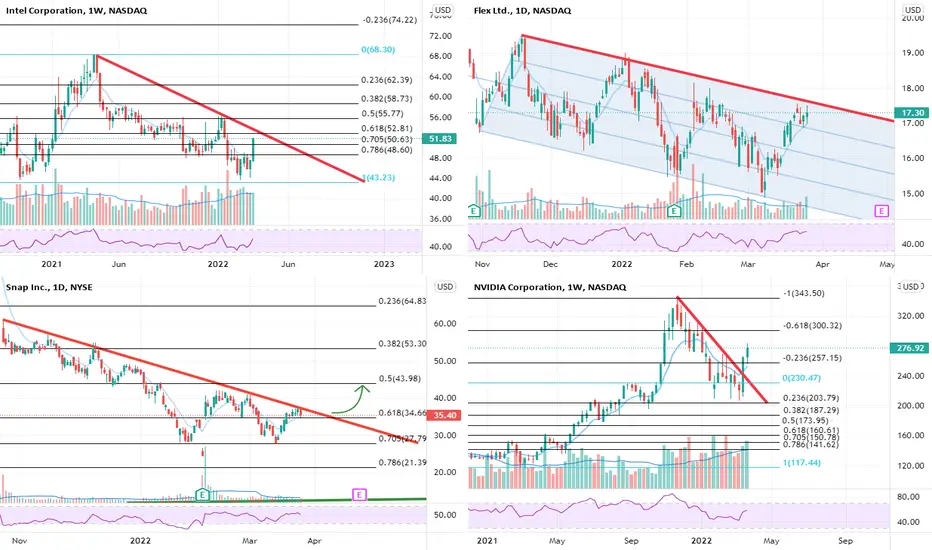
$FLEX $INTC $NVDA $SNAP I OptionsSwing WatchlistINTC has been moving on news that NVDA is interested in using their foundry. Also, unusual options activity was picked up on INTC $56 calls exp 04/14.
Massive bull flag on the daily time frame. Our bots are picking up unusual options activity on FLEX $19c 10/21. Possibly an earnings play since ER is n May 4th.
We have a double bottom near $30 on SNAP. Encountering resistance on this trend, but it looks good on a breakout above for a run up into earnings.
NVDA held that $200 level to wildly bounce and break through our fib extensions. Our OS ALGO caught NVDA $300 calls expiring 04/01 on Friday.
Avoid the TSLA excitement. Use caution, learn from price action.The story:
* TSLA started 2021 mostly rangebound between 830-880 and then continued lower for the first half of the year.
* On 24 Jun price went over the green resistance line and started moving up in a channel (yellow lines). It gained momentum, rising over the channel and holding it as support.
* In October, price made a parabolic rise up and has been much more volatile since.
*** When you follow a stock with trendlines, support and resistance notes on chart, you can plan for good trades. Study this TSLA chart and then try your own analyses. Have a basket of stocks that you watch regularly for trading opportunities, and your chart notes will help you identify good setups.
Trading lessons:
* Upper blue line - price filled the gap and exactly touched 1208 before selling ensued. When small fish "bought the news" on 4 Jan, big fish set the sell trade to start at 1208.
* Stock/calls bought on/before 4 Jan should have been sold around 1200.
* Puts bought near 1200 should have been sold (at least partially) when Gap 1 filled.
* Twice you can see price moved from 1170 to 1020-1010 (white circles). Today the green bar held as a bounce zone. Price came down to 1020 again and made a fast 30pt move up. This was a day trade on a 5m chart.
* If Gap 2 fills before earnings, existing price action shows a great entry would be near the top of Gap 1 around 1120. If selling pressure stays high then price may not get over 1080.
*** When trading volatile stocks as this, use little capital, know that computers/algos will move the price, and be aware of bull/bear traps (use partial exits and multiple stop losses)
Options lessons:
* Options have been extremely expensive since October and there is no need to risk capital to chase price moves or "just for the thrill."
* It is prudent with small accounts to buy only 1 option if you desire a trade and be comfortable to hold it. You can take a big percent loss because your real capital loss is small.
* If you buy a weekly option as VIX and IV rise then keep it a day trade. Otherwise your option price can tank as VIX and IV reduce, in addition to normal theta and delta loss.
* If IV and VIX rise are helping your options profit, keep the benefit with at least a partial exit, even if your price target has not been reached.
*** With a good plan and low capital risk, you can hold through wild price swings as long as your trade idea stays intact.
Options trade example (for education):
* I bought one 21Jan 890 put during the last week of December for $8.40. I rarely swing trade on TSLA, but I saw strong indications that price would drop further. Feb monthly expiry was too expensive for me so I bought Jan monthly, thinking price would drop before earnings.
* On Monday as stock soared up on vehicle delivery news, I held my option for 3 reasons: I had time until expiry, I was comfortable with only $840 in the trade, and I saw the 1208 gap as a magnet and also as a double top possibility.
* On 4 Jan this option was priced below $3. My real capital loss was small, though the option was down over 60%.
* On 5 Jan as stock sold off the option gained to over $5. If my trade idea was broken I would have taken this smaller loss. I held the put for further price decline.
* On 6 Jan as price fell again and VIX rose, I sold my option for $12, a 43% gain.
*** In this example, my target price for TSLA was initially 860-850, which would retest the recent low, maybe touch the upper yellow line, and be in the price zone support. Since I am uncertain of how price and IV may fluctuate over the next few days, I sold the option.
$AAPL $NFLX $BABA $HD I OptionsSwing WatchlistHD 2H I HD is currently breaking out of this bullish formation with strength. Looking for a break above $313 with a $320 target next week.
AAPL 1D I Held the bullish uptrend established back in September. Unusual options activity was bullish and they bet on a retest of $128 this upcoming week.
NFLX 1H I Trading within a bull flag, we are looking for a break this week give unusual options activity betting on the $495-$500 calls for 06/18.
BABA 1D I Massive falling wedge pattern which could break to the upside before earnings on 08/19. The Chinese giant is more than 30% down from ATH levels. However, there is some sense of renewed hope in the company as US investor Charlie Munger recently disclosed a sizable stake in the company.
Range-bound between $117-$122.50After completing Head & Shoulder formation and breaking down below $122 support, reached our $117 targets, and now range-bound. Trends remain bearish, watch for a break below $117 support for continuation lower, targeting $114 (minor) and $110 (major) support levels.
Use Vertical Put Spreads to limit your risk when taking bearish bets. Register for a free 30 Day Trial to OptionsPlay .
NVDA & AAPL unusual options activity todayNVDA & AAPL unusual options activity today
NVDA 262.5 call 4/8 expiry
NVDA 260 call 4/8 expiry
NVDA 255 call 4/8 expiry
NVDA 252.5 call 4/8 expiry
NVDA 250 call 4/8 expiry
NVDA 247.5 call 4/8 expiry
NVDA 245 put 4/8 expiry
NVDA 242.5 put 4/8 expiry
NVDA 230 put 4/8 expiry
NVDA 220 put 4/8 expiry
AAPL 172.5 call 4/22 expiry
AAPL 172.5 call 4/8 expiry
AAPL 170 put 4/8 expiry
AAPL 135 put 6/25/2024 expiry
*options use 100x leverage you could lose everything*
There are many types of options trading strategies and positions, simple to sophisticated & hybrids. I group them into theta, delta or mix strategies and bull, bear or neutral positions. There's a buy side and sell side to every trade. If you check the open interest (OI), you can see how liquid it is. Check how wide the bid vs ask spread is.
Theta:
iron condor
iron fly
covered call
cash secured put
calendar spread
collar
Delta:
call
put
straddle
strangle
debit spread
credit spread
Bull:
call
put credit spread
call debit spread
cash secured put
Bear:
put
call credit spread
put debit spread
covered call
Neutral:
straddle
strangle
iron condor
iron fly
collar (often used for downside insurance)
calendar spread (short or long time)
Options important variables:
Strike = share price
itm, atm, otm = strike position
Expiry = Date of expiration
Value = H, L & Mark
Liquidity = bid vs ask spread
Direction = put or call
OI = open interest
V = volume
CP = chance of profit
IV = implied volatility
Delta = price
Theta = time
Vega = volatility
Gamma = momentum
Do your own due diligence, your risk is 100% your responsibility. This is for educational and entertainment purposes only. You win some or you learn some. Consider being charitable with some of your profit to help humankind. Good luck and happy trading friends...
*3x lucky 7s of trading*
7pt Trading compass:
Price action, entry/exit
Volume average/direction
Trend, patterns, momentum
Newsworthy current events
Revenue
Earnings
Balance sheet
7 Common mistakes:
+5% portfolio trades, capital risk management
Beware of analyst's motives
Emotions & Opinions
FOMO : bad timing, the market is ruthless, be shrewd
Lack of planning & discipline
Forgetting restraint
Obdurate repetitive errors, no adaptation
7 Important tools:
Trading View app!, Brokerage UI
Accurate indicators & settings
Wide screen monitor/s
Trading log (pencil & graph paper)
Big, organized desk
Reading books, playing chess
Sorted watch-list
Checkout my indicators:
Fibonacci VIP - volume
Fibonacci MA7 - price
pi RSI - trend momentum
TTC - trend channel
AlertiT - notification
tickerTracker - MFI Oscillator
www.tradingview.com
$SE $MSFT $SQ $SPY I OptionsSwing WatchlistSE 1D I SE recently broke out from a massive downtrend on the daily. It is making a double bottom near $65 and our OS ALGO picked up activity on the $69 strike!
MSFT 4H I MSFT is making a higher low as earnings approach. Resistance near $255 and our scanners are picking up significant bullish activity on the $260 strike for 07/22.
SQ 1D I SQ is down nearly 80% from all time high. It is trading within a wedge pattern on the hourly and based on unusual options activity SQ is likely to run up into earnings.
SPY 4H I SPY macrotrend remains bearish, however it recently broke out from a downtrend on the hourly. Resistance near $385, $400; and support near $380.
$ET $LIT $CIEN $SPY I OptionsSwing WatchlistET 1W I ET has been consolidating above $11.50 for some time. We have bullish unusual options activity betting on a retest of $12 by 10/21. Reports earnings on 08/02!
LIT 1D I Energy stocks and lithium stocks in general have been overperforming the market for the past two weeks. Watching for a breakout from this downtrend.
CIEN 4H I Bullish unusual activity picked up on our scanner. Possible breakout from this downtrend and fib extension. They are trading the $54c expiring on 06/03.
SPY 1D I A SPY made a double bottom near $385 last week and ended up breaking from its downtrend in just two sessions. Expecting resistance at $430, and support at $410.