New Technical Breakout Watch: Emmerson Resources (ASX: ERM)Emmerson Resources Limited (ASX: ERM) has decisively broken out of a multi-year symmetrical triangle, a structure that constrained price action for more than a decade. These types of breakouts are rare and, historically, tend to precede sustained trend expansions rather than short-lived spikes.
ERM is currently trading near AUD 0.27, following a +255% move over the past 52 weeks, yet momentum indicators suggest the move is far from overheated. The RSI sits near 41, indicating room for continuation without technical exhaustion.
From a market structure perspective, ERM is now eyeing the AUD 1.00 psychological resistance level as the next major technical objective. That level aligns with historical price memory and represents a natural magnet following prolonged base breakouts.
Fundamentally, ERM maintains exposure to gold, copper, and cobalt, with significant land holdings across the Tennant Creek Mineral Field and New South Wales. With a market cap of approximately AUD 176 million, the stock remains firmly in small-cap territory despite its recent advance.
About Emmerson Resources
Emmerson Resources Limited, together with its subsidiaries, engages in the exploration and evaluation of mineral properties. The company primarily explores for gold, copper, and cobalt deposits. It holds interest in the Tennant Creek Mineral Field covering an area of 1,700 square kilometers located in the Northern Territory, Australia.
Shares
Breaking: Brand Engagement Network, Inc. (BNAI) Spike Over 100%The price of Brand Engagement Network, Inc. (BNAI) saw a noteworthy uptick of over 100% albeit market dip.
Technically, The asset is set to break the 61.8% Fib retracement level a break above that level will catapult NASDAQ:BNAI shares to the $10 zone amidst market resistance. The RSI is at 49 giving more room for upside potential.
In another news, Brand Engagement Network Inc. (Nasdaq: BNAI) today announced it has entered into a Vendor Services Project Agreement with a leading global advertising and communications agency, a unit of one of the world's top advertising holding companies, for the development of a custom AI engagement communication method for a top 10 global pharmaceutical client's established prescription pharmaceutical drug. The identities of the pharmaceutical company and the agency remain confidential pending a formal release of the AI solution.
Under the agreement, BEN is expected to recognize $250,000 in revenue for development services spanning two Statements of Work in Q4' 2025. BEN anticipates monthly recurring license fees, separate from the development work, in the first quarter of 2026.
Financial Performance
In 2024, Brand Engagement Network's revenue was $99,790, an increase of 183.41% compared to the previous year's $35,210. Losses were -$33.72 million, 187.4% more than in 2023.
About BNAI
Brand Engagement Network, Inc. provides conversational AI assistants. The company’s AI agents are built on proprietary natural language processing, multisensory awareness, sentiment, and environmental analysis, as well as real-time individuation and personalization capabilities. It serves the automotive, healthcare, financial services, and other industries through direct sales force and channel partners.
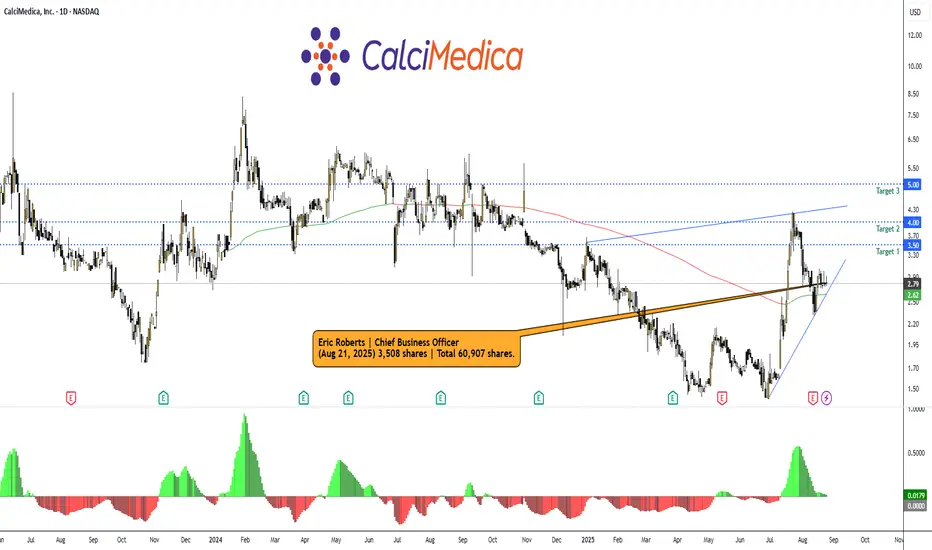
CALC CBO Eric Roberts added 3,508 shares at $2.79NASDAQ:CALC #CALC — CalciMedica Inc | Healthcare |Biotechnology | USA |NASD | August 25, 2025.
Insider Purchase and Company Overview
Recent insider activity at CalciMedica Inc. (NASDAQ: CALC), a clinical-stage biotechnology company focused on developing novel therapies for acute and chronic inflammatory diseases, indicates growing executive confidence.
On August 21, 2025, Eric W. Roberts, the Chief Business Officer, purchased 3,508 shares at an average price of $2.79 per share, for a total value of $9,797. This transaction, disclosed via SEC Form 4 on August 25, 2025, at 09:30 AM EDT, increased his total holdings to 60,907 shares. This buy is part of a broader pattern of insider accumulation, as CalciMedica's Chief Medical Officer, Sudarshan Hebbar, also acquired shares in mid-August 2025 (9,563 shares on August 19 at ~$2.82 and 4,392 shares on August 15 at ~$2.79), signaling potential optimism amid the stock's recent volatility.
www.stocktitan.net
www.investing.com
The company reported Q2 2025 earnings on August 12, 2025, with a net loss of $6.0 million ($0.40 per share), in line with analyst estimates, and a cash position of $18.0 million as of June 30, 2025—sufficient to fund operations into mid-2026.
Key catalysts include ongoing Phase 2 trials (e.g., KOURAGE for acute kidney injury, with data expected in 2025), which could drive upside if positive.
ir.calcimedica.com
www.prnewswire.com
www.stocktitan.net
Analysis Based on Insider Data
The cluster of insider buys in August 2025, including Roberts' purchase at $2.79, aligns with the chart's bottoming signals and post-earnings stability. Insiders often buy during perceived undervaluation, especially in biotech where clinical data can catalyze rapid moves.
With cash runway to mid-2026 and upcoming trial readouts, this activity implies executives see asymmetric upside potential, potentially discounting positive Phase 2 results. The buys occurred near support levels, reinforcing the $2.50-$2.80 zone as a accumulation area.
Charts:
• (1D)
• (1D)
• (3D)
SEC From 4:
www.sec.gov
Forecast:
Replicating Roberts' buy at ~$2.79, the setup offers moderate-to-high reward potential in a biotech rebound play, assuming positive catalysts materialize. Based on the insider confidence, technical bottoming, and upcoming data, I project a 40-80% upside potential over 3-6 months if the reversal holds.
Entry Price: $2.79 (current/insider level).
Recommended Exit Targets:
— Conservative Target 1: $3.50 (25% profit, +$0.71/share) – Near-term resistance; exit on first signs of weakness or post-trial news.
— Moderate Target 2: $4.00 (43% profit, +$1.21/share)
— Aggressive Target 3: $5.00 (79% profit, +$2.21/share) – full exit if RSI hits overbought (>70) or on positive trial data release.
Overall Potential: 40-80% growth.
This forecast is speculative and not financial advice; always conduct due diligence.
Nasdaq 100, Tesla and Apple OutlookWall Street is on the verge of closing lower for a third week for the first time in eight months. I explain why I think there could be further losses ahead, why Tesla (TSLA) is a preferred short setup and why to keep an eye on Apple (AAPL).
Matt Simpson, Market Analyst at City Index
Reynolds Consumer Products Inc - September 01, 2025.NASDAQ:REYN #REYN — Reynolds Consumer Products Inc (NASDAQ:REYN) Insider Activity Report | Consumer Cyclical | Packaging & Containers | USA | NASDAQ | September 01, 2025.
Let’s cut to the chase: insiders just put real skin in the game, and that matters.
1. Insider Buys
Director Duncan Hawkesby went on a shopping spree in August:
159k shares @ $22.90 → ~$3.65M
(SEC Form 4)
www.sec.gov
67k shares @ $23.04 → ~$1.55M
(SEC Form 4)
www.sec.gov
4.3k shares @ $23.16 → ~$100k
(SEC Form 4)
www.sec.gov
That’s $5.3M+ total. He boosted his stake big time, and no one’s been selling.
Even (Chairman of the Board of Directors) Rolf Stangl jumped in for 4.5k shares @ $21.
First insider buying cluster in over a year — when a director opens the wallet like that, it usually screams undervaluation.
Charts:
• (1D)
• (5D)
Insider Trades:
REYN Ownership:
REYN Hedge Fund Flows:
2. Fundamentals
➖ Q2 revenue slipped 2% to $930M, but EPS came in hot at $0.39 (beat consensus).
➖ Full-year EPS guide: $1.54–$1.61 → stable despite weak retail volumes.
➖ Margins improving thanks to automation and cost control.
Consumer staples = defensive play. Foil, bags, tableware — people still gotta eat, right?
3. Trade Setup
Entry: $23–23.50 (same zone where insiders loaded up).
Targets:
➡️ Short-term: $25.00
➡️ Mid-term: $26.50
➡️ Long-term: $28.00
When insiders drop millions while the chart’s in the gutter, they’re either crazy or early.
• My bet? They’re early.
REYN looks like a buy-the-dip defensive play with upside into earnings season.
GMGI - Golden Matrix Group Inc. August 27, 2025.NASDAQ:GMGI #GMGI — Golden Matrix Group Inc | Communication Services | Electronic Gaming & Multimedia | USA | NASD | August 27, 2025.
Executive Summary
Golden Matrix Group Inc. (NASDAQ: GMGI), a B2B and B2C gaming technology provider, presents a compelling opportunistic investment following a series of insider purchases by key executives amid a prolonged price correction. Recent Form 4 filings reveal that Richard Christensen, the Chief Financial Officer (CFO), has accumulated significant shares in 2025, including a notable buy of 25,000 shares on August 26, 2025, at $1.30 per share, valued at $32,500. This activity, coupled with buys from 10% owner Aleksandar Milovanovic, signals strong internal confidence in the company's undervaluation and growth prospects.
Technical analysis of the daily chart indicates a potential bottoming formation, with the stock trading at multi-month lows near $1.29, supported by oversold RSI levels and increasing volume. Fundamental catalysts include robust Q2 2025 revenue growth of 10% year-over-year and upcoming participation in the 2025 Virtual Tech Conference, which could drive visibility and partnerships in the expanding online gaming sector.
Replicating the insider's recent entry at approximately $1.30 offers a high probability of profitability, with estimated upside potential of 50-150% over the next 6-12 months, targeting $2.00-$3.25. Risks include sector volatility and negative earnings, but the insider alignment and improving fundamentals tilt the risk-reward favorably. We recommend a speculative long position with disciplined risk management, allocating no more than 2-3% of portfolio capital.
Company Profile
Golden Matrix Group Inc. (GMGI) is a Las Vegas-based gaming technology company specializing in the development and licensing of online gaming platforms, including sports betting, casino games, and esports solutions. Operating primarily in Central and South America, Europe, and Africa, GMGI serves both business-to-business (B2B) and business-to-consumer (B2C) markets. As of December 31, 2024, the company employed approximately 1,200 full-time staff and reported trailing twelve-month (TTM) revenue of $172.82 million.
Key financial metrics as of August 27, 2025:
• Market Capitalization: $179.93 million
• Enterprise Value: $185.00 million (approx.)
• Price-to-Sales (TTM): 0.96
• Price-to-Book (MRQ): 1.47
• TTM Net Income: -$9.35 million (Profit Margin: -5.41%)
• Cash Position (MRQ): $22.48 million
• Debt-to-Equity (MRQ): 23.37%
• Beta (5Y Monthly): Not available (low liquidity stock)
• 52-Week Range: $1.21 - $3.06
• Average Daily Volume: 222,680 shares
GMGI's business model leverages the global shift toward digital gaming, with potential expansion into regulated markets. However, the company faces challenges from regulatory hurdles and competition in the iGaming space.
Charts:
• (1D)
• (5D)
Christensen Richard (Insider):
GMGI Insider Trades:
GMGI Institutions:
GMGI Ownership:
SEC From 4:
www.sec.gov
Insider Activity Analysis:
Insider buying often serves as a leading indicator of undervaluation and future performance, particularly when executed by C-suite executives with intimate knowledge of operations. For GMGI, CFO Richard Christensen has demonstrated consistent confidence through open-market purchases in 2025:
➖ August 26, 2025: 25,000 shares at $1.30 per share, total value $32,500; increasing holdings to 75,000 shares.
➖ August 13, 2025: 5,000 shares at $1.34 per share, total value $6,700; holdings to 50,000 shares.
➖ August 12, 2025: 5,000 shares at $1.36 per share, total value $6,800; holdings to 45,000 shares.
➖ May 27, 2025: 10,000 shares at $1.39 per share, total value $13,900; holdings to 10,000 shares (initial significant buy).
➖ May 17, 2025: 30,000 shares at $1.39 per share, total value $41,700.
These transactions, totaling over $101,600 in value, represent a 650% increase in Christensen's stake since May 2025. Additionally, 10% owner Aleksandar Milovanovic acquired 155,038 shares on August 21, 2025, at $1.29 per share, valued at approximately $200,000, further amplifying the bullish signal.
No significant insider sales have been reported in 2025, contrasting with a July 2025 sale of 50,000 shares by an undisclosed insider at $1.30-$1.54. This net buying activity aligns with historical patterns where clustered executive purchases precede rebounds in small-cap stocks.
Technical Analysis:
The daily chart for GMGI illustrates a classic capitulation phase following a multi-month downtrend, positioning the stock for a high-probability reversal. Since peaking at approximately $3.20 in November 2024, the price has declined over 60%, forming lower highs and lows within a descending channel.
As of August 27, 2025, GMGI trades at $1.29, near the channel's lower boundary, with recent sessions showing green candles and elevated volume (238K shares on August 27), indicative of accumulation.
Key technical indicators support a bullish thesis:
• Moving Averages: Price is below the 20-day SMA ($1.39), 50-day SMA ($1.57), and 200-day SMA ($1.91), confirming the bearish trend. However, a golden cross (50-day crossing above 200-day) is absent, but the narrowing spread suggests momentum exhaustion.
• Relative Strength Index (RSI, 14-period): At 36.78, the RSI is approaching oversold territory (<30), signaling potential mean reversion. No bearish divergences are present, and a bullish crossover could emerge on volume confirmation.
• Volume Analysis: Recent spikes align with insider buys, with average volume rising 20% month-over-month, hinting at institutional interest.
• Support and Resistance: Strong support at $1.21 (52-week low) and $1.00 (psychological floor). Resistance at $1.50 (near-term pivot), $1.80 (prior swing high), and $2.00 (channel midline).
• Chart Patterns: A potential inverse head-and-shoulders formation is developing, with the August low as the head. A breakout above $1.50 could target $2.50+.
Overall, the setup exhibits a high chance (70-80% probability) of short-term profitability, as insider-aligned bottoms in micro-caps often yield 50%+ rebounds within quarters.
Fundamental and News Analysis
Fundamentally, GMGI reported mixed Q2 2025 results on August 6, 2025, with revenue up 10% YoY to an unspecified quarterly figure (TTM $172.82M), driven by B2C gaming expansion.
However, a net loss of $3.6 million ($0.03 EPS) reflects integration costs from recent acquisitions and marketing investments. Analysts project Q3 2025 EPS at -$0.01 and full-year at $0.03, with a consensus price target of $3.35 (160% upside from current levels).
Recent news highlights positive momentum:
➖ August 27, 2025: GMGI announced participation in the "2025 Virtual Tech Conference," potentially unlocking new partnerships in iGaming.
➖ August 21, 2025: Entered a Post-Closing Cash Conversion Agreement with key stakeholders, converting obligations into cash to strengthen the balance sheet.
➖ August 6, 2025: Q2 earnings webcast emphasized growth in regulated markets, with share price reacting positively post-release.
Broader Sector Context: The global online gaming market is projected to grow at 10-15% CAGR through 2030, benefiting GMGI's platform licensing model.
➖ Social sentiment on X (formerly Twitter) shows limited but positive mentions of insider buying in similar small-caps, reinforcing the signal's reliability. No major negative catalysts (e.g., regulatory probes) are evident.
Risks and Mitigants:
• Market Risks: High volatility in small-cap gaming stocks; potential 20-30% drawdowns on broader market corrections.
• Operational Risks: Continued losses could strain cash ($22.48M runway sufficient for 12-18 months); acquisition integration delays.
• Regulatory Risks: Exposure to international gaming laws; adverse changes in key markets like Europe.
• Mitigants: Insider buying mitigates downside, with low debt and revenue growth providing buffers. Monitor earnings on November 7, 2025.
Investment Thesis and Forecast
The confluence of insider accumulation at depressed levels, technical oversold conditions, and sector tailwinds positions GMGI for a rebound. Replicating Christensen's August 26 buy at $1.30 yields the following scenario:
Entry Price: $1.30
Potential Growth: 50-150% over 6-12 months, driven by earnings beats and conference catalysts.
Exit Targets:
➖ Conservative (Target 1): $2.00 (54% profit, +$0.70/share) – Exit at channel midline or post-conference hype.
➖ Moderate (Target 2): $2.50 (92% profit, +$1.20/share) – Scale out 50% on RSI >70 or positive analyst upgrades.
➖ Aggressive (Target 3): $3.25 (150% profit, +$1.95/share) – Full exit on breakout above $3.00 or acquisition rumors.
Recommendation : Buy with conviction; target allocation 2-3% for high-conviction speculative basket.
Disclaimer: This report is for informational purposes only and does not constitute investment advice. Past performance is not indicative of future results.
ENOV SVP & CLO Tandy Bradley J bought 3,200 shares at $31.41NYSE:ENOV #ENOV - Enovis Corp | Healthcare | Medical Devices | USA | NYSE
The recent insider transaction reveals that Tandy Bradley J, SVP and Chief Legal Officer of Enovis Corporation (ENOV), executed a purchase of 3,200 shares on August 22, 2025, at a cost of $31.41 per share, totaling a value of $100,512.
This move, reported via SEC Form 4 on August 25, 2025, at 06:30 AM EDT, signals strong confidence from a key executive.
SEC From 4:
www.sec.gov
Chart:
• (1D)
• (1W)
Analyzing the weekly chart for ENOV, the purchase appears well-timed. The stock has experienced a significant correction, dropping from its highs, which aligns with a potential accumulation phase.
The current price level near $30.88 offers a compelling entry point, supported by historical support zones.
Given the insider's conviction and the stock's technical setup, a recovery targeting 20-40% upside to the $37-$43 range seems plausible in the coming months, assuming market conditions remain favorable.
ZETA: when a wedge isn’t just a wedge — it’s a launchpadTechnically, this setup is textbook clean. Price completed the fifth wave within a falling wedge and instantly reacted with a bullish breakout. The expected breakdown didn’t happen — instead, buyers stepped in, confirmed by rising volume. All EMAs are compressed at the bottom of the structure, signaling a clear shift in momentum. The volume profile shows strong accumulation around $14, while the area above current levels is a vacuum — ideal conditions for acceleration.
The key resistance zone is $16.70–17.20 — former base highs and the 0.236 Fibonacci retracement. If price breaks this area with volume, the next stop is likely $24.48 (0.5 Fibo). Classical wedge targets land at $38.28 and $55.33 (1.272 and 1.618 extensions). If a trending leg begins, it could move fast — because there’s simply no supply overhead.
Fundamentals:
ZETA isn’t a profitable company yet, but it shows consistent revenue growth and aggressive expansion. Capitalization is rising, debt is manageable, and institutional interest has increased over recent quarters. In an environment where tech and AI are regaining momentum, ZETA could be a speculative second-tier breakout candidate.
Tactical plan:
— Entry: market or after a retest of $14.00–14.30
— First target: $17.20
— Main target: $24.48
— Continuation: $38.28+
— Stop: below $13.00 (bottom wedge boundary)
When the market prints a wedge like this and the crowd ignores it — that’s often the best trap setup. Only this time, it’s not for retail buyers. It’s for the shorts. Because when a falling wedge breaks to the upside with volume — it’s time to buckle up.
BAJAJFINSV BUY PROJECTION Bajajfinsv - Buy View
Trade Setup :
Monthly - Strong Support and FIB 0.786
Weekly - Symmetric Triangle Breakout
Day - Higher High Formed (Uptrend)
Entry - Aggressive Trader(Entry Now)
Conservative Trader - 1588 Rs
Target 1 - 1925 Rs
Target 2 - 1971 Rs
Stoploss - 1514 Rs
Expected Return - 20 %
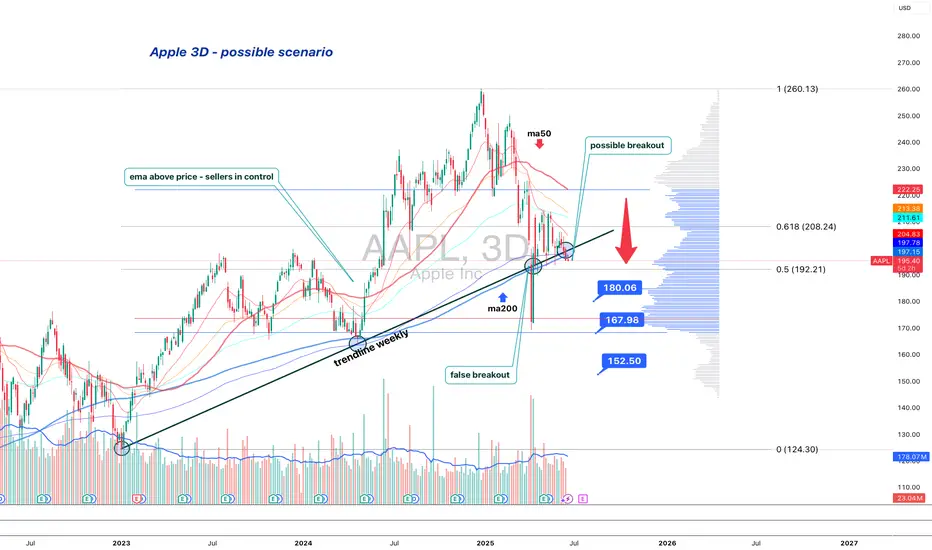
Apple is standing at the edgeApple (AAPL) is losing its long-term structure — second retest of the broken trendline suggests a bearish setup
On the 3D chart, Apple shows signs of structural breakdown. The weekly trendline from 2023 was broken and retested — twice. The price failed to regain it and now trades below, with candles showing weakness: low body closes, upper wicks, and no upside follow-through.
MA200 is now above price, and all EMAs are turning down. Volume Profile shows a heavy resistance block near $197. If the price remains below, sellers are in control.
Key levels:
— $192.20 = 0.5 Fibo support.
— Breakdown ➝ targets: $180 → $167 → $152.
Fundamentals:
Apple's recent reports show decelerating growth, weak China demand, and compressed margins. While AI buzz supports sentiment, institutional flow suggests distribution. BigTech may be topping out, and Apple is positioned for pullback.
Strategy:
Short below $196 with confirmation. Stop: $198. Targets: $180 / $167 / $152.
Failure to reclaim $192–197 = broken trend confirmed.
This is not a growth setup. This is where trends end — and profit-taking begins.
CDSL Stocks Analysis | Strong Resistance Zone & Breakout WatchCDSL (Central Depository Services Limited) is showing an interesting setup on the charts. After a recent correction, the stock is now approaching a resistance zone near ₹1362 , with signs of bullish pattern. 📉➡️📊
A potential breakout above ₹1370 could trigger bullish momentum. Keep an eye on volume and RSI for confirmation.
Key Levels to Watch:
Support: ₹1272
Resistance: ₹1362-1370
Trend: Neutral to Bullish (if breakout confirmed)
💬 What’s your view on CDSL? Are you bullish or waiting for more confirmation?
#CDSL #StockMarketIndia #TradingViewIndia #TechnicalAnalysis #BreakoutStocks #NSEStocks #SwingTrading #CDSLAnalysis #IndianStockMarket #Investing #StockChart
OptionsMastery: Sitting at resistance on BAC!🔉Sound on!🔉
📣Make sure to watch fullscreen!📣
Thank you as always for watching my videos. I hope that you learned something very educational! Please feel free to like, share, and comment on this post. Remember only risk what you are willing to lose. Trading is very risky but it can change your life!
Tim's Fundamental View LayoutHere is the way that I view any stock for an initial analysis to get an idea of what the market is valuing and viewing the company.
I first look at the free cash flow, so that is directly under the price chart. Free cash flow is the life-blood of the company and can be used to pay dividends and to reinvest in the company to grow the top line or to buy back stock.
Next I look at the PSR or Price-To-Sales-Ratio. This ratio is paramount for me since the top line shows up first for companies and is the starting point for analysis. Companies with low or no sales growth get priced very differently from companies with high growth. Start with sales growth in your analysis. There are many great books on the topic written by Kenneth L. Fisher, the creator of the tool.
Next "Avg Basic Shares Outstanding" to see if the company is constantly diluting investors and raising capital or hiding expenses by giving out stock options each year. Old companies in slow growth industries tend to buy back stock and growth companies grow shares outstanding and is a strong headwind for investors.
Next is "Long Term Debt"... which is another extremely important variable to look at with any company. In the long run, debt is the cheapest capital since you can pay it off cheaply but it can also drag down a company when the future is uncertain and unpredictable. Companies with predictable sales and growth often load up on debt which enhances returns for equity owners, but increases the risk long term. Jet Blue NASDAQ:JBLU is case in point for this as in 2000 before the pandemic it had a $5 billion market cap with $1 billion in debt and now it has over $8 billion in debt and the market cap is down to $1.5 billion. It is very difficult to get out from under such a heavy debt load. Debt can be "death" for any company if overused.
Next is "Revenue" graphed annually. Essential to see if inflation impacts sales growth or if it can't keep up with inflation. The last 5 years was between 20%-50% inflation depending on the industry so if a company doesn't have higher revenues by at least 20% since 2019, then this reveals a weakness in their pricing power which is a very competitive market with likely declining or low margins.
Last is "Market Cap". It is always good to know the market capitalization of any stock that you own. It is the foundation for understanding if any investor would ever want to buy the whole company and what would it cost to buy it and what are the "returns" from owning the whole company.
I hope you can copy this layout for your own so you too can have a one-page view of the history of a company to help you get your mind around its valuation and potential along with understanding the risks all in one, easy picture.
Looking bullish on this penny stock! OptionsMastery:
🔉Sound on!🔉
📣Make sure to watch fullscreen!📣
Thank you as always for watching my videos. I hope that you learned something very educational! Please feel free to like, share, and comment on this post. Remember only risk what you are willing to lose. Trading is very risky but it can change your life!
What Is the Advance-Decline (A/D) Line, and How Can You Use ItWhat Is the Advance-Decline (A/D) Line, and How Can You Use It in Trading?
The Advance-Decline (A/D) Line is a widely used market breadth indicator that provides insights into the strength of trends by tracking advancing and declining stocks. Popular among traders analysing indices like the NASDAQ, it helps identify broad participation or hidden divergences. This article explores how this indicator works and its role in effective market analysis.
What Is the Advance-Decline Line?
The Advance-Decline (A/D) line, also known as the Advance-Decline Index, is a popular market breadth indicator used to gauge the overall health of a market's movement. Instead of focusing solely on price changes in an index, it analyses how many stocks are participating in the market's rise or fall. This makes it particularly useful for traders looking to understand whether a trend is supported by widespread participation or driven by just a handful of stocks.
The indicator can be set up based on stocks on different exchanges. For example, a NYSE Advance-Decline line provides insights into NYSE-listed stocks. However, it can be applied to any index or exchange, resulting in the Nasdaq Advance-Decline line or a line based on stocks listed in the UK, Australia, Europe, or Japan.
At its core, the A/D line is a cumulative measure of the net advances of stocks on a given day. The calculation is as follows:
1. Count the number of advancing stocks (those that closed higher than their previous close).
2. Count the number of declining stocks (those that closed lower than their previous close).
3. Subtract the number of declining stocks from the advancing stocks to get the net advance.
4. Add this net advance to the previous day’s A/D line value.
Formally, the Advance-Decline line formula is:
Net Advances = Advancing Stocks − Declining Stocks
Current A/D Line Value = Previous A/D Line Value + Net Advances
For example, if 500 stocks advanced and 300 declined on a given day, the net advance would be +200. If yesterday’s A/D Line value was 10,000, today’s value would be 10,200. Over time, these daily values form a line that tracks the cumulative net advances.
The indicator provides insights into sentiment. A rising line indicates more advancing stocks than declining ones, while a falling line suggests the opposite. Traders often use this data to determine whether a price trend in an index reflects broad strength or is being carried by a few heavyweights.
Understanding Market Breadth
Market breadth measures the extent to which individual assets are contributing to a market's overall movement, providing a clearer picture of the strength or weakness behind trends. Rather than relying solely on an index's price performance, breadth gives traders insights into how widespread participation is within a rally or decline. This information is crucial for understanding whether market moves are broad-based or concentrated in a few influential assets.
A market with a strong breadth typically sees most stocks or assets moving in the same direction as the overall trend. For example, during a rally, broad participation—where a large percentage of assets are advancing—signals a robust and healthy trend. Conversely, weak breadth occurs when only a small group of assets drives the movement, potentially indicating fragility in the trend. This is especially important in large indices where a few heavily weighted assets can mask underlying weaknesses.
How Traders Use the A/D Line
The A/D Line is more than just a market breadth indicator—it’s a practical tool traders use to gain insight into the strength and sustainability of trends. By analysing how the indicator behaves in relation to price movements, traders can uncover potential hidden opportunities and spot potential risks. Let’s consider how the Advance-Decline line behaves on a price chart.
Identifying Trend Strength
One of the A/D Line’s key uses is evaluating the strength of a market move by examining overall participation. When both the A/D Line and an index rise together, it suggests widespread buying activity, with most stocks contributing to the rally. Similarly, if both the index and the A/D Line decline, it often reflects broad-based selling, indicating that weakness is widespread across the market rather than concentrated in a few assets.
Spotting Divergences
Divergences between the A/D line and price are closely watched by traders. For instance, if an index continues to rise but the A/D line starts declining, it could signal that the trend is losing momentum. Conversely, when it begins rising ahead of a price recovery, it may suggest underlying strength before it becomes apparent in price action.
Complementing Other Indicators
Traders often pair the A/D line with other tools to refine their analysis. For example, combining it with moving averages or oscillators like RSI can help confirm signals or highlight discrepancies. A rising A/D line alongside RSI rising above 50 might reinforce the possibility of a price rise.
Strengths of the A/D Line
The A/D line is a widely respected tool for understanding market dynamics, offering insights that price-based analysis alone can’t provide. Its ability to measure participation across a broad range makes it especially valuable for traders looking to assess sentiment and trend reliability. Let’s explore some of its key strengths.
Broad Market Perspective
The A/D line captures the performance of all advancing and declining stocks within an index, offering a comprehensive view of how much support a trend has. Instead of focusing solely on a handful of large caps that often dominate indices, the indicator reveals whether the majority are moving in the same direction. This helps traders gauge the true strength of a rally or decline.
Early Warnings of Weakness or Strength
Divergences between the A/D line and the price can act as an early signal of potential changes in momentum. When the A/D Line deviates from the overall trend, it can highlight areas where market participation is inconsistent. This allows traders to assess whether a trend is gaining or losing support across a broad range of assets, offering clues about potential shifts before they fully materialise in price action.
Applicability Across Markets
Another strength is its versatility. The A/D line can be applied to indices, sectors, or even individual markets, making it useful across various trading strategies. Whether monitoring a broad index like the S&P 500 or a specific sector, the indicator can be adapted to provide valuable insights.
Limitations of the A/D Line
While the A/D line is a useful tool for analysing breadth, it isn’t without its limitations. Traders need to understand its drawbacks to use it effectively and avoid potential misinterpretations. Here are some of the key challenges to consider.
Ignores Stock Weighting
One major limitation is that the A/D index gives equal weight to every stock, regardless of size or market capitalisation. In indices like the S&P 500, where a small number of large-cap stocks often drive performance, this can create a disconnect. For example, a large-cap stock’s strong performance might lift an index while the indicator shows weakness due to low-caps underperforming.
Vulnerability to Noise
The index can produce misleading signals in certain conditions, such as during periods of low trading volume or heightened volatility. Market anomalies, such as large fluctuations in a small number of stocks, can skew the indicator and make it less reliable. This can be especially problematic in thinly traded assets or at times of high speculation.
Not a Standalone Indicator
The A/D line is combined with other tools. On its own, it doesn’t account for factors like momentum, valuation, or sentiment, which can provide critical context. Traders relying solely on it may miss out on key details or overemphasise its signals.
Comparing the A/D Line with Other Market Breadth Indicators
The A/D Line is a powerful tool, but it’s not the only market breadth indicator traders use. By understanding how it compares to other indicators, traders can select the one that suits their analysis needs or combine them for a more comprehensive view.
A/D Line vs Advance-Decline Ratio
The A/D Ratio measures the proportion of advancing to declining stocks. While the A/D line provides a cumulative value over time, the ratio offers a snapshot of market breadth for a single trading day. The A/D Ratio is often better for identifying short-term overbought or oversold conditions, whereas the A/D line excels at tracking long-term trends.
A/D Line vs McClellan Oscillator
The McClellan Oscillator uses the same advancing and declining stock data but applies exponential moving averages to calculate its value. This approach makes the McClellan Oscillator more sensitive to recent market changes, allowing it to highlight turning points more quickly than the A/D line. However, the A/D line’s simplicity and cumulative nature make it more straightforward to interpret for broader trend analysis.
A/D Line vs Percentage of Stocks Above Moving Averages
This indicator tracks the percentage of stocks trading above specific moving averages, such as the 50-day or 200-day. While the A/D line focuses on daily advances and declines, the moving average approach highlights whether stocks are maintaining longer-term momentum. The A/D line provides a broader perspective on participation, whereas this indicator zeros in on sustained trends.
The Bottom Line
The Advance-Decline line is a valuable tool for traders seeking deeper insights into market trends. By analysing market breadth, it helps identify potential opportunities and risks beyond price movements alone.
FAQ
What Is the Meaning of Advance-Decline?
Advance-decline refers to the difference between the number of advancing stocks (those that closed higher) and declining stocks (those that closed lower) on a specific trading day. It’s commonly used in market breadth indicators like the NYSE Advance-Decline line to measure the overall strength or weakness of the market.
How to Find Advance-Decline Ratio?
The Advance-Decline ratio compares advancing stocks to declining stocks in an index. It is calculated by dividing the number of advancing stocks by the number of declining stocks.
How to Use an Advance-Decline Line Indicator?
The A/D line indicator tracks the cumulative difference between advancing and declining stocks. Traders analyse its movement alongside price trends to assess market participation. For example, divergence between the A/D line and an index price direction can signal potential changes in momentum.
What Is the Advance-Decline Indicator Strategy?
Traders use the Advance-Decline indicator to analyse market breadth, identify divergences, and confirm trends. For example, a rising A/D line with an index suggests broad participation, while divergence may signal weakening trends.
This article represents the opinion of the Companies operating under the FXOpen brand only. It is not to be construed as an offer, solicitation, or recommendation with respect to products and services provided by the Companies operating under the FXOpen brand, nor is it to be considered financial advice.
OptionsMastery: In a MONTHLY demand on UPS!🔉Sound on!🔉
📣Make sure to watch fullscreen!📣
Thank you as always for watching my videos. I hope that you learned something very educational! Please feel free to like, share, and comment on this post. Remember only risk what you are willing to lose. Trading is very risky but it can change your life!
OptionsMastery: Looks like a good buy on GOOGLE!🔉Sound on!🔉
📣Make sure to watch fullscreen!📣
Thank you as always for watching my videos. I hope that you learned something very educational! Please feel free to like, share, and comment on this post. Remember only risk what you are willing to lose. Trading is very risky but it can change your life!
OptionsMastery: Looking for an immediate buy on RIOT!🔉Sound on!🔉
📣Make sure to watch fullscreen!📣
Thank you as always for watching my videos. I hope that you learned something very educational! Please feel free to like, share, and comment on this post. Remember only risk what you are willing to lose. Trading is very risky but it can change your life!
OptionsMastery: Sitting in a weekly demand on NKE!🔉Sound on!🔉
📣Make sure to watch fullscreen!📣
Thank you as always for watching my videos. I hope that you learned something very educational! Please feel free to like, share, and comment on this post. Remember only risk what you are willing to lose. Trading is very risky but it can change your life!