Technical Analysis
XAUUSD GOLD RESISTANCE AND SUPPORT READ CAPTIONHi trader's what do you think about gold
Gold market is currently trading above the support level 3702 and holding the demand zone around 3682. This area has acted as a base for buyers to push the market upward.
On the upside, immediate resistance is at 3727, and a stronger resistance zone is placed near 3736. If price struggles here, rejection is possible. However, if momentum stays strong, these levels will decide the next move.
📌 Summary:
Support Levels: 3702, 3682 (demand)
Resistance Levels: 3727, 3736
👉 For more safe analysis & updates, Follow my profile
Gap-Fill Watch: Euro FX Futures React to Weekly RejectionIntroduction
When analyzing futures markets, one of the most compelling signals arises when higher timeframe candlestick rejection aligns with lower timeframe price imbalances. That is exactly what we see in Euro FX Futures (6E, M6E). On the weekly chart, long upper shadows (LUS) have historically marked turning points, reflecting exhaustion of bullish pressure. On the daily chart, an open gap below current price offers a potential magnetic pull. Together, these elements provide a textbook technical case study of how price can align across timeframes.
This article explores the educational insights behind candlestick rejection and gap mechanics, then applies them to a concrete trading scenario in 6E and its micro equivalent, M6E.
Weekly Chart: The Long Upper Shadow (LUS)
Long Upper Shadows appear when a market tests higher levels but fails to sustain them, leaving sellers in control by the close. They are one of the clearest visual expressions of rejection.
In Euro FX Futures, past long upper shadows have preceded significant bearish moves. Each instance reflects an imbalance where buyers were unable to absorb selling pressure at higher prices. The most recent weekly candlestick shows another long upper shadow forming near resistance. For technically minded traders, this is an early warning sign of potential downside ahead.
Daily Chart: The Open Gap Below Price
Price gaps occur when markets open significantly away from the prior session’s close. In futures, gaps often act like magnets—price tends to revisit them over time as liquidity seeks balance.
Currently, Euro FX Futures show an unfilled gap just below the market. Historically, such gaps in 6E have attracted price action, especially when combined with bearish rejection signals from higher timeframes. The combination of a weekly LUS above and a daily gap below paints a picture of imbalance: rejection at the highs, unfinished business at the lows.
Trade Setup
A structured trade idea emerges from this technical alignment:
Entry condition: Short position if 6E breaks below the prior day’s low at 1.17865. This ensures price is moving in line with bearish continuation before entry.
Target: 1.17475, the origin of the open gap. This is where the “magnet effect” is expected to complete.
Stop-loss: 1.18090, derived from a 2-day ATR calculation and adjusted to 25%. This keeps risk tight but accounts for minor noise.
Reward-to-Risk Ratio: With entry near 1.17865, risk is around 22 ticks while potential reward is about 39 ticks, yielding a favorable R:R of almost 2:1.
Risk caveat: Right below the gap origin lies a UFO support area. This means price may stall or reverse after the gap is filled. Being conservative with the target is wise—seeking deeper downside could run into structural support.
Contract Specs and Margin Notes
Understanding the contract structure is vital when applying risk management.
o Euro FX Futures (6E):
Contract size = €125,000
Tick size = 0.00005 USD per euro = $6.25 per tick
Initial margin (approximate, varies daily): ~$2,500–$3,000
o Micro EUR/USD Futures (M6E):
Contract size = €12,500 (1/10th of 6E)
Tick size = 0.0001 USD per euro = $1.25 per tick
Initial margin (approximate, varies daily): ~$300–$400
Application: Traders with smaller accounts can use M6E to size positions more precisely, while larger participants may choose 6E for liquidity. Micros provide flexibility to scale in/out of trades while maintaining strict risk per trade.
Risk Management Essentials
Risk management is not about avoiding losses—it is about ensuring that any loss remains controlled relative to potential reward. This trade idea highlights three core principles:
Stop placement by ATR: Volatility-based stops adjust naturally to current market conditions. Using 25% of a 2-day ATR prevents overexposure while respecting noise.
Position sizing: Traders should calculate how many contracts (6E or M6E) align with their personal risk tolerance.
Target discipline: While tempting to aim lower than the gap origin, technical evidence suggests price may encounter support there. Conservative targeting avoids overstaying a move.
Educational Takeaway
This setup demonstrates the power of multi-timeframe confluence. A weekly rejection signal provides context, while a daily gap gives tactical direction. Traders often gain an edge when higher timeframe sentiment (bearish rejection) aligns with lower timeframe imbalances (gap fill).
For students of price action, this is a reminder that candlestick patterns should never be taken in isolation. Instead, they should be validated by market structure, liquidity imbalances, or other confirming signals.
Conclusion
Euro FX Futures present a case study in how weekly rejection and daily gaps can combine to create a structured opportunity. While no outcome is certain, the confluence of signals here underscores the educational value of analyzing shadows and gaps together.
Traders can study this setup not only as a potential trade but also as a lesson in disciplined multi-timeframe analysis.
When charting futures, the data provided could be delayed. Traders working with the ticker symbols discussed in this idea may prefer to use CME Group real-time data plan on TradingView: www.tradingview.com - This consideration is particularly important for shorter-term traders, whereas it may be less critical for those focused on longer-term trading strategies.
General Disclaimer:
The trade ideas presented herein are solely for illustrative purposes forming a part of a case study intended to demonstrate key principles in risk management within the context of the specific market scenarios discussed. These ideas are not to be interpreted as investment recommendations or financial advice. They do not endorse or promote any specific trading strategies, financial products, or services. The information provided is based on data believed to be reliable; however, its accuracy or completeness cannot be guaranteed. Trading in financial markets involves risks, including the potential loss of principal. Each individual should conduct their own research and consult with professional financial advisors before making any investment decisions. The author or publisher of this content bears no responsibility for any actions taken based on the information provided or for any resultant financial or other losses.
GBPJPY: Bearish Outlook Explained 🇬🇧🇯🇵
GBPJPY formed a bearish imbalance candle on Friday,
breaking a solid rising trend line and forming a confirmed
Change of Character CHoCH.
The broken trend line and horizontal structure compose
a significant supply area now.
With a high probability, the price will drop lower from that.
Goal - 199.0
❤️Please, support my work with like, thank you!❤️
I am part of Trade Nation's Influencer program and receive a monthly fee for using their TradingView charts in my analysis.
Ethereum at Critical Support – What’s Next?📊 ETH/USDT – 4H Chart Analysis
1️⃣ Descending Channel:
Ethereum is still moving inside a clear descending channel. Sellers remain in control as every rally to the channel top has been rejected.
2️⃣ Trendline Break:
The short-term ascending trendline (orange) has just been broken with strong selling pressure, dragging the price into the $4,200 – $4,250 support zone.
3️⃣ Key Support Zone:
The first major support lies at $4,200 – $4,250. If this level holds, ETH could see a short-term rebound toward $4,400 – $4,600.
4️⃣ Main Buy Zone:
If $4,200 fails, the next strong demand zone sits at $3,950 – $4,100, aligning with the lower boundary of the descending channel. This is where stronger buying interest is expected.
5️⃣ Resistance Levels:
• Near-term: $4,450 – $4,600
• Major: $4,750 – $4,800
⚖️ Summary:
• Bullish scenario: Holding $4,200 → bounce to $4,400 / $4,600.
• Bearish scenario: Losing $4,200 → drop to $4,000 – $3,950 (main BUY zone).
👉 At this stage, trading in the middle of the channel is risky. Safer entries come either near $4,000 – $4,100 or after a confirmed breakout above $4,600.
NSE BALRAMCHIN – Elliott Wave Suggests Bounce After Wave CNSE BALRAMCHIN shows that the stock completed a strong up-move earlier and is now going through a correction. At the moment, the stock is trading below its 20, 50, 100, and 200 EMAs, which means the short-term trend is still down. The ADX (21.41) also indicates that the trend is not strong right now, and the market is more sideways. However, a falling wedge pattern is visible, and such patterns often end with a sharp upward reversal.
According to Elliott Wave theory, the 5-wave rally ended near 627.80, after which the price started falling in an A-B-C correction. Currently, the stock looks close to completing the last leg of this correction (wave C). The important support zone is between 514 and 500. If the price manages to stay above 514 and crosses back above 525, traders can go long for the following targets: 543 – 576 – 615 – 640 +
$SPY / $SPX Scenarios — Week of Sept 22 → Sept 26, 2025🔮 AMEX:SPY / SP:SPX Scenarios — Week of Sept 22 → Sept 26, 2025 🔮
🌍 Market-Moving Headlines
📉 Post-Fed positioning: Traders continue to recalibrate after last week’s cut + SEP; rates & USD tone drive risk.
💻 Mega-cap watch: NASDAQ:AAPL NASDAQ:MSFT NASDAQ:NVDA guidance/AI chatter keeps AMEX:XLK leadership in focus.
🛢️ Energy & FX: Oil swings and a firm dollar remain cross-asset headwinds.
📊 Key Data & Events (ET)
Tue 9/23
⏰ 9:45 AM — S&P Global Flash PMIs (Sep) (Mfg & Services).
Wed 9/24
⏰ 10:00 AM — New Home Sales (Aug).
Thu 9/25
⏰ 🚩 8:30 AM — Initial Jobless Claims (weekly).
⏰ 🚩 8:30 AM — GDP (Q2, Third Estimate).
⏰ 8:30 AM — Durable Goods Orders (Aug).
⏰ 10:00 AM — Existing Home Sales (Aug).
Fri 9/26
⏰ 🚩 8:30 AM — Personal Income & Outlays (Aug) incl. PCE/Core PCE.
⏰ 10:00 AM — UMich Consumer Sentiment (Final, Sep).
⚠️ Disclaimer: Educational/informational only — not financial advice.
📌 #trading #stockmarket #SPY #SPX #PCE #GDP #PMI #joblessclaims #housing #consumer #Fed #Dollar #oil #megacaps
ETHFIUSDT: long setup from daily resistance at 1.6776BINANCE:ETHFIUSDT.P has a strong historical level that saw a false breakout yesterday and today.
Considering how long ago this level was formed and the fact that the price is testing it almost to the tick today, I am 99.99% sure that this is a level one not only can, but must work with.
I am expecting a breakout to the upside.
The lower timeframe looks very good: the price is gradually squeezing towards the level, making a smaller pullback each time.
Key factors for this scenario
Global & local trend alignment
Correlation with the market
Volatility contraction on approach
Immediate retest
Prolonged consolidation
Repeated precise tests of the level
No reaction after a false break
OPENUSD: short setup from daily support at 0.8213BINANCE:OPENUSDT.P
The level is local and fresh, which means it's not strong. However, below it lies a "clean zone" with no obstacles to a free fall. This factor lowers the requirements for the level's strength; a break below it, even though weak, could trigger panic selling as it serves as the only reference point. This panic, in turn, would only accelerate the fall.
Therefore, I am closely watching how the asset approaches this level. A sharp move into it is undesirable.
Key factors for this scenario
Global & local trend alignment
Price void / low liquidity zone beyond level
Volatility contraction on approach
Immediate retest
Repeated precise tests of the level ("sticking")
TOTAL2 – Altcoin Market Cap (Weekly TF) 2025
**Summary:**
The TOTAL2 chart (crypto market cap excluding BTC) is showing a structurally bullish formation after a deep retracement and a higher low confirmation. This setup suggests a potential multi-phase rally toward 2.98T and beyond, with defined support zones and Fibonacci targets aligned with liquidity cycles. This analysis visualizes the expected roadmap based on trend-based Fibonacci extensions, retracement levels, and psychological market phases. Notably, the outlook includes the possibility of an initial correction to retest strong support zones before the market begins its ascent.
**Chart Context:**
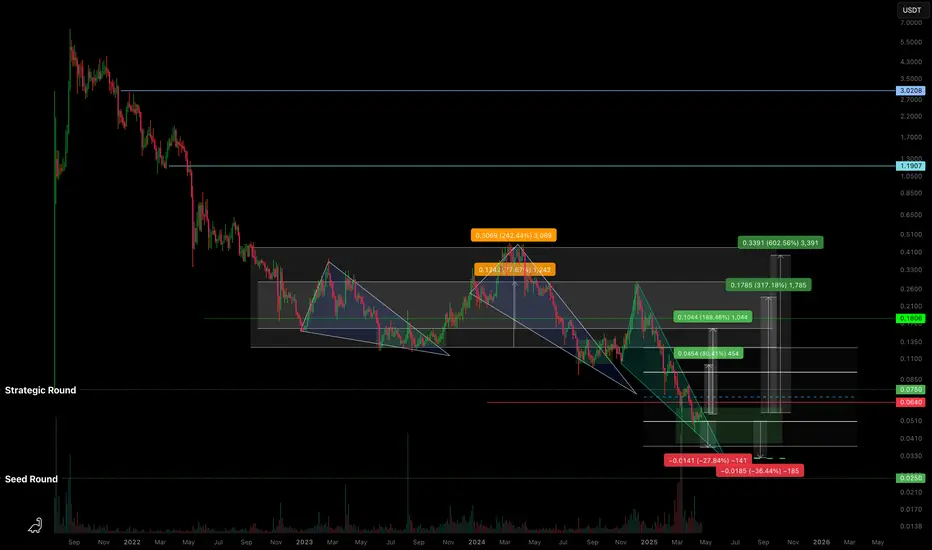
TOTAL2 represents the aggregated market capitalization of all crypto assets excluding Bitcoin. Historically, it reflects capital rotation into altcoins, especially following BTC dominance peaks. The current chart shows strong reaccumulation above the 1T support zone, with Fibonacci confluences hinting at a sustained recovery pattern. Dotted arrows illustrate a wave-like projection of accumulation, rally, retracement, and expansion. The possibility of a near-term correction to lower support zones is also embedded in the path structure.
**Key Technical Observations: and Levels**
TP1 = 1.78T
TP2 = 2.05T
TP3 = 2.4T
TP4 = 2.85T
* **Secondary Fib Retracement :** 0% = 1.23T, 100% = 425.89B
* Key zones: 23.6% = 1.04T, 38.2% = \~840.42B, 61.8% = \~569.41B
Possible Support Levels: 1.04T, 930B, 840B, 766B, 735B,
* **Trend-Based Fib (A-B-C):** A = \~420B, B = \~1.23T, C = \~735B
* This projection aligns with TP1 at 1.78T
* **Support Area:** Around 1T psychological zone (930B)
* **Strong Support Zone:** 735 Bto775B
* **First Target Zone:** Between 1.73T and 1.89T (early resistance + Fib cluster)
**Indicators:**
* Weekly structure forming higher lows
* Long-term Fib retracements respected
* Trend-Based Extension projecting 1.618 move
* No divergence, confirming strength
**Fundamental Context:**
* Liquidity conditions are improving globally with rate cuts expected into late 2025.
* ETH and ecosystem tokens are likely to lead altcoin recovery.
* Regulatory clarity and ETF flows add legitimacy to broader crypto allocations.
* Historical alt-seasons emerge from BTC profit rotation—TOTAL2 leads that shift.
* However, several macro risks may trigger a correction before rallying:
* The Crypto Fear & Greed Index is currently high, suggesting overbought conditions.
* Macroeconomic uncertainties (e.g., inflation, rate hike fears) can suppress short-term risk appetite.
* Regulatory tightening across major jurisdictions introduces hesitation in capital deployment.
* Technical signs of a five-wave drop in BTC hint at a larger ABC correction scenario.
* DAT (Digital Asset Treasury) exposure among public firms may lead to forced liquidations during downturns.
**Philosophical or Narrative View:**
This is not just a market cycle—it's a reflection of decentralized innovation reclaiming narrative dominance. After fear-induced lows, TOTAL2's rise echoes the resilience of builders, protocols, and investor conviction. Each Fibonacci level acts like a checkpoint in the unfolding story of crypto's evolution beyond Bitcoin.
**Related Reference Charts:**
*
**Bias & Strategy Implication:**
* **Bias:** Bullish with short-term corrective risk
* **Accumulation Zone:** 1.0T–1.23T
* **Initial Risk:** Price may revisit the **Support Area (1T)** or even the **Strong Support Zone (775B–725B)** before a sustained move higher.
* **Partial TP:** 1.78T–2.05T
* **Extended TP:** 2.4T–2.98T
* Caution near TP4–Bonus zones as distribution risk increases
* Invalidated if closes below 725B (structure break)
**Notes & Disclaimers:**
This is a structural macro outlook and not financial advice. Markets are dynamic and subject to rapid shifts in sentiment, liquidity, and regulation. Always use risk management.
From Mystery to Mastery: Trading EssentialsIntroduction: Why Trading Feels Like a Mystery
For many aspiring traders, the markets appear as a mysterious puzzle. Prices move in ways that often feel unpredictable, charts are filled with patterns that seem random, and every strategy seems to work until it suddenly doesn’t. This is why trading so often feels like a mystery: it blends human behavior, technical structures, and ever-changing fundamentals into one living system.
Yet behind this apparent chaos lies a logic. The transition from “mystery” to “mastery” begins with understanding that trading is not about luck, but about process. Just like a scientist doesn’t guess but instead forms hypotheses, tests them, and adapts based on evidence, traders must approach the markets with discipline and structure.
The main chart attached to this article is a good reminder of this. At first glance, it looks overwhelming: candlestick patterns, oscillators, UFO support and resistance zones, chart patterns, and volume data all layered together. But this is not noise — it’s information. Each element highlights a different aspect of market behavior. Once organized and understood, these tools stop being mysterious and instead form the building blocks of trading mastery.
In this guide, we’ll walk step by step through those building blocks: how markets are structured, how trades are placed, how risk is managed, how strategies are built, and how psychology influences decisions. Along the way, you’ll see how these concepts work together to transform confusion into clarity.
Trading mastery doesn’t come overnight, but the journey begins the moment you stop chasing secrets and start building a foundation.
Understanding Market Types
Not all markets are created equal. Before diving into strategies and chart patterns, it’s important to recognize that different markets operate under different structures. Knowing where you are trading — and how those markets function — can be the difference between confidence and confusion.
Exchange-Traded Markets
In exchange-traded markets such as futures or stocks, trading takes place on centralized venues. This means:
Prices are transparent, with all participants seeing the same quotes.
Orders are matched through a regulated system, reducing counterparty risk.
Clearing houses guarantee performance, ensuring that when one side of a trade wins, the other side’s obligations are met.
This structure creates confidence, especially for leveraged instruments like futures, where position sizes can be large.
Over-the-Counter (OTC) Markets
On the other side, forex, crypto and many other derivatives are traded over-the-counter. Here, there is no central exchange — trades are made directly between counterparties, such as banks or brokers.
Prices can vary slightly between providers.
Liquidity depends on the institution offering quotes.
Most importantly, there is counterparty risk — the risk that the other side may not honor the trade.
While OTC markets can be deep and liquid, traders must understand the role of intermediaries and the risk they take on when choosing where and how to trade.
Why It Matters
The choice between exchange-traded and OTC instruments affects everything: order execution, spreads, transparency, and even regulation. Many professional traders favor exchange-traded products for their transparency and reliability, but OTC instruments remain popular due to accessibility and flexibility.
Whether you’re trading futures on the CME or currency pairs in the OTC forex market, the principle is the same: know your marketplace, because the rules of engagement define the playing field.
The Mechanics of Trading
Once you know where you’re trading, the next step is to understand how trades are actually placed. This is where many traders feel overwhelmed, because order types, execution rules, and volume data can feel like a different language. But when broken down, the mechanics are straightforward.
Order Types: The Building Blocks
Market Orders: Execute immediately at the best available price. Fast, but can suffer from slippage in fast-moving markets.
Limit Orders: Specify the maximum price you’re willing to pay (buy) or the minimum price you’ll accept (sell). Excellent for controlling entry, but no guarantee of execution.
Stop Orders: Triggered once price hits a certain level, commonly used for stop-losses.
Bracket Orders: Automating Discipline
One of the most practical tools for managing trades is the bracket order. Instead of placing just an entry, a bracket order automatically places:
A stop-loss order to protect against adverse moves.
A profit-taking order to lock in gains.
This setup creates a “bracket” around your trade, ensuring that risk and reward are defined from the start. It shifts the trader’s mindset from hoping to managing.
Volume: The Footprint of Filled Orders
Volume is more than a number at the bottom of a chart — it’s the record of filled orders. When volume surges at a level, it shows where buyers and sellers agreed most aggressively. Combined with support/resistance or UFO zones, volume can help traders identify which levels have strong institutional participation.
Execution Matters
Bid-ask spreads, commissions, and slippage all impact profitability. A great strategy can still fail if execution costs aren’t managed. This is why many traders choose more liquid products — deeper liquidity usually means tighter spreads and better fills.
By mastering these mechanics — order types, brackets, and the interpretation of volume — traders gain the ability to structure trades with precision instead of improvisation.
Core Principles of Risk Management
If there’s one constant across all successful traders, it’s this: they never risk their capital blindly. Strategies may differ, but the principles of risk management remain universal.
Risk per Trade
A common practice is to limit the risk of any single trade to a small percentage of account equity — often 1–2%. This way, even a series of losing trades doesn’t wipe out a portfolio.
Position Sizing
Lot size isn’t just about ambition, it’s about survival. Position sizing must reflect both account size and volatility of the instrument. A highly volatile product like crude oil futures demands a smaller size than a low-volatility product like Treasury futures, even if account equity is the same.
Reward-to-Risk Ratio
Before placing a trade, the potential reward should always justify the risk. For example, risking 10 points to potentially gain 30 points gives a 3:1 reward-to-risk ratio — meaning you can be wrong more often than right and still be profitable over time.
Support, Resistance, and UFO Levels
Risk management becomes more effective when combined with technical reference points. Placing a stop-loss just beyond a well-defined support or UFO zone means that if price breaks through, the trade’s premise is invalidated. Similarly, setting profit targets near resistance zones allows traders to exit before momentum fades.
The Role of Discipline
None of these rules matter without discipline. A trader who moves stops, doubles down on losers, or takes oversized positions is effectively abandoning their edge. Consistency, not heroics, is what keeps traders in the game long enough to grow.
By embedding risk management into every decision, traders shift from chasing trades to controlling outcomes. The market will always be uncertain, but risk can always be defined.
Strategy Frameworks
While no strategy works all the time, every successful trader operates within a clear framework. Frameworks provide structure, helping traders decide when to engage the market and how to manage trades once they’re in.
Trend Following
The principle: “the trend is your friend.”
Traders look for higher highs and higher lows in an uptrend, or lower highs and lower lows in a downtrend.
Tools: moving averages, trendlines, and momentum indicators help confirm direction.
Mean Reversion
The assumption: prices oscillate around a fair value.
Traders buy when prices move far below the average and sell when they stretch too far above.
Tools: oscillators such as RSI or Stochastics signal overbought/oversold conditions.
Breakout Trading
Focused on capturing momentum when price escapes a range.
Traders identify consolidation zones and look for strong volume when price breaks through support or resistance.
Tools: candlestick patterns and chart patterns (triangles, rectangles, flags) often mark breakout points.
Volatility-Based Trading
Markets don’t just move in one direction; they expand and contract in volatility cycles.
Volatility traders adapt position size, target levels, and even strategy choice depending on whether the market is calm or turbulent.
The Role of Confirmation
Frameworks are strengthened when multiple signals align. For example, a breakout confirmed by a candlestick pattern and supported by volume at a UFO level carries more weight than a breakout without confirmation.
By mastering these strategy families, traders learn to adapt their approach to different environments instead of forcing one method onto all markets. Flexibility, not rigidity, is the true hallmark of mastery.
The Trader’s Process as a Scientific Method
The biggest difference between beginners and professionals isn’t the chart setup — it’s the process. Professionals treat trading as a science, not a game.
Step 1: Form a Hypothesis
Just like in a laboratory, the process begins with a hypothesis: “If price breaks above resistance with strong volume, then it is likely to continue higher.” The hypothesis defines what you expect and under what conditions.
Step 2: Backtest the Hypothesis
Rather than risking money immediately, traders test their idea against historical data. The goal is not to prove the trade will work, but to see whether it has worked consistently under similar conditions.
Step 3: Evaluate the Results
If backtesting shows inconsistent outcomes, the hypothesis must be refined or discarded. If results show positive expectancy, the door opens to the next stage.
Step 4: Trade Small in Live Markets
Even a strong backtest doesn’t guarantee success in the real world. Execution, slippage, and emotions enter the equation. That’s why traders begin with small size in live markets to confirm that performance holds.
Step 5: Scale with Confidence
Only after a hypothesis survives both backtesting and live verification should size be increased. At this point, the trader has turned uncertainty into structured probability.
By approaching the market scientifically, traders avoid gambling behavior. Instead of chasing tips or hunches, they move step by step, letting data guide decisions. In doing so, they transform trading from a mysterious guessing game into a disciplined pursuit of mastery.
Psychology of Trading
Even with a solid strategy and risk plan, many traders still struggle — not because the markets beat them, but because their own minds do. Psychology is the silent force that shapes every decision.
Discipline Over Impulse
The temptation to move stops, double down on losing trades, or exit winners too early is constant. Without discipline, even the best strategy collapses under emotional pressure.
Common Biases
• Recency bias: believing that the most recent outcome will repeat.
• Loss aversion: cutting winners short while letting losers run.
• Confirmation bias: searching for information that supports your existing view while ignoring evidence against it.
Emotional Cycles
Traders often swing between fear and greed. Fear prevents them from taking valid setups, while greed leads them to overtrade or oversize. Recognizing these emotional cycles is the first step toward controlling them.
The Power of Journaling
A trading journal records not just trades, but also the reasoning and emotions behind them. Over time, it becomes a mirror that reveals behavioral patterns — both strengths and weaknesses.
Process > Outcome
Individual trade results are largely random. Mastery comes from focusing on process rather than outcome. Following the plan consistently matters more than whether the next trade wins or loses.
By understanding and managing psychology, traders learn to master themselves first. The market will always test patience and conviction, but the disciplined trader treats emotions as signals to be managed — not instructions to follow.
Case Study: A Structured Trade Example
Theory becomes powerful only when applied in practice. Let’s walk through a trade example using the below chart attached.
Setup
The market is trending upward, confirmed by the SMA ribbon sloping higher.
A UFO support zone aligns with prior price action, creating a logical area where buyers may step in again.
A candlestick wick test into this zone provides confirmation of demand.
Trade Execution
Entry: Buy as price approaches the UFO support zone, in line with the trend.
Bracket Order: Place both a stop-loss and a profit target automatically.
(Stop-Loss: Positioned just below the UFO support zone. If price breaks down through support, the trade’s hypothesis is invalid. | Target: Set at the next UFO resistance zone, where prior sellers are likely to appear.)
Risk-to-Reward Balance
The defined stop ensures risk is limited.
The distance from entry to target is significantly larger than the distance to the stop, producing a favorable reward-to-risk ratio.
Outcome
Whether this trade wins or loses is secondary — the key is that it was structured with:
A clear hypothesis.
A defined entry, stop, and target.
Proper use of a bracket order.
Risk contained and reward potential aligned.
This is what separates structured trading from guesswork. Each element — support, UFOs, moving averages, and volume — works together as part of a process-driven decision, not an emotional one.
Conclusion: From Mystery to Mastery
For many traders, the markets begin as a blur of candles and numbers — a mystery that seems impossible to solve. But as we’ve seen, mastery doesn’t come from secrets or shortcuts. It comes from building a structured foundation:
Knowing the market type you’re trading, and whether it’s exchange-traded or over-the-counter.
Understanding the mechanics of orders, brackets, and volume.
Applying risk management principles that define losses before they happen.
Using strategy frameworks to adapt to different conditions.
Following a scientific process that tests hypotheses before scaling them.
Developing the psychological discipline to follow the plan consistently.
Executing trades with structure, where every element — entry, stop, and target — has a reason.
Trading mastery is not about eliminating uncertainty. It’s about controlling what you can — risk, process, discipline — and allowing the market to do the rest. The mystery never fully disappears, but with the right approach, it becomes manageable, even profitable.
This article is the first step in our From Mystery to Mastery series. Here, we’ve laid the foundation for trading in general. From here, we’ll expand into the specialized worlds of futures and options, where leverage, diversification, and advanced strategies open even more doors.
The journey continues — but the path is now clearer.
From Mystery to Mastery trilogy:
When studying markets, it’s important to remember that chart data can sometimes be delayed. This article has presented concepts that apply broadly to trading across all asset classes. The chart examples used here happen to feature products listed on exchanges operated by the CME Group. For traders who follow these products closely and wish to access real-time market data, TradingView offers a dedicated CME Group real-time data plan: www.tradingview.com . This is particularly relevant for shorter-term traders who depend on precise price action, though longer-term participants may find delayed data sufficient for their needs.
General Disclaimer:
The trade ideas presented herein are solely for illustrative purposes forming a part of a case study intended to demonstrate key principles in risk management within the context of the specific market scenarios discussed. These ideas are not to be interpreted as investment recommendations or financial advice. They do not endorse or promote any specific trading strategies, financial products, or services. The information provided is based on data believed to be reliable; however, its accuracy or completeness cannot be guaranteed. Trading in financial markets involves risks, including the potential loss of principal. Each individual should conduct their own research and consult with professional financial advisors before making any investment decisions. The author or publisher of this content bears no responsibility for any actions taken based on the information provided or for any resultant financial or other losses.
USD/JPY: Is the Bear Coming Back?Hello traders, USD/JPY is still under the influence of the latest news from the BOJ . The Bank of Japan kept interest rates at 0.5% but started selling ETFs and REITs, showing they are gradually moving away from their ultra-loose policy. This is a hawkish signal that supports the yen. In addition, 2 out of 9 BOJ board members even wanted to raise rates to 0.75% , increasing market expectations that the JPY will become even stronger in the near future. Meanwhile, the Fed is in a rate-cutting cycle , leaving the USD weaker against the JPY.
From a technical perspective, USD/JPY has just touched the resistance area around 148.200 and bounced down. The downtrend line continues to act as pressure. The market structure is also forming lower highs, reinforcing the bearish outlook. The 148.200 level is a strong supply zone, difficult to break without unexpected news.
The preferred scenario is to look for sell entries around the resistance zone , with a near-term target at 147.000 and a further target at 146.000 – a key support level overlapping with the demand zone. A stop-loss should be placed above 148.500 to avoid false breakouts.
Overall, both fundamentals and technicals support a bearish move for USD/JPY . The dominant trend is bearish, and the effective strategy is to wait for pullbacks to sell with the trend.
Weekly Market Outlook – Nifty, BankNifty & S&P 500Nifty ended the week on a positive note, closing at 25,327 – up 213 points from last week’s close. This week’s price action was once again perfectly aligned with my projected range of 25,500 – 24,700, making a high of 25,448 and a low of 25,048.
Nifty Outlook for Next Week:
I expect Nifty to trade within 25,700 – 24,900. A break below 24,900 could open the doors towards 24,600 / 24,400.
Sector Strength Check:
Looking at the monthly time frame, none of the major indices look particularly strong right now. On the weekly chart, strength is visible only in selective sectors like Consumption, FMCG, Metals, and a few Auto stocks.
⚠️ Caution: Until we see strength coming back in at least 3–4 major indices, it’s better to stay selective and avoid aggressive long positions.
BankNifty Analysis:
BankNifty has staged a sharp V-shaped recovery, but I am not fully convinced with this move.
Support to watch: 55,000 – a break below this can take it down to 54,700 / 54,600.
Resistance to watch: Above this week’s high of 55,835, it can test 56,000 / 56,400.
Expected Range: 56,400 – 54,550
India VIX Alert:
India VIX is currently near its support zone, which signals possible volatility ahead – so stay cautious.
Global Markets – S&P 500:
S&P 500 once again gave an all-time high close at 6,671 (+80 points WoW).
Breakout Levels: Above 6,671, we could see 6,689 / 6,780 / 6,930 / 6,959 (key level).
Investors holding long positions should keep a trailing SL at 6,450 to protect profits.
Bitcoin OutlookWeekend trade after the FOMC has been a ghost town—low volume and choppy, un-tradable price action.
The dollar has been pinned inside a narrow hourly fractal range: high 116.211 / low 115.132.
I’ve been waiting for a sharp dollar pullback with a news driver, but the broader macro picture keeps price in oversold territory. Timing the next big move is anyone’s guess.
For now:
Higher-timeframe bias: still unpredictable.
Intraday (high-frequency) moves: perfectly tradable.
Crypto: don’t expect a clean breakout this weekend.
On the weekly map, there’s a bullish imbalance that still needs to be tapped.
Expect any breakout to have a dose of manipulation—trade carefully.
Shriram Finance at Crossroads: Breakout or Breakdown..?
* CMP: ₹633
* Resistance: ₹640 (important barrier)
* Support: ₹630 (trendline + price support)
* Trend: Short-term uptrend
---
🔼 Bullish Scenario
* If price breaks and sustains above ₹640, it may extend the uptrend.
* Upside targets:
* 🎯 ₹648
* 🎯 ₹655
🔽 Bearish Scenario
* If price breaks below the trendline and loses ₹630 support, downside pressure likely.
* Downside targets:
* 🎯 ₹624
* 🎯 ₹620
📌 Conclusion
* As long as ₹630 holds, buyers have control.
* A breakout above ₹640 will strengthen the bullish case.
* A breakdown below ₹630 shifts sentiment bearish, opening room for deeper correction.
EURUSD: Support & Resistance Analysis For Next Week 🇪🇺🇺🇸
Here is my latest structure analysis:
important supports and resistances for EURUSD for next week.
Consider these structures for pullback/breakout trading.
❤️Please, support my work with like, thank you!❤️
I am part of Trade Nation's Influencer program and receive a monthly fee for using their TradingView charts in my analysis.
Art of Technical Analysis: How Traders Decode MarketTrading the financial markets may seem mysterious at first glance. Prices move up and down within minutes, news headlines shake investor confidence, and charts look like random zig-zag patterns. But behind this chaos, there lies a structured language – the language of technical analysis (TA).
Technical analysis is the study of past price action and chart patterns to forecast future market behavior. Unlike fundamental analysis, which focuses on economic data, earnings, and macroeconomic events, technical analysis is about understanding the psychology of buyers and sellers as reflected in the price chart.
Why Technical Analysis Matters
Markets are driven by human behavior – fear, greed, uncertainty, and confidence. These emotions repeat themselves over time, creating recognizable patterns. Technical analysis doesn’t predict the future with 100% certainty, but it helps traders identify high-probability scenarios.
For example:
- If price consistently bounces from a certain level, traders call it support.
- If price struggles to move above a particular level, it becomes resistance.
- When these levels break, a new trend often begins.
By combining these concepts, traders can build strategies for intraday trading, swing trading, or even long-term investing.
The Core Principles of Technical Analysis
Before diving into charts, let’s outline the three golden principles that technical analysts believe in:
Market Discounts Everything
Every piece of information – economic data, news, investor sentiment – is already reflected in the price. The chart tells the whole story.
Price Moves in Trends
Markets are not random. They move in uptrends, downtrends, and sideways ranges. Identifying the trend is the first step in any analysis.
History Repeats Itself
Patterns like triangles, head and shoulders, flags, and channels have been repeating for decades because human behavior remains consistent.
Decoding the Chart: Support, Resistance & Trendlines
Take a look at the Gold (XAU/USD) chart. At first, it may look like price is simply bouncing around. But once we draw trendlines and mark levels, a clear story unfolds.
1. Support and Resistance
- Support is where demand is strong enough to prevent the price from falling further. On the chart, the green trendlines show these bounce points.
- Resistance is where supply prevents the price from rising higher. The red trendlines highlight these areas.
Example:
If Gold bounces multiple times from the $3,630 zone, traders call it support. If it fails to cross $3,700 several times, that becomes resistance.
Traders often:
- Buy near support (with stop-loss below).
- Sell near resistance (with stop-loss above).
2. Trendlines
- Trendlines are diagonal lines drawn across swing highs or swing lows. They act like dynamic support and resistance.
- An uptrend line connects higher lows, showing bullish momentum.
- A downtrend line connects lower highs, signaling bearish pressure.
In the Gold chart:
- The green rising lines show bullish phases.
- The red falling lines show bearish corrections.
- When price breaks a trendline, it often signals a shift in trend.
3. Wedge & Patterns
- A Wedge is formed when price moves between two trendlines – one acting as support, the other as resistance.
- Ascending Wedge = Bullish structure.
- Descending Wedge = Bearish structure.
- Symmetrical Triangle = Consolidation.
- Sideways Channel = Consolidation.
In the chart, Gold moved within wedge before breaking out. This tells traders when to trade the range and when to prepare for breakout momentum.
Chart Patterns That Repeat in Every Market
Beyond support and resistance, technical analysis studies chart patterns. These are the footprints of market psychology.
1. Continuation Patterns
Indicate that the current trend will likely continue.
- Flags and Pennants
- Ascending Triangles
- Rectangles
2. Reversal Patterns
Suggest that the trend is about to change.
- Head and Shoulders
- Double Tops / Bottoms
- Descending Triangles
3. Breakouts
- When price escapes from a channel, triangle, or range, it signals a big move ahead.
In the Gold chart, you can clearly see multiple breakout points where price surged after leaving a Wedge.
Risk Management: The True Game Changer
Even the best technical setup can fail. That’s why risk management is the backbone of trading success.
Rules every trader should follow:
- Never risk more than 1-2% of account balance on a single trade.
- Always place a stop-loss.
- Follow a risk-to-reward ratio (RRR) of at least 1:2+.
- Example: Risking $100 to potentially make $200.
Avoid overtrading; patience pays.
Pros and Cons of Technical Analysis
Advantages
✔ Works across all markets – stocks, forex, crypto, commodities.
✔ Useful for intraday, swing, and long-term trading.
✔ Focuses on price action, the most direct reflection of market psychology.
Limitations
✘ False signals occur during low volume.
✘ Over-analysis can cause “paralysis by analysis.”
✘ Works best when combined with fundamentals and risk management.
Final Thoughts: Technical Analysis as a Trader’s Compass
- Technical analysis is not about predicting the market with magic. It’s about understanding probabilities, spotting patterns, and managing risks.
- When you master support, resistance, trendlines, and candlestick psychology, charts stop looking like random chaos – and start telling you stories.
Remember:
- Price is the ultimate truth.
- Risk management protects your capital.
- Consistency builds profits over time.
Whether you trade Gold, stocks, or crypto, the principles remain the same. The more you practice, the sharper your eye becomes in spotting opportunities.
So the next time you look at a chart, don’t just see candles. See the psychology of thousands of traders battling it out – and use technical analysis as your compass to navigate the markets.
Thread>>Live Examples
EUR/USD: Mild Uptrend, Awaiting Breakout of ResistanceCurrently, EUR/USD is in a mild uptrend, supported by both macroeconomic and technical factors. Let's analyze the key influences and suitable trading strategies in this article.
With the Fed cutting interest rates and stable economic indicators from the Eurozone, EUR/USD may continue to rise if it breaks through the 1.18300 level, targeting 1.18600. The nearest support is at 1.17400. If the price holds above this support, the uptrend is likely to continue. However, a strong break of support or resistance levels could shift the trend.
Keep a close eye on the upcoming developments and prepare your strategy to capitalize on market opportunities.
XAUUSD: Current Sideway Trend, Breakout Opportunity Ahead?Hello traders, in this analysis, we will examine XAUUSD (gold) in the current context, with a sideway trend that could continue over the next few sessions.
At the moment, the market does not have any significant news impacting it immediately. Gold may continue to move within the range between the support at 3,650 USD and the resistance at 3,700 USD. The stable trading volume indicates a lack of strong momentum. Gold might continue sideway within this range until there is a clear signal from the market.
While the likelihood of a sideway movement in gold is high in the coming days, we must also prepare for a potential breakout if strong signals emerge from macroeconomic events.
Keep a close eye on the developments ahead and always maintain a proper risk management strategy.