Nifty 50 | Intraday Price–Time Structure Study(12 July 2023 | WD Gann Methodology)
This idea is a historical, educational study demonstrating how price structure and time alignment, as described in classical WD Gann methodology, can be analysed on an intraday chart.
This post is not a trade call, prediction, or recommendation.
📌 Market Context
On 12 July 2023, Nifty was trading within a short-term consolidation phase after a prior decline.
According to WD Gann principles:
Markets often react near structural price levels
These levels gain importance when price and time balance
Risk is always defined before observing market response
📈 What the Chart Illustrates
The chart highlights:
A reference price zone derived from prior structure
A downside risk boundary used for invalidation
Subsequent price response after interaction with the level
This example is shared to explain how price structure can be studied objectively, without emotional bias.
🧠 Key Learning Points
Gann analysis begins with price structure
Risk must be pre-defined, not adjusted later
Time confirms whether price is accepted or rejected
Studying completed sessions improves execution discipline
The focus here is on process, structure, and risk awareness, not outcome.
⚠ Disclaimer
This idea is shared strictly for educational and analytical purposes only.
It does not constitute financial advice, live trade calls, or investment recommendations.
Trend Analysis
Nifty 50 | Price–Time Square Structure(22 Nov 2023 | Educational Gann Study)
This idea presents a historical, educational study of how Price–Time Square geometry, as described in classical WD Gann methodology, appeared on the Nifty 50 intraday structure.
The intent of this post is market structure analysis, not prediction or trading advice.
📌 Structural Context
On 22 November 2023, Nifty was trading within a defined intraday range after a prior swing.
According to Gann principles:
Markets often respond to square relationships between price and time
When price units align proportionally with time units, measurable reaction zones may appear
These zones act as reference levels, not guarantees
📈 What the Chart Illustrates
The chart highlights:
A reference base level used for structure measurement
Two price–time proportional zones derived from square calculations
Price movement interacting with these zones during the same session
This example helps demonstrate how price symmetry and time balance can be studied objectively.
🧠 Key Takeaways
Gann analysis focuses on structure, not certainty
Price–Time Squares help define potential reaction areas
Risk control and confirmation remain essential
Studying completed sessions improves future market awareness
The emphasis is on process and discipline, not outcome.
⚠ Disclaimer
This idea is shared strictly for educational and analytical purposes.
It does not constitute financial advice, live calls, or recommendations.
USDCHF is Ready to flyUSDCHF is trading within a corrective consolidation after a strong bearish impulse, with price currently reacting from a clearly defined H4 demand and support zone, signaling potential accumulation and a developing base for a bullish retracement toward the higher supply area. The rejection wicks and compression above support suggest selling pressure is weakening while buyers are gradually absorbing liquidity, aligning with a mean-reversion move within a broader corrective structure. Fundamentally, the pair is influenced by ongoing US dollar softness driven by expectations of Federal Reserve rate cuts later in 2025 following mixed US inflation and labor data, while the Swiss franc remains relatively strong due to its safe-haven status, although downside CHF momentum has eased as risk sentiment stabilizes. With liquidity resting above the recent range, improving short-term momentum, and price respecting institutional demand, this structure favors a technical rebound toward premium levels, offering a favorable risk-to-reward opportunity for bullish continuation plays within the current market context.
US10Y United states government 10 year bond yieldThe US10Y refers to the yield on the 10-year US Treasury note, a benchmark rate for the return investors demand to lend to the US government over 10 years.
the US10Y is Issued by the US Treasury, these notes pay semi-annual interest and return principal at maturity; yields move inversely to prices based on auction bids and secondary market trading. Seen as virtually risk-free, US10Y signals investor confidence in inflation, growth, and Fed policy.
Economic Effects
Rising US10Y increases borrowing costs ,while strengthening the dollar. Falling yields signal economic worries or flight to safety, spurring growth via cheaper credit but risking bubbles if prolonged. Inverted yield curve (US10Y below short-term rates) often precedes recessions.
US10Y (10-year US Treasury yield) and the Dollar Index (DXY) share a generally positive historical relationship, where rising yields often strengthen the dollar by attracting foreign investment seeking higher returns. However, this correlation has weakened recently, with divergences noted since early 2025 due to factors like global risk sentiment and fiscal policy.
US10Y-DXY Link
Higher US10Y yields boost DXY as investors buy Treasuries, increasing USD demand; falling yields reduce appeal, pressuring the dollar lower. Correlation around 0.55 lately, but it can invert during uncertainty (e.g., 2020 pandemic).
Fed Rate Impact on US10Y
Fed funds rate hikes typically push US10Y yields higher via expectations of sustained tight policy, inflation control, and stronger short-term rates influencing the yield curve. Cuts lower yields by signaling easing and boosting bond prices; US10Y reflects the average expected future fed funds path over 10 years.
#US10Y #DONDS #STOCKS #DOLLAR
AUD/TRY#2 – H1 Bearish Channel & FVG Short Setup🔹 Market Structure :
AUD/TRY is trading within a well-defined bearish structure, inside a descending channel
Sellers remain in control with a clear sequence of Lower Highs / Lower Lows
The latest bearish impulse created a H1 Fair Value Gap (FVG), currently being retraced
➡️ Current bounce is corrective, not a trend reversal
🔹 Key Zones – FVG & Resistances :
H1 FVG : 30.18 – 30.22
Unfilled bearish imbalance
Dynamic resistance (trendline)
R1 / Pivot area : ~30.25
These levels define a high-probability sell zone
📝 Trading Plan :
🔵 Strategy – Short on H1 FVG
🔵 Entry zone : 30.18 – 30.22
🟢 TP1 : 30.00 – 29.95
🟢 TP2 : 29.80 – 29.75
🔴 Invalidation / SL : above 30.35
➡️ Estimated Risk / Reward : ~1:2 to 1:3
🧠 Core Logic In a bearish market :
Do not buy against structure
Let price retrace into imbalance zones
Sell pullbacks, not extensions
➡️ FVGs often act as institutional redistribution zones
🎯 Summary :
H1 bearish channel + FVG =
Pullback → sell zone → bearish continuation
HRHO showed strong follow-through after rebounding from 24 HRHO showed strong follow-through after rebounding from 24 🔄📊 and broke above the key resistance at 28.6 with strong volume 📈🔊.
Price is now facing a very strong resistance at 29.85 🧱, a level that has rejected price twice before ❌❌.
A clean break above 29.85 would likely fill the gap and open an order block around 31.9, with upside extending toward the fair value near 35 🎯🚀.
👍 If you like my posts, please consider boosting
⚠️ Disclaimer: This is general information only and not financial advice. For personal guidance, please talk to a licensed professional.
Bitcoin: Key level 74,508Monthly Chart
The price has moved below the lower boundary of the last buyer initiative at 74,508 and also dipped below the low of the November 2024 buyer candle (66,835).
That November candle remains the highest-volume buyer candle from April 2024 through January 2026. It will be important to see what volume forms in February 2026.
The 74,508 level is now a key reference.
Weekly Chart
A sideways range has been forming on the weekly timeframe since January 2025.
The chart shows a nearly symmetrical expansion of this range:
first downward by about 14,700
then upward by 14,200
and now downward again by roughly 14,500.
This symmetry likely points to stabilization within a broad price range of 60,000–126,000.
The volume of the latest weekly candle is notable. While it is still below the volume of the February 24, 2025 candle, the week has not yet closed and may exceed it.
This suggests solid demand for Bitcoin at current price levels.
Key resistance levels are marked on the chart.
Conclusion:
From a conservative perspective, long positions can be considered once buyers reclaim the seller candle on the weekly timeframe — that is, with a close above 79,360.
Until then, it makes sense to focus on local setups on lower timeframes, as the price may consolidate in this area for several weeks.
Profitable trades!
This analysis is based on the Initiative Analysis (IA) method.
BTCUSD: Recovery Momentum and Key Resistance ChallengeMarket Context: Bitcoin (BTC/USD) is exhibiting signs of a bullish recovery on the 15-minute timeframe after finding strong support near the 62,000 level.
Technical Observations:
Support Base: The price has formed a clear "V-shaped" recovery from the recent lows, reclaiming previous minor support zones.
Current Structure: The price is now oscillating around 68,821, showing a series of higher highs and higher lows.
Projected Path: The analysis (black path-line) anticipates a potential retest of the immediate demand zone near 65,000 before an impulsive move toward higher liquidity areas.
Key Targets:
Primary Objective: The major supply zone located near 78,000, where previous sell-side pressure originated.
Critical Hurdle: A break above the blue ascending trendline would be a strong confirmation of a broader trend reversal.
monday Silver Structural Analysis: Strategic Rejections and RecoXAG/USD (Silver) Analysis
Market Sentiment: Bullish Recovery Attempt
Technical Setup: Silver has successfully defended the long-term demand zone near 56.000. We are now witnessing a structural shift with a "V-shaped" recovery pattern emerging.
Price Path: The analysis indicates a series of higher highs and higher lows following a reclaim of the 72.000 support level. The current objective is to test the blue ascending trendline and move toward the overhead supply.
Key Levels:
Immediate Support: 72.000 – 74.000
Target 1: 84.000 (Mid-range liquidity)
Target 2: 92.000 (Primary supply zone)
monday Silver Long Opportunity: Targetting Higher Liquidity ZoneTrade Rationale: This setup is based on a successful defense of the long-term demand zone. The shift in market character on the 15-minute timeframe indicates that accumulation is complete and a recovery phase has begun.
Execution Details:
Entry Range: 77.000 - 78.000 (Looking for entries on minor pullbacks).
Support to Watch: 72.000 (Key structural floor).
Take Profit (TP) 1: 86.000 (Mid-range liquidity).
Take Profit (TP) 2: 94.000 (Major supply zone).
Risk Management: Maintain strict risk protocols. If the price fails to hold above the 72.000 level, the bullish thesis is invalidated.
Outlook: We expect some volatility near current levels as the price encounters local resistance, but the overall momentum is shifting upward.
XAGUSD: Support Confirmation and Potential Bullish Reversal PathMarket Outlook: Silver is currently showing signs of a strong structural bounce after testing the major demand zone near 56.000 - 60.000.
Price Action Analysis: Following a sustained bearish move, we are observing a "V-shaped" recovery attempt. The price has reclaimed the 76.000 horizontal support level, which is a critical sign of buyer strength.
Trend Dynamics: The current path (black lines) suggests a series of higher highs and higher lows. We are anticipating a corrective retest of the 74.000 area before a continuation toward the next major supply zone.
Key Targets: * Immediate Resistance: 84.000
Primary Objective: 92.000, where the previous breakdown originated.
Sentiment: Bullish as long as the price maintains its structure above the 72.000 support cluster.
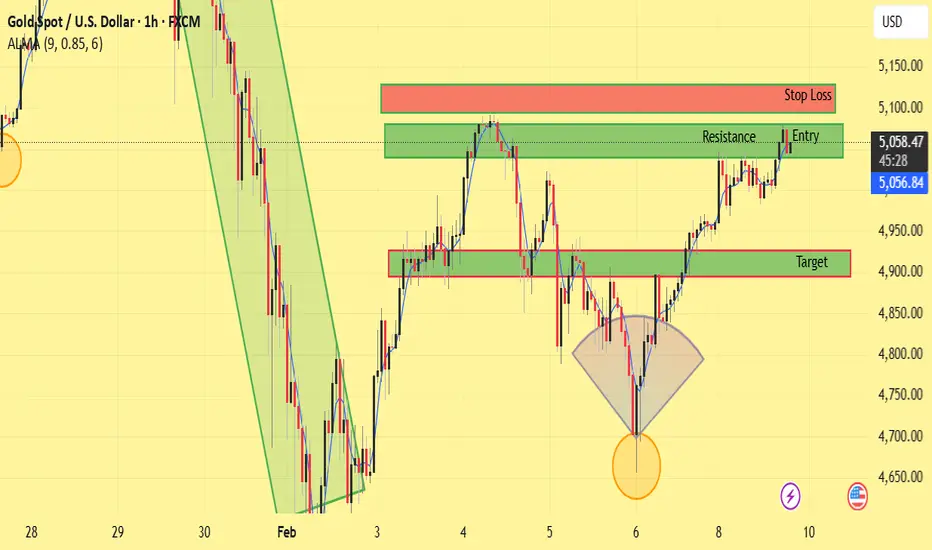
XAUUSD: Heavy Rejection at Key Supply Zone – Bearish OutlookMarket Context: Gold is exhibiting significant bearish pressure after failing to sustain momentum above the major supply zone between 5,120 and 5,180.
Technical Breakdown:
Resistance Rejection: The current price action on the 15-minute timeframe shows a clear rejection from the overhead purple resistance block.
Trend Shift: The failure to break higher has resulted in a structural shift, with the price now following a descending path (indicated by the black trajectory lines).
Key Targets:
Immediate Support: 4,800.
Primary Downside Objective: The liquidity cluster near 4,484, highlighted by the large bearish impulse arrow.
Risk Management: This bearish thesis remains intact as long as the price continues to hold below the 5,180 resistance level.
monday Gold Bearish Outlook: Watching the Breakdown Below 4,800Overview: Gold is currently trading in a bearish corrective phase. After a brief rally toward the 5,000 psychological level, the bears have regained control at the key resistance zone.
Support/Resistance Levels:
Resistance: 5,120 (Major Supply)
Immediate Pivot: 4,964
Support: 4,800 and 4,400 (Major Demand)
Trend Analysis: The combination of trendline rejection and the blue momentum arrow suggests high selling pressure. We anticipate a continuation of the downward move toward the lower value areas.
Trading Bias: Strongly bearish. Look for confirmation on the 15-minute candle close below 4,800 for further downside confirmation.
S&P/ASX 200 (XJO) — Bearish Continuation in Play | Smart Money CS&P/ASX 200 (XJO) — Bearish Continuation in Play | Smart Money Concepts
📉 Bias: Bearish | Timeframe: Daily | Style: ICT/SMC
What's Happening
The ASX 200 just printed a -2.03% rejection candle from the premium zone near 9,008, confirming what the structure has been whispering for weeks — the recent high was a Weak High, and smart money has been distributing into retail longs.
We now have a confirmed Break of Structure (BOS) to the downside, followed by a Change of Character (CHoCH) — the market has shifted from bullish to bearish on the daily timeframe.
Price is currently sitting at 8,708 — right at the equilibrium (50% fib) of the macro swing. This is decision territory.
The Setup
Structure:
✅ Weak High confirmed at 9,008 — made on declining momentum
✅ BOS to the downside — lower low printed
✅ CHoCH confirmed — bullish structure broken
✅ Price rejected from Premium zone into Equilibrium
Projected Path:
I'm looking for a mitigation retest back toward the 8,850–8,900 zone (previous BOS level / order block) before continuation lower. This is the sell zone — not chasing here at equilibrium.
Key Levels
LevelPriceSignificancePremium / Weak High9,008Invalidation zone — if reclaimed, bearish thesis is deadMitigation Block8,850–8,900Optimal entry zone for shortsEquilibrium8,708Current price — 50% fib, decision point0.618 Fib8,662First support — needs to break for continuationDiscount / Swing Low8,383Primary target — strong demand zone1.382 Extension8,103–8,116Extended target — major horizontal support confluenceDeep Discount7,651Extreme scenario — only if macro black swan event
RSI Confirmation
Momentum hasn't even reached oversold territory yet. RSI is sitting at 58/42 — there is significant room for this move to develop before any mean-reversion pressure kicks in. When structure and momentum align like this, the probability tips heavily in favor of continuation.
What I'm Watching
Retest of 8,850–8,900 — this is where I want to see price wick into and reject. If we get a bearish engulfing or shooting star on the daily in this zone, that's the trigger.
RBA Rate Decision — this is the macro wildcard. A hold or hawkish tone accelerates the move lower. A surprise cut could invalidate and squeeze shorts.
Daily close below 8,662 (0.618) — this confirms the sell-off has legs and opens 8,383 as the next magnet.
The Plan
Entry Zone: 8,850–8,900 (mitigation retest)
Confirmation: Bearish price action on daily (engulfing, shooting star, BOS on lower TF)
Target 1: 8,383 (discount zone / swing low)
Target 2: 8,103–8,116 (1.382 fib extension + horizontal support)
Invalidation: Daily close above 9,008 (reclaim of weak high)
Risk-to-reward on this setup from the mitigation zone to T1 is roughly 3:1. To T2, it stretches to 5:1+.
Macro Context
The ASX 200 is heavily weighted toward financials (~36%) and mining. Both sectors are facing headwinds:
Banks — NIM compression concerns as the rate cycle peaks
Miners — China demand uncertainty continues to weigh on iron ore sentiment
Global risk-off flows — if US equity weakness persists, ASX follows
The index composition means when this thing sells off, the selling is concentrated and fast.
Summary
Smart money distributed at the premium zone. The BOS and CHoCH are confirmed. We're at equilibrium — the market is offering one more opportunity to enter on a retest before the discount zone becomes the target. Structure, momentum, and macro all align bearish.
Patience on the entry. Let price come to you.
This analysis is for educational purposes only. Not financial advice. Always manage your risk.
🏷️ Tags: #ASX200 #XJO #SmartMoneyConcepts #ICT #BearishSetup #TechnicalAnalysis #AustralianStocks #SwingTrade
📊 Chart by WaverVanir International LLC | VolanX Trading Systems
🔗 Follow for more institutional-grade analysis on ASX & global markets
The volume will increase, as the room becomes smaller. Hear me out, this isn't about music. Inverted chart. Trend lines to establish our channel with current PA. Reverse trend-based fib from previous lows (10k) into current ATH (126k). Establishing support at key levels and a buy zone from 0.5 & 0.382 if ( IF, IF !!) our (complex) head and shoulders breaks the pattern. If the pattern plays out we can see a small rally into our 0.786 where we'll reject and have another opportunity to buy this dip. In the future 1.618 isn't spot on, but it aligns with psychological resistance @ 200k . Another key area of future resistance to eye is around another psychological level of resistance of 150k which aligns with our trend lines. 50k being between our 0.5 & 0.382 acting as support.
200 EMA is an indicator to keep an eye on as we're nearing current PA.
XAUUSD Analysis todayHello traders, this is a complete multiple timeframe analysis of this pair. We see could find significant trading opportunities as per analysis upon price action confirmation we may take this trade. Smash the like button if you find value in this analysis and drop a comment if you have any questions or let me know which pair to cover in my next analysis.
#RSR/USDT Forming Bullish Momentum#RSR
The price is moving within a descending channel on the hourly timeframe. It has reached the lower boundary and is heading towards a breakout, with a retest of the upper boundary expected.
The Relative Strength Index (RSI) is showing a downward trend, approaching the lower boundary, and an upward bounce is anticipated.
There is a key support zone in green at 0.001600. The price has bounced from this level several times and is expected to bounce again.
The RSI is showing a trend towards consolidation above the 100-period moving average, which we are approaching, supporting the upward move.
Entry Price: 0.001688
Target 1: 0.001753
Target 2: 0.001834
Target 3: 0.001935
Stop Loss: Below the green support zone.
Remember this simple thing: Money management.
For any questions, please leave a comment.
Thank you.
AAPL — Trend Continuation / HOLD LONGBias: Hold Long
The technical structure remains solid. Price continues to trade above both the SMA50 and SMA200, confirming an intact long-term uptrend, while ADX indicates healthy trend strength. The most recent pullback occurred on light volume, suggesting orderly consolidation rather than distribution and supporting continuation toward higher levels.
Order flow remains neutral, showing no significant institutional supply at current levels. Sentiment is mildly constructive, reinforcing the existing long posture but not materially increasing conviction beyond the technical foundation. The next key resistance is located near 288.62, with the broader upside objective near 293.86.
Risk management
Trailing stop: 269.75
Hard stop: 245.73
Primary upside target: 293 (20-40 days)
Amazon - Continuing CorrectionThe correction is ongoing, and wave C has started to form.
Since wave B is longer than wave A , wave C is expected to move below the low of wave A .
Main target: 142
Intermediate target: 187
---
Please subscribe and leave a comment.
You’ll get new information faster than anyone else.
---
Bitcoin's Institutional Volume Structure: A Case Study in Regime
Current Market Context
Bitcoin is trading at $70,571 on the 4-hour timeframe, displaying a textbook bearish regime structure that institutional traders recognize immediately. The Cantillon Institutional Volume Suite LITE confirms what volume analysis has been signaling for weeks: this is distribution territory, not accumulation.
Regime Classification: Why Structure Matters
The indicator shows three critical components:
Structure: BEARISH - Price remains firmly below AVWAP, the institutional benchmark that separates bullish from bearish regimes. This isn't a subjective assessment; it's a mathematical fact about where volume-weighted institutional positioning sits relative to current price.
POC Distribution: -20.88% - The Point of Control sits nearly 21% below current price, indicating the highest volume node—where institutions established their positions—resides well beneath the market. This negative distribution signals that the majority of recent volume occurred at lower prices, creating overhead supply as price rallies.
In VA: YES - Price remains within the Value Area, but this is deceptive. Being inside the VA while below AVWAP and with negative POC distribution means we're in the upper range of a bearish structure, not the beginning of a bullish reversal.
Volume Profile Analysis: Reading Institutional Footprints
The left-side volume profile reveals the auction process with clarity. Two prominent high-volume nodes (HVNs) appear around $88,000-$90,000 and $78,000. These represent institutional absorption zones where large players accumulated inventory during the decline. The current rally from $62,000 lows is approaching the lower HVN, which typically acts as resistance in bearish regimes.
Notice the volume gap between $70,000 and $76,000—a low-volume node (LVN) that price traversed quickly during the breakdown. LVNs offer minimal support on declines but equally minimal resistance on rallies, explaining the recent vertical move off the lows.
AVWAP: The Institutional Reference Point
The purple AVWAP line descending from the $96,000 highs defines the regime. In institutional trading, AVWAP serves as the volume-weighted average entry point for participants over the calculation period. When price trades below AVWAP, institutions with long positions are underwater on average, creating natural selling pressure on rallies as they seek to reduce risk or exit at breakeven.
The current price action shows a relief rally within a confirmed downtrend. The AVWAP slope remains decisively negative, and each touch of the line from below has resulted in renewed selling—a classic sign of distribution resistance.
Strategic Implications for Traders
This setup illustrates why regime-based trading outperforms pattern-based approaches. Retail traders often interpret the $62,000 to $70,000 rally as a reversal signal, searching for bullish continuation patterns. Institutional volume analysis tells a different story:
Resistance Layers - The $78,000 HVN sits directly above, followed by the declining AVWAP around $79,000-$80,000, and the major distribution zone at $88,000-$90,000.
Probability Weighting - Rallies in bearish regimes should be sold, not bought. The confluence of negative POC distribution, price below AVWAP, and overhead volume resistance creates a high-probability short environment on strength.
Risk Management Zones - The LVN between current price and $76,000 offers minimal support. A failure to sustain above $70,000 would likely result in rapid repricing back toward the $64,000-$66,000 support cluster.
The Institutional Perspective
Professional traders view this chart and see a corrective bounce within a distribution phase. The volume structure indicates institutions are using strength to reduce exposure, not accumulate new positions. This is why the POC sits 21% lower—it reflects where the majority of institutional activity occurred during the initial decline, and that activity was primarily selling.
The rally from $62,000 lows represents short covering and retail buy-side activity, not institutional accumulation. True accumulation would show expanding volume at the lows, a rising AVWAP, and positive POC distribution. None of these conditions exist currently.
Educational Takeaway
Volume structure precedes price action. The LITE indicator synthesizes multiple institutional metrics into a coherent regime framework. When structure signals bearish, POC distribution is negative, and price remains below AVWAP, the probabilities favor continuation of the trend rather than reversal—regardless of short-term price strength.
This is the difference between trading what you want to happen versus what the institutional footprint suggests will happen. The chart doesn't predict the future, but it does quantify probability-weighted scenarios based on where the largest participants have positioned themselves. And currently, that positioning remains decisively bearish.