EUR/USD buys up to sells ideaThis week’s outlook for EU is slightly different from the other pairs as price is approaching a very clean demand zone. Although the short-term momentum may still appear bearish, I’ll be watching closely for clear confirmation to potentially take a counter-trend buy back to the upside.
The main reason for this is that the nearest supply zone is quite far from current price, so I’ll wait to see how price opens on Sunday night and reacts around this area.
Confluences for EU Buys:
• Price slowing down before tapping demand would be a strong sign
• Overall structure has been bullish over the past month
• DXY approaching supply, which could support upside on EU
• A clean, unmitigated demand zone below price
• Asia high liquidity resting above that price may look to take
P.S. If price breaks cleanly through this demand, I’ll reassess and look for a closer, valid supply zone to potentially trade from instead.
Wyckoffmethod
GU Sells to continue short term trendMy outlook is consistent across all pairs this week, with a focus on selling opportunities to continue the downside trend. While there is a stronger demand zone much lower, I’ll be looking to sell pullbacks that can take price into that area.
Confluences for GU Sells:
• DXY remains bullish, supporting downside pressure on GU
• GU has been strongly bearish over the past week
• Multiple breaks of structure confirm bearish momentum
• Clean supply zones above price that offer sell opportunities
P.S. If price retraces and sweeps the inducement I’ve marked, this could present a solid sell opportunity around the 1.34300 level.
Gold needs a correction after the ATH!Greetings!
If you see me at the charts, it means a fresh dose of solid analysis is coming.
Today my focus is on XAUUSD.
Yesterday we updated the ATH at 4642. Congrats to all holders and bullish traders. 🔥
This move happened amid global uncertainty. Greenland, Cuba, Iran, Trump is actively talking about all of this after what happened in Venezuela.
Because of that, investors are rushing into safe-haven assets to protect capital from a potential crisis.
And gold is the #1 safe-haven asset of all time.
Now to the chart:
The local uptrend started with Wyckoff accumulation. After that, at the top of the channel, price went sideways and formed a Wyckoff distribution.
For those who don’t know:
Accumulation → potential reversal up
Distribution → potential reversal down
At the highs, smart money distributes, so I’m expecting the start of a correction (for now, local).
There are 2 key zones where we could potentially see a reversal.
Profits to everyone! 💰
Follow for more 🚀
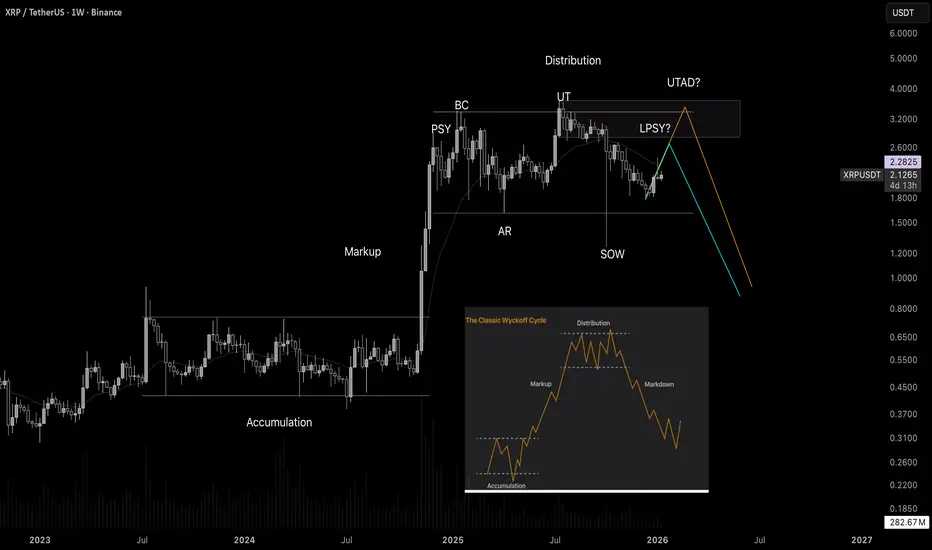
The XRP chart is like from a textbook! Wyckoff tutorialWelcome! When finance professionals are watching, you can expect solid analytics and real education.
Today we’re going to break down Wyckoff market cycles using the XRP chart in real time.
Wyckoff cycles are not just theory - they are an established concept that works in all markets. This is a model of price behavior based on the actions of large players ("smart money"). It shows how professionals accumulate positions, drive the market, and distribute assets, creating repeating phases of growth and decline.
Any market moves cyclically. Wyckoff identified two major cycles:
Bull market cycle (Accumulation → Markup → Distribution → Markdown)
Bear market cycle (the mirror reflection of the first)
Each cycle consists of four phases:
-Accumulation
-Markup (Growth)
-Distributio
-Markdown (Decline)
Phase 1. Accumulation
This is the phase when "smart money" buys the asset in large volumes while trying not to push the price too high. Conditions are created where regular market participants do not want to buy the asset, and may even sell it near market lows. Usually during this period there is bad news, lack of confidence, etc. Large players quietly buy up all this negativity.
Phase 2. Markup (Growth)
An impulsive upward movement begins - a trend that everyone notices when it is already too late. The crowd starts to wake up and enters the market at high prices.
Phase 3. Distribution
The price again enters a trading range, but now major participants sell their positions to retail traders who come in euphoric after the rise. Usually, the news is excellent here, everyone expects further growth, there is general euphoria, people load into the asset to the maximum while large players quietly unload their positions.
Phase 4. Markdown (Decline)
Professionals have sold everything they wanted, and now the market goes down almost without resistance. Retail - back to the factory.
EURJPY smart money is here!Hi! A financier is at the screens - today I’ll show you the trade I entered.
In front of us is the EURJPY chart.
First, it’s worth noting that the inverse chart JPYEUR looks very weak. This tells us that the euro is indeed stronger now, and we may see growth.
Second, in mid-December we had a similar structure. I’ve highlighted these structures with a blue rectangle.
Inside these rectangles, an accumulation schematic based on Wyckoff formed. This suggests that we have potential for a reversal and solid upside. It’s also worth noting that the structures are similar to each other and exhibit fractality.
So overall, I opened a long position, aiming to trade it up to the high where we have a liquidity shelf.
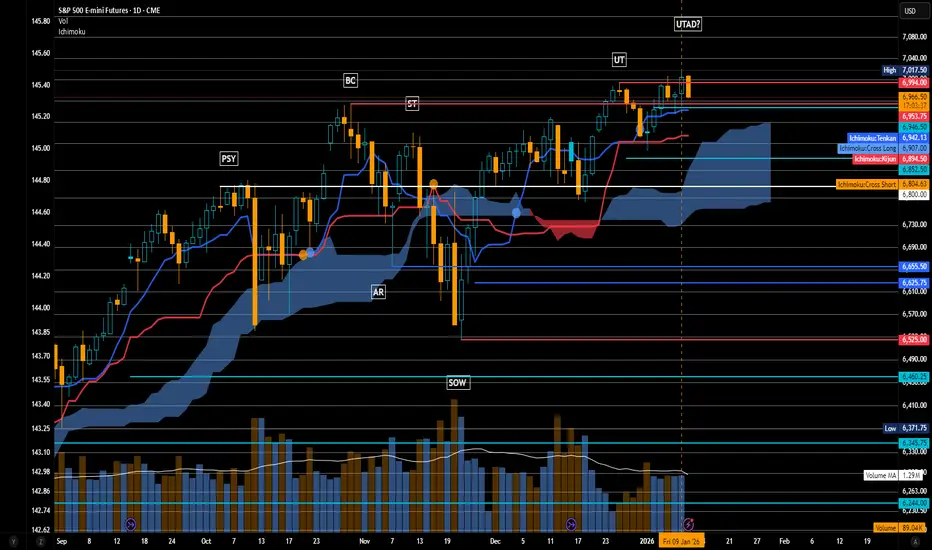
SPX/ES - Bayesian Market thesis 📊 SPX / ES — Bayesian Market Thesis (Academic Summary)
🎯 Objective
Frame current market conditions using a probabilistic research process, not directional prediction, with emphasis on regime identification and invalidation logic.
🧠 Research Methodology (High-Level Transparency)
Our process integrates multiple, independent analytical domains into a single probabilistic view:
Probabilistic inference
We evaluate competing market regimes and assign likelihoods that update as new information emerges.
Market structure analysis (Modern Wyckoff)
Focus on acceptance vs rejection, testing behavior, and transitions between accumulation, markup, distribution, and markdown.
Flow & derivatives context
Options-related positioning and transaction flow are used to understand how positioning may shape price behavior, not to forecast direction.
Classical technical structure
Trend quality, range behavior, and relative location within recent value are used as structural constraints.
These inputs are cross-validated. No single signal determines the thesis.
🧱 Current Structural Context (Wyckoff Lens)
Price is operating near upper range boundaries
Multiple high-area tests with reduced follow-through
Structure consistent with late markup transitioning into distribution risk
➡️ Upside continuation is conditional, not assumed.
📐 Bayesian Scenario Assessment
Probability-weighted view (dynamic):
Regime Probability Characteristics
🔴 Distribution / Downside Rotation ~60–65% Failed acceptance, rotational volatility
🟢 Bullish Continuation ~35–40% Requires sustained acceptance above highs
Probabilities adjust as price resolves uncertainty.
🚦 Invalidation Criteria (Bullish Reassessment)
The current thesis is invalidated only by structural confirmation, not isolated price excursions.
Required conditions:
Sustained acceptance above range highs
Higher high followed by a higher low holding above prior resistance
Expansion in range and follow-through consistent with demand-led control
Absent these, upside moves are treated as tests, not confirmations.
🧭 Interpretation Guidance
This is a location- and regime-based assessment
Elevated prices increase sensitivity to invalidation signals
Risk management outweighs conviction in late-cycle structure
🧩 Closing Note
This framework is designed to continuously update expectations, not predict outcomes.
Markets resolve uncertainty first — direction follows.
The Wyckoff Trading MethodThe Wyckoff Trading Method
The Wyckoff Method is a classical approach to market analysis designed to help traders understand trend development, market cycles, and potential reversals. Despite being developed over a century ago, it remains highly relevant in modern financial markets and is widely used across stocks, forex, and cryptocurrencies.
What Is the Wyckoff Method?
The Wyckoff Method is a form of technical analysis created in the early 20th century by Richard D. Wyckoff, a pioneering trader and market analyst. The core idea behind this method is that price movements are governed by supply and demand, and that large institutional participants (often referred to as “composite operators”) leave identifiable footprints on the chart.
Wyckoff believed that by studying price, volume, and time, traders could anticipate future price behavior rather than react to it.
Core Principles of the Wyckoff Method
The Wyckoff methodology is built around several foundational concepts:
1. Supply and Demand
Price rises when demand exceeds supply and falls when supply exceeds demand. Observing how price responds to changes in volume helps traders identify who is in control of the market.
2. Market Structure and Phases
Markets move in recurring cycles, typically broken down into:
- Accumulation
- Markup
- Distribution
- Markdown
Recognizing these phases allows traders to align with institutional activity rather than trade against it.
3. Price and Volume Relationship
Volume acts as a confirmation tool. Strong price movement with weak volume often signals exhaustion, while strong volume supports trend continuation.
4. Liquidity and Institutional Behavior
The method emphasizes how large players accumulate or distribute positions over time, often through range-bound price action designed to absorb liquidity.
The Market Cycle
The Wyckoff Market Cycle
The Wyckoff methodology describes market behavior as a repeating four-phase cycle driven by supply and demand. These phases help traders understand where the market is in its process, rather than simply reacting to price movements.
Accumulation Phase
Accumulation typically appears as a range-bound market after a decline. During this phase, large institutional participants quietly build long positions while price remains relatively stable. To most traders, the market appears directionless, but in reality, buying is taking place without pushing price higher. The true intent of the market is concealed until accumulation is complete.
Markup Phase
Once sufficient long positions have been accumulated, institutions begin to drive price higher. This phase is characterized by a clear uptrend as increased demand attracts additional buyers. Breakouts from accumulation ranges often trigger momentum traders and breakout strategies, reinforcing the trend. Markups may include re-accumulation phases, where price pauses and consolidates before continuing higher.
Distribution Phase
Distribution occurs after an extended advance, when upward momentum begins to slow. During this phase, large players gradually offload long positions and build short exposure. Price often moves sideways in a range, giving the illusion of stability, while smart money exits positions. This phase prepares the market for the next directional move lower.
Markdown Phase
The markdown is the declining phase that follows distribution. Selling pressure overwhelms demand, leading to a sustained downtrend. As price falls, traders are encouraged to enter short positions, further accelerating the move. Similar to markups, markdowns may include redistribution phases, where price consolidates before continuing lower.
Why the Wyckoff Model Works
Large financial institutions must execute trades of significant size, which requires liquidity. Liquidity is often found around stop losses, breakout levels, equal highs and lows, and key support or resistance zones. By intentionally pushing price into these areas, institutions can fill large orders efficiently without excessive slippage. This interaction between liquidity and market psychology forms the foundation of the Wyckoff model across all asset classes.
Core Principles of the Wyckoff Method
A key concept in Wyckoff theory is the Composite Man, a symbolic representation of institutional or “smart money” participants. Traders are encouraged to analyze price action as if a single, highly informed entity is controlling the market. The Composite Man accumulates or distributes positions strategically before allowing price to trend.
The Law of Supply and Demand explains that price rises when demand exceeds supply and falls when supply exceeds demand. The Law of Cause and Effect states that the size and duration of accumulation or distribution determine the magnitude of the subsequent price move, with higher-timeframe structures producing larger effects. The Law of Effort versus Result compares volume (effort) with price movement (result), highlighting potential trend continuation or exhaustion when these two factors diverge.
Wyckoff Schematics
Wyckoff schematics visually represent accumulation and distribution structures. Although these patterns may appear complex at first, they are mirror images of each other, with accumulation and distribution sharing identical phases and logic—only inverted. Studying these schematics helps traders recognize institutional behavior and align their trades with the dominant market process.
Type 1 Schematics
Accumulations
Phase A: Stopping the Downtrend
Phase A marks the transition from a markdown to the beginning of accumulation, where selling pressure starts to weaken.
- Preliminary Support (PS) : After a prolonged decline, initial buying emerges and temporarily halts the downtrend. Volume increases as early demand appears, signaling that selling pressure is no longer dominant.
- Selling Climax (SC) : Panic selling accelerates as long positions are stopped out and breakout traders enter short positions. At this point, the Composite Man absorbs this excess supply. The SC often leaves long lower wicks, reflecting strong buying interest.
- Automatic Rally (AR) : Once selling pressure is exhausted, price rebounds quickly as shorts cover and new buyers step in. The high of the AR establishes the first resistance boundary of the accumulation range.
- Secondary Test (ST) : Price revisits the SC area to test remaining supply. This test may form equal or slightly higher/lower lows, usually with reduced volume, confirming that selling pressure has diminished.
Phase B: Building the Cause
Phase B is where accumulation develops over time. The Composite Man continues to build long positions while price fluctuates within a range.
- Sign of Strength in Phase B (SOS(b)): In some cases, price rallies above the AR, creating a higher high within the range. This move suggests improving demand but still remains below preliminary resistance.
- Secondary Test in Phase B (ST(b)): A sharp decline follows, designed to trigger stop losses below prior lows and attract breakout sellers. This “liquidation” move provides the liquidity institutions need to continue accumulating, forming the underlying cause for the next trend.
Phase C: The Final Shakeout
Phase C is the critical phase that distinguishes accumulation from continuation lower.
- Spring: Price makes a final push below established support, sweeping remaining stop losses and trapping late sellers. This move briefly violates the range before quickly reversing.
- Test: After the Spring, price retests the area to confirm that supply has been fully absorbed. These tests typically form higher lows and occur on lower volume, signaling reduced selling interest.
Phase D: Transition to Markup
Phase D confirms that accumulation is complete and the market is ready to trend higher.
- Last Point of Support (LPS): Following the test and a rally, price pulls back shallowly, forming a higher low. This pullback reflects strong demand and is often the final opportunity before markup.
- Sign of Strength (SOS): Price breaks above the accumulation range with expanding volume, confirming bullish control. After this breakout, the market enters the markup phase, where the effect of prior accumulation is realized through sustained upward movement.
Distributions
Phase A: Stopping the Uptrend
Phase A marks the transition from an uptrend into distribution, where demand begins to weaken and supply quietly enters the market.
- Preliminary Supply (PSY) : After a sustained advance, large operators start unloading positions, causing the first noticeable pause or pullback in price.
- Buying Climax (BC): Buying pressure reaches an extreme as late buyers enter aggressively, often accompanied by very high volume. This is where smart money sells into strength.
- Automatic Rally (AR): Once buying is exhausted, price pulls back sharply as demand fades. The AR typically forms below the BC and defines the first support boundary of the distribution range.
- Secondary Test (ST): Price revisits the BC area to test remaining demand, usually failing to make a new high. Volume is generally lower, indicating reduced buying interest and building liquidity for later phases.
Phase B: Building the Distribution
Phase B is where the Composite Man continues distributing positions while price fluctuates within a range.
- Sign of Weakness in Phase B (SOW(b)): A decline below the AR signals that supply is beginning to dominate. This move does not always appear, but when it does, it establishes a second support boundary.
- Upthrust (UT): Price briefly breaks above resistance to trigger buy stops and attract breakout buyers. This false breakout allows institutions to sell into increased demand and build short exposure.
Phase C: The Final Liquidity Grab
Phase C completes the distribution process by targeting remaining demand.
- Upthrust After Distribution (UTAD): Similar to a Spring in accumulation, UTAD is the final false breakout above resistance. It is designed to capture the last wave of liquidity before the true bearish move begins.
- Test: Price often revisits the UTAD area to confirm that demand has been fully absorbed. These tests typically occur on lower volume, signaling weakening bullish participation.
Phase D: Transition to Markdown
Phase D confirms that distribution is complete and bearish control is established.
- Last Point of Supply (LPSY): After price begins to decline, weak rallies attempt to test demand. These rallies are shallow and usually represent the final bullish reactions before the markdown.
- Sign of Weakness (SOW): Price breaks decisively below the range, confirming a bearish structure. Additional LPSYs may form, but this phase marks the final transition into the markdown.
Type 2 Schematics
Type 2 Wyckoff schematics contain the same structural components as Type 1, but without a Spring (in accumulation) or a UTAD (in distribution). In these cases, the market does not perform a final liquidity sweep before trending.
A Type 2 schematic can be identified by observing a direct transition into trend confirmation:
- In accumulation, price forms a Secondary Test (ST) and possibly an ST(b), then proceeds directly into a Sign of Strength (SOS) followed by markup.
- In distribution, price forms an ST or Upthrust (UT), then transitions directly into a Sign of Weakness (SOW) followed by markdown.
If markup or markdown begins without a Spring or UTAD, the structure should be classified as Type 2. Importantly, Type 2 schematics are traded using the same principles and execution logic as Type 1 structures.
The Five-Step Wyckoff Trading Strategy
Richard D. Wyckoff proposed a structured five-step approach to applying his methodology in real market conditions. This framework helps traders align with market structure and institutional intent.
1. Determine the Market Trend
Identify whether the broader market environment is bullish or bearish. Trading in alignment with the dominant trend increases probability.
2. Select a Suitable Market
Choose an asset or trading pair that clearly reflects the identified market trend and shows strong structural clarity.
3. Identify Accumulation or Distribution
Focus on assets that are currently forming a Wyckoff accumulation or distribution structure rather than those already trending.
4. Assess Readiness for a Move
Analyze the current Wyckoff phase and volume behavior. Events such as a Spring, UTAD, SOS, or SOW help confirm whether the market is prepared for markup or markdown.
5. Execute the Entry
Entries are commonly taken on Tests, Last Points of Support (LPS), or Last Points of Supply (LPSY), where risk can be controlled and structure is clear.
Does the Wyckoff Method Still Work?
- Despite being developed nearly a century ago, the Wyckoff Method remains highly relevant in modern markets. Its core principles supply and demand, market structure, volume analysis, and liquidity behavior are universal and apply across forex, stocks, commodities, and cryptocurrencies.
- When combined with complementary tools such as support and resistance, indicators, or pattern analysis, Wyckoff can form the foundation of a robust and disciplined trading approach. Its enduring value lies in teaching traders how markets move, not just where price is going.
Educational Disclaimer
This material is provided for educational purposes only. It reflects a general interpretation of the Wyckoff methodology and should not be considered financial advice, investment recommendations, or an offer to trade. Traders should always conduct their own analysis and manage risk responsibly.
EURUSD analyticsAfter the downward movement on the chart, there was an upward wave. It began with the formation of an order block at the bottom. Then we saw a return to the order-block zone with a strong bullish candle.
In addition to this, I also see potential Wyckoff accumulation here, which can also reverse the price.
I expect a move toward the upper order block during this week.
Relief rally Inbound? IMX is shaping up for a potential reversal.
After the aggressive October 10 sell‑off, price responded with a clean Automatic Rally (AR) before rolling over into a controlled pullback. This latest dip appears to be sweeping the October 10 lows, and the December 19 bullish engulfing candle is the first meaningful sign of demand stepping back in.
Crucially, price closed back inside the prior range, which keeps the structure constructive. While heavier volume on the reversal would’ve added confidence, the low‑volume nature of the sweep actually supports a spring narrative — supply has been drying up for weeks, and there’s been no evidence of aggressive selling pressure. That’s exactly what you want to see heading into a potential Wyckoff spring.
Trade Scenario
Initial TP would be just below the range EQ which lines up with the yearly pivot and 50% of the range retracement. From here, if the price can close, hold and form higher lows above this level, would strongly suggest that a bottom is in. The next meaningful upside target sits around $0.58, where prior resistance and structural alignment converge.
Market Context
A surprising number of alts are printing similar spring‑like structures right now:
• Washed‑out lows
• Diminishing volume
• Reclaims back into range
• Early signs of demand returning
Relief Rally Inbound? S is shaping up for a potential reversal.
After the aggressive October 10 sell‑off, price responded with a clean Automatic Rally (AR) before rolling over into a controlled pullback. This latest dip appears to be sweeping the October 10 lows, and the December 19 bullish engulfing candle is the first meaningful sign of demand stepping back in.
Crucially, price closed back inside the prior range, which keeps the structure constructive. While heavier volume on the reversal would’ve added confidence, the low‑volume nature of the sweep actually supports a spring narrative — supply has been drying up for weeks, and there’s been no evidence of aggressive selling pressure. That’s exactly what you want to see heading into a potential Wyckoff spring.
Trade Scenario
Initial TP would be just below the range EQ which lines up with the yearly pivot and 50% of the range retracement. From here, if the price can close, hold and form higher lows above this level, would strongly suggest that a bottom is in. The next meaningful upside target sits around $0.16593, where prior resistance and structural alignment converge.
Market Context
A surprising number of alts are printing similar spring‑like structures right now:
• Washed‑out lows
• Diminishing volume
• Reclaims back into range
• Early signs of demand returning
Relief Rally Inbound? VET is shaping up for a potential reversal.
After the aggressive October 10 sell‑off, price responded with a clean Automatic Rally (AR) before rolling over into a controlled pullback. This latest dip appears to be sweeping the October 10 lows, and the December 19 bullish engulfing candle is the first meaningful sign of demand stepping back in.
Crucially, price closed back inside the prior range, which keeps the structure constructive. While heavier volume on the reversal would’ve added confidence, the low‑volume nature of the sweep actually supports a spring narrative — supply has been drying up for weeks, and there’s been no evidence of aggressive selling pressure. That’s exactly what you want to see heading into a potential Wyckoff spring.
Trade Scenario
Initial TP would be just below the range EQ which lines up with the yearly pivot and 50% of the range retracement. From here, if the price can close, hold and form higher lows above this level, would strongly suggest that a bottom is in. The next meaningful upside target sits around $0.0194, where prior resistance and structural alignment converge.
Market Context
A surprising number of alts are printing similar spring‑like structures right now:
• Washed‑out lows
• Diminishing volume
• Reclaims back into range
• Early signs of demand returning
Nanocap Beast Poised for a Breakout?*Reuploaded - chart was recently deleted as I accidently used a paid indicator. However, this setup is looking really nice and still worth to follow. the analysis below is still relevant and now we wait to see how price reacts at the supply structure.
CZR is shaping up for a potential macro range breakout, and while the technicals are compelling, it's critical to acknowledge the elevated risk profile. As a nanocap, CZR demands disciplined risk management and precise position sizing.
Setup Options
Option 1: Aggressive Breakout Anticipation
Enter early if the current monthly candle closes above the yearly pivot ($0.26).
Stop Loss: $0.210 (tight and tactical).
Target: Initial TP at ~$0.70 (major supply zone), with full TP at the 100% macro range extension.
Option 2: Confirmation & Pullback Entry
Wait for a confirmed breakout and close above the range.
Enter on the first clean pullback.
Stop Loss: Based on structure formed during the pullback (can use the SL).
Target: Same as Option 1 — ~$0.70 and full range extension.
Option 3: Deeper Pullback & Reassessment
If price retraces deeper into the range, reassess the setup.
Look for signs of strength (e.g., volume spike, bullish divergence) before re-engaging particularly ~$0.135
This scenario may offer a better R:R if structure holds.
*please note arrows are not based on time analysis just market structure.
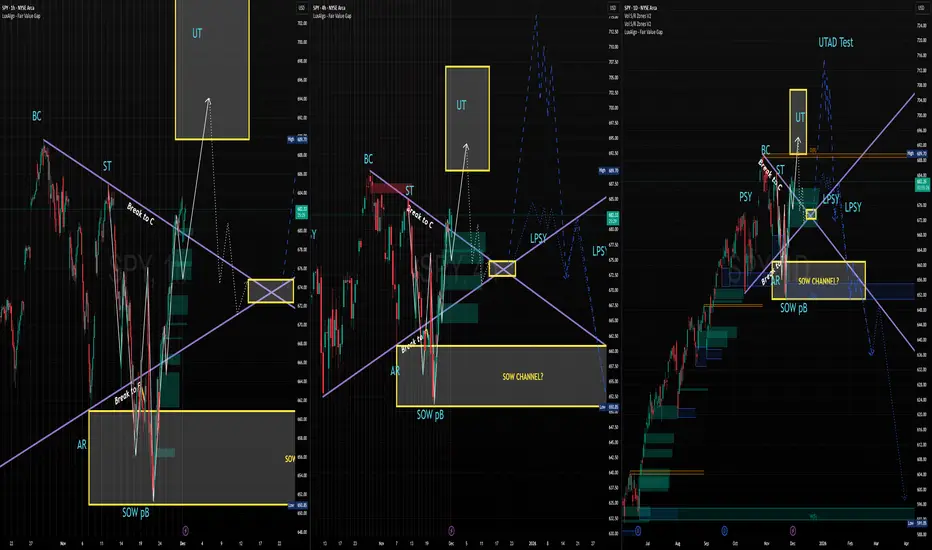
4H Long Term $SPY Wyckoff Distribution StructureThis idea is an updated and more simplified chart to show current structure that has build out on the 4H chart from the multi-timeframed chart I had in a previous idea -
As the title states, we have a Wyckoff distribution method/pattern in play here on the chart.
So far the set up and pattern has been pretty on-point if you take a look and analyze Wyckoff Methods from www.wyckoffanalytics.com
.
I don't have a ton of additional analysis to add here. I am only analyzing the chart and indicators I have. However, I'd love to hear some additional feedback for contrasting opinions or agreeing opinions for some confluence.
I'll add that two weeks later from the original idea, the structure, important support / resistance zones, and volume at those areas in the structure strengthens my opinions on validity of what is forming here.
This is still too early in the pattern / structure to play any moves based solely on this idea. In my opinion we are likely in the latter half of Phase B and this will take some patience to play out if you find conviction in it.
I am being patient and playing what the market gives me on an intra-day and intra-week basis while keeping this chart in the back of my mind.
I'm still early in my trading and TA journey (began January of this year) and I'm still learning but I thought I'd share an idea with the TV community that I have been keeping my eye on and trying to learn more about.
Thanks for your time and as stated in my other idea, it is always great to hear feedback for contrasting opinions or agreeing opinions for some confluence.
Long Term Wyckoff Distribution In-PlayAs the title states, we have a Wyckoff distribution method/pattern in play here on the chart.
So far the set up and pattern has been pretty on-point if you take a look and analyze Wyckoff Methods from www.wyckoffanalytics.com .
I don't have a ton of additional analysis to add here. I am only analyzing the chart and indicators I have. However, I'd love to hear some additional feedback for contrasting opinions or agreeing opinions for some confluence.
Have a great day TV gang and I hope you have a great December.
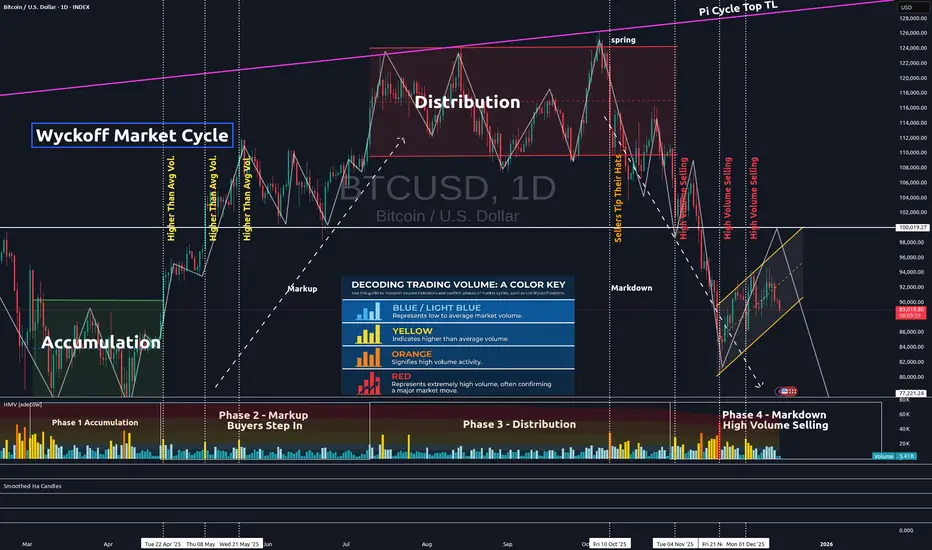
Confirming Chart Patterns With VolumeIn the chart above, one can clearly recognize the Wyckoff Market Cycle pattern. The pattern's legitimacy can be confirmed by volume. The volume is represented in the lower portion of the chart.
Low to average volume candles are blue. Average volume is indicated by light blue candles. Yellow candles represent higher than average volume. Orange is high volume. And red represents extremely high volume.
You will see each phase of the Wyckoff Market Cycle pattern confirmed by this volume on our current Bitcoin chart.
First, the market enters the accumulation phase. Market volume is fairly high, as seen in the accumulation quadrant in the lower left on the chart. However, it is important to note that there is an equal distribution of high-volume selling days as there are high-volume buying days. Thus, price tends to trend sideways within the channel until the true buying power comes into action.
Next, the buyers step in and take the price higher. This is generally indicated by a high-volume day when the price breaks above the accumulation channel. When buyers step in, most of the yellow and orange volume candles are, in fact, buyers in the markup phase. You can verify this is true by lining these higher-than-average volume candles up with the green price candles on the Bitcoin chart. This indicates the markup phase has begun and is underway.
Then, we come to the distribution phase on our chart. Notice the volume in that 3rd quadrant, the distribution quadrant. It is mostly average volume. Institutional sellers are attempting to carefully exit quietly. But you can also see that near the end of the distribution phase, sellers are starting to step in, tipping their hats and indicating that the distribution phase is about to end.
Finally, sellers take back full control, dropping us from the distribution channel altogether. High volume selling confirms this move and the pattern. The final quadrant in the bottom right proves that mostly sellers have control, as the majority of higher volume candles (yellow, orange, and red) are credited to the sellers.
Our Wyckoff Market Cycle pattern is now confirmed, and further selling can be expected until volume is once again taken back by the buyers. One will need to see clearly that high-volume candles are in line with green price candles. In this chart, that is not yet the case. Thus, more selling should be expected until it is clearly evident that buyer command control once again.
Hope you found this brief educational write-up informative and helpful, as volume can often be utilized in many uncertain pattern formations to find pattern legitimacy and confirmation.
✌️Stew
MRK 1H Conservative Short SwingTradeConservative Trade
+ short impulse
+ 1/2 correction
+ BUI test level (exhaustion volume?)
+ weak approach
+ biggest volume Ut?
+ weak test
+ first bearish bar close entry
Calculated affordable virtual stop
(bought puts)
1 to 2 R/R take profit
1D Trend
"+ short impulse
+ short volume distribution
+ neutral zone 2"
1M Trend
"+ short impulse
+ 1/2 correction
+ resisting bar level
+ resistance level
- strong approach from far
+ volumed manipulation bar"
1Y CounterTrend
"+ long impulse
+ 1/2 correction"
KLCI CONTINUE TO SELLThis is an update from my previous post
-Kindly refer to the link attached
Persistent weakening, Dominating tape of Weakness from Leaders.
I view all rallies as nothing more than a 'counter-trend' rally, in which ,
spots for the institutions to sell their positions
Bar @ 28/11/25 (red arrow), formed A spring-type action [/b ].
Penetrated the Ice-Line (bold black line)
- given today's incomplete bar (1/12/25), im still humbly bearish on market.
no position at the moment, 100% cash sitting.
Until condition improve, im sitting tight awaiting next opportunity.
In a Bear market, weakness beget more weakness
i always reminding myself : do not be confuse . As strength in weakness, during bear market, is different as compared to, strenght in weakness, during bull market.
**TradingView doesnt provide vol data for KLCI. Need to refer other source.
AMC Accumulation I believe NYSE:AMC has been in a large accumulation starting around April 24'. The most recent break below the range on decreasing volume leads me to believe we are in Phase C. In order for this to be a Spring, we need to see strong volume come into the upside to break back into the range and a test of Supply. A break above Supply would be a Sign of Strength. (SOS) While many scream fundamentals, I choose to trade the chart. With that said, a strong Q4 could flip net profit positive. (HUGE) I see deep value in AMC if they can pull off profitability in Q4. This is just my opinion and what I see on the chart. I am focused on the Wyckoff events and phases. As far as timing, I wish I could remove the dates below the chart. This is my thesis.
Originally posted on Nov. 19th. Had to remove due to educational link to external source explaining what accumulations and distributions are.
KLCI CONTINUE SELLThis is continuation from my previous thesis :
-Kindly refer to the link attached
As been mentioned, i look the level of 1640-1676 as probably be the end for 2025
Given the pathological and continuous soaring 'sepsis' of market leaders, i dont see any reason to get in :
-volatily around springboard too wide
-paroxysmall huge supply at any given time
-failure of 'Stage-Reversal'
-surge of laggards
I was forced to be cash since late October-Early Nov
In the mean time, my few last dipping toes didnt make any dime
I learned earlier that, during hard-ringgit times, i will just let others fighting for it.
meanwhile, i am sitting, disclipne, waiting for the easy-ringgit moment.
Quiet Strength Beneath the NoiseWhile the broader crypto sentiment leans bearish, TRB/BTC is quietly carving a bullish structure that deserves attention. The October flash dump printed a textbook Spring extreme volatility, yes, but the wick down only saw 32k in volume compared to the 549k on the Selling Climax. That’s a low-volume Spring, which typically signals strength. Don’t expect price to revisit that wick in any meaningful way.
Phase B is showing classic reaccumulation traits: price pulling back on declining volume, small overlapping candles, and no real selling pressure from smart money. It’s quiet, but it’s telling.
Trade Scenario
Note, this isn’t about USD strength it’s about TRB outperforming BTC. That distinction matters. You’re not chasing a pump, you’re positioning for relative strength.
Stop Loss
• Clean invalidation sits below the Spring. Yes, it’s a deep wick, but if we print a monthly higher swing low, SL can be tightened or adjusted to the weekly TF.
Take Profit
• TP1: Just below the EQ of the range.
• TP2: Near range highs.
• TP3 (trail): Use monthly higher swing lows to trail toward the minimal range high. It’s a stretch target, but the chart shows it. No bias, just structure.