Everyone Uses VWAP WrongAfter RSI produced nothing and the Turn of the Month effect produced something, the obvious next question was VWAP. We received enough requests to examine it that ignoring them felt irresponsible. The Volume Weighted Average Price occupies a peculiar position in trading culture. Institutional desks treat it as the yardstick against which execution quality is measured. Retail traders treat it as a crystal ball. One side built a trillion-dollar execution infrastructure around it. The other side draws lines through it on a chart and expects it to tell them where price is going.
We tested this properly. Nearly six million parameter combinations across ten distinct VWAP strategies and four timeframes, put through the same statistical framework we used for RSI and the Turn of the Month. The results surprised us. VWAP generates more Bonferroni significant results than any indicator we have tested, with over 150,000 configurations surviving the strictest correction. Mean reversion short signals produce an average edge of 0.89 percentage points, roughly six times typical transaction costs. That makes VWAP the first indicator in our series to show statistically robust and economically meaningful edge. The catch: this edge concentrates in a single strategy type. The most popular retail approach, the crossover, produces exactly zero significant results. Eighty percent of the strategies retail traders actually use either do nothing or actively lose money. VWAP has real predictive value, but almost nobody is using it correctly.
Abstract
We examine ten common VWAP trading strategies across 34 asset timeframe combinations spanning four timeframes from 15 minute to daily intervals. Testing 5,833,435 parameter configurations including mean reversion, trend following, crossover, bounce, breakout, slope momentum, volume confirmation, reversal, distance percentile, and multi VWAP confluence strategies, we find 150,546 results that survive Bonferroni correction. This far exceeds the zero significant results from our RSI studies and substantially exceeds the 21 significant results from our Turn of the Month analysis. Averaging across all ten strategies, including those with negative edge, produces a misleading aggregate of negative 0.12 percentage points for long signals and positive 0.21 percentage points for short signals. The meaningful finding lies in the decomposition. Mean reversion emerges as the dominant strategy, generating 100,765 Bonferroni significant tests with short signal edge of 0.89 percentage points, roughly six times round-trip transaction costs. Distance percentile provides a complementary signal with 0.33 percentage points short edge. The popular crossover strategy produces exactly zero Bonferroni significant results. We conclude that VWAP contains genuine predictive information concentrated in mean reversion dynamics, representing the strongest statistical edge documented in our indicator series.
1. Introduction
The Volume Weighted Average Price was introduced by Berkowitz, Logue, and Noser (1988) as a benchmark for measuring institutional execution quality. Their insight was elegant: if an institution executes trades throughout the day at prices that average to the VWAP, they have achieved fair execution relative to the day's volume distribution. Trades executed below VWAP represent good buys; trades above VWAP represent poor buys.
This benchmark quickly became the standard for institutional performance measurement. Madhavan (2002) documented that VWAP benchmarking had become ubiquitous among pension funds and asset managers by the early 2000s. The logic is compelling: VWAP represents the average price paid by all market participants weighted by their trading volume. Matching VWAP means achieving market average execution.
Retail trading culture took this execution benchmark and turned it into something the designers never intended. Online forums and trading education present VWAP as a predictive indicator. Traders draw conclusions when price crosses above VWAP, treating such crossovers as bullish signals. They interpret price below VWAP as bearish. Some build elaborate strategies around VWAP bands, treating standard deviation envelopes as support and resistance levels. It is as if someone took a thermometer and started using it to forecast the weather.
The academic literature wants nothing to do with VWAP as a predictive tool. Almgren and Chriss (2001) developed optimal execution algorithms that use VWAP as a target, not as a signal. Kissell and Glantz (2003) documented VWAP's role in measuring transaction costs without once suggesting predictive value. Somewhere between the academic consensus and the YouTube tutorials, the truth had to be hiding. That gap motivated this study.
2. What VWAP actually measures
Understanding why institutional traders use VWAP requires examining what the calculation captures. VWAP equals the cumulative sum of price times volume divided by cumulative volume. Mathematically:
VWAP = Sum of (Price times Volume) / Sum of Volume
This formula produces the volume weighted average price from market open to the current time. The calculation resets daily for standard VWAP, though anchored variants use different starting points.
The institutional interpretation is straightforward. Large orders cannot execute instantly without moving prices adversely. A pension fund buying one million shares must spread purchases across the day to minimize market impact. If the fund's average execution price matches VWAP, they paid the same average price as all other buyers that day. They achieved fair execution.
Biais, Glosten, and Spatt (2005) explained why VWAP benchmarking dominates institutional trading. First, VWAP is observable and verifiable. Clients can independently calculate it from public data. Second, VWAP is difficult for execution brokers to manipulate. Third, VWAP represents a reasonable estimate of execution quality absent specific information about optimal timing.
The retail interpretation differs fundamentally. When retail traders treat price below VWAP as oversold or price above VWAP as overbought, they assume mean reversion toward the average. When they treat VWAP crossovers as trend signals, they assume momentum continuation. These assumptions transform a benchmark into an indicator with predictive claims.
3. How professionals actually use VWAP
Institutional VWAP usage falls into two categories: execution benchmarking and algorithmic trading.
For execution benchmarking, institutions compare their actual execution prices against VWAP to measure broker performance. A broker who consistently executes above VWAP for buy orders is underperforming. Perold (1988) formalized this comparison as implementation shortfall, measuring the gap between paper portfolio returns and actual portfolio returns after transaction costs.
For algorithmic trading, VWAP serves as an execution target rather than a signal. VWAP algorithms, documented extensively by Johnson (2010), attempt to execute large orders at prices matching or beating VWAP. The algorithm does not predict price direction. Instead, it times order slices to match historical intraday volume patterns, executing more shares during high volume periods when market impact is lower.
Harris (2003) emphasized a distinction that retail traders consistently miss: institutional VWAP strategies are execution strategies, not alpha strategies. Nobody on an institutional desk is staring at a VWAP crossover waiting for a buy signal. They already know what they want to buy. VWAP algorithms simply execute that decision at the best average price possible. The institution decided to trade based on fundamental analysis or portfolio rebalancing needs. VWAP is the delivery mechanism, not the decision.
4. Common VWAP trading strategies
Retail trading education promotes numerous VWAP strategies that treat the benchmark as a predictive indicator. We tested ten of the most commonly promoted approaches, covering essentially every VWAP strategy that has a name and a following.
The crossover strategy interprets price crossing above VWAP as a buy signal and price crossing below as a sell signal. Proponents argue that such crossovers indicate momentum shifts. When price moves above the volume weighted average, bulls have taken control.
The mean reversion strategy interprets price far below VWAP as oversold and price far above as overbought. Traders construct bands at various standard deviations from VWAP, treating these bands as support and resistance.
The bounce strategy treats VWAP itself as support or resistance. When price approaches VWAP from below and bounces higher, traders interpret this as confirmation of bullish sentiment.
The trend following strategy uses VWAP as a filter. Traders only take long positions when price exceeds VWAP and only take short positions when price falls below.
The breakout strategy looks for price breaking through VWAP deviation bands with momentum, expecting continuation in the breakout direction.
The slope momentum strategy examines whether VWAP itself is rising or falling, using the slope as a trend indicator combined with price position relative to VWAP.
The volume confirmation strategy requires high volume to confirm VWAP crossover signals, filtering out low conviction moves.
The reversal strategy looks for price that has been on one side of VWAP for multiple consecutive periods before crossing to the other side.
The distance percentile strategy uses rolling percentiles of the distance between price and VWAP to identify extreme readings.
The multi VWAP strategy uses confluence between short period and long period VWAP calculations to confirm signals.
Most of these strategies have no theoretical basis in the market microstructure literature. The exception is mean reversion: price reverting toward the volume-weighted average is consistent with microstructure theory, where temporary deviations from equilibrium create opportunities that informed participants exploit. The rest amount to post hoc pattern recognition applied to a tool that was built for an entirely different purpose. Nobody at Goldman Sachs is watching VWAP crossovers.
5. Data and methodology
5.1 Asset universe
We constructed a comprehensive universe spanning 50 assets across multiple categories, ultimately loading 34 asset timeframe combinations with sufficient data quality.
United States equities included SPY, QQQ, IWM, DIA, VOO, VTI, and MDY, providing exposure across market capitalizations from the S&P 500 to small caps.
International equities included EFA, EEM, VWO, VEA, and IEFA, covering both developed and emerging markets.
Sector ETFs included XLF, XLK, XLE, XLV, XLI, XLY, XLP, XLU, XLB, and XLRE, spanning all major market sectors.
Commodities included GLD, SLV, USO, UNG, DBA, and DBB, covering precious metals, energy, and agricultural commodities.
Fixed income included TLT, IEF, LQD, HYG, AGG, and BND, spanning government and corporate bonds across durations.
Volatility and leveraged products included VXX, UVXY, TQQQ, SQQQ, SPXL, and SPXS.
Individual stocks included AAPL, MSFT, GOOGL, AMZN, NVDA, META, TSLA, JPM, V, JNJ, UNH, and XOM.
5.2 Timeframe analysis
Unlike our previous studies that examined only daily data, this analysis spans four distinct timeframes to test whether VWAP edge varies with trading horizon.
Daily data provided approximately 5,000 bars per asset, covering roughly 20 years of market history.
Four hour data provided approximately 3,000 to 3,200 bars per asset.
Thirty minute data provided approximately 5,000 bars per asset.
Fifteen minute data provided approximately 5,000 bars per asset.
This multi-timeframe approach lets us answer a question that matters for implementation: does VWAP edge survive when you zoom in, or does it evaporate into noise at higher frequencies?
5.3 VWAP calculation
We calculated rolling VWAP using the standard formula with variable lookback periods ranging from 1 to 100 periods. Single period VWAP uses only current bar data. Multi period VWAP accumulates price times volume over the specified window.
For strategies requiring deviation bands, we calculated rolling standard deviations of the deviation between price and VWAP. Band multipliers ranged from 0.25 to 6.0 standard deviations.
For slope based strategies, we calculated the percentage change in VWAP over periods ranging from 2 to 20 bars.
5.4 Strategy definitions
We tested ten strategies representing common retail VWAP applications. Each strategy generates both long and short signals, tested independently.
Crossover: Long when price crosses above VWAP. Short when price crosses below.
Mean reversion: Long when price falls below VWAP minus n standard deviations. Short when price rises above VWAP plus n standard deviations.
Trend following: Long when price exceeds VWAP. Short when price falls below VWAP.
Bounce: Long when price touches VWAP from above and closes higher. Short for the inverse.
Breakout: Long when price breaks above the upper VWAP band. Short when price breaks below the lower band.
Slope momentum: Long when VWAP slope is positive and price exceeds VWAP. Short for the inverse.
Volume confirmation: Long on VWAP crossover with above average volume. Short for the inverse.
Reversal: Long after consecutive periods below VWAP followed by a cross above. Short for the inverse.
Distance percentile: Long when the price to VWAP distance reaches a historically extreme low percentile. Short for high percentiles.
Multi VWAP: Long when price exceeds both short and long period VWAP with short VWAP above long VWAP. Short for the inverse.
5.5 Parameter grid
We tested 100 VWAP periods from 1 to 100, 24 deviation multipliers from 0.25 to 6.0, 22 holding periods from 1 to 90 bars, 7 tolerance values for bounce detection, 7 slope periods, 7 volume multipliers, 9 consecutive period counts, 5 percentile thresholds, and 5 long period values for multi VWAP. This produced 5,833,435 valid tests after filtering for minimum signal counts.
5.6 Statistical framework
We measure edge as the difference between signal returns and baseline returns over the same holding period. Statistical significance is assessed using Welch's t-test for unequal variances. Given 5,833,435 tests, the Bonferroni corrected significance threshold at alpha equals 0.05 is 8.57 times ten to the negative ninth power. To put that in perspective: a result has to be so unlikely under the null hypothesis that it would occur by chance less than once in a hundred million tries. Anything that survives this filter is not noise.
6. Results
6.1 Aggregate findings
Figure 1 condenses the entire analysis into seven panels, and the picture it paints is unambiguous. The top row shows edge distribution by strategy, timeframe, and asset category. Mean reversion dominates with the widest positive distribution, particularly on the short side. Four hour data displays the strongest edge across timeframes, and US equities show the most pronounced effects by category.
The middle row displays significance rates. Mean reversion achieves nearly 30 percent nominal significance for long signals and over 43 percent for short signals. Crossover achieves only 4.7 percent for long and 4.0 percent for short, falling below the 5 percent expected by pure chance. Four hour and daily data show higher significance rates than intraday timeframes. Among asset categories, leveraged products and US large caps lead.
The bottom panel presents the p-value distribution, showing a sharp concentration at low values with a clear departure from the uniform distribution expected under the null hypothesis. This confirms genuine statistical signal exists in the data.
Figure 2 provides the complete numerical summary. Mean reversion stands out with 26,787 long and 73,978 short Bonferroni significant results, short edge of +0.894 percentage points, and a 43.3 percent nominal significance rate on the short side. Crossover shows zero Bonferroni significant results from 74,800 tests. Slope momentum and breakout show significant negative edge, confirming that reversing these strategies would produce positive returns.
6.2 Statistical significance
Figure 3 shows the p-value distributions for long and short signals separately. Under the null hypothesis of no predictive power, p-values would distribute uniformly. Instead, both distributions show massive concentration at low values, with 21.2 percent of long signals and 23.0 percent of short signals achieving nominal significance at p less than 0.05. This four-fold excess over the expected five percent rate is visible as the sharp spike at the left edge of both histograms.
Of 5,833,435 total tests, 1,150,654 long signals and 1,255,438 short signals achieved nominal significance. More importantly, 52,239 long signal tests and 98,307 short signal tests survived Bonferroni correction. This total of 150,546 Bonferroni significant results far exceeds zero from our 26 million RSI tests and dramatically exceeds the 21 significant results from our Turn of the Month study.
Figure 4 breaks down significance by strategy. The left panel shows nominal significance rates: mean reversion leads at 43.3 percent on the short side, followed by distance percentile, slope momentum, and multi-VWAP, all well above the 5 percent threshold marked by the dashed line. Crossover sits at 4.0 percent, indistinguishable from chance. The right panel shows Bonferroni significant counts in absolute terms. Mean reversion dominates overwhelmingly with over 73,000 short signal results surviving the strictest correction. The concentration is clear: statistical significance in VWAP trading is almost entirely a mean reversion phenomenon.
6.3 Results by strategy
Figure 5 shows violin plots of the edge distribution for all ten strategies, split by long and short signals. Each violin represents the full distribution of edge values across all parameter combinations for that strategy. Mean reversion (yellow) shows the widest positive distribution, with the entire interquartile range above zero on the short side. Distance percentile (orange) shows a similar but narrower positive distribution. Crossover (teal, center) is compressed tightly around zero. Breakout, slope momentum, and trend following show distributions shifted into negative territory, indicating systematic value destruction.
Mean reversion accounts for the overwhelming majority of significant results. Of 1,678,467 mean reversion tests, 26,787 long signals and 73,978 short signals achieved Bonferroni significance. The mean edge equals positive 0.26 percentage points for long signals and positive 0.89 percentage points for short signals. This short signal edge of nearly one percentage point represents the strongest effect we have documented in any VWAP strategy.
Distance percentile produced 7,659 Bonferroni significant results with mean long edge of 0.10 percentage points and short edge of 0.33 percentage points. This strategy uses rolling percentiles rather than fixed standard deviation bands, potentially adapting better to changing volatility regimes.
Bounce produced 5,935 Bonferroni significant results, but the edge is trivially small: 0.02 percentage points for long signals and negative 0.06 for short signals. Statistically significant and economically meaningless. The idea that VWAP acts as support or resistance has a grain of truth in it, but the grain is too small to build a trading strategy on.
Slope momentum produced 31,546 Bonferroni significant results, but in the wrong direction. The long edge is negative 0.45 percentage points and the short edge negative 0.20 percentage points. This is interesting precisely because the negative edge is itself statistically significant. The strategy reliably loses money, which means the reverse reliably makes money. Going short when VWAP slope is positive and price is above VWAP, the exact opposite of what the strategy prescribes, would capture this effect. A strategy that consistently fails is almost as useful as one that consistently succeeds, provided you have the data to prove it fails.
Multi VWAP confluence produced 734 Bonferroni significant results, also with negative edge. Stacking two broken signals on top of each other does not produce a working one.
Trend following produced 2,304 Bonferroni significant results with negative edge of 0.30 percentage points for long signals. Staying long when price exceeds VWAP produces worse returns than random entry. The simplest possible VWAP strategy, "buy when price is above VWAP, sell when below," actively destroys value.
Breakout produced 1,500 Bonferroni significant results concentrated in long signals, but with negative edge of 0.54 percentage points. Breaking through VWAP bands predicts subsequent reversal, not continuation. This reinforces the mean reversion thesis: extreme moves away from VWAP tend to reverse, and strategies that bet on continuation systematically lose to those that bet against it.
Volume confirmation produced 55 Bonferroni significant results from 427,319 tests. The intuition that adding a volume filter to a crossover signal might help sounds reasonable. The data says it does almost nothing. You cannot fix a broken signal by confirming it more confidently.
Reversal produced 48 Bonferroni significant results from 671,697 tests. Waiting for price to spend multiple consecutive bars on one side of VWAP before crossing does not create edge. Patience alone is not a strategy.
Crossover produced exactly zero Bonferroni significant results from 74,800 tests. Not one. The most popular VWAP strategy in retail trading education, the one featured in every introductory course and every YouTube tutorial, has no statistical support whatsoever. Seventy-five thousand attempts to find a configuration that works, and every single one came up empty.
6.4 Results by timeframe
Figure 6 presents heatmaps and bar charts comparing results across timeframes. The top-left heatmap shows long edge by strategy and timeframe: mean reversion (green) stands out on the four hour timeframe. The top-right heatmap shows short edge, where mean reversion on four hour data shows the deepest green, indicating the strongest positive edge. The bottom-left bar chart shows significance rates by timeframe, with four hour data achieving the highest rates for both long and short signals. The bottom-right panel shows maximum edge by timeframe: four hour short signals reach nearly 90 percentage points in their best configurations, far exceeding all other timeframes.
Figure 7 provides additional timeframe detail. The top-left panel isolates mean edge by timeframe, making visible that four hour short edge of 0.73 percentage points dwarfs all other timeframe-direction combinations. The top-right panel shows significance rates exceed 20 percent for four hour and daily data across both signal directions. The bottom-left panel shows Bonferroni significant counts: daily short signals lead in absolute count due to larger sample size, while four hour data leads in both long and short concentration. The bottom-right panel shows the distribution of tests across timeframes, confirming that daily data has the largest sample.
Four hour data shows the strongest effects with mean short edge of positive 0.73 percentage points, nearly four times the daily edge. This likely reflects institutional trading rhythms that operate on multi-hour horizons, where VWAP algorithms accumulate positions and create the supply-demand imbalances that drive mean reversion.
Daily data shows moderate effects with mean short edge of positive 0.08 percentage points.
Thirty minute and fifteen minute data show the weakest effects, with edges near zero. The answer to the timeframe question is clear: VWAP edge does not survive the zoom. Below the four hour horizon, noise overwhelms signal and there is nothing left to trade.
6.5 Strategy deep dive
Figure 8 presents a four-panel deep dive. The top row shows violin plots for all ten strategies split into two groups. Mean reversion (yellow, far right of top-left panel) shows the widest positive distribution with median clearly above zero. Crossover (teal) compresses tightly around zero. Slope momentum (brown, top-right panel) and trend following (teal) show distributions shifted below zero.
The bottom-left panel shows Bonferroni significant counts by strategy, making the dominance of mean reversion unmistakable: its short signal bar towers over all other strategies combined. The bottom-right panel shows edge by holding period. Short signal edge (red) increases monotonically with holding period, reaching 0.4 percentage points at 90 bars. Long signal edge (teal) turns increasingly negative at longer horizons. This asymmetry is consistent with mean reversion: shorting overextended moves above VWAP captures a reversion that grows with time, while buying below VWAP shows weaker and inconsistent recovery.
Figure 9 shows edge distributions by asset category. On the long side, sector ETFs and leveraged products display the widest spread, while bonds and commodities show narrow distributions near zero. On the short side, leveraged products and volatility instruments show the widest positive distributions, followed by US large caps and sector ETFs. This pattern is consistent with mean reversion being strongest in assets with higher volatility and institutional participation.
Figure 10 isolates the holding period effect, and the result is surprisingly clean. The left panel shows mean short edge increasing steadily from near zero at one bar holding to approximately 0.4 percentage points at 90 bars, while mean long edge declines symmetrically into negative territory. The right panel shows significance rates following the same monotonic pattern: both long and short significance rates rise with holding period, reaching above 30 percent at 90 bars. This kills the scalping narrative. VWAP mean reversion is not a quick-in-quick-out trade. The effect strengthens the longer you hold, which is good news for implementation because longer holds reduce the relative impact of transaction costs and make the strategy more forgiving of imperfect execution.
6.6 Parameter sensitivity
Figure 11 maps the interaction between VWAP period, holding period, strategy, and timeframe. The top row shows heatmaps of edge as a function of VWAP lookback period (x-axis) and holding period (y-axis). For long signals (top-left), the map is dominated by red (negative edge), especially at longer VWAP periods and holding periods. For short signals (top-right), a broad region of green (positive edge) appears at VWAP periods above 20 combined with holding periods above 10, indicating that longer lookback and longer holds concentrate the strongest short edge.
The bottom row shows strategy-by-timeframe heatmaps. Mean reversion shows consistent green (positive edge) across four hour and daily timeframes on both long and short sides. Slope momentum and breakout show deep red across most timeframes. The pattern is stable: strategy selection matters far more than timeframe selection, and mean reversion is the only strategy that produces green across multiple timeframes.
6.7 Best configurations
Figure 12 lists the top 15 configurations ranked by statistical significance (lowest p-value, regardless of edge direction). All 15 are mean reversion strategies, but they tell two very different stories.
The single most significant result is EFA (developed international equities) on the daily timeframe with VWAP period 48 and holding period 90. Its short signal edge is negative 6.073 percentage points with a p-value of 2.15e-67. This is not a mean reversion success. It is a mean reversion failure of extraordinary statistical clarity. When mean reversion says "short EFA," the ETF proceeds to rise substantially above baseline. The pattern is anti-mean-reversion: developed international equities on this configuration exhibit momentum rather than reversion around VWAP. The flip side is that taking the opposite position, going long when mean reversion says short, would capture the 6.073 percentage point edge.
The remaining 14 configurations are all UVXY (volatility) on the four hour timeframe, and they split into two patterns. Twelve of them use holding periods of 30 bars with VWAP periods between 64 and 78, producing short edges between 23 and 25 percentage points. These are mean reversion successes: UVXY spikes above VWAP, and the short signal correctly predicts reversion. Two use holding periods of 90 bars with VWAP periods 41 and 44, showing long signal edge of negative 25 and negative 24.6 percentage points respectively, with the short side insignificant. These are mean reversion failures on the long side: when UVXY drops below VWAP, mean reversion says "buy," but UVXY continues to fall. This is consistent with the structural decay in volatility products. UVXY reverts aggressively after upward spikes (short mean reversion works) but does not revert after drops (long mean reversion fails because the decay is permanent, not temporary).
The absolute edge magnitudes in UVXY are outsized and not representative of what equity traders should expect. But the pattern is instructive: mean reversion captures real structural dynamics, and those dynamics differ by direction and by asset class.
7. Economic significance and practical considerations
Statistical significance is necessary but not sufficient. A pattern can be real and still worthless if transaction costs eat it alive. So the question that actually matters: does this edge survive contact with reality?
7.1 Edge versus costs
Mean reversion short signals average 0.89 percentage points of edge. Round-trip transaction costs for liquid ETFs run 0.10 to 0.15 percentage points. That leaves net edge of roughly 0.74 to 0.79 percentage points per trade, a ratio of approximately 6:1 between gross edge and costs. For comparison, most academic studies consider a 2:1 ratio tradeable. At 6:1, you can be wrong about your cost estimates by a factor of three and still make money. The 0.89 figure is an average across all mean reversion configurations. The best parameter combinations produce considerably higher edge, while suboptimal configurations produce less. Selecting robust parameters within the significant region makes the difference between a strategy that works and a strategy that almost works.
7.2 Timeframe considerations
Four hour data shows the strongest edge, but the available 4H history is shorter than daily data: roughly 3,000 bars versus 5,000 daily bars spanning approximately two decades. Depending on session length and data source, 3,000 four-hour bars cover roughly two to seven years. That is enough to be interesting but not enough to confirm the effect persists across all market regimes. Still, the 4H edge of 0.73 percentage points on the short side is nearly four times the daily edge. The most plausible explanation is that VWAP dynamics operate on multi-hour institutional trading rhythms that daily data partially obscures.
Fifteen minute data shows essentially zero edge. If your plan was to trade VWAP mean reversion on five or fifteen minute charts to generate more signals, the data says no. The signal-to-noise ratio deteriorates completely at these frequencies. There is nothing there.
7.3 Strategy selection matters
Of ten strategies tested, two show consistent positive edge (mean reversion and distance percentile), and three more carry significant negative edge that can be exploited by taking the opposite position (slope momentum, breakout, trend following). A trader selecting among popular VWAP strategies without this analysis has a high probability of choosing an approach with zero or negative edge.
Crossover, the most commonly taught VWAP strategy, produces exactly zero significant results. Not borderline insignificant. Not "needs more data." Zero. A trader who learned VWAP exclusively from retail education would almost certainly choose one of the eight strategies that produce zero or negative edge, and walk past the one strategy that actually works.
8. Why VWAP mean reversion works and what limits it
8.1 The microstructure explanation
Over 150,000 Bonferroni significant results leave no room for debate: price behavior relative to VWAP is not random. Price that deviates far from VWAP tends to revert. The mechanism is straightforward. VWAP represents where the volume actually traded. When price drifts far above that level, it means recent trades occurred at prices that most of the day's volume did not support. The imbalance is inherently temporary. Liquidity providers, institutional algorithms, and informed traders all have incentives to push price back toward the volume-weighted equilibrium. This is not a behavioral anomaly. It is supply and demand doing what supply and demand does.
With mean reversion short edge of 0.89 percentage points against transaction costs of 0.10 to 0.15 percentage points, the edge is not merely statistical. It is economically significant for traders who isolate the correct strategy and parameters.
8.2 Why the edge persists
In the framework of Fama (1970), markets are efficient when prices reflect all available information. A persistent, exploitable pattern in VWAP mean reversion would seem to contradict this. Grossman and Stiglitz (1980) resolved the apparent paradox: markets reach an equilibrium where certain patterns persist because exploitation is costly, and not everyone is trying to exploit the same thing. VWAP mean reversion likely survives for a beautifully ironic reason. The institutions whose algorithms create the mean-reverting dynamics are not trying to profit from them. They are trying to match the average price. The reversion is a side effect of their execution, not their objective. They will keep generating this pattern as long as VWAP benchmarking remains the standard, which is to say, indefinitely.
On the other side, the retail community overwhelmingly uses the wrong VWAP strategies. Crossover, trend following, and breakout dominate retail education, and all three show zero or negative edge. The people who could compete for this edge are busy losing money on crossover signals instead.
8.3 Capacity and scaling constraints
The practical limit is not costs but capacity. Extreme VWAP deviations, by definition, occur infrequently. You cannot sit on a billion dollars waiting for SPY to trade two standard deviations from VWAP and expect that to keep you busy. Scaling this strategy to meaningful capital requires trading across many assets simultaneously and accepting that any single asset produces sparse signals. This natural capacity constraint is probably part of why the edge remains available. The arbitrage capital that typically compresses anomalies cannot concentrate here in sufficient size to eliminate it.
9. Comparison with RSI and Turn of the Month
Three studies, 32 million tests, three indicators. The scoreboard:
RSI: zero Bonferroni significant results from 26 million tests. Twenty-six million attempts to find a configuration where RSI predicts anything, and every single one failed. The most popular technical indicator in existence is a random number generator with a pretty chart.
VWAP: 150,546 Bonferroni significant results from 5.8 million tests. Mean reversion short signals deliver 0.89 percentage points of edge, roughly six times transaction costs. Not borderline. Not "promising." Statistically overwhelming.
Turn of the Month: 21 Bonferroni significant results from 385 tests. A small test universe but a real anomaly driven by institutional payment cycles.
The pattern is worth noting. Indicators built from price alone, like RSI, contain nothing. RSI takes price, puts it through a formula, and hands you back the same information in a different wrapper. Indicators that incorporate volume, like VWAP, tap into market microstructure and carry genuine information about who is trading and at what price. Calendar anomalies reflect institutional flow patterns. The common thread between VWAP and Turn of the Month: both trace back to identifiable economic mechanisms. RSI traces back to nothing.
10. Implications for traders
10.1 For institutional traders
Nothing in this analysis suggests changing institutional practice. VWAP remains the right execution benchmark, and the data confirms that it represents fair value for trading periods. What the data does add is an insight about timing. The strong mean reversion results suggest that institutional execution algorithms themselves contribute to the mean-reverting dynamics around VWAP. There is a feedback loop: institutional trading creates the pattern, and understanding it may improve execution. Initiating large orders during periods of extreme VWAP deviation, when mean reversion pressure is highest, could reduce effective implementation shortfall.
10.2 For systematic strategy developers
VWAP mean reversion on the short side represents the strongest edge documented in our indicator series. The data points toward several development paths:
Focus on mean reversion short signals on four hour and daily timeframes across US large cap equities. This combination concentrates the highest significance rates and edge magnitudes. Distance percentile provides a complementary signal that adapts to changing volatility regimes.
Strategies with significant negative edge, specifically slope momentum, breakout, and trend following, can be reversed. Their negative edge is statistically significant, meaning the opposite position carries positive edge. A contrarian breakout strategy, fading moves through VWAP bands rather than following them, is supported by the data.
Consider combining VWAP mean reversion with the Turn of the Month effect documented in our previous study. The two signals operate on different mechanisms, VWAP on microstructure dynamics and Turn of the Month on institutional flow cycles, and their combination could improve both signal density and diversification.
A portfolio approach across multiple liquid ETFs increases signal frequency and reduces the variance inherent in any single asset. The data shows consistent effects across US equity ETFs, providing a natural universe for diversification.
Position sizing should reflect deviation magnitude. Larger deviations from VWAP produce stronger mean reversion and higher edge per trade, while smaller deviations carry weaker signals that may not justify transaction costs.
10.3 For retail traders
If you are using VWAP crossovers, stop. We tested 74,800 configurations and found zero significant results. Not "few." Zero. The strategy you learned from that YouTube tutorial is statistically indistinguishable from flipping a coin, except the coin does not charge you transaction costs.
VWAP mean reversion on the short side with four hour or daily data is the only approach the data supports. Beyond that, use VWAP the way institutions do: as a benchmark. If you decide to buy a stock for fundamental reasons, compare your execution price to VWAP afterward. It will not tell you what to buy. It will tell you whether you bought it well.
10.4 For trading educators
Stop teaching VWAP crossover as a trading strategy. Zero significant results from nearly 75,000 tests should end that conversation. If you want to teach VWAP honestly, teach mean reversion with proper context about the microstructure dynamics that drive it. Explain why VWAP exists as an execution benchmark, how institutional algorithms create predictable supply-demand dynamics around it, and why betting against extreme deviations works while betting on crossovers does not. The data is unambiguous. The curriculum should be too.
11. Limitations
No study is complete without an honest accounting of what it did not test and what could change the conclusions.
First, we tested only four timeframes. Tick level data or other intervals might show different results.
Second, our analysis assumes execution at bar close prices. Real trading involves execution at varying prices within bars.
Third, we did not test combinations of VWAP with other indicators. Some traders use VWAP as a filter in conjunction with other signals.
Fourth, transaction cost estimates reflect current market conditions. Historical periods with wider spreads would have more strongly eliminated the observed edge.
Fifth, we did not test anchored VWAP starting from specific events like earnings or gap openings. These variants might behave differently than rolling VWAP.
Sixth, we tested each strategy in isolation. Combining mean reversion with filters such as volume confirmation, volatility regimes, or the Turn of the Month effect could improve both hit rate and edge magnitude. These combinations represent natural next steps for strategy development.
Seventh, position sizing was not modeled. Scaling position size with deviation magnitude, where larger VWAP deviations receive larger allocations, could substantially improve risk-adjusted returns given the non-linear relationship between deviation and subsequent mean reversion.
12. Conclusion
Nearly six million parameter combinations. Ten strategy types. Four timeframes. Thirty-four asset-timeframe combinations. This is, to our knowledge, the largest quantitative analysis of VWAP trading strategies ever conducted.
The headline result: VWAP is the strongest indicator we have tested. Mean reversion generates over 100,000 Bonferroni significant results with short signal edge of 0.89 percentage points, roughly six times typical transaction costs. This is not a signal emerging tentatively from the noise. It is a robust statistical effect with a clear microstructure explanation: institutional execution around VWAP creates predictable mean-reverting price behavior, and that behavior is exploitable.
The data also makes it clear which strategies do not work. Crossover, the most widely taught VWAP approach, produces exactly zero Bonferroni significant results. Breakout, trend following, and slope momentum all show significant negative edge, meaning they systematically destroy value. Out of ten tested strategies, two generate consistent positive edge (mean reversion and distance percentile), and three more can be reversed to extract positive signals. The remaining five contribute nothing.
The practical path forward is narrow but well-lit. VWAP mean reversion on the short side, focused on four hour and daily timeframes across liquid US equity ETFs, represents a genuine foundation for systematic strategy development. Distance percentile provides a complementary signal. Diversification across multiple assets addresses the capacity problem inherent in trading sparse signals.
Berkowitz, Logue, and Noser built VWAP as a benchmark in 1988. They intended it to measure execution quality, not to predict price. Our analysis of six million tests shows it does both. You just need to know which strategy to apply, and the data is extremely specific about which one that is.
References
Almgren, R. and Chriss, N. (2001). Optimal execution of portfolio transactions. Journal of Risk, 3(2).
Berkowitz, S.A., Logue, D.E. and Noser, E.A. (1988). The total cost of transactions on the NYSE. Journal of Finance, 43(1).
Biais, B., Glosten, L. and Spatt, C. (2005). Market microstructure: A survey of microfoundations, empirical results, and policy implications. Journal of Financial Markets, 8(2).
Fama, E.F. (1970). Efficient capital markets: A review of theory and empirical work. Journal of Finance, 25(2).
Grossman, S.J. and Stiglitz, J.E. (1980). On the impossibility of informationally efficient markets. American Economic Review, 70(3).
Harris, L. (2003). Trading and exchanges: Market microstructure for practitioners. Oxford University Press.
Johnson, B. (2010). Algorithmic trading and DMA: An introduction to direct access trading strategies. 4Myeloma Press.
Kissell, R. and Glantz, M. (2003). Optimal trading strategies: Quantitative approaches for managing market impact and trading risk. AMACOM.
Madhavan, A. (2002). VWAP strategies. Trading, 2002(1).
Perold, A.F. (1988). The implementation shortfall: Paper versus reality. Journal of Portfolio Management, 14(3).
In-depth trading ideas
ES - March 5th - Daily Trade PlanMarch 5th - Daily Trade Plan - 6:35am
*Before reading this trade plan, if you did not read yesterday's take the time to read it first! (You can view the posts in the related publication section) *
If my posts provide quality information that has helped you with your trading journey. Feel free to boost it for others to find and learn, also!
My daily trade plan and real-time notes that I post are intended for myself to easily be able to go back and review my plan and how I did from an execution perspective.
** NOTE - If you trade before I write out my daily trade plan. You can look at the prior days chart and 9/10 the levels already pre-planned out are still being respected. **
--------------------------------------------------------------------------------------------------------
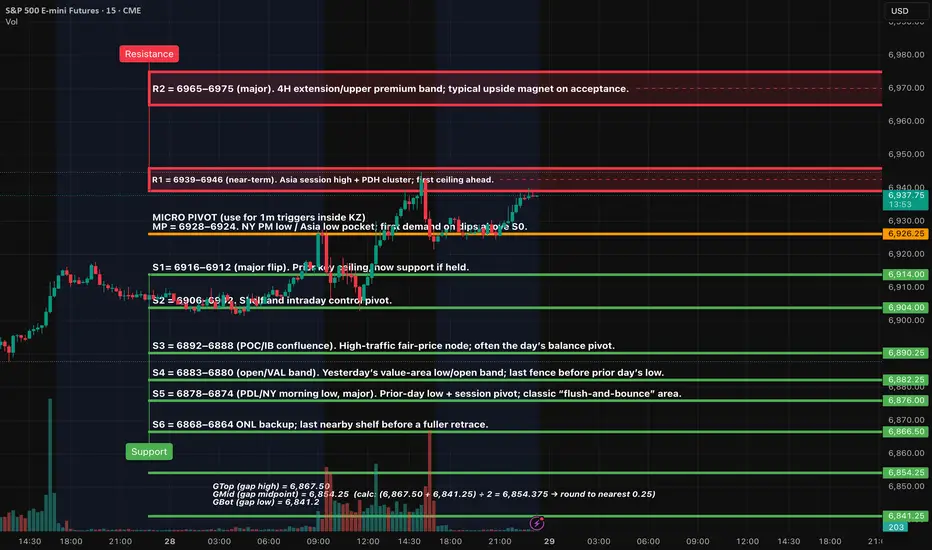
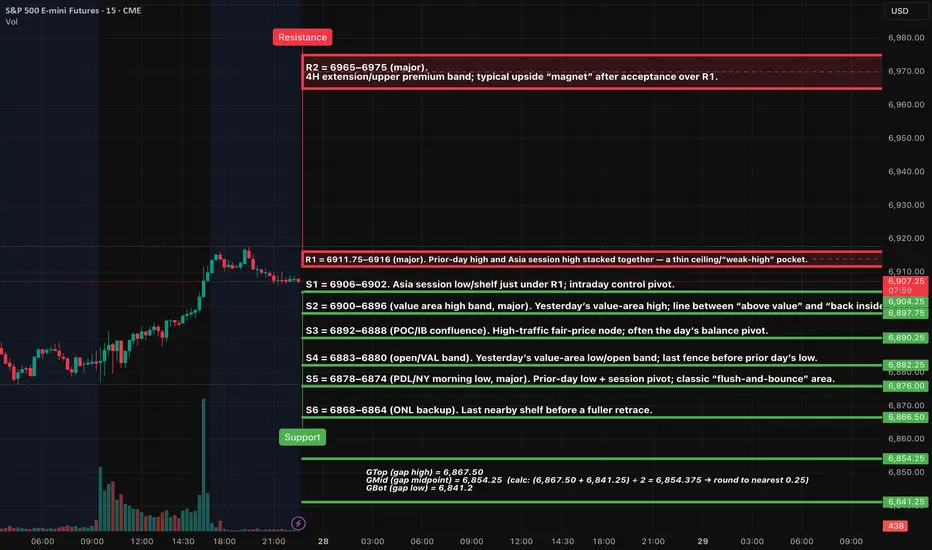
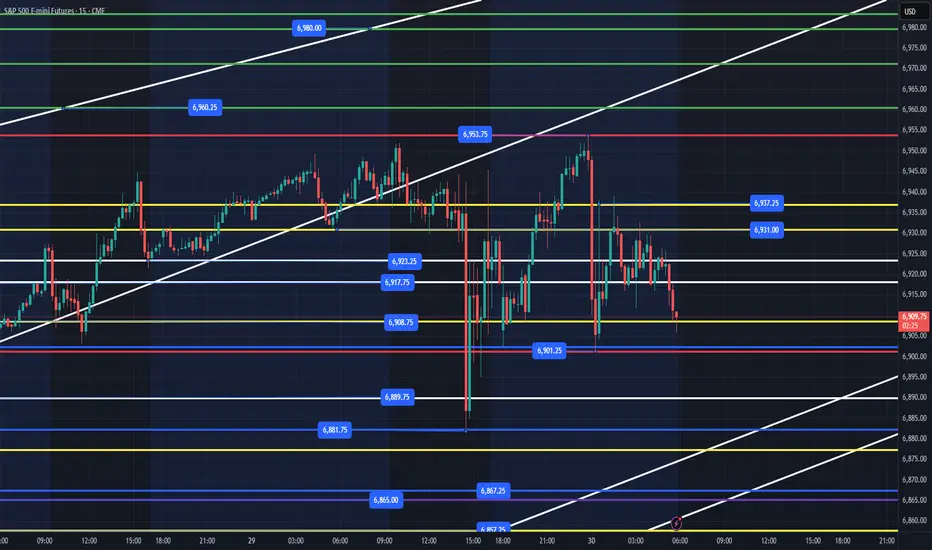
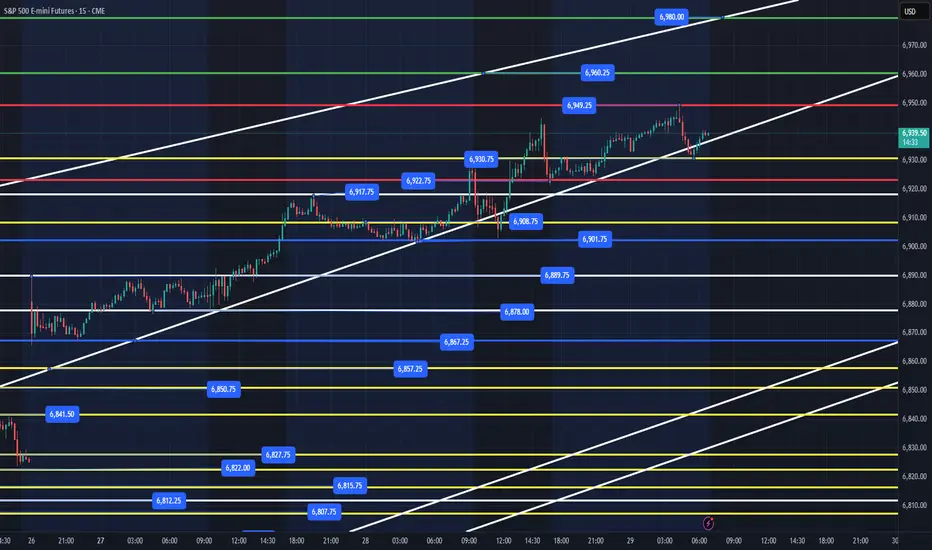
Our Overnight High is 6900 and our Overnight Low is 6844. 6772 is yesterday's low that should produce some good points when it comes back down into this range.
Key Levels Today -
1. 6844 - Flush & Reclaim
2. 6812, 6824 - Flush & Reclaim
3. 6772 - Flush & Reclaim (Highest Quality)
4. 6742, 6719 - Flush & Reclaim
If we do lose the 6719 level, we will need to look at 6709, 6690 as levels that a short squeeze can happen, especially if we are selling off pretty quickly. Below 6690 and 6655, 6621, 6611 are the levels below that I will be waiting for.
I will post an update around 10am EST.
----------------------------------------------------------------------------------------------------------
Purple = A Weekly Low (Current or Previous Week)
Blue = A previous day low (Day before or day in the past week)
Red - Overnight Session High/Low (Prior to my post)
White = Key Support/Resistance Levels
ES - March 3rd - Daily Trade PlanMarch 3rd - Daily Trade Plan - 8:45am
*Before reading this trade plan, if you did not read yesterday's take the time to read it first! (You can view the posts in the related publication section) *
If my posts provide quality information that has helped you with your trading journey. Feel free to boost it for others to find and learn, also!
My daily trade plan and real-time notes that I post are intended for myself to easily be able to go back and review my plan and how I did from an execution perspective.
** NOTE - If you trade before I write out my daily trade plan. You can look at the prior days chart and 9/10 the levels already pre-planned out are still being respected. **
--------------------------------------------------------------------------------------------------------
We rallied yesterday into the 6912-resistance area. I wrote on my note at 10:23am the following:
"If price loses 6828, we will most likely retest 6800 and then the 6770 level. We are in a macro downtrend and until price clears 6930, we should expect Lower Highs, Lower Lows with price."
We did not clear 6930 yesterday as 6912 was the high of the day and then we sold off overnight down to 6743.
The Overnight High is 6885 and Overnight Low is 6743. The Immediate resistance we need to clear is 6770, 6783 to continue up the levels. We flushed and reclaimed the 6756-weekly low from February 5th that I mentioned yesterday.
Key Levels Today -
1. 6770 - Flush & Reclaim
2. 6756 - Flush & Reclaim
3. 6743 - Flush & Reclaim
4. 6727 - Flush & Reclaim
5. 6709 - Flush & Reclaim
6. 6690 - Flush & Reclaim
I do not think we lose 6690 today, but if we do, I will get out the way. Ideally, price can flush down to 6726 or 6706 area and then reclaim a level above it. 6770, 6756 are good levels to keep price moving higher and up the levels.
I will post an update around 10am EST.
----------------------------------------------------------------------------------------------------------
Purple = A Weekly Low (Current or Previous Week)
Blue = A previous day low (Day before or day in the past week)
Red - Overnight Session High/Low (Prior to my post)
White = Key Support/Resistance Levels
ES - March 2nd - Daily Trade PlanMarch 2nd - Daily Trade Plan - 8:50am
*Before reading this trade plan, if you did not read yesterday's take the time to read it first! (You can view the posts in the related publication section) *
If my posts provide quality information that has helped you with your trading journey. Feel free to boost it for others to find and learn, also!
My daily trade plan and real-time notes that I post are intended for myself to easily be able to go back and review my plan and how I did from an execution perspective.
** NOTE - If you trade before I write out my daily trade plan. You can look at the prior days chart and 9/10 the levels already pre-planned out are still being respected. **
--------------------------------------------------------------------------------------------------------
We kicked off the month with some geopolitical headlines and war in Iran. I have mentioned many times over the past month that 6772 would be a key level for price to stay above or we would potentially have a change in the macro trend and end the massive rally from April lows of 2025. We still have not done that yet, but we are continuing to see price come back down to this level. The 6756 level is a weekly low from February 5th week.
We gapped down overnight with the Overnight High at 6855 and the Overnight Low is 6770. Just below is the 6756 level. My general lean today is that we could flush down at the open and have retail shorts pile in and I will be looking for a potential short squeeze with the loss and reclaim of 6756. If price does not build a base and at this level, there is not much below until 6727, 6709.
Key Levels Today -
1. 6812 - Flush & Reclaim
2. 6783 - Flush & Reclaim
3. 6770 - Flush & Reclaim
4. 6756 - Flush & Reclaim (Highest Quality)
Nothing else below until 6727, 6709, 6690.
I will post an update around 10am EST.
----------------------------------------------------------------------------------------------------------
Purple = A Weekly Low (Current or Previous Week)
Blue = A previous day low (Day before or day in the past week)
Red - Overnight Session High/Low (Prior to my post)
White = Key Support/Resistance Levels
ES - February 27th - Daily Trade PlanFebruary 27th - Daily Trade Plan - 6:50am
*Before reading this trade plan, if you did not read yesterday's take the time to read it first! (You can view the posts in the related publication section) *
If my posts provide quality information that has helped you with your trading journey. Feel free to boost it for others to find and learn, also!
My daily trade plan and real-time notes that I post are intended for myself to easily be able to go back and review my plan and how I did from an execution perspective.
** NOTE - If you trade before I write out my daily trade plan. You can look at the prior days chart and 9/10 the levels already pre-planned out are still being respected. **
--------------------------------------------------------------------------------------------------------
We had a nice pullback yesterday that produced some points from the 6875, 6882 levels that were on the chart. When price is selling off like yesterday, you have to wait for price to react at each level. A good example was that price at each level outlined, sliced through it, but could never reclaim it from below. This will happen much more during downtrends than uptrends. When the market is in an uptrend price can bounce at a level and take off. I have many readers that will just buy at the outlined level. While it can work during uptrends, yesterday was an example of not just buying at each level. You have to wait for price to reclaim the key level and start to build a base and show that price is looking to build higher highs, higher lows.
The Overnight High is 6915 and the Overnight Low is 6882 (as of typing this post). Yesterday's low of 6875 is the obvious first area we are interested in seeing price react. Below there and we will need to see 6855, 6846, 6835.
Key Levels Today -
1. 6882 - Flush and Reclaim
2. 6875 - Flush and Reclaim (Waiting on 6882 reclaim would be safer)
3. 6855 - Flush and Reclaim
4. 6846 - Flush and Reclaim
5. 6835 - Flush and Reclaim
Below and we will most likely be selling off pretty hard and you will need to wait for price to build a base at or below a key level on the chart.
While I do not think we get lower than 6835 today with the weekend ahead and it being the last trading day of the month, we need to react on what price gives us.
I will post an update around 10am EST.
----------------------------------------------------------------------------------------------------------
Purple = A Weekly Low (Current or Previous Week)
Blue = A previous day low (Day before or day in the past week)
Red - Overnight Session High/Low (Prior to my post)
White = Key Support/Resistance Levels
S&P500 - The Long & Short ThesisS&P 500 Analysis with the Medianline Rules & Framework
We can see how the S&P 500 has followed Median Line rules right out of the textbook.
Looking closely at the last five candles, the price action tells a clear story:
- The breakout of the L-MLH: Price reached its 80% probability target at the CL.
- The pullback: A classic test/retest back up to the L-MLH.
- The "Zoom": Price zoomed through the orange CL, followed by a retest before the eventual "give-up."
Current Support: Price is currently sitting on the white 1/4 line.
If we assume the price will continue to respect the Median Line framework, we can project the following two scenarios:
Scenario 1: The Bullish Retest
Price pulls back up to test/retest the white L-MLH (indicated by the white arrow). From there, a revisit of the white CL is the likely outcome.
Scenario 2: The Bearish Breakdown
Price gives up completely and targets the L-MLH of the orange fork. I expect slight support at the orange 1/4 line before a sharper decline toward the L-MLH.
I will be releasing a video today to explain these details and further information in depth.
👉 If you found this analysis helpful, I would greatly appreciate a boost and a follow here and on my Social & Website links. Thank you for your support.
Below ES 6720 and Intermediate wave (4) is likely underwayJust a brief update to my post dated February 15th .
Overnight futures breaking 6791 shifts the tone meaningfully, because that level was the final structural line keeping any near‑term upside pattern intact. Even so, the a = c symmetry at 6720 now becomes the next critical marker. A clean breach of 6720 would almost certainly force the ES to subdivide deeply enough to break the wave iv of one lesser degree, which is the technical confirmation that intermediate wave (4) is underway.
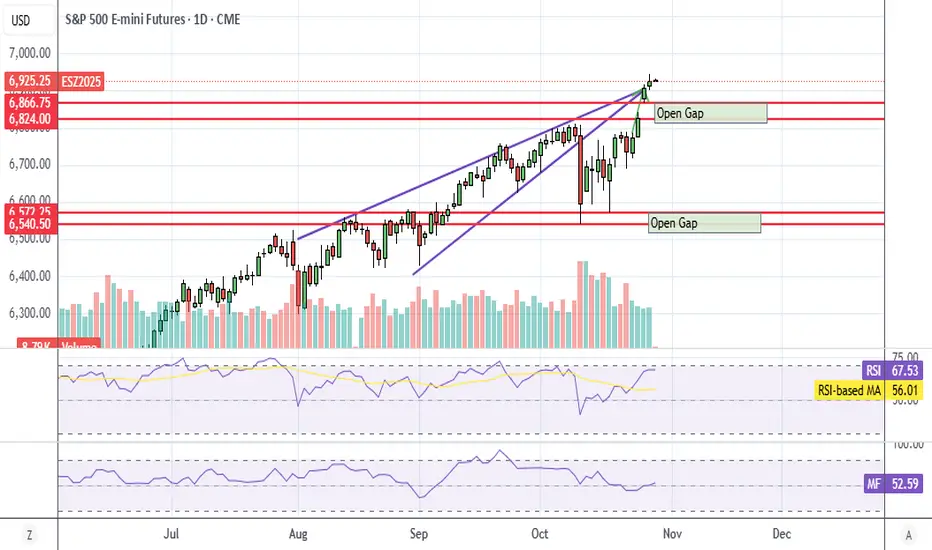
S&P 500 FuturesS&P 500 futures over the past month has been trading in a narrow range, near its all-time highs. The long-term trend remains bullish, however, from a seasonal perspective, February and the first half of March are challenging months for the stock markets. Accordingly, in the short-term perspective a pullback toward the support level around the $6600 cannot be ruled out.
Long-term trend: Up
Resistance level: 7000
Support level: 6500
ES Daily time frame +1,820 ticks bullish ideaES Daily time frame is in an up trend. The
market is making higher highs and higher
lows. The market has an up Fibonacci with
an extension price point 7365.00 about
+1,820 ticks above the market. As long as
the market does not take out the one boundary
price point 5880. It is expected the market to
push bullish to the Fibonacci extension.
If the risk is too large off the daily time frame.
It will be a good idea to turn to the one hour
time frame or smaller and look for long ideas
in the buy zone.
I see Upside next week.One things for sure we have a large liquidation the last couple trading days. My thoughts are this if you take a close look at some of the top 20-30% of the companies int the 500 they have topped out marriott etc... now we have banks, a major sector and most of the Mag 7 are down over 10-15% from the top this year anyways. SO here we can see support and a trnedline heading north... intrested in seeing if we get that money rotation into tech stocks... Again nvm the war that brings money to the economy. Tons of money in puts is just what market makers need to continue this bull run. Anyways dont load the boat on puts thinking war is going to change the market next week.. there is algos in place to stablize the immoral compass in this case.....
ES (SPX, SPY) Analysis, Key-Zones, Setup for Fri (Mar 6)Markets are still processing the Iran escalation. The US and Israel launched coordinated strikes on Iran, taking out military infrastructure across the country. Iran's IRGC responded with "True Promise 4" - missiles and drones at Tel Aviv. Trump says Iran's communications, aircraft, and anti-aircraft weapons are gone. Meanwhile, the US House voted 219-212 to reject halting strikes. In the middle of it all, Trump says Iran called asking to make a deal, but quickly added it's "too late." No ceasefire in sight. All of this heading into NFP Friday - 55k expected vs 130k prior - which will either compound the selling or trigger a relief rally if weak data revives rate cut hopes.
Thursday's session saw ES sell off sharply from the 6,870s down to 6,777 before bouncing to close around 6,835. The 4H structure shows a monster break-of-structure candle from 6,877 to 6,777 that remains dominant. Price is now forming a lower high in the 6,840-6,855 range, sitting below all short-term and medium-term moving averages. The overnight session has been tight, consolidating 6,822-6,850 as traders wait for NFP.
News & Sentiment Analysis:
The Iran situation is the dominant macro driver right now. US and Israeli strikes targeted military installations across Iran, reportedly destroying air defense systems, communications infrastructure, and aircraft. Iran's IRGC launched a new wave of retaliatory strikes (designated "True Promise 4") involving Khaibar missiles and drones targeting central Tel Aviv. The US House rejected a resolution to halt strikes 219-212, giving the White House full Congressional backing for continued military action. Trump made a series of statements calling on Iran's military to lay down weapons and urging Iranian diplomats worldwide to request asylum - language that suggests regime change objectives rather than de-escalation. While Trump mentioned Iran "called asking to make a deal," he immediately dismissed it as "too late," which is more gloating than negotiation. Australian troops were confirmed aboard a US submarine that sank an Iranian ship. This is escalation, not resolution.
On the macro side, all eyes are on NFP at 08:30 ET. Consensus is 55k vs 130k prior - a significant slowdown. The institutional crib sheet from premium data sources breaks it down: much weaker (below 0 NFP) would be very bullish for stocks as rate cut expectations surge, dollar and yields drop hard, gold rips. A weaker print (0k-40k) still leans bullish for equities with moderate dollar weakness. In-line (40k-75k) would be a non-event. Stronger (75k-113k) would be mildly negative for stocks with dollar strength, and much stronger (above 113k) would be the worst outcome for equities - rate cut narrative dies completely. On unemployment, anything above 4.4% is very bearish for dollar/yields and bullish for stocks, while 4.2% or below would be hawkish. NFP benchmark revisions came in at -862k vs -825k forecast - the labor market is weaker than initially reported. Retail Sales MoM is also at 08:30, expected at -0.3% vs 0.0% prior - a consumer spending contraction signal. Fed's Daly speaks at 08:30 alongside the data. Unemployment Rate expected steady at 4.3%.
The overnight session in Asia saw Hong Kong's Hang Seng Materials Index down roughly 3%, China's CSI energy and gold equity indexes set to open down 2%. PBOC set the yuan mid-point at 6.9025, while China's central bank injected 44.8B yuan via 7-day reverse repos at 1.40%. European futures are actually positive - Eurostoxx 50 futures up 0.68%, DAX futures up 0.57% - suggesting Europe is shrugging off the geopolitical risk for now. German Industrial Orders came in at -4.1% vs 7.8% prior, a massive miss.
Technical indicators have collapsed across the board. Composite indicator readings fell from 88% buy last week to 56% sell today - one of the sharpest weekly reversals in recent memory. The medium-term trend indicator flipped to SELL. Short-term indicators show 60% sell with 3 sell signals and 2 holds. The direction gauge shows weakening. Price sits below the 5-day (6,904), 20-day (6,948), 50-day (6,984), and 100-day (6,945) moving averages - only the 200-day at 6,731 remains below. The 14-day ADX at 36.32 confirms a strong trend, with -DI (20.62) dominating +DI (8.94) - a confirmed downtrend.
The risk-off backdrop includes dealer mechanics all negative from yesterday's scan: -$54.4B delta, -$6.5B vega, -$36.4M theta, with Spot-Vol Beta at 3.05. Oil pulled back to 79.10 (-2.36%) as Trump said "further action to reduce pressure on oil is imminent" and called oil "pretty much stabilized." DXY at 98.95, down 0.11%. VIX at 23.76 (+12.39%) - elevated but below the 25 kill switch. The 10Y yield at 4.15 (+1.67%) tells us bonds are not fully in panic mode.
Forecast:
• Overnight: Tight consolidation 6,825-6,855 as traders wait for NFP
• Morning Session: High volatility expected at 08:30. NFP will dictate direction - weak number likely causes a whipsaw (initial spike up on rate cut hopes, then reassessment of recession risk). Strong number would accelerate selling
• Afternoon: Likely range-bound after the NFP reaction settles. End-of-week positioning ahead of continued Iran escalation over the weekend
• Daily Close: Leaning lower, expecting close in the 6,790-6,830 range if NFP is weak. Could close near 6,770-6,790 if NFP is very weak and geopolitical risk stays bid
• Expected Range: 6,770 to 6,880 (statistical range of ~96-100 points based on 14-day ADR)
• Most Likely Path: Pre-NFP drift in the 6,830-6,850 range, violent move at 08:30, likely test of 6,800 area by midday, then afternoon consolidation. Weekend risk premium keeps a lid on any rally attempts
Friday Events:
• 08:30: US Nonfarm Payrolls (55k exp vs 130k prior)
• 08:30: US Unemployment Rate (4.3% exp vs 4.3%)
• 08:30: US Retail Sales MoM (-0.3% exp vs 0.0%)
• 08:30: US Core Retail Sales MoM (0.0% exp vs 0.0%)
• 08:30: US Average Earnings MoM (0.3% exp vs 0.4%)
• 08:30: US Average Earnings YoY (3.7% exp vs 3.7%)
• 08:30: US Private Payrolls (63k exp vs 172k prior)
• 08:30: Fed's Daly Speaks
• 08:30: ECB's Cipollone Speaks
• 10:00: Canadian Ivey PMI (50.9 exp)
• 16:15: COST earnings ($4.55 EPS, $69.27B Rev)
• 19:00: Fed's Goolsbee Speaks
Resistance:
• 6,877-6,880 – 4H BOS origin candle top. This is where Thursday's monster selloff started. Any rally back here would be a major reclaim signal
• 6,855-6,858 – Overnight high area and 15m premium zone. Multiple rejections here overnight. Strong sellers defending this level
• 6,849-6,852 – Today's session high and lower high formation zone. Bulls need to clear this to change short-term structure
• 6,840-6,842 – Current price area, session VWAP region. Minor resistance on any pullback from below
• 6,904 – 5-day moving average. First major MA overhead, roughly 65 points above current price
Support:
• 6,822-6,825 – Today's session low and computed pivot S1 (6,825). First test zone on any breakdown
• 6,800-6,805 – Psychological round number. Was briefly tested during Thursday's selloff
• 6,777-6,780 – Thursday's LOD and the 4H equilibrium target. This is where the selling exhausted on Thursday. A break below opens the floodgates
• 6,770-6,775 – 1-month and 13-week low zone. Confluence of computed levels. Put profit target zone
• 6,700-6,710 – Computed pivot S3 at 6,700. Extended target if panic selling resumes
How I'm seeing it:
• Leaning bearish below 6,855. The 4H structure is firmly bearish with the monster BOS candle intact and a lower high forming. Price is below every meaningful moving average except the 200-day
• If NFP comes in weaker (0k-40k range), expect an initial pop toward 6,855-6,870 on rate cut excitement, followed by a reversal as recession fears take over. The geopolitical backdrop amplifies any selling
• If NFP misses badly (below 0 or negative), that's a shock scenario. Could see ES whipsaw hard - initial spike up, then accelerated selling to test 6,770-6,780 by afternoon
• If NFP surprises strong (above 113k), the rate cut narrative dies and ES sells straight down. This would be the worst-case scenario for bulls - strong economy + geopolitical war + no Fed help
• Weekend risk is real. With Iran strikes ongoing and IRGC retaliating, nobody wants to be long heading into the weekend. This caps any rally attempts
• Primary Setup: Short from 6,855-6,860, stop 6,882, targeting 6,780 (Thursday's LOD / 4H equilibrium). This sets up at the lower high zone where sellers have been defending all night. Risk/reward roughly 3:1
Stay nimble around 08:30 - NFP will create the move of the day. Let the dust settle before committing to any direction.
Good Luck !!!
ES - March 4th - Daily Trade PlanMarch 4th - Daily Trade Plan - 7:45am
*Before reading this trade plan, if you did not read yesterday's take the time to read it first! (You can view the posts in the related publication section) *
If my posts provide quality information that has helped you with your trading journey. Feel free to boost it for others to find and learn, also!
My daily trade plan and real-time notes that I post are intended for myself to easily be able to go back and review my plan and how I did from an execution perspective.
** NOTE - If you trade before I write out my daily trade plan. You can look at the prior days chart and 9/10 the levels already pre-planned out are still being respected. **
--------------------------------------------------------------------------------------------------------
We got our short squeeze yesterday when price lost the 6727 level and reclaimed it and moved up the levels. Overnight High is 6855 and the Overnight Low is 6772.
If price can clear 6855, we should attempt a retest of the 6912 level above. If price loses 6772 and cannot reclaim pretty quickly, we will most likely need to retest the 6742, 6719 levels.
Key Levels Today -
1. 6812, 6800, 6783 (These levels can produce some points)
2. 6772, 6742, 6719 (Highest Quality levels for some points)
If we do lose the 6719 level, we will need to look at 6709, 6690 as levels that a short squeeze can happen, especially if we are selling off pretty quickly. Below 6690 and 6655, 6621, 6611 are the levels below that I will be waiting for.
I will post an update around 10am EST.
----------------------------------------------------------------------------------------------------------
Purple = A Weekly Low (Current or Previous Week)
Blue = A previous day low (Day before or day in the past week)
Red - Overnight Session High/Low (Prior to my post)
White = Key Support/Resistance Levels
Gamma Exposure Setup: Finding Alignment Between SPY and VIXIn this educational idea, we want to share one of our best trading setups, which appears from time to time. We use gamma exposure as the framework for our analysis, and we want to keep it as simple as possible.
Before we begin, here are some important notes on how to build our chart templates: We don’t open AMEX:SPY directly; instead, we prefer to open CME_MINI:ES1! as the main symbol and plot the AMEX:SPY in a new pane below. With this approach, we can view the full gamma exposure of the previous day before the spot market opens, as we have 23 hours per day on our charts. Then, we add the GexView indicator, which helps us monitor how gamma exposure has developed over the last five days. We analyze it like the classic Volume Profile indicator, looking to find major and repeatable levels. Finally, we add a momentum indicator. We prefer the twice-awarded MACD-V indicator by Alex Spiroglou.
From a bird’s-eye view, we can see that on AMEX:SPY , one of the major gamma levels during these days is 690. Some levels are added, while others disappear completely, but the 690 gamma level remains in place. Especially on February 23, it represents the largest gamma level and acts as a magnet for price. After the market opens during RTH, the ticker touches exactly the 690 price level and immediately rejects it (1). We can add to our analysis the negative divergence between the MACD-V and the ES futures contract (2). As CME_MINI:ES1! completes a higher high, the MACD-V creates a lower high, triggering a negative divergence. Are these two signals enough to take action and enter a trade?
No. We need confirmation from an asset moving in the “opposite” direction, like TVC:VIX . Look at the image. The gamma level that separates positive from negative gamma is at 20. On February 23, it represents the largest gamma level of the day. During Extended Trading Hours, TVC:VIX seems to find support at 20 (1). However, after the market opens (RTH), TVC:VIX makes a false breakdown (bear trap) at 20 and immediately rises rapidly (2). Note that this false breakdown happens at the same time AMEX:SPY hits resistance. It’s the perfect alignment between AMEX:SPY and TVC:VIX . In addition, we observe the same MACD-V behavior, but from the opposite side. It now produces a positive divergence for the CBOE:VX1! futures contract (3).
That’s it — simple, clean, and effective. We trade setups like this using CME_MINI:NQ1! or CME_MINI:ES1! , and now we patiently wait for the next opportunity to appear.
ES - March 6th - Daily Trade PlanMarch 6th - Daily Trade Plan - 7:06am
*Before reading this trade plan, if you did not read yesterday's take the time to read it first! (You can view the posts in the related publication section) *
If my posts provide quality information that has helped you with your trading journey. Feel free to boost it for others to find and learn, also!
My daily trade plan and real-time notes that I post are intended for myself to easily be able to go back and review my plan and how I did from an execution perspective.
** NOTE - If you trade before I write out my daily trade plan. You can look at the prior days chart and 9/10 the levels already pre-planned out are still being respected. **
--------------------------------------------------------------------------------------------------------
Yesterday we got 3 key levels that provided us some great points! Before the open price flushed down to 6835, recovered 6844 and rallied. Then around 11:15am we sold off down to 6812, recovered 6824 and rallied into 6845. After lunch price built a nice base between 6783-6800, broke out and rallied into the 6840-resistance area.
Today we have employment report coming out at 8:30am. I expect price to be very erratic this am. We sold off overnight and our Overnight High is 6850 with the Overnight Low being 6800. While typing this post, price lost the 6800 level and is currently trading around 6793. The reclaim of 6800-04 will keep us moving higher.
Key Levels Today -
1. 6800 - Flush & Reclaim
2. 6783 - Flush & Reclaim
3. 6772 - Flush & Reclaim
4. 6742, 6719 - Flush & Reclaim
If we do lose the 6719 level, we will need to look at 6709, 6690 as levels that a short squeeze can happen, especially if we are selling off pretty quickly. Below 6690 and 6655, 6621, 6611 are the levels below that I will be waiting for.
I will post an update around 10am EST.
----------------------------------------------------------------------------------------------------------
Purple = A Weekly Low (Current or Previous Week)
Blue = A previous day low (Day before or day in the past week)
Red - Overnight Session High/Low (Prior to my post)
White = Key Support/Resistance Levels
ES (SPX, SPY) Analysis, Key-Zones, Setup for Thu (Mar 5)Wednesday delivered one of the more impressive intraday reversals we've seen in recent weeks. ES gapped down to the 6,782 area in pre-market on escalating Iran conflict headlines, then staged a nearly 100-point rally throughout the regular session fueled by a massive ISM Services beat and a dovish Fed commentary from Miran. AVGO delivered a blowout after the close with Q2 guidance of $22B versus $20.53B expected, AI semiconductor revenue hit $10.7B, and the company announced a $10B buyback. But the Globex session has been unable to extend Wednesday's gains. ES opened the overnight session around 6,883, pushed up to 6,900.75 before fading back sharply. Price has been drifting lower throughout the Asia session and currently sits near the 6,862 area, basically giving back all of Thursday's overnight gains and trading below Wednesday's settlement. The geopolitical backdrop remains the dominant overhang heading into Thursday. Late Wednesday, the NYT reported that Iranian operatives have made an offer to discuss terms for ending the war, the first diplomatic signal from Tehran. However, the US reportedly hasn't responded yet per Axios. US Energy Secretary Wright stated the US Navy will escort ships through the Straits of Hormuz when the time is right, and Trump posted on Truth Social that the US will ensure the free flow of energy to the world. Meanwhile, thousands of Iraqi Kurds have launched a ground offensive in Iran (FOX), Israel carried out a broad wave of strikes overnight, and Iran has threatened to target the Israeli nuclear site of Dimona if regime change is sought. Reports of blasts in Doha and Dubai with missiles intercepted by Saudi Arabia signal the conflict is widening beyond Iran's borders.
On the technical side, Wednesday's regular session opened near 6,810 after the pre-market selloff to 6,782, then rallied throughout the day to close near 6,876. That's a wide-range day that resolved to the upside, recovering most of Tuesday's selloff. However, price remains below the 20-DMA (6,895.25) and 100-DMA (6,890.91), which now form a resistance confluence in the 6,890-6,900 zone. The 5-DMA sits at 6,866.95, providing immediate overhead reference. The 50-DMA at 6,933.83 is significantly higher and represents the first major structural resistance above. The 200-DMA remains well below at 6,676.28, so the broader trend support is intact. The 14-Day RSI has dropped to 45.45, now sliding below the neutral 50-line, giving bears a marginal momentum edge. The Stochastic %K at 48.56 and %D at 46.50 are similarly below neutral and pointing lower. The ADX at 35.16 indicates a trending environment, with -DI at 21.76 versus +DI at 9.27 confirming the bears maintain structural dominance despite Wednesday's bounce. The composite technical indicators read 40% Sell with soft strength and weakening direction, a significant deterioration from yesterday's 56% Sell, last week's 8% Sell, and last month's 16% Buy. Short-term composite is at 60% Sell, medium-term 25% Sell, and the long-term remains at Hold, painting a picture where the bounce has completely failed to shift the technical picture.
News & Sentiment Analysis:
The Iran conflict dominated Wednesday's session from the opening bell. US-Israeli military operations continued to escalate with CENTCOM confirming they have struck or sunk more than 20 Iranian naval vessels and hit over 2,000 targets across Iran. General Caine stated that CENTCOM has established localized air superiority across the southern flank of the Iranian coast and announced plans to expand operations inland. IDF fighter jets are actively carrying out strikes, with heavy airstrikes reported in Tabriz in northwest Iran and explosions heard in Tehran and the holy city of Qom. The IRGC warned that time is in Iran's favor and that they are prepared for a long war, while Iran's retaliatory strikes have reportedly declined in frequency. White House Press Secretary Leavitt laid out the US position clearly: the goal is to destroy Iran's ballistic missiles and bunkers, ground troops are not part of the plan, and Trump will determine victory once objectives are realized. The Senate began a procedural vote on a war powers resolution to end the Iran operation, adding a political dimension to the military conflict.
Treasury Secretary Bessent made several notable comments during the morning session. On Iran, he stated that everything is going magnificently, the US will take out Iran's ballistic missiles and bunkers in coming days, crude markets are well supplied, and the US Navy will provide safe passage for tankers if needed. He compared the current situation favorably to the Ukraine invasion, noting the US is in a very different position regarding energy. On the tariff front, Bessent confirmed the 15% tariff rate is likely to enter force this week but added that rates will revert to previous levels in about five months, suggesting the administration views the escalation as temporary leverage rather than permanent policy. He also took aim at Spain for free-riding on NATO allies, which prompted diplomatic pushback from the EU Commission stating that a threat against any EU member is a threat to the whole EU. The EU reportedly expects to remain at the 10% tariff level despite Bessent's 15% headline, having received private assurances from the US.
Fed commentary was headlined by a notably dovish Miran, who is now stepping down as Chair of the CEA to be replaced by Warsh. Miran delivered an extensive set of remarks calling for continued rate cuts at the March meeting, stating that one percentage point of cuts is appropriate this year, that he prefers to move in 25bps increments until reaching neutral, and that he sees monetary policy as still modestly restrictive. He pushed back against the notion that Iran should change the Fed's outlook, noting that evidence of oil prices feeding into core inflation is quite limited and that this situation is different from the Ukraine invasion in 2022 because monetary and fiscal policy were both more expansionary back then. Miran also flagged that if housing inflation decelerates as expected, the Fed could actually undershoot the 2% target. He noted a 2-year trend of labor market weakening that he sees as too early to reject based on recent data. Separately, Fed's Hammack called for being methodical on balance sheet shrinkage, and the SCOTUS released no opinions on the Fed's Cook case.
Economic data was a tale of two PMIs on Wednesday. The ISM Services PMI blew past expectations at 56.1 versus 53.5 forecast and 53.8 prior, representing the strongest reading since mid-2022 and the 20th consecutive month of expansion. New Orders surged to 58.6 from 53.1, Employment improved to 51.8 from 50.3, and Business Activity jumped to 59.9 from 57.4. Critically, Prices Paid came in at 63 versus 68.3 expected, suggesting that despite robust activity, inflationary pressures in services are actually cooling. This is the closest thing to a goldilocks print the market could have hoped for. In contrast, the S&P Services PMI Final missed at 51.7 versus 52.3 forecast, and the Composite PMI similarly disappointed at 51.9 versus 52.3. The ADP Employment Change beat expectations at 63k versus 50k forecast and an upwardly revised 11k prior, but the absolute level remains anemic for a healthy labor market. MBA Mortgage Applications surged 11% versus 0.4% prior as the 30-Year rate held at 6.09%, suggesting some rate-sensitive demand is returning.
The Fed's Beige Book released at 14:00 ET painted a cautiously optimistic picture. Overall economic activity increased at a slight to moderate pace in seven of the twelve Federal Reserve districts, though notably the number of districts reporting flat or declining activity increased from the prior period. Prices increased moderately with eight districts reporting moderate price growth and four seeing slight or modest increases. Wages rose at a modest or moderate pace. Most districts expected slight to moderate growth in the coming months. This moderate tone is consistent with Miran's view that the economy doesn't warrant the current level of policy restriction.
AVGO's after-hours earnings were the standout corporate event. The company beat on every metric with EPS of $2.05 versus $2.03 expected and revenue of $19.31B versus $19.26B expected. The real headline was Q2 guidance of $22.0B versus the $20.53B consensus, a $1.5B beat that underscores the continued strength of AI semiconductor demand. AI semiconductor revenue is projected at $10.7B in Q2, and the company announced a $10B buyback program. This is the kind of guidance beat that should provide a tailwind for the AI infrastructure trade heading into Thursday, though how much of it gets offset by geopolitical risk remains the question.
The energy picture is increasingly complex. EIA Crude Oil Inventories built 3.475M barrels versus the 3M forecast, with Cushing adding 1.564M. Gasoline drew 1.704M. But the real story is in the global energy market: Brent crude hit $82.14, the highest since July 2024, European natural gas soared another 21.98% to €54.29/MWh building on Monday's 39% spike, and US-Asia oil supertanker hire costs hit a new record of $29 million. Bloomberg reported that Iraq had started to shut down oil production that could halt 3 million barrels per day if the crisis persists. Despite Bessent's assurances that crude markets are well supplied and the US Navy will secure shipping lanes, the risk premium in energy markets continues to build. The Strait of Hormuz remains the key bottleneck, and the IRGC's warnings about it cannot be dismissed.
Options and positioning data shows net dealer premium at roughly $226.33B with 0DTE premium at about $2.45B. The SPX Spot-Vol Beta reading of -2.45 indicates the VIX is significantly under-reacting relative to the price move, meaning options traders are not aggressively pricing in protection despite the market move and geopolitical backdrop. This kind of complacency in the vol space is worth noting, as it means a sudden spike in hedging demand could amplify any downside move. The Fear and Greed Index sits at 34, firmly in Fear territory and down significantly from 45 Neutral just one week ago and 47 one month ago. Institutional analysis from Credit Agricole shows their FX Risk Index surging to 1.0894 from 0.6546 last week, the highest level since the Liberation Day tariffs in April 2025, driven primarily by higher FX and equity market volatility. US money market fund assets surged to a record $8.271 trillion, with $49 billion flowing in during the week ended March 3 and $18.5 billion on Tuesday alone from the US-Israeli strikes, representing a meaningful flight to safety that rivals previous crisis episodes.
Institutional analysis paints a cautious but nuanced picture. Deutsche Bank notes there's no sign of either side de-escalating, and if anything things are ratcheting up. However, they point out that despite everything, the S&P 500 is only within 2.5% of its peak and the STOXX 600 within 5%, meaning we haven't gotten to correction territory yet. MUFG reports Asian equities were hammered with the Kospi down 12% and Thai equities down 8%, while other markets fell 2-4% as investors price in a more substantial hit to growth. Goldman Sachs' data shows the US has heavily underperformed the rest of the world so far in 2026, with the S&P 500's relative return versus MSCI World ex-US currently in the bottom decile of the distribution going back to 1995. This rotation theme continues to pressure US large-cap allocations.
On the tech side, Google committed to paying for 100% of the power its data centers use and bringing net-new energy to the grid, while also signing the White House Affordability Pledge. Meta confirmed data center power and water costs will not be passed to consumers. XAI is committed to developing a 1.2GW power plant as their supercomputer's primary power source. Apple announced the MacBook Neo priced at $599 with the A18 Pro chip, Intel's CFO warned that memory chip shortages will persist through 2027 with factories operating above 100% capacity, and the server CPU market is expected to grow meaningfully in 2026. Kraken became the first crypto firm to win access to the Fed's core payments system. The US Government shed 386,826 jobs in the first year of Trump's second term per government data, and the Warsh-for-Miran personnel change at the CEA signals a potential shift in economic advisory direction for the White House.
Thursday's data calendar features Jobless Claims at 08:30 ET as the key release. Initial Claims are expected at 215k versus 212k prior, with Continued Claims at 1.8475M versus 1.833M prior. Also at 08:30: US Productivity Prelim expected at 1.8% versus 4.9% prior (a significant deceleration), Unit Labor Costs Prelim at 2% versus -1.9% prior (a big swing to positive), and Import Prices MoM at 0.3% versus 0.1% prior. The Unit Labor Costs number is worth watching closely because a strong print above 2% would complicate the dovish Fed narrative that Miran laid out. European data in the morning session includes Construction PMIs across the Eurozone and ECB speakers de Guindos (03:50), Rehn (04:35), and Nagel (05:00). Eurozone Retail Sales at 05:00 are expected at 1.7% YoY versus 1.3% prior. COST reports earnings after the close at 16:15 ET with expectations of $4.55 EPS and $69.24B revenue. AVGO's pre-market reaction will set the tone for tech and AI names.
Forecast:
• Overnight: AVGO's massive guidance beat ($22B vs $20.53B expected) should support ES in the Asia-Europe session, potentially pushing price back toward the 6,880-6,890 zone. However, Iran escalation headlines could cap upside and create choppy, headline-driven price action. European Construction PMIs and ECB speakers unlikely to be major catalysts
• Morning Session: Pre-market focus on AVGO reaction and any overnight Iran developments. Jobless Claims at 08:30 along with Productivity and Unit Labor Costs provide the key data. In-line claims with hot Unit Labor Costs (above 2%) could pressure ES back toward 6,855-6,865. Soft data across the board could extend the rally toward 6,890-6,900 (MA confluence zone)
• Afternoon: Direction likely established by the morning data reaction. If ES reclaims the 6,890-6,900 area, the afternoon could see a grind toward 6,920. If rejected at that zone, the afternoon drift likely targets 6,860-6,870. COST earnings anticipation may keep volume subdued into the close
• Daily Close: Expecting a close in the 6,855-6,910 range depending on data and geopolitical developments. The path of least resistance remains lower given the structural bearish setup, but AVGO momentum and dovish Miran provide counterweights
• Expected Range: 6,810 to 6,910 (based on 14-Day ADR of 95.55 points, widened for geopolitical volatility)
• Most Likely Path: AVGO should attempt to lift the pre-market toward 6,875-6,890, testing the 5-DMA and 100-DMA/20-DMA confluence. However, the overnight fade from 6,900 to 6,862 shows sellers are already active. Jobless Claims and Unit Labor Costs at 08:30 determine whether the rally attempt gains traction or gets sold. Likely scenario is a grind up toward 6,880-6,890 that gets faded, with the afternoon drifting back toward 6,855-6,865 equilibrium. Iran headlines remain the wildcard that could swing the range 40-50 points in either direction
Thursday Events:
• 02:45: French Industrial Production MoM (0.4% forecast, -0.7% prior)
• 03:00: Swiss Unemployment Rate Adjusted (2.9% forecast, 2.9% prior)
• 03:30: French Construction PMI (43.5 prior), Eurozone Construction PMI (45.3 prior), German Construction PMI (44.7 prior)
• 03:50: ECB's de Guindos Speaks
• 04:30: UK Construction PMI (47 forecast, 46.4 prior)
• 04:35: ECB's Rehn Speaks
• 05:00: Eurozone Retail Sales YoY (1.7% forecast, 1.3% prior), Eurozone Retail Sales MoM (0.3% forecast, -0.5% prior)
• 05:00: ECB's Nagel Speaks
• 08:30: US Initial Jobless Claims (215k forecast, 212k prior)
• 08:30: US Continued Jobless Claims (1.8475M forecast, 1.833M prior)
• 08:30: US Productivity Prelim (1.8% forecast, 4.9% prior)
• 08:30: US Unit Labor Costs Prelim (2% forecast, -1.9% prior)
• 08:30: Import Prices MoM (0.3% forecast, 0.1% prior)
• 16:15: COST earnings (EPS $4.55, Rev $69.24B)
• Ongoing: Iran military operations, AVGO post-earnings reaction, 15% tariff implementation watch
Resistance:
• 6,930-6,935 - 50-DMA (6,933.83). Major overhead resistance and the first level that would signal a meaningful technical improvement. Price has been consistently rejected below this zone for the past week. Only in play on a combination of hot AVGO rally and soft economic data
• 6,920-6,925 - Computed first resistance (6,922.17) / 3-standard deviation band (6,922.69). This was Wednesday's approximate high area and represents the ceiling the bulls need to break. 38.2% Fib retracement from 13-week high sits at 6,919 adding confluence
• 6,890-6,900 - 100-DMA (6,890.91) / 20-DMA (6,895.25) / 1-SD resistance (6,902.96) confluence. The most important zone for Thursday. These moving averages have converged with the statistical expected range ceiling. The Globex session already tested and rejected this area at 6,900.75, confirming sellers are defending aggressively
• 6,876-6,880 - Wednesday settlement (6,876) / 50% Fib retracement from 13-week range (6,880.88). Key resistance now that price has pulled back below it. A reclaim would suggest the overnight fade was just noise
• 6,865-6,868 - 5-DMA (6,866.95) / 50% Fib from 4-week range (6,865.13). Immediate overhead. Price is trading right around this area, making it the first level bulls need to reclaim
Support:
• 6,850-6,855 - Thursday Globex low (6,850.25) / Stochastic 50% level (6,855.75) / 1-SD support (6,849.04). Immediate support and the overnight low. This area lines up with the computed pivot point (6,847.83), creating a dense support cluster. A clean break below here changes the complexion from consolidation to distribution
• 6,838-6,843 - 38.2% Fib from 13-week low (6,842.61) / 2-SD support (6,837.88). A secondary demand zone below the pivot. If the first support breaks, this is where the next wave of buying should emerge
• 6,800-6,810 - Computed first support (6,801.67) / Stochastic 30% level (6,800.95) / psychological round number. A significant demand zone representing a full retracement of Wednesday's bounce. Institutional buyers likely step in here
• 6,775-6,785 - Wednesday pre-market low / Stochastic 20% level (6,773.55). This is where the Iran-driven selloff found a bottom before the ISM Services reversal. A break below signals the entire recovery has been negated
• 6,718-6,727 - Monday's weekly low / computed second support (6,727.33) / 1-month and 13-week low (6,718.75). The critical level for the entire week. A break below confirms a new leg lower in the correction
How I'm seeing it:
• Leaning bearish for Thursday, and the overnight fade from 6,900 to 6,862 reinforces this view. The geopolitical risk from Iran is the dominant factor, and the market tested the 100-DMA/20-DMA confluence and got immediately rejected. Wednesday's bounce was impressive but it was driven by a single data point (ISM Services) and the broader technical structure remains bearish with -DI dominant, composite indicators at 40% Sell weakening further (from 56% Sell yesterday), and price now below ALL moving averages including the 5-DMA (6,866.95)
• AVGO's $22B Q2 guidance beat is substantial and should support the AI trade in the pre-market. However, the broader Magnificent Seven has been under pressure with Goldman Sachs data showing the US in the bottom decile of relative performance versus MSCI World ex-US. Individual earnings beats may not be enough to lift the entire index when rotation is working against US large-caps
• The 6,890-6,900 zone (100-DMA/20-DMA confluence) is the key battleground for Thursday. A reclaim above 6,900 on strong volume would flip the short-term picture bullish and target the 50-DMA at 6,934. A rejection sets up a retest of 6,860-6,865 and potentially Wednesday's pre-market low at 6,782
• Unit Labor Costs at 08:30 is the underappreciated risk. The forecast of 2% versus -1.9% prior is a massive swing, and any upside surprise above 2.5% would directly contradict Miran's dovish narrative and could trigger a sharp selloff. Conversely, a soft print would reinforce the rate cut case
• The Spot-Vol Beta at -2.45 showing VIX under-reacting is a warning signal. If the fear response catches up to the actual price action and geopolitical risk, we could see an abrupt VIX spike that amplifies any downside move. The record $8.27 trillion in money market funds and Credit Agricole's FX Risk Index at the highest since Liberation Day both confirm institutional risk aversion is elevated even if the VIX isn't fully reflecting it yet
• Primary Setup: Short from 6,885-6,895, stop 6,920, targeting 6,840 first then 6,800 (computed first support). Fading any AVGO-driven push into the 100-DMA/20-DMA resistance confluence, which already rejected price at 6,900.75 in the overnight session. Bearish technical structure, geopolitical headwinds, overnight fade confirmation, and potential Unit Labor Costs catalyst all support the short thesis
The weekly structure is shaping up as a battle between fundamental catalysts and geopolitical risk. ISM Services and AVGO point higher, but the Iran conflict, 15% tariff implementation, record flight to safety, and institutional risk aversion all argue for continued caution. Wednesday's reversal from 6,782 to 6,876 showed the market can rally on good data, but the overnight fade from 6,900 back to 6,862 confirms the key moving averages are acting as a ceiling and sellers remain in control. The Iran diplomatic signal (NYT) is the one wildcard that could shift sentiment, but until the US actually responds, it's just a headline. COST earnings after the close could provide the next directional catalyst for Friday.
Good Luck !!!
ES - February 26th - Daily Trade PlanFebruary 26th - Daily Trade Plan - 8:30am
*Before reading this trade plan, if you did not read yesterday's take the time to read it first! (You can view the posts in the related publication section) *
If my posts provide quality information that has helped you with your trading journey. Feel free to boost it for others to find and learn, also!
My daily trade plan and real-time notes that I post are intended for myself to easily be able to go back and review my plan and how I did from an execution perspective.
** NOTE - If you trade before I write out my daily trade plan. You can look at the prior days chart and 9/10 the levels already pre-planned out are still being respected. **
--------------------------------------------------------------------------------------------------------
Yesterday I stated the following on the 10:05am - Update
"Price needs to clear 6945 to continue higher. If we lose 6930 we will need to test 6917, 6900."
At 11:27am we finally broke above it and then back tested 6945 at 11:37am and then rallied higher.
Overnight High is 6969 and the Overnight Low is 6942 (Coincidence?) No, it is a strong support that was resistance yesterday and has been support since. We have tested this area 3x overnight and the next time we test this level, I am not sure how much liquidity will be left. IF we do flush 6942 and reclaim 6956, we should continue higher. 6969 is the top end of the range and in the bigger picture, price must clear yesterday's high 6976-84 area and we can then see 6996, 7011+.
Key Levels Today -
1. 6942 - Flush and Reclaim (Waiting on 6956 reclaim would be safer)
2. 6931 - Flush and Reclaim
3. 6917 - Flush and Reclaim
4. 6900 - Flush and Reclaim (Yesterday's Low & Highest Quality Level)
Below and we will most likely be selling off pretty hard and you will need to wait for price to build a base at or below a key level on the chart.
I say often in my daily trade plan that when price rallies before the NYSE open into a heavy resistance area to be careful on having FOMO and riding price higher. Institutions can rug pull price very quickly. While I have no idea what will happen this am, it is better to be cautious than greedy. Be patient on levels and let price show its hand at each key level.
I will post an update around 10am EST.
----------------------------------------------------------------------------------------------------------
Purple = A Weekly Low (Current or Previous Week)
Blue = A previous day low (Day before or day in the past week)
Red - Overnight Session High/Low (Prior to my post)
White = Key Support/Resistance Levels
ES UpdateWow, they did the pump and dump after all even though there's still an open gap on ES and NQ. Looked like a hedge fund dump, the dump was mostly chip stocks and industrials like CAT. Lots of stocks are green, especially stuff that recently tanked like software stocks.
Lost some money get whipsawed today, I think I'm just gonna wait to see what happens tomorrow.
I say hedge fund dump, because every time they close their positions UAA goes up, lol. Same with other heavily shorted stocks. Unfortunately UAA doesn't seem to be able to hold teh gain, same with others. Need to find a stock that can hold teh gain to pay that game.
S&P 500 E Mini Futures (ES) Consolidating, Traders Eye Next MoveThe S&P 500 E-Mini Futures (ES) has largely traded sideways with a modestly bullish bias since October 2025. The short-term cycle, which began from the November 21, 2025 low, remains in progress as a five-wave Elliott Wave structure. Wave 1 concluded at 7043, marking the all-time high in the Index. Following this peak, price action shifted lower in a zigzag formation. Specifically, wave ((a)) ended at 6864.5, while wave ((b)) terminated at 7011.5, as reflected in the one-hour chart.
Wave ((c)) then extended lower to 6791.6, completing wave 2 at a higher degree. From that point, the Index turned upward into wave 3. However, a decisive break above the wave 1 high at 7043 is still required to eliminate the possibility of a larger double correction. From the wave 2 low, wave (i) advanced to 6925.75, followed by a corrective pullback in wave (ii), which ended at 6828.5.
In the near term, as long as the pivot at 6791.6 remains intact, dips are expected to find support within the 3, 7, or 11 swing sequence. This technical condition favors further extension to the upside. The broader implication is that the Index retains constructive momentum, but confirmation through a sustained break above 7043 will be critical for validating the bullish outlook.