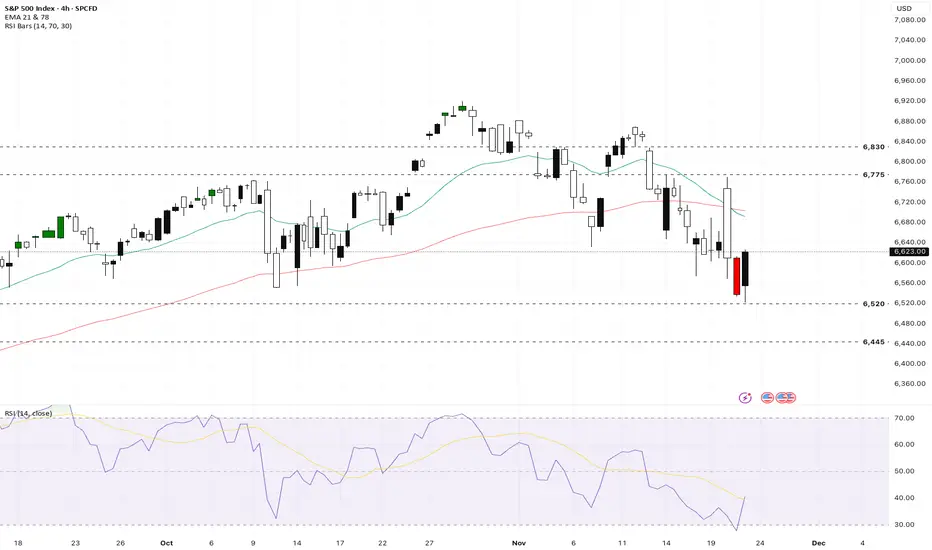
SPX into the open,.Monday 24th NovemeberThe pattern is startng to get bullish Big test is if gets to 6700 aLets see what happensrea by Dentalfloss12361
SPX: Are tech stocks overvalued?Are tech stocks too expensive at this moment? This continues to be one of the main questions among investors. The second is related to the next Fed move at the FOMC meeting in December. The markets entered November in a corrective mood. The S&P 500 dropped another week in a row, to the level of 6.524. Although the market was trading in a positive territory on Friday, still, the S&P 500 is marking around a 5,5% drop for the month. The week started with markets' high concerns regarding Nvidia quarterly results. Jan Huang brought some relief commenting that the demand for chips remains extremely strong, especially for its Blackwell GPUs. The posted quarterly result showed Q3 revenue of $57B, up 62% y/y. The company expects strong earnings to continue till the end of this year, with estimated $65B in Q4, which is higher from current Wall Street estimates. Regardless of data, the shape price dropped by 11%. Amazon is cutting more than 1,800 engineering roles as part of a broader reduction of 14,000 corporate jobs, the largest layoff in its 31-year history. Its share price went down by 8% for the week. On the opposite side, Alphabet (GOOGL) managed to hold the higher grounds, despite the general sell-off of tech stocks. The sentiment on equity markets continues to be negative, with decreasing expectations that the Fed might cut interest rates in December. Current odds by the CME FedWatch Tool dropped to 41%, considering relatively mixed jobs data posted for September. by XBTFX10
Consumer Price Index (CPI) Data in the Global Market1. Meaning of CPI and Why It Matters CPI measures the average change in prices paid by consumers for a set of goods and services over time. This “basket” typically includes: Food and beverages Housing Transportation Apparel Medical care Education Recreation Communication and utilities Because CPI directly represents consumer purchasing power, it helps economists determine whether the cost of living is rising or falling. In the global context, CPI is a major tool for comparing economic conditions across countries. Large economies like the US, EU, China, India, and Japan publish CPI monthly, influencing global financial markets. 2. CPI and Inflation: The Core Relationship Inflation is the rate at which prices rise, reducing the value of money. CPI serves as the most widely accepted measure of consumer inflation. When CPI rises sharply: Consumers pay more for the same goods Savings lose value Borrowing may become costlier if interest rates rise Businesses face higher input costs When CPI rises moderately, it often signals healthy economic growth. Very low or negative CPI (deflation) suggests weak demand and economic slowdown. 3. Types of CPI: Headline and Core Inflation Headline CPI Includes all items in the basket, including volatile components like food and energy. Strongly influenced by fuel prices, supply chain issues, weather shocks. Core CPI Excludes food and energy to reflect long-term inflation patterns. Used by central banks to design monetary policies. In the global market, core CPI is often viewed as the more stable and reliable indicator because it filters out short-term price volatility. 4. How Countries Use CPI in the Global Market 1. Monetary Policy Decisions Central banks such as the Federal Reserve (US), ECB (Eurozone), Bank of England, RBI (India), and Bank of Japan rely heavily on CPI numbers. If CPI rises above the target, central banks typically raise interest rates to control inflation. If CPI falls below the target, they cut interest rates to stimulate demand. Interest rate changes influence capital flows across borders, making CPI a global market mover. 2. Currency Market Impact Currency traders react strongly to CPI releases because inflation affects interest rate expectations. Higher CPI → Higher inflation → Higher probability of interest rate hikes → Currency strengthens Lower CPI → Lower inflation → Rate cuts possible → Currency weakens For example, a positive US CPI surprise often leads to a stronger US dollar, impacting emerging market currencies. 3. Trade Competitiveness CPI also reflects the relative price competitiveness of a country. High inflation may make a country’s goods more expensive globally, reducing export competitiveness. 5. CPI Effects on Global Financial Markets 1. Stock Markets CPI data significantly affects stock indices like the S&P 500, Dow Jones, Nikkei, Nifty, and FTSE. High CPI is often negative for equities Signals inflation pressure Higher interest rates reduce corporate profits Consumer spending may slow Moderate CPI growth is positive Signals healthy demand Supports corporate earnings Indicates stable economic expansion Growth sectors like technology react strongly to CPI because they rely on cheaper capital. 2. Bond Markets Bond prices and yields react instantly to CPI. If CPI rises, bond yields rise because investors demand higher returns to compensate for inflation. If CPI falls, yields may decrease as inflation expectations ease. Government bonds (US 10-year Treasury, German Bunds, UK Gilts) are highly sensitive to CPI surprises. 3. Commodity Markets Inflation affects commodity prices directly: Oil and energy: Higher CPI reflects demand pressure. Gold: A hedge against inflation; tends to rise when CPI is high. Agricultural commodities: CPI reflects food inflation trends. Global commodity traders watch CPI to anticipate supply-demand dynamics. 6. CPI and Global Economic Stability 1. Inflation Targeting Most central banks aim for inflation around 2%, as this level supports stable growth. Too much or too little inflation affects global trade and investment decisions. 2. Emerging Markets Impact Emerging markets like India, Brazil, and South Africa are highly sensitive to global CPI trends: Rising US CPI may cause capital outflows from emerging markets. Higher domestic inflation may pressure their currencies and foreign reserves. Thus, CPI is crucial for maintaining macroeconomic stability. 7. Factors Influencing CPI in the Global Market Several global forces drive CPI fluctuations: 1. Supply Chain Disruptions Events like pandemics, wars, logistics delays, and shipping container shortages cause shortages and price spikes. 2. Commodity Prices Oil prices directly impact transportation, manufacturing, and food costs. 3. Currency Movements A weaker currency makes imports costlier, raising national CPI. 4. Geopolitical Tensions Wars or sanctions can disrupt energy and food supply, increasing inflation. 5. Global Demand Cycles Strong global demand (e.g., during recovery phases) tends to increase CPI. 8. CPI and the Future of Global Markets The role of CPI is expanding as economies become more interconnected. Some future trends include: 1. AI and Big Data in CPI Measurement Governments increasingly use digital tools to track price changes across online marketplaces. 2. Climate Change and CPI Extreme weather events may raise food and energy prices globally, influencing CPI patterns. 3. Deglobalization and Supply Chain Reshoring Countries shifting production back home may face temporary inflation spikes. 4. Rising Importance of Core CPI As economies evolve, stable long-term indicators are becoming more important for policymakers. Conclusion CPI data plays a central role in shaping global market trends. It influences interest rates, currency values, bond yields, stock prices, and trade competitiveness. For investors, traders, businesses, and policymakers, CPI is not merely a number—it is a key indicator of economic health, inflationary pressures, and future financial conditions. Understanding CPI helps decode the direction of global markets and anticipate policy shifts that shape the global economic landscape.Educationby GlobalWolfStreet1
The Culmination of the 2025 Bull Market: AI Mania Tipping PointThe Culmination of the 2025 Bull Market: AI Mania Tipping Point A. Geometry of the 2-Week Chart On the 2-Week chart, price has reached the upper boundary of the 1:20 parallel channel — the same structural angle that has defined the entire post-2020 bull cycle. This angle rises at 20 points per 2-week bar, and the market has touched it only at major cycle culminations: Jan 3, 2022 — Major Top Oct 10, 2022 — Capitulation Low Oct 23, 2023 — Structural Low Apr 7, 2024 — Angle Retest Low Oct 27, 2025 — Structural Top Each contact marked the exhaustion of one cycle and the birth of another. Today, price is pressing against this ceiling with the weakest internal motion of any prior touch. B. Speed & Acceleration on the 2-Week Chart The internal motion confirms the structural peak. ⚡ Speed Has Rolled Over Speed at the February 2025 top reached 159 Market Knots. At the October 2025 top, Speed failed to exceed that reading. Price made higher highs while Speed made lower highs. Higher highs with lower speed = exhaustion. The trend is rising, but the force behind it is hollow. 🔻 Acceleration Has Already Turned Negative Acceleration always breaks first — it is the earliest signal of structural weakness. Acceleration turning negative on the 2-Week chart reveals something critical: It can go much deeper negative. The force of the trend is collapsing before price. Acceleration turning negative on the 2-Week chart reveals something critical: It can go much deeper negative — the force of the trend is collapsing before price. 📉 The Unified Signal When both Speed and Acceleration deteriorate at the highs, the market becomes structurally vulnerable. C. The 2-Day Chart — Short-Term Angles Breaking Inside the broader structure, the rise has been carried by two steep geometric angles: The $4-per-degree angle From the Oct 27, 2023 low (1° = 4 points) The $8-per-degree angle From the Apr 7, 2025 low (1° = 8 points, the steepest of the advance) Both angles have now broken. This confirms what the 2-Week structure already signaled: the completion of a cycle. D. 2-Day Motion (Market Knots) — Internal Force Collapsing The 2-Day chart reveals what the price action hides: the internal engine of the trend has failed while price still sits near the highs. ⚡ Speed has imploded Price is still hovering near peak levels But Speed has collapsed straight downward This is one of the strongest exhaustion signatures the Market Knots System can print When Speed collapses while price remains elevated, the trend is no longer supported — it is hanging at the highs without the force that once carried it and dangerously no structure beneath . 🔻 Acceleration is deeply negative Acceleration has plunged into the deepest negative zone since 2022 The internal force behind the advance is not just fading — it has completely reversed Acceleration is violently negative. This creates a structurally fragile condition: The trend’s internal force has shut down, and price is standing on hollow ground. 2. CONVERGENCE OF CYCLES — December as the Stress Point This breakdown occurs precisely as multiple independent cycles converge into the same temporal window — a natural stress point in the market’s architecture. • The 2020 Cycle — Five Years Completed The post-pandemic cycle that began in March 2020 now enters year five — a common terminal phase in Gann-based cycle structures. Five-year expansions often mark major growth culminations before a structural reset. • The 2021/2022 High — A 3-Year Echo The December 2021–January 2022 top forms a three-year resonance window. Markets often return to the vibration of prior highs on a three-year cadence. Once again, we arrive in the December–January window. • The 7-Year Cycle (2520°) — The Echo of 2018 In 2018, the market peaked early in Q4 and panicked into December as liquidity tightened and the long structural angle exhausted. Seven years later, in 2025, price stands in the same geometric position: touching the top of its structure, with motion collapsing and key angles broken. Seven-year cycles often carry the potential for panics, sharp declines, and structural breaks when the underlying geometry reaches full extension. 3. VALUATIONS — A Market Lifted by the Few The 2025 advance has been extraordinarily narrow. Nine companies now represent 37.64% of the S&P 500: NVIDIA Apple Microsoft Amazon Alphabet (GOOGL + GOOG) Broadcom Meta Tesla This is not a broad-based advance. It is an AI megacluster lifting the entire index. Top S&P 500 YTD Performers (AI/Tech-Linked) And the top S&P 500 YTD performers inside the index are also AI/Tech domiannt. Western Digital (WDC) — +208.82% Robinhood (HOOD) — +187.98% Seagate (STX) — +175.16% Micron (MU) — +146.40% Palantir (PLTR) — +104.75% (Ranked #7 on official S&P list) Lam Research (LRCX) — +97.49% (Ranked #8 on official S&P list) AI Mania Is the Only Engine The market’s strongest performers — both mega-cap and mid-cap — are uniformly driven by: AI hardware AI compute capacity AI storage and memory AI cloud infrastructure AI-driven speculation flow This is not organic economic breadth. It is a narrow, leveraged bet on a single technological axis, carrying the S&P to its ceiling. A Structural Imbalance When nearly 40% of index weight — and nearly all performance — comes from one cluster, the structure becomes top-heavy, like a building with all its weight on a single floor. The index reached its 2025 peak not through collective expansion, but because a handful of megacap Tech/AI companies propelled it upward in stalling economy. 5. SYNTHESIS — A Moment of Completion The 2025 bull market has reached its culmination. A cycle viscously powered by a narrow AI concentration. The market stands at the top of its orbit, supported by a structure whose internal beams are already failing. Historically, this alignment produces volatility as one cycle completes and the next takes form. Multiple independent cycles — 5-year, 3-year, and 7-year — are converging into the December/January window Our geometric measurements indicate a contraction of prices in December and into Q1 of next year. This will initiate a price decline back toward the 1:20 angle into 2026, followed by a resumption of higher prices into 2027. Nana Hermes — All Things Move by Measure. Shortby Nana-Hermes131375
SPX Idea 23.11.2025I also have several scenarios for SPX, unfortunately for this one, it's not possible otherwise. I would consider a potential short first when the SFP is above the weight at the price level of 6883 and then above the new ATH. I would open a long position at the level around Vwap 6453, where the daily level is also nearby, and then at the level of 6200, where the Vwap and weekly levels are located for context, and then a little lower, the Fibo level of 0.382.by Sony970
Bullish S&P 500 - Elliott Wave Count The S&P 500 (SPX) decline since 10/29/25 has the choppy look of an Elliott wave – Double Zigzag correction. If this wave count is correct, it implies the SPX could rally in the last week of November 2025. Intraday momentum supports this theory. The 30 – minute RSI has several bullish divergences going into the bottom made on 11/21/25. This implies selling has exhausted. Upside price action could occur in the next few trading days. Longby markrivest5
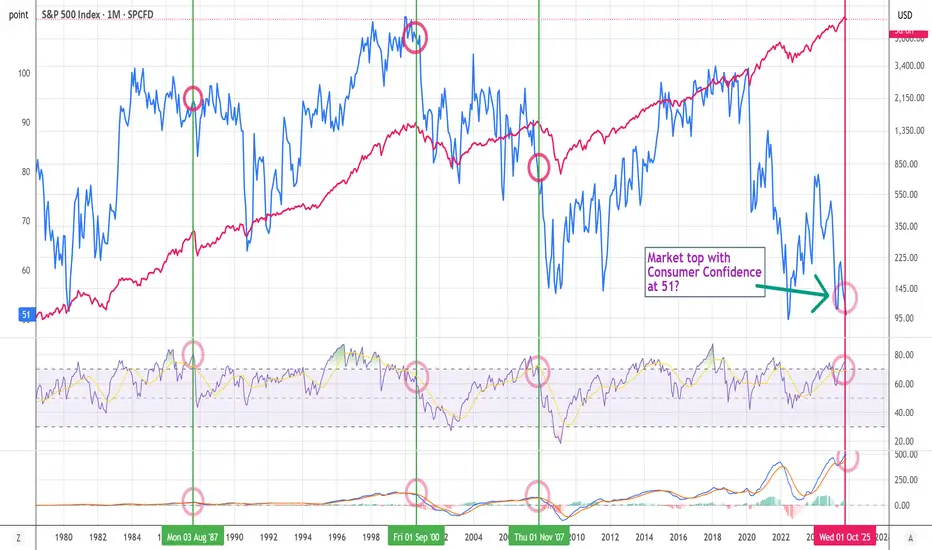
Consumer sentiment vs SPX - Is this the top?🧠 Historically, market tops happen when optimism peaks — not when consumers feel miserable. Today, the U.S. Consumer Confidence Index sits at just 51, near recessionary levels. Hard to call this a “market top” when sentiment is this low. #SPX #Macro #MarketCycle #InvestingLongby brian76830
Bear Case for DecemberBear Case for December. Looking for the sell off to continue. Decent R/R with a clear "stop" level above us.Shortby NicTheMajestic1
sp500 4h🔹 Overall Outlook and Potential Price Movements In the charts above, we have outlined the overall outlook and possible price movement paths. As shown, each analysis highlights a key support or resistance zone near the current market price. The market’s reaction to these zones — whether a breakout or rejection — will likely determine the next direction of the price toward the specified levels. ⚠️ Important Note: The purpose of these trading perspectives is to identify key upcoming price levels and assess potential market reactions. The provided analyses are not trading signals in any way. ✅ Recommendation for Use: To make effective use of these analyses, it is advised to manually draw the marked zones on your chart. Then, on the 15-minute time frame, monitor the candlestick behavior and look for valid entry triggers before making any trading decisions.by Deltafx_Broker0
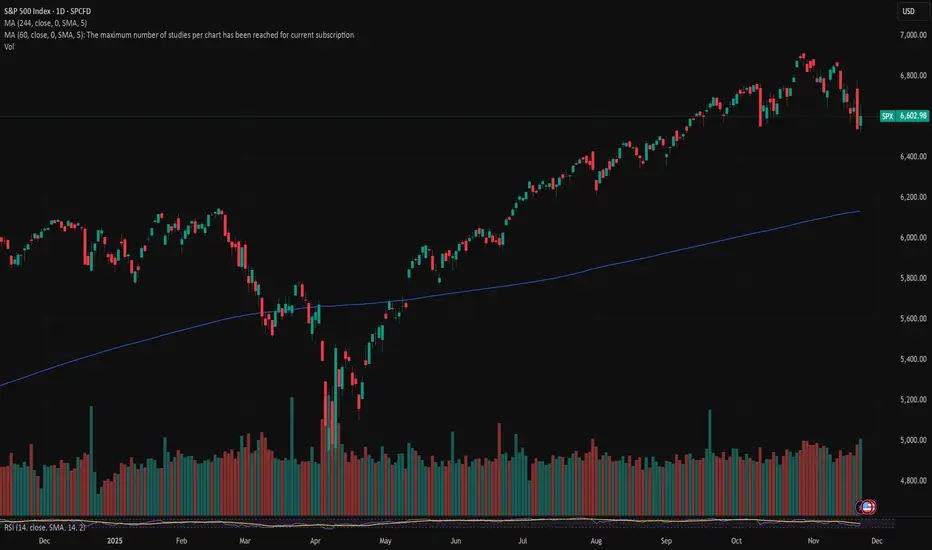
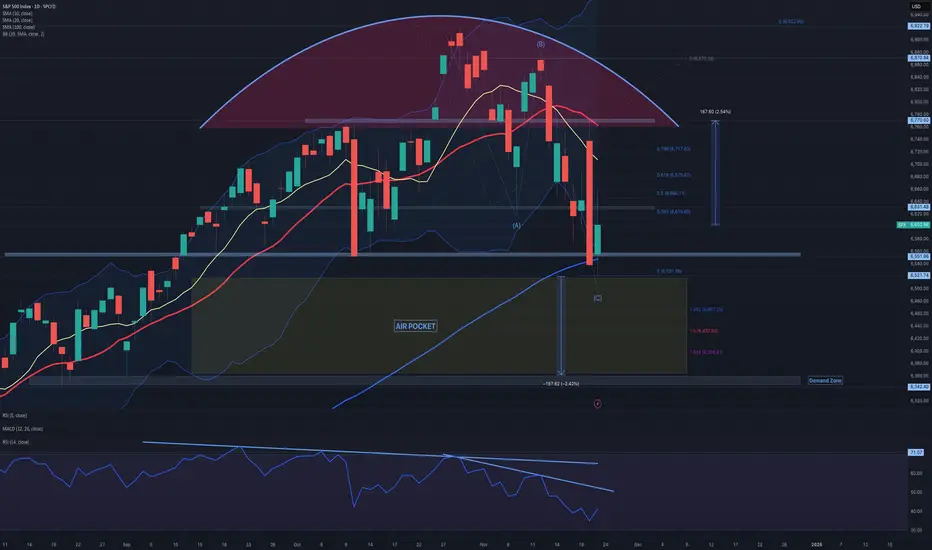
$SPX: dead cat bounce SP:SPX : Following the unexpected downturn on Thursday, SP:SPX stabilized last Friday after an intraday decline below the horizontal support at 6,550, which aligns with the 100-day simple moving average (SMA). The candlestick wicks on the daily chart suggest a potential short-term pause in the prevailing selling pressure. Monday will probably see a continuation of the rebound from Friday’s lows; however, it remains unclear whether Friday’s low marks the end of the current pullback. The RSI14 is approaching, but not yet within, oversold territory, and does not exhibit positive divergence. For the upside scenario, retracement levels from Friday’s high have been identified. Bulls must first reclaim the 6,530 resistance to maintain momentum; nevertheless, unless the key resistance at 6,770—168 points above Friday’s close—is breached, the probability of another downward move remains elevated, targeting the 6,360–6,340 region.by OLIV20200
SP500 to 5700It was not the AI bubble, it was Venezuela. This is an idea linked to a possible intervention of US military in Venezuela, provided some airlines (Iberia, Tap,...) have cancelled their flights to the country on Nov 22nd. If this happens, we can see Oil going up, affecting the whole stock market. We can see what happened during Ukraine War, also linked to energy prices. Shortby CryptoPummel0
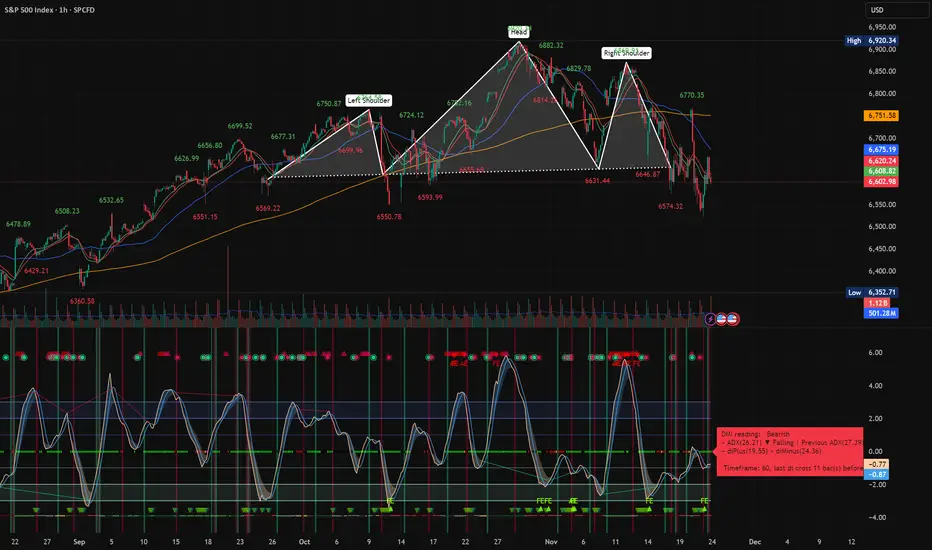
Head and Shoulders on SPXAt the core of the current setup is a fully formed Head and Shoulders pattern, which has already broken its neckline and is now in the process of playing out its measured-move target. The left shoulder formed around 6750, the head extended to roughly 6882, and the right shoulder peaked near 6829. The neckline, positioned around 6590–6630, was decisively broken. This is crucial because a neckline break with momentum and no immediate reclaim typically confirms that a bearish trend has begun. The measured downside projection, based on subtracting the pattern height from the neckline, lands near 6350, which is also a visible structural level on the chart—adding confluence to the target. Trend structure reinforces this bearish posture. Price is trading below both the 50 EMA and the 200 EMA, creating a dual timeframe downtrend. The 50 EMA has curled downward, illustrating a clear loss in short-term strength, while the 200 EMA has acted as resistance rather than support—another hallmark of a shift in momentum. Attempts to rally back above the neckline have been weak and short-lived, showing that buyers lack control. Until price can reclaim the neckline and hold above it, the path of least resistance remains to the downside. Volume behavior also strengthens the bearish case. Downward moves are accompanied by heavier volume, while bounce attempts show declining volume and little enthusiasm. Frequent cluster WVF signals—AE, FE, and other markers—concentrated before the breakdown. Clusters that appear before structural breaks often signal distribution. Since no capitulation spike has appeared yet, it is likely that the move is not finished. VIX is above 26, as well and curling upwards. On the lower panel, the Momentum Oscillator is oversold, but importantly, it has not produced a strong upward reversal. Historically, similar deep dips with hesitation tend to precede an additional flush lower before the next meaningful bounce. Meanwhile, the DMI (Directional Movement Index) gives a clear bearish reading. The displayed values show ADX falling from a higher level and –DI outperforming +DI. A falling ADX during a bearish configuration suggests that although the trend is bearish, the strength of acceleration is cooling slightly—often a pause before continuation. The “last DI cross 11 bars ago” informs us that this downtrend is still young; past cycles in this chart tend to run significantly longer, suggesting more room for follow-through. Altogether, the evidence points to a strong bearish bias. The breakdown from the Head and Shoulders pattern, rejection from both EMAs, confirming volume, bearish DMI, and lack of bullish divergence collectively support a continued decline toward the 6350 region. A rally could occur, but unless it recaptures the 50 EMA and the neckline, any bounce is likely to be corrective rather than trend-changing. For now, the most probable direction remains downward, with the measured move target representing a logical destination before any larger reversal attempt emerges.Shortby GabrielAmadeusLau117
SPX Gann boxSPX is currently turning bearish and its second motive wave of maximum 3 or 4 motive ways down according to wave count. We finished 1st wave of second bigger wave and its consolidation and are now in 2nd wave of 2nd bigger wave. Gann Box gives us time and price targets relative to length and duration of the first wave for SPX second wave down. i highlited upcoming fibs and strong horizontal resistance. Astonishingly they fit perfectly together. Shortby MrKrft1
Bullish continuation of US500Looks like a pullback on the downtrend of the US500, may potentially move upto 6750 in the coming week(s).by Ranj800
US500 - Oversold at Triple Confluence… Bounce Incoming?US500 is approaching a major oversold zone, where three powerful elements intersect at the same point: • The lower bound of the falling red channel • The blue long-term trendline • The orange structure zone acting as demand ⚔️This alignment creates a strong confluence area, a spot where buyers usually step in to absorb selling pressure and trigger corrective moves. As long as the index holds above this zone, we can expect the possibility of a bullish correction toward the upper trendlines. But if this area fails, the structure would weaken and open the door for deeper downside. Right now, all eyes are on this confluence… will the US500 bounce from the oversold zone, or break through it? 🤔 ⚠️ Disclaimer: This is not financial advice. Always do your own research and manage risk properly. 📚 Stick to your trading plan regarding entries, risk, and management. Good luck! 🍀 All Strategies Are Good; If Managed Properly! ~Richard Nasr.Longby TheSignalyst1110
Last chance for SPX500USD to go upHi traders, Last week SPX500USD dropped, went corrective up and dropped again. The pattern changed. Now it could become an (orange) wave 4 Triangle (if it doesn't break the grey arrow) or it finished a Zigzag. So next week we could see more (corrective or impulsive) upside for this pair. Let's see what the market does and react. Trade idea: Wait for a small correction down on a lower timeframe. After a change in orderflow to bullish you could trade longs. This shared post is only my point of view on what could be the next move in this pair based on my technical analysis. But I react and trade on what I see in the chart, not what I've predicted or expect. Don't be emotional, just trade your plan! EduwaveLongby EduwaveTrading2
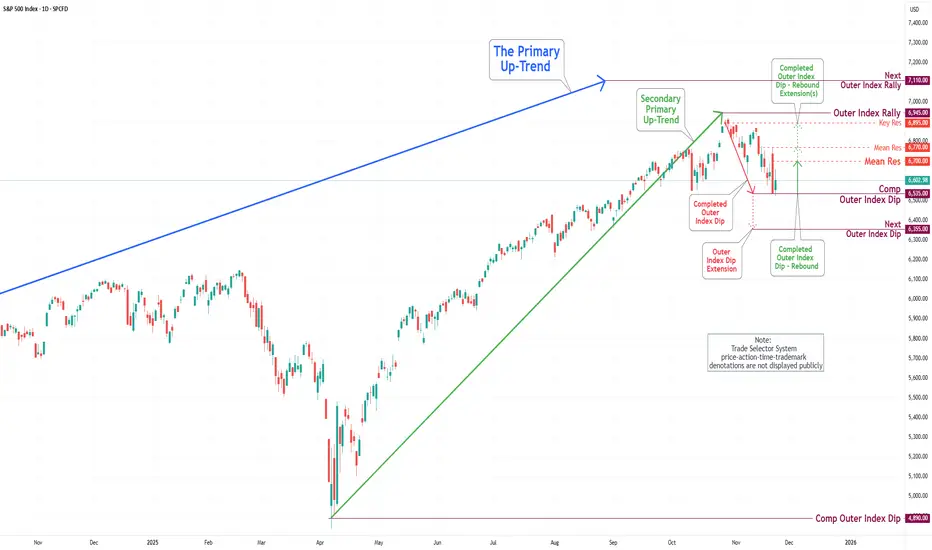
S&P 500 Daily Chart Analysis For Week of Nov 21, 2025Technical Analysis and Outlook: In the last trading session, the S&P 500 Index exhibited significant gyrations, implying a pump-and-dump scenario and highlighting the significance of our completed Outer Index Dip at 6,535. At present, this position suggests the possibility of further upward movement, with the primary targets established at the Mean Resistance levels of 6,700 and possibly 6,770. Furthermore, there exists a well-defined extension towards the Key Resistance level of 6,895, with an ultimate target for the Outer Index Rally set at 6,945. Nonetheless, it is imperative to acknowledge the risk of a potential drawdown in the forthcoming trading session. Such an event could result in prices retesting the completed Outer Index Rally at 6,535, as well as the expansion towards the next Outer Index Rally at 6,355.by TradeSelecter0
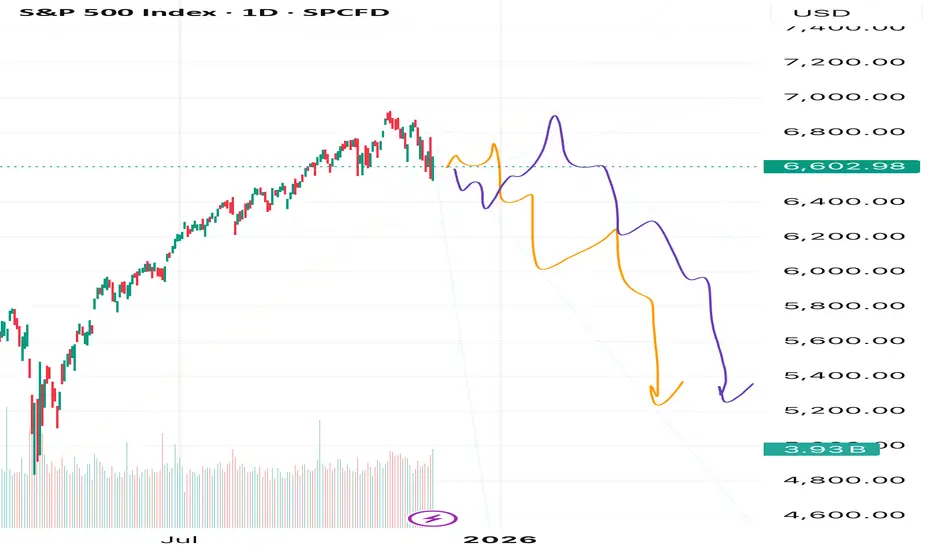
A Historic Shift in the S&P 500 Is BeginningFriends, in my view, the unstoppable rally in the S&P 500 has finally come to an end. The market has completed a massive five-wave structure with an extended fifth wave — and now we’re witnessing a historic moment as an exceptionally large correction begins. As always, I’m watching two possible scenarios: the orange path and the purple path. But despite their differences, both point to the same outcome — my target at 5200. And that’s only the first target out of several. Make sure to follow and subscribe, so you don’t miss the upcoming updates and deeper breakdowns. This is just my personal market outlook — not financial advice. More updates coming soon.Shortby chart1stry3
SPX Going Down to 6200SPX Bearish Head & Shoulders formation points to decline to 6200 ar 250 EMAShortby Dronen113
SPY - likely lower into next weekCorrection of yesterday's strong down move is likely close to being over here. Gold also looks like it will drop and probably hard. Oil, probably lower. BTC lower. Short08:53by rsitrades4
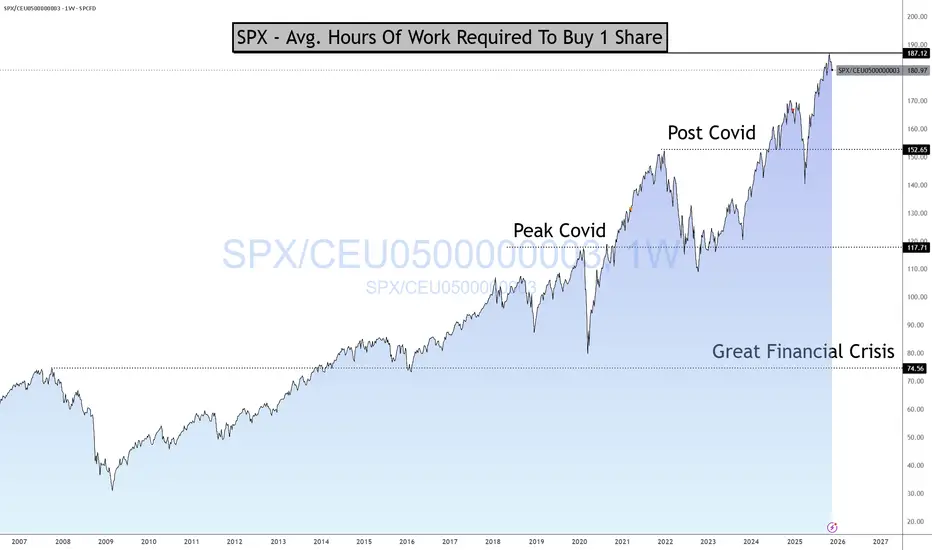
SPX - Hours Of Work To Buy 1 ShareHours of work needed to buy just one share of the S&P 500 just hit a new all-time high: 187 hours. That’s: 150% more work than 2007 60% more than pre-COVID (2019) 10% more than “Liberation Day” As I tell my kids: Don’t look at the price tag. Look at how many hours of your life — your blood, sweat, and effort — it takes to buy the thing. Then decide if it’s actually worth it. When the amount of work required keeps rising while what you get keeps shrinking, that’s not “innovation” or “AI magic.” That’s over-speculation. Buffett said it best: Price is what you pay. VALUE is what you get. Everyone screams about the price going up… but nobody asks whether the VALUE justifies the hours of work required to own it. That’s the truth — not the narratives. THANK YOU for getting me to 5,000 followers! 🙏🔥 Let’s keep climbing. If you enjoy the work: 👉 Boost 👉 Follow 👉 Drop a solid comment Let’s push it to 6,000 and keep building a community grounded in truth, not hype.Shortby RealMacro8821
US500 remains under pressure as technology sector momentum coolsThe US500 moved lower after a volatile session marked by fading momentum in technology stocks and renewed macroeconomic uncertainty. Despite short-term weakness, the index remains up almost 10% year-on-year compared to this period in 2024. Fundamental analysis The US Federal Reserve policy is now in sharp focus, with remarks from policymakers supporting expectations for a possible interest rate cut in Dec, which is inspiring a slight rebound and giving traders hope for year-end support. Fed New York President Williams said the central bank has room to cut rates again soon as the labor market softens, which improved sentiment. Recent strong US earnings, including from key US 500 members, have offered some relief but have not reversed the current downward trend as AI-driven enthusiasm cools. Renewed fiscal uncertainties, increasing debt issuance, and mixed economic data have weighed on sentiment. Technical analysis The index charted a bearish engulfing candlestick below its EMA21, suggesting sellers still control price action in the short term. Key resistance is observed near 6775 and 6830, while immediate support is now at 6520 and a major support at 6445. The volatility index (VIX) jumped by nearly 12% to 26.42, signaling rising market stress and a defensive posture by portfolio managers. In a technical warning that sellers have seized control, charts show Thursday’s losses fully erased the previous session’s advance. The Bearish Engulfing pattern was unusually large and swift and echoed a similar setup in early Mar that preceded a 5% drop in the index. The US500 broke below both its EMA21 and EMA78, levels that many traders view as key lines of support. Sentiment and outlook A $5 tln slide in global equities has left investors questioning how much further the tech-led pullback can go. US stock futures swung between gains and losses in volatile trading amid a sustained retreat from the market’s riskier corners. However, seasonality is historically positive heading into Thanksgiving week, and many market participants expect a rebound into year-end, especially with the Fed likely leaning dovish and volatility peaking. Risk appetite remains subdued, but technical and macro catalysts point toward possible stabilization and recovery if central bank signals remain supportive. Analysis is by Terence Hove, Senior Financial Markets Strategist at ExnessShortby WiseLeoTrading0
SPY in consolidationNothing to report as yet. Looks like a correction, nothing telling me it's a bottom. We could have some drop and pop type moves, so be careful. Gold looks like it will go higher so far. Oil probably goes lower to test it's lows. BTC hit 82k target but could easily fall to 73k. MJ stocks look interesting around here, so I'm wondering if there will be news to legalize soon.12:03by rsitradesUpdated 3