

Trade ideas

NQ1 - Bullish OpenIndexes looking fine to start the week.
Nasdaq has had plenty of chop post interest rate cut, but its been quite tame to print a descending expanding pattern - likely to be bullish but perhaps with some more chop in the pipeline.
Let's see how regular trading hour indexes open 🧐.
This analysis is shared for educational purposes only and does not constitute financial advice. Please conduct your own research before making any trading decisions.


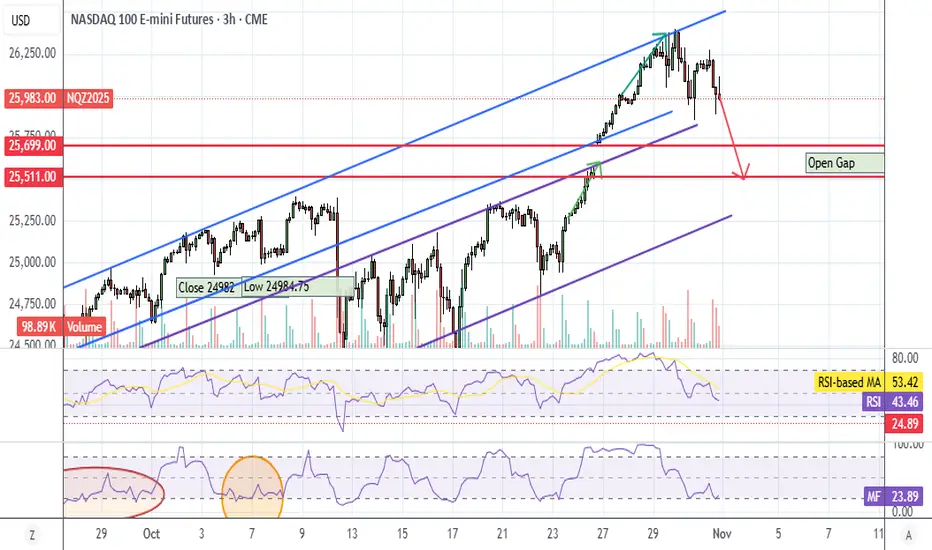
Possible price forecast, roadmap MNZQ2025 3-7 Nov 25The price will be continue with bearish action the main target will be $ 25855 please be cautious do not trade on Thursday and NFP news

NASDAQ 100 (NQ1!): Bullish! Buy This Dip!Welcome back to the Weekly Forex Forecast for the week of Nov. 3 - 7th.
In this video, we will analyze the following FX market: NASDAQ (NQ1!) NAS100
The NASDAQ reached all time highs last week, then started a pullback, landing in a +FVG.
As the +FVG continues to hold, look for valid buy setups to form.
Sells are not valid, my friends. Go with the trend!
Enjoy!
May profits be upon you.
Leave any questions or comments in the comment section.
I appreciate any feedback from my viewers!
Like and/or subscribe if you want more accurate analysis.
Thank you so much!
Disclaimer:
I do not provide personal investment advice and I am not a qualified licensed investment advisor.
All information found here, including any ideas, opinions, views, predictions, forecasts, commentaries, suggestions, expressed or implied herein, are for informational, entertainment or educational purposes only and should not be construed as personal investment advice. While the information provided is believed to be accurate, it may include errors or inaccuracies.
I will not and cannot be held liable for any actions you take as a result of anything you read here.
Conduct your own due diligence, or consult a licensed financial advisor or broker before making any and all investment decisions. Any investments, trades, speculations, or decisions made on the basis of any information found on this channel, expressed or implied herein, are committed at your own risk, financial or otherwise.

#202544 - priceactiontds - weekly update - nasdaq e-mini futuresGood Evening and I hope you are well.
comment: Two red days to end the month but until the giant gap down to 25350 is closed, nothing matters for the bears. Only below that price we can think about getting down to the bull trend line around 24800 but for now we are 400 points below the ath and the mania continues. I firmly believe the move from 24933 to 26399 was the blow-off-top but no one can tell until we completely reverse it.
current market cycle: bull trend
key levels for next week: 24800 - 26500
bull case: Every dip is heavily bought, even dips so small, you can not even see them properly on the daily chart. Full on fomo in the last inning of this. Only a complete AGI/proper lvl5 self driving can convince me otherwise. This is ‘99 all over and for sure we will get an amazing Michael Lewis book about this. Bulls remain in control until we completely reverse the last move and print below 24800 again. Every short is low probability but great r:r.
Invalidation is below 24900.
bear case: We will most likely test the bigger bull trend line again. As of now, the price action shows nothing bearish. Market is driven by a hand full of stonkz but at this point, no one cares because it’s only going up. No measure of excess matters because the snake-oil salesmen just make up new ones. Again. Nothing about the chart is bearish and until we at least close the gap down to 25350, we can not even think about getting confident about shorts. Yes it’s overbought, overdone, a bubble, whatever have you. Does not help with making money shorting this one bit. Wait.
Invalidation is above 26500.
short term: Neutral.
medium-long term - Update from 2024-11-02: Market went further in the wrong direction so my targets become increasingly unrealistic. Right now the 50% retracement is 21750 and would mean a 18% drop. That’s a bit too much to ask for as of now. 23150 is the breakout-retest of the prior ath from 2024-12 and a more realistic target.

NASDAQ this is my opinion for the week not an advice I hate ath price action but I think it will be better when we start q1 next year
be safe trade good don't burn money and be patient the most important! follow your rules

Potential ShortFriday Price pulled back into 26065 and rejected and started to push back to the downside so I do believe that price could go down and close up the FVG and could push lower.

Full Market Cycle Analysis for Nasdaq E-mini Futures (NQ) 11/3Price Action Confirmation & Levels to Watch
Key Levels:
26,200 and 26,150 (major inflection/guard lines per recent market structure)
25,950 and 25,675 (cycle lows, reversion zones)
Breakout Confirmation:
Watch for price action around 26,150–26,170: best risk/reward short setup triggers if price retests and rejects this zone.
Stop Loss: Place above 26,205 for intraday shorts (tight risk discipline).
Initial Target: 500 pts lower to the 25,650–25,670 zone (mean-reversion target).
Mean-Reversion & Swing Behavior
Trend Context:
Current structure shows NQ is way overbought (RSI/MFI excess); big players may tank the rally if major Fed/Earnings events hit tomorrow.
Bearish divergence noted on H1, confirmed by loss of momentum and price rejection from upper channel. Short-term bias is toward retracement.
Seasonal Triggers: FOMC, job numbers, and earnings continue to drive intraday spikes, though daily closes typically mean revert after exhaustion breaks.

Understanding the Structure of Global Financial Markets1. Introduction: The Backbone of the Global Economy
The global financial market is the lifeblood of the world economy. It connects investors, governments, institutions, and corporations across borders, allowing capital to flow seamlessly where it is most needed. Whether it’s a farmer in India taking a loan, a startup in Silicon Valley raising funds through IPOs, or a central bank managing currency reserves, all these activities are influenced by the structure of the global financial system.
Understanding how these markets operate provides insight into how money moves, how wealth is created, and how economic growth is sustained. The structure of global financial markets is not just about trading stocks or currencies—it represents a vast ecosystem that includes banks, exchanges, institutions, and regulatory bodies working in tandem.
2. The Core Components of Global Financial Markets
The financial market is broadly divided into five major segments, each serving a unique function in the flow of funds and risk management.
a. Capital Markets
Capital markets are where long-term securities are bought and sold. They include:
Equity Markets (Stock Markets): Where companies issue shares to raise capital, and investors trade those shares. Examples include the New York Stock Exchange (NYSE), London Stock Exchange (LSE), and National Stock Exchange (NSE) of India.
Bond Markets (Debt Markets): Governments and corporations issue bonds to borrow money for development projects, infrastructure, or business expansion. Bonds provide investors with fixed returns and are a safer investment option compared to equities.
These markets are vital for economic development, as they help mobilize savings and channel them into productive investments.
b. Money Markets
The money market deals with short-term borrowing and lending, typically for periods less than one year. It provides liquidity to financial institutions, corporations, and governments.
Key instruments include Treasury Bills, Certificates of Deposit (CDs), Commercial Papers, and Repurchase Agreements (Repos).
Money markets are crucial for maintaining monetary stability and ensuring that businesses have access to working capital.
c. Foreign Exchange (Forex) Markets
The foreign exchange market is the largest and most liquid financial market in the world, with over $7 trillion traded daily. It enables the conversion of one currency into another and supports international trade and investment.
Participants include banks, hedge funds, corporations, and central banks.
For example, an Indian company importing goods from the U.S. must convert INR to USD, a process facilitated by the forex market.
d. Derivatives Markets
Derivatives are financial contracts whose value is derived from underlying assets like stocks, bonds, commodities, or interest rates. Common types include futures, options, forwards, and swaps.
These markets allow investors to hedge risks or speculate on price movements.
For instance, airlines use derivatives to lock in fuel prices, protecting themselves from price volatility.
e. Commodity Markets
The commodity market deals with the trading of physical goods such as oil, gold, natural gas, and agricultural products.
There are two major types:
Hard commodities: Metals and energy resources like crude oil or gold.
Soft commodities: Agricultural goods like coffee, sugar, and wheat.
Commodity prices often reflect global supply-demand imbalances and geopolitical tensions, making them a key indicator of economic health.
3. The Participants in the Financial Market Ecosystem
Global financial markets are powered by a diverse set of participants, each playing a specific role in ensuring efficiency, liquidity, and transparency.
a. Central Banks
Institutions like the Federal Reserve (U.S.), European Central Bank (ECB), and Reserve Bank of India (RBI) oversee monetary policy, control inflation, and maintain currency stability. Their interest rate decisions and liquidity measures have global ripple effects.
b. Commercial and Investment Banks
Banks serve as intermediaries between savers and borrowers. Investment banks, such as Goldman Sachs or Morgan Stanley, help corporations raise capital through stock or bond issuance and advise on mergers and acquisitions.
c. Institutional Investors
These include mutual funds, pension funds, insurance companies, and sovereign wealth funds. They manage large pools of money and play a dominant role in capital allocation and price discovery.
d. Retail Investors
With technological advancements and low-cost trading platforms, retail participation in global markets has surged. Platforms like Robinhood, Zerodha, and Interactive Brokers have democratized investing.
e. Regulatory Bodies
Regulators ensure market integrity, transparency, and investor protection.
Examples include:
SEC (U.S.) – Securities and Exchange Commission
FCA (U.K.) – Financial Conduct Authority
SEBI (India) – Securities and Exchange Board of India
These institutions enforce compliance and curb insider trading, market manipulation, and systemic risks.
4. The Role of Technology in Modern Financial Markets
Technology has completely reshaped global finance, making markets faster, more efficient, and accessible.
Algorithmic and High-Frequency Trading (HFT): Automated systems execute trades in milliseconds, enhancing liquidity but also introducing flash crash risks.
Blockchain and Cryptocurrencies: Decentralized finance (DeFi) and cryptocurrencies like Bitcoin and Ethereum challenge traditional banking structures, offering transparency and borderless transactions.
Artificial Intelligence and Big Data: AI analyzes massive datasets to predict market trends, optimize portfolios, and assess credit risks.
Fintech Platforms: Apps and online brokers have made trading, investing, and lending more convenient for individuals worldwide.
The rise of digital transformation ensures that even small investors can participate in global opportunities that were once limited to large institutions.
5. Interconnectedness of Global Markets
Global financial markets are interlinked. A shock in one region can quickly ripple across others—a phenomenon known as financial contagion.
The 2008 Global Financial Crisis began in the U.S. housing market but spread to Europe and Asia.
The COVID-19 pandemic disrupted global supply chains, leading to massive volatility in stock and commodity markets.
Today, geopolitical tensions (e.g., U.S.–China trade conflicts or Russia–Ukraine war) impact global energy prices, currencies, and investment flows.
This interconnectedness makes coordination among central banks and international institutions (like the IMF and World Bank) essential to maintaining financial stability.
6. The Importance of Financial Market Infrastructure
Behind every trade or transaction lies a complex network of infrastructure institutions ensuring smooth operation:
Stock Exchanges (e.g., NYSE, NSE, HKEX)
Clearing Houses (which ensure settlement of trades)
Depositories (which hold securities electronically)
Payment Systems (SWIFT, RTGS, NEFT, etc.)
These systems enable trust and efficiency, allowing billions of transactions daily with minimal risk of default or delay.
7. Global Financial Centers
Certain cities serve as nerve centers of the global financial system, each with its specialization:
New York: Global leader in equities and investment banking.
London: Known for foreign exchange and derivatives trading.
Hong Kong & Singapore: Gateways to Asian capital markets.
Dubai: Emerging as a Middle Eastern financial hub.
Mumbai: India’s financial powerhouse, home to NSE, BSE, and a growing fintech ecosystem.
These hubs attract multinational corporations, financial institutions, and investors, reinforcing the global network of finance.
8. Integration of Emerging Markets
Emerging markets such as India, Brazil, China, and Indonesia have become major players in global finance.
They offer:
Higher growth potential
Expanding consumer bases
Attractive investment opportunities
However, they also carry higher risks — including currency volatility, regulatory uncertainty, and political instability.
Global investors increasingly view emerging markets as essential diversification opportunities, while international organizations like the World Bank and IMF provide financial support and stability frameworks.
9. Challenges Facing the Global Financial Market Structure
Despite technological and institutional progress, several structural challenges persist:
a. Systemic Risks
The interconnected nature of finance means that a collapse in one sector or country can trigger a global chain reaction.
b. Regulatory Divergence
Different countries have varying financial regulations, making global harmonization difficult.
c. Cybersecurity Threats
As markets digitalize, cyberattacks pose significant risks to data security and financial stability.
d. Market Inequality
Wealth concentration among institutional investors and developed economies often widens inequality between nations.
e. Climate and ESG Challenges
Sustainability has become a key issue. Markets are increasingly adapting to ESG (Environmental, Social, Governance) frameworks, integrating ethical and ecological considerations into investment decisions.
10. The Future of Global Financial Markets
The future structure of global financial markets will be shaped by innovation, regulation, and inclusivity.
Key trends include:
Central Bank Digital Currencies (CBDCs) revolutionizing payment systems.
Tokenization of Assets, allowing fractional ownership of real estate or art.
Sustainable Finance, where green bonds and ESG-focused funds dominate portfolios.
Cross-border interoperability, enabling faster and cheaper global transactions.
The focus will increasingly shift toward resilience, transparency, and financial inclusion—ensuring that economic growth benefits both developed and developing economies alike.
11. Conclusion: A System of Opportunity and Responsibility
Understanding the structure of global financial markets is essential not just for investors or policymakers, but for anyone who wants to comprehend how the modern world operates. These markets determine everything from interest rates on home loans to the prices of everyday commodities.
At its core, the global financial system represents a balance between risk and reward, stability and innovation, and regulation and freedom. As globalization deepens and technology evolves, financial markets will continue to transform — becoming more interconnected, intelligent, and inclusive.
However, this evolution also demands responsible participation. Ethical investing, prudent regulation, and financial literacy are vital to ensure that the benefits of global finance reach everyone — not just a privileged few.
In short, the global financial market is a dynamic, living system — a mirror reflecting the collective ambitions, fears, and progress of the world’s economies.

NQ UpdateI noticed this morning that MFI actually went down, not up.
I bought ALB in the morning and flipped it for $1 per share profit. That stock moves well.
NQ Short (10-27-25, Week 5)NAZ with O/N Gap open to lock in the Long chase and clean out the short stops. Regarding Friday short, I always go flat into the close. The O/N continues be used to lift it with ease. This may be blow off top day into balance of Friday - Monday Long Play. Netflix had the -10% move and has not recovered, NAZ is using the off session to Rig it up. Drop may not be until Tuesday, yellow arrow is range for retest should upper stall out. Current gap fill likely either way. Pump/Dump into Open, Gap up in O/N and expect some Tweets. When this stalls, look short. AP on Friday, voided by Gap.
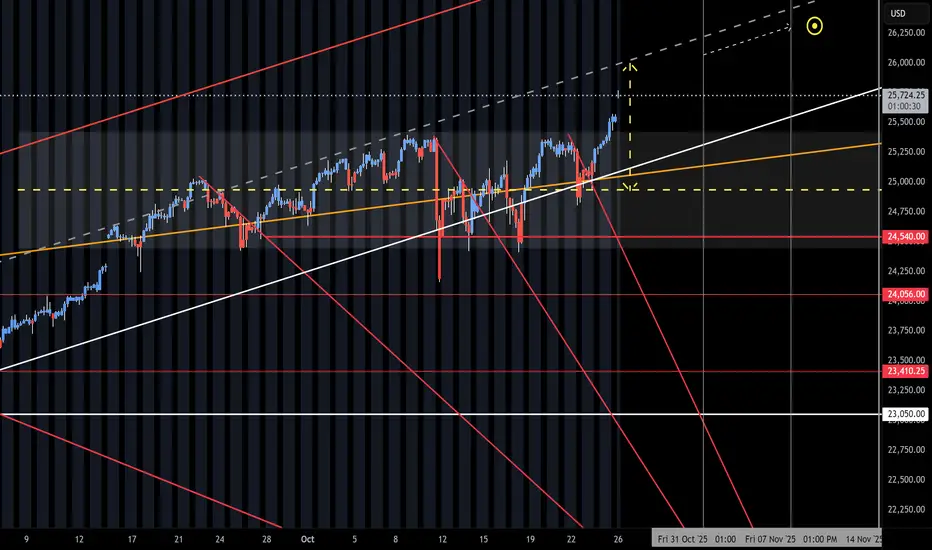
NQ 10/30lets see where this goes today. the lines are color coded and they mean things. go to other posts to see what that means.

HOW TO TRADE THE LONG TERM TREND BY DRAWING TRENDLINES!Hey Traders so today wanted to make a quick video that explains how to trade the long term trend early. Also when to move your trendline to stay with the market for as long as possible in long term trends.
Hope This Helps Your Trading 😃
Clifford


Heads Up!!!!5m chart, 09:45 candle is a Heads Up!!!! candle. Volume, Long Lower Wick, ~High Wave Doji on a strong support
If you had waited for the 10:05 close and deployed the following plan:
1.-1 Pawn @ 26084.50
2.+2 Kings @ 26085.00
3. MNQ Ladder of Success
You would have traded this like a true champion.
Make this plan your own. Adapt it to your account size and your risk tolerance.


Bullish Bias on NQ for TodayBias: Bullish
Draw on Liquidity: All-Time High
Until 1H BISI/FVG made on Yesterday is not violated, We are Bullish on NQ.

NQ Nasdaq Trade Set Up for NY session Price breakout from intradayPRIMARY: Bearish Setup #2 (Conservative Retest Entry)
Why:
✅ Aligns with your 10+ hour analysis
✅ Best risk/reward (8:1 potential)
✅ Waits for confirmation
✅ Tighter stop = better position sizing
✅ Matches your patient discipline
Execution:
Watch NY open for break below 26,150
Don't chase - wait for retest of 26,150-26,170
Enter on rejection confirmation
Stop at 26,205 (60pt risk)
Target 500pts = 25,650-25,670
ALTERNATIVE: If no break by 23:00 JST → Wait for H4 close and use Bearish Setup #3 reach 26200 in Asian session but

HALLOWEEN THEME: TRICK OR TREAT - RATTLE SKELETON BONES OF 1999Trick or treat
- smell my feet.
Give me something
- good to eat.
If you don't
- I won't be sad.
I'll just make you wish you had!
🎃 Happy Halloween y'all! 🎃
--
Best wishes,
@PandorraResearch Team

The Concept of Competitive DevaluationIntroduction
In the complex world of international trade and global finance, currency valuation plays a central role in determining the economic health of nations. A country’s currency value not only affects its imports and exports but also influences investment flows, inflation, and overall competitiveness in the global market. Among the many policies that governments use to influence exchange rates, one particularly controversial and strategic move is competitive devaluation—sometimes referred to as a “currency war.”
Competitive devaluation occurs when countries deliberately lower the value of their own currencies in order to gain a trade advantage over others. The main goal is simple: to make exports cheaper and imports more expensive, thereby boosting domestic production and improving the trade balance. While the concept seems straightforward, its implications are far-reaching, affecting everything from global trade relationships to inflation and geopolitical stability.
Understanding Devaluation
Before delving into competitive devaluation, it is crucial to understand what “devaluation” itself means.
Devaluation refers to a deliberate downward adjustment in the value of a country’s currency relative to other currencies. This policy is typically implemented by nations with a fixed or pegged exchange rate system, where the value of the currency is tied to another currency, such as the U.S. dollar or the euro.
For instance, if India were to officially lower the rupee’s exchange rate from ₹80 per U.S. dollar to ₹90 per U.S. dollar, it would mean the rupee has been devalued. This makes Indian exports cheaper for foreign buyers but makes imports costlier for domestic consumers.
Devaluation is generally used to:
Boost exports by making goods cheaper abroad.
Reduce imports by making foreign goods more expensive.
Correct trade imbalances or current account deficits.
Support domestic industries and employment.
However, when multiple countries start engaging in devaluation simultaneously to outcompete one another, the practice turns into competitive devaluation—a self-reinforcing cycle that can destabilize global trade.
Defining Competitive Devaluation
Competitive devaluation is a situation where several countries intentionally devalue their currencies to gain an upper hand in international trade. It’s often described as a “race to the bottom” because every country tries to make its currency weaker to outcompete others.
The basic logic is that if one country devalues its currency, its exports become cheaper on global markets. Other countries, fearing a loss of export competitiveness, may respond by devaluing their own currencies. This leads to a chain reaction of devaluations that can distort trade relationships and create volatility in financial markets.
In essence, competitive devaluation reflects an international tug-of-war where each country attempts to export more and import less by manipulating exchange rates—often at the expense of its trading partners.
Historical Background
The concept of competitive devaluation isn’t new; it has appeared in different forms throughout economic history.
1. The Great Depression (1930s)
During the Great Depression, countries abandoned the gold standard and devalued their currencies to stimulate exports. Britain devalued the pound in 1931, followed by the U.S. in 1933, and many others soon after. This wave of devaluations led to what economists termed “beggar-thy-neighbor” policies—where one nation’s gain in trade came at the expense of others, worsening global economic instability.
2. Post–World War II Period
Under the Bretton Woods System (1944–1971), exchange rates were fixed to the U.S. dollar, and the dollar was pegged to gold. Devaluations were rare but highly significant. For example, Britain devalued the pound by 14% in 1967, and France followed with smaller adjustments. However, competitive devaluation pressures contributed to the eventual collapse of the Bretton Woods system in 1971, when the U.S. dollar was floated.
3. The Modern Era (2008–Present)
The global financial crisis of 2008 revived fears of competitive devaluation. With interest rates at historic lows, countries including the U.S., Japan, and China were accused of manipulating currencies to support exports. This period saw the rise of the term “currency wars,” famously coined by Brazilian Finance Minister Guido Mantega in 2010.
The rise of quantitative easing (QE)—massive money-printing programs by central banks—indirectly weakened currencies, leading to a new form of competitive devaluation, even if not officially declared.
Mechanics of Competitive Devaluation
Competitive devaluation typically occurs through monetary policy tools rather than explicit announcements. The following mechanisms are commonly used:
Interest Rate Cuts:
Lowering interest rates reduces the returns on assets denominated in that currency, making it less attractive to investors. This causes capital outflows and weakens the currency.
Foreign Exchange Intervention:
Central banks may directly buy foreign currencies and sell domestic currency in the forex market to push down its value.
Quantitative Easing (QE):
By injecting liquidity into the economy through large-scale bond purchases, a central bank increases the money supply, which tends to lower the currency’s value.
Capital Controls:
Restricting capital inflows and outflows can manipulate currency movement indirectly.
Official Declarations or Peg Adjustments:
In fixed exchange rate regimes, governments can officially devalue their currency peg to make exports cheaper.
Motives Behind Competitive Devaluation
Countries engage in competitive devaluation primarily to achieve short-term economic goals. Key motives include:
Boosting Exports: A weaker currency makes domestic goods cheaper in global markets, leading to higher export demand.
Reducing Trade Deficits: Costlier imports help reduce trade imbalances.
Stimulating Economic Growth: Export-led growth can boost production and employment.
Combating Deflation: Devaluation can help raise domestic prices by making imports costlier.
Debt Relief: For countries with large foreign debt, devaluation can reduce the real burden when the debt is denominated in local currency.
However, while these benefits may appear attractive, the strategy comes with severe side effects, especially when used by multiple countries simultaneously.
Consequences of Competitive Devaluation
1. Short-Term Gains
In the initial phase, devaluation can indeed stimulate exports and improve a country’s trade balance. Domestic producers gain an advantage, and employment may rise in export-oriented industries. However, these gains are often temporary.
2. Imported Inflation
A weaker currency makes imports more expensive. This leads to higher costs for fuel, machinery, and raw materials—especially in countries dependent on imports—resulting in inflationary pressures.
3. Loss of Purchasing Power
Consumers face higher prices for imported goods, reducing their real income and purchasing power.
4. Retaliation and Trade Wars
When one country devalues, others retaliate to maintain competitiveness. This spiral can trigger global currency instability and even trade wars, where nations impose tariffs or barriers.
5. Financial Market Volatility
Rapid currency movements create uncertainty in capital markets. Investors may pull out funds, leading to exchange rate fluctuations and financial instability.
6. Diminished Global Confidence
Persistent devaluations erode investor confidence in a country’s economic management, leading to capital flight and loss of foreign investment.
7. Long-Term Inefficiency
Instead of improving productivity and innovation, countries may become reliant on devaluation as a shortcut to competitiveness. This undermines long-term structural growth.
Competitive Devaluation vs. Currency Manipulation
Although the two concepts overlap, they differ in intent and execution.
Competitive Devaluation is often part of a broader monetary policy aimed at economic recovery or export promotion.
Currency Manipulation, on the other hand, involves deliberate and sustained actions by a country to artificially maintain an undervalued currency for unfair trade advantage, often drawing international criticism (e.g., the U.S.–China trade tensions).
Real-World Examples
1. China (2000s–2010s)
China was often accused by the U.S. and other nations of keeping the yuan undervalued to boost exports and maintain high trade surpluses. The strategy helped China become a global manufacturing powerhouse, though it also led to significant trade frictions.
2. Japan (Abenomics Era)
Under Prime Minister Shinzo Abe (2012 onward), Japan’s policy of aggressive monetary easing weakened the yen, helping Japanese exporters but drawing criticism from trading partners who saw it as competitive devaluation.
3. Eurozone (Post-2015 QE)
The European Central Bank’s quantitative easing program weakened the euro, benefiting exporters in Germany, France, and Italy, while raising concerns in the U.S. and emerging markets.
4. United States (Post-2008)
Though not a traditional devaluation, the U.S. Federal Reserve’s low-interest-rate and QE policies weakened the dollar, indirectly boosting exports and prompting other countries to follow suit.
Global Implications
The ripple effects of competitive devaluation go far beyond national borders:
Distorted Trade Balances: Export gains in one country often mean export losses in another, leading to global imbalances.
Increased Global Inflation: Weak currencies make global commodities like oil and metals more expensive.
Tensions Among Trading Partners: Countries may accuse one another of unfair practices, straining diplomatic relations.
Unstable Capital Flows: Investors shift funds rapidly in response to currency movements, destabilizing emerging markets.
Reduced Global Growth: If all countries devalue simultaneously, the net benefit vanishes—resulting instead in uncertainty and slower trade growth.
Policy Alternatives to Devaluation
Instead of engaging in competitive devaluation, countries can pursue more sustainable policies such as:
Improving Productivity and Innovation: Enhancing competitiveness through technology and efficiency rather than currency weakness.
Fiscal Reforms: Managing government spending and taxation to stabilize the economy.
Diversifying Exports: Reducing dependence on a few export sectors or trading partners.
Enhancing Domestic Demand: Building a stronger internal market to offset external vulnerabilities.
Coordinated Monetary Policies: Through organizations like the IMF or G20, countries can align exchange rate strategies to avoid destructive currency wars.
Conclusion
Competitive devaluation is a double-edged sword. While it may offer short-term relief to struggling economies by stimulating exports and reducing trade deficits, it ultimately creates more problems than it solves when used excessively or simultaneously by multiple nations.
The strategy can lead to global instability, inflation, and erosion of investor confidence—undermining the very competitiveness it seeks to enhance. The real solution lies not in weakening currencies but in strengthening economic fundamentals: productivity, innovation, diversification, and fair trade practices.
In a world where economies are deeply interconnected, competitive devaluation is less a path to prosperity and more a reminder that sustainable growth depends on cooperation, not competition, in currency markets.
NQ: 279th trading session - recapPretty sad that I won't be here tomorrow but its fine ig, next weeks a holiday. I can trade all 5 days long.

