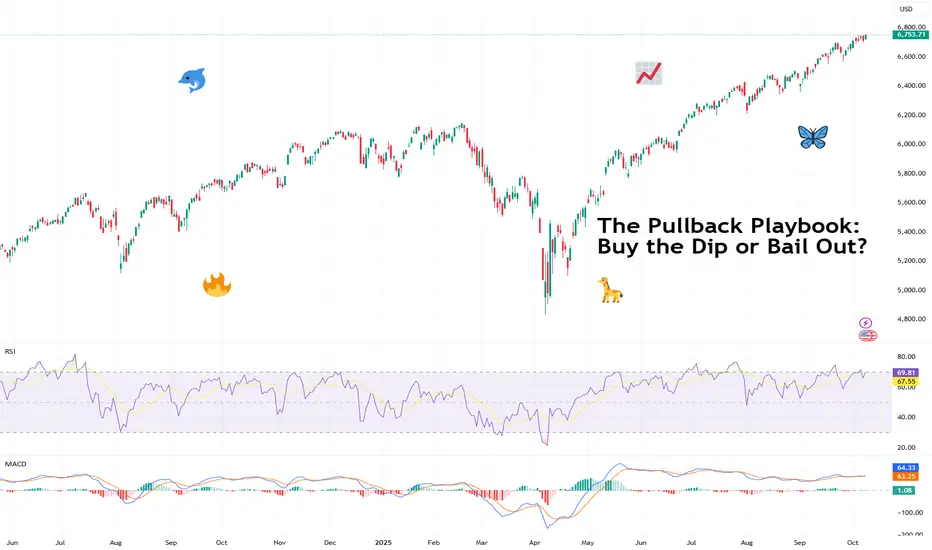
The Pullback Playbook: Buy the Dip or Bail Out?Markets don’t go up in straight lines. Even the strongest trends pause, retrace, and test your conviction.
These pauses are called pullbacks and they can either be healthy breathers before the next leg higher or the first cracks in a trend about to fall apart. The challenge for traders is knowing the difference.
📉 What Exactly Is a Pullback?
Think of a pullback as a temporary trend halt, not necessarily a crash. The price moves against the prevailing trend for a short period, testing support levels or shaking out weak hands before deciding where to go next. They’re common, normal, and — if managed right — they’re opportunities rather than threats.
But here’s where it gets tricky: not all pullbacks are trend halts. Some are the start of a flat-out reversal. And unless you’re comfortable holding through a potential nosedive, you need skills and tools to tell which is which.
🧐 Pullbacks vs. Trend Reversals
So how do know if you’re looking at a pullback or a trend reversal? The main differentiating factor is the length of the move. The healthy pullback looks orderly — modest in size, controlled in volume, and often retracing to familiar moving averages or support zones.
A healthy pullback might retrace 3-5% in a bull run, testing the 20- or 50-day moving average before bouncing higher.
A trend reversal barrels through multiple support levels in days, erasing weeks of gains. It’s often sharper, louder, and driven by news or panic.
Signs of a healthy pullback include:
• Price holding above key moving averages (20, 50-day. Some stretch to the 100-day but these tend to be rare — it’s more likely a trend reversal by then).
• Volume shrinking on the way down, then swelling on the rebound.
• Oscillators like RSI cooling off from overbought territory without plunging into oversold.
Trend reversals look more like:
• Breaks of multiple support levels in one go.
• Heavy, accelerating sell volume.
• Headlines driving panic: tariffs, central bank surprises, data releases from the Economic calendar , crypto exchange blowups, or noise coming from the Earnings calendar .
📊 Technical Tools to Judge the Dip
Charts can’t predict the future, but they can help you gauge probabilities. Pullbacks often line up with Fibonacci retracements, moving averages, or horizontal support and resistance levels.
• Moving Averages : If price pulls back to the 50-day and holds, that’s often a green light for trend continuation. If it slices straight through the 100-day? Not so healthy.
• Trendlines : Respecting the line = confidence. Breaking it = trouble.
• Volume : Low-volume pullbacks suggest sellers aren’t that committed. High-volume dumps are red flags.
None of these are crystal balls. But together, they give you a framework to avoid buying every dip.
🏄♂️ The Psychology of Buying the Dip
Why do traders love dips? Because everyone wants a discount. A pullback offers a chance to jump on a trend at a better price, and social media culture has turned “buy the dip” into a meme strategy. But memes don’t pay the bills when a dip turns into a crater.
The psychology works both ways:
• Optimists see dips as golden tickets.
• Pessimists see them as traps.
• Realists know both can be true, depending on the setup.
Being aware of your own bias — whether you lean toward buying too early or panicking too soon — is half the battle.
🔄 Asymmetric Risk and the Smart Bet
Here’s where it gets interesting. You don’t need to be right all the time if your risk-reward ratio is skewed in your favor. A tight stop and a wide target can mean one win cancels out several small losses.
Imagine risking 1% to potentially make 10%. Even if you’re wrong most of the time, the math can work. Pullbacks are prime territory for asymmetric setups: smart, thought-out entries, clear invalidation points (below support, trendline breaks), and attractive upside if the trend resumes.
This doesn’t mean chasing every dip. A pullback can wipe your position clean if you’ve placed your stop loss a little too close, a little too early.
⏳ Timing Matters
The biggest mistake with pullbacks is trying to catch the exact bottom. Traders love to brag about nailing the wick, but most who try end up paying for it. Smarter is to wait for confirmation — a bounce, a reversal candle, a break back above a short-term moving average.
Yes, you may miss the lowest price. But you’ll also miss buying into a freefall.
🌍 Pullbacks in Context
Context is everything. A dip in a raging bull market is not the same as a dip in a shaky sideways market. Macro matters too. If the Fed is cutting rates , risk assets might rebound fast. If tariffs, wars, or inflation are spiking, a pullback could turn into something bigger and deeper.
That’s why traders zoom out before diving in. Daily charts tell one story; weekly charts often tell the bigger tale.
🚀 Buy or Bail?
So, do you buy the dip or bail out? The honest answer is: it depends. A well-structured pullback in a strong uptrend with unchanged fundamentals is an opportunity.
A violent, volume-heavy selloff in a fragile market with cracked fundamentals is a warning.
The pullback dilemma isn’t just about charts but also about psychology. Can you hold your nerve when the market wobbles, or will you cut and run? Both choices can be right in the right context.
🎯 Final Takeaway
Pullbacks are part of every trend’s DNA. They test conviction, patience, and risk management. The key isn’t to predict every wiggle but to recognize whether price action is just cooling off or signaling something bigger.
Stay disciplined, respect your stops, and let the chart, not the noise, tell you when it’s time to stay in or step aside.
Off to you : Buy the dip? Or bail out? How do you respond to expected and unexpected market pauses? Let us know your coping mechanism in the comments!
Btd
Linking Time with Price LevelThe relationship between time and price level can be observed through the analysis of price charts and technical indicators. Technical analysis involves the use of charts and indicators to identify patterns and trends in price movements. One important aspect of technical analysis is the identification of support and resistance levels, which can help traders make decisions about when to buy or sell a particular asset.
Technical indicators can also be used to analyze the relationship between price and time. For example, moving averages can be used to identify trends in price movements over a specific period of time. The slope of the moving average can indicate the strength of the trend, while the distance between the price and the moving average can indicate the level of deviation from the trend.
In addition to technical indicators, traders also use fundamental analysis to assess the relationship between time and price level. Fundamental analysis involves the study of economic and financial data to identify factors that can influence the price of an asset. For example, changes in interest rates, inflation, and political events can all have an impact on the price of an asset over time.
To summarize, the relationship between time and price level is complex and multifaceted. Traders use a variety of tools and techniques to analyze this relationship, including technical indicators, charts, and fundamental analysis. By understanding the relationship between time and price level, traders can make more informed decisions about when to buy or sell a particular asset.
Regarding the development of price ratios, the expected price level and the expected price movement for the wave can be determined by analyzing technical indicators such as Relative Strength Index (RSI) and Price Oscillator. The RSI can be used to identify the overbought and oversold conditions of an asset, while the Price Oscillator can indicate the strength of the trend. By analyzing these indicators, traders can develop price ratios and make informed decisions about when to enter or exit a trade.
Finally, it's important to note that the relationship between price and time is not always straightforward. While technical analysis and fundamental analysis can provide valuable insights, they are not foolproof. Traders need to be aware of the limitations of these tools and use them in conjunction with other forms of analysis and risk management strategies.
WMB - Pullback within trendTook entry here Jul 18 after WMB closed below the 9 - first time since Jun 23 - and took out the Jul 18 O in the opening bars. Looking for a new SH here over $34.25. Thirteen days to earnings so plenty of time for this to print a higher high and test that DTLR around $34.65. Volume has been below average on this pullback suggesting not a ton of sellers here; just a round of profit-taking. And it could last into earnings. we'll see.
#BTC/USDT 2Hr UPDATE !!Hello dear traders, we here new so we ask you to support our ideas with your LIKE and COMMENT, also be free to ask any question in the comments, and we will try to answer for all, thank you, guys.
BTC 6Hr UPDATE !
As I told in the previous update, you can read further in BTC's it is going on
As we can see at the above mentioned chart after a sharp rejection from upper resistance trend line BTC moved to south by 3% and again able to recover towards north and currently facing the resistance level again.
As BTC is suffering to break above which is the most necessary rally above.
Break above will lead BTC towards its upper price level of $25k and rejection will again lead it to drop towards lower support levels.
Let’s see how price perfumes in upcoming hours.
Remember:-This is not a piece of financial advice. All investment made by me is at my own risk and I am held responsible for my own profit and losses. So, do your own research before investing in this trade.
Sorry for my English it is not my native language.
Do hit the like button if you like it and share your charts in the comments section.
Thank you.
BTC: Panicking for no reason...yetBTC
~ Interesting how everyone is panicking when it has clearly yet to break key support on the weekly and has even begun to bounce off of it
~ There is even bullish divergence on the RSI as well.
~ I am no expert but it ain't raining until it's raining.
If we break that support line, that when I would be worried. As of now it seems to be a BTFD
🔥 CHR Bullish Move ExpectedLike many other tokens, CHR is currently seeing a strong bullish reversal after the BTC pump a couple of days ago.
If we connect the March top with the current one, we can clearly distinguish an ascending wedge pattern. The top of my pattern is also my intermediate target.
Happy trading!
buy the dip sell gap close (SPY)pretty simple idea. if we gap down spx and we hold some new higher daily low early on, then break above premarket close by a significant margin, the index is a buy until gap is almost or all the way closed
volatility spike still expected by end of wed, thu morning
if we gap up and start to trade up, the higher targets can be used
Ethereum recovers quickly - Where your stop loss needs to beFriday's crypto crash recovered almost as fast with BTD traders bringing many coins, especially Ethereum, back up to the prior crash range. The crash bar should not be discounted as a fluke by any means. It sets up a clear defining line in price action going forward. Where price went to, stopped, and reversed quickly is the clear support. Breaking the low of the crash bar is very bad for the long term trend. So long as 3400 holds it is fine to be a remain optimistic about the "next bull run". Breaking this level, however, should rightfully challenge one's long term prospects and encourage them to apply good risk management.
Simply put: if the low is broken... the party's over for this cycle.
I remain short ETHUSD
No Croissant Crumbs since mondayCem didn't post any levels for 2 days.
He did however leave a hint in Monday levels.
Cem only posted "Resistance" instead of "Support/Resistance" as he usually does.
There is still plenty of vanna and charm flows as a result of higher skews.
Gary has bananas.
if you look at monday - tuesday open regression trend its pointing to a slow gradual unwinding to the "Buy the Dip" OPEX.
My thinking is that market makers are aware and unwinding earlier.
Another gamma expert I follow also showed last week institutional buyers were net aggressive equity calls (retail not so much).
Retail can't buy the dip, if there is no dip, but rather a slow gradual slide.
I'm not a financial advisor. Not that there is anything wrong that. This is not financial advice.
MELI Long Opportunity after the correction Mercadolibre is still correcting although drawing closer to a zone I expect a bounce/reaction.
Since Sept 2020 MELI has been trading inside a ascending channel and printed a fresh ATH in Jan 21.
I anticipate a move down to the bottom of the channel with the following confluences 200EMA,
.618 fib pull from bottom of the channel to the last swing high and the point of control *POC as drawn on the chart.
ALways know your invalidation and use a SL ..Like Share and follow for regular setups and analysis
To buy or not to buy.That is the question.
Not much time to analyze because somebody needs to get work done.
I think we're going to see some ups and downs the rest of the week but my expectation is to land right smack where I guessed 2 1/2 weeks ago.
China is persistent and will continue to de-risk their economy.
I think this will eventually cause a snap back / rubber band effect as China and US economies pull apart from each other.
Demand for CPU will continue to be a pivotal factor as employers continue to kick the can down the road.
BTC.D almost at ATL get ready for it to reverse BTC Dominance just hit 39.82 very close to ATL 35.5 of Jan 2018. While BTC.D may still go a bit lower, but get ready for a reversal. Once a reversal starts, the market could get very violent blooding all ALTs in BTC pairs.
While there's nothing certain in the world of crypto, but BTC remains king, that's for sure. Once BTC heads up, Alts shall bow.
Buying this dip one more time!See annotated chart. There's a decent chance we bounce once more above SPY 415. If the red pivot zone becomes resistance, I will quickly switch to bearish and short. I'm long with calls as of Monday's close. Not interested in holding under 414. Wouldn't buy if we tap ATH and roll-over...but if we do squeeze again, it's gonna be a doozy!
Using Fibonacci Arcs to predict BTCUSD pattern Fibonacci arcs are a an important indicator for price patterns. They plot many useful areas of support and resistance, which gives a trader a better chance to buy or sell at a better value accordingly.
Now while all these lines might seem confusing to some amateurs. Do not worry about all the lines. You only care about the lines which are around the current price of the asset you are assessing.
In this case, BTC has bounced off a support and makes its way up, it has room for more bullish momentum. A clearer indicator of a re-bounce is that the price did not break through the support level it was closest to.
Hope this was useful for you!
DO NOT PANIC SELL! HODL & BTD
Thierry Hitti
BTC price reversal using Trend based Fib Time toolThe trend based fib time tool is used to predict pattern reversals by using horizontal fib levels. This method has proven effective and predicts many reversal patterns.
By plotting the Key points on the daily BTC time frame. I as able to find that we are very close to a trend reversal, which means that bullish momentum is imminent and waiting impatiently to takeover.
Please note that the numbers and charts are not 100% accurate and contain some offset.
This idea is only published for educational purposes.
HODL & BTD!
Thierry Hitti
🔥 BNB Bullish Triangle Break-OutBNB has seen a long period of consolidation after the immense run-up a few weeks ago. It seems that the $200 definitely was the bottom of that semi-bearish period. Over the last week or so BNB has shown small signs of recovery and produced a bullish triangle whilst doing exactly that.
Before entering this trade wait for the price to close above the Entry line. Higher time frames yield a higher predictive power.
On the chart I’ve marked two potential areas of resistance, R1 and R2. These areas are based on recent swing highs and round numbers. Do your own due diligence.
Happy trading!