Harmonic Patterns
URGBP Long Opportunity After Channel Support ReactionEURGBP has been trading within a well-defined descending channel, respecting both the upper and lower boundaries. Price has now reached the lower channel support and is showing signs of stabilization, indicating a potential bullish reversal or corrective pullback.
A buy entry is planned near the channel support zone, where price has previously reacted. The stop loss is placed below the recent swing low to protect against further downside continuation. The target is set toward the upper area, aligning with prior structure and offering a clean risk-to-reward profile.
Technical Confluence:
Price reacting at descending channel support
Potential exhaustion of bearish momentum
Structure suggests corrective move upward
Clear entry, stop loss, and target levels defined
Trade Plan Notes:
Wait for confirmation at entry level
Manage risk according to position size
Partial profits can be considered at mid-channel resistance
ZCASH expected to crash brutally to $32.00Zcash (ZECUSD) has been the revelation of this Bull Cycle as it's been the last major coin to rally from mid September to mid November, outside of the main Altseason. It broke above last Cycle's Top but for more than a month, it's been showing clear signs that the market has peaked. The last indicator to confirm that is the 1W MACD, which has completed a Bearish Cross.
ZEC's main long-term pattern has been a Channel Down since the February 20 2017 Low and the recent Cycle Top is technically a Lower High, which structurally initiates a Bearish Leg. This Bearish Leg is the market's new Bear Cycle.
The previous two Bear Cycles bottomed on the 1.05 Fibonacci extension, dropping dramatically by -97.94% and -95.78% respectively. As a result, we have a minimum Target of $32.00 (-95.78%) and can see an overextension to $13.00 (Fib 1.05), which is riskier. The most effective indicator for a long-term buy again regardless of the price, is when the 1M MACD forms a Bullish Cross.
Also, see how well the Sine Waves grasp the cyclical behavior of this pattern, timing both the Tops and Bottoms very well. We also need to mention the 1W Golden Cross, which seems to be formed just before a Bull Cycle peaks.
---
** Please LIKE 👍, FOLLOW ✅, SHARE 🙌 and COMMENT ✍ if you enjoy this idea! Also share your ideas and charts in the comments section below! This is best way to keep it relevant, support us, keep the content here free and allow the idea to reach as many people as possible. **
---
💸💸💸💸💸💸
👇 👇 👇 👇 👇 👇
Gold Trade plan 23/12/2025Dear Traders,
Price is currently trading within a bullish institutional framework following a confirmed Break of Structure (BOS) to the upside. After sweeping internal liquidity above prior highs, the market transitioned from accumulation to expansion, indicating strong participation from smart money.
The recent impulsive leg shows efficient price delivery, while the current consolidation suggests re-accumulation rather than distribution.
🔹 Market Structure (HTF)
Confirmed Bullish BOS
Clean sequence of HH / HL
No HTF CHOCH detected
Trend remains valid while structure holds
🔹 Liquidity & Orderflow
Buy-side liquidity above recent highs is being targeted
No sell-side imbalance strong enough to indicate reversal
Volume behavior supports continuation, not exhaustion
🔹 Key Institutional Zones
Breaker / Demand (HTF POI)
4460 – 4430
Former supply → flipped to demand
Confluence with channel midline
Secondary Demand
4300 – 4250
Range equilibrium & unmitigated demand
Liquidity Targets (Premium Zones)
4580 – 4620
4700+ (External liquidity)
🔹 Imbalances & Fair Value
Minor inefficiencies have been partially mitigated
Any return into HTF imbalance within demand is considered optimal entry
🔹 Execution Model (LTF Alignment)
📌 Primary Setup(Looking for buy)
Wait for price to tap HTF demand (4460–4430)
Look for LTF CHOCH → BOS
Enter on displacement
Target buy-side liquidity above highs
Invalidation level : Close below 4430
Regards,
Alireza!
XAUUSD on Swing High XAUUSD H1- M30 Timeframe Commantary:
Gold continues its bullish moves holding the Proper rising wedge pattern.
What will be my stance?
We're waiting for the Proper BOS or CHOOCH for our Entry earlier, currently I active my buy orders from 4485 belt on retest.
If market gives candle closing above 4495 then Ready for Target 4535 then 4550 in extension.
Secondly if any candle closes below the lower Trendline line then we'll consider is CHOOCH and break of Structure
Targets will be 4410 and 4380 in extension
Elise | XAUUSD | 30M – Bullish Continuation StructureOANDA:XAUUSD
Following the impulsive breakout from the flip zone, price is consolidating within the channel. This consolidation indicates controlled bullish continuation rather than exhaustion. A shallow pullback toward channel equilibrium is expected before continuation higher.
Key Scenarios
✅ Bullish Case 🚀
Sustained price action above the flip zone and channel support may lead to further upside.
🎯 Target 1: 4,480
🎯 Target 2: 4,500
❌ Bearish Case 📉
A breakdown below the flip zone would invalidate the bullish structure.
🎯 Downside Target: 4,370 – 4,350
Current Levels to Watch
Resistance 🔴: 4,480 – 4,500
Support 🟢: 4,370 – 4,350
⚠️ Disclaimer: This analysis is for educational purposes only. Not financial advice.
Gold Post-Breakout Trend Outlook & Key LevelsGold continued its strong upward trend at high levels following the breakout today, driven by the combined forces of interest rate cut expectations, geopolitical safe-haven demand, and capital inflows for long positions. Technically, the bias remains bullish but the RSI is in overbought territory. The key focus for the evening session is on the breakout of the 4480–4500 range and the validity of the 4420 support level, which will determine whether the price surges toward 4500 or undergoes a short-term pullback.
Support Levels:
Core support: 4420, a former breakout level turned support and a critical level for pullback confirmation
Secondary support: 4450–4460, previous resistance converted into support
Backup support: 4470–4480, the intraday consolidation platform
Resistance Levels:
4497, the intraday high and a dense zone for short-term profit-taking
4500, a psychological round number and key sentiment level
4520, the trend extension target
Evening and Tomorrow Outlook:
Evening session: A firm hold above 4480 will open the way for a rally to 4500–4520; a break below 4420 will trigger a correction to 4450–4460.
Tomorrow Dec 24: Trading activity will thin out ahead of Christmas. Focus on the breakout of 4500 and the 4420 support level. A weakening trend could lead to consolidation within the 4400–4420 range.
Trading Strategy:
Buy 4470–4480
SL 4450
TP 4497–4500–4520
Sell 4495–4500
SL 4510
TP 4470–4460–4450
SLGL Golden Ratio Bounce SetupSLGL has broken its supply zone and continues to form higher highs and higher lows. The price is currently bouncing from the 0.618 Fibonacci golden ratio . A buy can be made at the current market price, with take profit around the last high and the ABCD projection , and a stop loss below the last higher low.
GBPCAD UpsideFirst, after that recent drop, price transitions into range behavior.
No clear trend, just back-and-forth movement, building structure.
Now focus on the key area marked on the chart.
This zone has acted as resistance multiple times. That’s important context.
This time, price approaches the zone differently. The move up is more concentrated, pressure is building.
GOLD – AB=CD Bullish Setup | High-Probability Long Opportunity#GOLD is currently trading inside a strong buying zone, and the 1D timeframe is forming a clear AB = CD harmonic pattern.
The AB leg has fully completed, and the CD leg is now in progress, indicating a potential continuation toward the completion zone.
Why This Setup Matters
AB=CD harmonic pattern shows a strong bullish continuation structure
Price is holding within a perfect buying range
No bearish signals on the higher timeframe
Higher-timeframe trend supports long positions
Trading Plan
I will look for long entries at CMP, targeting the completion of the CD leg, with strict risk management to maintain discipline and protect capital.
Strategy Focus
This analysis is based on harmonic pattern confluence and market structure alignment.
If #GOLD continues to respect the current buying range, we may see a bullish move toward the pattern completion level.
Share your thoughts below. Are you expecting continuation or a reversal on #GOLD?
Like, comment, and follow for more advanced setups and daily analysis.
#GoldAnalysis #HarmonicPatterns #ABCDPattern #XAUUSD #GoldTrading #PriceAction #TechnicalAnalysis #TradingView #ForexTrader #SmartMoneyConcepts #TrendTrading #BuyTheDip
XAGUSD | Bulls Fully in ControlHello and well done to all my TradingView followers 👋✨
Hope today’s market is offering you clean and profitable opportunities 📈
🔹 Symbol: XAGUSD (Silver / U.S. Dollar)
Silver is one of the strongest assets in the commodities market, serving both as an industrial metal and a store of value. XAGUSD often delivers sharp, trend-driven, and highly technical moves, making it an excellent instrument for short-term and mid-term trading opportunities.
📊 Technical Analysis (1H)
🔸 The overall market structure remains clearly bullish, with price respecting a well-defined ascending channel.
🔸 The main bullish trendline (dynamic support) has been tested multiple times with precise reactions and remains fully valid.
🔸 The highlighted support zone sits at the confluence of dynamic trendline support and horizontal structure, significantly strengthening this area.
🔸 All pullbacks so far have been shallow and controlled, clearly indicating strong buyer dominance.
📌 Primary Scenario (Strongly Bullish):
🚀 As long as price holds above the ascending trendline and the current support zone,
the dominant scenario is a direct bullish continuation from this area.
Any minor pullbacks are considered healthy corrections and potential continuation opportunities toward higher targets.
🔼 There are no signs of structural weakness or trend exhaustion on the chart. The market bias remains strongly bullish.
⚠️ Disclaimer:
This analysis is for educational and informational purposes only and does not constitute financial or investment advice. Always apply proper risk and capital management.
📊 What’s your view? (Poll)
❓ How do you see the next move for XAGUSD?
🔘 Strong bullish continuation from current levels 🚀
🔘 Short pullback, then continuation higher 📈
🔘 Deeper correction expected
👇 Share your thoughts in the comments.
Wishing you consistent and profitable trading 🌱💚
🏷️ Tags (TradingView):
#XAGUSD #Silver #Commodities #TechnicalAnalysis
#Bullish #Uptrend #TrendLine
#PriceAction #DayTrading #TradingView
Bullish momentum to extend?S&P500 (US500) could fall towards the pivot, which acts as an overlap support, and could bounce to the 1st resistance.
Pivot: 6,825.54
1st Support: 6,798.23
1st Resistance: 6,890.05
Disclaimer:
The opinions given above constitute general market commentary and do not constitute the opinion or advice of IC Markets or any form of personal or investment advice.
Any opinions, news, research, analyses, prices, other information, or links to third-party sites contained on this website are provided on an "as-is" basis, are intended to be informative only, and are not advice, a recommendation, research, a record of our trading prices, an offer of, or solicitation for, a transaction in any financial instrument and thus should not be treated as such. The information provided does not involve any specific investment objectives, financial situation, or needs of any specific person who may receive it. Please be aware that past performance is not a reliable indicator of future performance and/or results. Past performance or forward-looking scenarios based upon the reasonable beliefs of the third-party provider are not a guarantee of future performance. Actual results may differ materially from those anticipated in forward-looking or past performance statements. IC Markets makes no representation or warranty and assumes no liability as to the accuracy or completeness of the information provided, nor any loss arising from any investment based on a recommendation, forecast, or any information supplied by any third party
Is Globalization Fading Out?Understanding the Shift in the Global Economic Order
For more than three decades, globalization has been the defining force shaping the world economy. Goods, capital, technology, and labor flowed across borders at unprecedented speed, integrating national economies into a tightly connected global system. Multinational corporations built complex supply chains, financial markets became deeply interlinked, and global trade expanded faster than global GDP. However, in recent years, a growing debate has emerged: is globalization fading out, or is it simply transforming into a new form?
This question has gained urgency due to rising geopolitical tensions, trade wars, pandemics, technological rivalry, and shifting political priorities. While globalization is not disappearing entirely, evidence suggests that the era of hyper-globalization is slowing, giving way to a more fragmented, cautious, and regionally focused global system.
The Rise of Globalization: A Brief Context
Globalization accelerated rapidly after the Cold War. The collapse of the Soviet Union, the rise of free-market capitalism, and the creation of institutions like the World Trade Organization (WTO) fostered an environment of trade liberalization. China’s entry into the WTO in 2001 marked a turning point, integrating a massive labor force into global manufacturing and lowering production costs worldwide.
Corporations optimized efficiency by outsourcing production, countries specialized based on comparative advantage, and consumers benefited from cheaper goods. Financial globalization also deepened, with capital flowing freely across borders in search of higher returns. For many years, globalization was seen as inevitable and irreversible.
Signs That Globalization Is Slowing Down
In the last decade, several indicators suggest that globalization has lost momentum. Global trade growth has slowed relative to GDP growth, cross-border investment flows have become more volatile, and multinational supply chains are being restructured.
One major signal was the U.S.–China trade war, which challenged the assumption that economic integration would override political rivalry. Tariffs, export controls, and sanctions became tools of statecraft. Similarly, Brexit represented a political rejection of economic integration by a major developed economy.
The COVID-19 pandemic further exposed the vulnerabilities of global supply chains. Shortages of medical equipment, semiconductors, and essential goods highlighted the risks of over-dependence on distant suppliers. As a result, governments and firms began prioritizing resilience over efficiency.
Geopolitics and Economic Nationalism
Geopolitical risk is now one of the strongest forces reshaping globalization. Strategic competition between major powers, particularly the United States and China, has introduced the concept of economic security into trade and investment decisions. Technologies such as semiconductors, artificial intelligence, and clean energy are increasingly treated as national security assets rather than purely commercial goods.
Economic nationalism has gained political support across many countries. Governments are encouraging domestic manufacturing, protecting strategic industries, and imposing restrictions on foreign investment. Policies like “Make in India,” U.S. industrial subsidies, and Europe’s strategic autonomy agenda reflect this shift. These trends suggest a move away from unrestricted globalization toward controlled and selective integration.
From Globalization to Regionalization
Rather than a complete collapse, globalization appears to be reconfiguring into regional blocs. Supply chains are being shortened through near-shoring and friend-shoring, where production is relocated to politically aligned or geographically closer countries. Asia, North America, and Europe are increasingly functioning as semi-independent economic zones.
Trade agreements are also becoming more regional than global. Frameworks like the Regional Comprehensive Economic Partnership (RCEP) in Asia and renewed focus on regional trade in the Americas indicate that countries still value trade—but prefer it within trusted networks. This marks a shift from global integration to regional interdependence.
Technology and Digital Globalization
While traditional globalization in goods and manufacturing may be slowing, digital globalization is expanding. Cross-border data flows, digital services, e-commerce, and remote work are growing rapidly. Technology allows firms to collaborate globally without relying on physical supply chains to the same extent as before.
However, even digital globalization faces fragmentation. Data localization laws, digital taxes, and competing technology standards are creating “digital borders.” The internet itself is becoming more segmented, reflecting broader geopolitical divides. Thus, even in the digital realm, globalization is evolving rather than expanding freely.
Impact on Emerging and Developing Economies
For emerging markets, a slowdown in globalization presents both risks and opportunities. Countries that relied heavily on export-led growth may face challenges as global demand weakens and supply chains shift. At the same time, diversification away from China has created opportunities for nations like India, Vietnam, and Mexico to attract new investment.
Developing economies now need to focus more on domestic demand, regional trade, and value-added production rather than relying solely on global export markets. Policy reforms, infrastructure development, and skill enhancement will determine which countries benefit from the new global order.
Is Globalization Ending or Just Changing?
The evidence suggests that globalization is not ending, but the rules governing it are changing. The era of maximum efficiency, lowest cost, and borderless integration is being replaced by a system that balances efficiency with security, resilience, and political alignment.
Global trade, capital flows, and international cooperation still exist, but they are increasingly shaped by strategic considerations. Instead of one unified global market, the world is moving toward a multipolar economic structure with multiple centers of power and influence.
Conclusion: The Future of Globalization
Globalization is fading in its old form, but it is not disappearing. What we are witnessing is a transition—from hyper-globalization to a more fragmented, regionalized, and cautious model. Governments and businesses are adapting to a world where geopolitics, technology, and resilience matter as much as cost and efficiency.
For policymakers, investors, and traders, understanding this shift is critical. The future will likely be defined by selective globalization, where countries remain interconnected but with clearer boundaries and strategic priorities. In this sense, globalization is not fading out—it is being reshaped to fit a more complex and uncertain world.
Market ShiftingHow Global Financial Markets Are Entering a New Phase of Transformation
Financial markets across the world are undergoing a profound shift. The forces that once defined market behavior—cheap liquidity, synchronized global growth, predictable central bank support, and deep globalization—are no longer dominant. Instead, markets are being reshaped by structural changes in geopolitics, technology, monetary policy, demographics, and investor behavior. This “market shifting” phase is not a temporary correction or a short-term cycle; it represents a transition into a new market regime where volatility, selectivity, and adaptability matter more than ever.
At its core, market shifting refers to the reallocation of capital, changes in leadership among asset classes and sectors, evolving risk-return dynamics, and altered relationships between traditional financial indicators. Understanding this shift is essential for investors, traders, policymakers, and businesses alike, as strategies that worked in the past decade may fail in the decade ahead.
From Easy Money to Tight Financial Conditions
One of the most important drivers of today’s market shift is the global move away from ultra-loose monetary policy. For more than a decade after the 2008 financial crisis, central banks flooded markets with liquidity through near-zero interest rates and quantitative easing. This environment inflated asset prices, reduced volatility, and encouraged risk-taking across equities, bonds, real estate, and alternative assets.
That era has now ended. Persistent inflation forced central banks such as the U.S. Federal Reserve, European Central Bank, and others to raise interest rates aggressively. Higher rates increase the cost of capital, compress valuations, and shift investor preference from speculative growth assets to cash-flow-generating and defensive investments. As a result, markets are recalibrating what assets are truly worth in a world where money is no longer free.
Shifting Asset Class Leadership
Another defining feature of the current market shift is the rotation in asset class leadership. During the previous cycle, equities—especially technology and growth stocks—consistently outperformed. Bonds served as reliable hedges, and correlations between asset classes were relatively stable.
Today, those relationships are changing. Bonds are no longer guaranteed safe havens during inflationary periods, commodities have regained importance as inflation hedges, and currencies are becoming active trading instruments rather than background variables. Gold, energy, industrial metals, and even agricultural commodities have taken center stage as investors seek protection against inflation, supply shocks, and geopolitical risk.
This shift means diversification strategies must be rethought. Traditional 60/40 portfolios are under pressure, pushing investors to explore alternatives such as commodities, infrastructure, private credit, and tactical trading strategies.
Geopolitics and Fragmentation of Global Markets
Geopolitical tensions are accelerating the market shift. The U.S.–China rivalry, regional conflicts, trade wars, sanctions, and the reshoring of supply chains are fragmenting global markets. Instead of one integrated global financial system, the world is moving toward regional blocs with distinct rules, risks, and capital flows.
This fragmentation impacts markets in multiple ways. Supply chain disruptions increase costs and inflation volatility. Trade restrictions alter corporate earnings and sector leadership. Capital controls and sanctions affect currency stability and cross-border investments. For markets, geopolitical risk is no longer a tail risk—it is a core pricing factor.
Technology, Automation, and Market Structure Changes
Technology is also reshaping how markets function. Algorithmic trading, artificial intelligence, high-frequency strategies, and retail participation through digital platforms have altered market microstructure. Price movements can be faster, sharper, and sometimes disconnected from fundamentals in the short term.
At the same time, technology-driven sectors are themselves undergoing a shift. Investors are now distinguishing between profitable, scalable tech businesses and those reliant on cheap funding. Innovation remains powerful, but valuation discipline has returned. This change reflects a broader market shift toward quality, earnings visibility, and balance sheet strength.
Behavioral Shifts Among Investors
Investor psychology is changing as well. The “buy the dip” mentality that dominated during central-bank-supported markets is no longer universally effective. Increased volatility, sudden drawdowns, and macro-driven price swings have made market participants more cautious.
Retail investors are more active but also more selective. Institutional investors are shortening time horizons, using derivatives for hedging, and actively managing risk rather than relying on passive exposure alone. This behavioral shift reinforces market volatility and creates frequent rotations between risk-on and risk-off environments.
Emerging Markets and Capital Flow Realignment
Market shifting is also visible in emerging markets. Higher global interest rates have reversed capital flows that once favored emerging economies. Stronger reserve currencies, especially the U.S. dollar, have pressured emerging market currencies, debt, and equities.
However, this shift is uneven. Countries with strong fundamentals, manageable debt, domestic growth drivers, and stable policy frameworks are attracting selective investment. Others face capital outflows and market stress. This divergence highlights how the new market environment rewards differentiation rather than broad-based exposure.
Implications for Traders and Long-Term Investors
The ongoing market shift demands a new approach to strategy and risk management. For traders, volatility creates opportunity, but it also increases the importance of discipline, position sizing, and macro awareness. Technical analysis must be combined with macro context, as news events and policy signals can override chart patterns.
For long-term investors, patience and selectivity are crucial. Instead of chasing momentum, focus is shifting toward valuation, earnings resilience, dividends, and real assets. Flexibility—across asset classes, geographies, and styles—is becoming a competitive advantage.
Conclusion: Adapting to the New Market Reality
Market shifting is not a crisis; it is a transition. Financial markets are adjusting to a world defined by higher interest rates, geopolitical complexity, technological disruption, and changing investor behavior. While this environment is more volatile and uncertain, it also offers opportunities for those who understand the new rules.
Success in this phase depends on adaptability, risk awareness, and a willingness to move beyond outdated assumptions. Markets are no longer driven by a single narrative or policy backstop. Instead, they reflect a complex interplay of economics, politics, and psychology. Recognizing and respecting this shift is the first step toward navigating the markets of today—and thriving in the markets of tomorrow.
Global Finance History: Evolution of Money, Markets, and PowerThe history of global finance is deeply intertwined with the evolution of human civilization. From the earliest systems of barter to today’s complex web of digital currencies, stock exchanges, and global capital flows, finance has shaped economic growth, political power, and social change. Understanding global financial history helps explain how modern markets function, why financial crises recur, and how wealth and influence are distributed across nations.
Early Origins: Barter, Money, and Banking
In ancient societies, economic exchange began with barter—direct trade of goods and services. However, barter was inefficient due to the “double coincidence of wants.” To overcome this, early civilizations introduced money in the form of commodities such as cattle, grains, shells, and precious metals. Around 600 BCE, the Lydians (in modern-day Turkey) minted the first standardized coins, marking a turning point in financial history.
Ancient Mesopotamia and Egypt laid the foundations of banking. Temples and palaces acted as financial centers, accepting deposits, extending loans, and keeping records. The Code of Hammurabi (circa 1750 BCE) included laws regulating interest rates and debt, highlighting the early importance of financial regulation.
Classical and Medieval Finance
In ancient Greece and Rome, financial systems expanded alongside trade and empire-building. Money changers, maritime loans, and early forms of insurance supported long-distance commerce. Rome developed sophisticated taxation and public finance systems, funding infrastructure and military expansion. However, the collapse of the Roman Empire led to economic fragmentation in Europe.
During the medieval period, global finance re-emerged through trade networks connecting Europe, the Middle East, Africa, and Asia. Islamic civilizations played a crucial role, advancing credit instruments such as checks (sakk), bills of exchange, and partnership contracts. These innovations later influenced European banking.
Italian city-states like Venice, Florence, and Genoa became financial powerhouses between the 12th and 15th centuries. Merchant banks financed trade, governments, and wars. The Medici Bank, for example, pioneered double-entry bookkeeping, a system still fundamental to modern accounting.
The Rise of Capitalism and Financial Markets
The early modern period marked the transition from mercantilism to capitalism. European exploration and colonial expansion created global trade routes and massive capital flows. Joint-stock companies such as the Dutch East India Company (VOC) and the British East India Company allowed investors to pool capital and share risk, a major milestone in financial innovation.
The first stock exchange emerged in Amsterdam in the early 17th century, enabling the trading of shares and bonds. This period also saw the development of government debt markets, as states borrowed to finance wars and expansion. Central banking began to take shape with institutions like the Bank of England (founded in 1694), which helped stabilize government finances and manage currency.
Industrial Revolution and Modern Finance
The Industrial Revolution of the 18th and 19th centuries transformed global finance. Rapid industrialization required large-scale investment in factories, railways, and infrastructure. Banks, stock markets, and bond markets expanded to meet these needs. Financial centers such as London and later New York emerged as global hubs of capital.
Gold became the backbone of the international monetary system. Under the gold standard, currencies were pegged to a fixed amount of gold, promoting stability in exchange rates and international trade. However, this system also limited governments’ ability to respond to economic shocks.
20th Century: Crises, Regulation, and Globalization
The 20th century was marked by extreme financial volatility and institutional reform. World War I disrupted the gold standard, and the Great Depression of the 1930s exposed weaknesses in unregulated financial markets. Massive bank failures and stock market crashes led governments to intervene more actively in finance.
In response, new regulatory frameworks emerged. The United States introduced banking reforms, while globally the Bretton Woods system (established in 1944) created institutions such as the International Monetary Fund (IMF) and the World Bank. The US dollar became the world’s reserve currency, pegged to gold, while other currencies were pegged to the dollar.
From the 1970s onward, the collapse of Bretton Woods led to floating exchange rates. Financial globalization accelerated as capital controls were lifted, technology advanced, and multinational banks expanded. Derivatives, hedge funds, and complex financial instruments grew rapidly, increasing both efficiency and risk.
The Digital Age and Contemporary Finance
The late 20th and early 21st centuries ushered in the digital revolution in finance. Electronic trading, online banking, and real-time global markets transformed how money moves across borders. Financial innovation brought benefits such as efficiency and inclusion but also new vulnerabilities.
The global financial crisis of 2008 was a defining moment, revealing systemic risks in interconnected financial systems. Governments and central banks responded with unprecedented monetary stimulus and tighter regulations. Since then, issues like sovereign debt, inequality, and financial stability have remained central concerns.
Today, global finance is evolving again with the rise of fintech, cryptocurrencies, central bank digital currencies (CBDCs), and sustainable finance. Emerging markets play a larger role, while geopolitical tensions increasingly influence capital flows and monetary policy.
Conclusion
Global financial history is a story of innovation, expansion, crisis, and reform. Each era built upon the successes and failures of the past, shaping today’s complex financial system. By understanding this history, policymakers, investors, and citizens can better navigate modern financial challenges and anticipate future transformations in the global economy.
Analyzing the Federal Reserve, ECB, BOJ, and Bank of EnglandGlobal Interest Rate Trends
Interest rates are among the most powerful tools used by central banks to influence economic activity, control inflation, stabilize financial systems, and manage growth cycles. Over the past few years, global interest rate trends have undergone a dramatic shift as the world economy transitioned from ultra-loose monetary policy to aggressive tightening. The Federal Reserve (Fed), European Central Bank (ECB), Bank of Japan (BOJ), and Bank of England (BOE) represent four of the most influential central banks, and their policy decisions collectively shape global liquidity, capital flows, currency movements, and financial market behavior. Understanding their interest rate trends provides crucial insight into the global macroeconomic environment.
The Federal Reserve (United States): From Ultra-Low Rates to Aggressive Tightening
The U.S. Federal Reserve has played a leading role in shaping global interest rate trends. Following the global financial crisis of 2008 and later during the COVID-19 pandemic, the Fed maintained near-zero interest rates and implemented large-scale quantitative easing (QE) to support economic recovery. However, the post-pandemic surge in inflation—driven by supply chain disruptions, fiscal stimulus, and strong consumer demand—forced a sharp pivot.
The Fed entered one of the most aggressive rate-hiking cycles in decades, rapidly increasing the federal funds rate to curb inflation. This tightening phase aimed to slow demand, cool labor markets, and anchor inflation expectations. As inflation showed signs of moderation, the Fed shifted from rapid hikes to a more data-dependent stance, emphasizing the importance of economic indicators such as inflation, employment, and wage growth.
The Fed’s interest rate policy has global consequences. Higher U.S. rates strengthen the dollar, attract global capital, and tighten financial conditions worldwide. Emerging markets often feel pressure as capital flows toward U.S. assets, increasing borrowing costs and currency volatility. As a result, the Fed remains the most influential central bank in the global interest rate ecosystem.
European Central Bank (Eurozone): Fighting Inflation Amid Fragmentation Risks
The European Central Bank faced a unique challenge in its interest rate journey. For years, the ECB operated with negative interest rates to stimulate growth and prevent deflation across the Eurozone. However, inflation surged sharply due to energy price shocks, supply disruptions, and geopolitical tensions, particularly the Russia–Ukraine conflict.
In response, the ECB abandoned its negative-rate policy and initiated a series of rate hikes. The objective was to contain inflation while avoiding financial instability in weaker Eurozone economies. Unlike the U.S., the Eurozone consists of multiple countries with varying fiscal strength, making uniform monetary policy more complex.
The ECB had to balance tightening with tools designed to prevent bond yield spreads from widening excessively between core economies (like Germany) and peripheral nations (such as Italy or Spain). This delicate balancing act highlights the ECB’s dual challenge: controlling inflation without triggering sovereign debt stress.
ECB rate decisions have influenced the euro’s valuation, cross-border investment flows, and borrowing costs across Europe. While tightening has helped reduce inflationary pressures, growth concerns remain, keeping the ECB cautious and highly data-driven.
Bank of Japan (Japan): The Last Defender of Ultra-Loose Policy
The Bank of Japan stands out as an exception among major central banks. For decades, Japan has struggled with deflation, weak demand, and stagnant wage growth. As a result, the BOJ maintained ultra-low interest rates and implemented unconventional policies such as yield curve control (YCC), which caps government bond yields.
Even as global inflation surged, the BOJ was slow to tighten policy. It viewed inflation as largely cost-push rather than demand-driven and remained focused on achieving sustainable wage growth. This divergence caused a significant depreciation of the Japanese yen, as interest rate differentials widened between Japan and other major economies.
Eventually, the BOJ began adjusting its stance, allowing more flexibility in bond yields and signaling a gradual normalization path. However, its approach remains cautious compared to other central banks. Any rate hikes are expected to be slow and measured to avoid disrupting Japan’s highly leveraged public sector and fragile growth dynamics.
The BOJ’s policy divergence has played a major role in global currency markets, carry trades, and capital allocation strategies.
Bank of England (United Kingdom): Balancing Inflation and Growth Risks
The Bank of England was among the earliest major central banks to begin raising interest rates in response to rising inflation. The UK faced particularly strong inflationary pressures due to energy costs, labor shortages, and post-Brexit structural challenges.
The BOE embarked on a steady tightening cycle to bring inflation under control while managing risks to economic growth. Unlike the U.S., the UK economy is more sensitive to interest rate changes due to higher levels of variable-rate borrowing, especially in the housing market.
BOE policy decisions also had to account for financial stability concerns, particularly after episodes of market stress in the UK bond market. As inflation began to ease, the BOE adopted a more cautious tone, signaling that rates may remain elevated for an extended period rather than rising aggressively.
The BOE’s interest rate trajectory has influenced the British pound, domestic credit conditions, and investor confidence in UK assets.
Global Implications of Diverging Interest Rate Policies
The divergence in interest rate trends among the Fed, ECB, BOJ, and BOE has created complex global dynamics. Higher rates in the U.S. and Europe have tightened global liquidity, increased borrowing costs, and reshaped investment strategies. Meanwhile, Japan’s accommodative stance has fueled carry trades, where investors borrow in low-yield currencies to invest in higher-yielding assets elsewhere.
Currency volatility has increased as interest rate differentials widened. Trade balances, capital flows, and asset valuations have all been affected. For emerging markets, global rate trends determine access to capital, debt sustainability, and exchange rate stability.
Conclusion
Global interest rate trends reflect a world adjusting to post-pandemic realities, inflationary pressures, and structural economic changes. The Federal Reserve leads with a strong anti-inflation stance, the ECB balances tightening with regional stability, the BOJ cautiously exits ultra-loose policy, and the BOE navigates inflation amid growth constraints. Together, these central banks shape the global financial landscape, influencing everything from currencies and commodities to equities and bonds. Understanding their interest rate trajectories is essential for policymakers, investors, and businesses operating in an interconnected global economy.
Trading Sovereign Debt: How Government Bonds Shape Global MarketTrading sovereign debt is one of the most important and influential activities in the global financial system. Sovereign debt refers to bonds and other debt instruments issued by national governments to finance public spending, manage budget deficits, and refinance existing obligations. These instruments are considered the backbone of financial markets because they influence interest rates, currency values, capital flows, and even equity market performance. Understanding how sovereign debt trading works is essential for traders, investors, policymakers, and anyone seeking insight into global macroeconomic dynamics.
What Is Sovereign Debt?
Sovereign debt is money borrowed by a government, typically through the issuance of bonds. These bonds promise to pay periodic interest (known as coupons) and return the principal at maturity. Governments issue debt in their own currency (domestic debt) or in foreign currencies (external debt). Examples include U.S. Treasury bonds, Indian Government Securities (G-Secs), UK Gilts, and Japanese Government Bonds (JGBs).
Sovereign debt is often considered low-risk compared to corporate debt because governments have taxation authority and, in some cases, the ability to print money. However, risk levels vary significantly between developed and emerging economies. While U.S. Treasuries are seen as near risk-free, bonds issued by highly indebted or politically unstable countries can carry substantial default risk.
Why Governments Issue Sovereign Debt
Governments issue debt for several reasons. The most common reason is to finance fiscal deficits when public spending exceeds tax revenue. Sovereign debt is also used to fund infrastructure projects, social welfare programs, defense, and economic stimulus during downturns. Additionally, governments refinance old debt by issuing new bonds, managing maturities to ensure stable funding.
From a macroeconomic perspective, sovereign debt plays a vital role in monetary policy. Central banks use government bonds in open market operations to control liquidity and influence interest rates. As a result, trading sovereign debt is closely linked to central bank decisions and economic data.
How Sovereign Debt Is Traded
Sovereign debt is traded primarily in the bond market, both in primary and secondary markets. In the primary market, governments issue new bonds through auctions. Institutional investors such as banks, insurance companies, pension funds, and foreign investors participate heavily in these auctions.
In the secondary market, existing bonds are bought and sold among investors. Prices fluctuate based on interest rate expectations, inflation outlook, credit risk, currency movements, and global risk sentiment. Sovereign bonds are traded over-the-counter (OTC) rather than on centralized exchanges, although electronic trading platforms have become increasingly popular.
Bond prices and yields move inversely. When demand for a bond increases, its price rises and yield falls. Traders often focus more on yields than prices because yields reflect the cost of borrowing for governments and influence all other asset classes.
Key Drivers of Sovereign Debt Prices
Several factors influence sovereign debt trading. Interest rates are the most important driver. When central banks raise interest rates, existing bonds with lower coupons become less attractive, causing prices to fall and yields to rise. Conversely, rate cuts support bond prices.
Inflation expectations are another major factor. Higher inflation erodes the real value of fixed coupon payments, leading investors to demand higher yields. Economic growth data, employment numbers, and fiscal deficits also play a role, as they affect a government’s ability to service its debt.
Credit ratings issued by agencies such as Moody’s, S&P, and Fitch significantly impact sovereign bond markets. A downgrade can trigger capital outflows and sharp increases in yields, especially for emerging markets. Political stability, elections, geopolitical tensions, and fiscal discipline further influence investor confidence.
Sovereign Debt and Currency Markets
Sovereign debt trading is deeply connected to currency markets. Foreign investors who buy government bonds must convert their capital into the local currency, affecting exchange rates. High yields often attract foreign inflows, strengthening the currency, while rising debt concerns can lead to capital flight and currency depreciation.
For example, if a country raises interest rates to combat inflation, its sovereign bonds may offer higher yields, attracting global investors. This can lead to currency appreciation. However, if higher rates signal economic stress or debt sustainability issues, the opposite may occur. Macro traders often analyze sovereign bond yields and yield differentials to predict currency movements.
Developed vs Emerging Market Sovereign Debt
Developed market sovereign debt, such as U.S. Treasuries or German Bunds, is typically characterized by low yields and high liquidity. These bonds are often used as safe-haven assets during periods of global uncertainty. Traders use them for capital preservation, hedging, and relative value strategies.
Emerging market sovereign debt offers higher yields but comes with higher risk. These risks include currency volatility, political instability, weaker institutions, and external debt burdens. Trading emerging market debt requires careful analysis of fiscal balances, foreign exchange reserves, and external vulnerabilities. Despite the risks, many investors are attracted by the potential for higher returns and portfolio diversification.
Trading Strategies in Sovereign Debt
Sovereign debt traders employ a variety of strategies. Duration trading involves positioning for changes in interest rates by buying or selling bonds with different maturities. Yield curve trading focuses on the shape of the yield curve, such as steepening or flattening trades.
Carry trades are popular in sovereign debt markets, where investors borrow in low-yielding currencies and invest in higher-yielding sovereign bonds. Relative value trades compare yields between countries or maturities, aiming to profit from mispricing. Macro hedge funds often trade sovereign bonds based on expectations of central bank policy, inflation trends, and economic cycles.
Risks in Sovereign Debt Trading
Despite its reputation for safety, sovereign debt trading carries risks. Interest rate risk is the most common, as bond prices can fall sharply when rates rise. Credit risk, though low for developed nations, can be significant for highly indebted countries.
Liquidity risk can emerge during market stress, making it difficult to exit positions. Currency risk affects foreign investors holding local-currency bonds. Political risk, including sudden policy changes or fiscal slippage, can also disrupt sovereign bond markets. Effective risk management is essential, even in government bond trading.
Importance of Sovereign Debt in Global Finance
Sovereign debt markets form the foundation of the global financial system. Government bond yields serve as benchmarks for pricing corporate bonds, loans, mortgages, and other financial instruments. Central banks rely on sovereign debt markets to transmit monetary policy.
For traders and investors, sovereign debt provides opportunities across economic cycles, from capital preservation in downturns to yield generation in stable periods. Understanding sovereign debt trading is crucial for navigating global markets, as it reflects the intersection of economics, politics, and finance.
Conclusion
Trading sovereign debt is far more than buying and selling government bonds. It is a sophisticated activity that reflects economic health, monetary policy, fiscal discipline, and global investor sentiment. From safe-haven Treasuries to high-yield emerging market bonds, sovereign debt offers diverse opportunities and risks. For anyone involved in trading or investing, mastering sovereign debt dynamics is essential to understanding how global financial markets truly operate.
Potential bullish rise?DAX40 (DE40) has bounced off the pivot and could rise to the 1st resistance, which acts as a swing high resistance.
Pivot: 24,210.89
1st Support: 24,102.79
1st Resistance: 24,434.34
Disclaimer:
The opinions given above constitute general market commentary and do not constitute the opinion or advice of IC Markets or any form of personal or investment advice.
Any opinions, news, research, analyses, prices, other information, or links to third-party sites contained on this website are provided on an "as-is" basis, are intended to be informative only, and are not advice, a recommendation, research, a record of our trading prices, an offer of, or solicitation for, a transaction in any financial instrument and thus should not be treated as such. The information provided does not involve any specific investment objectives, financial situation, or needs of any specific person who may receive it. Please be aware that past performance is not a reliable indicator of future performance and/or results. Past performance or forward-looking scenarios based upon the reasonable beliefs of the third-party provider are not a guarantee of future performance. Actual results may differ materially from those anticipated in forward-looking or past performance statements. IC Markets makes no representation or warranty and assumes no liability as to the accuracy or completeness of the information provided, nor any loss arising from any investment based on a recommendation, forecast, or any information supplied by any third party
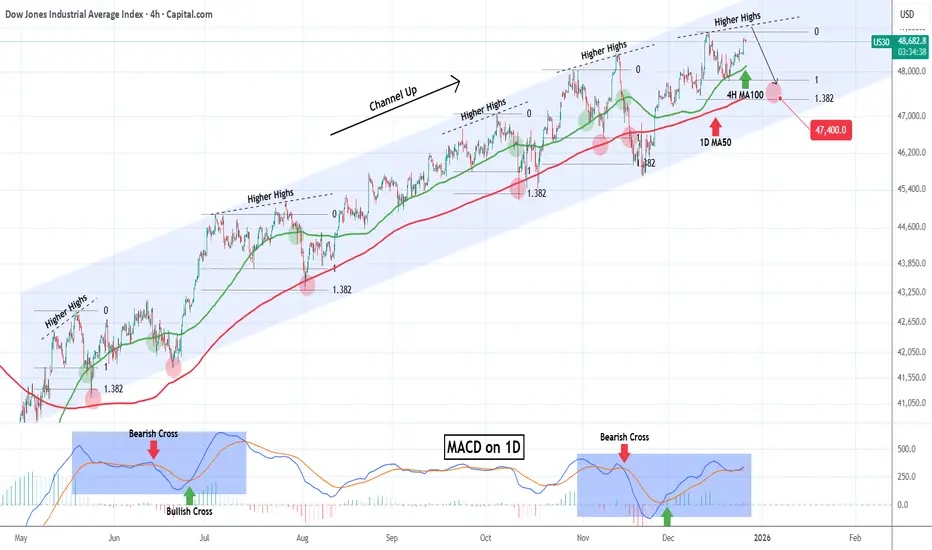
Bullish bounce off?Dow Jones (US30) is falling towards the pivot, which is a pullback support and could bounce to the pullback resistance.
Pivot: 48,242.25
1st Support: 48,027.46
1st Resistance: 48,693.05
Disclaimer:
The opinions given above constitute general market commentary and do not constitute the opinion or advice of IC Markets or any form of personal or investment advice.
Any opinions, news, research, analyses, prices, other information, or links to third-party sites contained on this website are provided on an "as-is" basis, are intended to be informative only, and are not advice, a recommendation, research, a record of our trading prices, an offer of, or solicitation for, a transaction in any financial instrument and thus should not be treated as such. The information provided does not involve any specific investment objectives, financial situation, or needs of any specific person who may receive it. Please be aware that past performance is not a reliable indicator of future performance and/or results. Past performance or forward-looking scenarios based upon the reasonable beliefs of the third-party provider are not a guarantee of future performance. Actual results may differ materially from those anticipated in forward-looking or past performance statements. IC Markets makes no representation or warranty and assumes no liability as to the accuracy or completeness of the information provided, nor any loss arising from any investment based on a recommendation, forecast, or any information supplied by any third party
$Btc Faces Rejection Near 91K — Key Price Action Levels to WaBitcoin is currently showing clear rejection near its previous resistance zone between $90,000 and $91,000, with repeated rejections forming around the $90,500–$90,600 area. This zone is acting as a strong supply region, and price action is struggling to sustain above it.
From a structure perspective, the market needs confirmation before considering long positions. Ideally, Bitcoin should either form a clear higher low after a controlled pullback or print a double bottom pattern while holding above the critical $80,500 support zone. If this support remains intact and buyers step in with strong volume, upside continuation can be expected.
However, if $80,500 fails, the structure weakens significantly. In that scenario, downside pressure may accelerate, opening the door for a deeper move toward the $75,000 region, which aligns with previous demand zones.
At the moment, the market structure does not favor aggressive long entries. Long positions should only be considered after confirmed price action signals such as support validation or bullish structure shift. On the other hand, short positions remain valid near resistance, especially when taken close to rejection zones with proper risk management.
Key Levels to Watch:
Resistance: $90,500 – $91,000
Immediate Support: $80,500
Breakdown Target: $75,000
Patience is key here. Let the market show its intent before committing to directional bias.