TESLA TO BTC & TOTALThis analysis compares NASDAQ:TSLA performance relative to BINANCE:BTCUSDT .
As you can see, Tesla’s stock is showing a bullish stance against Bitcoin and appears to be at the beginning of its Elliott Wave 3.
This chart delivers Four key messages:
1.Bitcoin is expected to decline while Tesla moves higher
2.Bitcoin is expected to drop while Tesla moves into a range
3.Both are expected to decline, but Tesla is likely to fall less than Bitcoin
4.Both rise, but Tesla gains more.
I’d be happy if you shared your thoughts.
NASDAQ:TSLA
BINANCE:BTCUSDT
CRYPTOCAP:TOTAL
BINANCE:BTCUSD
Hedge
Bitcoin Target 60K - Here's why (...you should hedge now)🔱 Bitcoin is behaving like a model student when it comes to the fork framework. 🔱
The first re-test at the white centerline, followed by a drop down to the red centerline, and then to the white lower median line parallel was already impressive. And the story isn’t over yet!
In the past days we’ve seen a re-test at the white L-MLH. Bitcoin failed to trade its way back into the fork. That leaves further price losses as the likely outcome.
The next targets are:
👉 the 1/4 level at around 76,000
👉 the white warning line at about 70K–72K
👉 the final move to the red L-MLH at around 60K
This decline would go hand in hand with continued sell-offs in the major indices like the Nasdaq and S&P 500. It would also support my previous post regarding a massive rise in TLT.
(props to @coinwide for the heads-up!)
🚨 A hedge would be appropriate now, before the VIX ignites its rocket and option prices explode.
Wish you all the best out there!
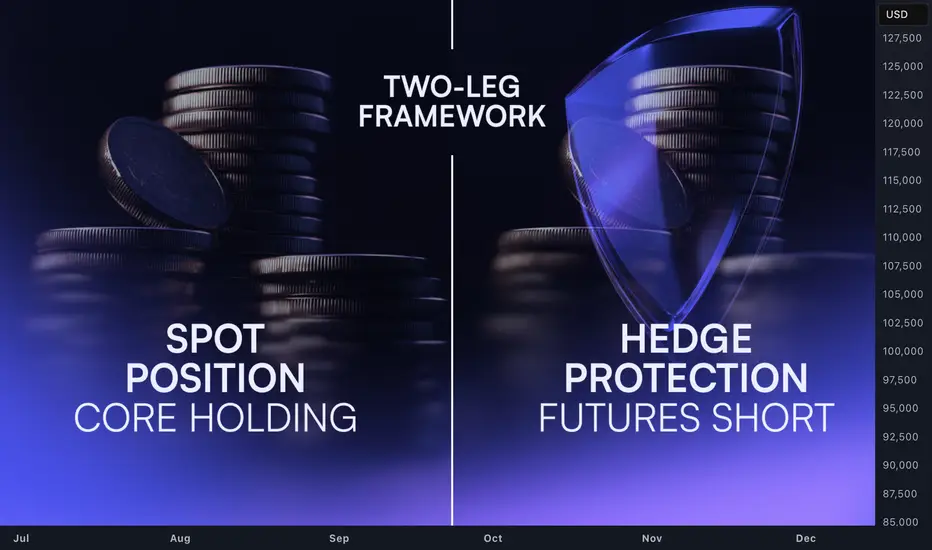
Spot + Hedge — The Fundamental Framework for Investors Who TradeYou don’t have to treat holding and trading as two separate worlds. The most effective market participants combine both. They anchor their strategy in long-term conviction while using short-term tools to manage volatility and protect capital. This balance allows them to participate in structural growth without exposing their portfolio to unnecessary drawdowns.
Spot holdings are the foundation. A well-built spot position compounds through cycles, absorbs volatility, and benefits from every wave of adoption that pushes the market forward. Staking adds an additional layer by generating yield during periods of consolidation. For traders who think in cycles rather than days, spot is the engine that keeps building value in the background.
A hedge position serves a different purpose. It is not designed for aggressive speculation. It is a tactical layer that reduces exposure when conditions become unstable. Futures shorts, when sized properly, act as a defensive tool that preserves the value of your long-term assets without forcing you to sell them. This approach keeps you invested while giving you room to breathe during sharp corrections.
When hedging makes sense:
– After a strong rally pushing into major resistance levels.
– When funding rates are extremely positive and the market is crowded with leveraged longs.
– When macro data shifts, liquidity tightens, or a regulatory event increases uncertainty.
– When your portfolio has grown significantly and you want to lock in part of that increase without taking profits.
The purpose of the hedge is stability. You are not aiming to turn the short into a profit engine. You are using it as portfolio insurance. A well-timed hedge limits the damage during pullbacks and keeps you positioned for the next leg of the cycle.
Simple implementation example: assume you hold $20,000 of ETH spot as your long-term allocation. To hedge, you short 25–30 percent of the position using ETH perpetual contracts. If ETH drops 10 percent, the hedge cushions the downside by generating gains on the short. If ETH continues rising, your spot position captures the upside and the hedge becomes the cost of protection, similar to an insurance premium.
This framework helps traders stay in the market, avoid emotional exits, and preserve capital during volatile periods. It combines conviction with discipline and gives long-term holders a practical way to navigate uncertainty without breaking their overall strategy.
ASTERUSDT.P | Clone or Clown? My Short Hedge ASTERUSDT.P | Clone or Clown? My Short Hedge 🎭📉
This is no Hyperliquid. It’s a clone and a clown — and that makes it a perfect hedge candidate for me right now.
Price is stuck in a falling channel with clear breakout and breakdown levels forming:
🔻 Short Breakdown Target: 0.7325
⚠️ Key Pivot: 1.0371
📈 Bullish Breakout: 1.1223
🎯 Upper Fib Zones: 1.4021 → 1.5166 → 1.9590
I'm leaning short here, but this is tactical — not emotional. If it flips above the channel, I’ll adapt. Until then, this is my hedge .
Charts will tell you when and what. Don’t rush the move.
Mindset Check 🧘
Sometimes the trade isn’t about belief — it’s about balance . A solid hedge doesn’t care about the narrative. It just does its job.
Disclaimer: I’m just sharing wisdom, not instructions. No licenses, no guarantees — just years of trading scars and precision chartwork. Be smart, protect your capital, and don’t copy blindly.
One Love,
The FXPROFESSOR 💙
PS:
A whale friend of mine is stacking ASTER slowly. His take? “I only buy things with crooks behind them — they’re the ones who make it.” 😅
He’s bullish. I’m tactical. We made a bet:
If I get to buy at 0.7325 , I win. Let’s see who the market loves more — the whale or the daytrader?
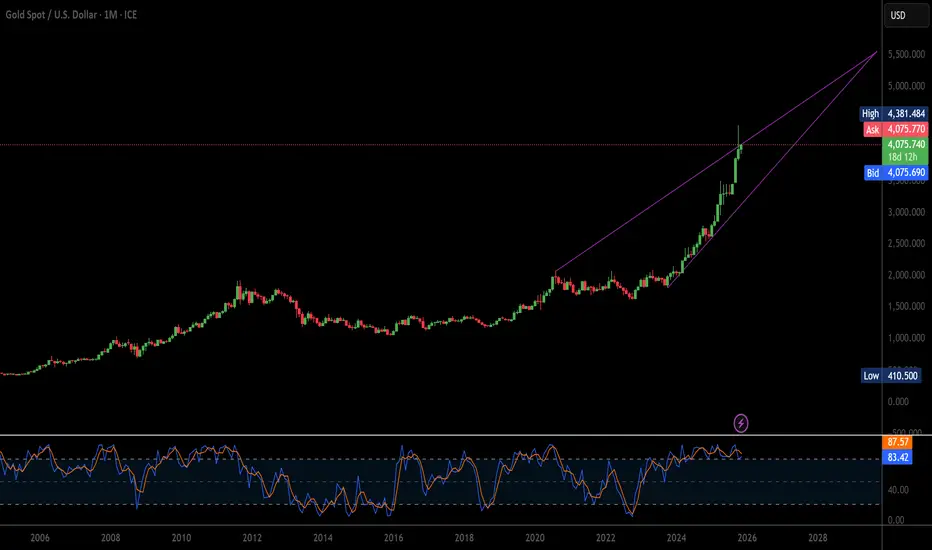
Golden Anchor: The Multi-Domain Resilience of BullionThe price of gold recently surged past $4,045 per ounce, cementing its role as a strategic global asset. This upward trend, pushing the year-to-date gain above 50%, is not merely speculative. It reflects deeply rooted structural forces across multiple global domains, from macroeconomics to high-tech demand. Investors are proactively using gold as a vital hedge against accelerating global uncertainty and fiat currency debasement.
Geopolitics & geostrategy: The De-Dollarization Hedge
Persistent geopolitical tensions drive sustained demand for gold's safe-haven status. Heightened conflict risks and unpredictable US tariff policies create global market volatility. In this fragmented landscape, gold acts as a politically neutral reserve asset, mitigating counterparty risk. Central banks globally are strategically accumulating gold to diversify away from the US dollar, accelerating the de-dollarization trend. This shift enhances national economic sovereignty, fueling gold's ascent.
Macroeconomics: Fiscal Dominance and Rate Cuts
Weakening US economic indicators directly reinforce gold’s appeal. A dip in the University of Michigan’s Consumer Sentiment Index signals broad economic unease. This fragility increases market bets on an earlier and more aggressive Federal Reserve rate-cutting cycle. Lower interest rates reduce the opportunity cost of holding non-yielding gold, boosting its price. Furthermore, the fiscal dominance prevalent in developed economies promotes gold as a critical hedge against the debasement of G7 fiat currencies.
Central Bank & Investment Demand Dynamics
Central bank purchases provide a formidable structural floor for gold prices. Despite the recent price correction, global central banks remain net buyers. They added 220 tonnes in Q3 2025 alone, representing a strategic, long-term commitment to gold. Poland, Kazakhstan, and Azerbaijan are notable accumulators. Retail and institutional investors are also turning to gold ETFs and physical bullion, viewing gold as essential financial insurance during systemic shocks.
Technology, Science, and High-Tech Demand
Technological advancements, particularly the boom in Artificial Intelligence, subtly support gold demand. While gold's main drivers remain macroeconomic, the high-tech sector consumes gold in electronic components and specialized circuits. Industrial demand remains resilient, offsetting a decline in jewelry consumption due to high prices. The massive, energy-intensive growth of AI and data centers indirectly creates a strategic need for high-value, reliable assets like gold to back infrastructure growth and hedge associated capital risks.
Technical Outlook and Consolidation Phase
Gold exhibits high long-term conviction but faces short-term consolidation after its historic rally. The price peaked at over $4,380 per ounce in mid-October before profit-taking began. Analysts expect the price to remain range-bound in the near term, with a maximum pullback risk around the strong $3,500/oz support level. Key technical resistance levels above the current peak are seen at $4,420/oz and $4,500/oz. Investors should utilize short-term dips as strategic long-term accumulation opportunities.
Gold Bull Markets Long Term Overview and 2025 Market UpdateGold Bull Markets Long Term Overview and 2025 Market Update
________________________________________
• This cycle is different: record central-bank buying + renewed ETF inflows + lower real rates = powerful tailwind.
• Price: Gold notched fresh ATHs this month (up to $3,790.82). 2025 is shaping up as the strongest year since the late 1970s.
• Relative: Gold is crushing equities YTD (≈+40% vs S&P 500 ≈+13% total return).
• Setup: A 13-year “cup-and-handle” breakout in 2024 kick-started the move.
• Outlook: Base case from the Street: $3,700 by end-’25 and ~$4,000 by mid-’26; upside to $4,500 if flows accelerate.
________________________________________
🏆 Historic Gold Bull Markets — Timeline & Stats
1) 1968–1980 “Super Bull”
• Start/End: ~$35 → $850 (Jan 1980)
• Gain: ~2,330%
• Drivers: End of Bretton Woods, oil shocks, double-digit inflation, geopolitical stress.
• Drawdown: ~–45% (1974–1976) before the final blow-off run.
2) 1999–2011/12
• Start/Peak: ~$252 (1999) → ~$1,920 (2011–12)
• Gain: ~650%
• Drivers: Commodities supercycle, EM demand, USD weakness, GFC safe-haven bid.
3) 2016/2018–Present (The “CB-Led” Cycle)
• Start Zone: $1,050–$1,200 → New ATH $3,790 (Sep 2025)
• Gain: ~215–260% (depending on 2016 vs 2018 anchor)
• Drivers: Record central-bank accumulation, sticky inflation/low real rates, geopolitics; 2024 13-yr base breakout.
________________________________________
📊 At-A-Glance Comparison (Updated 2025)
Metric 1968–80 Super Bull 1999–2012 2016/18–2025 Current
🚀 Total Gain ~2,330% ~650% ~215–260% (so far)
⏲️ Duration 12 yrs 13 yrs 7–9 yrs (ongoing)
💔 Max Drawdown ~–45% (’74–’76) ~–30% (’08) ~–20% (2022)
🏦 Main Buyer Retail/Europe Funds/EM Central Banks (dominant)
🏛️ Pattern Secular parabolic Cyclical ramps 13-yr base → breakout (’24)
Notes: current cycle characteristics validated by WGC demand trends & technical breakout in Mar 2024.
________________________________________
📈 Top 10 Stats of the Current Bull (2025)
1. Price & ATHs: Spot $3,75–$3,79k; fresh ATH $3,790.82 on Sep 23, 2025.
2. 2025 YTD: Roughly +40–43% YTD (best since the late ’70s).
3. Central Banks: 1,045 t added in 2024 (3rd straight 1k+ year). H1’25 ≈ 415 t (still elevated).
4. ETF Flows: Strongest half-year inflows since 2020, aiding the surge.
5. Gold vs Equities: Gold ≈+40% vs S&P 500 ≈+13% total return YTD.
6. Jewelry Demand: Price strength is crimping tonnage (2024 down ~11%; Q2’25 –14% y/y), even as value hits records.
7. Gold–Silver Ratio: Now around ~85–88 (silver catching up as it pushes $43–$44).
8. Macro Link: Strong safe-haven bid + rate-cut hopes supporting new highs.
9. Technical: Confirmed cup-and-handle breakout (Mar ’24) underpinning trend.
10. Street Forecasts: DB lifts 2026 to $4,000; GS baseline $4,000 by mid-’26, upside $4,500 with bigger private-investor rotation.
________________________________________
🔄 What Makes This Bull Different (2025 Edition)
• 🏦 Central-Bank Dominance — Official sector is the anchor buyer (3rd straight 1k+ tonne year in 2024; 2025 tracking strong despite Q2 deceleration).
• ⚡ Faster Recoveries — Pullbacks have been shallower and shorter vs the 1970s analog.
• 📈 Coexisting With Risk Assets — Rare combo: gold ATHs with equities up YTD suggests a macro hedge bid alongside optimism in select risk assets.
• 📐 Structural Breakout — The 13-year base cleared in 2024 set multi-year targets.
________________________________________
🎯 Strategy Ideas (2025 & Beyond)
Core
• Buy/Hold on Dips: Stagger entries (DCA) into physical (allocated), ETFs (e.g., GLD/IAU), and quality miners/royalties.
• Prefer Physical/Allocated where counterparty risk matters; use ETFs for liquidity.
Satellite/Leverage
• Silver & GSR Mean-Reversion: With the GSR ~85–88, silver historically offers torque in up-legs. Pair with high-quality silver miners.
• Factor Tilt in Miners: Focus on low AISC, strong balance sheets, growing reserves, and jurisdictions with rule-of-law.
Risk-Management
• Define max drawdown tolerance per sleeve; pre-plan trims near parabolic extensions or if macro invalidates (e.g., real-yield spike).
________________________________________
🧪 Reality Check: What Could Invalidate the Bull?
• Real yields + USD rip higher (sustained), dampening non-yielding assets.
• Sharp halt in official-sector buying (e.g., policy shifts).
• Rapid growth re-acceleration reducing safe-haven & rate-cut expectations.
________________________________________
🧭 Quick Reference Tables
🧾 Summary: Historic vs Current
Feature 1968–80 1999–2012 2016/18–2025
Total Gain ~2,330% ~650% ~215–260%
Duration 12 yrs 13 yrs 7–9 yrs (ongoing)
Correction ~–45% ~–30% ~–20% (’22)
Main Buyer Retail/Europe Funds/EM Central Banks
Pattern Parabolic Cyclical Cup & Handle → Secular
🧩 “If-This-Then-That” Playbook
• If real yields fall & CB buying persists → Ride trend / add on consolidations.
• If USD + real yields jump → Trim beta, keep core hedge.
• If GSR stays >80 with silver momentum → Overweight silver sleeve for torque.
________________________________________
🧠 Outside-the-Box Adds
💼 Role in a Portfolio (example frameworks)
• Resilience sleeve (5–10%): Physical + broad ETF.
• Offense sleeve (2–5%): Quality miners/royalties; optional silver tilt.
• Tactical (0–3%): Trend-following overlay (breakouts/consolidations).
🧭 Decision Checkpoints (quarterly)
• Central-bank net purchases (WGC).
• ETF flows (Western markets).
• Real yields (10y TIPS), USD trend, and GSR.
________________________________________
🔚 Key Takeaways (Updated)
• Relentless official-sector demand + technical breakout are the twin pillars of this cycle.
• Macro mix (policy easing expectations, geopolitics, diversification from USD reserves) supports an extended run.
• Base case: Street sees $3.7k by end-’25 and ~$4k by mid-’26, with upside to $4.5k if private capital rotation accelerates. Manage risk; embrace volatility.
Hedge Against Inflation in the Global Market1. Gold: The Timeless Inflation Hedge
Gold has historically been one of the most reliable hedges against inflation. Its value tends to rise when paper currencies lose value, making it a safe haven during times of economic uncertainty.
Why gold works: Gold is a tangible asset that isn’t tied to the performance of any single currency or government policy. When inflation increases, investors often flock to gold as a store of value, pushing prices higher.
Global impact: Central banks around the world—especially in emerging economies—have increased their gold reserves to protect against currency volatility and inflation in the dollar-dominated global trade system.
Forms of investment: Investors can choose physical gold (bars, coins), gold ETFs, gold mining stocks, or gold mutual funds. Each offers different liquidity and risk profiles.
However, gold doesn’t generate income like dividends or interest, so it’s best used as part of a diversified inflation hedge strategy rather than the sole protection.
2. Real Estate: Tangible Asset with Rising Value
Real estate is another traditional inflation hedge because property values and rents tend to rise when the cost of living increases.
Why it works: Inflation pushes up the cost of construction materials and labor, leading to higher property prices. Meanwhile, landlords can increase rent, which enhances returns.
Global examples: Real estate in countries with growing urbanization—such as India, Indonesia, and Brazil—often outpaces inflation. In developed markets like the U.S. and Europe, real estate investment trusts (REITs) offer investors exposure to property markets without owning physical property.
Best strategies: Diversify across sectors—residential, commercial, and industrial properties—and across regions to minimize local market risks.
However, real estate can be illiquid, and property taxes or maintenance costs may rise with inflation, so it’s essential to balance exposure carefully.
3. Commodities: Riding the Price Surge
Commodities such as oil, natural gas, agricultural products, and metals are directly linked to inflation because they form the foundation of production and consumption costs globally.
How they hedge: When inflation rises, commodity prices often surge due to increased demand or reduced supply. Investing in commodities allows investors to benefit from this upward price pressure.
Investment methods: Commodity futures, ETFs, and mutual funds offer exposure without the need for physical ownership.
Global relevance: The Russia-Ukraine war highlighted how energy and food prices can spike globally, influencing inflation everywhere—from Europe’s energy bills to Asia’s food markets.
Yet commodities can be volatile, influenced by weather, political instability, and global trade dynamics, so they are best used as part of a diversified inflation-protection portfolio.
4. Inflation-Protected Bonds (TIPS and Global Equivalents)
Governments issue inflation-linked bonds to protect investors’ purchasing power. In the U.S., these are known as Treasury Inflation-Protected Securities (TIPS). Other countries have similar instruments, such as the UK’s Index-Linked Gilts or India’s Inflation-Indexed Bonds.
How they work: The principal value of these bonds adjusts according to inflation, measured by a consumer price index (CPI). Interest payments are based on the adjusted principal, preserving real returns.
Benefits: They provide stable, government-backed protection against inflation with predictable income streams.
Limitations: They may underperform in deflationary periods or when interest rates rise sharply.
For globally diversified investors, combining TIPS with foreign inflation-linked bonds can smooth out regional inflation differences.
5. Equities: Long-Term Growth Against Inflation
Stocks, especially in sectors that can pass on rising costs to consumers, can also serve as an effective inflation hedge.
Why equities help: Over the long term, companies that maintain profitability and pricing power can outpace inflation.
Best-performing sectors: Energy, consumer staples, healthcare, and industrials tend to perform well in inflationary periods.
Global exposure: International diversification—investing in both developed and emerging markets—can protect against regional inflation and currency depreciation.
However, short-term market volatility can be significant during inflation spikes, so equities are most effective for investors with a long-term perspective.
6. Cryptocurrencies: The New-Age Hedge?
Digital currencies like Bitcoin have often been promoted as “digital gold,” appealing to investors looking for decentralized alternatives to fiat currencies.
Inflation argument: Bitcoin’s fixed supply of 21 million coins theoretically protects against currency devaluation caused by excessive money printing.
Global adoption: Some countries, such as El Salvador, have even adopted Bitcoin as legal tender. Many investors worldwide view crypto assets as protection from central bank policies.
Risks: Cryptocurrencies are highly volatile and influenced by market sentiment, regulation, and technology adoption. While they can act as an inflation hedge, they require a high-risk tolerance.
For balanced portfolios, a small allocation (typically 2–5%) may provide potential upside without excessive risk exposure.
7. Foreign Currencies and Global Diversification
Investing in foreign currencies or assets denominated in stable currencies can reduce exposure to domestic inflation.
Example: If the U.S. dollar weakens due to high inflation, holding assets in currencies like the Swiss franc, Japanese yen, or Singapore dollar can protect value.
Currency ETFs and forex trading: These allow investors to gain exposure to different currencies and hedge against inflation-driven devaluation.
Caution: Currency markets can be complex, requiring expertise to navigate geopolitical and economic factors.
Diversification across multiple economies helps smooth out the effects of localized inflationary pressures.
8. Alternative Investments: Private Equity, Infrastructure, and Art
Alternative assets are increasingly used by institutional and high-net-worth investors to hedge against inflation.
Private equity and venture capital: These investments can generate high returns through business growth that outpaces inflation.
Infrastructure investments: Assets like toll roads, utilities, and renewable energy projects often have inflation-linked revenue streams.
Collectibles and art: Tangible, scarce assets like fine art, vintage cars, and luxury watches can appreciate as the value of money declines.
Though less liquid, these assets provide diversification and long-term inflation protection, especially in global portfolios.
9. The Role of Central Banks and Policy in Inflation Control
Central banks play a key role in influencing inflation through interest rate policies and monetary tightening.
When inflation rises: Central banks often increase interest rates to reduce money supply and demand. This can strengthen currencies but also slow economic growth.
Global coordination: The U.S. Federal Reserve, European Central Bank, and Bank of Japan set policy directions that ripple through global markets.
Investor impact: Understanding these policies helps investors adjust their hedge strategies—shifting from growth assets to income or inflation-protected securities when rates rise.
10. Building a Diversified Inflation-Hedging Portfolio
The most effective way to hedge against inflation is through diversification. No single asset class can perfectly offset inflation under all conditions. A well-structured global portfolio may include:
25% Equities (with inflation-resistant sectors)
20% Real estate and REITs
15% Commodities and natural resources
15% Inflation-protected bonds
10% Gold and precious metals
10% Global currencies and foreign assets
5% Alternative investments (crypto, art, etc.)
This diversified mix balances risk and return while providing resilience against inflationary shocks.
11. The Future of Inflation Hedging: Technology and Innovation
The global market is evolving rapidly, and so are the tools to combat inflation.
Tokenized assets: Blockchain technology enables fractional ownership of real estate, commodities, and art—making inflation hedging more accessible.
AI-driven investing: Machine learning models analyze inflation data and market movements to adjust portfolios dynamically.
Green investments: Renewable energy, carbon credits, and ESG-focused funds are emerging as inflation-resilient assets due to global policy support.
As innovation continues, investors have more opportunities than ever to protect wealth in a changing world.
Conclusion: Preparing for the Inflationary Future
Inflation is an unavoidable part of the global economic cycle, but its impact doesn’t have to erode wealth. By understanding the drivers of inflation and strategically allocating assets across gold, real estate, commodities, equities, bonds, and alternative investments, individuals and institutions can safeguard purchasing power and even profit from global inflationary trends.
In a world where markets are interconnected, global diversification is the ultimate hedge. Whether through traditional assets like gold or modern options like digital currencies and AI-powered portfolios, the key lies in proactive and adaptive financial planning.
Inflation is inevitable — but with the right global strategy, your wealth doesn’t have to lose its value.
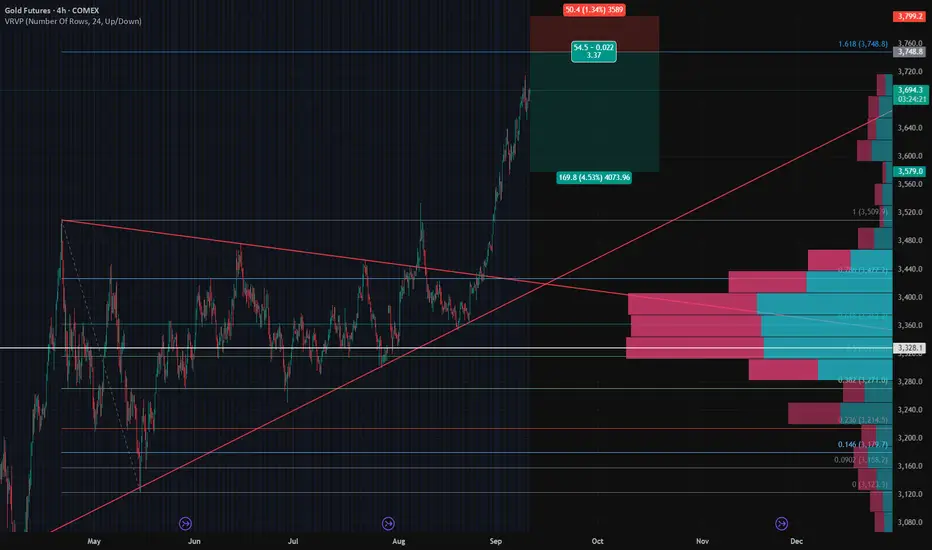
Gold Futures – Short Setup to Lock in Profits🟠 Gold Futures – Short Setup to Lock in Profits
Gold has had a strong breakout above the symmetrical triangle and has now pushed into an extended move near $3,700+. While the trend remains bullish on the higher timeframe, the current leg looks overextended, and I’m looking to hedge profits with a short setup.
🔑 Key Technicals
Pattern Breakout: Gold broke out of a long consolidation wedge and accelerated higher.
Resistance Zone: Price is testing the Fib 1.618 extension near $3,750, a potential exhaustion area.
Volume Profile: Strong demand zone sits between $3,300 – $3,360 where most volume is concentrated. A pullback could retest this area.
Risk-Reward: Setup gives ~1:3.4 RR with stop above recent highs and target into the HVN zone.
📉 Trade Idea – Protective Short
Entry: 3750
Stop Loss: 3800 (extension level).
Take Profit: $3580
⚖️ Strategy
This is not a reversal call – the larger trend is still bullish. The short setup is hedge/profit-protection only, aiming to capture a pullback after the parabolic leg.
I’ll be watching if buyers can defend $3,600 on the first dip; failure to hold could accelerate selling toward the high-volume zone.
📊 Bias
Short-term: Bearish (pullback expected)
Mid-term: Neutral to Bullish (trend intact above $3,300)
What do you think – do we see a healthy correction here, or is gold too strong to fade yet?
BITCOIN TP1 Hit Against the TrendLast night’s move tagged TP1 right into the counter-trend zone.
Stops are now stacked behind that level—classic trap fuel.
The 1-hour fractal remains intact and technically “safe,”
but we’re in a true 50/50 pocket:
either the squeeze continues or the fade begins.
Trade the reaction, not the prediction.
Let the order flow prove the next leg.
Why Hedging Is a Powerful Strategy in Trading (Antisthathmisis)⚖️📉 Why Hedging Is a Powerful Strategy in Crypto Trading 🏛️🌿
This post is educational . It’s not about predicting the market—it's about preparing for it.
And one of the most powerful tools in a trader’s toolkit is: Hedging —or as we say in Greek, Αντιστάθμηση .
Rather than gambling on direction, hedging is about staying balanced, staying strategic, and staying alive in volatile markets. Unless you are a προφήτης ('prophet') or you have inside information from Trump and Powell...
📘 Why Hedging Matters:
Most traders go all-in on one direction.
But what if you could go long on the strongest and short the weakest —at the same time?
That’s not being indecisive. That’s called being smartly hedged .
Not picking sides. Picking survival. 🔐 (αντισταθμισμένος-balanced)
📊 Examples from My Own Trading:
🔻 LUNA — One of my most successful shorts. From $100+ to nearly zero.
🔻 Pump.fan — Shorted from $0.63 to $0.24, even as Ethereum pumped.
These were not "luck." These were strategic, chart-based and fundamentally backed, hedged trades .
🏛️ Hellenic Wisdom Meets Trading 🔮🌿
In Greek we say:
“Πρόβλεψη” (pro-vlep-si) → I see what may happen
To do that, we need “Πρόγνωση” (pro-gnosi) → knowledge of what happened before
And if done well, it feels like “Προφητεία” → prophecy
But let’s be clear: I’m no prophet. I'm a trader, and my edge is in staying Αντισταθμισμένος — hedged/balanced/insured/covered.
🧠 The Edge of Antistathmisi:
✅ Long the strong
✅ Short the weak
✅ Charts and fundamentals aligned
✅ Reduce emotional exposure
✅ Create balance in chaos
Closing Thought:
Don’t chase prophecy. Chase prognosis through knowledge.
And let Antistathmisi be your guide. 🧿
One Love,
The FXPROFESSOR 💙
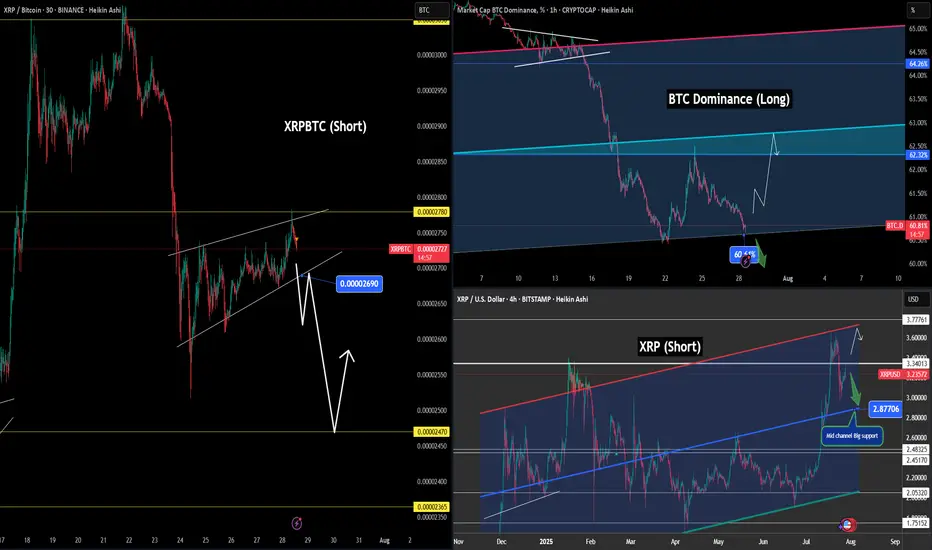
XRP Structure with Bitcoin Dominance - (Hedge is Edge)📉📊 Mastering XRP Structure with Bitcoin Dominance - (Hedge is Edge) 🧠⚖️
Hey guys, I just posted the video — so you can hear the full breakdown there. 🔊🎥
This time, I'm also sharing the charts here to support the lesson and give you a clear visual on the educational idea. Let’s break it down:
🔍 XRP/BTC – Short Bias
We’re at a clean rejection point around 0.00002780, with a wedge formation breaking lower. First support target sits around 0.00002690, with 0.00002470 and even 0.00002365 possible if the move deepens. Invalidation sits just above that yellow resistance — always define your risk.
📈 Bitcoin Dominance – Long Bias
BTC dominance is resting on solid support around 60.61% . A bounce here typically signals Bitcoin outperformance — either BTC rising faster than alts or BTC holding while alts bleed. Either way, it adds pressure to the XRP side of this setup.
💸 XRP/USD – Short Bias
Rejection off the top of a long-term channel, with price pushing down. The next key level is $2.87, the midline of the channel. Until price breaks and holds above $3.34, the structure leans bearish.
♟️ Hedge is Edge
What does this setup teach us?
🔹 Long BTC (structure + dominance support)
🔹 Short XRP (multiple confirmations of weakness)
This hedge reduces directional exposure and allows for a calculated trade, based on structure — not hope.
🧠 The big takeaway: trading isn't about predictions. It's about aligning logic, risk, and market structure into something that makes sense.
Check out the video above to hear the full breakdown. (Audio won’t play inside TradingView — sorry about that — but it’s all explained there.)
One Love,
The FX PROFESSOR 💙
Disclosure: I am happy to be part of the Trade Nation's Influencer program and receive a monthly fee for using their TradingView charts in my analysis. Awesome broker, where the trader really comes first! 🌟🤝📈
Mastering XRP Structure with Bitcoin Dominance - (Hedge is Edge)📉📊 Mastering XRP Structure with Bitcoin Dominance - Educational Breakdown 🧠💡
Hey traders! FXPROFESSOR here 👨🏫
From now on, my TradingView Crypto posts will be 100% educational only . I won’t be sharing target charts or trade setups here anymore. Why? Because even with the best chart, most traders still struggle to execute properly. So instead, I’ll teach you how to think, read, and act like a real trader.
👉Let’s jump into today’s educational case:
🔍 Chart 1: XRP/BTC
We're facing a clear resistance zone around 0.00002780, rejecting after several tests. There’s also a wedge pattern forming, suggesting a drop is likely — possibly toward 0.00002690 or even further to the unchecked support at 0.00002469. That’s a 9.4% move — but remember, this becomes invalidated if XRP breaks back above 0.00002780.
🔍 Chart 2: Bitcoin Dominance
Dominance is sitting right on support. If BTC dominance rises, it means Bitcoin could gain strength relative to altcoins. This typically leads to:
BTC holding steady or rising
Some major Alts (like XRP) might correct
Watch this carefully — a BTC dominance rebound strengthens the XRP short thesis.
🔍 Chart 3: XRP/USD
XRP/USD is moving inside a large wedge formation. The current rejection level is around $3.34, with price possibly aiming for $2.88 or lower if the wedge plays out. Until we break above that resistance, the bias remains bearish.
🎯 Strategy Insight – The Hedge
What’s a calculated way to play this setup?
→ Go long Bitcoin (dominance at support)
→ Go short XRP (at resistance)
This way, you hedge your exposure while staying aligned with market structure. This is not financial advice — but a great exercise in developing strategic thinking.
📌 Remember: Managing the position is a whole different skill — one that you must learn through real-time practice and proper mentorship. But the charts today give you valuable food for thought to sharpen your edge.
Let’s stop gambling and start thinking like traders. No hype. No signals. Just structure, context, and logic.
One Love,
The FX PROFESSOR 💙
Disclosure: I am happy to be part of the Trade Nation's Influencer program and receive a monthly fee for using their TradingView charts in my analysis. Awesome broker, where the trader really comes first! 🌟🤝📈
Crude Oil Futures: Navigating Geopolitical Risk and VolatilityMarket Context:
NYMEX:CL1! COMEX:GC1! CBOT:ZN1! CME_MINI:ES1! CME_MINI:NQ1! CME:6E1!
Implied volatility (IV) in the front weeks (1W and 2W) is elevated, and the futures curve is in steep backwardation. This indicates heightened short-term uncertainty tied to geopolitical tensions, particularly in the Middle East involving Iran and Israel. The forward curve, however, suggests the market is not fully pricing in sustained or escalating conflict.
We evaluate three possible geopolitical scenarios and their implications for the Crude Oil Futures market:
Scenario 1: Ceasefire Within 1–2 Weeks
• Market Implication: Short-term geopolitical premium deflates.
• Strategy: Short front-month / Long deferred-month crude oil calendar spread.
o This position benefits from a reversion in front-month prices once the risk premium collapses, while deferred months—already pricing more stable conditions—remain anchored.
o Risk: If the ceasefire fails to materialize within this narrow window, front-month prices could spike further, causing losses.
Scenario 2: Prolonged War of Attrition (No Ceasefire, Ongoing Missile and Air War)
• Market Implication: Front-end volatility may ease slightly but remain elevated; deferred contracts may begin to price in more geopolitical risk.
• Strategy: Long back-month crude oil futures.
o The market is currently underpricing forward-looking risk premiums. A persistent conflict, even without full-scale escalation, may eventually force the market to adjust deferred pricing upward.
o Risk: Time decay and roll costs. Requires a longer holding horizon and conviction that the situation remains unresolved and volatile.
Scenario 3: Full-Scale Regional War
• Market Implication: Severe market dislocation, illiquidity, potential for capital flight, and broad-based risk-off sentiment across global assets.
• Strategy: Avoid initiating directional exposure in crude. Focus on risk management and capital preservation.
o In this tail-risk scenario, crude oil could spike sharply, but slippage, execution risk, and potential exchange halts or liquidity freezes make it unsuitable for new exposure.
o Alternative Focus: Allocate to volatility strategies, defensive hedging (e.g., long Gold, long VIX futures), and cash equivalents.
o Risk: Sudden market shutdowns or gaps may make exit strategies difficult to execute.
Broader Portfolio Considerations
Given the crude oil dynamics, there are knock-on effects across other markets:
• Gold Futures: Flight-to-safety bid in Scenarios 2 and 3. Long positioning in Gold (spot or near-month futures) with defined stop-loss levels is prudent as a hedge.
• Equity Index Futures (E-mini Nasdaq 100 / S&P 500): Vulnerable to risk-off flows in Scenarios 2 and 3. Consider long volatility (VIX calls or long VX futures) or equity index puts as portfolio hedges. In Scenario 1, equities could rally on resolution optimism—especially growth-heavy Nasdaq.
• Currency Futures: USD likely to strengthen as a safe haven in Scenarios 2 and 3. Consider long positions in Dollar and Short 6E futures.
• Bond Futures: Risk-off flows theoretically should support Treasuries in Scenarios 2 and 3. Long positions in 10Y or 30Y Treasury futures could serve as a defensive allocation. Yields may retrace sharply lower if escalation intensifies. However, given the current paradigm shift with elevated yields, higher for longer rates and long end remaining high, we would not bet too heavily on Bond futures to act as safe haven. Instead, inflows in Gold, strengthening of Chinese Yuan and Bitcoin will be key to monitor here.
Scenario-based planning is essential when markets are pricing geopolitical risk in a non-linear fashion. Crude oil currently reflects a consensus expectation of de-escalation (Scenario 1), which opens the door for relative value and mean-reversion strategies in the front-end of the curve.
However, given the asymmetric risks in Scenarios 2 and 3, prudent exposure management, optionality-based hedges, and a flexible risk framework are imperative. A diversified playbook; leveraging volatility structures, calendar spreads, and cross-asset hedges offers the best path to opportunity while managing downside risk.
BTCUSD: Short for Delta-Neutrality after buying Spot @ Range-LowLike i mentioned in my previous analysis, BTCUSD is in a range and it might be ignored by the majority that there's no clear knowledge of the range spread. Noone knows, me included.
I just stick to my plan. Check my previous analysis if you want to know the reasons for this idea. Now it's more concrete and it's still worth a try, but if you are a retail trader, you should ignore it because of the leverage being used as well as the lack of experience with delta-neutral trading.
Also it is completely different from a typical HODL- or DCA-strategy. Trend-Followers and Breakout-Traders in general should wait for a more directional BIAS elsewhere because my analysis and trade idea results in a non-directional BIAS.
Crypto Hedge against Trumpism chaos, destruction and tariffsTrump is going to wreck havoc on the US economy which is why many are hedging against USD with crypto. Inflation, shortages and recession are coming in a few years.
For awhile, Biden policy will prop up USD but once Trump policy kicks in and effects the government, expect food shortages from deportations, recession from tariffs and draconian policy and more wars with Putin unchecked.
Chaos is coming in about year 2 into Trump presidency. Until then I expect positive Biden policies to continue to strengthen US dollar while smart hedgers long crypto the hedge against the chaos that is coming. When not if.
How to PROTECT your profits while letting them runIn the trading business you need to let your profits run while also managing your risks that means to cut your losses short.
Losses of unrealized profits are real profits that are lost. What if you could save them?
Well, there is a way...
It is not always available but it is one you want to know since if you can save 3 points of wiggle room and pay 1 point or less, over the long run it adds up to HUGE chunk of profit to your bottom line.
The reason I applied this method is because TSLA was doing 3 days in a row a push and gap up, so it seems likely people will want to take profits... but this is TSLA... it can shoot up above 500 and reach who knows where... (she did it before...).
So I want to TAKE MY HUGE profit, while giving it the option to continue to the moon, if it will want to do so...
You can never take the very top anyway, so if you "give back" 1 point of profit it is considered reasonable, but if in case the price falls down sharply or gapped down I can give back maybe 3 points with this strength of volatility, which is undesireable.
So what I did?
I sold the PUT option at strike 470 at a price of $15 (my point was $17) so for me it is even less than a point so it is very attractive deal to me...
Then... if the price had crushed down it meant for me that I sold my stocks at a price of 470 while paying the hedge cost of the PUT option of 15 so it is equivalent to me that I sold my stock at a price of 455, which is ALMOST the top. Making sure ~90% of the profit stays in my pocket. So I WIN.
If the price would continue to shoot up, then I making SUPER HUGE MONEY, while sleeping like a baby, that I already realized my HUGE profit. So I WIN.
So either way, I WIN !
Since the price did not crushed the next day and hold, and my stop loss advanced, so there was no longer need to my PUT option hedge since if price will fall I will get out with the stop loss with the same profit. So I sold the PUT hedge for a small loss, so the hedge cost me 0.25 a point overall. SUPER WORTH IT !
FYI, this comes from years of experience, but I give you some of my experience, you could do it too.
The moral of the story... when you have HUGE profit, and you feel itchy to take profit, don't ! and try to hedge yourself with options ! this way, if you were wrong and you have GME, AMC on your hand, you don't let them go, and you WIN either way ! Sleeping like a baby.
Mon 16th Dec 2024 NZD/CHF Daily Forex Chart Buy SetupGood morning fellow traders. On my Daily Forex charts using the High Probability & Divergence trading methods from my books, I have identified a new trade setup this morning. As usual, you can read my notes on the chart for my thoughts on this setup. The trade being a NZD/CHF Buy. Enjoy the day all. Cheers. Jim
Using Derivatives for Hedging Risks on ForexUsing Derivatives for Hedging Risks on Forex
In the dynamic world of forex trading, understanding how to protect one's position is paramount. This article delves into the strategic use of derivatives, specifically CFDs, to hedge against potential adverse currency movements, offering traders a safety net in the volatile forex environment.
The Concept of Hedging in Forex
Hedging, in the realm of forex trading, refers to the strategic use of certain financial instruments, such as derivatives, to protect an investment or portfolio from adverse price movements. By employing this technique, market participants can potentially offset losses from their primary investments, ensuring a more balanced financial outcome.
Companies that use derivatives to hedge risk, for example, aim to safeguard their operations from volatile currency fluctuations. For individual traders, hedging risk with derivatives becomes a key tactic, especially in the unpredictable waters of forex markets. The primary goal isn't necessarily to profit but to create a safety net against potential losses.
An Overview of CFDs (Contract for Difference)
CFDs, or Contracts for Difference, are derivative financial instruments that allow traders to speculate on price movements of underlying assets without actually owning them. In the forex context, CFDs enable traders to gain exposure to currency pairs' price changes without physically exchanging the currencies involved. Instead, traders enter into a contract to exchange the difference in value of a currency pair between the time the contract is opened and when it's closed.
One of the primary uses of derivatives in risk management is employing CFDs to take an opposing position, thereby potentially reducing exposure to adverse market movements. The perks of CFDs include flexibility, leverage, and the ability to go long or short. However, these benefits come with downsides, such as the risk of amplified losses due to leverage and the possibility of incurring additional costs like overnight funding fees.
The Mechanics of Hedging with CFDs
The mechanics of hedging forex trades with CFDs are the following:
1. Establishing a Primary Position
Traders first establish a primary position in the forex market, predicting a currency pair's direction. For instance, a trader might expect the EUR/USD pair to rise and hence buy or "go long" on it.
2. Recognising Exposure
Once the primary position is established, traders identify potential risks. Is there an impending economic event? Could geopolitical tensions influence the currency pair's movement? Recognising these exposures is pivotal in hedging using derivatives.
3. Taking an Opposing CFD Position
To hedge, traders take an opposing position using a CFD. If our trader has gone long on the EUR/USD, hedging would involve going short on the same pair through a CFD. This doesn't mean expecting the EUR/USD to fall but rather creating a protective stance using derivatives to hedge risk.
Another option is to use a negatively correlated asset from another asset class, e.g. commodities, to the currency pair you trade and open a CFD trade in that asset.
4. Monitoring and Adjusting
Successful hedging isn't a set-and-forget approach. As the forex market fluctuates, the effectiveness of the hedge might change. Platforms like FXOpen's TickTrader provide traders with the necessary tools and real-time data to monitor their positions effectively.
If the primary position experiences an unfavourable move, the opposing CFD position can offset some or all of those losses. Conversely, if the market moves favourably, gains from the primary position can be realised, while the loss from the hedging position is an accepted cost for protection.
5. Closing Positions
When traders believe the risk has subsided or their trading goals are achieved, they can close both their primary and hedging positions. Depending on the market movement, this could result in a net profit, a minimised loss, or a break-even scenario.
In the world of derivatives and risk management, CFDs offer a nuanced tool for traders navigating the often-tumultuous waters of the forex market. When executed correctly, hedging with derivatives, like CFDs, can provide a layer of protection against unwanted market swings.
A Brief Look at Options
Options are a type of financial derivative that gives traders the right, but not the obligation, to buy or sell an asset at a predetermined price within a specified time frame. Unlike CFDs, which track the underlying asset's movement, options are based on the probability of reaching a particular price point.
While they can be used for hedging purposes, their complexity often deters many retail traders. The steep learning curve associated with options means they're not typically the first choice for risk mitigation, especially when simpler derivatives like CFDs are available.
Considerations Before Hedging with Derivatives
Before implementing hedging strategies using derivatives, traders take into account several crucial aspects to ensure their risk management tactics align optimally with their financial objectives. Here are some essential considerations:
Understanding the Derivative's Structure
Before diving into hedging, it's crucial to thoroughly understand the derivative you're using, whether it's a CFD, option, or another instrument. Each derivative has unique features, payout structures, and costs. A lack of understanding can lead to unintended exposures.
If you use derivatives, it's vital to determine the position size, as leverage leads to increased risks. The theory states that a trader’s CFD position shouldn't be larger than the trade they hedge.
Cost Implications
While hedging can safeguard against potential losses, it's not free. Factors like spread costs, overnight financing, leverage, or premiums (in the case of options) can impact the profitability of a hedged position. Traders factor these costs into their risk management calculations.
Duration of Hedge
How long do you anticipate the need for the hedge? The time frame can affect the choice of derivative and its cost. Some hedges might be short-lived due to specific events, while others could be more extended due to ongoing market uncertainties.
Effectiveness of the Hedge
No hedge is perfect. Consider the effectiveness of the derivative in relation to the primary position. How closely does the CFD or option's performance correlate with the asset you're trying to hedge?
Regular Evaluation
Risk management in the derivatives market requires constant vigilance. Market conditions evolve, and what was once an effective hedge might lose its potency. Regularly evaluate the hedge's performance and adjust if necessary.
Seek Expert Advice
Given the complexities, it's beneficial to seek advice from experts and explore in-depth resources. They can offer help in crafting a more tailored hedging strategy.
The Bottom Line
In navigating the intricate waters of forex trading, understanding hedging with derivatives like CFDs can offer traders valuable protection against unforeseen market shifts. This exploration has highlighted the nuances and considerations essential for effective risk management. For those keen to delve deeper into the world of CFDs and optimise their hedging strategies, opening an FXOpen account could be the next step in fortifying their trading arsenal.
This article represents the opinion of the Companies operating under the FXOpen brand only. It is not to be construed as an offer, solicitation, or recommendation with respect to products and services provided by the Companies operating under the FXOpen brand, nor is it to be considered financial advice.
BTC/USDT.P UpdateIf we ignore the election, we had a bearish weekly candle close this past week so I anticipate a sizeable pull back. If we considering election effects, usually the election week is bearish and then an unconditional rally comes soon after; typically it will last till the end of the year. If this pattern holds true, I would personally hedge a trade to profit on both sides. I'm still long term BTC bullish, but this week, I will consider shorting to hedge against my longs. I have marked a few places where I would take TPs on the short and DCA for my longs for you to reference. Trade safely! @Nate Alert
payo are you gonna correct?after the great boom payo brought us some great profits. tbh i havent closed anything and i am still bullish on payo.
payo accumulation and bingbongdingdong has been formed for 3 years as of this moment we are attempting to turn previous critical resistance into support.
2 scenerios according to wykoff theory.
1. correction then big money needs to defend its positions and at a reasonable price.
fundementally that could be previous value area high (vah upper white line) because we need to create a new value range it would only make sense to turn vah to the new point of control (poc) or the new value area low (where price is traded the most e.g mid range val bottom area)
another point to consider for the correction is the gap, so previous point of control to turn value area low or a sweep to that level would provide 4 things
first it will close the gap and get rid of that imbalance.
2nd it will shake off weak hands and get rid of breakout traders when it
grabs the single print
3rd it will provide a decent price for big money to enter at.. liquidity liquidity liqduidity.
4th provide the oprotunity for hedge shorting and basically thats more fuel to the upside when said shorts close. (so basically proffesionals get paid to pump the market for free)
2. leave everyone behind everyone whos waiting for the correction. that scenerio is less likely to anticipate, depends more on the company preformance and has less upside for big money that wants to accumulate low and provide big gains.
i believe the first scenerio is more likely that the other one.
the teal circles on the green lines are where i am looking to see reactions for swing fail patterns and adding to my positions
luckily i already have an open position on payo for quite a while now, so im chilling.
Inflation Increases 2.5%, Setting Scene for Rate CutMarket Update, September 13th 2024
Takeaways
Inflation stays under control: The Consumer Price Index increased 2.5% in August compared to the previous year, down from the 2.9% bump in July. The latest data indicates the Federal Reserve will likely cut interest rates by 25 basis points next week.
Bankrupt crypto exchange FTX has reached a $14 million settlement with Emergent Technologies, resolving a dispute over 55 million Robinhood shares: The agreement avoids further legal action and allows Emergent to finalize its bankruptcy proceedings.
US spot bitcoin ETFs have seen a streak of daily net outflows, with nearly $1.2 billion withdrawn in just eight days: The downturn coincides with broader market volatility.
The North Carolina Senate has passed a bill prohibiting state participation in any Federal Reserve-sponsored CBDC testing: The bill bans payments to the state using a CBDC. It passed despite a veto by Governor Roy Cooper.
🕰️ Topic of the Week: Understanding Interest Rates
🫱 Read more here
Bitcoin's local perspective 09.09.24Before looking at the local perspective, we would like to mention that globally we are now moving within two main patterns:
AMEXP on BINANCE:ETHBTC dated July 29👇
And the pattern on INDEX:BTCUSD , which we first recognized as MDB on the daily timeframe dated May 21 and later formed as EXP on the weekly timeframe and essentially describes the current trend 👇
Our expectations are now based on the fact that on BINANCE:ETHBTC we see a key magnetic level at 0.03492, which we will reach with a high probability (we have marked this block with a red square on the chart).
We also note that CME also opened with a GEP at $52,980, and CME:BTC1! has two nearest open GEPs: at $61,880 and $52,980👇
Locally, we now see three main scenarios:
1️⃣ INDEX:BTCUSD reaches the $56,552 level, after which it continues to decline with a target of $48,973
2️⃣ INDEX:BTCUSD does not reach the level of $56,552 and continues its decline with a target of $48,973.
3️⃣ INDEX:BTCUSD reaches the level of $56,552 and continues to move towards $61,700.
Now you have an open long on INDEX:BTCUSD and over the weekend we opened a hedging short on INDEX:ETHUSD for a portion of the INDEX:BTCUSD position, and now in the case of each scenario:
1️⃣ INDEX:BTCUSD close half on the first target around $56,552 and put the stop to breakeven, then on the downside close the profitable hedge short
2️⃣ Around $48,973 close the hedge-short on INDEX:ETHUSD on the fall and buy more INDEX:BTCUSD
3️⃣ Close INDEX:BTCUSD position on all targets, part of the profit is taken by a losing hedge-short on $INDEX:ETHUSD.
Thus, in the current market situation we have formed such a construction, which will allow us to earn in most of our expected scenarios