Risk Management Is Not Protection... It’s Your Edge!!!Most traders treat risk management like a seatbelt.
Something you use just in case.
🧳Professionals treat risk management as their main edge.
Because in trading, you don’t get paid for being right...
you get paid for staying in the game long enough for probabilities to work.
1️⃣ Risk Is Defined Before the Trade Exists
Before you think about entries or targets, one question must already be answered:
Where am I wrong?
If you don’t know where your idea fails,
you’re not managing risk... you’re hoping.
Professionals define risk first.
The trade only exists after invalidation is clear.
2️⃣ Small Risk Creates Big Freedom
When risk is small and predefined:
- hesitation disappears
- emotions calm down
- execution improves
Why?
Because no single trade matters anymore.
You stop needing trades to work, and that’s when trading becomes objective.
3️⃣ Risk Management Turns Losses Into Data
Losses are unavoidable.
Damage is optional.
A controlled loss is not a failure; it’s information.
Every loss tells you:
- the market condition wasn’t right
- the timing was early
- or the structure changed
When risk is managed, losses educate instead of punish.
4️⃣ Consistency Is Built on Risk, Not Wins
Winning streaks feel good.
They don’t build careers.
Surviving losing streaks does.
Proper risk management ensures:
- drawdowns stay shallow
- confidence stays intact
- discipline stays repeatable
That’s how traders last long enough to improve.
💡The Real Truth
You don’t need a better strategy.
You need better control over downside.
Risk management is what allows:
- imperfect strategies to work
- average win rates to grow accounts
- traders to evolve instead of quit
⚠️ Disclaimer: This is not financial advice. Always do your own research and manage risk properly.
📚 Stick to your trading plan regarding entries, risk, and management.
Good luck! 🍀
All Strategies Are Good; If Managed Properly!
~Richard Nasr
Riskreward
Why Risk–Reward Matters More Than Win Rate!!One of the biggest myths in trading is this:
“I need to win more trades to be profitable.”
✖️You don’t...
Some of the most profitable traders in the world win less than 50% of their trades.
So what’s the real edge?
👉 Risk–reward.
1️⃣ Win Rate Without Risk–Reward Is Meaningless
A trader who wins 70% of the time but risks 3 to make 1 is still bleeding slowly.
Meanwhile, a trader who wins only 40% of the time
but risks 1 to make 3 can grow consistently.🪜
Win rate tells you how often you’re right.
Risk–reward tells you how much it matters when you are.
2️⃣ Risk Defines the Trade Before Entry
Professionals don’t start with targets.
They start with invalidation.
They ask:
- Where is my idea wrong?
- Where does structure break?
- Where must I be out?
Only after risk is defined, do rewards become meaningful.🏆
If you don’t know where you’re wrong,
you don’t know what you’re trading.
3️⃣ Good Risk–Reward Creates Emotional Stability
When your risk is small and predefined:
- losses feel normal
- hesitation disappears
- overtrading drops
Why?
Because no single trade can hurt you badly❗️
Risk–reward doesn’t just protect your account.
It protects your mindset.
4️⃣ Risk–Reward Is What Builds Consistency
Consistency doesn’t come from winning streaks.
It comes from surviving losing streaks.📉
Proper risk–reward ensures:
- drawdowns stay shallow
- confidence stays intact
- discipline stays repeatable
That’s how traders last long enough to let probabilities work.
📚The Big Lesson
✔️You don’t need to be right more often.
✖️You need your winners to matter more than your losers.
When risk is controlled and reward is logical, trading stops feeling like gambling and starts feeling like execution.
⚠️ Disclaimer: This is not financial advice. Always do your own research and manage risk properly.
📚 Stick to your trading plan regarding entries, risk, and management.
Good luck! 🍀
All Strategies Are Good; If Managed Properly!
~Richard Nasr
Risk Control, Risk Assessment, Risk ManagementWhy do the professionals make consistently high incomes from trading stocks?
They always control and manage their risk. They use the candlestick patterns as support and resistance levels and allow the stock to "breathe" within a range they have determined is a natural price movement up and down within a tight consolidation, which is what the professionals prefer to trade.
Professionals do mitigate risk on huge-lot orders over 1 million - 5 million shares or higher. They may use Option Puts, e-minis, futures, or spots--whatever they decide for that specific stock trade they have entered and are holding with the intent of having HFTs gap or run the stock upward at market open.
Professionals calculate their risk versus the Run Gain Potential for that individual stock. This provides the Risk vs. Profit gain that can be estimated with a high degree of accuracy.
When you trade any stock, if the stop loss placement makes you nervous, do not tighten the stop loss order price.
Instead, find a lower risk stock with good support very close to your entry price.
4 TYPES OF TRADERS & THEIR RISK MANAGEMENT STYLES (MASTERCLASS)In the world of trading, your personality dictates your strategy. There is no "one size fits all" approach to closing a trade. Some traders prefer peace of mind, while others chase maximum potential returns.
Below are the four main types of traders based on how they handle Take Profit (TP) levels and risk. Identifying which one you are the first step to consistency.
1) THE EXTREME PROFIT LOCKER This trader closes the entire position the moment TP1 is hit or at a certain level like 1R.
PROS:
Immediate Profit: The moment TP1 is hit, the profit is secured in the wallet.
Zero Stress: No more emotional pressure or chart watching since the trade is fully closed.
Safety: No chance of the trade reversing into a loss because you are already out.
CONS:
FOMO (Fear Of Missing Out): You completely miss TP2, TP3, or any massive continuation rallies.
Limited Upside: You are capping your winners early, which means you need a higher win rate to be profitable long-term.
2) THE SMART FUND PROTECTOR This is the most balanced approach. This trader usually books 50% to 80% of the profit at TP1 and shifts the Stop Loss to Breakeven for the remaining position.
PROS:
Capital Preservation: Both the initial capital and a portion of the profit are locked in immediately.
Stress-Free Runners: You are "safe" even if the trade reverses, as the worst-case scenario is breaking even on the remainder.
Psychological Comfort: It is easier to hold for big targets when you have already banked money.
CONS:
Premature Stop-Outs: If price pulls back to entry after TP1 (a common occurrence) and then rallies, you get stopped out at breakeven and miss the big move.
Regret: You may feel frustration when the market pumps hard, but you are only holding a tiny "moon bag" position.
3) THE SMART NO TRAIL TRADER This trader focuses on math over comfort. Instead of closing fully or moving to breakeven immediately, they scale out based on their initial risk. For example, if their risk was $100, they lock in $100 profit at TP1 and keep the rest running without moving the Stop Loss to breakeven.
PROS:
Maximum Potential: This style gives the best chance to ride big trends and catch all TPs.
Balanced Math: At every TP, they cover their potential loss, ensuring the math works in their favor.
Room to Breathe: By not rushing to breakeven, they avoid getting stopped out by standard market volatility before the real move happens.
CONS:
Reversal Risk: If the trade reverses completely from TP1, they might end up with nothing or a full loss.
High Stress: Requires active monitoring, patience, and a strong stomach to watch profits turn into drawdowns during pullbacks.
Whipsaw Danger: Many trades pull back after TP1. This trader risks giving back open profits in exchange for the chance of a home run.
4) THE ONE TARGET HIGH R.R. PLAYER This trader operates with a "sniper" mentality. They do not take partial profits. They only lock profit at a specific, high-value level (e.g., 1:3 or 1:5 Risk-to-Reward). It is usually "All or Nothing."
PROS:
Profitability with Low Win Rate: Because the winners are so big (3x or 5x the risk), you can be profitable even if you lose 60% of your trades.
Efficiency: One winning trade covers multiple small losses.
CONS:
Low Win Rate: Since you target high rewards, price will reach your target less often.
Psychological Difficulty: This requires extreme patience and experience. It is mentally painful to watch a trade go up 2R (2x profit) and then reverse to hit your Stop Loss, but that is the cost of this strategy.
SUMMARY -
Each style has its own specific advantages:
The "Profit Locker" sleeps best at night.
The "Fund Protector" survives the longest.
The "No Trail Trader" maximizes trends.
The "High R.R. Player" plays the long-term probability game.
Choose the style that fits your risk appetite and how much time you can actively watch the charts.
- TUFFYCALLS
How AI is Revolutionizing Risk ManagementIn a world where bots can fire off hundreds of orders in the time it takes you to sip your coffee, risk management isn't a checkbox at the end of your plan it's the core operating system.
AI has given traders incredible leverage:
Faster execution than any human
Exposure to more markets and instruments
Complex position structures that would be impossible to manage manually
But that same leverage cuts both ways. When something breaks, it doesn't trickle it cascades.
The traders who survive this era won't be the ones with the most aggressive models. They'll be the ones whose risk frameworks are built to handle both human mistakes and machine speed.
Why Old-School Risk Rules Aren't Enough Anymore
For years, the standard advice looked like this:
"Never risk more than 1–2% per trade"
"Always use a stop loss"
"Diversify across assets"
Those principles still matter so much. But AI and automation helped improve and changed the landscape:
Orders can hit the market in microseconds your "mental stop" is useless
Correlations spike during stress what looked diversified suddenly moves as one
Multiple bots can unintentionally stack risk in the same direction
Feedback loops between algos can turn a normal move into a cascade
In other words: the classic rules are the starting point , not the full playbook.
How AI Supercharges Risk Management (If You Let It)
Used well, AI doesn't just place trades it monitors and defends your account in ways a human never could.
Dynamic Position Sizing
Instead of risking a flat 1% on every trade, AI can adjust size based on:
Current volatility
Recent strategy performance
Correlation with existing positions
Market regime (trend, range, chaos)
When conditions are favorable, size can step up modestly.
When conditions are hostile, size automatically steps down.
The goal isn't to swing for home runs.
It's to press when the wind is at your back, and survive when it's in your face.
Smarter Stop Placement
Fixed stops at round numbers are magnets for liquidity hunts.
AI can analyze:
ATR-based volatility bands
Clusters of swing highs/lows
Liquidity pockets in the book
Option levels where hedging flows are likely
Stops get placed where the idea is broken, not where noise usually spikes.
Portfolio-Level Heat Monitoring
Most traders think in single trades. AI thinks in portfolios.
It can continuously measure:
Total percentage of equity at risk right now
Sector and theme concentration
Correlation clusters (everything tied to the same macro factor)
Worst-case scenarios under shock moves
If your "independent" trades are all secretly the same bet, a good risk engine will tell you.
The 4-Layer Risk Stack for AI Traders
Think of your protection as layered armor:
Trade Level
Clear stop loss
Defined target or exit logic
Position size tied to account risk, not feelings
Strategy Level
Max number of open positions per strategy
Daily loss limit per system
"Three strikes" rules after consecutive losing days
Portfolio Level
Total open risk cap (for example: no more than 2% at risk at once)
Limits by asset class, sector, and narrative
Rules to prevent over concentration in one theme (AI stocks, crypto, etc.)
Account Level
Maximum drawdown you're willing to tolerate
Hard kill switch when that line is crossed
Recovery plan (size reductions, pause period, review process)
AI can monitor all four layers at once every position, every second and trigger actions the moment a rule is violated.
Kelly, Edge, and Why "More" Is Not Always Better
The Kelly Criterion is a famous formula that tells you how much of your account you could risk to maximize long‑term growth.
Kelly % = W - ((1 - W) / R)
Where:
W = Win probability
R = Average Win / Average Loss
Example:
Win rate (W) = 60%
Average win is 1.5× average loss (R = 1.5)
Kelly = 0.60 - (0.40 / 1.5) ≈ 0.33 → 33%
On paper, that says "risk 33% of your account each trade." In reality, that's a fast path to a margin call.
Serious traders and any sane AI risk engine treat Kelly as the ceiling , then scale it down:
Half‑Kelly (≈ 16%)
Quarter‑Kelly (≈ 8%)
Or even less, depending on volatility and confidence
AI can recompute W and R as fresh trades come in, adjusting risk when your edge is hot and cutting risk when your edge is questionable.
Designing Your AI‑Era Risk Framework
You don't need hedge‑fund infrastructure to think like a pro. Start with five questions:
What is my absolute pain threshold?
At what drawdown (%) would I stop trading entirely?
Write that number down. Build backwards from it.
How many consecutive losses can I survive?
If you want to survive 10 straight losses at 20% max drawdown, your per‑trade risk must be ~2% or less.
How will I shrink risk when volatility spikes?
Tie your size to ATR, VIX‑style measures, or your own volatility index.
What are my circuit breakers?
Daily loss limit
Weekly loss review trigger
Conditions where all bots shut down automatically
Is everything written down?
If it's not in rules, it's just a wish.
Rules should be clear enough that a bot could follow them.
Four AI Risk Mistakes That Blow Accounts Quietly
Over‑optimization - Training models until the backtest is perfect… and live trading is a disaster.
Ignoring tail risk - Assuming the future will look like the backtest, and underestimating rare events.
No true kill switch - Letting a "temporary" drawdown turn into permanent damage.
Blind trust in the model - Assuming "the bot knows best" without understanding its logic.
AI should be treated like a high‑performance car: powerful, fast, and absolutely deadly if you drive it without brakes.
Discussion
How are you handling risk in the age of automation?
Do you size positions dynamically or use fixed percentages?
Do you cap total portfolio risk, or just think trade by trade?
Do your bots or strategies have clear kill switches?
Drop your thoughts and your best risk rules in the comments. In the future of trading AI will be the one watching your back.....
"Precision Zones: The S&D Approach That Works for Me"My Supply & Demand Framework (Multi-Timeframe & Trend-Aligned)
This is the structure I use to trade Supply & Demand across all timeframes, from swing trading down to scalping. The logic stays the same — only the lens changes.
“I'm using ICMARKETS:BTCUSD latest 4H chart as an example, I’ve marked key demand and supply zones based on the last candle before significant moves, some refined on the 1H timeframe, with entries considered on 15M rejections or order blocks.”
⸻
🔹 1. Trend Comes First
I only look for:
• Demand setups in an uptrend
• Supply setups in a downtrend
This applies on every timeframe.
I never force countertrend trades — direction is the foundation.
⸻
🔹 2. Identifying Zones (4H Core Logic)
My main zone selection starts on the 4H chart.
I mark the last candle before a strong impulsive move:
• Strong move up → Demand zone
• Strong move down → Supply zone
• High probability zone must create Fair Value Gap
That origin candle can be:
• Bullish
• Bearish
• Indecisive
The shape doesn’t matter — the impulse does.
⚠️ The same logic can be applied to any timeframe:
Daily, 1H, 15M, 5M — structure doesn’t change.
⸻
🔹 3. Refining (Optional) on the 1H
Once the zone is marked on 4H, I zoom into 1H:
• If 1H gives a cleaner origin → refine
• If it adds noise → keep the 4H zone as it is
Sometimes i'm even using multiple candles. Refinement is a tool, not a requirement.
⸻
🔹 4. Execution on the 15M
Entries are taken on the 15-minute timeframe.
I wait for two conditions when price returns to my zone:
A. Strong rejection
Examples:
• Sharp wick rejection
• Strong displacement
• Clear shift in short-term order flow
B. A fresh 15M order block
Once rejection creates an order block in the direction of the trend,
that becomes my trigger.
⸻
🔹 5. The “Instinct Entry”: Limit Order at the Zone
Sometimes, when everything aligns strongly, I skip confirmation and place a limit order at the start of the zone.
I only do this when:
• The trend is extremely clear
• Momentum is clean and one-sided
• The zone originated from a very strong displacement, FVG formed
• Structure fully supports continuation
This is not mechanical — it’s experience and flow.
If I’m deeply bullish and the demand zone was the engine of a massive move,
I’m comfortable taking the risk.
Same idea for supply in a strong downtrend.
It’s high-confidence, high-conviction — but optional.
⸻
🔹 6. Fully Scalable Across Timeframes
This system works like a staircase:
• Daily → 4H execution
• 4H → 15M execution
• 1H → 5M execution
• 5M → 1M execution
- Higher timeframe defines the zone.
- Lower timeframe gives the entry.
- Trend ties everything together.
⸻
🔹 7. Entry & Risk Management
• Enter at the beginning of the marked zone.
• Place stop loss at the end of the zone.
• Primary target: fixed 1:3 risk-to-reward (RR).
• Consider liquidity areas, nearest support, or resistance levels for profit-taking.
• I usually take partial profits at 1:3 RR and let the remaining position run toward internal/external range liquidity or key support/resistance levels.
⸻
🔹 8. What This Gives Me
• Strong HTF structure
• Clear LTF triggers
• Cleaner entries
• More confidence
• Less noise
• A consistent, repeatable process
• Flexibility when conviction is extremely high
Thank you for reading! 💛 Show some love, and I hope I can bring real value to your trading journey.
Why We Loaded $MSTR at $169 (5:1 Risk/Reward to $355)Have you ever watched a stock pull back 65% and wondered if it was opportunity or disaster?
Have you ever missed a major setup because fear told you to stay away?
This analysis breaks down why NASDAQ:MSTR at $169 presented a textbook geometric retracement opportunity with exceptional risk/reward asymmetry.
Hello ✌️
Spend 3 minutes ⏰ reading this educational breakdown of structure-based position entry.
🎯 Analytical Insight on MSTR
MicroStrategy pulled back from $543 to $169 a 65% retracement that brought price directly into a major accumulation zone. This wasn't random. It aligned perfectly with:
Fibonacci retracement from 2020 lows to 2024 highs
A long-term ascending trendline dating back to 2020
The monthly $112 support zone that held as a floor
Our position entry: $169
Our invalidation level: $131.80 (below structure)
Our first target: $360 (previous resistance zone)
Risk: $37.20 per share
Reward: $191 per share
Ratio: 5.13:1
This setup didn't require predicting the future. It required identifying where risk was defined and reward was probable based on historical price structure.
📚 Educational Section: Why Geometric Retracements Work
The Psychology of Pullbacks
When price drops 65%, most traders experience:
Fear that it will continue falling forever
Doubt about whether the trend is still valid
Paralysis from watching others panic sell
Professional traders see the same chart differently:
Defined risk at structural support
Historical patterns of mean reversion
Favorable asymmetry when risk is small relative to potential reward
The majority fears what professionals buy.
📉 Understanding Market Structure
Markets don't move in straight lines. They:
Trend in one direction (impulse)
Retrace to gather liquidity (correction)
Resume the primary direction (continuation)
The 0.618 to 0.786 retracement zone historically shows the highest probability of reversal in trending assets. Why?
Early sellers have exhausted
Value buyers recognize the discount
Risk can be defined tightly below support
At $169, MSTR offered:
Clear invalidation below $131.80
Multiple timeframe confluence
Structural support from prior consolidation
🎯 Why This Entry Made Sense
Risk Was Defined
Below $169, the next logical support was $131.80. If price broke below that level, the bullish structure would be invalidated. This gave us a clear exit point before entering.
Reward Was Probable
The previous resistance zone at $360 represented a 113% gain from entry. Even a conservative 50% retracement would target $220+, still offering excellent reward.
Structure Aligned
Monthly support held
Trendline from 2020 intact
Retracement zone tested multiple times
Volume showed exhaustion, not acceleration
📊 Tools Used for This Analysis
Fibonacci Retracement
Identified the 0.786 level as a deep pullback zone where buyers historically step in.
Trendline Analysis
The ascending line from 2020 provided dynamic support that price respected.
Volume Profile
Showed accumulation at lower levels with decreasing selling pressure.
Horizontal Support Zones
The $105-110 monthly level acted as a psychological floor, preventing further collapse.
Risk/Reward Calculator
Entry: $169
Stop: $131.80
Target: $360
Result: 5.13:1 asymmetry
🛡️ Risk Management Framework
Stop Loss Below Structure
Our stop at $131.80 was placed below the invalidation point. If price reached that level, our thesis would be wrong and we'd exit with controlled loss of $37.20 per share.
Position Sizing Based on Risk
With $37.20 risk per share, position size was calculated to risk only 1-2% of total capital. This meant even if wrong, the account remained intact.
Target Based on Structure, Not Hope
$360 wasn't arbitrary. It represented previous resistance where sellers had historically appeared. We planned to reduce exposure at that level.
🧠 Trader Psychology: Why Most Miss These Setups
Fear of Catching a Falling Knife
After a 65% drop, the brain assumes it will continue. But without defined support, there's no knife just falling into the void. At $169, support was visible and the stop at $131.80 was clear.
Recency Bias
The most recent price action (the drop) feels like it will continue forever. Historical structure suggests otherwise, but emotions overpower data.
Herd Mentality
When everyone is bearish, contrarian positions feel uncomfortable. But the best risk/reward setups rarely have crowd consensus.
Waiting for Confirmation
Many traders wait for price to "prove" itself by moving higher first. By then, risk has expanded and reward has diminished. Entry at $169 with $37.20 risk is superior to entry at $250 with $118.20 risk to the same stop level.
📌 Proper Entry Execution
We didn't enter the entire position at once:
First third at $169 (initial position)
Second third at $155 if support retested (average down if structure held)
Final third reserved if $140 tested (closer to stop but maximum opportunity)
This scaling approach:
Reduced emotional pressure
Improved average entry if structure tested
Maintained discipline through volatility
🏆 What Professionals Do Differently
They Don't Chase Momentum
Entry at $543 (the top) felt safe because price was rising. Entry at $169 felt dangerous because price was falling. Professionals understand that perceived safety is often maximum risk.
They Define Risk First
Before asking "how much can I make," they ask "how much can I lose." The $131.80 level answered that question clearly.
They Accept Being Wrong
If MSTR broke $131.80, the position would be exited without hesitation. No hoping, no averaging down into a broken structure. Wrong is wrong.
They Journal Every Decision
Entry logic, risk parameters, and target zones were documented before entry. This removes emotion from exit decisions later.
🎯 Key Takeaways
✅ Risk/reward asymmetry matters more than being right: A 5:1 setup allows you to be wrong multiple times and still profit overall if position sizing is consistent.
✅ Structure defines opportunity: Random entries have random outcomes. Entries at defined support with clear invalidation have statistical edges.
✅ Emotions are the enemy: When $169 felt scary, that was the signal. When $543 felt safe, that was the warning.
✅ Patience beats prediction: We didn't predict $169 was the bottom. We identified it as a zone where risk was small ($37.20) and reward was large ($191). That's enough.
⚠️ Important Disclaimers
This analysis is educational and reflects a specific position entry based on technical structure. It is not financial advice or a recommendation to buy or sell MSTR or any security.
Position entries, stop losses, and targets are shared for educational purposes to demonstrate risk management principles. Your risk tolerance, timeframe, and capital allocation should differ based on your individual circumstances.
Past price structure does not guarantee future performance. MSTR could have broken $131.80 and invalidated this setup entirely, resulting in a controlled loss. Not all setups work, which is why risk management exists.
Always conduct your own analysis, consider your risk tolerance, and consult with a financial professional before making investment decisions. All trading and investing involves risk of loss.
✨ Support This Content
If this breakdown helped you understand structure-based entries and risk management, leave a comment with your thoughts or questions. Your engagement helps us create more educational content like this.
📜 Do your own research. Manage your risk. Trade with discipline.
EUR/GBP Trade Setup — Bullish OpportunityOn EUR/GBP, price has recently broken above a key resistance area that previously rejected price multiple times. After the breakout, price returned to the same zone, where it is now showing signs of support. This is a classic example of resistance turning into support, suggesting that buyers are defending this level.
At the same time, price has filled a fair value gap (FVG) created during the bullish move. When the imbalance gets filled, the market often establishes a stronger foundation for continuation in the same direction.
With buyers reacting to both the support zone and the FVG, this area becomes a potential bullish entry point. A stop loss placed just below the support protects the position if buyers fail to hold it, while targeting the recent swing high provides a 1:3 risk-to-reward setup.
📈 Bias: Bullish
🟦 Zone of Interest: Support + FVG
🎯 Target: Previous swing high
🛡 Stop Loss: Below support
CRYPTOCHECK Throwback - BEST POSTS 2025New Year loading 🥳🥂
Setting up your trading technique and sticking to it
The Dunning Kruger Effect
How to trade Bollinger Bands
How to Dollar-Cost-Average
Spotting reliable Bottom Patterns
These ideas may help you improve your strategy and become a more profitable trader. Happy Trading!
Still Good Long R:R's (Gold)Setup
Bullish trend / Correction
Gold still above 50 day moving average
Daily RSI stable around 50 level
Has made a 50% correction of rally since breakout at 3400
Commentary
It seems likely gold needs to first complete an ABCD correction before moving higher - meaning one more lower low. However, support at 3920 could hold, offering good R:R opportunities - even if 4200 holds as resistance.
Strategy
Look for bullish reversals below 4000, above 3920 support
Wait for bigger pullback to the 61.8% Fib / demand zone under 3800
ARM Holdings : First Long AttemptWhen I asked ChatGPT what Arm does for someone who is not in the chip industry or an electronics engineer, chatgpt gave a very nice answer:
"“A linguist who designed the world’s operating language.”
We're very close to the earnings date. (5 november 2025)
A target price between 200 and 230 is reasonable, but a sharp rise or fall is possible on earnings day.
Whether 230 should be maintained initially or whether a downgrade to the 200 target price will be determined then.
Arm Holdings has subsidiaries in China, making it a giant affected by the US-China trade war.
Reasonable position sizing should be made with this in mind.
We're above the 200 moving average on the 4-hour chart.
ATR % shows that relatively decreasing volatility can experience sharp increases in a short time.
(Not price , volatility )
First, let's try a target of 230 based on a Risk/Reward ratio of 3.
Parameters:
Stop-Loss : 137.5 ( or close under 137.5 )
Risk/Reward Ratio : 3.00
Take-Profit Level : 230.00
As I mentioned above, earnings or other developments can trigger a rapid stop-loss. Therefore, a small position is ideal for this trade.
Regards.
Diary of emotions: a detailed guide. Part 1Hello, traders 😊
Today we will talk about 📖 diary of emotions .
🏳️ This is part 1, as the topic is very voluminous.
In the second part, there will be an example of a diary and consider the mistakes in its management.
I know many people don't even keep a trade journal, but they don't take into account the importance of recording emotions at all.
⚡️ Perhaps, after reading this article, you will change your mind and the diary will become as routine and important for you as opening/ closing deals.
Let's start with the definition:
✔️ Emotion Diary - is a structured tool for the systematic registration and analysis of a trader's psychoemotional state at key moments of the trading process: before entering a position, during its execution, and after closing .
📍 The purpose of the diary is to objectively identify correlations between emotional states and the quality of trading decisions, as well as to exclude subjective interpretations in the process of analyzing the results.
It is not intended for therapy, self-reflection, or motivation.
✂️ It serves as an analytical tool that allows you to quantify the impact of psychological factors on the execution of a trading strategy, thereby reducing the likelihood of errors caused by cognitive biases (there was a recent post about some cognitive biases, it will be attached)
🔎 Theoretical basis
The psychology of trading demonstrates that decisions in the market are often made not based on analysis, but under influence.
➡️ Cognitive distortions:
- the effect of disposition (profit is attributed to oneself, loss to the market);
- loss effect (greater reaction to loss than to equivalent profit);
- confirmation effect (interpretation of data in favor of one's own beliefs).
➡️ Emotional triggers:
- stress from a previous loss;
- the desire to win back;
- social pressure (comparison with other traders);
- feeling guilty or ashamed of a mistake.
📔 Studies of behavioral economics (Daniel Kahneman, Amos Tversky and Richard Thaler) and neuroscience (A.Damasio) confirm that emotions influence decision-making even among experienced traders, and this influence cannot be realized without external fixation.
The diary of emotions is a methodology of external cognitive support that allows to circumvent the limitations of human memory and subjective interpretation.
🔎 Diary structure:
A diary can consist of several important components, each of which is designed to capture a specific aspect of a psychological state and its relationship to an action.
✏️ For example, such:
🟣 1. Date and time of the transaction: provides an emotional state link to a specific transaction and time context (session, news background).
🟣 2.Position type: long / short - allows you to analyze whether there is a dependence of emotions on the direction of the transaction (for example, fear of shorts)
🟣 3.Trading instrument and time frame of analysis: BTC/USDT, H1 - captures the context, whether the emotional state affects the choice of the instrument (for example, high volatility → increased anxiety).
🟣 4. Emotional state before entering, determine the state: calm, nervous, aggressive, tired, expectation of profit, fear of loss, doubt, indifference.
Purpose: to record the basic psycho-emotional state prior to making a decision.
🟣 5. The key thought before entering. Captures the automatic thought that influenced the decision. Examples: "The market needs to bounce off this level," "I don't want to miss the last opportunity," "I lost yesterday, I'll fix everything today." Objective: to identify the cognitive biases underlying the input.
🟣 6. Emotional state during the execution of the transaction. Captures the dynamics of emotions in real time. It may differ from the state before entering, for example, "calm" → "nervous" after the stop is triggered. The goal: to determine how the price affects the emotional state, and vice versa.
🟣 7. Emotional state after closing the deal. Captures the consequences of a decision. For example: "The deal closed with a profit, but I feel empty" → indicates dependence on the result, not on the process.
🟣 8. Was there a violation of the trading plan? yes/no
If "yes", it is mandatory to indicate the type of violation: entering without a signal, changing the stop loss, increasing the lot, holding a losing position, no take profit, trading outside the Kill Zone.
The goal: to connect emotions with specific violations of the rules.
🟣 9. The factor that influenced the emotional state. Indicates an external or internal trigger: a previous loss, someone else's profit on the social network, lack of sleep, FOMC news, lack of a plan for the day ...
Goal: to identify systemic provocateurs of emotional breakdowns.
.......
💡 The second part will be released in a few days .
Leave 🚀, so I'll understand that the topic is interesting to you.
Profit and discipline to all 🪙
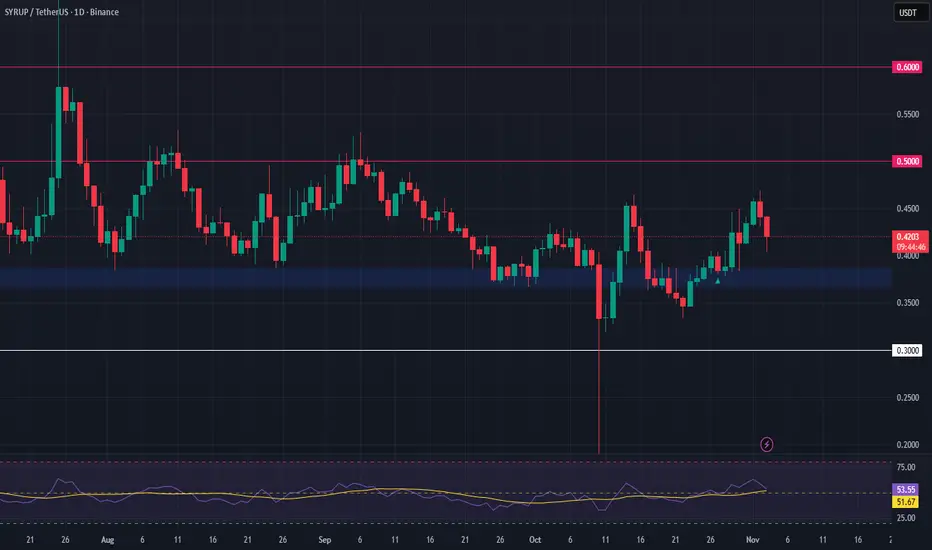
SYRUPUSDT – Watching for Pullback OpportunityAfter a strong 24% surge since our last analysis, SYRUP is starting to show signs of a potential retracement. This could be a healthy move, offering a chance to reset before a possible continuation higher on the higher time frames.
We’re now closely monitoring the $0.37 support zone, a level that aligns with previous consolidation and demand. If price pulls back and holds this zone, we may see a bullish reversal setup forming—a potential entry point for a spot long trade. Confirmation from candlestick structure or volume would strengthen the case.
📈 Trade Plan:
Entry Zone: $0.37
Take Profit Targets: $0.50, $0.60
Stop Loss: $0.30
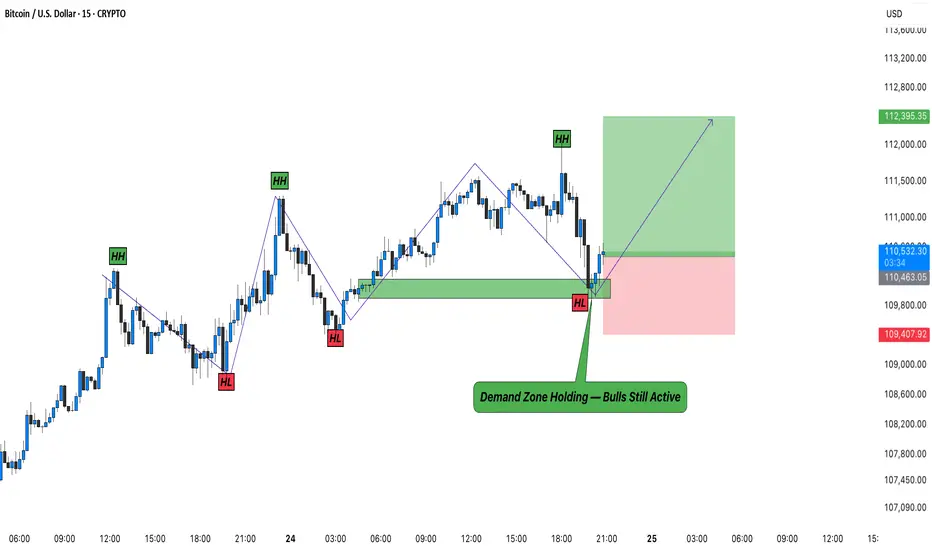
BTC – Demand Zone Holding Firm, Bulls Still in Control!Bitcoin (BTCUSD) continues to respect its demand zone around 110K–109.4K , where buyers have stepped in once again to defend the short-term structure. This area has acted as a reliable reaction point multiple times, confirming that smart money is active around this region.
Price recently dipped into the green zone and showed a quick rebound, forming a possible higher low structure. As long as BTC stays above this zone, the short-term bias remains bullish with immediate targets near 112.3K .
If the momentum continues to build, we might see another impulsive leg to the upside. However, any sustained close below 109.4K would invalidate this setup.
Remember: structure defines direction, not emotions.
Rahul’s Tip:
The best trades often form when most traders panic. Let the market test patience, not your conviction.
Disclaimer: This analysis is for educational purposes only and is not financial advice. Always trade with risk management.
Position Sizing and Risk ManagementThere are multiple ways to approach position sizing. The most suitable method depends on the trader’s objectives, timeframe, and account structure. For example, a long-term investor managing a portfolio will operate differently than a short-term trader running a high-frequency system. This chapter will not attempt to cover all possible methods, but will focus on the framework most relevant to the active trader.
Equalized Risk
The most practical method for position sizing is known as equalized risk per trade. This model ensures that each trade risks the same monetary amount, regardless of the stop loss distance. The position size will be calculated based on the distance between the entry price and the stop loss, which means a closer stop equals more size, where a wider stop equals less size. This allows for a more structured and consistent risk control across various events.
Position Size = Dollar Risk / (Entry Price − Stop Price)
Position Size = Dollar Risk / (Entry Price × Stop in %)
For example, an account size of $100,000 and risk amount of 1% will be equivalent to $1,000. In the scenario of a $100 stock price, the table below provides a visual representation of how the position size adapts to different stop loss placements, to maintain an equalized risk per trade. This process can be integrated into order execution on some trading platforms.
The amount risked per trade should be based on a fixed percentage of the current account size. As the account grows, the dollar amount risked increases, allowing for compounding. If the account shrinks, the dollar risk decreases, which helps reduce the impact of continued losses. This approach smooths out the effect of random sequences. A percentage-based model limits downside exposure while preserving upside potential.
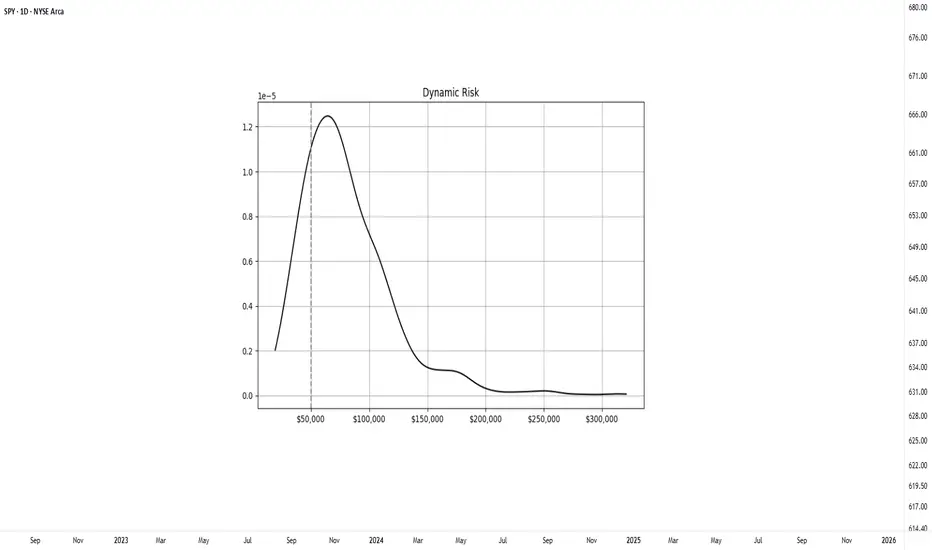
To better illustrate how position sizing affects long-term outcomes, a controlled simulation was conducted. The experiment modeled a system with a 50% win rate and a 1.1 to 1 average reward-to-risk ratio. Starting with a $50,000 account, the system executed 500 trades across 1000 separate runs. Two position sizing methods were compared: a fixed dollar risk of $1000 per trade and a dynamic model risking 2% of the current account balance.
Fixed-Risk Model
In the fixed-risk model, position size remained constant throughout the simulation. The final outcomes formed a relatively tight, symmetrical distribution centered around the expected value, which corresponds to consistent variance.
Dynamic-Risk Model
The dynamic-risk model produced a wider and more skewed distribution. Profitable runs experienced accelerated increase through compounding, while losing runs saw smaller drawdowns due to self-limiting trade size. Although dynamic risk introduces greater dispersion in final outcomes, it allows scalable growth over time. This compounding effect is what makes a dynamic model effective for achieving exponential returns.
A common question is what percentage to use. A range between 1–3% of the account is generally considered reasonable. Too much risk per trade can quickly become destructive, consider that even profitable systems may experience a streak of losses. For instance, a series of five consecutive losses at 10% risk per trade would cut the account by roughly 41%, requiring over a 70% return to recover. In case catastrophic events occur; large position sizing makes them irreversible. However, keeping position size and risk too small can make the entire effort unproductive. There is no such thing as a free trade, meaningful reward requires exposure to risk.
Risk Definition and Stop Placement
Risk in trading represents uncertainty in both the direction and magnitude of outcomes. It can be thought of as the potential result of an event, multiplied by the likelihood of that event occurring. This concept can be formulated as:
Risk = Outcome × Probability of Outcome
This challenges a common assumption that using a closer stop placement equals reduced risk. This is a common misconception. A tighter stop increases the chance of being triggered by normal price fluctuations, which can result in a higher frequency of losses even when the trade idea is valid.
Wide stop placements reduce the likelihood of premature exit, but they also require price to travel further to reach the target, which can slow down the trade and distort the reward-to-risk profile. An effective stop should reflect the volatility of the instrument while remaining consistent with the structure of the setup. A practical guideline is to place stops within 1–3 times the ATR, which allows room for price movement without compromising the reward-risk profile.
When a stop is defined, the distance from entry to stop becomes the risk unit, commonly referred to as R. A target placed at the same distance above the entry is considered 1R, while a target twice as far is 2R, and so on. Thinking in terms of R-multiples standardizes evaluation across different instruments and account sizes. It also helps track expectancy, maintain consistency, and compare trading performance.
In summary, risk is best understood as uncertainty, where the outcome is shaped by both the possible result and the probability of it occurring. The preferred approach for the active trader is equalized risk per trade, where a consistent percentage of the account, typically 1–3%, is risked on each position regardless of the stop distance. This allows the account to develop through compounding. It also reinforces the importance of thinking in terms of sample size. Individual trades are random, but consistent risk control allows statistical edge to develop over time.
Practical Application
To simplify this process, the Risk Module has been developed. The indicator provides a visual reference for position sizing, stop placement, and target definition directly on the chart. It calculates equalized risk per trade and helps maintain consistent exposure.
TRADING LEVERAGE | How to Manage RISK vs REWARDFor today's post, we're diving into the concept " Risk-Reward Ratio "
We'll take a look at practical examples and including other relevant scenarios of managing your risk. What is considered a good risk to reward ratio and where can you see it ? This applies to all markets, and during these volatile times it is an excellent idea to take a good look at your strategy and refine your risk management.
You've all noticed the really helpful tool " long setup " or " short setup " on the left-hand column. This clearly identifies the area of profit (in green), the area for a stop-loss (in red) and your entry (the borderline). It also shows the percentage of your increases or decreases at the top and bottom. It looks like this :
💭Something to remember; It is entirely up to you where you decided to take profit and where you decide to put your stop loss. The IDEAL anticipated targets are given, but the price may not necessarily reach these points. You have that entire zone to choose from and you can even have two or three take profits points in a position.
Now, what is the Risk Reward Ratio expressed in the center as a number.number ?
The risk to reward ration is exactly as the word says : The amount you risk for the amount you could potentially gain. NOTE that your risk is indefinite, but your gains are not guaranteed. The risk/reward ratio measures the difference between the entry point to a stop-loss and a sell or take-profit point. Comparing these two provides the ratio of profit to loss, or reward to risk.
For example, if you're a gambler and you've played roulette, you know that the only way to win 10 chips is to risk 5 chips. Your risk here is expressed as 5:10 or 5.10 .You can spread these 5 chips out any way you like, but the goal of the risk is for a reward that is bigger than your initial investment. However, you could also lose your 5 and this will mean that you need to risk double as much in your next play to make up for your loss. Trading is no different, (except there is method to the madness other than sheer luck...)
Most market strategists and speculators agree that the ideal risk/reward ratio for their investments should not be less than 1:3, or three units of expected return for every one unit of additional risk. Take a look at this example: Here, you're risking the same amount that you could potentially gain. The Risk Reward ratio is 1, assuming you follow the exact prices for entry, TP and SL.
Can you see why this is not an ideal setup? If your risk/reward ratio is 1, it means you might as well not participate in the trade since your reward is the same as your risk. This is not an ideal trade setup. An ideal trade setup is a scenario where you can AT LEAST win 3x as much as what you are risking. For example:
Note that here, my ratio is now the ideal 2.59 (rounded off to 2.6 and then simplified it becomes 1:3). If you're wondering how I got to 1:3, I just divided 2.6 by 2, giving me 1 and 3.
Another way to express this visually:
In the first chart example I have a really large increase for the long position and you can't easily simplify 7.21 so; here's a visual to break down what that looks like:
If you are setting up your own trade, you can decide at what point you feel comfortable to set your stop loss. For example, you may feel that if the price drops by more than 10%, that's where you'll exit and try another trade. Or, you could decide that you'll take the odds and set your stop loss so that it only triggers if the price drops by 15%. The latter will naturally mean you are trading at higher risk because your risk of losing is much more. Seasoned analysts agree that you shouldn't have a value smaller than 5% for your stop loss, because this type of price action occurs often during a day. For crypto, I would say 10% because we all know that crypto markets are much more volatile than stock markets and even more so than commodity markets like Gold and Silver, which are the most stable.
Remember that your Risk/Reward ratio forms an important part of your trading strategy, which is only one of the steps in your risk management program. Dollar cost averaging is another helpfull way to further manage your risk. There are many more things to consider when thinking about risk management, but we'll dive into those in another post.
Global Market Risks and Rewards1. Introduction to the Global Market Landscape
The global market functions as a single ecosystem that links economies, corporations, and investors worldwide. With technology, globalization, and liberalized trade policies, even small and medium-sized enterprises (SMEs) can participate in international trade. However, the very interdependence that fuels growth also magnifies vulnerabilities — such as financial crises, geopolitical tensions, and supply chain disruptions.
Therefore, participation in global markets is a balance of risk and reward, shaped by economic cycles, political decisions, innovation, and global events.
2. Major Rewards of Participating in Global Markets
a. Economic Growth and Expansion Opportunities
One of the most significant rewards of global market participation is access to new consumer bases. Companies can move beyond saturated domestic markets to tap into emerging economies with growing middle-class populations. For instance, Indian IT companies like Infosys and TCS expanded globally, gaining large revenue shares from clients in North America and Europe.
Global exposure allows companies to scale production, diversify demand, and strengthen their brand presence. Investors also gain from exposure to fast-growing regions and sectors unavailable in their home markets.
b. Diversification of Investments and Risk Spreading
For investors, the global market offers a chance to diversify portfolios. By investing in multiple countries and asset classes, they can reduce exposure to country-specific risks such as inflation, political instability, or currency depreciation. For example, when one economy slows down, another may be in a growth phase — creating a natural hedge.
This diversification principle works across equities, commodities, bonds, and even digital assets, spreading risks while increasing long-term stability.
c. Innovation, Technology Transfer, and Knowledge Sharing
Globalization promotes cross-border innovation. Companies operating in international markets often adopt advanced technologies and management practices from developed economies. Likewise, emerging economies benefit from foreign direct investment (FDI) and partnerships that bring expertise, modern infrastructure, and new skills.
For instance, the automobile industry in India and Mexico has grown significantly due to joint ventures with global players who introduced efficient production technologies and quality control standards.
d. Competitive Advantage and Cost Efficiency
Operating in a global marketplace encourages firms to become more efficient and competitive. They must innovate continuously, optimize costs, and maintain high product standards to survive. This process improves overall productivity and quality in both domestic and international markets.
For example, multinational corporations (MNCs) strategically set up production units in countries with lower labor and operational costs, such as Vietnam or Bangladesh, enabling them to reduce costs while maintaining global quality standards.
e. Access to Capital and Financial Markets
Global markets open access to international funding sources. Companies can issue bonds or stocks in foreign markets to attract investors and raise capital at lower interest rates. Developing countries also gain from global financial flows through FDI, portfolio investments, and sovereign funds.
For instance, many Asian startups receive venture capital from the U.S. and Europe, boosting innovation and entrepreneurship.
3. Key Risks of Global Market Participation
While rewards are significant, global markets also carry systemic risks that can impact profits, stability, and long-term growth.
a. Political and Geopolitical Risks
Politics plays a vital role in shaping trade and investment decisions. Sudden changes in government policies, taxation, trade restrictions, or sanctions can disrupt business operations. Geopolitical conflicts — such as tensions in the Middle East or U.S.–China trade wars — can destabilize global supply chains and affect commodity prices.
For instance, the Russia–Ukraine war in 2022 led to energy supply shocks, surging oil and gas prices, and inflation across Europe, showing how one regional conflict can ripple through the global economy.
b. Exchange Rate and Currency Risks
Currency fluctuations directly affect international trade and investments. A company exporting goods to another country may face losses if the foreign currency weakens against its home currency. Similarly, investors holding assets in multiple currencies may face returns volatility due to exchange rate shifts.
For example, if the U.S. dollar strengthens sharply, emerging market currencies often fall, increasing the debt burden of countries or companies that borrowed in dollars.
c. Economic and Financial Market Risks
Global financial markets are deeply interconnected — which means crises spread rapidly. The 2008 global financial crisis began in the U.S. housing market but soon spread worldwide, affecting banks, investors, and governments globally.
Similarly, inflation, interest rate hikes, or recessions in major economies like the U.S., China, or the Eurozone can influence investment flows, commodity prices, and capital markets globally.
d. Supply Chain and Logistics Risks
The COVID-19 pandemic revealed how fragile global supply chains can be. Lockdowns, port delays, and labor shortages disrupted production and trade across sectors. Overdependence on a single supplier or region (e.g., China for electronics manufacturing) can create vulnerabilities.
Companies are now diversifying supply chains — a concept called “China + 1” strategy — to reduce geographic concentration risk.
e. Legal and Regulatory Risks
Each country has its own laws on taxation, labor, environment, and intellectual property. Multinational companies must comply with multiple legal frameworks, which can be complex and costly. Sudden changes in trade policies, tariffs, or environmental standards can affect profitability.
For instance, stricter data protection laws in Europe (GDPR) forced global tech firms to revamp their data-handling systems, adding compliance costs.
f. Environmental and Climate Risks
Climate change has become a major factor in global business and trade. Extreme weather, resource scarcity, and environmental regulations affect production and logistics. Companies with high carbon footprints face increasing pressure from both regulators and investors to transition toward sustainable models.
Environmental disruptions — such as floods in Southeast Asia or droughts in Africa — can also lead to supply shortages and price spikes in food and commodities.
g. Cybersecurity and Technological Risks
As trade and finance shift to digital platforms, cybersecurity risks have multiplied. Hacking, ransomware, and data breaches can cause severe financial and reputational damage. Financial markets, logistics systems, and digital payments depend on secure IT infrastructure — making cybersecurity a top priority for global firms.
h. Cultural and Operational Risks
Differences in language, culture, and business practices can lead to misunderstandings and inefficiencies. A product successful in one country might fail in another due to different consumer preferences or cultural sensitivities.
For example, Western fast-food chains initially struggled in Asian markets until they localized menus and marketing strategies.
4. Balancing Risk and Reward: Strategic Approaches
To succeed in global markets, businesses and investors must balance risks with potential rewards through strategic planning and diversification.
a. Risk Management and Hedging
Companies use hedging instruments like futures, options, and forward contracts to protect against exchange rate and commodity price fluctuations. Insurance policies can mitigate risks from political instability or natural disasters.
For example, exporters hedge currency exposure to lock in future exchange rates and stabilize revenues.
b. Geographic and Sectoral Diversification
Expanding into multiple countries or sectors helps spread risk. A company heavily dependent on one market may face losses during local downturns, while a diversified firm can offset that with growth elsewhere.
For investors, holding a mix of assets — stocks, bonds, commodities, and foreign equities — reduces portfolio volatility.
c. Sustainable and Responsible Business Practices
Modern global markets increasingly reward companies that adopt Environmental, Social, and Governance (ESG) principles. Sustainable businesses attract long-term investors, gain regulatory advantages, and reduce exposure to environmental or ethical risks.
Green investments, renewable energy projects, and responsible sourcing are not only good for the planet but also create competitive advantages.
d. Technological Adaptation and Innovation
Digital transformation, automation, and AI-driven analytics help firms manage operations efficiently and respond to global challenges. Technology enables real-time monitoring of logistics, market trends, and customer needs, improving adaptability and profitability.
e. Strategic Alliances and Partnerships
Collaboration with local partners, joint ventures, or regional alliances helps global firms understand local markets, comply with regulations, and build trust. Such partnerships reduce entry risks while leveraging local expertise.
5. Emerging Trends Influencing Global Risks and Rewards
The dynamics of global markets are constantly evolving. Several emerging trends are reshaping the risk-reward balance.
a. Shift Toward Emerging Economies
Asia, Africa, and Latin America are expected to drive most global growth in the next decades. Investors and corporations see significant opportunities in these fast-growing markets — though they often come with higher political and currency risks.
b. Rise of Digital and Decentralized Finance
Cryptocurrencies, blockchain, and digital payment systems are transforming how international transactions occur. They offer efficiency and lower costs but also introduce regulatory uncertainty and cyber risks.
c. Reshoring and Supply Chain Realignment
Post-pandemic, many countries are encouraging domestic manufacturing and reducing dependence on foreign supply chains. This reshoring trend reduces vulnerability but may increase costs in the short term.
d. Focus on Green and Inclusive Growth
Governments and investors are aligning with climate goals, encouraging low-carbon industries, and penalizing polluting sectors. Green energy, electric vehicles, and carbon trading markets are creating new global investment opportunities.
6. Conclusion: The Dual Nature of Global Markets
The global market is a double-edged sword — offering unprecedented rewards while exposing participants to complex risks. Economic interdependence ensures that prosperity in one region can fuel global growth, but crises can just as easily spread across borders.
Success in the global arena requires strategic risk management, adaptability, and continuous innovation. Companies and investors who understand these dynamics — and balance opportunity with caution — can not only survive but thrive in this interconnected world.
In essence, the global market is not just about trade and investment; it is about understanding the rhythm of global change — where risk and reward coexist as inseparable partners in the journey toward progress and prosperity.
BIGGEST Crypto Liquidation TO DATE - Market CorrectsToday and yesterday over the past few hours, $19 billion dollars was wiped out in crypto. This is historic. And also a lesson in risk management, an eerie reminder of how risky speculation can be.
The market was over leveraged , and this is the result.
How can we monitor/ safeguard against this going ahead and be prepared for such an event in the future?
1) Always use a stop loss
2) Watch Bid/Ask spread and volatility
3) Use proper risk management
On the 10th of October, POTUS Donald Trump Tweeted about a new set of trade measures that include 100% tariff on certain Chinese exports, and new stricter export controls. The market immediately reacted; stocks and commodities dropped and crypto fell into chaos. What made this worse is that several exchanges were down, resulting in investors being unable to close or update their positions.
It seems like a fitting "reason" and also not, oddly. What we need to note here, is that the market was over leveraged. This is a self-correcting event that presents truer market reflections and better prices for investors - a blessing for those who were not affected/invested.
As an extra measure if you trade S&P500, you could watch the VIX - and set an indicator to any daily change greater than 15%-20%. This way, you'll be notified if there's action in the stock market.
You can also take a look at this idea on Risk vs Reward:
Risk Management Rules That Save AccountsSummary
You lower impulsive errors at the open by running a one minute pre market checklist that begins with a threat label. You then walk five gates for news, volatility, risk, size, and stop. The routine is simple, fast, and repeatable. It creates a small pause that shifts you from emotional reaction to planned execution. This is education and analytics only.
Decision architecture under stress . Name it to tame it. A short written label reduces limbic reactivity and gives the planning system a window of control.
Why this matters
Most bad sessions begin before the first click. Fatigue, caffeine spikes, fear of missing out, and a cluttered screen push the brain toward shortcuts. The checklist gives you a tiny container of time where you look at the day with clear eyes. One minute is enough. The goal is not perfection. The goal is a stable entry state and a hard off switch when risk boundaries are reached.
The one minute routine
Threat label . Write one sentence that names your current state in plain language. Example: Slept five hours, feel rushed, second coffee, mild anxiety. This is affect labeling.
News gate . Scan the calendar for high impact items. Decide if size is reduced or if a filter is active around event times.
Volatility gate . Classify the regime as normal or high by reading average true range or a recent range. High regime shrinks size and widens stop distance inside your plan.
Risk gate . Confirm risk per trade, the max daily loss, and the rule that stops new entries for the day.
Session gate . Choose your focus window. Define a time box. Write one line that states your setup and the review point.
Principle one — the threat label
The label is short, neutral, and written. You are not trying to be poetic. You are moving the experience from the body into words so that attention can be allocated with intent. Include four elements.
Sleep . Hours and quality. Broken sleep counts as low quality.
Fatigue . Subjective rating from 1 to 5 where 3 is workable.
Stimulants . Caffeine count and timing. Early heavy intake tends to raise urgency.
Emotion . One word such as calm, rushed, irritated, fearful, confident.
Add a mood score from 1 to 5. If the score is 1 or 2 you move to simulation or wait fifteen minutes after the open. If the score is 3 or higher you can proceed with the five gates at reduced size when the day feels heavy. The act of naming is not a cure. It is a lever that opens a window where better choices are available.
Principle two — breathing as a switch
Use a physiological sigh or box breathing for sixty seconds when arousal is high.
Physiological sigh: inhale through the nose, take a short second inhale to top off, then exhale slowly through the mouth. Repeat five times.
Box breathing: inhale for four, hold for four, exhale for four, hold for four. Repeat for one minute.
This is not about relaxation. It is about coming back to a steady baseline so that the gates can be applied without haste.
Principle three — time boxing and two strike control
Time without boundaries invites drift. Choose a primary window. Add a two strike rule. Two avoidable mistakes or two full stops and you switch to review mode. This is a hard rule. You can always restart in simulation. The account does not need you to win today. It needs you to preserve optionality for tomorrow.
The five gates in depth
Gate 1. Threat label details
Format . One sentence. Neutral tone. No judgment.
Signal . If the label uses words like frantic, desperate, angry, or invincible you reduce size or you step back. Extreme emotion is a red flag.
Action . If the label is heavy, attach a micro plan. Example: Watch the first range print, take one A quality setup only, then review.
Why it works. The label hijacks the loop that pairs sensation with urgency. By assigning words you create distance. Distance allows choice. Choice reduces error.
Gate 2. News gate details
Scan . Look for clustered items such as inflation prints, policy statements, or employment data.
Filter . If an item is imminent you set a no trade buffer around it. Five minutes is a good default for the day session. Longer buffers can be used when events are central to the day.
Size . On days with dense events you run smaller. Your goal is survival and clarity, not heroics.
Reasoning. Event periods change the distribution of short term outcomes. The checklist assumes there are times to engage and times to wait. Waiting is a skill.
Gate 3. Volatility gate details
Classification . Use a simple rule such as normal regime when the rolling range is near its median and high regime when it is in the upper quartile. You do not need complex math here.
Translation . High regime implies half size and wider stops within your plan. Normal regime allows baseline size and standard stops.
Exit awareness . Volatility is not a gift and not a threat. It is a condition. When it is extreme your first task is to avoid clips that come from noise.
The psychology note. When volatility rises your heart rate rises and the mind searches for action. The gate reminds you that you do not need to swing at every pitch. You need to scale your effort to the environment.
Gate 4. Risk gate details
Risk per trade . Choose a range that respects your current skill. Many traders use values between 0.25 percent and 0.50 percent while they build consistency. Use your data.
Max daily loss . Choose a hard cap between 1.5 percent and 2.5 percent. The exact figure is less important than the enforcement.
Stop trading rule . When the max is reached you stop. You move to review mode. You do not attempt a last minute rescue. You treat tomorrow as a fresh session.
Psychology note. Most blowups do not come from one bad idea. They come from the refusal to stop when the day is off. The risk gate eliminates that refusal by binding action to a predefined boundary.
Gate 5. Session gate details
Focus . Choose one session. Focus beats breadth. Split focus is a silent drain.
Window . Define the first hour as your primary window and stick to it. The goal is quality not quantity.
Written micro plan . One line that states what you are allowed to take. One line that states when you stand down.
Time discipline creates high quality boredom. High quality boredom is where patience grows.
The one minute card
Copy this card and keep it next to your screen.
Threat label: Today I feel … because …
Mood 1 to 5: __
Sleep hours: __
Caffeine cups: __
Five gates
News: list items and times.
Volatility: normal or high.
Risk: risk per trade and max daily loss.
Size: full or half.
Stop: exit rule and stop trading rule.
Session plan
Primary session: __
Window: first sixty minutes
Setup: described in one line
Review: five notes after the first trade
Bias management
Your checklist doubles as a bias tracker. Below are common traps and their counters.
Fomo . The urge to enter early because price is moving. Counter : read your session plan line out loud and wait for the condition that defines your setup.
Revenge . The urge to win back a loss. Counter : two strike rule. After two avoidable errors you switch to review.
Confirmation . The habit of seeking only data that supports the current idea. Counter : write one invalidation condition in your micro plan before each entry.
Sunk cost . Staying with a poor position because time and effort were invested. Counter : use structure based exits and honor them without debate.
Outcome bias . Judging process by result. Counter : score the decision quality in your journal independent of profit and loss.
Recency . Overweighting the last outcome. Counter : review three prior similar sessions before the open.
Anchoring . Fixating on a number seen early. Counter : update levels using the most recent structure and ranges.
Gambler fallacy . Expecting balance in small samples. Counter : treat each setup as independent and sized by plan.
Environment design
Your surroundings push behavior. Design them on purpose.
Screen hygiene . Close unrelated tabs. Remove flashing items. Keep only the chart, the calendar, and your checklist.
Desk card . Print the one minute card. Physical presence increases compliance.
Timer . Use a simple timer for your first window. When it ends you review by default before you extend.
Journal access . Keep the journal one click away. Reduce friction to writing.
Standing rule sheet . Place the two strike rule and the max daily loss in large font at eye level.
Journal method
A short consistent journal beats a long sporadic one. Use five lines per session.
Threat label . Copy the exact sentence you wrote.
Gate notes . News, volatility classification, risk settings, session window.
Two key decisions . What you took and why.
Discipline score . Rate from 1 to 5 based on process quality.
Next session intent . One line that you can act on tomorrow.
Once a week add a short review.
Count how many times the max daily loss was hit.
Count how many sessions began with a score of 1 or 2 and what you did in response.
Note one pattern you want more of and one behavior you want less of.
Comparator — checklist day versus reactive day
A checklist day has five visible differences.
Entries occur inside the written setup line rather than outside of it.
Size reflects volatility classification rather than emotion.
News windows are respected rather than ignored.
The two strike rule switches you to review rather than escalation.
Post session notes exist and inform the next session.
A reactive day shows the opposite pattern. You can measure this. Track three numbers for a month.
Number of impulsive entries per session.
Number of max daily loss hits per week.
Average emotional intensity rating captured in the first five minutes of the session.
Expect the checklist month to show fewer impulsive entries, fewer max loss days, and lower opening intensity. The goal is stable execution and preserved capital for learning.
Scenarios and how to apply the gates
Low sleep morning
Threat label notes low sleep and mild irritability. Mood 2.
Action is simulation or a fifteen minute wait after the open. Coffee is delayed. You observe the first range and journal one line without taking risk.
Outcome is a cleaner state for the second half of the hour or a full stand down without regret.
Clustered event day
Threat label notes excitement and urgency.
News gate shows several items within the first hour. Filter is applied. Size is reduced.
Two strike rule is activated with extra caution due to the environment.
High volatility regime
Volatility gate classifies the day as high using a simple rolling range rule.
Size is cut in half. Stops are placed at a distance that matches the regime inside your plan.
You aim for one A quality setup and then you review.
Emotional drift after early win
Threat label catches the rise of euphoria and the phrase I can push it.
Risk gate reminds you that risk per trade remains constant. Size does not increase without a monthly review and data.
You write a single intent line to protect the day from giving back an early gain.
Emotional drift after early loss
Threat label captures frustration and the urge to get it back.
You pause for a breathing cycle. You re read the setup line. You allow the next clean condition or you stop.
If you reach two avoidable errors you switch to review mode by rule.
Building the habit
Habits form when three conditions exist. A cue, a simple action, and a visible reward.
Cue . The first launch of your platform is the cue. The card sits in front of the keyboard.
Action . You write the threat label and walk the five gates. It takes one minute.
Reward . You check off a visible box on a small tracker. Ten sessions completed equals a micro reward of your choice that does not increase arousal.
Use streak tracking. Breaking a streak is a useful signal. Ask why with curiosity, not shame.
Risk of ruin as a psychological anchor
Ruin is the end of the game. You reduce ruin probability by keeping the max daily loss small, by sizing positions inside your plan, and by cutting activity when the state is poor. The checklist operationalizes this. You do not need to compute formulas every morning. You need to enforce boundaries in real time.
Plain language rules you can post above your monitor
Write a threat label before the open.
Respect event windows without exception.
Match size to volatility.
Stop at the max daily loss.
Run a small time box and review by default when it ends.
Metrics that keep you honest
Track the following numbers each week.
Sessions with the card completed.
Sessions that reached the max daily loss.
Impulsive entries per session.
Average mood score at the open.
Average discipline score at the close.
Make a tiny table with ten rows that covers two weeks. This takes five minutes and will reveal whether the checklist is real or theater.
Frequently asked questions
Can I apply this to longer timeframes
Yes. The gates do not change. Only the windows change. The principle remains the same. Protect the mind, protect the account, and execute the plan.
Should I scale size after a win
No, not inside the day. Size changes are a monthly decision informed by data and by a stable discipline score. Day level changes usually reflect emotion rather than edge.
What if fear is very high
Use one cycle of the physiological sigh and one cycle of box breathing. Write the label. If the score remains 1 or 2 your best decision is to observe and learn without risk.
What if I fail the routine for a week
Do a small reset. Print a fresh card. Shorten the window. Reduce goals. Your only task is to complete the card for three sessions in a row.
What about accountability
Share your five line journal with one trusted peer. No opinions. No trade calls. Only the five lines. This light social pressure improves compliance.
Risks and failure modes
Liquidity pockets . Thin periods can distort short term structure. The solution is to reduce activity rather than to force entries.
Event clusters . When several items land in the same session, conditions can whipsaw. The solution is to go smaller or to wait for the post event phase.
Emotional drift . After two losses the urge to fight rises. The solution is the two strike rule and a physical walk away trigger.
Overfitting the checklist . A card with twenty questions will not be used. Keep it at one minute.
Rationalization . The mind can twist rules in real time. The solution is to write numbers before the session and follow them when it is hardest.
From routine to identity
Behavior sticks when it becomes who you are. You can call yourself a routine first trader. That means you respect the card before you respect your opinions. You can call yourself a review first trader. That means you treat the journal as part of the session rather than an afterthought. Identity makes rules easier to keep because breaking them feels like breaking character.
Closing summary
The pre market checklist is a small lever with large impact. You begin with a written threat label that pulls emotion into words. You pass five gates that cover news, volatility, risk, size, and stop. You work inside a time box and you accept the two strike rule. You record five lines and you adjust week by week. There is no promise of profit. There is only the reliable reduction of avoidable errors and the protection of your decision making capacity. The rest follows from consistent behavior over time.
Education and analytics only. Not investment advice. No performance promises.
The Process Notebook #1 — The Successful Trader’s RoutineThe Successful Friday's Trader Routine: Evaluate but Think in Blocks, Not Trades
Another trading week is about to end. For most traders, Friday means checking wins and losses. For professional traders, it means evaluating the system.
💡 Remember: a single trade means nothing.
Proper evaluation, to avoid emotional bias caused by variance, should always be done on blocks of trades (minimum 10–20).
But here’s the real twist: If you’re judging your system only by Win Rate (WR) or Reward-to-Risk (RR)… you’re missing the real picture.
A robust trading system needs to be monitored through a small set of key metrics that reflect not just how much you earn, but how consistent and reliable your edge truly is.
Here’s the minimum you should be tracking 👇
📈 Return Metrics (How much your system makes)
Expectancy (average return per trade): quantifies the true profitability of your edge.
CAGR (Compound Annual Growth Rate): shows long-term compounding efficiency.
Payoff Ratio (avg win / avg loss): evaluates quality of your wins vs. losses.
📉 V olatility & Risk Metrics (How stable your system is)
Standard Deviation of Returns: measures the variability of your outcomes.
Max Drawdown: identifies the deepest pain your account can face.
Recovery Factor (Net Profit / Max DD): shows resilience and system efficiency.
⚙️ Consistency Metrics (How repeatable your process is)
Sharpe Ratio: return per unit of volatility — higher = more efficient risk use.
Win/Loss Streak Distribution: reveals your emotional endurance threshold.
Trade Frequency Stability: checks if your system behaves consistently over time.
🧠 Why this matters
When you evaluate your trading in blocks (using statistics, not emotions), you detach from the noise and connect with your system’s real performance.
You stop judging yourself trade by trade… and start thinking like a risk
manager.
How do you evaluate your system — by emotion or by metrics?
Trading: The Most Relative Profession in the WorldIntroduction
Most professions operate within clear boundaries of right and wrong, success and failure. A doctor either saves the patient or doesn’t. An engineer either builds a stable bridge or one that collapses. But trading doesn’t work like that.
In trading, “being right” and “being wrong” are relative. Two traders can look at the exact same market, take opposite positions, and both can be right. At the same time, they can both be wrong. This relativity is what makes trading not only fascinating, but also psychologically challenging.
________________________________________
Why “Being Right” Is an Illusion in Trading
Many traders fall into the trap of needing to be right. They celebrate when their forecast matches the price action, and they criticize others when opinions diverge. But trading isn’t about intellectual debates — it’s about execution, timing, and money management.
You can make the perfect call, but if you enter at the wrong time or exit poorly, you still lose. Conversely, you can be “wrong” in your forecast, yet still make money because you managed your trade correctly.
________________________________________
A Real Example: Gold’s Price Action Yesterday
Take gold, for instance:
• Trader A says: “Gold will rise.”
• Trader B says: “Gold will fall.”
Who is right? The answer is not straightforward.
• Gold made a new all-time high during the day — Trader A can claim victory.
• Gold sold off after — Trader B can also claim victory.
But here’s the twist:
• Trader A was wrong if he bought at the very top before the selloff.
• Trader B was wrong if he sold too early at 3860 before the new ATH.
This example shows how trading doesn’t operate in absolutes. The market gives both validation and punishment, depending not only on the direction, but also on timing and execution.
________________________________________
Timeframe Relativity: Scalper vs. Swing Trader
This relativity becomes even more visible when we compare a scalper with a swing trader — in fact, this is where it shows itself most clearly.
Consider this scenario:
• The scalper buys against the larger trend, catching a quick 50-pip bounce from intraday volatility.
• The swing trader sells with the dominant trend, holding for several days and capturing 300 pips once the broader move unfolds.
At first glance, their positions contradict each other. One is long, the other is short. Yet both can be right — and both can make money — simply because they operate on different timeframes, with different objectives and risk tolerances.
Don’t believe me? Here’s a real and concrete example: back in 2022, I shorted BTC heavily and made strong profits. At the same time, a good friend of mine kept buying into weakness and applying a DCA strategy.
Who was right?
The answer, again, is relative. I was right in the medium term — profiting from the bearish momentum. My friend was right in the long term — building a position that paid off when the market eventually recovered.
This is the purest example of relativity in trading: the same market, moving in both directions, rewarding two very different strategies.
________________________________________
The Key Lesson
Trading is not about proving a point. It’s not about winning an argument on social media or showing that your market call was correct. It’s about managing trades in a way that consistently extracts profits, regardless of who “guessed” the move better.
The market doesn’t reward opinions. It rewards discipline and risk control. Always remember:
• Entries are relative.
• Exits define success.
• Risk is king. A “right” prediction with poor risk management can still end in disaster.
In other words: you don’t get paid for being right — you get paid for good execution and risk management.
________________________________________
Why Relativity Matters
Understanding the relativity of trading helps in three ways:
1. It kills the ego. You stop caring about being right and start caring about making money.
2. It reduces conflicts. Another trader’s opposite view doesn’t threaten yours; both can co-exist.
3. It shifts focus. The conversation moves from “Was I right?” to “Was my trade profitable?”
________________________________________
Conclusion
Trading is the most relative profession in the world because “truth” in markets is never absolute. Two traders can both be right, both be wrong, or both at once.
What separates successful traders from the rest is not their ability to “predict,” but their ability to trade with discipline, adapt to changing conditions, and manage risk.
In the end, the scoreboard is your trading account — not your pride in being right. 🚀