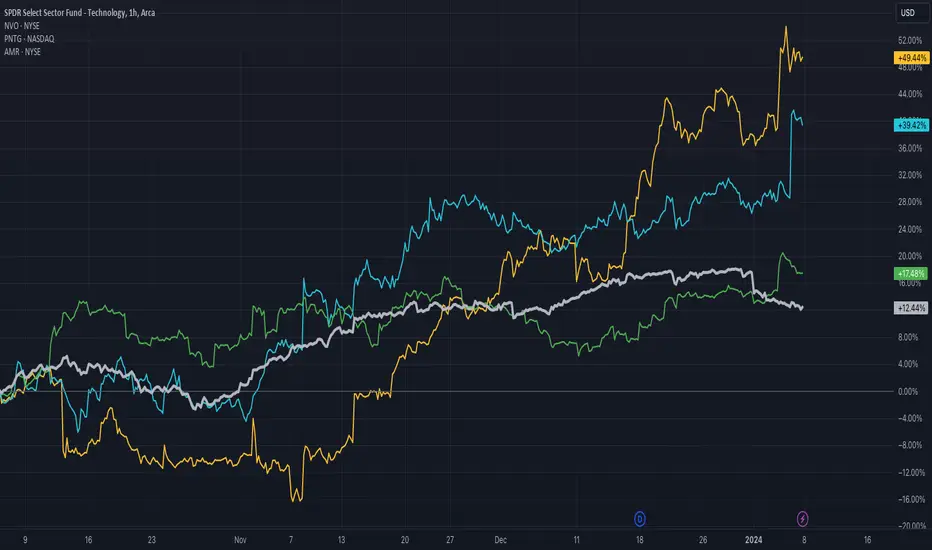
XLK breakout - Expect new all time highsXLK has effectively broken above the downtrend line that started on 6/3/26. After a break and retest the technology sector has continued to show resilience in wanting to push to the upside.
Our stop loss will go below the swing low prior to the trendline break.
T1 is new ATHs
T2 is 233
T3 is 251
Compare with State Street Technology Select Sector SPDR ETF
Key stats
Details
Home page
Inception date
Dec 16, 1998
Structure
Open-Ended Fund
Replication method
Physical
Dividend treatment
Distributes
Distribution tax treatment
Qualified dividends
Income tax type
Capital Gains
Max ST capital gains rate
39.60%
Max LT capital gains rate
20.00%
Primary advisor
SSgA Funds Management, Inc.
Distributor
State Street Corp. (Fund Distributor)
ISIN
US81369Y8030
CUSIP
81369Y803
FIGI
BBG000BJ7007
Identifiers
ISIN US81369Y8030
XLK was the first to launch in this space, as such it offers a more narrow focus on the US technology segment. Its S&P 500-only portfolio tilts away from our segment benchmark. XLK is heavily concentrated and also a few that seem like misfits, such as financial payment processers or telecom firms. Its limited selection universe excludes small-caps and most midcaps. Avoiding smaller, less-stable firms results in lower volatility and a tilt toward value compared to our broad tech-industry benchmark index, and can cause other minor performance differences. XLK held the title for a long time as the cheapest and the largest fund in its segment. Prior to Dec. 1, 2025, the fund name did not include the Issuer's name, State Street.
Classification
What's in the fund
Exposure type
Electronic Technology
Technology Services
Breakdown by region
Top 10 holdings
Market Rotation Cheat Sheet: Week of July 27See levels and key areas for this week:
After you click the link, click “Grab this Chart” at the bottom/right of the chart or Load Live Bars on far middle-right.
“Grab this Chart” opens a copy of the chart environment, but it doesn’t automatically save as a permanent layout in your dashboard. Once t
How To Tell If A Sector Is Actually StrongTech is strong is something people say. Here's how you check it instead.
A sector being up means nothing on its own. On a good day, almost everything is up. What you want to know is whether it's outrunning the market.
Relative strength, plainly Relative strength (RS) is just this: how a stock or
XLK/SPY at a Key Pullback Zone — Is Tech Ready to Regain StrengtXLK/SPY is testing an interesting area after weeks of underperformance.
The ratio briefly traded below support before reclaiming it, while Stochastic is forming a bullish divergence —price made a lower low, but momentum held a higher low.
This does not confirm a reversal yet, but the reaction fro
Market Sector Rotation - Week of July 20thSee levels and key areas for this week:
After you click the link, click “Grab this Chart” at the bottom/right of the chart or Load Live Bars on far middle-right.
“Grab this Chart” opens a copy of the chart environment, but it doesn’t automatically save as a permanent layout in your dashboard. Once t
Market Rotation Cheat Sheet: Week of July 13thSee levels and key areas for this week:
After you click the link, click “Grab this Chart” at the bottom/right of the chart or Load Live Bars on far middle-right.
“Grab this Chart” opens a copy of the chart environment, but it doesn’t automatically save as a permanent layout in your dashboard. Once t
Market Rotation Cheat Sheet - Week of July 6thSee levels and key areas for this week:
After you click the link, click “Grab this Chart” at the bottom/right of the chart or Load Live Bars on far middle-right.
“Grab this Chart” opens a copy of the chart environment, but it doesn’t automatically save as a permanent layout in your dashboard. Once t
Market Sector Rotation - week of June 29See levels and key areas for this week:
After you click the link, click “Grab this Chart” at the bottom/right of the chart or Load Live Bars on far middle-right.
“Grab this Chart” opens a copy of the chart environment, but it doesn’t automatically save as a permanent layout in your dashboard. Once t
See all ideas
Summarizing what the indicators are suggesting.
Oscillators
Neutral
SellBuy
Strong sellStrong buy
Strong sellSellNeutralBuyStrong buy
Oscillators
Neutral
SellBuy
Strong sellStrong buy
Strong sellSellNeutralBuyStrong buy
Summary
Neutral
SellBuy
Strong sellStrong buy
Strong sellSellNeutralBuyStrong buy
Summary
Neutral
SellBuy
Strong sellStrong buy
Strong sellSellNeutralBuyStrong buy
Summary
Neutral
SellBuy
Strong sellStrong buy
Strong sellSellNeutralBuyStrong buy
Moving Averages
Neutral
SellBuy
Strong sellStrong buy
Strong sellSellNeutralBuyStrong buy
Moving Averages
Neutral
SellBuy
Strong sellStrong buy
Strong sellSellNeutralBuyStrong buy
Displays a symbol's price movements over previous years to identify recurring trends.
Frequently asked questions
An exchange-traded fund (ETF) is a collection of assets (stocks, bonds, commodities, etc.) that track an underlying index and can be bought on an exchange like individual stocks.
XLK trades at 188.86 USD today, its price has risen 1.49% in the past 24 hours. Track more dynamics on XLK price chart.
XLK net asset value is 186.16 today — it's risen 0.44% over the past month. NAV represents the total value of the fund's assets less liabilities and serves as a gauge of the fund's performance.
XLK assets under management is 122.10 B USD. AUM is an important metric as it reflects the fund's size and can serve as a gauge of how successful the fund is in attracting investors, which, in its turn, can influence decision-making.
XLK price has risen by 3.15% over the last month, and its yearly performance shows a 42.30% increase. See more dynamics on XLK price chart.
NAV returns, another gauge of an ETF dynamics, have risen by 0.44% over the last month, showed a 6.36% increase in three-month performance and has increased by 41.68% in a year.
XLK fund flows account for 2.14 B USD (1 year). Many traders use this metric to get insight into investors' sentiment and evaluate whether it's time to buy or sell the fund.
Since ETFs work like an individual stock, they can be bought and sold on exchanges (e.g. NASDAQ, NYSE, EURONEXT). As it happens with stocks, you need to select a brokerage to access trading. Explore our list of available brokers to find the one to help execute your strategies. Don't forget to do your research before getting to trading. Explore ETFs metrics in our ETF screener to find a reliable opportunity.
XLK invests in stocks. See more details in our Profile section.
XLK expense ratio is 0.08%. It's an important metric for helping traders understand the fund's operating costs relative to assets and how expensive it would be to hold the fund.
No, XLK isn't leveraged, meaning it doesn't use borrowings or financial derivatives to magnify the performance of the underlying assets or index it follows.
In some ways, ETFs are safe investments, but in a broader sense, they're not safer than any other asset, so it's crucial to analyze a fund before investing. But if your research gives a vague answer, you can always refer to technical analysis.
Today, XLK technical analysis shows the buy rating and its 1-week rating is buy. Since market conditions are prone to changes, it's worth looking a bit further into the future — according to the 1-month rating XLK shows the strong buy signal. See more of XLK technicals for a more comprehensive analysis.
Yes, XLK pays dividends to its holders with the dividend yield of 0.43%.
XLK trades at a premium (0.04%).
Premium/discount to NAV expresses the difference between the ETF’s price and its NAV value. A positive percentage indicates a premium, meaning the ETF trades at a higher price than the calculated NAV. Conversely, a negative percentage indicates a discount, suggesting the ETF trades at a lower price than NAV.
XLK shares are issued by State Street Corp.
XLK follows the S&P Technology Select Sector. ETFs usually track some benchmark seeking to replicate its performance and guide asset selection and objectives.
The fund started trading on Dec 16, 1998.
The fund's management style is passive, meaning it's aiming to replicate the performance of the underlying index by holding assets in the same proportions as the index. The goal is to match the index's returns.