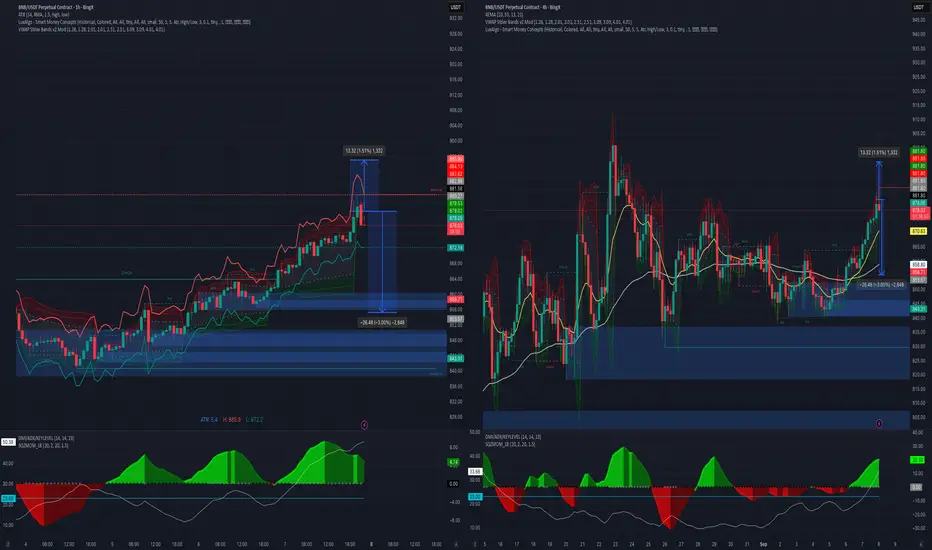
“What I will do today in BNB”Possible entry in BNB around 881.64 with stop at 895.17 and take at 855.14, 1:2 ratio.Shortby frankhzhz112
BNBUSDTI see a divergence on a daily time frame for BNB. Lower prices are expected for the upcoming weeks. Shortby eshafiee0
Bnb scalp long to $870bnb scalp long to $870 then dump Sl: 857.13 Tp: 870 Time sensitive Longby FilnftUpdated 2
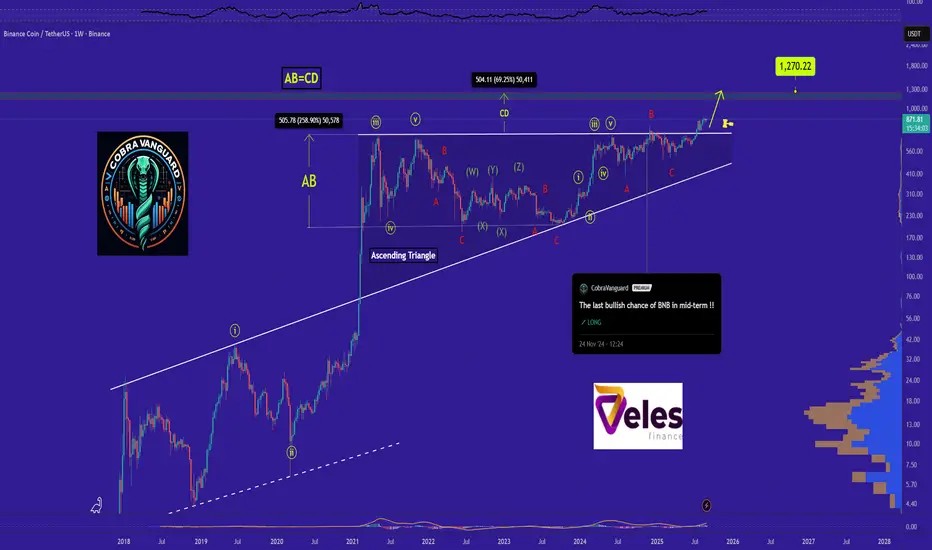
BNB is bullish now and many Traders don't see it !!As I said, BNB broke the triangle, it could surge to $1000 , and you still think I'm joking!! The price is currently supported well, which can increase the price. Stay Awesome , CobraVanguard Previous analysis Longby CobraVanguard2252
What Does a Range-Bound Market MeanThe market isn’t always driven by dynamic, trending moves. There are periods when price seems to “freeze” between levels, moving up and down but without a clear direction. This condition is called a range-bound market, or flat (sideways movement). Such phases often become a real test for traders because trend-following strategies stop working, and chaotic trades frequently lead to losses. What Is a Range-Bound Market A range-bound market is a section of the chart where price oscillates within a narrow channel, repeatedly testing support and resistance levels without a decisive breakout. In such phases, the market is essentially “resting” after a strong move, consolidating energy and preparing for the next impulse. From a market psychology perspective, flat conditions represent a balance between buyers and sellers. Some participants wait for a favorable entry point, while others lock in profits or reduce exposure. As a result, price fluctuates within a corridor until an imbalance of forces triggers a breakout. Why Flat Conditions Are Risky At first glance, sideways movement may seem safe: price isn’t crashing or soaring dramatically. But this is exactly where the danger lies for traders. - False breakouts: Price often moves beyond the range briefly, creating the illusion of a new trend, only to snap back. Traders who rushed in usually end up with losses. - Increased transaction costs: Frequent entries and exits within a range lead to numerous small trades, and commissions eat into potential profits. - Emotional burnout: A prolonged sideways market makes it hard to stay focused. Mistakes stem from fatigue and the urge to “make something happen.” That’s why many traders consider a range-bound market the worst state: it offers little directional movement but creates plenty of opportunities to overtrade and lose. How to Trade During Flat Conditions The most common mistake is trying to trade a flat market the same way as a trending one. Instead, a different playbook applies here. - Define the range boundaries: Support and resistance levels become critical. Mark them clearly and pay attention to repeated touches. - Trade from the edges: It’s usually better to enter near support (buy) or resistance (sell) rather than in the middle of the range. - Take profits quickly: Don’t expect large moves. Targets in range trading are much smaller than in trending conditions. - Reduce trade frequency: Avoid reacting to every small price swing. Wait for confirmations at levels and act selectively. - Watch the volume: Breakouts are often accompanied by a volume spike. That can be the first signal of a directional move ahead. When to Expect a Breakout Every range eventually ends. The question is when and in which direction. To avoid guessing, look for signs of preparation: - Price starts compressing within the range, forming a triangle pattern. - Trading volume decreases, followed by a sudden surge. - Support or resistance levels get tested more frequently. A breakout confirmed by price consolidation above resistance or below support usually marks the start of a new trend. These moments often create the best entry opportunities. Why a Systematic Approach Matters Most Most traders lose money in sideways markets not because they lack knowledge, but because they give in to emotions. The urge to chase every move, fear of missing “the breakout,” or frustration from inactivity turn trading into random gambling. A systematic approach changes the picture. When a trader has a clear algorithm—how to spot ranges, which levels to mark, where to take profits, and when to wait for a breakout—the market becomes structured, not chaotic. Discipline is even more important in flat conditions than in trends, because this is where the foundation for the next strong move is laid. The Practical Value of Automation Flat phases are where automation tools are especially helpful. Algorithms that highlight levels, suggest take-profit zones, and manage risk allow traders to avoid guesswork and emotional mistakes. - For beginners, this serves as a navigation tool: they learn to recognize market structure and understand when to act and when to stay out. - For experienced traders, automation supports discipline, speeds up analysis, and reduces emotional bias. Conclusion A range-bound market isn’t the enemy of traders—it’s a natural state of the market. It may be exhausting with its unpredictability and tempting false moves, but these periods build the energy for future trends. Traders who can identify flat conditions and follow a structured system not only protect their capital but also position themselves for strong moves that always follow consolidation. The market will always test traders’ nerves. But with discipline, technical analysis, and automation, even the chaos of a sideways phase becomes a controlled process. And that’s what separates random luck from consistent results.Educationby CryptoVision113
BNB: Downward TrendOn August 24, the BNB market turned into a downward move on the 1-hour chart from the $871 level. Since then, price has steadily moved through profit-taking zones and reached a low of $832, giving a difference of nearly $40 per coin. The trade has already passed four targets and remains active, keeping potential for further continuation. The main value here lies in management. The algorithm step by step highlighted profit-taking zones and helped relieve emotional pressure. This approach allows traders to hold positions longer and capture more from the move without giving in to fear or greed. For beginners, it works like a navigator: simplifying chart reading and showing where it’s safer to take profit and where holding makes sense. The market will always be unpredictable, but when the process is structured, trading stops being a chaotic gamble and turns into a system where discipline makes the difference.Shortby CryptoVision112
BNB WEEKLY CHARTBNB WEEKLY CHART,we are still bullish for BNB until the break of the weekly demand floor ,if we dont break that weekly floor dont think of making careless sell other, NOTE all buy and sell are given in the structure for reference only #bnb #bnbusdtLong07:57by Shavyfxhub2
Bnb long to 855Just recently opened a long on bnb. Still good enough for a 1:1 to $855 area Sl: 847.42 or lower Longby FilnftUpdated 1
BNB/USDT 4H chart1. Trend • There is a clear yellow inheritance trend on the chart - the price has been moving under it for a long time. • Currently, the course is testing this line - that is, we are at which it is possible to either break up the mountain or another reflection down. ⸻ 2. Key levels • Resistance resistance: • 856 USDT (SMA - green line, short -term resistance). • 865 USDT (last local peak, additional psychological resistance). • Support (Support): • 849 USDT (red SMA #1). • 843 USDT (horizontal support). • 835 USDT (stronger support, marked in red). ⸻ 3. Indicators • SMA - the price is between short -term (red) and medium -term (green) average walking. This is a consolidation signal. • MacD - the blue line pierces the orange from the bottom, the histogram begins to shine green → a sign of potential growth. • RSI - around 45–50 → neutral, shows neither a sale nor buying out. It indicates the possibility of both directions. ⸻ 4. Possible scenarios • bullish (upward): • If the price stands out above 856–865 USDT and persists, a possible level of 880 USDT levels. • Confirmation will be further strengthening MacD and RSI going towards 60+. • Bear (inheritance): • If the course is rejected from the trend line, the decline may go down to 843 USDT first, and in case of puncture - up to 835 USDT. • RSI Congress below 40 and MacD reversing down will confirm their weakness. ⸻ ✅ Summary: BNB is now in the decision zone - it tests the downward trend line and key resistance at 856–865 USDT. MacD suggests that bulls are trying to take the initiative, but RSI is still neutral. If the mountain is broken, the movement can be dynamic. If rejection - descent to 835 USDT very real.by cryptodailyuk1
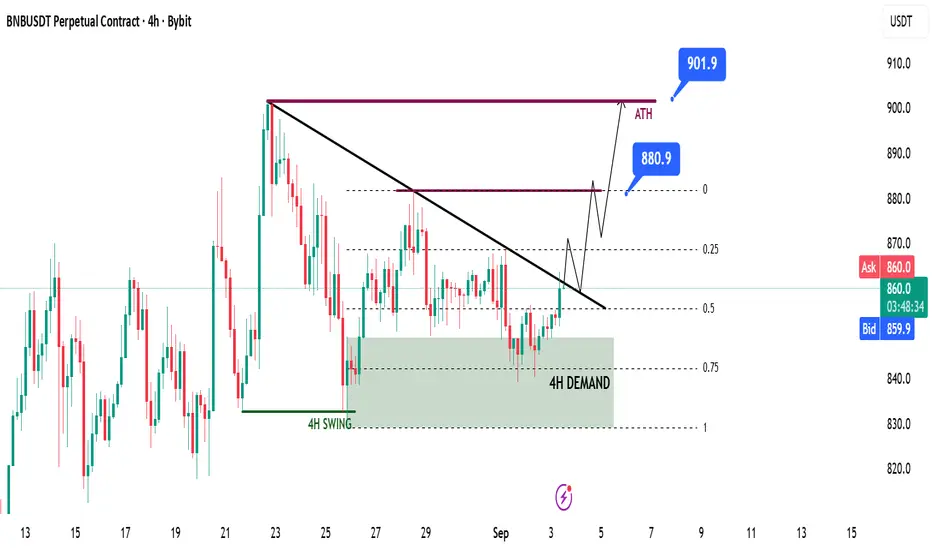
BNB Targeting All-Time Highs BNB Targeting All-Time Highs 📊 Market Sentiment Sentiment remains constructive, supported by the prospect of a 0.25% rate cut in the upcoming FOMC meeting. With the USD losing strength and global risk appetite improving, conditions continue to favor upside momentum in crypto markets. 📈 Technical Analysis BNB shows strong bullish momentum, so I’m only focused on long setups. Price swept 4H swing liquidity and closed strongly above, signaling a deviation of the liquidity pool and intent to push higher. A 4H demand zone was created after the liquidity raid, and price has already retested it while aligning with the 0.75 max discount zone both giving a strong bounce. Currently, price is moving towards the LTF bearish trendline. 📌 Game Plan I want to see a clean breakout above the bearish trendline. At least two consecutive 4H candle closes above the trendline will confirm the breakout for me. 🎯 Setup Trigger I will enter after a confirmed retest of the broken trendline. 📋 Trade Management Stoploss: Two consecutive 4H closes below the broken trendline Targets: • TP1: $880 • TP2: $901 (All-Time Highs) 💬 Like, follow, and comment if you find this setup valuable! ⚠️ Disclaimer: This content is for informational and educational purposes only and does not constitute financial, investment, or trading advice. Always do your own research before making any financial decisions.Longby UA_CAPITALUpdated 3
BNB weeklyBNB is in an uptrend on the weekly timeframe and has broken above the key $700 resistance. However, a bearish divergence on the MACD signals a potential correction. Key support: $700 – Next resistance: $1,100. Overall trend remains bullish, but a pullback may occur before further upside.by amir90
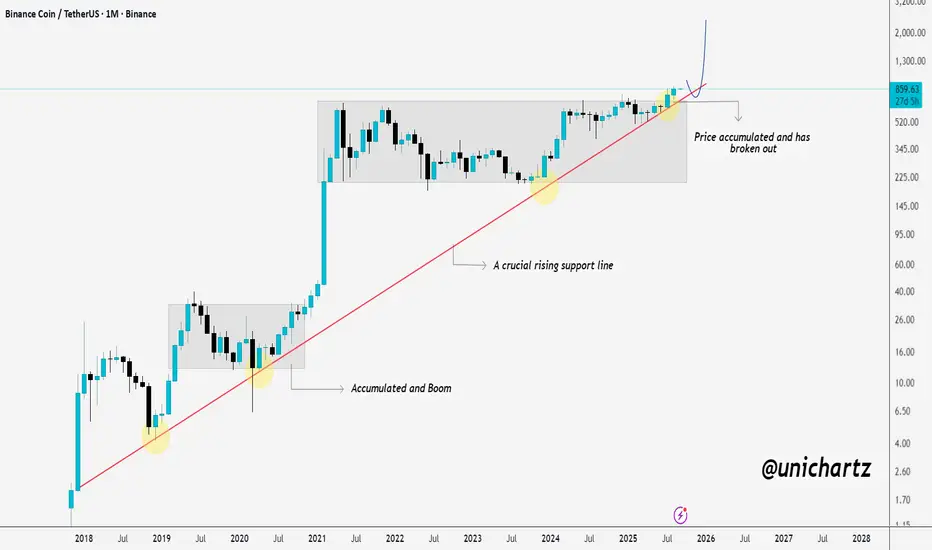
$BNB could move 80% from here - the key levels to watch BNB/USDT Monthly Analysis CRYPTOCAP:BNB has been respecting a strong rising support line since 2018, showing consistent strength over the long term. Each time BNB consolidated near this trendline, it accumulated and then rallied hard, marking key breakout points in previous cycles. Right now, price has accumulated again and broken out, signaling a potential continuation to the upside. If momentum sustains, the next targets could push toward $1,200–$1,500 and beyond in the coming months. The rising trendline remains a crucial support, holding above it keeps the macro bullish structure intact. DYOR, NFA Thanks for checking this out.Longby unichartz5
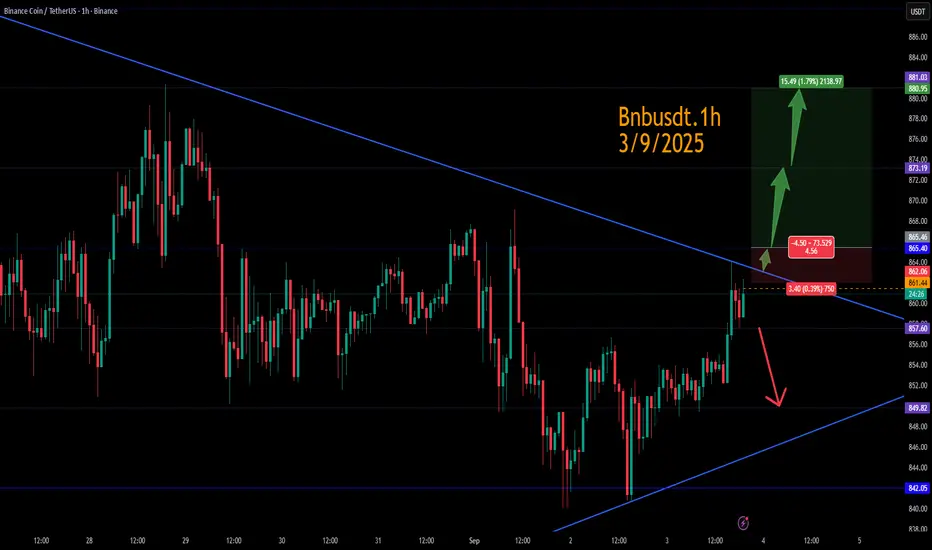
bnbusdt.1hAnalysis of the bnbusdt pair on the hourly timeframe. The analysis is based on trend analysis, support and resistance levels, and price action. The strongest scenario is an upward trend, provided the trend is correctly broken.Longby wmforex0
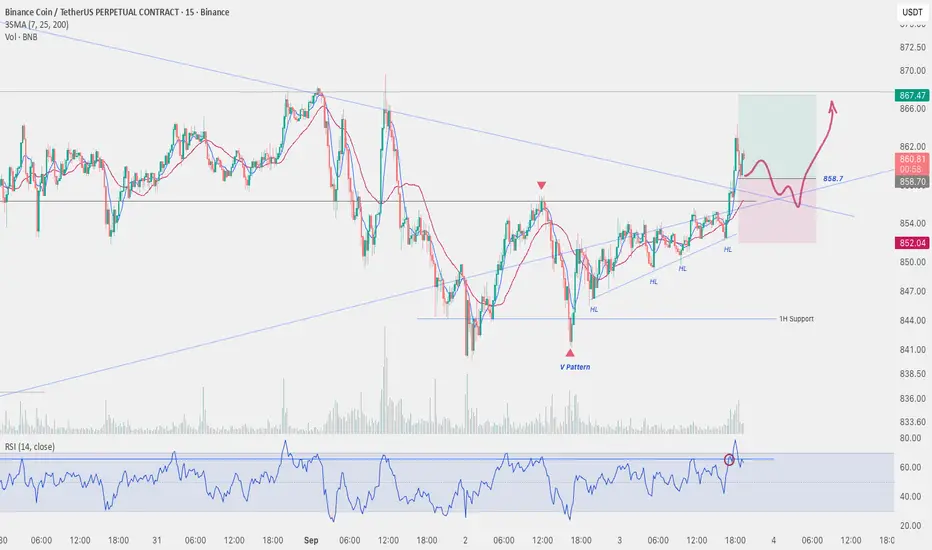
Sep 3, 2025 - BNBUSDT Long Position ReviewFor my last position today, I opened a long trade on BNB . After the price touched and reacted to the daily ascending trendline, I set my entry trigger above the first 1H resistance at 856 . Similar to other coins, the V-pattern that formed before the breakout gave me additional confidence in the bullish move. Once the strong 1H candle closed above resistance, I placed a buy stop order above its wick at 858.7 for extra confirmation, which eventually triggered my entry. I must admit, this trade was a bit emotional — it would have been better to wait for a confirmed medium wave cycle bullish structure before entering. On top of that, the BNB/BTC chart doesn’t look very bullish, which suggests I might have found a better setup on other coins. The main reason I rushed was the opportunity to use relatively high leverage on this setup. 📌 Stop-Loss Strategy The main strength of this trade is the well-positioned stop-loss. Even if price decides to retest the broken descending trendline with a pullback, my stop would not be triggered prematurely. ⚠️ Overall, this is a risky position that is currently open. If I notice weakening bullish signals, I’ll likely exit early. BNBUSDT Highwave-Cycle on 4H Timeframe: BNB/BTC Chart: Longby Utopia-20252
Bnb pump to $861 tonight Just recently opened a scalp long on bnb. Called it in the chat Still good enough for 1-2RR from current entry Sl: 847.43 Tp: 861 Potential early close at $857.08Longby Filnft2
BNBAnyway, whether sooner or later, the price will eventually break out of this box, and this is while gold has surpassed an astonishing price, and Bitcoin and Ethereum have also experienced even higher prices. Logically, we should expect better prices for altcoins. As for the price of Binance Coin, it depends on the market conditions, but if I had to give a figure, my estimate would be something close to $2000.by Mehdi_Rasouli94222
Short term Trade Sell BNB at 848$ Sell BNB. BNB (Binance Coin) will plunge to $ 825 from it's current price of 848 $. You can book profit as per your desire.Shortby JayKoober1
Binance Coin (BNB): Looking For 100EMA Breakout | Bullish CMEBNB is consolidating under the 100EMA, and for now, we keep waiting for a proper breakout above that level. If buyers manage to push through, we’ll have a clean entry setup that could lead us to fill the bullish CME gap higher up. Until that happens, patience is key — the 100EMA remains the line to watch. Swallow AcademyLongby SwallowAcademy5
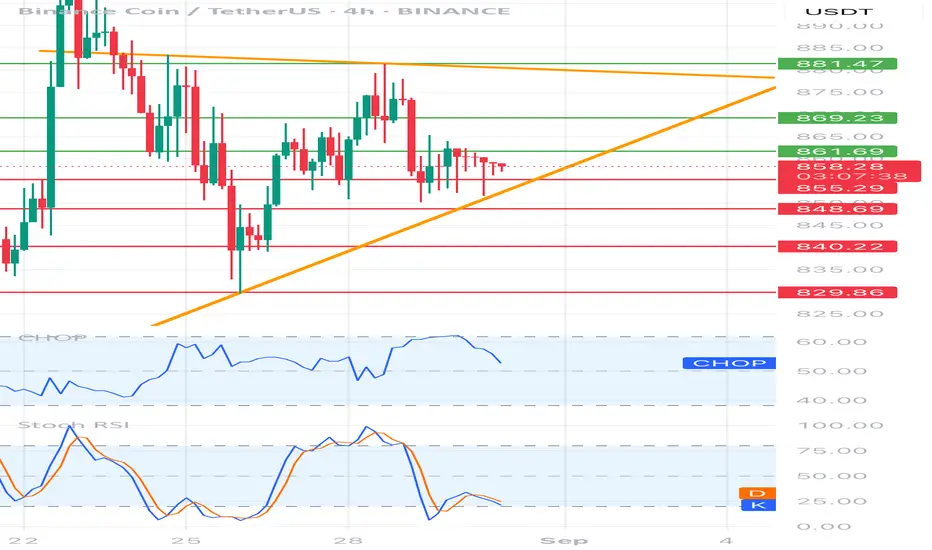
BNBUSDT 4H Chart 1. Price structure • Current price: ~ 858 USDT • The price moves in the clinic in a lowering (yellow lines). Upper inheritance trend (~ 881) + lower growth line (~ 848). • We see consolidation - the market is "squeezed" between supports and resistance. 2. Horizers of support and resistance • Support: • 855 (local, this is where the price stopped) • 848 (Important - lower wedge + demand level) • 840 and 829 (key with a larger decline). • resistance: • 861 (first test, short -term) • 869 (stronger resistance, earlier reflections) • 881 (upper wedge line, strategic resistance). 3. Oscillators • RSI (Chop) - around 50, i.e. neutral → no clear advantage of bulls/bears. • STOCHASTIC RSI - is located at the bottom of the zone (approx. 20-25), which suggests the possibility of reflecting up (bull signal, but only after the candle confirmation). 4. Scenarios Bullish (reflection up): • If the price persists over 855–848 → possible reflection to 861 and 869. • Breaking above 869 → opens the road to 881 (Test of the upper line of Klina). • Only closure of the 4h candle above 881 → a signal of a kick from the wedge and a stronger upward movement. Bearish (continuation of the inheritance): • If the price drops below 848 and closes the candle at this level → strong inheritance signal, tarpapers: 840 and 829. • 829 is key support - its bursting down can deepen the declines. ⸻ 📊 Summary BNB is now in the Departing Clinic, in the uncertainty zone: • Maintenance 848–855 = chance of reflection. • Punction down 848 = signal to a stronger decrease. • Only breaking above 881 = signal of stronger growth movement.by cryptodailyuk2
BNB is showing DiverganceBNB is showing a divergance between the bullish price and the bearish stochastic oscillator. in addition the volume is falling. I wish best of luck to you MarketsTitanShort00:50by MartketsTitan2
Possible SHORT on BNBUSDTSo, BNBUSDT just broke out of a minor Bullish Counter Trendline, so now we expect a SELL.Shortby PWiNZ210
bnb pump back to $873.41855.7 sl for bybit 856.41 sl for mexc Tp1:868 tp 2: $873.41 Market likely to push back up tonight based on my analysis. Bulls are taking back controlLongby Filnft4
BNB - LONG SET-UPBINANCE:BNBUSDT bnb Looking good to long between 770 -- 790 SL Below 740 (Accordingly) Lev & Margin as per your risk capacity Longby UnculturedTrade0074