How I Use SMA Angle + Pullbacks for High-Probability EntriesIn today’s video I reveal a powerful strategy using my SMA Angle Alert Indicator combined with precision pullback entries.
This setup helps filter fake breakouts, avoid chop, and only take trades when momentum AND price structure align.
👉 SMA Angle + Pullback Entry Indicator
www.tradingview.com
➡️ Core Concept:
Use the SMA Angle to confirm trend direction + strength, then wait for a pullback into value before entering.
This creates high-probability continuation trades that work beautifully on MES, ES, NQ, MGC, and Forex pairs.
📌 What You’ll Learn in This Video
How the SMA Angle detects trend strength
The exact pullback entry trigger I use
How to avoid chop and false breakouts
How to time entries with precision (no guessing)
My personal tips for SL/TP placement
Live chart examples
How to add alerts for automated entries
💡 Why This Works
Most traders enter too late.
This strategy forces you to:
✔ Identify strong trend
✔ Wait for a clean pullback
✔ Enter when momentum returns
✔ Avoid over-trading
✔ Catch the meat of the move—not the noise
This video is for educational purposes only and is not financial advice. Trading futures, Forex, and derivatives involves substantial risk and may not be suitable for all investors. Always trade with money you can afford to lose. Past performance is not indicative of future results. You are responsible for your own trading decisions.
S&P 500 E-mini Futures
No trades
Market insights
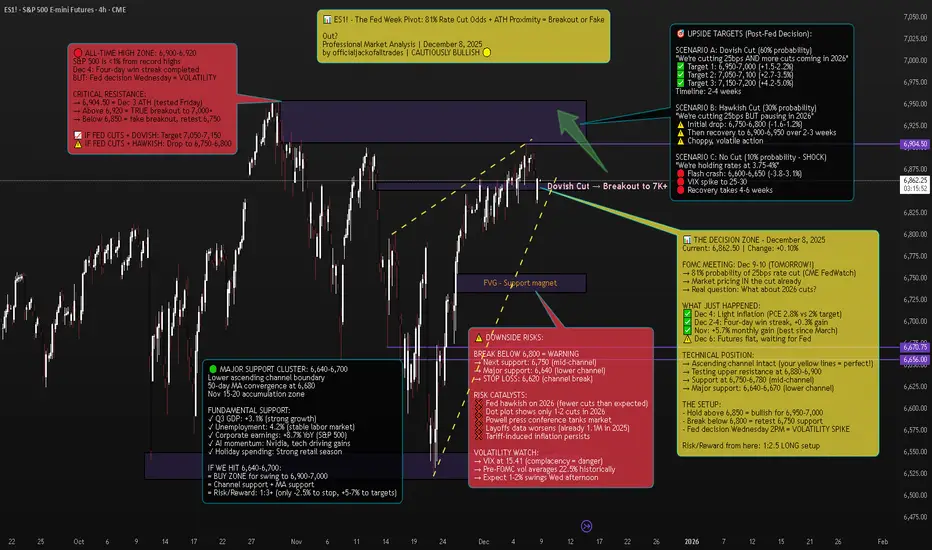
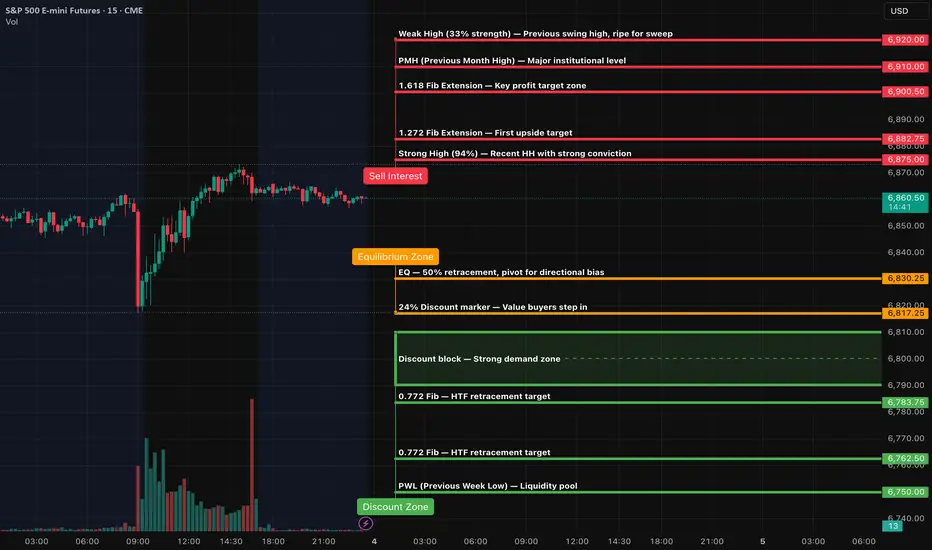
ES1! S&P 500 E-mini Futures - The Fed Week Pivot📈 Executive Summary - The Setup
Current Price: 6,862.50 | Date: December 8, 2025 | Change: +6.75 (+0.10%)
The S&P 500 E-mini futures are sitting less than 1% from all-time highs on the eve of the Federal Reserve's most anticipated meeting of 2025. After a four-day win streak that added 0.3% to the index, markets are now in a classic consolidation pattern at resistance, waiting for Wednesday's 2PM ET catalyst.
The Technical Picture:
Pattern: Ascending channel (intact since November)
Current Position: Testing upper resistance at 6,880-6,900
ATH: 6,904.50 (December 3) - 0.6% away
Support: 6,750-6,780 (mid-channel), 6,640-6,670 (lower channel)
The Fundamental Backdrop:
FedWatch shows a near-90% probability the FOMC will cut the target range for the federal funds rate by another 25 basis points. But here's what markets are REALLY pricing: not just the cut itself (that's a given), but Powell's guidance on 2026.
Minutes from the October meeting showed "many" FOMC members saying no more cuts are needed at least in 2025. Yet the market now indicates an 80% likelihood of a December rate cut, following dovish statements from NY Fed President John Williams and Fed Governor Christopher Waller.
The Trade: This is a tactical long from 6,850-6,870 targeting 6,950-7,050, with stop at 6,820. Risk/reward: 1:2.5.
But the real opportunity? Buying any Fed-induced dip to 6,750-6,800 for a swing to 7,000+.
🔎 Market Context - What's REALLY Happening
The Pre-Fed Calm
US stock futures stall as traders wait for the Fed meeting, with the S&P 500 just below record highs. This is textbook behavior: The indexes have quietly stitched together consistent gains. The Dow and Nasdaq scored back-to-back positive weeks; the S&P 500 added another 0.3% and now sits only a touch from record territory.
S&P 500 futures (ES) traded around 6,880-6,885, roughly 0.1% higher by 6:00-7:30 a.m. ET on Monday.
But don't mistake the calm for weakness. Even after November's wobble, dip-buyers came back as shutdown fears faded and AI jitters cooled.
The Fed's Dilemma
The Federal Reserve is in an impossible position:
Argument FOR cutting:
Concerns about a softening labor market
Employers cut more than 1.1 million jobs through November, the most since 2020 and a 54% increase from the same period a year ago
Job growth remains too low to keep up with labor supply growth and a rising unemployment rate
Argument AGAINST cutting:
Latest inflation scorecard, the Fed's preferred PCE index, is running at 2.8 percent a year, close to its 2 percent goal but not quite there
The annualized inflation rate grew to 3% in September from 2.9% in August and 2.7% in July
Officials expressing skepticism about the need for an additional cut that markets had been widely anticipating, with "many" saying that no more cuts are needed at least in 2025
The Missing Data Problem:
Here's something CRITICAL that most traders don't know: The U.S. central bank will have to make its decision without some key government data. Hiring data for November and the latest inflation number have been delayed until mid-December, after the Fed's meeting, because of the U.S. government shutdown.
The meeting minutes indicated the decision-making was complicated by a lack of government data during the 44-day federal government shutdown. Powell himself compared this to "driving in the fog".
Translation: The Fed is making a $28 TRILLION (SPY market cap) decision BLIND.
The Internal FOMC War
"It's difficult to recall a time when the Federal Open Market Committee has been so evenly divided about the need for additional rate cuts than the upcoming December meeting," Michael Pearce, chief U.S. economist at Oxford Economics, said.
Jerome Powell faces a credibility issue as he tries to satisfy hawks and doves on the most divided Fed in recent memory.
The October meeting vote was 10-2, but the 10-2 vote was not indicative of how split officials were at an institution not generally known for dissent. The minutes revealed multiple camps:
Some favored cutting
Some supported cutting but could have supported holding
Several were against cutting
For December, Mericle expects at least two dissents in favor of no rate cut as well as one in favor of a larger rate cut.
📊 Technical Analysis - The Ascending Channel At Decision Point
The Pattern: Ascending Channel (Bullish Structure)
Your chart annotation is PERFECT. The yellow dashed ascending channel captures the exact structure driving ES1! since the November bottom.
Channel Characteristics:
Lower Support: 6,640 (tested Nov 15, Nov 29) → 6,670 (current)
Upper Resistance: 6,850 (Nov 25) → 6,900 (Dec 3-6) → 6,920 (projected)
Angle: ~25° (strong bull trend)
Tests: 6 touches (3 upper, 3 lower) = highly reliable pattern
Current Position: We're at the UPPER boundary of the channel, testing 6,880-6,900 resistance.
Key Technical Levels:
🔴 RESISTANCE (Selling pressure zones):
6,880-6,900: Current test, upper channel boundary
6,904.50: All-time high from December 3
6,920-6,950: True breakout zone (if we clear ATH)
7,000: Psychological milestone
🟢 SUPPORT (Buying interest zones):
6,850: Immediate support, bull/bear line
6,800-6,820: Minor support cluster + FVG
6,750-6,780: Mid-channel support + 23.6% Fib
6,700-6,720: 38.2% Fib retracement
6,640-6,670: Major support (lower channel + 50-day MA + November accumulation)
Technical Indicators:
Moving Averages:
50-day MA: ~6,680 (rising, bullish)
200-day MA: ~6,450 (rising, bullish)
Golden Cross: Active since mid-November = long-term bullish
RSI (Relative Strength Index):
Current: 58-60 (neutral/slightly bullish)
Not overbought (room to run to 70+)
Not oversold (not panic selling)
Interpretation: Healthy consolidation before next leg
Volume Analysis:
Declining volume into Fed decision = normal pre-FOMC behavior
Stock volatility averages around 22.5% in the month preceding rate cuts, compared with roughly 15% during normal periods
Expect volume spike Wednesday 2PM-4PM (100K+ contracts)
VIX (Fear Index):
VIX at 15.41, down -0.37 (-2.34%)
This is LOW = market complacency
Pre-FOMC, VIX typically rises to 18-22
IF VIX spikes to 20+ Wednesday = sell signal
🎯 Scenario Analysis - Three Possible Outcomes
SCENARIO A: Dovish Cut (60% Probability) - BULLISH
What Happens:
Fed cuts 25bps to 3.50-3.75% range ✓
Dot plot shows 3-4 more cuts in 2026 ✓
Powell says "labor market concerns outweigh inflation" ✓
Balance sheet runoff stops as planned (December 1) ✓
Market Reaction:
Immediate: ES pumps 1-1.5% to 6,930-6,950
Day 1-3: Consolidation at 6,920-6,950
Week 1-2: Breakout to 7,050-7,100
Month 1: Target 7,150-7,200 (+4.2%)
Sector Leaders:
Small caps (Russell 2000) +2-3%
Tech (Nasdaq) +1.5-2%
Financials +1-1.5%
Trade Setup:
Enter: ANY dip to 6,850-6,870 before Fed
Add: On breakout above 6,910 with volume
Target: 7,050 (+2.7%), 7,150 (+4.2%)
Stop: 6,820 (-0.6%)
Risk/Reward: 1:4
SCENARIO B: Hawkish Cut (30% Probability) - NEUTRAL/CHOPPY
What Happens:
Fed cuts 25bps to 3.50-3.75% range ✓
BUT dot plot shows only 1-2 cuts in 2026 ❌
Powell says "we're near neutral, will pause to assess" ❌
Market had priced in 3-4 cuts for 2026 = DISAPPOINTMENT
Market Reaction:
Immediate: ES drops 0.8-1.2% to 6,790-6,820
Day 1: Volatility, chop between 6,780-6,850
Week 1-2: Dip-buying brings it back to 6,870-6,900
Month 1: Grind back to 6,950-7,000 (+1.3%)
Sector Rotation:
Small caps (Russell 2000) -1.5-2%
Tech holds up better (mega-caps)
Defensives (utilities, staples) outperform
Trade Setup:
DO NOT chase before Fed (risk of -1.2% drop)
Buy: Dip to 6,750-6,800 (mid-channel support)
Target: 6,900-6,950 (+2-3% from dip entry)
Stop: 6,720 (-1%)
Risk/Reward: 1:2
SCENARIO C: No Cut OR Very Hawkish (10% Probability) - BEARISH
What Happens:
Fed HOLDS at 3.75-4% range (SHOCK) ❌
OR cuts but says "this is the last one for 6+ months" ❌
Powell cites inflation persistence, tariff risks ❌
Market has 90% priced in for cut = PANIC
Market Reaction:
Immediate: ES flash crashes 2-3% to 6,650-6,750
Day 1: Volatility, VIX spikes to 25-30
Week 1-2: Bounce attempt to 6,750-6,800 fails
Month 1: Retest 6,600, then recovery to 6,800-6,850
Sector Carnage:
Small caps (Russell 2000) -3-4%
Tech -2-3%
Everything bleeds
Trade Setup:
Exit ALL longs immediately on no-cut announcement
Wait for VIX to spike above 25
Buy: Capitulation at 6,600-6,650 (lower channel)
Target: Recovery to 6,850-6,900 (+3-4%)
Risk/Reward: 1:3 (but high stress)
🎯 THE TRADE SETUP - Professional Execution Plan
🟢 PRIMARY LONG SETUP: BUY ES1!
Entry Strategy (Scale In):
Option A: Conservative (Wait for Fed)
50% at 6,750-6,780 (IF hawkish cut dips)
50% at 6,720-6,750 (IF deeper dip)
Best for: Risk-averse traders
Option B: Tactical (Enter Now)
40% at 6,860-6,870 (current - small position)
30% at 6,820-6,840 (IF pre-Fed dip)
30% at 6,750-6,780 (IF post-Fed dip)
Best for: Experienced traders comfortable with volatility
Stop Loss: 6,620 (HARD STOP)
Below 6,620 = channel break on daily close
Below this = technical structure invalidated
Max loss from 6,862 entry: -3.5%
Take Profit Targets:
TP1: 6,950-7,000 (Probability: 70%)
Initial breakout above ATH
Psychological 7,000 level
Action: Take 40% profit, move stop to 6,850
Gain: +1.3-2.0% | Risk/Reward: 1:2
TP2: 7,050-7,100 (Probability: 50%)
Momentum continuation
Channel projection
Action: Take 30% profit, trail stop to 6,920
Gain: +2.7-3.5% | Risk/Reward: 1:3
TP3: 7,150-7,200 (Probability: 30%)
Full breakout extension
TradingView puts it, with a potential breakout in S&P 500 futures above the 6,900 area
Action: Take 20% profit, let 10% ride
Gain: +4.2-4.9% | Risk/Reward: 1:4
Entry Confirmation Checklist:
Before entering, CHECK:
✅ Price holding above 6,850 (bull/bear line)
✅ Volume spike on bounce (80K+ contracts on 15min)
✅ RSI crosses above 60 (momentum shift)
✅ VIX drops below 16 (fear subsiding)
✅ Fed announces 25bps cut (as expected)
✅ Powell's tone is dovish or neutral (not hawkish)
WAIT FOR 4/6 BEFORE FULL POSITION
Fed Day Volatility Protocol:
December 10, 2PM ET - Fed Announcement:
1:45 PM: Tighten stops to 6,830 (before announcement)
2:00 PM: Fed statement released - READ IMMEDIATELY
2:00-2:05 PM: Algorithmic reaction (ignore, volatile)
2:05-2:30 PM: Human digestion of statement
2:30 PM: Powell press conference begins - WATCH LIVE
2:30-3:15 PM: Powell Q&A determines direction
3:15-4:00 PM: Final positioning for overnight
IF DOVISH: Add to position on dip to 6,900
IF HAWKISH: Cut 50%, trail rest tight at 6,820
Weekly Monitoring:
Check EVERY DAY:
Fed speakers: Any 2026 guidance changes
Economic data: Jobs (Dec 16), CPI (Dec 18)
Technical levels: Is channel intact?
VIX: Spikes above 20 = warning
Volume: Declining = weak trend
Emergency Exit Conditions:
❌ Daily close below 6,620 = EXIT ALL (channel break)
❌ VIX spikes above 25 = EXIT 50%, tight stop on rest
❌ Fed announces NO cut (10% scenario) = EXIT ALL immediately
❌ Powell says "this is the last cut for 2026" = EXIT 50%
❌ ES gaps down >1.5% overnight = reassess, likely exit
📊 Fundamental Analysis - Why This Matters
CATALYST #1: The Fed's Impossible Position
Federal Reserve policymakers are expected to cut interest rates at this week's meeting despite inflation remaining above their target amid concerns about a softening labor market.
This is the classic Fed dual mandate dilemma:
Mandate #1: Maximum employment (FAILING - 1.1M layoffs in 2025)
Mandate #2: Stable prices (FAILING - inflation at 2.8% vs 2% target)
They can't fix both. So they have to choose.
David Mericle, chief U.S. economist at Goldman Sachs notes job growth remains too low to keep up with labor supply growth and a rising unemployment rate.
My take: The Fed will prioritize employment over inflation. That's dovish = bullish for stocks.
CATALYST #2: Corporate Earnings Remain Strong
Despite all the macro noise, corporate profits are SOLID:
S&P 500 earnings: +8.7% YoY
Tech sector leading: +12-15% earnings growth
AI spending driving margins higher
Q4 guidance mostly positive
Carvana (CVNA) stock rose 8% before the bell on Monday following news on Friday that it will join the S&P 500 as part of the index's quarterly rebalancing.
Translation: Fundamentals support higher prices, Fed just needs to cooperate.
CATALYST #3: Seasonal Tailwinds
Could spark a "year-end melt-up", as TradingView puts it, with a potential breakout in S&P 500 futures above the 6,900 area.
December-January has positive seasonality:
Holiday spending strong
Tax-loss selling done (Nov-early Dec)
January effect (fresh capital inflows)
Pension/401k rebalancing (buy equities)
Historically, S&P 500 averages +1.3% in December and +1.1% in January.
CATALYST #4: Institutional Positioning
Bloomberg's interviews with 39 investment managers show that most are still planning for a risk-on 2026, citing expectations of continued AI-driven productivity and earnings growth.
But here's the key: Asset managers such as EFG Asset Management and BNP Paribas Asset Management caution that with 2025 already a strong year, they are reluctant to increase equity exposure into thin year-end liquidity, preferring instead to wait for better entry points in early 2026.
Translation: Institutions are WAITING to buy. Any Fed-induced dip to 6,750-6,800 will be AGGRESSIVELY bought.
⚠️ Risk Factors - The Bear Case
RISK #1: Hawkish Powell Tanks Market
Feroli noted that the firm is anticipating at least two dissents in favor of no rate cut as well as one in favor of a larger rate cut.
If Powell leans hawkish to appease the dissenting hawks, market could drop 1-2%.
RISK #2: Tariff-Induced Inflation
Minutes mentioned Trump's tariff policies in forecasts they provided in early September, projecting higher inflation and unemployment, slower growth and a lower federal funds ratel.
If inflation accelerates in 2026 due to tariffs, Fed might have to HIKE again = very bearish.
RISK #3: Labor Market Deterioration
Employers cut more than 1.1 million jobs through November, the most since 2020 and a 54% increase from the same period a year ago.
If this accelerates, could trigger recession fears.
RISK #4: Technical Breakdown
Break below 6,620 = channel invalidated → target 6,500-6,550 (-4.5-5.2%)
🔥 The Bottom Line
Here's what I KNOW on December 8, 2025:
✅ 81% probability of 25bps cut Wednesday
✅ S&P 500 less than 1% from ATH
✅ Your ascending channel is PERFECT technical structure
✅ 39 investment managers planning risk-on 2026
✅ Corporate earnings strong (+8.7% YoY)
✅ Seasonal tailwinds (December +1.3% avg)
✅ Support at 6,750-6,800 = institutional buy zone
Here's what I DON'T know:
Will Powell be dovish or hawkish?
How many 2026 cuts will dot plot show?
Will Q&A reveal recession concerns?
But here's what the MATH says:
Risk: 6,862 → 6,620 = -3.5% (if channel breaks)
Reward: 6,862 → 7,050 = +2.7% (base case)
Extended: 6,862 → 7,150 = +4.2% (bull case)
Risk/Reward: 1:2.5 minimum
The Play:
Small position NOW at 6,860-6,870 (20-30% of intended size)
IF hawkish dip to 6,750-6,800 → ADD 50-70%
IF dovish → ADD on breakout above 6,910
Stop at 6,620 (non-negotiable)
Target 7,050, then 7,150
This is a PROBABILITY game. 60% dovish, 30% hawkish, 10% shock. Position accordingly.
📍 Follow officialjackofalltrades for institutional-grade technical analysis, professional risk management, and trades backed by data.
Drop a 📊 if you're trading the Fed decision.
Drop a 🎯 if this helped your ES1! analysis.
Drop a 💰 if you're ready for 7,000+ SPX.
US500 - 30MIN profile nuance and Cluster overlay viewUS500 - 30MIN profile nuance and Cluster overlay view.
Monitor if the value continue to build side ways inside last few days, note the highlighted data and markup prior to this level.
Leading upto FOMC - side ways balance vs flush down into clear the long inventory ?
ES UpdateWas kinda hoping both RSI and MFI hit oversold, but it might be just MFI that hits it tomorrow. RTY MFI is already oversold. NQ looks the same as ES.
In any case Fed rate cut on Wed. WHat Powell says will either pump or tank the market. Keep in mind rate cut is already priced in, so it's all about January....
why i quit forex for futures (and why you probably should too)i traded forex for about 3 years before switching to futures, and honestly i feel like an idiot for waiting so long.
CME_MINI:NQ1!
i see a lot of new guys asking "what's the difference?" so i wanted to break it down simply.
the big lie about forex is that when you trade "forex" on most retail brokers, you aren't trading the actual market. you are trading a cfd. basically, your broker is the casino. because there is no centralized exchange, the price on one broker might be different than the price on another. this means "hidden" spreads and weird slippage are rampant. you are playing in a decentralized pool where the big boys have way more info than you.
futures are cleaner because they trade on a centralized exchange like the CME. everyone sees the exact same price. everyone sees the exact same volume. there is no "broker A vs broker B" price difference.
the cost difference is huge too.
in forex, the "spread" is how the broker gets paid. it fluctuates. during news, it widens and stops you out. in futures, the spread is usually 1 or 2 tick. commissions are fixed and usually way cheaper if you are trading any decent size.
the data quality is the biggest one for me. in futures, you can see real volume data (order flow). in spot forex, "volume" is just tick volume (how many times price changed), not actual money changing hands.
it's useless for real analysis. anyway, not financial advice, just my 2 cents. if you are struggling with "stop hunts" in forex, try switching to futures. it felt like taking off training wheels for me.
anyone else make the switch recently?
CME_MINI:ES1!
WEEKLY WARMAP: DOLLAR MARKETThe week begins with a balanced dollar, firm U.S. yields, and suppressed volatility.
DXY remains inside its 97.672–99.985 range, reflecting equilibrium rather than trend.
No directional signal is valid until structure breaks.
Short-end yields moved ~2.8% higher last week and extended another ~0.76% into Monday’s session.
The 10-year yield advanced ~2.88% last week with further upside today.
The curve is repricing risk while volatility remains suppressed following a ~16.6% decline.
This week’s macro catalysts:
FOMC decision + Powell press conference
JOLTS labor demand data
PPI
Weekly jobless claims
Federal budget and projections
All influence: credibility, yield expectations, liquidity conditions.
Cross-asset behavior remains neutral.
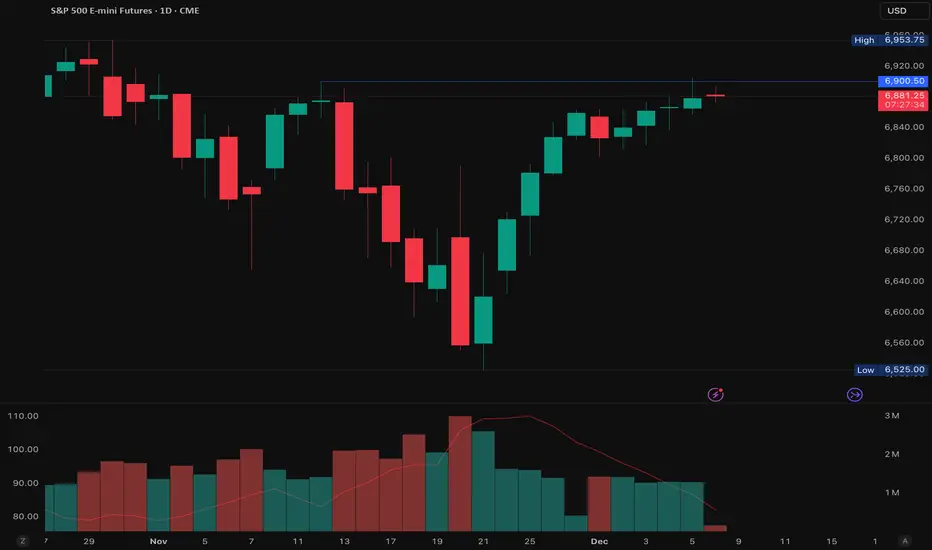
ES stays inside its 6540.25–6953.75 bracket — strong order flow but extended location near the monthly upper boundary and roughly +2 deviations above the mean.
Gold remains inside its 3996.2–4380.7 weekly range.
Key DXY levels:
98.175 — downside liquidity
98.917 — upside structural trigger
Inside this band = non-directional behavior.
Outside = actionable change.
The overall environment reflects structural tension, not directional conviction.
TECHNICAL CONTEXT (CORE5 STRUCTURE)
DXY trades only 0.11% from monthly balance, creating conditions for algorithmic defense at key price boundaries.
The current question:
rotation or continuation?
Price remains inside its daily range (97.672–99.985).
Structure is balanced, but location matters:
DXY sits within the dynamic discount zone on the DGM model
This typically supports accumulation
But there is a bullish volume cap beneath price — an unfinished orderflow pocket resembling a bookkeeping discrepancy
This imbalance often requires a downward corrective spike before any sustained upward movement.
If bearish flow develops:
Liquidity sits cleanly below 98.175 and may be targeted before stabilization.
If bullish flow emerges:
A daily close above 98.917 is required to confirm shift.
Anything below this level is intra-range noise.
Current read:
Structure: balanced
Geometry: supportive zone
Volume: incomplete
Order flow: neutral, awaiting data
Execution: conditional environment, not trend environment
This week’s direction depends on how DXY responds to the incoming data sequence.
WEEKLY TAKEAWAY
Two levels govern the week:
98.175 → downside liquidity
98.917 → upside structural trigger
Inside the band: neutral.
Outside the band: decisive.
— CORE5DAN
Institutional Logic. Modern Technology. Real Freedom.
Global IPO Trends and SME Listings1. Evolution of Global IPO Markets
Historically, IPO markets have experienced cyclical trends influenced by macroeconomic conditions, investor confidence, interest rates, and geopolitical developments. In periods of economic expansion, companies are more likely to go public to leverage favorable valuations, while in downturns, IPO activity often slows. For example, the 1990s witnessed a surge in technology IPOs during the dot-com boom, whereas the global financial crisis of 2008 led to a significant contraction in IPO activity.
In the last decade, the IPO landscape has been shaped by several key factors:
Technology and innovation-driven IPOs: Tech giants such as Facebook, Alibaba, and Spotify have demonstrated that high-growth companies can attract massive investor interest, even without immediate profitability. Tech IPOs continue to dominate global IPO volumes.
Emerging markets participation: Countries like China, India, and Brazil have increasingly contributed to global IPO activity. China, for instance, has leveraged domestic exchanges such as Shanghai and Shenzhen to attract high-growth tech and manufacturing firms.
Special Purpose Acquisition Companies (SPACs): Particularly in the United States, SPACs emerged as an alternative to traditional IPOs, offering a faster route to public markets. SPACs peaked in popularity around 2020-2021, though the market has since matured and stabilized.
Sectoral shifts: Traditional sectors such as banking, infrastructure, and consumer goods continue to pursue IPOs, but newer sectors like clean energy, fintech, e-commerce, and biotech have increasingly dominated listings due to investor enthusiasm for innovation and sustainability.
2. Regional Trends in IPO Markets
Different regions have exhibited distinct IPO trends influenced by regulatory environments, capital availability, and investor appetite:
North America: The U.S. IPO market remains the largest globally, supported by deep capital markets, sophisticated investor base, and robust regulatory frameworks. IPOs here tend to attract large valuations and often set benchmarks for global investor sentiment.
Europe: European IPO activity has historically been slower, influenced by more stringent regulations, fragmented markets, and less aggressive investor risk appetite. However, London, Frankfurt, and Amsterdam continue to host significant listings, particularly in fintech and renewable energy.
Asia-Pacific: Emerging economies in Asia have experienced rapid IPO growth. China’s domestic exchanges have become major IPO hubs, while India has seen a surge in both mainboard and SME IPOs. Regulatory reforms, ease of listing, and government support have been critical in this growth.
Middle East and Africa: IPO markets are smaller but growing, with governments increasingly encouraging privatization and public listings as a source of funding. The UAE, Saudi Arabia, and Nigeria are key markets in this region.
3. Drivers of IPO Activity
Several factors drive IPO activity globally:
Capital Requirements: Companies use IPOs to raise funds for expansion, debt repayment, acquisitions, or R&D investments.
Market Valuations: Bull markets with high investor confidence encourage companies to go public to maximize valuations.
Regulatory Support: Simplified listing processes, tax incentives, and supportive policies can stimulate IPO activity.
Investor Appetite: Retail and institutional investors seeking high-growth opportunities influence IPO success. Trends such as ESG (Environmental, Social, and Governance) investing have also affected the types of companies going public.
4. SME Listings: Importance and Trends
Small and Medium Enterprises (SMEs) are a crucial component of global economies, contributing to employment, innovation, and regional development. SME listings refer to the practice of enabling smaller companies to raise capital on stock exchanges through dedicated platforms or mainboards with tailored regulations. Unlike traditional IPOs of large corporations, SME listings often involve lower compliance requirements, smaller funding amounts, and targeted investor bases.
Significance of SME Listings:
Access to Capital: SMEs often struggle to access large-scale institutional funding. Public listings allow them to raise equity capital for growth and expansion.
Enhanced Visibility and Credibility: Being listed provides SMEs with public recognition, which can attract customers, partners, and investors.
Governance and Transparency: Listing requirements instill higher levels of corporate governance, reporting, and transparency, which can improve operational efficiency and investor confidence.
Global SME Listing Trends:
India: India’s SME Exchange platform, such as the BSE SME and NSE EMERGE, has facilitated hundreds of SME listings, helping small companies access public markets with relatively lower listing costs. The Indian government has also encouraged SME participation through policy support.
China: China’s ChiNext and STAR Market cater to high-growth SMEs, particularly in technology and innovation sectors. These platforms have been instrumental in supporting domestic entrepreneurship.
Europe: Several European countries provide SME-specific segments on stock exchanges. For example, AIM in London is a specialized market for smaller companies seeking growth capital.
Other Regions: Emerging markets such as Brazil and Malaysia have also developed SME listing platforms to promote economic growth and entrepreneurship.
5. Challenges in Global IPOs and SME Listings
While IPOs and SME listings present opportunities, they come with significant challenges:
Market Volatility: IPOs are sensitive to macroeconomic conditions, interest rates, and geopolitical risks. Market downturns can result in delayed or underperforming IPOs.
Regulatory Compliance: High compliance costs and complex regulatory requirements can discourage SMEs from going public.
Valuation Pressure: Overvaluation or undervaluation can impact investor perception and post-listing performance.
Liquidity Constraints: SME stocks often face lower trading volumes, which can limit investor participation and affect market perception.
Investor Education: In emerging markets, lack of investor awareness about SMEs can limit participation, impacting the success of public listings.
6. Future Outlook
The global IPO and SME listing markets are poised for continued evolution. Key trends likely to shape the future include:
Digitalization of IPO Processes: Online platforms, automated regulatory filings, and virtual roadshows are making IPOs more accessible.
Sustainable and ESG-Focused Listings: Companies with clear ESG strategies are attracting premium valuations, suggesting that sustainability will play a critical role in future IPOs.
Emerging Market Growth: Countries with expanding middle classes and technology-driven growth are likely to witness increased SME listings and IPO activity.
Innovative Financing Mechanisms: Hybrid models, such as SPACs, crowdfunding, and direct listings, will continue to complement traditional IPO routes.
Cross-Border Listings: Companies may increasingly explore dual or international listings to access global capital and diversify investor bases.
7. Conclusion
Global IPO trends reflect a dynamic interplay of economic conditions, sectoral innovation, and regulatory frameworks. While large-cap IPOs dominate headlines, SME listings have emerged as an equally vital avenue for economic growth, entrepreneurship, and capital formation. The global trend indicates a growing recognition of SMEs’ importance in fostering innovation and employment, with countries developing specialized platforms to facilitate their listing. Despite challenges like volatility, compliance costs, and liquidity issues, the outlook for IPOs and SME listings remains positive, driven by technological advancements, investor enthusiasm, and supportive policy frameworks. The continued evolution of global IPO markets and SME listing platforms will play a pivotal role in shaping the economic and financial landscape of the coming decades.
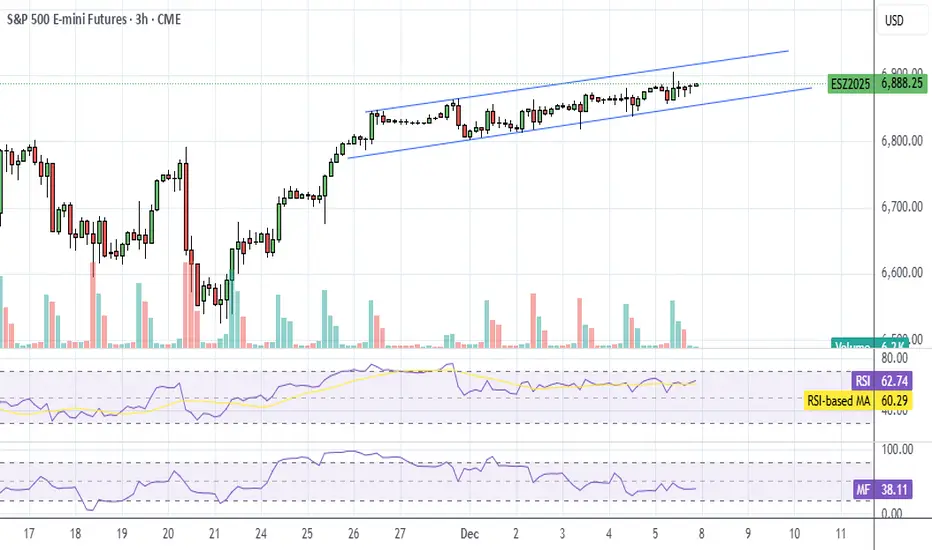
ES UpdateSeems like there is an up channel, but it's so shallow, I might just take a few days off this week. Basically a really slow melt up.
I'm only going to post an update if I see something interesting. If you have any stocks or commodities you want me to plot. let me know. Not really seeing much right now.
Maybe I'll get lucky and find a stock to play like last week.
Trading Future - 1-Minute TimeframeTrading Future - 1-Minute Timeframe CME_MINI:MES1! CME_MINI:ES1! CME_MINI:M2K1!
RSI Low (Reversal) Entry Strategy
Spot ENTRY
Trend completed - Succeed !
Entry Criteria
✔ RSI Low alert
✔ RSI crosses above MA
✔ Price crosses above SMA9
✔ Price pullback holds SMA9
✔ Optional: Price above SMA20 for stronger confirmation
Exit Criteria
❌ Price closes below SMA9
❌ Price falls below HMA-Low (secondary exit)
❌ Price hits target below HMA-High line
Indicators Setup:
1. HMA Low/High – Length 15
Entry: Price crosses above HMA-Low and stays inside the HMA channel.
Exit: Price falls below SMA 9 OR price goes below HMA-Low line (secondary exit).
2. SMA 9 (Blue)
Entry: Price pulls back to SMA9 but does not fall under it.
Exit: Price falls under SMA9.
3. SMA 20 (Red)
Confirmation trend line.
Entry Confirmation: Price crosses above SMA20.
4. SMA 70 (Teal)
Higher-timeframe trend bias.
5. RSI (14) – Low/High 30/70
Reversal signal at RSI Low.
RSI extreme lows highlight with BG color.
6. MACD Histogram (12/26/9)
Trend confirmation: Histogram cross above 0 = momentum shift upward.
Trading Steps:
1. Identify the RSI Low (Alert)
RSI prints a lowest point and background highlights in the extreme zone.
2. RSI Crosses Above Its MA (Yellow)
RSI breaks above its MA = early upward momentum.
At the same time:
Price crosses above SMA 9 (blue).
3. Entry Trigger
Wait for a price pullback to SMA9,
BUT price must not break below SMA9.
If SMA9 holds support → Enter long.
4. Stop Loss Rules
Primary Stop Loss: Price closes below SMA 9 (blue).
Secondary Stop Loss: Price dips just under HMA-Low = early trend failure.
5. Position Hold Conditions (Confirmation)
Hold the trade ONLY IF:
Price stays above SMA 9.
MACD Histogram crosses above 0
→ Trend shifts from negative to positive, confirming upward movement.
6. Ride the Trend
Let price continue inside HMA channel.
Wait for trend to complete (usually when RSI approaches 70 or MACD weakens).
7. Profit Taking (Exit Rules)
Option A: HMA-High line target
Set take-profit just below HMA-High line.
Option B: SMA9 Breakdown
Exit when price falls below SMA 9 (blue).
ES (SPX, SPY) Analysis, Key-Zone, Setups for Fri (Dec 5th)Market Overview
The daily trend remains firmly upward, with prices pressing against the November swing-high band, characterized by a sequence of higher lows and a gradual ascent toward previous peaks. Momentum indicators on both the daily and 4-hour charts are on the rise, yet they have not entered extreme levels, suggesting a likelihood of continued upward movement into the upper premium band rather than an imminent substantial reversal.
On the 4-hour and 1-hour charts, the E-mini S&P 500 (ES) has been consolidating in a narrow range, roughly between 6835 and 6880, as it builds energy just below the prior high. This range coincides with the 1.272 to 1.618 Fibonacci extension zone, located around 6895 to 6917. Given this setup, the outlook for tomorrow appears slightly bullish, provided the price remains above the mid-range support levels.
Market Brief: Key Developments for December 5, 2025
As we approach the final Federal Open Market Committee (FOMC) meeting of the year scheduled for December 9 -10, market participants are increasingly pricing in a substantial likelihood of a 25 basis point rate cut, along with further easing anticipated in the coming year.
For tomorrow, however, it’s important to note that the widely followed November employment situation report (including Non-farm Payrolls and the unemployment rate) has been officially postponed to December 16 due to the ongoing government shutdown. While some generic calendars may still reflect the original December 5 date for the payroll figures, this information has become outdated. At this time, it appears unlikely that any partial wage data will be released in lieu of the full report.
Nevertheless, many calendars are still marking U.S. hourly earnings and related labor indicators for the morning session. Expectations are set for hourly earnings, nonfarm payrolls, and unemployment rate placeholders around 8:30 AM ET, alongside the University of Michigan consumer sentiment and inflation expectations reports at 10:00 AM ET.
In practical terms, traders should expect regular liquidity levels in Asian and London markets. However, be prepared for potential volatility spikes around the 10:00 AM ET release of the U. Michigan data, especially if any unexpected headlines arise concerning the delayed labor report.
Market Outlook: Overnight Trends into New York Trading Session
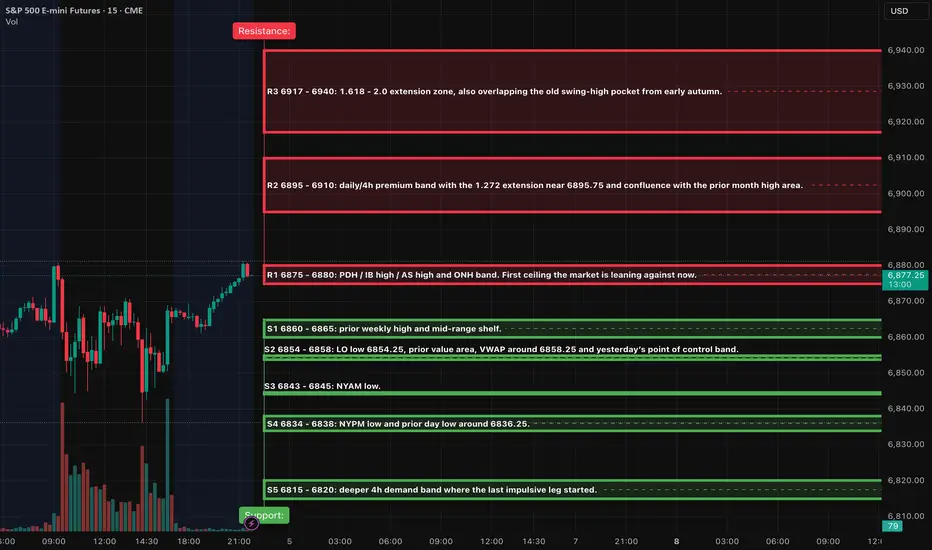
As we head into the New York trading session, the key focus remains on the E-mini S&P 500 (ES). The base case scenario suggests that as long as ES maintains support above the significant range of 6854 to 6858 - often referred to as S2 - during any dips seen in the Asian and London sessions, we can anticipate a gradual upward movement. This trajectory would likely involve repeated testing of resistance levels around 6875 to 6880 (R1). Should we witness consistent hourly closes that approach this resistance with only modest pullbacks toward 6860, the likelihood of a breakout toward the premium zone of 6895 to 6910 increases, potentially occurring before or during the New York session.
On the other hand, the alternative scenario would unfold if the market decisively breaks below S2, resulting in a series of hourly closes beneath 6854. Such a development would signal a shift in sentiment and a potential rotation toward support levels S3 and S4, which target 6835. This would likely create a mean-reversion environment, with trading in New York focused more on the lower half of the 6835 to 6880 range rather than pushing for a breakout above resistance. Investors should tread carefully as these scenarios develop.
A++ setup 1 - Long breakout continuation above 6875
Bias: continuation long, only if we see real acceptance above R1.
Trigger conditions:
15m candle closes with a solid body above 6880, turning the 6875 - 6880 band from
Entry zone: 6878 - 6882 on the first 1m/5m higher low after that pullback holds.
Initial stop: 6869, tucked below the 6870 intraday pivot and just under the reclaimed band.
• TP1: 6904 - 6908, inside the 6895 - 6910 premium band, giving you roughly 2R or better if you are filled near the middle of the entry band and respect the tight stop.
• TP2: 6915 - 6918, near the 1.618 extension.
A++ setup 2 - Short reversal from failed break 6895 - 6910
Bias: high-quality fade only if the market runs stops into the premium band and then traps longs.
Entry zone: 6890 - 6896 on a retest of 6895 from below after that rejection is confirmed.
Initial stop: 6908, above the rejection high and inside the upper part of the premium band.
• TP1: 6858, back into the VWAP / prior value area pocket. That gives you roughly 2R or better if you are filled near mid-band with a 10 - 12 point stop.
• TP2: 6843 - 6845, test of NYAM low.
Tomorrow is shaping up to be a pivotal decision point following a robust advance in the market. As long as the support level around 6855 remains intact, any dips should be viewed as buying opportunities, particularly targeting the premium range of 6895 to 6917. However, a decisive rejection from this premium zone, with prices falling back through 6870, may signal an A++ short opportunity, potentially driving prices down toward 6858 and beyond.
Good Luck !!!
Types of Trading in the World Market1. Equity (Stock) Trading
Stock trading is one of the most popular forms of trading globally. Traders buy and sell shares of publicly listed companies on exchanges such as NYSE, NASDAQ, London Stock Exchange, Tokyo Stock Exchange, and NSE/BSE in India.
Types of Stock Trading
Intraday Trading:
Buying and selling within the same trading day. Traders use technical analysis, chart patterns, and indicators to exploit short-term price movements.
Swing Trading:
Positions are held for several days or weeks. Swing traders focus on medium-term trends and market cycles.
Position Trading:
Long-term trading, where traders hold stocks for months or years based on fundamentals, economic outlook, and company growth.
Momentum Trading:
Traders enter stocks showing strong upward or downward movement with high volume, aiming to profit from continued momentum.
Equity markets are influenced by earnings reports, corporate news, economic data, interest rates, and geopolitical events.
2. Forex (Foreign Exchange) Trading
The Forex market is the largest and most liquid financial market in the world, with daily turnover exceeding $7 trillion. Traders buy and sell currency pairs such as EUR/USD, GBP/JPY, USD/INR, etc.
Key Features
Market remains open 24 hours, five days a week.
Influenced by macroeconomic indicators, central bank policy, and global events.
Types of Forex Trading
Scalping:
Ultra-short-term trading where traders make dozens of trades in a day for small profits.
Day Trading:
Similar to intraday trading in stocks but applied to currency markets.
Carry Trade:
Traders borrow in low-interest currencies and invest in high-interest currencies to profit from rate differences.
Algorithmic Forex Trading:
Automated systems trade based on programmed strategies.
3. Commodity Trading
Commodities include gold, silver, crude oil, natural gas, wheat, coffee, copper, and more. These are traded on global exchanges like the Chicago Mercantile Exchange (CME), London Metal Exchange (LME), and Multi Commodity Exchange (MCX) in India.
Two Types of Commodity Trading
Spot Trading:
Immediate purchase and delivery of commodities.
Futures Trading:
Buying and selling commodity futures contracts, where traders speculate on future prices rather than owning the physical commodity.
Commodity prices are influenced by weather, supply-demand dynamics, geopolitical tensions, and macroeconomic trends.
4. Derivatives Trading
Derivatives derive their value from underlying assets like stocks, indices, commodities, interest rates, or currencies. The most common derivatives are Futures and Options.
Futures Trading
A legally binding agreement to buy or sell an asset at a predetermined price on a future date. Traders use futures for speculation and hedging.
Options Trading
Options give traders the right, but not the obligation, to buy or sell an asset at a certain price.
Two types:
Call Option – right to buy
Put Option – right to sell
Common option strategies include straddle, strangle, iron condor, and covered call.
Index Trading
Indices like S&P 500, NASDAQ 100, NIFTY 50, FTSE 100, and DAX are traded via futures and ETFs.
5. Cryptocurrency Trading
Crypto trading has become a major global phenomenon. Traders buy and sell digital currencies like Bitcoin, Ethereum, Solana, XRP, Dogecoin, and thousands of altcoins on exchanges such as Binance, Coinbase, and Kraken.
Types of Crypto Trading
Spot Crypto Trading:
Actual buying and selling of coins.
Margin Trading:
Using borrowed funds to amplify returns (high risk).
Futures and Perpetual Swaps Trading:
Popular for leveraged speculation without owning crypto.
Arbitrage Trading:
Profiting from price differences across exchanges.
Crypto markets operate 24/7 and are influenced by global sentiment, technological innovations, regulations, and market cycles.
6. Bond and Fixed-Income Trading
Bonds are debt instruments issued by governments, corporations, and municipal bodies. They are traded mostly in OTC markets.
Major Types of Bond Trading
Government bonds (U.S. Treasuries, Indian G-Secs)
Corporate bonds
Municipal bonds
High-yield bonds
Bond traders focus on interest rates, inflation data, monetary policy, and credit ratings.
7. ETF and Mutual Fund Trading
Exchange-Traded Funds (ETFs) trade like stocks but represent a basket of assets such as indices, sectors, commodities, or bonds.
ETF Trading Types
Index ETFs: Track major indexes
Sector ETFs: Technology, banks, energy
Commodity ETFs: Gold ETF, oil ETF
Leveraged ETFs: 2x or 3x exposure
Mutual fund trading is not intraday; purchase and redemption occur at day-end NAV.
8. Algorithmic & High-Frequency Trading (HFT)
Algorithmic trading uses automated computer programs to execute trades based on predefined rules. High-Frequency Trading focuses on extremely fast trades using powerful servers and low-latency connections.
Common Algo Strategies
Market making
Statistical arbitrage
Trend-following
Mean reversion
These strategies dominate global equity and forex markets.
9. Social & Copy Trading
Platforms like eToro allow traders to copy the strategies of top-performing traders. New traders benefit by following experienced professionals.
10. Dark Pool Trading
Dark pools are private exchanges where large institutional investors trade without publicly revealing their orders. This prevents price distortion caused by large trades.
11. OTC (Over-the-Counter) Trading
OTC trading happens directly between parties rather than on centralized exchanges. It is common in:
Forex
Bonds
Derivatives
Small-cap stocks
OTC trading provides flexibility but may involve higher counterparty risk.
Conclusion
The world market offers a wide spectrum of trading types, each with unique characteristics, risk levels, and opportunities. From stock and forex trading to advanced derivatives and algorithmic trading, the global financial landscape is vast and dynamic. Traders choose their preferred style based on time availability, capital, market knowledge, and psychological comfort. Understanding the various types of trading is the first step toward developing a strategy aligned with personal goals. As markets continue to evolve with technology and globalization, traders have more tools and asset classes than ever before, making the world of trading accessible and full of potential.
Day 79 — 100% Accuracy: When Market Structure Just Works Ended the day +$254 trading S&P Futures. Today was one of those rare "easy" days where the market structure and signals aligned perfectly. We saw some early volatility when news broke regarding MSFT, causing a quick market drop. However, once it was confirmed that the news was fake, the market pumped right back up. I stayed calm, trusted the signals, and let the market play out, resulting in a stress-free green day.
Well-Being: Good
🔔News Highlights: *DOW JUMPS 400 POINTS, VIX TUMBLES AS STOCKS END HIGHER ON RATE CUT HOPES
📈Key Levels for Tomorrow:
Above 6830= Bullish Level
Below 6800= Bearish Level
AI Stocks Started Sneezing… and Indices May Have Caught a Chill?The NASDAQ (a.k.a. the AI theme park) just printed a much lower monthly low.
ES? It dipped… but only politely.
That mismatch matters. When tech acts tired, the broader market usually needs caffeine — or a correction.
The Indicators Are Whispering… and They Don’t Sound Bullish
The CCI is saying “lower highs,” while price is saying “higher highs.”
Classic divergence.
The MACD histogram is fading like holiday lights at 4 a.m.
Momentum? Not dead — just yawning.
Three Levels That Could Decide Whether Santa Shows Up
Think of December like a video game boss fight with three phases:
6,525.00 → First alarm bell. Break it and the mood changes.
6,239.50 → “Bear trap danger zone.” Plenty could happen here.
4,430.50 → The deep level nobody wants to talk about, but everyone should mark.
If ES finds its footing near 6,239.50, Santa still has a shot.
If not… well… Grinch season might come early.
ES & MES Contract Specs + Margins
E-mini S&P 500 Futures (ES)
Tick size: 0.25 index points = $12.50
Approx. margin (as of now): ~$22,400 per contract
Micro E-mini S&P 500 Futures (MES)
Tick size: 0.25 index points = $1.25
Approx. margin (as of now): ~$2,240 per contract
Margins vary by broker and can change with volatility, but these figures reflect current exchange-level requirements.
Risk Management: The Only Real Holiday Magic
ES and MES give traders the same view of the market but with different intensity levels.
December is emotional, fast, and occasionally rude — so size positions like someone who wants to enjoy the holidays, not stress through them.
Pick a zone → define the invalidation level → cap your dollar risk → choose ES or MES accordingly.
Simple. Calm. Holiday-friendly.
Final Thought
Santa hasn’t canceled the rally yet. But AI stocks aren’t exactly singing Christmas carols either.
If the tech giants recover, December could still sparkle.
If they don’t… the sleigh might need a repair shop.
Either way: chart levels > seasonal hope.
Trade safe — and maybe hide a cookie for the market, just in case.
Want More Depth?
If you’d like to go deeper into the building blocks of trading, check out our From Mystery to Mastery trilogy, three cornerstone articles that complement this one:
🔗 From Mystery to Mastery: Trading Essentials
🔗 From Mystery to Mastery: Futures Explained
🔗 From Mystery to Mastery: Options Explained
When charting futures, the data provided could be delayed. Traders working with the ticker symbols discussed in this idea may prefer to use CME Group real-time data plan on TradingView: www.tradingview.com - This consideration is particularly important for shorter-term traders, whereas it may be less critical for those focused on longer-term trading strategies.
General Disclaimer:
The trade ideas presented herein are solely for illustrative purposes forming a part of a case study intended to demonstrate key principles in risk management within the context of the specific market scenarios discussed. These ideas are not to be interpreted as investment recommendations or financial advice. They do not endorse or promote any specific trading strategies, financial products, or services. The information provided is based on data believed to be reliable; however, its accuracy or completeness cannot be guaranteed. Trading in financial markets involves risks, including the potential loss of principal. Each individual should conduct their own research and consult with professional financial advisors before making any investment decisions. The author or publisher of this content bears no responsibility for any actions taken based on the information provided or for any resultant financial or other losses.
ES - December 3rd - Daily Trade PlanDecember 3rd- Daily Trade Plan - 6:10am
*Before reading this trade plan, if you did not read yesterday's take the time to read it first! (You can view the posts in the related publication section) *
If my posts provide quality information that has helped you with your trading journey. Feel free to boost it for others to find and learn, also!
My daily trade plan and real-time notes that I post are intended for myself to easily be able to go back and review my plan and how I did from an execution perspective.
--------------------------------------------------------------------------------------------------------
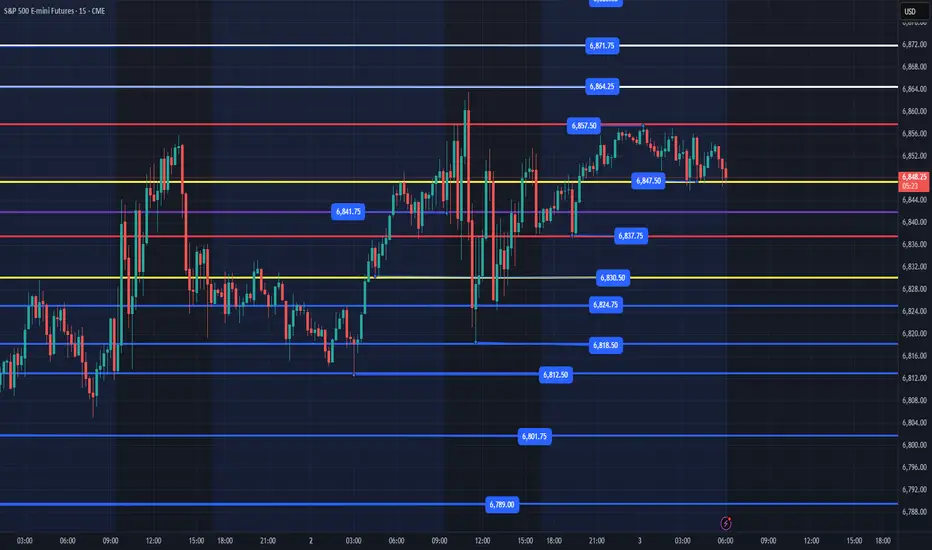
Yesterday we had some really good intraday levels that price continued to respect with no overnight session low that was flushed and reclaimed. You can see that we chopped around and have continued to maintain the range between 6812-6864.
Let's discuss today and what we are looking for. Our overnight session low is 6837 and our high is 6857. Price has been building a very tight range over the past few sessions, and we are getting close to a breakout or breakdown that could trigger today or tomorrow. Since we are not fortune tellers, we will need to focus on identifying levels we can grab points from today.
Key Levels Today
1. 6847 flush and reclaim (lower quality)
2. 6837 flush and reclaim (medium quality)
3. 6824 flush and reclaim (medium quality)
4. 6818 flush and reclaim (high quality)
5. 6812 flush and reclaim (high quality)
6. 6801 flush and reclaim (high quality)
Below these levels and price will most likely be selling off and I would be getting out the way and let price find a level below to reclaim and move higher.
I will post an update around 10am EST
----------------------------------------------------------------------------------------------------------------
Couple of things about how I color code my levels.
1. Purple shows a current or prior weekly low
2. Red shows the current overnight session High/Low (time of post)
3. Blue shows the previous day's session Low (also other previous day's lows)
4. Yellow shows core support/resistance levels
5. White shows overhead resistance/targets
Day 78 — Surviving the Chop: When Nothing WorksEnded the day +$36.64 trading S&P Futures. Today was super stressful despite the small green finish. The market structure was flipping up and down constantly, with no real trend and moving averages/zones failing to hold. It honestly felt like one of those days where the Market Makers are specifically trying to break trader psychology and force mistakes. Usually, when I see this kind of chop and manipulation, it signals that a big directional move is brewing for later in the week.
📰 News Highlights
OPENAI DECLARES ‘CODE RED’ AS GOOGLE NASDAQ:GOOGL CLOSES IN
🔑 Key Levels for Tomorrow
Above 6830 = Bullish Below 6800 = Bearish
S&P 500 Key Levels to Monitor:Trading Approach:
If you're LONG now: Consider taking partial profit or tightening stop
If you're FLAT: Wait for retest at 6,814-6,780 to enter long
If it bounces hard at 6,814: That's your buy signal for 7,000 target
You're reading the chart well — the rejection at 6,864 + weak 15-min candle = retest is likely beginning. Stay patient! 🎯
123 Pattern, The decline will find support.Divergence occurred before the broader market declined. Currently, it has broken below the trendline and is likely to resume the downtrend after a pullback. The medium-term top has not yet formed—following the decline, the market is highly probable to find support and may continue to hit new highs this month.
S&P500: Futures Stuck in Tight Range S&P 500 futures traded mostly sideways yesterday, remaining confined within a tight range. In our primary scenario, however, we anticipate that magenta wave (4) will soon resume its downward move. During this phase, the index is expected to initially break below the support levels at 6540 and 6371 points. We then look for the final low of the wave (4) correction to occur within our green Long Target Zone between 6163 and 5912 points. Once this low is established, the subsequent wave (5) should propel prices above resistance at 6952, marking the peak of the broader blue wave (III). Immediately after, we expect the onset of magenta wave (1), which should kick off a significant corrective phase. However, if the index continues to fall below the Long Target Zone, our alternative scenario may come into play (probability: 31%). In that case, it would suggest that the alternative blue wave alt.(III) has already completed and the major correction is already in progress.
ES - December 2nd - Daily Trade PlanDecember 2nd- Daily Trade Plan - 6:20am
*Before reading this trade plan, if you did not read yesterday's take the time to read it first! (You can view the posts in the related publication section) *
If my posts provide quality information that has helped you with your trading journey. Feel free to boost it for others to find and learn, also!
My daily trade plan and real-time notes that I post are intended for myself to easily be able to go back and review my plan and how I did from an execution perspective.
--------------------------------------------------------------------------------------------------------
I was on vacation with my family last week and received a lot of messages asking about my daily trade plan. I have not posted since the 25th as I was travelling and enjoying time with my family. I hope you had a great Thanksgiving and spent time with your families!
Let's get into today!
The overnight low is 6813 and overnight high is 6846. Since my last daily trade plan, we have been consolidating between 6789 - 6864. We have had some great trades around the 6800-6815 level that has been a magnet over the past sessions. We still have not made a higher high during this time. Until we clear 6854, 6864 we are technically in a range that has been bought and sold between 6813-6864. Price should continue higher and I do not expect price to lose 6779 (lowest) for us to continue higher. IF price loses 6779, we will most likely need to head lower to find levels to engage to take us higher. Until then, let's look at areas that could produce some points today.
Key Levels Today
1. 6813 flush and reclaim
2. 6801 flush and reclaim
3. 6789 flush and reclaim
Below these levels and price will most likely be selling off and I would be getting out the way and let price find a level below to reclaim and move higher.
I will post an update around 10am EST
----------------------------------------------------------------------------------------------------------------
Couple of things about how I color code my levels.
1. Purple shows the weekly Low
2. Red shows the current overnight session High/Low (time of post)
3. Blue shows the previous day's session Low (also other previous day's lows)
5. White Levels are previous day's session High/Low
Understanding CPI (Consumer Price Index)1. Headline CPI vs Core CPI
Headline CPI represents the total inflation, including all goods and services, such as food and energy. It is the most commonly cited figure in news reports.
Why headline CPI matters: It shows the immediate impact of inflation on consumers, reflecting changes in everyday expenses.
Core CPI excludes volatile items such as food and energy, which can fluctuate sharply due to seasonal changes or geopolitical events. Core CPI provides a clearer view of underlying, persistent inflation trends.
Why core CPI matters: Policymakers, especially central banks, prefer core CPI to guide interest rate decisions since it is less affected by short-term price swings.
For example, if headline CPI jumps due to a spike in oil prices, the core CPI may remain steady, indicating that the broader inflation trend is stable.
2. CPI Components and Categories
CPI is broken down into categories that reflect typical consumer spending patterns. These categories are weighted according to their importance in the average household budget. Common CPI components include:
Food and Beverages
Covers groceries, dining out, non-alcoholic beverages, and alcohol.
Highly sensitive to seasonal changes, supply chain disruptions, and agricultural output.
Housing
Includes rent, owners’ equivalent rent (OER), and utilities.
Often the largest component in CPI, reflecting the substantial share of housing in household budgets.
Transportation
Includes vehicle purchases, gasoline, public transit, and airline fares.
Sensitive to fuel prices, geopolitical risks, and transportation demand.
Medical Care
Covers health insurance, hospital services, and prescription drugs.
Price increases in healthcare can impact the middle and lower-income population disproportionately.
Education and Communication
Tuition, books, digital communication, and phone services.
Rising costs in education often drive broader inflation concerns.
Recreation
Includes leisure activities, electronics, and entertainment services.
Generally less volatile but contributes to long-term inflation trends.
Apparel
Clothing and footwear.
Seasonal sales and fashion trends influence price changes.
Other Goods and Services
Personal care, tobacco, and miscellaneous items.
Weighting in CPI: Each category is assigned a weight reflecting its share of total consumer spending. For example, in the US CPI, housing constitutes about 40% of the total index, making it the dominant driver of inflation changes.
3. Monthly vs Yearly CPI Changes
CPI reports provide two main types of comparisons:
Month-over-Month (MoM) Change:
Measures price changes compared to the previous month.
Useful for short-term analysis and monitoring immediate inflation trends.
Example: If CPI rises 0.5% MoM, it shows the average prices increased by half a percent in the last month.
Year-over-Year (YoY) Change:
Compares prices to the same month in the previous year.
Indicates long-term inflation trends.
Central banks often focus on YoY CPI for monetary policy decisions.
Seasonal Adjustments: CPI data is often seasonally adjusted to account for predictable price fluctuations, such as holiday shopping or harvest periods, making month-to-month comparisons more accurate.
4. CPI Report Breakdown – Detailed Analysis
A comprehensive CPI report provides multiple layers of information:
a) Overall Index and Percentage Change
Shows the headline CPI and core CPI.
Includes MoM and YoY percentage changes.
b) Sub-Index Analysis
Each category’s price change is reported separately.
Example: Food +0.4%, Housing +0.3%, Transportation +0.7%.
c) Contribution to Overall CPI
Categories are weighted to show their influence on the total CPI.
Example: Even if food prices rise sharply, their small weight in the index may result in a modest overall CPI increase.
d) Regional or Demographic Breakdown
Some countries provide CPI data by region or city.
Enables policymakers to assess localized inflation pressures.
e) Special Notes and Revisions
CPI reports include methodological notes, such as changes in survey methods, seasonal adjustments, or revisions to previous months.
5. CPI Interpretation for Policy and Investment
Central Banks and Monetary Policy:
CPI informs interest rate decisions to control inflation.
If CPI rises above the target range, central banks may increase rates to curb spending.
If CPI falls too low, it signals deflation, prompting rate cuts or stimulus.
Investors and Financial Markets:
Rising CPI may lead to higher bond yields and stock market volatility.
Traders monitor CPI closely for clues about inflation-driven asset performance.
Businesses and Wage Negotiations:
Companies use CPI to adjust pricing strategies, cost structures, and wages.
Labor unions and employees use CPI to negotiate cost-of-living adjustments (COLAs).
6. Limitations of CPI
Despite its importance, CPI has several limitations:
Does Not Capture All Consumer Experiences:
CPI represents an “average” basket and may not reflect specific household spending patterns.
Excludes Certain Goods:
Luxury goods, investment assets, and some services may not be fully included.
Quality Adjustments:
CPI tries to account for improvements in product quality, but this adjustment can be subjective.
Substitution Bias:
CPI assumes consumers purchase the same basket, even if prices change. In reality, people may substitute cheaper alternatives.
7. CPI and Inflation Trends
Monitoring CPI trends over time reveals the economy’s inflationary pressures:
Moderate CPI Increase: Healthy for economic growth, signaling rising demand and controlled inflation.
High CPI Increase: Indicates overheating economy, potential wage-price spirals, and higher interest rates.
Negative CPI: Signals deflation, reduced consumer spending, and economic slowdown.
Analysts often compare CPI to other indicators, such as Producer Price Index (PPI), wage growth, and commodity prices, to get a complete picture of inflation.
8. Example of CPI Report Interpretation
Imagine a CPI report shows:
Headline CPI YoY: +4.2%
Core CPI YoY: +3.5%
Food +2.0%, Energy +8.0%, Housing +4.0%
Interpretation:
The economy is experiencing moderate inflation, driven mainly by energy costs.
Excluding volatile items, the underlying inflation (core CPI) is more moderate.
Policymakers may consider gradual interest rate adjustments rather than aggressive hikes.
Consumers are feeling price pressures in daily essentials, especially fuel.
Conclusion
The CPI report is a vital tool for understanding inflation dynamics. Its detailed breakdown, including headline and core CPI, sub-indices, weights, and changes over time, allows stakeholders to assess economic conditions accurately. While it has limitations, when combined with other economic indicators, CPI provides invaluable insights for central banks, investors, businesses, and policymakers.
Understanding the CPI report is not just about numbers—it’s about interpreting how inflation impacts purchasing power, policy decisions, and overall economic health. Accurate analysis can guide investments, wage negotiations, and policy strategies, making it a cornerstone of economic literacy.