The Ghost Setup"I’m a buyer at $36,000 because Bitcoin has broken a double Head and Shoulders pattern (often called a 'Ghost Pattern'). By projecting the depth of this pattern, the price target lands right around that level, where I expect it to find a bottom.
Of course, once it reaches this point, I’ll be looking for buyer exhaustion and signs of support before entering.
Not financial advice.
Beyond Technical Analysis
xagusd Silver / USD)Big picture
Structure is still bearish from the left side: clear lower highs, heavy sell-off, then a sharp capitulation drop.
The bounce from the lows looks corrective, not impulsive. That matters.
What price is doing now
Price is compressing around ~74.10–74.30, basically chopping sideways.
This is a classic bearish consolidation after a strong dump.
Momentum has cooled, but buyers aren’t strong enough to reclaim key levels yet.
Key levels (the important part)
Immediate resistance
74.80 – 75.20 → first supply shelf
75.90 – 76.50 → major rejection zone (stacked resistance above)
If price pushes into these and stalls → sellers likely reload.
Support
73.30 → local demand / range floor
71.90 – 72.00 → last strong bounce area
Lose 71.90 cleanly → downside continuation is very much alive.
SPX500 | Futures Rebound After AI-Driven SelloffSPX500 | Futures Rebound as AI Selloff Triggers Market Repricing
U.S. equity futures rebounded after steep losses, as markets reassessed the recent AI-driven selloff that wiped nearly $1 trillion from the S&P 500 software and services sector. Investors are shifting from broad enthusiasm toward a more selective approach, focusing on winners and losers of the AI revolution rather than assuming all tech will benefit.
This evolving market dynamic suggests rising sector dispersion and continued volatility across equities.
Technical Outlook
The index dropped 2.6%, falling from 6940 to 6745 as previously outlined.
As long as price remains below the 6858 pivot, bearish pressure is expected toward 6820 and 6798.
A break below 6798 would extend losses toward 6771 and 6715.
A 1H candle close above 6858 would support a recovery toward 6877 and 6900.
Key Levels
• Pivot: 6858
• Support: 6798 – 6771 – 6713
• Resistance: 6877 – 6918 – 6940
The Elephant Jungle 2/6/26 Page 6On the 15m, market structure flipped bullish and kicked off a demand chain.
Sounds good… but don’t get comfortable.
Price is already struggling to break structure again, which tells me one thing, this move needs confirmation, not hope. Yeah, there might be a long here, but I’m not touching it without checking the lower timeframes.
The 5m, 3m, even the 1m, the lower timeframes Market Structure will tell the real story.
No guessing. No praying.
This is one of those days where the market looks friendly right before it decides who’s paying for lunch. So yeah, it’s going to be an interesting day, like always. Between structure, liquidity, and whatever News decides to drop out of nowhere, anything can happen.
As always:
Use proper risk management
Wait for your levels & confirmations
The Jungle rewards patience…
and it punishes impatience fast.
Stay safe out there.
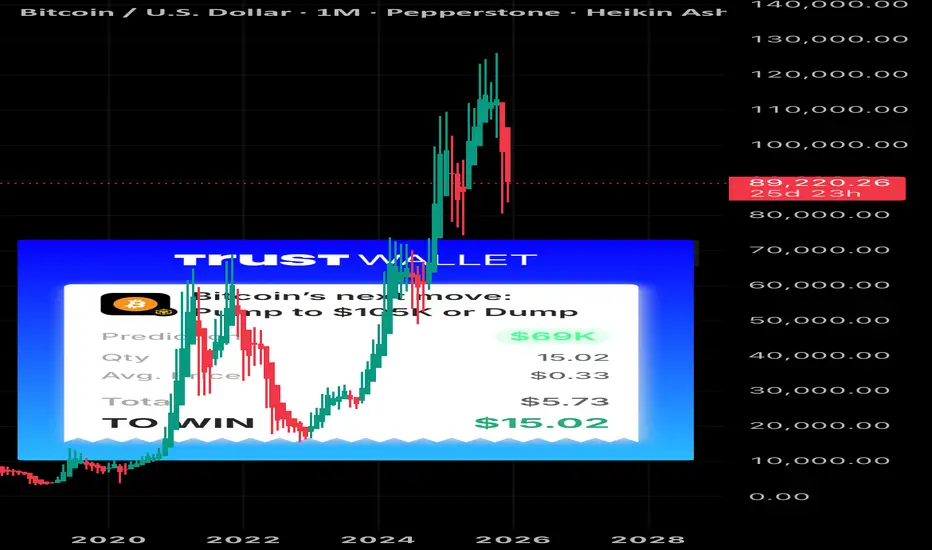
Bitcoin’s Next Big Move: Pump to $105K or Dump Back to $69K?👉 Is BTC preparing for a mega-pump toward $105,000?
or
👉 Is this rally losing steam, ready to correct back toward $69,000?
🗳️ Cast Your Vote:
What’s your prediction?
🔥 Pump to $105K
💧 Dump toward $69K
Drop your vote in the comments ⬇️ — I’m tracking the sentiment.
🎁 Want to Predict & Earn?
I’m testing BTC prediction games directly inside Trust Wallet, and the rewards have been surprisingly solid.
If you want to try predictions or explore on-chain tools:
📣 Let’s see what the community thinks!
Comment PUMP or DUMP, and tell me why you think BTC is headed there.
I’ll share updated market analysis once voting stabilizes.
Software Repricing in the AI EraSummary thesis:
Software isn’t collapsing — it’s being repriced.
For much of the past decade, software outperformed on the back of SaaS models, seat-based expansion, and expanding valuation multiples. AI is now disrupting the monetization unit faster than it clarifies the new one. That uncertainty is driving terminal-value repricing, not a cyclical growth scare.
What the chart is saying:
IGV has broken its long-term trend and failed to reclaim it. That behavior is consistent with a valuation reset, even as company-level execution remains largely intact.
About the recent sell-off:
The last week showed panic-like selling (volatility spike, fear gauges moving sharply). Panic in a structural repricing typically produces relief rallies, not durable trend reversals.
Prediction:
Near term: high probability of a reflexive bounce off panic conditions.
Medium term: rallies are likely to fail below broken resistance as repricing continues.
Base-case path: continued digestion / underperformance with price discovery toward a 65–70 zone before a durable base can form.
Invalidation:
This view changes if IGV reclaims and holds its long-term trend on a weekly basis and relative strength vs broader tech stabilizes.
Bottom line:
This is not a crash. It’s a reset.
In the AI era, growth alone no longer guarantees multiple expansion — defensibility does.
The Elephant Jungle 2/6/26 Page 5Right now, I’m watching for a long, a little ride up into the 4H Supply Range. But let’s not get reckless. There’s a 1H Supply Range sitting right in the way, and that’s a spot where I’ll happily take some money off the table… just in case the Bears decide they want to dump from there.
Because they might.
Now, if the Bulls are serious, I expect them to push through the 1H supply, sweep the liquidity trend, and then reject inside the 4H Supply Range. That’s the clean move.
If they’re really feeling themselves though..
Then they don’t stop there, they will sweep the liquidity curve and drive price straight into the 1W Supply Range.
Either way, my plan is simple, I’ll ride the Bulls on the way up… and the moment the Bears throw the signal, I’ll be switching sides like it’s halftime.
No loyalty in this Jungle, only signals.
Bitcoin in a corrective phase after the euphoriaOn this weekly BTC/USD chart, we observe a reversal structure following a strong uptrend in 2024–2025, marked by the break of the ascending channel and a clear rejection below the previous highs around $110,000–$120,000.
The price has now returned to test a key support zone around $62,000–$66,000, formerly an accumulation area and market pivot, making it a decisive level for the next moves. As long as this support holds, a technical rebound toward $75,000 remains possible, corresponding to a former intermediate resistance.
Conversely, a clear break of this zone would open the way to a deeper correction toward major lower supports around $30,000, or even the extreme zone near $18,000, corresponding to the previous cycle’s lows.
The current dynamics remain fragile: the market has moved from a phase of euphoria to a corrective phase, and only a sustained reclaim of $75,000–$80,000 would restore a medium-term bullish bias, while below $62,000, the bearish scenario would clearly dominate for the coming months.
BTC | The Calm Before the Dump... or Pump?Bitcoin is reacting from a key higher-timeframe point of interest (POI). Price has reached a high-probability FVG that broke structure to the downside with strong displacement — now forming a potential short-term ceiling.
Below, a notable sell-side liquidity pool sits near $74,558, offering a possible downside target if price continues to respect this daily FVG. Should that level give way, the next POI would be the marked bearish order block, with extended liquidity zones reaching toward the $52K region.
If both sell-side areas are taken out with strong momentum, it could confirm a deeper re-price phase before the next bullish leg.
Overall, we’re watching for how price responds within these key levels — structure will tell the story.
Disclaimer:
This analysis is for educational purposes only and does not constitute financial advice. Always do your own research (DYOR) before making any trading decisions.
The Elephant Jungle 2/6/26 Page 4On the 4H timeframe, the picture gets a lot clearer. The 4H Supply Range lines up perfectly as the next high probability short, especially with price rejecting off the Macro Range Low. That confluence alone makes this area worth paying attention to.
But if price blows through that 4H supply?
Then we’re likely looking at a liquidity sweep, one last push that runs stops and sucks in late buyers before price drives straight into the 1W Supply Range.
Same idea. Two outcomes.
Either the 4H supply holds and sellers step in,
or it fails, liquidity gets cleaned out, and higher timeframe supply does the real damage.
In this market, levels don’t fail quietly.
They fail violently, and only after taking liquidity with them.
The Elephant Jungle 2/6/26 Page 3With 13 hours left in the day, price is opening up bullish. Maybe, just maybe, the Bulls finally decide to show up. If they do, we could see a short term comeback, possibly even a clean test of the Macro Range Low. And if they’re really ’bout it, ’bout it like Master P, they might even take a swing at the 1W Supply Range.
But let’s be real.
This could just be London handing out a pullback, a clean little setup, so New York Bears can catch the alley-oop, slam price back down, and close the week out bearish. That’s how you get a slow, heavy weekend… and a lot of trapped Bulls. In this market, early strength doesn’t mean control. It means opportunity and not always for the Bulls.
The Elephant Jungle 2/6/26 Page 2The Bulls look like they’re trying to bounce from their second line of defense, the 1W Internal Demand Range. But the real question is simple, is it enough? After 3 straight weeks of hard selling into this zone, I can see price ranging here for the rest of the month. That’s a realistic outcome. The Bulls will finally gets a chance to breathe. But if this Demand Range fails? The next area that actually makes sense for a real swing reaction is the 1M Internal Demand Range, sitting right around 30K.
And yeah, that’s a big gap in between.
So let me answer the question I already know you’re asking:
“Red, are you sure there’s nothing price could bounce from inside that gap?”
Short answer: yes, there could be demand there.
On a smaller timeframe, there’s a chance some demand formed during the pump. But let’s be honest, would you really trust a tiny block of demand when the Bear Train is moving at 200 MPH? Anything is possible in this market. But that kind of demand? That’s not something I’d bet on for a swing. At best, it’s scalp material, in, out, and gone. Because when momentum is this heavy, the market doesn’t respect hope. It respects size, structure, and time.
Market Status: Reversal from Discount DemandGold is currently trading around $4,852 – $4,879, rebounding from a sharp technical correction that saw prices dip as low as $4,654 earlier in the session. This bounce follows a "historic crush" in late January where prices fell from record highs near $5,600.
Technical Evidence:
Discount Zone Reaction: The market has found temporary support in the $4,500 – $4,650 region, which aligns with the 61.8% Fibonacci retracement level of the recent major rally.
Momentum Shift: Spot gold rose as much as 2.3% today amid a rout in global stocks and increased margin requirements by the CME Group to mitigate volatility risks.
Institutional Floor: Prices are holding above the $4,725 mark (200-period EMA), which analysts identify as a critical buy signal for a move back toward the $5,000 psychological level.
Bullish Bias: High conviction as long as gold maintains a close above the $4,725 support floor.
Invalidation: A sustained break and consolidation below the 200 EMA ($4,725) would negate the recovery and shift focus back to the $4,400 – $4,500 "hard floor".
Final Thought: The "Story-driven" crash has provided a deep discount for long-term buyers. With geopolitical talks between the US and Iran scheduled and the end of the US government shutdown releasing delayed jobs data, expect heightened volatility as gold attempts to reclaim the $5,000 handle.
Report 6/2/26Macro & Geopolitical Report
Framing
This report assesses the market impact of the U.S.–Iran nuclear talks in Oman occurring under elevated military signaling and wider strategic competition, with China and Russia aligning diplomatically around Iran while Taiwan is re-elevated as the core U.S.–China fault line. The central thesis is that markets are repricing the probability distribution rather than a single outcome: credible diplomacy compresses the oil risk premium quickly, but miscalculation risk (shipping incidents, proxy activity, rapid strikes) keeps a structural tail embedded across energy, inflation expectations, and safe-haven demand. The next 1–4 weeks are likely to be headline-driven and range-bound, with sharp rotations and volatility spikes keyed to Oman/Tehran/Washington statements and any operational events at sea.
What happened and why it matters now
The U.S. confirmed talks with Iran in Oman after last-minute format and scope disputes, with Iran pushing for a narrow nuclear-only frame while U.S. officials signaled a broader set of concerns. The negotiations are taking place alongside force posture and coercive signaling, meaning diplomacy is being attempted under conditions where both sides still want leverage. In parallel, Beijing and Moscow coordinated messaging around Iran and warned against destabilization, while China’s readout of U.S.–China leader contact emphasized reciprocity and elevated Taiwan as the principal issue—underscoring that Middle East crises are now increasingly nested inside great-power competition rather than isolated regional events. The macro implication is higher correlation risk: when crises are nested, markets are more prone to synchronized risk-premium moves across commodities, FX, and rates.
Market reaction and positioning signal
Crude is acting as the real-time barometer of Middle East tail risk. Confirmation of Oman talks has encouraged a compression of near-term risk premium, while any hint of breakdown or maritime incident tends to re-inflate it quickly. Equity behavior is consistent with a market that is not pricing immediate recession but is increasingly sensitive to inflation-tail risk via energy. FX is split: the dollar can behave as a haven in acute risk-off bursts, but it can also weaken if the market interprets U.S. policy volatility and fiscal/inflation risks as structural. The positioning signal is that “insurance demand” remains alive: even when equities stabilize, gold and volatility tend to stay supported because the distribution of outcomes is fat-tailed.
Macro transmission mechanism
The event transmits primarily through the energy-inflation channel, then into real rates and finally into risk premia across equities and credit. If Oman talks look credible, crude volatility compresses, near-term inflation expectations soften, real rates become less pressured on the upside, and equities can stabilize—especially sectors sensitive to input-cost relief. If talks wobble, the oil risk premium widens, inflation tails thicken, and central banks become less able to pre-commit to easing—tightening financial conditions even without a change in policy rates. The second transmission channel is geopolitical alignment risk: China–Russia coordination around Iran increases the probability that sanctions enforcement, shipping security, and energy diplomacy become bargaining chips in a wider strategic contest, which elevates correlation and reduces the market’s confidence in “clean containment.”
Political and fiscal implications
For the U.S., the political incentive is to pursue diplomacy while maintaining credible deterrence, but the fiscal consequence of any escalation would likely be higher defense and security spending alongside already large refinancing needs—raising term-premium sensitivity. For Europe, disinflation dynamics create a bias toward easier policy at the margin, but a renewed energy shock would immediately complicate that trajectory, forcing policymakers to choose between supporting growth and anchoring inflation expectations. For China and Russia, alignment around Iran is a low-cost way to constrain U.S. options and signal the limits of U.S. coercion, while Taiwan’s re-elevation in Chinese messaging reinforces that any tactical cooperation does not soften the structural rivalry that shapes technology, trade rules, and investment flows.
Strategic forecast: base case and pivot points
The base case for the next 2–6 weeks is managed escalation: Oman talks proceed with intermittent brinkmanship, producing headline volatility but not immediate all-out conflict. In that environment, crude retains a geopolitical floor, gold remains structurally supported, and equities are more likely to grind sideways with violent rotations than to trend cleanly. The key pivot points are whether the agenda expands beyond “nuclear only,” whether maritime harassment escalates into a shipping incident that forces insurance and rerouting costs higher, and whether any regional actor triggers an incident that pulls the U.S. into kinetic action. The most important variable is not the existence of talks but the credibility of de-escalation at sea, because shipping risk is the fast channel into oil and inflation expectations.
Asset impact section
XAUUSD (Gold)
Gold is the cleanest hedge for a multi-crisis regime because it prices both geopolitical tail risk and policy-credibility risk. In the base case of managed escalation, gold tends to stay supported on dips because the probability distribution remains wide even if spot volatility fades. In a narrow-deal scenario, gold can pull back tactically as the oil risk premium compresses and risk appetite improves, but the pullback is more likely to be corrective than trend-reversing if broader strategic rivalry and fiscal uncertainty persist. In an escalation scenario (shipping incident, proxy strike, rapid campaign), gold typically outperforms as a convex hedge—unless the move is driven by an extreme dollar squeeze, in which case gold can initially wobble before reasserting.
S&P 500
The S&P’s immediate sensitivity here is oil → inflation expectations → real rates. If diplomacy contains crude, equities can rally, but leadership will matter: the market tends to reward quality cash flows and sectors that benefit from easing input costs. If crude risk premium returns, the S&P becomes vulnerable to multiple compression even if growth data is stable, because inflation tails reduce the probability of near-term easing and raise the discount rate. In the base case, expect range-bound behavior with periodic drawdowns on headlines and fast mean reversion when diplomacy headlines stabilize.
Dow Jones
The Dow tends to behave like a “cash-flow visibility and old-economy” barometer, and it can be relatively resilient when the market is punishing long-duration growth on rate volatility. If oil remains contained, the Dow can participate in risk-on relief, particularly through industrial and value segments that benefit from stable demand and lower input costs. If escalation lifts oil, the Dow’s cyclical components can come under pressure, but it often holds up better than high-duration growth because valuation is less dependent on falling real rates.
USDJPY
USDJPY will be driven by the interaction of U.S. yield differentials and risk sentiment. In calm periods, wide U.S.–Japan rate gaps tend to keep USDJPY supported. In risk-off spikes tied to Middle East incidents, the yen can strengthen abruptly through de-risking and carry unwind, producing sharp USDJPY downside even if U.S. yields are higher. In the base case, expect whipsaw: trend pressure from yield differentials, punctuated by fast downside bursts during geopolitical shocks.
DXY
DXY is pulled in opposite directions. Acute geopolitical stress usually supports the dollar as a funding haven, but persistent U.S. policy volatility and fiscal/inflation concerns can cap dollar rallies and sometimes cause the dollar to weaken even as risk is noisy. If Europe remains disinflationary and the ECB leans more dovish, rate differentials can support the dollar; if an energy shock hits Europe harder, the euro weakens and DXY rises; if the shock is interpreted as structurally U.S.-destabilizing, the dollar’s haven function becomes less reliable. In this event set, DXY is best treated as a “confidence gauge” rather than a simple risk-off proxy.
Crude Oil
Crude is the fulcrum because it prices not just barrels but the probability distribution of transit safety. Credible Oman talks compress front-month risk premium first in options/skew and then in flat price. Any maritime incident or credible threat to shipping rapidly re-injects premium, often in gap-like moves rather than grindy trends. In the base case, oil trades a geopolitical floor with limited upside unless negotiations fail; in the tail case, upside is convex because disruption risk transmits instantly into inflation expectations and policy constraints.
The Elephant Jungle 2/6/26 Page 1Six days into the month, and the Bears are charging like they’re trying to drag price straight to 30K before February even ends. They’ve already smashed more than halfway through what was supposed to be fresh demand. And of course, the internet has theories.
Lately, I’ve been hearing people say Jeffrey Epstein was the creator of Bitcoin. If that’s true, is this what Dan Peña meant when he said, “If you knew who the creator of Bitcoin was, you would run... you would sell all your Bitcoin”? I don’t know. Sounds like a whole lot of fake news to me. Markets don’t move on conspiracy theories, they move on liquidity. And the funny part? None of this price action surprised me.
Back in August, I said we were in a manipulation phase of a PO3.
Back in October, I warned that once price reentered the Macro Range, we were headed to the Macro Range Low. And when the November candle closed, I had the balls to say it out loud, we were in a Bear Market even while the Bullies were still calling for ATHs. So now I’ve got a question for every Bully still pounding the table...Do you believe we’re in a Bear Market now? Are you really going to let the Bears run wild for a full year? Or are you finally going to step in, reclaim the Macro Range, and let the Jungle start talking about ATHs again?
Until then, the Jungle isn’t bullish, it’s hunting.
History Does Not Repeat, But It Rhymes: A Structural BTC CycleThis study is not presented as a deterministic forecast, but as a higher-timeframe structural comparison intended to probe regime similarity across Bitcoin market cycles. Specifically, I have overlaid the full bar-by-bar price path from the 2021 cycle top through the subsequent bear-market low onto current price action. The objective is not to assert repetition, but to examine whether the geometry of distribution is expressing statistically meaningful resemblance at comparable points in the cycle.
The primary reason I am publishing this is twofold. First, on a personal level, I find higher-timeframe confluence of this precision genuinely compelling from a structural and probabilistic standpoint. Second, despite actively surveying trading discourse across platforms, I have not encountered this specific comparison presented by influencers, YouTubers, or institutional-adjacent commentators. The cleanliness of the alignment, particularly when paired with independent volumetric signals, made it difficult to justify keeping the observation private.
What makes the comparison noteworthy is not visual symmetry alone, but the convergence of orthogonal market structure signals. The pink markers denote the point of control of the composite volume heatmap, representing the single price level at which the highest cumulative traded volume exists across the observed range. In the prior cycle, extended distribution ultimately resolved directly into this POC region before capitulation. In the current structure, the analog projection terminates at nearly the same volumetric locus. From an auction-market perspective, this implies a potential gravitation toward maximal historical acceptance rather than continuation into sustained price discovery.
Importantly, this framework does not preclude further upside. A temporary reclaim of the 100K region remains plausible and would be consistent with late-cycle behavior: liquidity-driven expansion, momentum chasing, and retail participation occurring after professional distribution has largely concluded. Such moves historically resemble terminal excursions rather than durable trend continuation. Whether price resolves through a final blow-off or continued rotational decay is secondary to the broader implication: the probability mass increasingly favors a post-cycle regime rather than a fresh impulsive advance.
To formalize this intuition probabilistically, the setup can be framed as a conditional regime model. Let R belong to the set {Continuation, Distribution}, where R represents the prevailing market regime. Define S in the interval as a normalized similarity score measuring alignment between current price evolution and the prior cycle path. Let V represent volumetric convergence, defined as the distance between the projected terminal price and the long-term point of control, normalized by ATR.
The posterior probability of a distributionary regime can then be expressed as:
P(R = Distribution | S, V)
= ( P(S, V | R = Distribution) * P(R = Distribution) ) / P(S, V)
Empirically, when both structural similarity S and volumetric convergence V exceed critical thresholds, the posterior probability of a distribution regime dominates. Under reasonable priors, this framework assigns materially higher likelihood to cycle exhaustion than to sustained upside continuation, even while allowing for short-term upside volatility.
My broader thesis remains consistent with this framework. I expect a deceptive upside resolution either later this quarter or into early Q2, potentially forming a right-shoulder structure before broader downside resumes. The region near 48K remains my probabilistic terminal zone, aligning with ETF-related liquidity concentration and long-duration inventory accumulation. This is not an actionable call, but a structural hypothesis grounded in probabilistic confluence rather than narrative.
I am sharing this not as prediction theater, but because higher-timeframe structural rhyme, when paired with volume-based acceptance metrics, has historically preceded major regime transitions. The absence of this discussion across mainstream trading discourse only reinforces its relevance. For traders operating with discretion and scale, these are precisely the environments where probabilistic framing and patience matter most.
FOR ANYONE INTERESTED IN THE QUANT FRAMEWORK; READ BELOW
Regime Probability Framework with Threshold Bands
Define the market regime R ∈ {Continuation, Distribution}.
Let
S ∈ denote a normalized structural similarity score between current price action and the prior cycle distribution path.
V denote volumetric convergence, defined as the absolute distance between projected terminal price and the long-term point of control (POC), normalized by ATR.
Posterior regime probability~
P(R = Distribution | S, V)
= ( P(S, V | R = Distribution) · P(R = Distribution) ) / P(S, V)
Threshold Interpretation Bands~
Low Distribution Probability~
S < 0.35
|V| > 1.5 ATR
Interpretation: Structural divergence and weak volumetric convergence. Trend continuation more likely than cycle exhaustion.
Transitional Regime ~
0.35 ≤ S ≤ 0.65
0.75 ATR ≤ |V| ≤ 1.5 ATR
Interpretation: Mixed signals. Distribution and continuation coexist. Expect volatility expansion and false directional conviction.
Dominant Distribution Regime~
S > 0.65
|V| < 0.75 ATR
Interpretation: Strong cycle-path alignment with price gravitating toward maximal historical acceptance. Late-cycle behavior dominates. Upside extensions, if present, are statistically more consistent with terminal moves than sustainable discovery.
Key Note
This framework classifies regime state, not trade direction. A dominant distribution regime can still support sharp upside moves driven by liquidity release, retail participation, or short-term imbalance, while remaining structurally bearish at the cycle level.
are you ignoring the power of divergence in trading?Let’s talk about divergences - the closest thing we have to seeing the future in technical analysis.
Price is lying to you all the time. Indicators lie too. But when price and indicator start lying in different directions - that’s divergence. And that moment, when the lies don’t match anymore, is where reversals are often born.
Imagine a car climbing a hill. It’s still moving forward, but the engine is clearly dying, speed is dropping. That’s a trend with divergence. Price still pushes in the old direction, but momentum is already bailing out.
Classic bullish divergence:
- Price makes a lower low
- Your indicator (RSI, MACD, whatever you use) makes a higher low
Translation into normal human language: sellers pushed price even lower, but they did it with less strength than before. The punch is weaker. That’s often how downtrends fade and bottoms form.
Classic bearish divergence:
- Price makes a higher high
- Indicator makes a lower high
Market makes a fresh high, everyone gets euphoric, but under the hood momentum is already dropping. That’s how tops are made - not with fireworks, but with quiet exhaustion.
Why divergences are so powerful:
Because most TA tools react to what already happened. Divergence is one of the few things that lets you catch when the current trend is running out of fuel before the actual reversal candle hits you in the face.
A few simple rules I use so divergences don’t kill my account:
1. Higher timeframe - stronger signal
H1 divergence beats M5. H4 and Daily are kings. On low timeframes, the market draws divergences every time it sneezes.
2. I never trade divergence alone
Best combo: divergence + level.
Support/resistance, demand/supply, trendline, key zone - if price shows divergence exactly there, that’s where I pay attention.
3. I don’t try to nail the exact top or bottom
Divergence is a warning, not an entry trigger. I wait for price action: break of structure, impulse in the new direction, retest. Let the market show it really wants to turn.
4. Stops are not optional
Bullish divergence - stop usually goes under the last low.
Bearish divergence - above the last high.
Otherwise you’ll watch a “strong signal” keep diverging while your account converges to zero.
There is also hidden divergence - when price makes a higher low, but the indicator makes a lower low (in an uptrend), or the opposite in a downtrend. That’s more about trend continuation: the market is correcting, but momentum hinting that the main trend is still strong.
Maybe I’m wrong, but divergence is the only TA signal I still respect after watching thousands of indicators lie to people for years.
The market doesn’t reverse out of nowhere. It first slows down, runs out of fuel, and only then turns. Divergence is you watching the fuel gauge, not just the speedometer.
Next time you see a clean trend, don’t just stare at candles. Glance at your RSI or MACD and ask:
“Are you sure you still believe in this move?”
If price says “yes” and momentum says “no” - that’s where things get interesting.