RECAP - MSTR bounce from support perfectlyNo Reasonable Scenario' Forces Strategy To Sell Bitcoin As $440 Target Stands: TD Cowen
Strategy Inc (NASDAQ:MSTR) shares surged 22% Friday as TD Cowen maintained its $440 price target, arguing there is “no reasonable scenario” forcing the company to sell Bitcoin (CRYPTO: BTC) despite trading underwater on its holdings.
The Bull Case Amid Carnage
TD Cowen analysts Lance Vitanza and Jonnathan Navarrete said Strategy is “better positioned than ever” to participate in a potential recovery, even as the premise looks strained amid steep declines. The company’s shares are down 13.4% so far in 2026, adding to a 47.5% slump last year.
The volatility looks intentional ― analysts noted Strategy’s common stock is designed to be about 1.5 times more volatile than Bitcoin.
“It should come as no surprise that Strategy’s shares outperform Bitcoin when the price rises, and underperform when falling. This is, in fact, by design,” they said. On solvency concerns, TD Cowen argued Strategy has the “wherewithal to ride out a hypothetically much steeper Bitcoin rout.”
They pointed to the company’s $2.25 billion cash reserve that could fund $900 million in fixed charges for nearly 17 months while covering $1 billion of convertible notes putable in 2027.
The earliest trouble point appears in March 2028, when additional convertibles mature or become putable.
Moreover, TD Cowen maintained Bitcoin price targets at $177,000 by December 2026 and $226,000 by December 2027. The $8K Threshold
TD Cowen’s view aligns with recent Strategy executive comments.
On the Q4 earnings call revealing $126 billion in losses, CEO Phong Le said Bitcoin would need to fall to around $8,000 and remain there for five to six years before Strategy faces difficulty servicing convertible debt.
Executive Chairman Michael Saylor reiterated the capital structure is designed to withstand extended volatility, dismissing quantum computing threats as “horrible FUD.” The Digital Credit Engine
TD Cowen highlighted Strategy’s emerging “digital credit engine” as a key thesis component.
The company raised over $7 billion of preferred equity in fiscal 2025, representing 33% of all preferred equity sold in the U.S.
The firm’s STRC preferred stock pays an 11.25% annualized dividend rate with daily liquidity above $118 million, providing an alternative funding mechanism beyond convertible debt.
MSTR Technical Reality Strategy’s shares are up 22% Friday, bouncing after testing the critical $100-$110 support.
However, the stock remains trapped in a descending channel with overhead resistance.
The SAR indicator at $155.29 positions above current prices, indicating the bearish trend remains intact. Immediate resistance sits at $155, followed by $165-$175, then $200+. Additionally, the RSI at 36.45 shows bouncing from oversold but remains below 50, confirming momentum stays bearish.
Support sits at $100-$110—if this fails, next support appears at $75-$85.
Trend Analysis
BTC Play 2/8/2026Yesterdays zone was fully swept as you can see if you click my last play. Today we are using the same red trendline on the 15m chart.
The green line is now at a zone that was just touched that has not been swept. Waiting on one of these to break for my entry.
TPs marked for my estimated long or short.
Goodluck All!
BTC Cycle Drawdown & Time-Based Bottom Projection
After identifying a potential market top around $126,000, Bitcoin has entered its historical post-ATH drawdown phase. Rather than focusing only on price levels, this analysis emphasizes time symmetry, which has been a consistent feature across previous BTC market cycles.
Historically, Bitcoin has taken approximately 55–65 weeks from cycle top to cycle bottom. This prolonged distribution and capitulation phase reflects weakening momentum, declining liquidity, and sentiment reset before the next accumulation period begins.
Applying the same time-based framework to the current cycle, a ~60-week drawdown window projects a potential market bottom around late November 2026, with 23 November 2026 marking a key time confluence to monitor.
This does not imply a straight move down. Prior cycles show:
High volatility within the drawdown
Multiple counter-trend rallies
Extended accumulation near the lows
Price confirmation and structure will still be required. This projection is time-based, not a prediction of exact price.
Key takeaway:
If Bitcoin continues to respect historical cycle behavior, the market may spend the next several months completing its corrective phase before forming a long-term bottom toward late 2026.
On the monthly timeframe, standard deviation bands currently place a key mean-reversion zone around $38,000. This level aligns with prior cycle behavior where BTC often gravitates toward extreme deviation zones during prolonged bear markets.
At the same time, there is insufficient historical data for a full 200-month moving average. However, the 170-month MA, currently sitting near $21,000, provides a useful proxy for ultra-long-term trend support. Historically, Bitcoin has shown the ability to overshoot downside expectations before forming durable macro bottoms.
The key question remains whether price stabilizes near the monthly deviation level (~38k) or continues toward deeper mean reversion closer to long-term moving average proxies (~21k).
This is a probabilistic, cycle-based outlook — not financial advice.
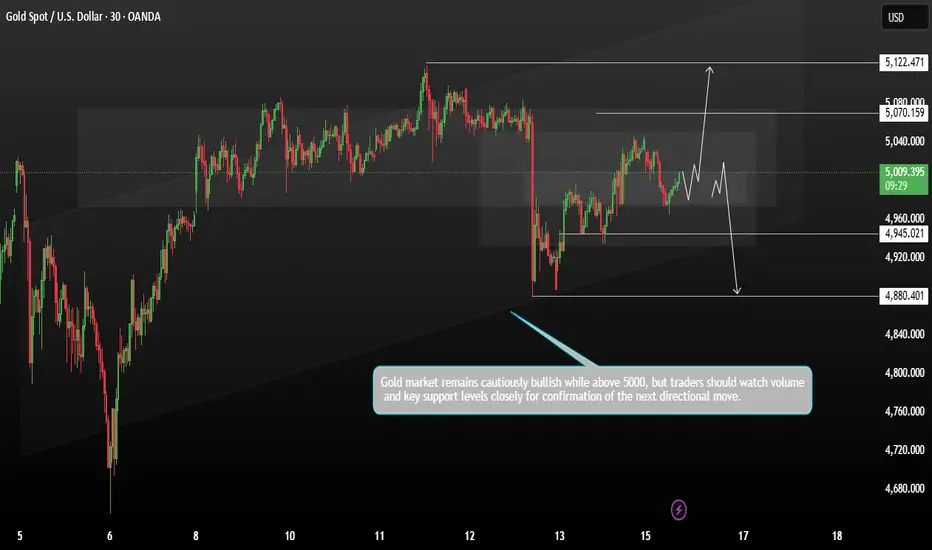
Gold Price Analysis (Monday)Gold Price Analysis (Monday)
Gold prices are currently at a critical juncture: approaching the key psychological and technical level of $5,000 per ounce. The sharp rise at the Asian open indicates strong short-term buying, but whether this momentum can be sustained and a new round of gains can begin requires clearer breakout signals and driving factors.
After opening today, gold prices briefly touched a high of $5,022 per ounce, up approximately $62 from the previous day. This suggests that after last week's sharp drop and consolidation at lower levels, bargain hunting and long covering began to emerge during the Asian trading session.
This rebound partially confirms the "potential upward breakout" mentioned in previous analysis.
📈 Key Technical Level Update
Gold's current consolidation range and key price levels are very clear:
$4,980 - $5,020, the core resistance zone.
This is the upper edge of the pivot area on the 2-hour chart, a previous double-top pattern, and also an important psychological round number. A breakout of this area after the surge in gold prices during the Asian trading session is crucial for the short-term trend. $4940-$4960: Current support and consolidation range.
This is the platform where gold prices consolidated after last week's rebound and the starting point of the current Asian trading session's upward movement. If gold prices pull back, this is the first line of defense that bulls need to hold.
$4870-$4900: Important support area.
This is a stronger support area further down. According to some analysts' intraday strategies, a pullback to the $4910-$4920 area could be seen as a short-term buying opportunity.
Around $4718: Key medium-term support level.
If gold prices unexpectedly break below recent lows, this will be the trendline support connecting the January lows and the market's "last line of defense." A break below this level would signal the start of a deeper correction.
The core logic driving the market remains unchanged, but at the start of the new week, the market's focus is more concentrated:
The shadow of a hawkish Fed (major restraining factor): Kevin Warsh's nomination as the next Fed Chair remains the biggest concern for the market. He is considered an "inflation hawk," and his stance has pushed up the dollar and bond yields, fundamentally altering the narrative of last year's dollar sell-off and triggering a plunge in gold prices from $5,600. Any follow-up news regarding his policy stance will directly impact gold prices.
Geopolitics and Credit Hedging (Long-Term Support Factors): Global trade tensions (e.g., the potential imposition of 100% tariffs) persist. Meanwhile, long-standing market doubts about the credibility of sovereign currencies have not been dispelled. Emerging market central banks (e.g., the National Bank of Poland) have continued to buy gold during the price decline, providing structural support to the market.
Market Sentiment and Funding: Last week's plunge unwound a large amount of leveraged speculation, stabilizing the market structure but potentially leading to decreased liquidity. Mainstream investment banks remain bullish on gold's long-term prospects, giving year-end target prices above $5,400 to $6,000, boosting long-term market confidence.
Trading Strategy: Short-Term (Intraday Trading - This Week): Focus on gold's challenge of the $4,980 to $5,020 resistance zone. If gold prices can hold above $5,000 during the Asian and early European trading sessions, short-term upside potential could expand, with the next target at $5,100 to $5,170.
Conversely, if gold prices rise and then fall back below $4,940, they may retreat to the $4,900 range, requiring a period of consolidation.
Risk Warning: The Chinese market is closed for the Lunar New Year holiday, which could reduce liquidity during the Asian trading session and exacerbate price volatility at certain times.
Breakout Trading: The safest strategy remains to patiently observe price movements within the key $4,980-$5,020 range. Avoid establishing large positions in the middle of this range until the price clearly holds or breaks below it.
Cautious Buying on Pullbacks: If overall market sentiment improves, aggressive traders can look for small buying opportunities using short-term technical signals when prices pull back to the $4,900-$4,920 range, placing stop-loss orders below $4,870.
Strict risk control: Given the continued high market volatility, all trades must have clearly defined stop-loss orders. Long stop-loss orders can be placed at $4870 or $4718, while short stop-loss orders should be placed above $5020 or $5050.
Feb 9, 2026 - XAUUSD GOLD Analysis and Potential Opportunity📊 Summary:
From a price-action perspective, bullish momentum is currently in control. Today, pay close attention to the key support at 4936. If price breaks below 4936, bearish pressure may start to emerge, and the strategy would shift to selling pullbacks where resistance holds.
Trade carefully, manage risk well, and prioritize capital protection.
🔍 Key Levels to Watch:
• 5092–5100 – Resistance
• 5063 – Resistance
• 5048 – Resistance
• 5024 – Support
• 4994–5000 – Support zone
• 4971 – Support
📈 Intraday Strategy:
SELL: If price breaks below 5025 → target 5020, with further downside toward 5013, 5007, 5000
BUY: If price holds above 5045 → target 5050, with further upside toward 5055, 5063, 5070
If you find this helpful or traded based on this plan, your likes, comments, and follows mean a lot and keep me motivated. Thanks for the support!
Disclaimer: This is my personal view, not financial advice. Always use proper risk
XLM — ABC Delivered, WCLs Now in PlayPrice has reached the bearish ABC C target on the 4H.
That’s a fact, not a forecast.
What happens next is not guaranteed .
Often after a sequence delivers, price looks for relief and retracement toward nearby liquidity — and in this case, the unreached WCL zones above are the obvious magnets.
But let’s be clear:
ABC delivery ≠ trend reversal
Price can accept the C target and continue lower
Or it can retrace toward WCLs before the next decision point
Both outcomes are valid until price accepts or rejects .
So the framework is simple:
If price retraces into WCL and rejects → bearish continuation remains intact
If price accepts above WCL → bias shifts and the structure changes
No assumptions.
No calling bottoms.
Just reacting to where price shows acceptance.
History Rhyming? Current Structure vs. 2020Hey everyone,
The recent drop toward 60K felt quite dramatic to me — very similar to the emotions and market behavior during the COVID crash. I compared the price action of both periods and found strong similarities. The main difference appears after July 2025, when the “Crypto Week” narrative was introduced and the market was supported, preventing a deeper decline. In a way, that seems to have delayed the reset rather than removed it.
As a result, price stayed elevated for a few extra months and then corrected in a way that resembles the March 2020 structure.
Another point to consider is the expected liquidity injections (2,000$ pay checks by Trump) around June/July, similar to what happened after the COVID crash. Also, historically markets tend to receive support ahead of major elections, so policy and liquidity conditions could become more favorable approaching November (please consider Trump).
My working expectation:
• Short-term: possible chop in the 65–75K range for several days
• Then: a push toward 80–90K
• Followed by: 2–3 months of consolidation
• Around June/July: start of the larger trending move into year end (and potentially beyond)
Of course this is only a structural comparison and not certainty — just a framework I’m watching.
These are only my personal opinions.
Please do your own research.
Cheers
XAUUSD Buy ForecastXAUUSD New forecast👨💻👨💻
Note:
Follow proper risk management rules. Never risk more then 2% of your total capital. Money management is the key of success in this business...... Set your own SL & TP.
Please support this idea with a Like and COMMENT if you find it useful click "follow" on our profile if you will like these type of trading ideas delivered straight to your email in the future.
Thanks for your continued support!! lemme know your thoughts in the comment sec...
Kaspa is coiling: June–July could decide everythingFor those still watching Kaspa, the technicals suggest the next upside move is likely around June–July.
I’m currently tracking two scenarios. If KAS holds the $0.028 support, the move higher should remain on schedule. However, if that level is lost, price could rotate down toward $0.015, which would push the volatility expansion out to late July–early August.
With these apexes in mind, this setup still provides a solid window for accumulation ahead of the next major move. Keep these levels on watch.
Litecoin is being ignored — That’s Usually When It Explodes! I’m posting Litecoin on the monthly timeframe because I genuinely believe LTC will have a run that very few people are expecting just not anytime soon.
In the near term, we may see some minor movement into March–April, but the larger moves I’m watching are toward the end of the year if price continues to hold the $53 support. If that level fails, the timeline likely shifts out toward early 2027.
That said, even those moves aren’t what I would consider the true volatility expansion. The real move, based on the current technical structure, points toward mid to late 2027. I know that sounds wild, but that’s where the TA is currently aligning. Of course, conditions can always change and cause an earlier breakout.
Overall, this suggests there is a lot of time for accumulation, which could also explain why Litecoin may remain relatively quiet for an extended period.
When you zoom out to the 3-month and 1-year timeframes, Litecoin has continued to make higher lows since the 2017 move, which is honestly insane. That structure alone signals persistent demand.
Something is definitely cooking.
Early bear market bottom? Kaspa is bullish & ready to grow next!I like Kaspa very much right now and I can no longer say that a lower low is necessary down the road. You know some projects can detach completely from the rest of the market, many projects. This can be one of those.
The truth is that KASUSDT reached as low as July 2023 this week. That's basically an entire bullish cycle completely eradicated, nullified—reset.
What's to like? Where is the good news?
The good news is that Kaspa is trading at bottom prices. A major low came in recently and the week is closing green with a strong volume breakout, the highest volume since November 2025.
It all depends on how this bullish phase develops but a strong rise would reveal the start of a new uptrend. Say, if KASUSDT were to hit $0.19 in the coming months, this would be enough for the ensuing correction to end as a higher low, keeping the chart technically bullish.
Maybe a rise to $0.14 can also support a higher low. On the other hand, if the current move, the one that is starting just now, peaks at only $0.095 then we can expect a major crash right after with new lows, lower lows.
This wouldn't be bad either, it would simply mean better entry prices Q3 2026 in anticipation of years of growth. Remember, after Bitcoin's bear market bottom is in, the market will grow for years to come.
Ok. So Kaspa is bullish and ready to grow next. This is very easy to predict.
Thank you for reading.
Namaste.
ChainLink Breaks Down: Hold Here or Drop to $6?Chainlink has broken below its previous 3 month support and is now trading within a new 3 month range, which can also be seen in the prior linked charts.
There are two main scenarios to be aware of. At current levels, LINK needs to hold this new 3 month support range to set up the next volatility expansion. As of now, that move is projected toward the end of March (highlighted).
If this 3 month support fails, price could rotate lower into the $6.00–$5.50 zone. That would likely extend the accumulation phase and push the apex out by roughly another month, toward April.
Excited to see how this develops. I remain a strong believer in LINK and its positioning within real world asset tokenization.