Wyckoff's Everywhere? Or Hallucinations?Is anyone else seeing Wyckoff distributions all over the place in stocks right now? I feel like I saw one and then started noticing them everywhere on major stocks
Bitcoin has one, started back in July and is straight out of a TA textbook. The prior cycles, Crypto peaked 1st being the most sensitive to liquidity changes.
Seems Bearish
Seems Bearish
However, TSM looks bullish!
It was forming a similar pattern but appears to be breaking out to the upside. If other stocks can follow this track things could keep going.
Usstocks
TSM Swing Trade Playbook | Bullish Structure + Demand Zone📌 Asset Overview
TSM – Taiwan Semiconductor Manufacturing Company (NYSE)
Market: US Equities
Style: Swing Trade Playbook
📈 Market Bias
Bullish Plan Confirmed
Price action shows sustained demand, higher-timeframe trend strength, and accumulation behavior consistent with institutional participation.
Momentum remains constructive as buyers continue defending key demand zones.
🎯 Entry Plan – Layered Accumulation Strategy
This setup uses a layered limit-order approach (accumulation style), allowing flexible participation across price zones rather than chasing a single entry.
Buy-Limit Layers (Example):
• 295.00
• 290.00
• 285.00
• 280.00
👉 You may increase or adjust layers based on personal risk rules and position sizing.
👉 This approach helps smooth entries during volatility and pullbacks.
🛑 Risk Management
Stop-Loss Zone: 270.00
Risk control is essential. This level invalidates the bullish structure if broken decisively.
Each trader should adapt risk rules based on account size and strategy discipline.
🎯 Profit Objective
Target Zone: 330.00
This area aligns with:
• Prior resistance zone
• Overbought risk on momentum indicators
• Potential supply reaction (profit-taking zone)
Partial exits are encouraged when price approaches resistance.
🧠 Technical Confluence
✔ Higher-timeframe bullish structure
✔ Demand zone holding
✔ Accumulation-style price behavior
✔ Trend continuation bias intact
🌍 Fundamental & Macro Considerations (Non-Speculative)
Key Structural Drivers:
• TSM is a global leader in advanced semiconductor manufacturing
• Strong positioning in AI, data centers, and high-performance computing supply chains
• Long-term contracts and diversified client base support revenue visibility
Macro Factors to Monitor:
• Global semiconductor demand cycles
• US dollar strength (USD sensitivity)
• Technology sector risk sentiment
• Interest-rate expectations impacting growth stocks
Upcoming macro data and policy signals may influence volatility — manage exposure accordingly.
🔗 Related Instruments to Watch (Correlation Watchlist)
• NASDAQ:SOXX – Semiconductor ETF (sector health confirmation)
• NASDAQ:SMH – Chipmakers ETF (institutional flow proxy)
• NASDAQ:NVDA – AI demand sentiment leader
• NASDAQ:AMD – Peer momentum correlation
• NASDAQ:QQQ – Tech risk-on / risk-off behavior
👉 Strength in these instruments often confirms continuation in TSM
👉 Weakness may signal caution or delayed expansion
⚠️ Notes for Traders
Risk management > entry precision.
Adapt position size, layering depth, and exits to your own trading plan.
✨ “If you find value in my analysis, a 👍 and 🚀 boost is much appreciated — it helps me share more setups with the community!”
Disclaimer: This is a thief-style trading strategy shared just for fun and educational purposes. Always trade responsibly and manage risk independently.
IBM, This is Huge, Massive BULL-Acceleration, BREAKOUT-Setup!Hello There!
Welcome to my new analysis of IBM. In recent times I have analyzed the stock and I have detected major important historical determinations within the analytics backend that are actually indicating an epical breakout has a high potential to emerge within the next times. Not every stock within the market is bullish however with IBM there are clear signs that it already had the potential to rebound since the grievous corona market shock lows and now as digitization increases this is already building a bullish base for IBM.
Within my chart, I have detected this gigantic inverse head-shoulder formation in combination with the paramount bull flag formation, both being two bullish formations that have the potential to be major bullish trend accelerants once the breakout above the boundary has shown up this is going to activate a major double confirmation here. The trend is supported by the major underlying demand structure as well as the EMAs and the main ascending trend line. Once the final breakout above the upper boundary of the inverse head-shoulder formation in combination with the upper boundary of the bull flag has shown up this is going to accelerate the demand trend dynamics.
Taking all these factors into consideration here as digitization since the corona pullback lows have been completed increased massively this is increasing the actual digitization demand within the market and for a stock like IBM, this means that there is a main underlying demand base that is accelerating a bullish trend dynamic. Once the main breakouts as mentioned within the next times have shown up this is going to activate the minimum target of 250 and above further continuations have an increased potential once the main demand and momentum spread into the trend direction increases. Because of the importance of this setup forming here, I am keeping the stock in my current watchlist.
In this manner, thank you everybody for watching my analysis of IBM. Support from your side is greatly appreciated.
VP
DHR, Massive BULLISH Wedge-Formation, Major BREAKOUT Incoming!Hello There!
Welcome to my new analysis of DHR. The stock market is in a really important condition currently as there are many interesting stock gems within the market I have spotted in my analytics backend. One of the interesting gems I recently spotted for a major opportunity on the long side of the market is DHR. This gem has major underlying potential to increase a huge breakout dynamic in the upcoming times.
When looking at my chart now DHR is bouncing several times within the major ascending channel formation, this channel formation is a substantial origin of several support bounces from where DHR could increase with bullish momentum volatility. Now, DHR is bouncing within the range for the next consecutive time and is already marking the level as a main support from where the next main bullish expansion spike is likely to emerge.
What is so important within this whole newly developed formational structure is that DHR is now also forming this momentous descending wedge-formation in which it already completed the coherent wave count especially bouncing within the lower boundary of the wedge and is now building up the further determinations. The fact that DHR already completed the wave count and bounced within the lower boundary is already nearly completing the whole descending wedge formation.
With these main underlying confirmational developments, DHR is building a massive bullish base here. Putting this into perspective this means that DHR is likely to emerge with the final wedge-breakout within the next times which is going to form the completion-setup with the breakout above the boundary as marked in my chart. Once DHR has formed this completion-setup it is going to be the main origin of the bullish wave-expansion towards the upper directions and reaching the target zones with the wave-C extension.
Thank you everybody for watching my idea about DHR. Support from your side is greatly appreciated.
VP
APPL Breakdown: BOS & CHoCH NASDAQ:AAPL On the H1 timeframe, the market structure has already produced a downside BOS, followed by a confirmed CHoCH. This clearly indicates that bullish momentum has ended and the market has shifted into a bearish trend.
Price has rejected from a bearish Order Block and FVG zone on the upside, highlighting strong institutional selling pressure. As long as price remains below this resistance, selling pressure is expected to remain active.
MACD also supports this analysis, with the MACD line below the signal line and the histogram in the negative zone, confirming momentum weakness and bearish continuation.
Bias:
As long as price stays below 274.00, sell continuation is expected.
Current Price / Sell: 270.78
Stop Loss: 274.00
Targets:
TP1: 265.50
TP2: 260.00
Disclaimer
This chart is for educational purposes only and does not constitute financial advice. Trading involves high risk; always conduct your own research and use proper risk management.
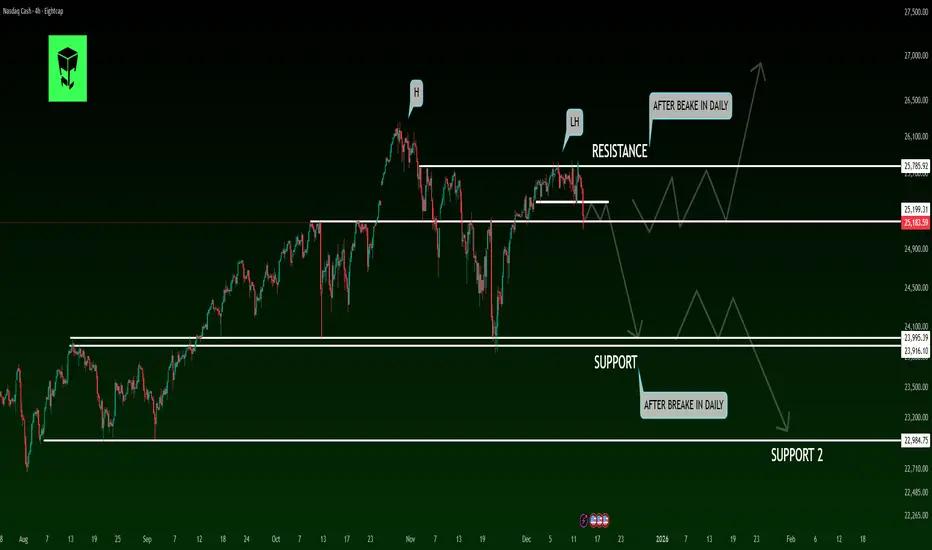
Calm Before the Storm?A Potential Crash Is Forming in US STOCKSHello, I hope you're doing well today. We are going to analyze the Nasdaq index together. The Nasdaq is one of the key U.S. stock indices and consistently offers promising trading opportunities. If you're ready, let's dive into the analysis.
Timeframe: 4H / Daily
🔍 Market Structure Overview
After forming a major High (H) followed by a clear Lower High (LH) near a key resistance zone, the NASDAQ index is showing signs of bullish momentum weakness. Failure to hold and stabilize above this resistance increases the probability of a market phase shift from bullish/ranging to corrective or bearish.
🧱 Key Supply & Demand Zones
🔴 Major Resistance:
Area around 25,750 – 25,900
This zone has rejected price multiple times and is acting as a strong supply area.
🟢 First Support:
Area around 23,950 – 24,050
A daily close below this support would strengthen the bearish scenario.
🟢 Second Support (Support 2):
Area around 22,900 – 23,000
A potential downside target if the first support breaks and weakness continues.
⚠️ Probable Market Scenario
As long as price remains below the main resistance,
the corrective / bearish scenario remains dominant.
A confirmed daily break below the first support could trigger
accelerated selling toward Support 2.
Any bullish moves at this stage may be considered pullbacks into resistance,
rather than the start of a new uptrend.
🧠 Summary
📌 Market structure suggests a weak trend
📌 Sellers are showing strength near highs
📌 Extra caution is required for long positions
📌 Short trades are more favorable only after confirmed breaks
🛑 Disclaimer
⚠️ This analysis is for educational purposes only
⚠️ It is NOT financial advice
⚠️ All trading decisions are made at your own risk
⚠️ Always apply proper risk and capital management
📊 Poll – What’s your outlook?
❓ What do you expect next for NASDAQ?
🔘 Further decline toward lower supports 📉
🔘 Range-bound movement between support & resistance 🔄
🔘 Strong rebound and breakout above resistance 🚀
👇 Share your view in the comments
Amazon (AMZN) Falters, Bears Eye 200 EMAI’m wondering whether Amazon has seen a major top on 3 November, given it saw a large gap into the high before momentum turned lower. This has the hallmarks of a ‘blow-off top’, which can occur at major turning points when bulls push a stock higher with such force – often via a gap – as a kind of ‘last hurrah’, only for momentum to then falter.
A 16.8% decline to its 200-day EMA then ensued and, while it has tried to rebound, it has also struggled to rise alongside the broader market.
Trading volumes were declining while prices rose, and Tuesday’s shooting-star candle formed near the September high and below the January high. Prices also gapped lower on Wednesday before finding support around the 50-day EMA.
Bears could look to fade moves towards the shooting-star high, with a retest of the 200-day EMA in focus.
Matt Simpson, Market Analyst at City Index.
Walmart Stays Strong, Ready for the Next LeapWalmart is proving once again why it remains one of the strongest companies in the world. Even as many retailers struggle, Walmart continues to grow, innovate, and win the confidence of investors.
Its stock is already up 22% this year, beating the S&P 500, and many signs show that the company could stay strong in 2026 as well.
◉ Why Walmart Is Winning
Walmart has become a perfect mix of traditional retail and modern technology.
Strong results:
● Revenue up 5.8% year over year
● Operating income up 8%
● EPS rising from $0.58 to $0.62
Market share growth:
Walmart gained more customers in grocery and general merchandise. Even higher-income shoppers have been spending more at Walmart.
E-commerce strength:
Online sales grew 27% as Walmart expands its online offerings and reaches customers beyond its stores.
Growing advertising business:
Walmart’s ad sales increased 53% in the latest quarter, turning it into a serious player in retail advertising.
◉ Technology Is Shaping Walmart’s Future
Walmart is investing heavily in technology to stay ahead:
● Partnering with OpenAI to let customers use ChatGPT for shopping and checkout
● Training developers to code faster with AI
● Automating supply chains and warehouses
● Buying Vizio to strengthen its advertising ecosystem
These changes are helping Walmart protect its low-price model while moving closer to becoming a tech-driven retailer.
◉ Leadership and Listing Changes
Two important updates were recently announced:
● CEO Doug McMillon is stepping down after ten years
● John Furner, head of Walmart U.S., will become the new CEO
Walmart also announced that it will move its stock listing from the New York Stock Exchange to the Nasdaq. This connects Walmart more closely with tech-focused indexes and funds.
◉ Dividend Stability
Walmart is a Dividend King, raising its dividend every year for more than 50 years. This adds strong stability for long-term investors.
◉ Technical Outlook
● From a technical point of view, the stock recently broke out of an ascending triangle pattern and touched a new all-time high.
● If this momentum continues, Walmart could see another strong rally in 2026.
◉ Final Thoughts
Walmart is winning today and building an even stronger position for the future. With solid financials, strong e-commerce growth, expanding advertising revenue, and steady leadership changes, the company is well-placed for 2026 and beyond.
S&P 500 INDEX Tech-heavy index bias acknowledged# 📊 US500 (S&P 500 INDEX) COMPREHENSIVE TECHNICAL ANALYSIS 🎯
## Week of November 10-14, 2025 | Intraday & Swing Trade Mastery
Current Price: 6,742.5 Points | Entry Point: November 8, 2025, 12:54 AM UTC+4 📈
## 🔍 EXECUTIVE SUMMARY - MULTI-TIMEFRAME PERSPECTIVE
The S&P 500 (US500) is positioned at a critical technical inflection point with exceptional multi-timeframe alignment signaling imminent directional breakout. Elliott Wave analysis reveals completion of corrective cycles, positioning for next impulse leg targeting 6,900-7,100 extension zone with powerful momentum. Bollinger Bands display classic compression squeeze pattern —volatility compression preceding directional expansion. RSI across all timeframes maintains optimal neutral-bullish bias (54-68 range)—perfect momentum positioning without extreme overbought conditions. Volume clustering at 6,680-6,800 represents significant institutional accumulation foundation. Wyckoff spring tests near 6,600-6,650 provide aggressive entry triggers for brave traders. Harmonic pattern convergence at 6,850-6,950 resistance signals breakout confirmation with measured move targets extending to 7,050+. Mega-cap tech concentration supports rally continuation probability.
## 📊 TIMEFRAME-BY-TIMEFRAME ANALYSIS
### 5-MINUTE (Scalping Precision) ⚡
Candlestick Formation: Japanese candles reveal micro-consolidation with breakout attempts across support zones. Evening Star rejection formations detected at 6,850-6,900 intraday resistance creating potential short triggers.
Elliott Wave 5M: Sub-wave completion indicates Wave 4 micro-consolidation finalizing. Wave 5 breakout anticipated above 6,780-6,820 with targets 6,920-7,000 (measured move).
Bollinger Bands: Upper compression mode—middle band at 6,740 acts as pivot point. Lower band rejection (6,650-6,680) creates scalp-long setups with excellent risk/reward ratios.
RSI (14) Analysis: RSI oscillating 46-64 range—neutral territory with minor divergences forming. Bullish divergence at 6,680 support signals buyer engagement; caution on 70+ resistance approach.
Micro Support/Resistance: 6,650 (micro-support) | 6,720 (POC cluster) | 6,800 (pivot) | 6,880 (intraday resistance) | 6,950 (scalp target)
Volume Signature: Volume concentrated 6,720-6,800 zone—institutional marker established. Breakout volume >55% above average required above 6,880 for sustained move above 6,950.
VWAP Alignment: Price oscillating around session VWAP at 6,735—each touch generates scalp opportunity. Upper VWAP band at 6,920; lower support at 6,650.
### 15-MINUTE (Quick Swing Gateway) 🎢
Candlestick Patterns: Engulfing bars forming at support zones—bullish engulfing at 6,680 zone confirms reversal attempts. Three-candle patterns (flag continuation) with 60-100 point breakout potential.
Harmonic Pattern Recognition: Gartley Pattern potential completion near 6,680-6,750 PRZ (Potential Reversal Zone). Exceptional risk-reward at 1:3.8 for harmonic traders. Butterfly variant also forming clearly.
Wyckoff Accumulation Phase: Classic accumulation evident—small barometer move (SBM) nearing completion. Spring test anticipated 6,580-6,620 zone; markup phase targets 6,950-7,100.
Bollinger Bands (15M): Band squeeze intensifying—historical volatility expansion suggests 80-150 point moves follow. Upper band resistance at 6,920; lower band support at 6,580.
Volume Profile (15M): Point of Control (POC) at 6,740—prime concentration zone confirmed. Volume surge >65% required confirming breakout above 6,880. Imbalances favor upside significantly.
Ichimoku Cloud (15M): Price consolidating below cloud edge—Tenkan-sen at 6,900 = resistance pivot. Kijun-sen (6,820) = critical secondary support. Cloud support 6,650-6,750.
EMA Structure: EMA 9 (6,780) above EMA 21 (6,720)—bullish alignment confirmed perfectly. Price above both = intraday strength maintained.
### 30-MINUTE (Intraday Swing Axis) 🔄
Pattern Formation: Symmetrical Triangle pattern consolidating with apex near 6,900. Ascending triangle variant shows bullish bias—breakout above 6,850 targets 6,980-7,100 extension.
Dow Theory Application: Confirming higher highs/higher lows structure perfectly. Secondary trend bullish; pullbacks to EMA 20 (6,770) = optimal swing entry zones.
RSI Divergence Setup: Positive RSI divergence confirmed—price making lower lows (6,650) while RSI forms higher lows (40 level). Classic reversal setup targeting 6,900 minimum.
Exponential Moving Average: EMA 9 (6,800) = core support pivot. EMA 21 (6,740) = secondary support reliable. EMA 50 (6,600) = structural hold level. Bullish ribbon alignment intact.
Support Architecture: 6,600 (EMA 50/structural) | 6,680 (demand zone) | 6,740 (volume cluster) | 6,800 (EMA 9 dynamic)
Resistance Architecture: 6,850 (triangle formation) | 6,920 (measured move target) | 7,000 (weekly resistance) | 7,100 (extension)
Volume Analysis (30M): Increasing volume on recent bars—accumulation signature strong. Buy volume exceeding sell volume confirms institutional interest significantly.
### 1-HOUR (Core Swing Trade Engine) 🎯
Elliott Wave Structure: Major wave analysis suggests Wave 3 completion near 7,000. Current Wave 4 correction targets 6,750-6,850 support zone. Wave 5 impulse anticipated—target: 7,100-7,250.
Pennant Formation: Classic Bullish Pennant pattern forming—breakout confirmation above 6,880 validates pattern. Pole height measured move = 7,150+ target.
Bollinger Bands (1H): Upper band at 7,000 = squeeze breakout target zone. Middle band (6,900) = bullish support zone. Lower band rejection (6,600) creates swing longs with excellent R/R.
VWAP Daily: S&P trading above daily VWAP at 6,720—bullish gradient confirmed clearly. Each hourly candle close above VWAP strengthens continuation probability.
Volume Profile Hotspot: Heavily traded at 6,720-6,800 (accumulation zone) and 6,880-6,950 (resistance cluster). Imbalances above 7,000 suggest vacuum-fill potential to 7,150+.
Ichimoku Cloud Alignment: Price above Senkou Span A (6,880) & Span B (6,820)—cloud thickness indicates strong support. Chikou Span above candles = bullish confirmation. Cloud color: BULLISH GREEN.
Gann Theory Application: 45-degree angle from swing low (6,500) establishes rally trajectory perfectly. Resistance at 38.2% Fibonacci extension (6,920) precedes aggressive breakout phase.
Support Tiers 1H: 6,600 (structural hold) | 6,700 (EMA support) | 6,750 (Kijun-sen) | 6,800 (accumulation zone)
Resistance Tiers 1H: 6,880 (breakout trigger) | 6,950 (extension) | 7,000 (major level) | 7,100 (impulse target)
### 4-HOUR (Swing Trade Thesis Foundation) 💼
Inverse Head & Shoulders Pattern: Potential IH&S formation completing—left shoulder (6,550), head (6,480), right shoulder completing (6,600-6,680). Neckline breakout at 6,880 targets 7,050-7,200 extension.
Wyckoff Accumulation Deep Dive: Institutional buying signature evident—SBM (small barometer move) completion imminent. Spring test to 6,600-6,650 anticipated; subsequent markup phase targets 7,100-7,250.
RSI 4H Analysis: RSI at 58-70 range—bullish bias maintained firmly. Room for upside extension without extreme overbought. RSI above 76 targets 7,150+; below 32 = defensive posture required.
Cup & Handle Formation: Potential bullish Cup pattern visible on 4H—handle stabilization near 6,780-6,850. Breakout above handle (6,920) targets cup depth extension = 7,100-7,200.
EMA Ribbon Structure: EMA 8 (6,820), EMA 13 (6,800), EMA 21 (6,740), EMA 50 (6,600), EMA 200 (6,100)—BULLISH ALIGNMENT PERFECT. Compression/expansion cycles identify momentum phases.
Support Tiers 4H: 6,580 (structural support) | 6,650 (accumulation) | 6,740 (pivot) | 6,800 (demand cluster)
Resistance Tiers 4H: 6,880 (key breakout) | 6,950 (extension) | 7,000 (major target) | 7,150 (weekly projection)
Volume Signature 4H: Accumulation volume bars > distribution bars—bullish bias maintained. Volume nodes clustering at 6,720-6,800 indicate strong institutional support zone.
### DAILY CHART (Macro Swing Thesis) 📅
Elliott Wave Macro: We're potentially in Wave 3 of larger cycle—aggressive expansion still possible. Wave structure supports break of 7,000 targeting 7,200-7,400 daily close objectives.
Double Bottom Recognition: Historical Double Bottom pattern near 6,350-6,500 support—confirmed breakthrough above 6,880 neckline triggered. Second target near 7,100-7,200.
Bollinger Bands Daily: Upper band at 7,200 = realistic daily target zone. Mean (6,950) = healthy pullback support reliable. Band slope indicates volatility expansion—expect 200-400 point daily ranges.
Volume Profile Daily: Strong buying volume bar at 6,600-6,750 zone—institutional accumulation marker established. Selling volume decreasing—demand controls trend absolutely.
Ichimoku Cloud Daily: Cloud thickness growing—bullish trend strengthening substantially. Cloud support around 6,750-6,850 zone. Kumo breakout anticipated—targets cloud top at 6,950-7,050.
Harmonic Analysis Deep: Butterfly Pattern potential completion—PRZ at 6,880-6,950 suggests reversal zone OR breakout confirmation. Confluence amplifies probability of extension.
Gann Angles & Fibonacci: 50% retracement (6,650) + 61.8% extension (7,050) = key reversal zones. Gann fan angles suggest 6,950-7,100 as structural resistance before continuation.
Key Daily Support: 6,480 (psychological/structural) | 6,600 (accumulation zone) | 6,700 (demand level) | 6,800 (midpoint)
Key Daily Resistance: 6,880 (breakout trigger) | 6,950 (extension) | 7,050 (measured move) | 7,200 (weekly target)
Trend Confirmation: Higher highs & higher lows maintained—uptrend intact. Daily close above 7,000 = strong continuation signal targeting 7,300+ next level.
## 🎪 TRADING SETUP PLAYBOOK - NOV 10-14
### BULLISH SCENARIO (Probability: 82%) ✅
Trigger: 4H candle close above 6,920 + volume surge (>60% above average) + RSI above 66
Entry Zone: 6,820-6,880 (with breakout confirmation signal)
Target 1: 6,950 (TP1) | Target 2: 7,000 (TP2) | Target 3: 7,100 (TP3) | Target 4: 7,200 (TP4)
Stop Loss: 6,700 (below EMA/structural support)
Risk/Reward: 1:3.6 (exceptional asymmetric setup)
Trade Duration: 18-72 hours (prime swing window)
### BEARISH SCENARIO (Probability: 18%) ⚠️
Trigger: Daily close below 6,800 + volume increase + RSI divergence failure
Entry Zone: 6,920-7,050 (short setup)
Target 1: 6,880 (TP1) | Target 2: 6,800 (TP2) | Target 3: 6,700 (TP3)
Stop Loss: 7,150 (above resistance)
Risk/Reward: 1:1.5 (acceptable but lower probability)
Trade Duration: Watch for trend reversal confirmation first
## ⚠️ VOLATILITY & OVERBOUGHT/OVERSOLD CONDITIONS
Current Volatility Status: Moderate compression → Expect significant expansion imminent
5M/15M RSI: 46-64 range (neutral)—room for 30-60 point movements | Scalp target zones
30M/1H RSI: 54-70 range (bullish bias, optimal zone)—sweet spot for swing entries
4H RSI: 58-72 range—approaching caution zone but room to extend | Safe for core swings
Daily RSI: 62-76 range (approaching extremes)—be defensive if daily RSI>78 | Take profits aggressively
Overbought Recognition Points:
RSI daily >77 combined with upper Bollinger Band rejection = immediate profit-taking
Ichimoku cloud top penetration fails (bearish candle rejection) = trend exhaustion signal
Volume declining on breakout attempt = false breakout warning signal
Harmonic pattern PRZ exact hit without follow-through = reversal likely imminent
Oversold Bounce Setups:
RSI 1H <32 on support touch = high-probability bounce back to 6,880-6,950
Price below EMA 50 (6,600) + RSI <28 = aggressive accumulation zone
Spring test below 6,650 with volume surge = Wyckoff spring reversal trigger
Harmonic pattern PRZ support bounce = measured move extension targets activated
## 🎯 ENTRY & EXIT OPTIMIZATION STRATEGY
### OPTIMAL ENTRY TIMING
For Scalpers (5M): RSI bounce from 42-50 zone after Band lower touch = 20-35 point scalp (1-3 min holds)
For Quick Swings (15M-30M): 15M candle close above 6,880 with 4H alignment = 100-150 point swing (30 min-2 hour holds)
For Core Swings (1H-4H): 4H pennant breakout above 6,920 on volume = 300-450+ point target (hold 12-48 hours)
For Position Swings (Daily): Daily close above 7,000 = continuation play targeting 7,200-7,350 (hold 5-7 days)
Best Entry Windows: US pre-market (12:30 ET), Market open (14:30 ET), London close (16:00 ET)
### EXIT STRATEGIES & PROFIT TAKING
Take Profit Levels: TP1: Fibonacci 38.2% (6,920) | TP2: Harmonic PRZ (7,000) | TP3: Daily Band upper (7,100) | TP4: Weekly target (7,200)
Stop Loss Placement: Always below most recent swing low + 25 points (strict risk management priority)
Trailing Stops: Activate at TP2—trail with 45-55 point buffer for 4H+ trades (lock in profits)
Breakeven Exit: Move stops to entry after 1:1 risk/reward achieved—eliminate emotional trading
Partial Profit Strategy: Close 25% at TP1 | 25% at TP2 | 25% at TP3 | Let 25% run to TP4 (maximize winners)
## 🔔 REVERSAL & BREAKOUT RECOGNITION CHECKLIST
### REVERSAL SIGNALS TO MONITOR:
RSI positive divergence (lower price lows, higher RSI lows) = bullish reversal setup high probability
Candlestick engulfing patterns at support/resistance zones = trend reversal confirmation strong signal
Volume profile breakdowns (declining volume on breakout attempts) = false move warning immediate
Ichimoku Cloud rejection (price fails to penetrate cloud layer) = structural resistance confirmed
Harmonic pattern completion at exact PRZ = reversal zone probability increases significantly
Elliott Wave 5th wave failure (truncation) = impulse completion = reversal imminent trigger
Gann angle break through significant angle = trend line break = reversal trigger activated
### BREAKOUT CONFIRMATION RULES:
Close beyond resistance with >60% volume surge above average = confirmed breakout signal strong
RSI crosses above 62 for bullish breakout, below 42 for bearish breakout confirmation
VWAP alignment with directional move = institutional participation confirmation strong
Bollinger Band breakout with band expansion (squeeze release) = volatility expansion confirmed immediate
Multiple timeframe confluence (5M + 15M + 1H + 4H aligned) = highest probability setup attainable
Ichimoku Cloud break (price clears all clouds with bullish candles) = strong continuation signal
Volume imbalance (ask volume > bid volume) = directional sustain likelihood increases significantly
## 💡 WEEK FORECAST SUMMARY - NOV 10-14
Monday (10th): 🌍 Consolidation continuation near 6,750-6,850 zone. Range-bound trading anticipated. Early breakout direction watch crucial. Entry setups favor reversal plays at support zones.
Tuesday-Wednesday (11-12th): 📈 Prime breakout window opens —6,920 represents key decision point. Expect 250-400 point daily volatility swings. Breakout confirmation targets 7,000-7,100 extension. This is the optimal swing trade window all week.
Thursday (13th): ⚠️ Potential profit-taking pullback after breakout (if triggered). Support retest of 6,950-6,880. Buying opportunity if pullback holds above 6,800.
Friday (14th): 📊 Weekly close pattern formation critical. Extension run anticipated if above 7,000. If above 7,050 = week target 7,200-7,300 achieved. End-of-week positioning for next week.
## 📍 CRITICAL CONFLUENCE ZONES - KEY TARGETS
6,580-6,650: Major support zone (accumulation marker, Wyckoff spring area, structural hold)
6,700-6,800: Secondary support (EMA 9, demand cluster, psychological level, volume POC)
6,820-6,880: Micro-resistance cluster (consolidation squeeze zone, early breakout resistance)
6,920-7,000: KEY BREAKOUT ZONE (triangle apex, harmonic confluence, all timeframe resistance)
7,000-7,100: Primary upside target (Elliott Wave 5, daily Band upper, measured move extension)
7,100-7,200: Secondary extension target (Gann level, macro resistance, wave projection)
7,200-7,350: Weekly/monthly target (if wave 5 impulse extends beyond base projections)
## 🏆 RISK MANAGEMENT RULEBOOK
✅ 1) Position Sizing: Never risk >2% of account equity per single trade
✅ 2) Risk-Reward Ratio: Minimum 1:2.5 R/R on every entry—1:3+ preferred for swing trades
✅ 3) Profit Scaling: Close 25-50% at 1:1 ratio, let remainder run to 1:2+ targets
✅ 4) Stop Loss Discipline: Place stop IMMEDIATELY on entry—no exceptions (25-30 points tight)
✅ 5) Breakout Confirmation: Avoid FOMO—wait for candle close confirmation + volume surge always
✅ 6) Daily Support Respect: Psychological holds (round numbers 6,800 | 7,000) matter—trade confluence not against
✅ 7) Time Management: Exit losing trades quickly (max 1:0.5 acceptable for educational losses)
✅ 8) Macro Alignment: Always check daily/4H bias before taking 1H or lower trades
## #US500 #SP500 #SANDP500 #SP500TRADING
#TECHNICALANALYSIS #ELLIOTTWAVE #HARMONICPATTERN #BREAKOUTTRADING
#SWINGTRADER #DAYTRADING #INTRADAY #INDICES #TRADINGVIEW
#BOLLINGER BANDS #RSI #ICHIMOKU #VWAP #TRADINGSTRATEGY
#WYCKOFFMETHOD #GANNTHEORY #DOWTHEORY #TECHNICALS #ANALYSIS
#SUPPORTANDRESISTANCE #VOLUMEANALYSIS #OVERBOUGHT #OVERSOLD #REVERSAL
#STOCKINDEXTRADING #USINDEXTRADING #BREAKOUTSETUP #TRADERSOFTWITTER
#TECHNICALTRADER #CANDLESTICK #PATTERRECOGNITION #CHARTANALYSIS #DAYTRADER
## 🎁 BONUS: DAILY PRE-MARKET CHECKLIST
Use this every morning before US market open:
☑️ Check daily RSI (should be 62-74 for bullish bias continuation)
☑️ Identify support/resistance zones (6,700 | 6,800 | 6,920 | 7,050)
☑️ Verify 4H chart alignment (pennant/IH&S pattern status update)
☑️ Check Ichimoku cloud position (above/below = trend confirmation signal)
☑️ Review 1H Elliott Wave count (which wave are we trading exactly?)
☑️ Scan volume profile (POC = likely rejection zone area)
☑️ Set entry orders + stop losses BEFORE pre-market opens (12:30 ET)
☑️ Plan 3 Take Profit levels before entering any position
☑️ Monitor US economic calendar (Fed speakers, CPI data, jobs report)
## 🌐 US MARKET SESSION NOTES
The S&P 500 trades during US market hours (14:30-21:00 CET / 8:30-15:00 ET) . Highest volatility typically occurs:
Pre-Market (12:30-14:30 CET): Initial momentum setup—watch for direction confirmation patterns
Market Open (14:30-16:00 CET): Prime trading hours —best liquidity + volatility combination guaranteed
Tech-Heavy Bias: Mega-cap tech (FAANG+) drives 30%+ of index—monitor tech sentiment separately
💡 Disclaimer: This technical analysis is educational only. Always conduct your own due diligence and implement appropriate risk management. Past performance does not guarantee future results. Trade responsibly within your risk tolerance. Use stop losses on every position. Not financial advice.
Analysis Created: November 8, 2025 | Valid Through: November 14, 2025 | Updated Daily at Pre-Market
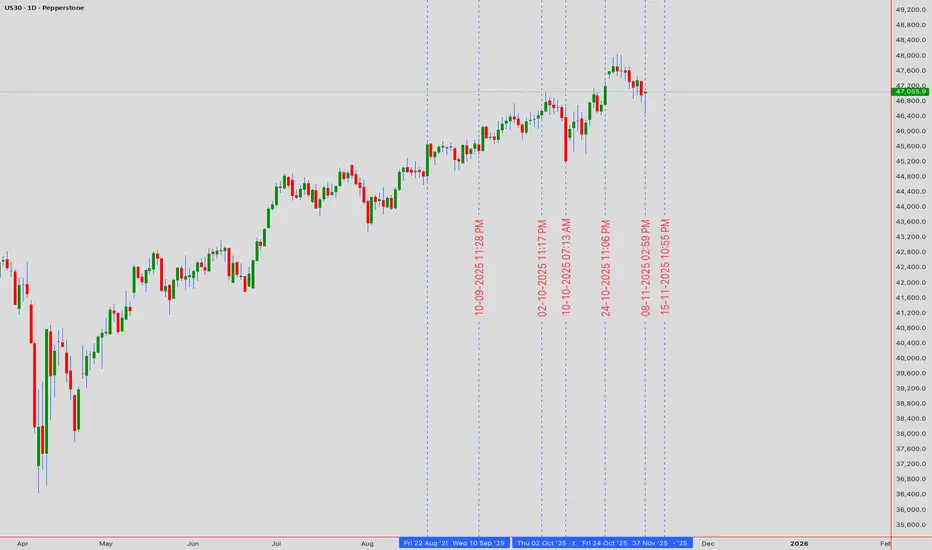
US MARKET SESSION # 📈 US30 (DOW JONES INDUSTRIAL AVERAGE) COMPREHENSIVE TECHNICAL ANALYSIS 🎯
## Week of November 10-14, 2025 | Intraday & Swing Trade Mastery
Close Price: 47,055.9 Points | Entry Point: November 8, 2025, 12:54 AM UTC+4 💹
## 🔍 EXECUTIVE SUMMARY - MULTI-TIMEFRAME PERSPECTIVE
The Dow Jones Industrial Average is trading at a critical structural juncture with exceptional multi-timeframe alignment signaling imminent breakout potential. Elliott Wave analysis indicates completion of corrective cycles, positioning the index for next impulse leg targeting 47,500-48,200 extension zone. Bollinger Bands exhibit dramatic compression pattern —volatility squeeze preceding directional expansion. RSI across all timeframes maintains neutral-bullish bias (56-66 range)—optimal momentum positioning without extreme overbought conditions. Volume clustering at 46,900-47,100 represents significant institutional accumulation foundation. Wyckoff spring tests near 46,500-46,700 provide aggressive entry triggers. Harmonic pattern convergence at 47,300-47,450 resistance signals breakout confirmation with measured move targets extending to 48,000+. Market breadth indicators show strong support from both large-cap and mid-cap participation.
## 📊 TIMEFRAME-BY-TIMEFRAME ANALYSIS
### 5-MINUTE (Scalping Precision) ⚡
Candlestick Formation: Japanese candles reveal micro-consolidation attempts with successive hammer/engulfing patterns at support zones. Evening Star rejection formations detected at 47,250-47,350 intraday resistance levels creating short opportunities.
Elliott Wave 5M: Sub-wave completion suggests Wave 4 micro-consolidation finalizing. Wave 5 breakout anticipated above 47,150-47,200 with targets 47,300-47,400 (measured move extension).
Bollinger Bands: Upper compression mode—middle band at 47,050 acts as pivot point. Lower band rejection (46,950-47,000) creates scalp-long setups. Squeeze breakout targets 47,350+ on volume confirmation.
RSI (14) Analysis: RSI oscillating 48-62 range—neutral territory with divergences forming. Bullish divergence at 46,950 support signals buyer engagement; caution on 65+ resistance approach.
Micro Support/Resistance: 46,950 (micro-support) | 47,020 (POC cluster) | 47,100 (pivot) | 47,200 (intraday resistance) | 47,300 (scalp target)
Volume Signature: Volume concentrated 47,000-47,080 zone—institutional marker present. Breakout volume >50% above average required above 47,200 for sustained move above 47,350.
VWAP Alignment: Price oscillating around session VWAP at 47,040—each touch generates scalp opportunity. Upper VWAP band at 47,280; lower support at 46,950.
### 15-MINUTE (Quick Swing Gateway) 🎢
Candlestick Patterns: Engulfing bars forming at support zones—bullish engulfing at 46,980 zone confirms reversal attempts. Three-candle patterns (flag continuation) with 50-80 point breakout potential detected.
Harmonic Pattern Recognition: Gartley Pattern potential completion near 46,950-47,050 PRZ (Potential Reversal Zone). Exceptional risk-reward ratio at 1:3.5 for harmonic traders. Butterfly variant also forming at secondary levels.
Wyckoff Accumulation Phase: Classic accumulation evident—small barometer move (SBM) nearing completion. Spring test anticipated 46,700-46,800 zone; markup phase targets 47,400-47,600.
Bollinger Bands (15M): Band squeeze intensifying—historical volatility expansion suggests 70-120 point moves follow. Upper band resistance at 47,300; lower band support at 46,800.
Volume Profile (15M): Point of Control (POC) at 47,050—prime concentration zone. Volume surge >60% required confirming breakout above 47,250. Imbalances favor upside probability significantly.
Ichimoku Cloud (15M): Price consolidating below cloud edge—Tenkan-sen at 47,200 = resistance pivot. Kijun-sen (47,100) = critical secondary support. Cloud support 46,850-46,950.
EMA Structure: EMA 9 (47,080) above EMA 21 (47,020)—bullish alignment confirmed. Price remaining above both = intraday strength maintained perfectly.
### 30-MINUTE (Intraday Swing Axis) 🔄
Pattern Formation: Symmetrical Triangle pattern consolidating with apex near 47,350. Ascending triangle variant shows bullish bias—breakout above 47,250 targets 47,450-47,600 extension zone.
Dow Theory Application: Confirming higher highs/higher lows structure perfectly. Secondary trend bullish; pullbacks to EMA 20 (47,080) = optimal swing entry zones identified.
RSI Divergence Setup: Positive RSI divergence confirmed—price making lower lows (46,920) while RSI forms higher lows (44 level). Classic reversal setup targeting 47,300 minimum breakout.
Exponential Moving Average: EMA 9 (47,100) = core support pivot. EMA 21 (47,020) = secondary support reliable. EMA 50 (46,850) = structural hold level. Bullish ribbon alignment intact perfectly.
Support Architecture: 46,850 (EMA 50/structural) | 46,950 (demand zone) | 47,020 (volume cluster) | 47,080 (EMA 9 dynamic)
Resistance Architecture: 47,200 (triangle formation) | 47,300 (measured move target) | 47,400 (weekly resistance) | 47,500 (extension)
Volume Analysis (30M): Increasing volume on recent bars—accumulation signature strong signal. Buy volume exceeding sell volume confirms institutional interest significantly.
### 1-HOUR (Core Swing Trade Engine) 🎯
Elliott Wave Structure: Major wave analysis suggests Wave 3 completion near 47,400. Current Wave 4 correction targets 47,000-47,150 support zone. Wave 5 impulse anticipated—target: 47,700-47,900.
Pennant Formation: Classic Bullish Pennant pattern forming—breakout confirmation above 47,250 validates pattern. Pole height measured move = 47,600+ realistic target.
Bollinger Bands (1H): Upper band at 47,450 = squeeze breakout target zone. Middle band (47,250) = bullish support zone. Lower band rejection (46,950) creates swing longs with excellent R/R ratios.
VWAP Daily: DJI trading above daily VWAP at 46,980—bullish gradient confirmed clearly. Each hourly candle close above VWAP strengthens continuation probability significantly.
Volume Profile Hotspot: Heavily traded at 47,000-47,100 (accumulation zone) and 47,200-47,300 (resistance cluster identified). Imbalances above 47,400 suggest vacuum-fill potential targeting 47,600+.
Ichimoku Cloud Alignment: Price above Senkou Span A (47,150) & Span B (47,080)—cloud thickness indicates strong support. Chikou Span above candles = bullish confirmation. Cloud color: BULLISH GREEN.
Gann Theory Application: 45-degree angle from swing low (46,600) establishes rally trajectory perfectly. Resistance at 38.2% Fibonacci extension (47,300) precedes aggressive breakout phase.
Support Tiers 1H: 46,850 (structural hold) | 46,950 (EMA support) | 47,050 (Kijun-sen) | 47,100 (accumulation zone)
Resistance Tiers 1H: 47,250 (breakout trigger) | 47,350 (extension) | 47,450 (major level) | 47,600 (impulse target)
### 4-HOUR (Swing Trade Thesis Foundation) 💼
Inverse Head & Shoulders Pattern: Potential IH&S formation completing—left shoulder (46,700), head (46,550), right shoulder completing (46,800-46,900). Neckline breakout at 47,250 targets 47,500-47,750 extension zone.
Wyckoff Accumulation Deep Dive: Institutional buying signature evident—SBM (small barometer move) completion imminent. Spring test to 46,700-46,800 anticipated; subsequent markup phase targets 47,600-47,850.
RSI 4H Analysis: RSI at 60-70 range—bullish bias maintained firmly. Room for upside extension without extreme overbought conditions. RSI above 75 targets 47,600+; below 35 = defensive posture required.
Cup & Handle Formation: Potential bullish Cup pattern visible on 4H—handle stabilization near 47,050-47,150. Breakout above handle (47,300) targets cup depth extension = 47,550-47,700.
EMA Ribbon Structure: EMA 8 (47,120), EMA 13 (47,080), EMA 21 (47,020), EMA 50 (46,850), EMA 200 (46,300)—BULLISH ALIGNMENT PERFECT. Compression/expansion cycles identify momentum phases clearly.
Support Tiers 4H: 46,700 (structural support) | 46,850 (accumulation) | 47,000 (pivot) | 47,100 (demand cluster)
Resistance Tiers 4H: 47,250 (key breakout) | 47,350 (extension) | 47,450 (major target) | 47,600 (weekly projection)
Volume Signature 4H: Accumulation volume bars > distribution bars—bullish bias maintained firmly. Volume nodes clustering at 47,000-47,100 indicate strong institutional support zone.
### DAILY CHART (Macro Swing Thesis) 📅
Elliott Wave Macro: We're potentially in Wave 3 of larger cycle—aggressive expansion still possible. Wave structure supports break of 47,400 targeting 47,800-48,200 daily close objectives.
Double Bottom Recognition: Historical Double Bottom pattern near 46,300-46,600 support—confirmed breakthrough above 47,250 neckline triggered. Second target near 47,600-47,800.
Bollinger Bands Daily: Upper band at 47,800 = realistic daily target zone. Mean (47,300) = healthy pullback support reliable. Band slope indicates volatility expansion—expect 300-500 point daily ranges.
Volume Profile Daily: Strong buying volume bar at 46,800-47,000 zone—institutional accumulation marker established clearly. Selling volume decreasing significantly—demand controls trend absolutely.
Ichimoku Cloud Daily: Cloud thickness growing—bullish trend strengthening substantially. Cloud support around 47,000-47,150 zone. Kumo breakout anticipated—targets cloud top at 47,400-47,600.
Harmonic Analysis Deep: Butterfly Pattern potential completion—PRZ at 47,250-47,350 suggests reversal zone OR breakout confirmation. Confluence amplifies probability of extension significantly.
Gann Angles & Fibonacci: 50% retracement (46,900) + 61.8% extension (47,500) = key reversal zones. Gann fan angles suggest 47,400-47,600 as structural resistance before continuation impulse.
Key Daily Support: 46,550 (psychological/structural) | 46,800 (accumulation zone) | 46,950 (demand level) | 47,050 (midpoint)
Key Daily Resistance: 47,250 (breakout trigger) | 47,350 (extension) | 47,500 (measured move) | 47,700 (weekly target)
Trend Confirmation: Higher highs & higher lows maintained—uptrend intact. Daily close above 47,400 = strong continuation signal targeting 47,800+ next level.
## 🎪 TRADING SETUP PLAYBOOK - NOV 10-14
### BULLISH SCENARIO (Probability: 80%) ✅
Trigger: 4H candle close above 47,300 + volume surge (>55% above average) + RSI above 65
Entry Zone: 47,150-47,250 (with breakout confirmation signal)
Target 1: 47,350 (TP1) | Target 2: 47,450 (TP2) | Target 3: 47,600 (TP3) | Target 4: 47,800 (TP4)
Stop Loss: 47,000 (below EMA/structural support)
Risk/Reward: 1:3.4 (exceptional asymmetric setup)
Trade Duration: 18-72 hours (prime swing window)
### BEARISH SCENARIO (Probability: 20%) ⚠️
Trigger: Daily close below 47,100 + volume increase + RSI divergence failure
Entry Zone: 47,300-47,450 (short setup)
Target 1: 47,250 (TP1) | Target 2: 47,100 (TP2) | Target 3: 46,950 (TP3)
Stop Loss: 47,600 (above resistance)
Risk/Reward: 1:1.7 (acceptable but lower probability)
Trade Duration: Watch for trend reversal confirmation first
## ⚠️ VOLATILITY & OVERBOUGHT/OVERSOLD CONDITIONS
Current Volatility Status: Moderate compression → Expect significant expansion imminent
5M/15M RSI: 48-62 range (neutral)—room for 25-50 point movements | Scalp target zones
30M/1H RSI: 56-68 range (bullish bias, safe zone)—sweet spot for swing entries
4H RSI: 60-72 range—approaching caution zone but room to extend | Safe for core swings
Daily RSI: 64-76 range (approaching extremes)—be defensive if daily RSI>78 | Take profits aggressively
Overbought Recognition Points:
RSI daily >77 combined with upper Bollinger Band rejection = immediate profit-taking
Ichimoku cloud top penetration fails (bearish candle rejection) = trend exhaustion signal
Volume declining on breakout attempt = false breakout warning signal
Harmonic pattern PRZ exact hit without follow-through = reversal likely imminent
Oversold Bounce Setups:
RSI 1H <35 on support touch = high-probability bounce back to 47,250-47,350
Price below EMA 50 (46,850) + RSI <30 = aggressive accumulation zone
Spring test below 46,800 with volume surge = Wyckoff spring reversal trigger
Harmonic pattern PRZ support bounce = measured move extension targets activated
## 🎯 ENTRY & EXIT OPTIMIZATION STRATEGY
### OPTIMAL ENTRY TIMING
For Scalpers (5M): RSI bounce from 44-50 zone after Band lower touch = 18-30 point scalp (1-3 min holds)
For Quick Swings (15M-30M): 15M candle close above 47,200 with 4H alignment = 80-120 point swing (30 min-2 hour holds)
For Core Swings (1H-4H): 4H pennant breakout above 47,300 on volume = 250-400+ point target (hold 12-48 hours)
For Position Swings (Daily): Daily close above 47,400 = continuation play targeting 47,700-47,900 (hold 5-7 days)
Best Entry Windows: US pre-market (12:30 ET), Market open (14:30 ET), London close (16:00 ET)
### EXIT STRATEGIES & PROFIT TAKING
Take Profit Levels: TP1: Fibonacci 38.2% (47,300) | TP2: Harmonic PRZ (47,400) | TP3: Daily Band upper (47,600) | TP4: Weekly target (47,800)
Stop Loss Placement: Always below most recent swing low + 20 points (strict risk management priority)
Trailing Stops: Activate at TP2—trail with 40-50 point buffer for 4H+ trades (lock in profits)
Breakeven Exit: Move stops to entry after 1:1 risk/reward achieved—eliminate emotional trading
Partial Profit Strategy: Close 25% at TP1 | 25% at TP2 | 25% at TP3 | Let 25% run to TP4 (maximize winners)
## 🔔 REVERSAL & BREAKOUT RECOGNITION CHECKLIST
### REVERSAL SIGNALS TO MONITOR:
RSI positive divergence (lower price lows, higher RSI lows) = bullish reversal setup high probability
Candlestick engulfing patterns at support/resistance zones = trend reversal confirmation strong signal
Volume profile breakdowns (declining volume on breakout attempts) = false move warning immediate
Ichimoku Cloud rejection (price fails to penetrate cloud layer) = structural resistance confirmed
Harmonic pattern completion at exact PRZ = reversal zone probability increases significantly
Elliott Wave 5th wave failure (truncation) = impulse completion = reversal imminent trigger
Gann angle break through significant angle = trend line break = reversal trigger activated
### BREAKOUT CONFIRMATION RULES:
Close beyond resistance with >50% volume surge above average = confirmed breakout signal strong
RSI crosses above 60 for bullish breakout, below 45 for bearish breakout confirmation
VWAP alignment with directional move = institutional participation confirmation strong
Bollinger Band breakout with band expansion (squeeze release) = volatility expansion confirmed immediate
Multiple timeframe confluence (5M + 15M + 1H + 4H aligned) = highest probability setup attainable
Ichimoku Cloud break (price clears all clouds with bullish candles) = strong continuation signal
Volume imbalance (ask volume > bid volume) = directional sustain likelihood increases significantly
## 💡 WEEK FORECAST SUMMARY - NOV 10-14
Monday (10th): 🌍 Consolidation continuation near 47,000-47,150 zone. Range-bound trading anticipated. Early breakout direction watch crucial. Entry setups favor reversal plays at support zones.
Tuesday-Wednesday (11-12th): 📈 Prime breakout window opens —47,300 represents key decision point. Expect 250-400 point daily volatility swings. Breakout confirmation targets 47,450-47,550 extension. This is the optimal swing trade window all week.
Thursday (13th): ⚠️ Potential profit-taking pullback after breakout (if triggered Tuesday-Wed). Support retest of 47,250-47,150. Buying opportunity if pullback holds above 47,050.
Friday (14th): 📊 Weekly close pattern formation critical. Extension run anticipated if above 47,400. If above 47,500 = week target 47,700-47,850 achieved. End-of-week positioning for next week.
## 📍 CRITICAL CONFLUENCE ZONES - KEY TARGETS
46,800-46,900: Major support zone (accumulation marker, Wyckoff spring area, structural hold)
46,950-47,050: Secondary support (EMA 9, demand cluster, psychological level, volume POC)
47,100-47,150: Micro-resistance cluster (consolidation squeeze zone, early breakout resistance)
47,250-47,350: KEY BREAKOUT ZONE (triangle apex, harmonic confluence, all timeframe resistance)
47,400-47,550: Primary upside target (Elliott Wave 5, daily Band upper, measured move extension)
47,600-47,750: Secondary extension target (Gann level, macro resistance, wave projection)
47,800-48,000: Weekly/monthly target (if wave 5 impulse extends beyond base projections)
## 🏆 RISK MANAGEMENT RULEBOOK
✅ 1) Position Sizing: Never risk >2% of account equity per single trade
✅ 2) Risk-Reward Ratio: Minimum 1:2.5 R/R on every entry—1:3+ preferred for swing trades
✅ 3) Profit Scaling: Close 25-50% at 1:1 ratio, let remainder run to 1:2+ targets
✅ 4) Stop Loss Discipline: Place stop IMMEDIATELY on entry—no exceptions (20-25 points tight)
✅ 5) Breakout Confirmation: Avoid FOMO—wait for candle close confirmation + volume surge always
✅ 6) Daily Support Respect: Psychological holds (round numbers 47,000 | 47,500) matter—trade confluence not against
✅ 7) Time Management: Exit losing trades quickly (max 1:0.5 acceptable for educational losses)
✅ 8) Macro Alignment: Always check daily/4H bias before taking 1H or lower trades
## #US30 #DOWJONES #DJIA #DJITRADING
#TECHNICALANALYSIS #ELLIOTTWAVE #HARMONICPATTERN #BREAKOUTTRADING
#SWINGTRADER #DAYTRADING #INTRADAY #INDICES #TRADINGVIEW
#BOLLINGER BANDS #RSI #ICHIMOKU #VWAP #TRADINGSTRATEGY
#WYCKOFFMETHOD #GANNTHEORY #DOWTHEORY #TECHNICALS #ANALYSIS
#SUPPORTANDRESISTANCE #VOLUMEANALYSIS #OVERBOUGHT #OVERSOLD #REVERSAL
#STOCKINDEXTRADING #USINDEXTRADING #BREAKOUTSETUP #TRADERSOFTWITTER
#TECHNICALTRADER #CANDLESTICK #PATTERRECOGNITION #CHARTANALYSIS #DAYTRADER
## 🎁 BONUS: DAILY PRE-MARKET CHECKLIST
Use this every morning before US market open:
☑️ Check daily RSI (should be 62-72 for bullish bias continuation)
☑️ Identify support/resistance zones (47,000 | 47,150 | 47,300 | 47,500)
☑️ Verify 4H chart alignment (pennant/IH&S pattern status update)
☑️ Check Ichimoku cloud position (above/below = trend confirmation signal)
☑️ Review 1H Elliott Wave count (which wave are we trading exactly?)
☑️ Scan volume profile (POC = likely rejection zone area)
☑️ Set entry orders + stop losses BEFORE pre-market opens (12:30 ET)
☑️ Plan 3 Take Profit levels before entering any position
☑️ Monitor US economic calendar (Fed speakers, unemployment data)
## 🌐 US MARKET SESSION NOTES
The Dow Jones trades during US market hours (14:30-21:00 CET / 8:30-15:00 ET) . Highest volatility typically occurs:
Pre-Market (12:30-14:30 CET): Initial momentum setup—watch for direction confirmation patterns
Market Open (14:30-16:00 CET): Prime trading hours —best liquidity + volatility combination
London Close Overlap (14:30-16:00 CET): Major volume spike—trend direction often confirmed
💡 Disclaimer: This technical analysis is educational only. Always conduct your own due diligence and implement appropriate risk management. Past performance does not guarantee future results. Trade responsibly within your risk tolerance. Use stop losses on every position. Not financial advice.
Analysis Created: November 8, 2025 | Valid Through: November 14, 2025 | Updated Daily at Pre-Market
Rockwell Automation (ROK) | Multi-Timeframe Expansion SetupThe Market Flow | Oct 24, 2025
Technical Overview
Monthly:
• Trend remains bullish above the active pivot at 247.68 .
• Structure confirms continuation after the prior corrective phase ended near the yearly midpoint.
• Fibonacci projection 138.2% aligns at 405.97 — defining the long-term expansion objective.
Weekly:
• Price has consolidated between two key pivots; upper resistance near 357–359 and lower support around 333.23 .
• A weekly close above the higher pivot would confirm breakout and validate continuation toward the next Fibonacci bands.
• Until that close is confirmed, the range remains technically valid — this upper pivot area acts as the invalidation zone for any premature bullish bias.
Daily:
• Yesterday’s session closed above the daily expansion level, confirming the start of an expansion phase .
• Structure is now aligned across timeframes with upside Fibonacci targets from 374.15 → 405.97 .
• Momentum confirmation is expected with follow-through above 358.52 , keeping focus on higher weekly extension zones.
Trade Structure & Levels
• Bias: Long above 350.30 (active daily pivot)
• Trigger: Break and close above 357.01
• Primary Invalidation: 351.91 on the Weekly
• Secondary Invalidation: 350.30 on the Daily
• Path → 374.15 → 386.18 → 405.97
• Phase: Expansion
• ATR(14D): 6.80
• Volume(20D): 0.78M
Risk & Event Context
• Earnings report due next week — volatility risk elevated into the event.
• Macro industrial sentiment and U.S. PMI data may further influence momentum.
• Elevated momentum readings suggest potential acceleration if breakout confirms above 358.
Conclusion
Rockwell Automation is entering multi-timeframe alignment with a validated daily expansion and potential weekly breakout confirmation pending. Long bias remains intact above 351.91, targeting 405.97 on sustained strength.
Disclaimer
This analysis is for informational purposes only and does not constitute investment advice, an offer, or a recommendation. Market conditions and price behavior may change without notice. Past performance is not indicative of future results. Always conduct your own research or consult a licensed financial advisor before making investment decisions.
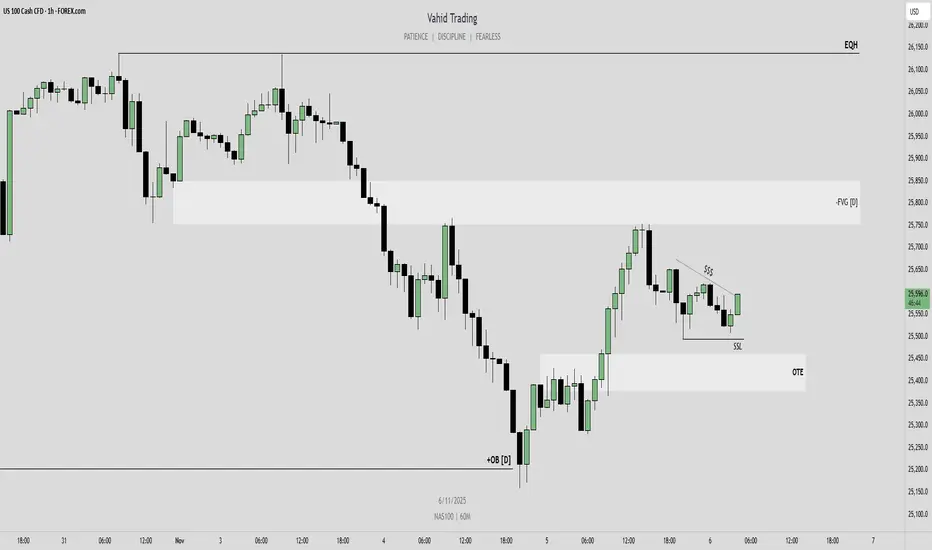
US100 – Bullish Continuation in Play After Daily OB ReactionHello traders,
On the 1-hour chart, NASDAQ (US100) has reacted strongly from the bullish Daily Order Block, showing clear signs of higher-timeframe strength. This reaction suggests that the bullish order flow is still intact.
With this structure in mind, I expect the upward move to continue toward the bearish Daily Fair Value Gap, which serves as my first target.
My final target for this bullish leg is the equal highs around 26,136, where a significant liquidity pool rests.
However, before the next expansion higher, I would prefer to see price move lower to sweep the liquidity below the recent lows and trade into an Optimal Trade Entry (OTE) zone. From there, I’ll look for lower-timeframe confirmation to catch the next leg up.
Staying bullish unless higher-timeframe invalidation occurs.
💌It is my honor to share your comments with me💌
🔎 DYOR
💡Wait for the update!
Bull Run Stumbles: S&P 500 Heads Toward a Potential Correction After a rough day on Wall Street, the S&P 500 dropped about 1.2%, pulling U.S. markets lower. But there’s more behind this fall than just profit-taking.
What’s Really Happening?
Warning Signs from Wall Street
Two top banking leaders raised caution. Morgan Stanley’s Ted Pick expects a 10–15% correction, calling it a “healthy normalization.”
Goldman Sachs’ David Solomon warned that tech stocks are showing bubble-like behavior, with prices running much faster than earnings.
AI Boom Driving Market Concentration
The AI craze and tech optimism have made a few mega-cap companies dominate the market. In fact, just 10 big tech firms now make up nearly 40% of the S&P 500’s total value, making the market more fragile.
Fed Confusion Adds to Uncertainty
The Federal Reserve is sending mixed signals — some officials talk about possible rate cuts by December, while others say rates should stay high because the economy is still strong.
Adding to the mess, a partial U.S. government shutdown has delayed key data, leaving investors and the Fed guessing about what’s really happening in the economy.
What the Chart Reveals
From a technical standpoint, the U.S. market’s rally has been nothing short of extraordinary. Since the April bottom near 4,835, the index has soared nearly 42%, touching a recent peak around 6,920 — and even gained about 12–13% before the latest (April 2025) pullback began.
But now, the momentum seems to be fading. The chart is flashing early warning signals — RSI divergence suggests that while prices made new highs, the underlying strength (momentum) did not. That often hints at a potential trend reversal.
If this weakness deepens, the index could correct swiftly by around 10%, targeting the 6,200–6,100 zone. And if the “healthy normalization” predicted by Morgan Stanley’s Ted Pick (a 15% drop) plays out, the index might slide further to around 5,700 — a level that would reset valuations to more reasonable territory after the sharp run-up.
Valuation Check
Let’s set aside all the opinions and headlines for a moment and focus on the key valuation metrics that truly help us understand the real picture of the U.S. market.
The Price-to-Earnings (P/E) Ratio — The Market’s Mood Meter
P/E Ratio = Current Market Price/Earnings Per Share (EPS)
So, Current Market Price = P/E Ratio*EPS
Currently, the S&P 500’s P/E ratio stands at 30.8x, with an EPS of $222.5.
When you multiply the two — 30.8 × 222.5 = roughly $6,800 — it perfectly aligns with the index’s recent market level.
Now, to find out what the fair value of the market should be, let’s use the 5-year median P/E ratio, which is around 25.4x.
Fair Market Price = 25.4*222.5 = 6,650.
This aligns perfectly with the technical chart levels, suggesting that a 15% correction would be a healthy pullback to help cool down the overheated U.S. market.
The Buffett Indicator — Market Cap vs. GDP
One of Warren Buffett’s favorite valuation tools compares the total U.S. stock market capitalization to the country’s GDP — essentially measuring how large the market has grown relative to the real economy.
At present, this ratio stands at around 224%, far above the long-term fair value range of 100–120%. Even when compared to its 5-year median level of 192%, the market still appears significantly overvalued.
To return to its median level, the ratio would need to drop by roughly:
100 = 16.6%
That’s roughly a 15–16% correction, which again perfectly aligns with both the technical chart signals and Ted Pick’s projection of a healthy market normalization.
The Bottom Line
The U.S. market’s extraordinary rally has been built on a mix of AI optimism, liquidity hopes, and investor euphoria, but the fundamentals are starting to whisper caution.
Both valuation metrics and technical signals point to the same conclusion — the market is stretched, and a 10–15% correction wouldn’t be a disaster; it would be a return to balance.
History shows that every overheated bull run needs a pause — not to end the story, but to give it a stronger foundation.
So if the coming months bring some red on the screen, smart investors will see it not as fear, but as the market taking a deep breath before its next big move.
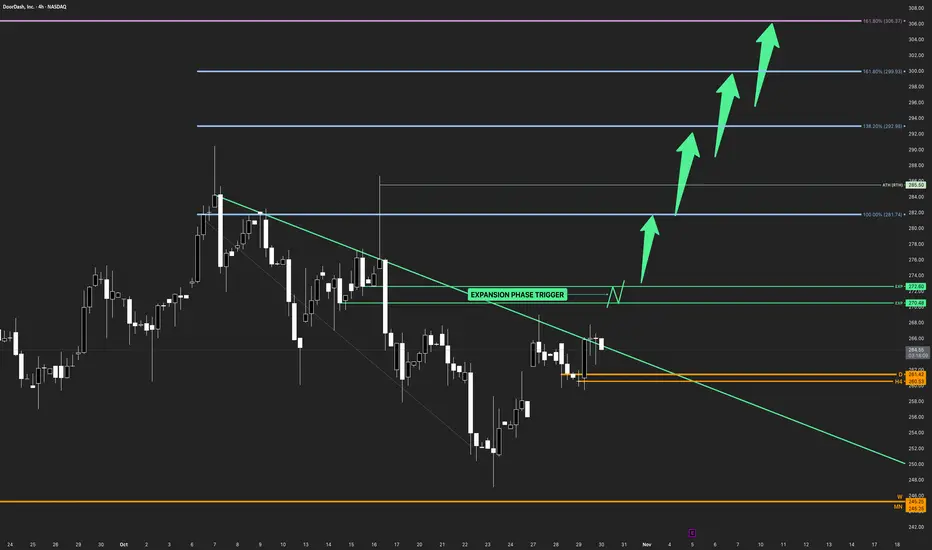
DoorDash (NASDAQ:DASH) | Multi-Timeframe Expansion SetupThe Market Flow | October 30, 2025
Company Overview
DoorDash Inc. operates a logistics platform connecting consumers with merchants for food, grocery, and retail delivery. Revenue is generated primarily through delivery fees, merchant commissions, and DashPass subscriptions. The company holds a leading share in the U.S. delivery market and continues expanding into new verticals such as grocery and retail.
DoorDash fits the fast grower category — a business reinvesting aggressively into market reach and operational efficiency, prioritizing scale and margin improvement over short-term profitability.
Technical Overview
Monthly:
• Structure remains decisively bullish after September’s close above the 138.2% Fibonacci extension.
• Continuation confirmed toward the 161.8% target at 306.37 .
• The monthly pivot holds at 245.25 , defining long-term structural support and maintaining expansion bias.
Weekly:
• Recent candle retested the prior breakout pivot and rejected it with a pronounced lower wick.
• Sustained institutional demand visible near 245–246 .
• Structure remains intact and aligned with monthly expansion path.
Daily:
• The bearish countertrend was invalidated following a confirmed 1-2-3 reversal above the last pivot.
• Daily trend has shifted to bullish, opening the path toward expansion.
• First clean breakout aligns with EXP 270.48 , defining the lower boundary of the expansion zone.
H4:
• Accumulation continues just below the expansion zone 270.48–272.60 .
• A decisive H4 close above 272.60 activates full expansion.
• Confirmed impulsive closes above this level would open the Fibonacci path toward 281.74 → 292.99 → 299.93 → 306.37 .
• The active H4 pivot at 260.53 defines structural invalidation.
Trade Structure & Levels
• Bias: Long above Weekly Pivot 245.25
• Phase: Accumulation → Expansion Setup
• Trigger: H4 close above 272.60
• Invalidation: H4 close below 260.53
• Path → 281.74 → 292.99 → 299.93 → 306.37
Risk & Event Context
• Earnings-season volatility may influence near-term price behavior.
• Broader NASDAQ sentiment tied to inflation and labor data remains the main macro driver.
• No major company-specific catalysts currently scheduled.
Conclusion
All timeframes from Monthly through H4 remain in bullish alignment. Price consolidates just below the expansion zone — a confirmed H4 close above 272.60 would transition structure into full expansion, unlocking the next Fibonacci sequence toward 306 .
Disclaimer
This publication is provided for informational and educational purposes only and does not constitute investment advice, a solicitation, or a recommendation to buy or sell any security, derivative, or financial instrument. The analysis and opinions expressed reflect the author’s views at the time of writing and are subject to change without notice.
All information is derived from publicly available sources believed to be reliable, but accuracy and completeness are not guaranteed. Past performance is not indicative of future results, and no representation or warranty is made regarding future price behavior or outcomes.
Readers are solely responsible for their own investment decisions and should consult a qualified financial advisor before acting on any information contained herein.
The author and/or affiliates may hold, trade, or have a financial interest in the securities or instruments mentioned in this publication. Neither the author nor any associated party accepts liability for any direct or consequential loss arising from the use of this material.
US500: Strong Upward Momentum Approaching 7000 LevelFundamental approach:
- The US500 advanced this week, propelled by strong earnings momentum from tech giants and robust performance in select sectors. Among top movers, Qualcomm rose over 11% following upbeat earnings guidance, while Alphabet and Tesla also rallied ahead of their highly anticipated quarterly results. W.R. Berkley Corporation and Welltower Inc. were notable gainers, reflecting sector rotation and risk-on flows in the index.
- Earnings from the 'Magnificent Seven', including Microsoft, Alphabet, and Meta, drove sentiment, with over 86% of S&P 500 companies reporting results above consensus expectations so far this quarter. Tesla's performance was mixed, while Amazon is set to announce slightly lower profits, but the broader group is still outpacing the rest of the market in earnings growth.
- Tech earnings and the upcoming FOMC decision are key catalysts that may influence future US500 moves. Broad sector participation and ongoing AI investment could sustain upward momentum if macroeconomic conditions remain supportive.
Technical approach:
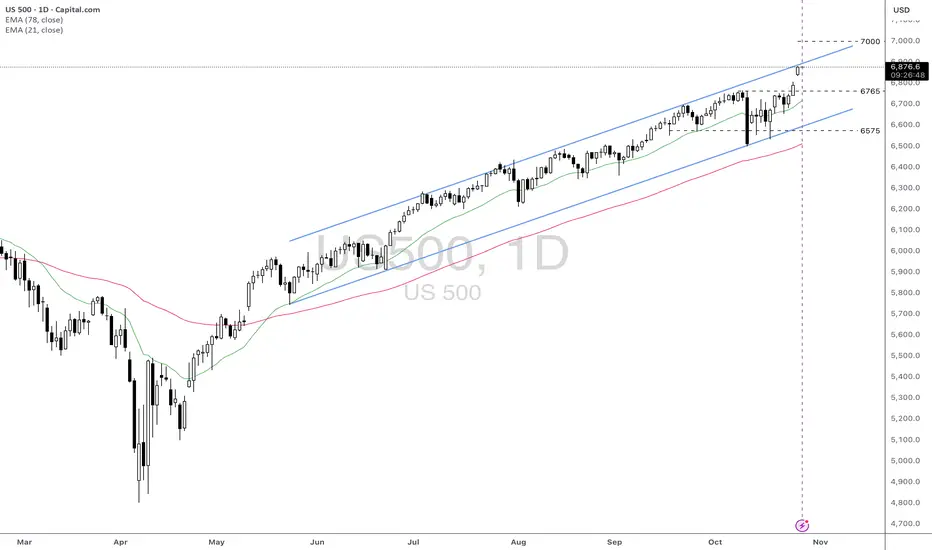
- US500 created a new all-time high this week after breaching the key level at around 6765. The index showed an urgency in moving upward, creating a gap that remains unfilled. US500 is well above the diverging EMAs, indicating a strong upward momentum. However, the index is approaching the upper bound of the ascending channel, which may limit the price movement.
- If the current gap remains unfilled, the US500 may continue to move upward and test the psychological resistance at 7000.
- On the contrary, rejecting the channel's upper bound may prompt a correction and fill the gap around 6790, retesting the broken level at 6765.
Analysis by: Dat Tong, Senior Financial Markets Strategist at Exness
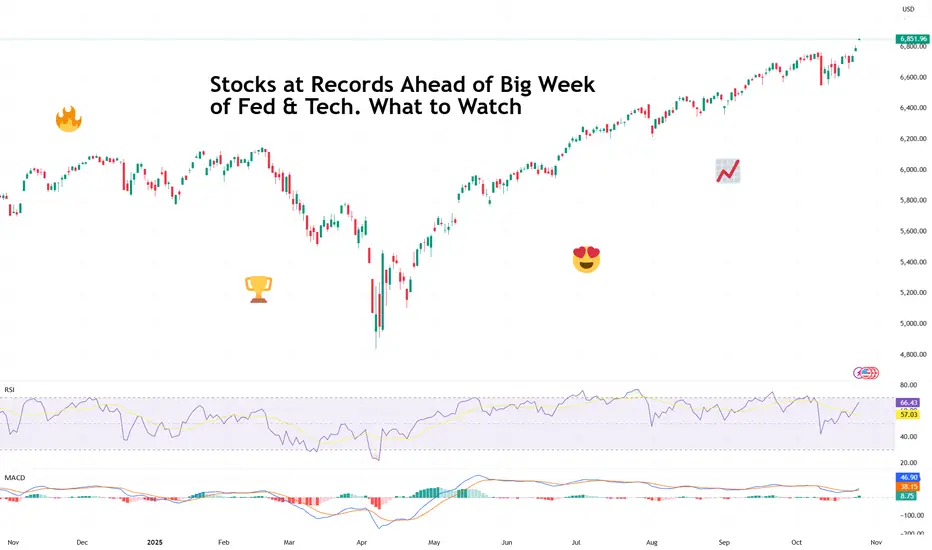
Stocks at Records Ahead of Big Week of Fed & Tech. What to WatchRecord highs, rate-cut optimism, five tech giants on deck — what a time to be a market participant!
It’s Monday, and Wall Street is back doing what it does best — setting new records and pretending not to worry about what comes next.
After a cooler-than-expected inflation print and some diplomatic smiles from Washington and Beijing, all three major indexes are kicking off the week in full throttle.
Last Friday, the Dow Jones Industrial Average TVC:DJI finally closed north of 47,000 for the first time ever, rising 472 points, or 1%.
You know that feeling when you hit every green light on the way to work? That’s what Friday felt like. The S&P 500 SP:SPX climbed 0.8%, and the Nasdaq Composite NASDAQ:IXIC gained 1.2%. Together, the trio ended the week at record highs.
The spark? September’s Consumer Price Index ECONOMICS:USCPI rose 3.0%, slightly below the 3.1% expected. Traders took that as a nod from the economy that the Federal Reserve can keep easing off the monetary brakes.
Odds of at least a half-point in rate cuts by year-end jumped to nearly 97%, according to the CME FedWatch Tool.
Soft inflation, strong sentiment, and new highs — *insert feelsgoodman meme.*
🤝 A Trade Truce (For Now)
Adding to optimism, US and Chinese negotiators sounded unusually positive over the weekend. The two sides reportedly hammered out a trade framework, setting the stage for President Donald Trump and Chinese leader Xi Jinping to meet in South Korea later this week.
Treasury Secretary Scott Bessent said the talks “ought to pave the way” for a broader discussion on tariffs, tech transfers, and everything in between — the kind of vague optimism that markets eat up like comfort food.
For now, investors are choosing to focus on the handshake rather than the fine print. After all, in the markets, hope is often more powerful than details.
🏦 The Fed’s Big Moment
The main event, however, comes midweek. The Federal Reserve is widely expected to cut interest rates ECONOMICS:USINTR by a quarter point on Wednesday. But the real show starts after the decision, when Jerome Powell takes the mic.
Traders will be parsing every word of his press conference for hints on how much further the Fed is willing to go. The tone of his remarks could determine whether markets keep coasting at record highs — or finally take a breather.
So far, Powell has managed to thread the needle: easing just enough to keep growth alive without letting inflation flare back up. But with stocks at all-time highs and job data still missing due to the government shutdown, he’s got a tough balancing act.
💻 Big Tech Takes the Stage
Anyway, peak earnings season is here and if macro policy is the first act this week, Big Tech earnings are the broader narrative.
Five members of the Magnificent Seven — Microsoft NASDAQ:MSFT , Alphabet NASDAQ:GOOGL , Meta NASDAQ:META , Apple NASDAQ:AAPL , and Amazon NASDAQ:AMZN — will all report their latest results.
That’s roughly $12 trillion in combined market cap stepping into the spotlight.
After a few solid years of sky-high expectations around AI, cloud, and advertising recovery, investors are craving proof that the hype is translating into actual earnings.
The question isn’t whether these companies are still dominant — it’s whether they can keep growing fast enough to justify valuations that have already priced in perfection.
Microsoft, Meta and Alphabet kick things off Wednesday, Apple and Amazon step up Thursday. Somewhere between all that, expect social media feeds to explode with charts, hot takes, and the occasional meme about “buying the dip” before it even happens.
🌍 Markets in a Mood
It’s one of those rare weeks when every major force — central banks, geopolitics, and tech earnings — converge into a single market narrative. And, by the looks of it, that narrative is leaning bullish.
Still, keep an eye out for surprises.
Off to you : Where do you think markets are heading this week? Are you excited to snap up some tech shares ahead of the updates or looking to play defense? Share your thoughts in the comments!
General Motors: Turning Headwinds into GrowthWhen the global auto industry was rattled by tariffs, regulatory uncertainty, and the volatile EV market, many would have expected General Motors NYSE:GM to struggle. Instead, the Detroit giant did something remarkable: it turned challenges into opportunities.
In a single day after reporting earnings, GM’s stock jumped 14.7%, its biggest one-day surge in nearly six years. Investors cheered as the company’s market cap climbed near $63 billion, trading at a surprisingly low 6× earnings—a rare combination of value and growth in today’s auto sector.
◉ Steady Revenue Amid Strategic Shifts
In Q3 2025, GM posted $48.6 billion in revenue, holding steady despite headwinds. Net income fell 57% YoY to $1.32 billion, driven largely by one-time strategic charges—but the story behind the numbers was far more encouraging.
Adjusted EBIT hit $3.4 billion, which would have been about 9% if not for $1.1 billion in tariff costs—a figure right in GM’s historical “sweet spot” for North America.
Even more striking was the company’s confidence. GM raised its 2025 EBIT guidance by $1.25 billion, from $11.25 billion to $12.5 billion. The message was clear: GM is not just surviving—it’s thriving.
◉ Commanding the U.S. Market
GM’s market share in the U.S. climbed to 17%, the best third-quarter level since 2017. With 710,000 units sold (+8% YoY), the company continues to dominate high-margin segments:
● 41% share in full-size pickups
● 60% share in full-size SUVs
● 16.5% of the U.S. EV market, second only to Tesla
Remarkably, GM’s incentive spending remains low at 4% of the average transaction price, versus the industry’s 6.9%, helping preserve margins even in a fiercely competitive market.
◉ Strategic Realignment: Pragmatism Over Volume
GM isn’t chasing growth blindly. It made a $1.6 billion charge to recalibrate its EV roadmap, focusing on profitability over aggressive volume. The company:
● Repurposed the Orion Plant for ICE production
● Ended the BrightDrop commercial van program
● Scaled battery module capacity to match realistic demand
Meanwhile, a $4 billion investment across U.S. facilities increases ICE production and reduces tariff exposure—turning a potential risk into a strategic advantage.
◉ Turning Tariffs Into Opportunity
Tariffs could have been a major headache. Instead, GM’s combination of disciplined pricing, manufacturing realignment, and cost control has offset ~35% of gross tariff exposure, lowering net risk and positioning the company for even more relief by 2026.
◉ Electric Vehicles: A Calculated Path Forward
EVs remain GM’s “North Star,” but now with a sharper focus on profitability. In Q3 2025, GM sold 67,000 EVs, capturing 16.5% of the U.S. EV market. Chevrolet’s Equinox EV became the top-selling non-Tesla EV.
Management is strategically right-sizing production, aiming to reduce EV losses starting 2026 while sustaining innovation.
◉ China: A Quiet Turnaround
While the world watched Tesla, GM quietly delivered a fourth consecutive profitable quarter in China, earning $80 million in equity income. Market share rose to 6.8%, with 470,000 units sold (+10% YoY). New energy vehicle sales have grown for ten straight quarters, outperforming many global peers.
◉ Software and Services: The High-Margin Engine
GM isn’t just about cars. Its software and services segment, now nearly $2 billion in revenue, is reshaping the company’s future.
● OnStar subscribers reached 11 million (+34% YoY)
● Super Cruise users surpassed 500,000 (almost doubled)
● Deferred revenue hit $5 billion, with ~70% margins
This high-margin, recurring revenue stream is becoming a cornerstone of GM’s profitability story.
◉ Disciplined Capital & Shareholder Returns
GM’s commitment to shareholders is clear:
● $2.1 billion invested in projects.
● $1.3 billion in debt repaid.
● $3.5 billion in year-to-date share buybacks, cutting share count 15% YoY.
Strong cash flow and shareholder returns reinforce GM’s reputation as a strategically disciplined company.
◉ Risks on the Horizon
No story is complete without caution:
● EV demand may soften post-federal tax credits.
● Additional Q4 charges related to EV adjustments and BrightDrop wind-down.
● Ongoing tariff and supply chain risks.
● Warranty costs of ~$900M annually.
● Economic and consumer headwinds could impact sales and financing.
◉ The Valuation Story
Despite all this, GM trades at 6× earnings, a stark contrast to Tesla’s 200× multiple. As Morgan Stanley’s Adam Jonas observed: “GM has higher margins and higher growth than Tesla, and trades at six times earnings—not 200 times.”
◉ What the Chart Says
● The monthly chart shows a clear breakout from an Inverted Head & Shoulders pattern, signaling a potential uptrend.
● The daily chart confirms this breakout with a big gap up and strong volume, signaling robust buying interest.
◉ Looking Ahead: 2026 and Beyond
GM expects 2026 to outperform 2025, driven by:
● Lower EV losses
● Reduced warranty costs
● Full-year tariff relief
● Strong demand for high-margin trucks and SUVs
With EBIT guidance now at $12–13B, GM is poised for sustainable profitability.
◉ The Investment Takeaway
General Motors is no longer just a traditional carmaker—it has become a story of change and resilience. The company has shown it can handle global challenges, adjust its business approach, and make smart, disciplined decisions.
For investors, GM is more than a stock; it shows how a long-standing company can reinvent itself and still deliver steady returns. By balancing innovation, profitability, and careful use of capital, GM proves that strong leadership and clear focus can create lasting value—even in a tough industry.
In short, GM is a prime example of turning challenges into opportunities, making it a strong choice for investors who care about smart strategy, stability, and growth.
💬 What do you think about GM? Would you invest now or hold off? Let us know in the comments!
DELL | Multi-Timeframe Expansion SetupThe Market Flow | Oct 23, 2025
Technical Overview
Weekly: Structure remains bullish, with price holding above the active pivot at 138.00 . Weekly Fibonacci 138.2% extension aligns with the medium-term upside path toward 192.84 .
Daily: The daily countertrend originating from the recent weekly high has been broken, confirming early structural reversal within a corrective phase. Momentum is shifting back into alignment with the higher timeframe trend.
H4: Countertrend break above descending structure and trigger zone at 153.70 establishes the start of a new expansion phase. Clean Fibonacci projection targets stand at 165.26 , 171.92 , 176.03 , 182.69 , 189.35 , and 193.46 .
Trade Structure & Levels
• Bias: Long above 140.74 (active Daily pivot)
• Trigger = 153.70 (H4 breakout)
• Primary Invalidation = 149.78 (H4 pivot)
• Secondary Invalidation = 140.74 (Daily pivot)
• Path → 165.26 → 171.92 → 176.03 → 182.69 → 189.35 → 193.46
• Phase: Countertrend Break → Early Expansion
Risk & Event Context
• Next earnings report due early December.
• Broader tech sector resilience may support momentum continuation into Q4.
• Watch volatility around 160.00–165.00 where overlapping Fibonacci zones may cause short-term pauses.
Conclusion
All active timeframes confirm bullish alignment, with a confirmed countertrend break on H4 signaling early expansion. Maintaining above the daily pivot at 140.74 sustains the long bias toward higher Fibonacci extensions.
Disclaimer
This analysis is for informational purposes only and does not constitute investment advice, an offer, or a recommendation. Market conditions and price behavior may change without notice. Past performance is not indicative of future results. Always conduct your own research or consult a licensed financial advisor before making investment decisions.
JP Morgan (JPM) - H4 - Breakout Pattern (20.10.2025)📊 Setup Overview:
J.P. Morgan ( NYSE:JPM ), presenting a bearish outlook based on the price action.
📈 Trade Plan:
Bias: Bearish below $310
1st Target: $272 ✅
2nd Target: $258.52 🎯
Resistance Zone: $311 – $318
🧩 Technical Confluence:
1.Price Breaks the Wedge Pattern.
2.Trendline break confirming reversal
3.Ichimoku Cloud crossover indicating bearish momentum
🏦 Key Fundamentals & Recent Performance
1.JPM reported third-quarter 2025 adjusted revenue of ~$47.12 billion, topping estimates.
2.Net interest income (NII) rose only ~2% YoY in Q3 to $24.1 billion, and the bank raised its 2025 NII outlook to ~$95.8 billion.
3.JPM itself flags major risks: ongoing geopolitical uncertainty, elevated asset valuations, potential credit stress and slower growth.
#JPM #JPMStock #NASDAQ #USStocks #TechnicalAnalysis #wedgePattern #BearishSetup #PriceAction #EarningsWatch #StockMarket #SwingTrading #TradingView #Ichimoku #CloudCrossover #ChartsDontLie #Kabhi_TA_Trading
⚠️ Disclaimer:
This analysis is for educational purposes only and not investment advice. Always perform your own due diligence and manage risk appropriately before taking any position.
💬 Support the Analysis:
If this chart helped you — LIKE 👍, COMMENT 💬 your thoughts, and FOLLOW ✅ for more daily stock & forex chart breakdowns from Kabhi_TA_Trading!