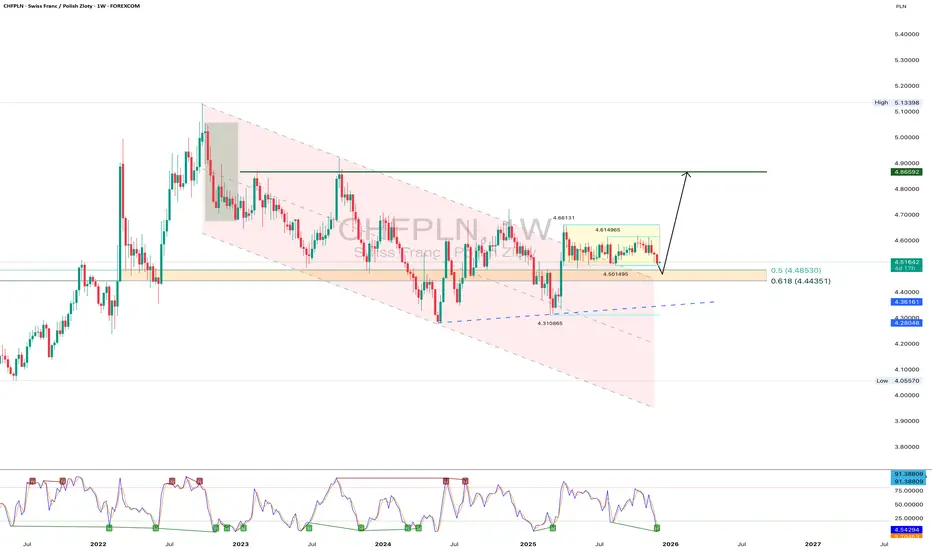
CHFPLN preparing a move or just testing everyone patienceCHFPLN continues to trade inside a developing upward structure after breaking out of a wide descending channel. The current pullback has brought the pair into the demand zone between 4.48 and 4.44 which aligns with the Fibonacci correction range at 0.5 and 0.618. Weekly oscillator divergence signal
Swiss Franc / Polish Zloty
No trades
No trades
Peers for comparison
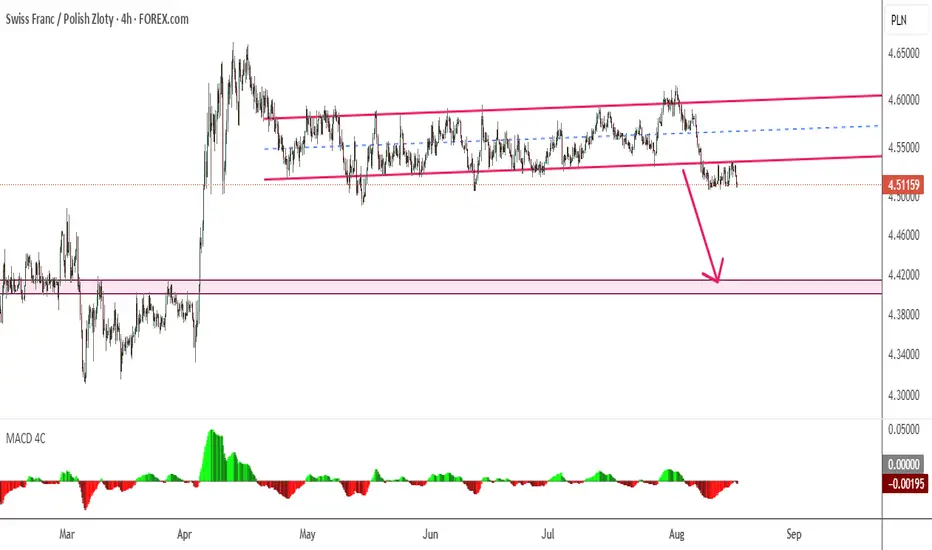
Polish zloty in trouble: Swiss franc is sharpening its teethTechnically, CHFPLN has completed a consolidation phase within a narrowing triangle and broke to the upside. The pair is now testing the 4.60 level (the 0.618 Fibonacci retracement) from below — a decisive zone. A breakout and confirmation above this area opens the path toward 4.705, which coincides
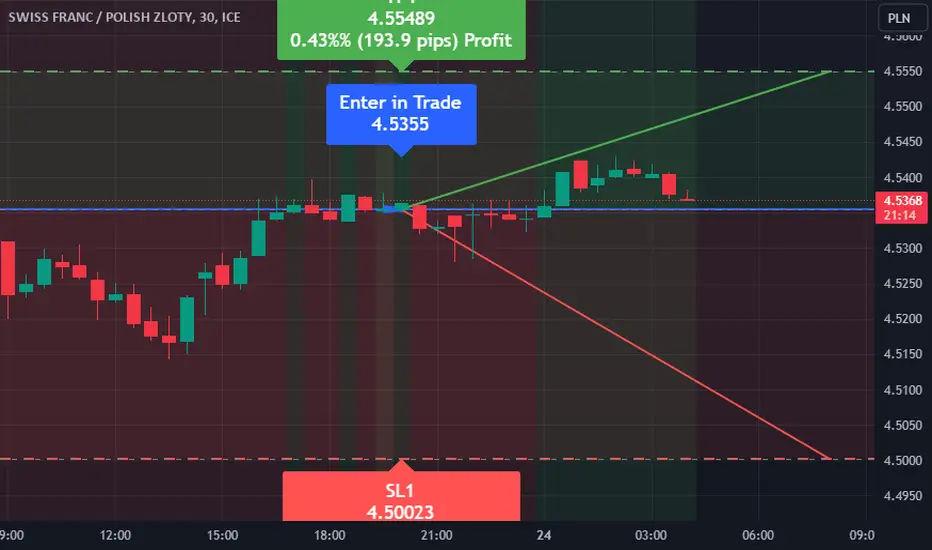
Trading Signal for CHF/PLN: Buy RecommendationDirection: Buy
Enter Price: 4.5355
Take Profit: 4.55489
Stop Loss: 4.50023
Our latest trading signal for the CHF/PLN currency pair indicates a buying opportunity. The signal has been generated using our advanced EASY Quantum Ai strategy, which analyzes various market factors to deliv
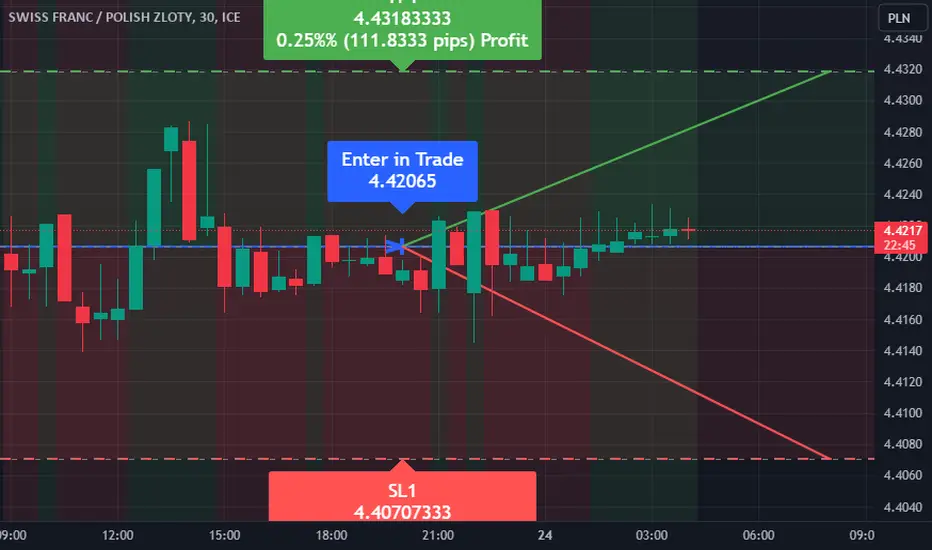
Forex Signal: CHFPLN MovementDirection: Buy
Enter Price: 4.42065
Take Profit: 4.43183333
Stop Loss: 4.40707333
Dear Traders,
We have identified a promising trade opportunity on the CHF/PLN currency pair. Based on our advanced analytics and the sophisticated EASY Quantum Ai strategy, we suggest taking a bullish positio
Trade Signal: CHF/PLN - Sell OpportunityWe have identified a sell opportunity on the CHF/PLN currency pair using our advanced trading strategy, EASY Quantum Ai. Below are the details of the trade:
Direction: Sell
Enter Price: 4.35767
Take Profit: 4.34857
Stop Loss: 4.37464
Rationale: The current market conditions indic
See all ideas
Summarizing what the indicators are suggesting.
Oscillators
Neutral
Oscillators
Neutral
Summary
Neutral
Summary
Neutral
Summary
Neutral
Moving Averages
Neutral
Moving Averages
Neutral
Displays a symbol's price movements over previous years to identify recurring trends.
Frequently asked questions
Today, CHF/PLN rate is 4.77051 PLN.
For broader market analysis, dive into the technicals on the CHFPLN live chart.
The safest way to trade CHFPLN is through a reliable broker. Create an account, fund it, and place a buy order.
You can trade CHFPLN directly from TradingView:
– Choose a broker: Explore our supported trading partners and pick one that fits your needs
– Compare options: View available brokers side by side to evaluate fees and features
– Connect your account: Open Supercharts, click "Trade", select your broker, and log in
– Start trading: Place orders without leaving the chart
Tip: If you're new to trading, try paper trading first — it lets you practice strategies in real market conditions without risking funds.
It's worth checking CHFPLN rate change for various periods to get the full picture:
– 1 day — +0.12%
– 1 week — −0.09%
– 1 month — +1.23%
CHFPLN's all-time low was 2.56000 PLN (Apr 19, 2010), and its highest price is 5.13398 PLN (Sep 29, 2022). Track the dynamics with the latest forex news right on TradingView.
– 1 day — +0.12%
– 1 week — −0.09%
– 1 month — +1.23%
CHFPLN's all-time low was 2.56000 PLN (Apr 19, 2010), and its highest price is 5.13398 PLN (Sep 29, 2022). Track the dynamics with the latest forex news right on TradingView.
When trading CHFPLN, one should keep in mind many factors.
First, analyze the fundamentals:
– Macroeconomic data: Inflation, GDP, employment, and other key indicators in the economies behind both currencies
– Central bank policy: Interest rate decisions and monetary policy from the respective central banks
– Market sentiment: Check what other traders anticipate
– News flow: Geopolitical events and economic releases
Then check technical ratings:
– Today — buy
– 1-week — buy
– 1-month — strong buy
Identify the trend, watch key levels (support and resistance), consider volatility and upcoming economic events. Then, you'll be closer to an informed decision.
CHFPLN volatility measures how much the exchange rate fluctuates over time, i.e. how quickly and how strongly it moves up or down.
The current volatility rating is 0.43%.
What it means for traders:
– Higher volatility: Larger and faster price swings → higher risk and opportunity
– Lower volatility: More stable price movement → smaller trading ranges
– Market behavior: Volatility often increases during major economic news or central bank decisions
Volatility helps traders estimate risk and position sizing. It's also useful for adapting strategies to market conditions.
How to use volatility:
– Compare volatility across other currency pairs
– Combine with technical analysis (trends, support/resistance)
– Monitor economic events that may increase market movement
CHFPLN is quoted as how many PLN (quote currency) it takes to buy one CHF (base currency).
For example, if the pair trades at 1.50, it means 1 CHF = 1.50 PLN.
What can influence the rate:
– Supply and demand: Driven by trade, investment flows, and speculation
– Economic data: Inflation, GDP, employment reports
– Central bank policy: Interest rates and monetary decisions
Follow these and more events in the Economic Calendar.