An ascending AUDUSD signals China recovering About 1pm today Monday 29 December, 2025, AUDUSD made a higher high.
It's a bullish chart on the monthly as well.
There is serious talk of the RBA increasing the official cash rate in 2027, perhaps early in the 2nd quarter.
But many mining experts in Australia, for example, a very experienced Geologist, James Cooper see mining bouncing back and happening now in Lithium's cycle finally swinging back in vogue and copper, rare earths. Thats just for starters.
The video is short about 7 minutes and the key takeaway is that 0.71 is the likely target for buying AUDUSD but patterns create pattern's creating further momentum in currency's and take a look at how a bigger picture in this chart is at it vey early stages of printing which would trigger further Chinese world dominance.
* Hypothetical infomercial in nature. This is not investment advice.
^ My publications are released at the same time as my trades, so I do not cherry pick.
# Trading is risky. Before following anyone, always backtest their previous publications.
China
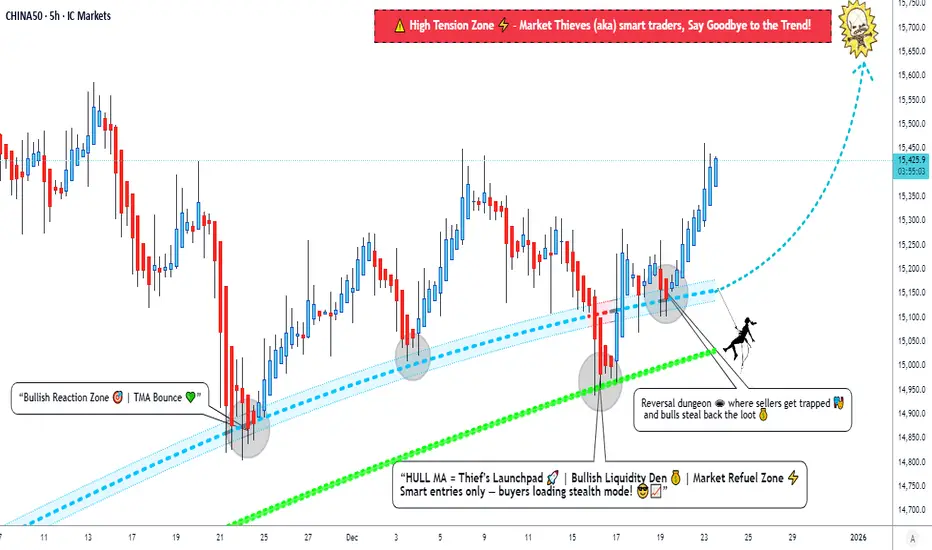
China 50 Index Maintains Uptrend Above Dynamic Support🚀 CHINA A50 INDEX SWING/DAY TRADE OPPORTUNITY 🚀
═══════════════════════════════════════════════════════
📊 ASSET: FTSE China A50 Index (XIN9) | CNY
💹 CURRENT PRICE: 15,366.93 | Last Updated: Dec 23, 2025
📈 52-WEEK RANGE: 12,182.84 - 15,759.61
───────────────────────────────────────────────────
🎯 BULLISH TRADING THESIS
✅ SETUP CONFIRMATION:
GREEN Hull Moving Average: Pullback + Retest Pattern Identified
BLUE Triangular Moving Average: Strong Support Confirmation
Market Structure: Higher Lows + Higher Highs (Uptrend Intact)
Volume Profile: Buying Pressure on Dips
📍 TRADE STRUCTURE: Swing Trade (1-7 Days) / Day Trade (Intraday)
───────────────────────────────────────────────────
🔥 ENTRY STRATEGY - "THIEF LAYERING METHOD"
Multiple Limit Order Entries (Reduce Average Cost):
Layer 1: Buy @ 15,200 (First Position)
Layer 2: Buy @ 15,250 (Add Position)
Layer 3: Buy @ 15,300 (Increase Exposure)
Layer 4: Buy @ 15,350 (Final Layer)
💡 Strategy Notes: You can increase/decrease layers based on your risk tolerance and account size. Each layer reduces emotional decision-making and optimizes entry cost basis.
⚠️ IMPORTANT: These are suggested entry points using established support zones. Adjust entries based on YOUR chart analysis and risk management rules.
───────────────────────────────────────────────────
🛑 STOP LOSS MANAGEMENT
THIEF STRATEGY SL: 15,100
Protects against breakdown of critical support zone
Allows room for natural market noise & pullbacks
Defines your maximum loss per trade
⚠️ CRITICAL DISCLAIMER:
Dear Ladies & Gentlemen (Thief OG's), your stop loss is YOUR choice. I recommend managing SL based on:
Your account size
Your risk/reward ratio (1:2 minimum)
Your personal risk tolerance
Market volatility at time of trade
Risk = Your Decision. Trade Responsibly. 🎲
───────────────────────────────────────────────────
🎊 PROFIT TARGET
PRIMARY RESISTANCE/TP ZONE: 15,650
Why 15,650?
🔴 ELECTRIC SHOCK RESISTANCE - Multi-Month Strong Resistance
⚡ OVERBOUGHT CONDITION - RSI/Stochastic Extended Levels
⚠️ BULL TRAP RISK - Correction Likely at This Level
🚪 ESCAPE POINT - Prudent Exit to Secure Profits
Secondary Resistance: 15,750-15,800 (Extended Run if Breakout Confirmed)
⚠️ CRITICAL DISCLAIMER:
Dear Ladies & Gentlemen (Thief OG's), your take-profit level is YOUR choice. I recommend:
Take partial profits at 15,650 (secure 50-70%)
Trail stop on remaining position
Let winners run if breakout confirmed
Never get greedy at resistance
Profits = Your Decision. Manage Exits Professionally. 💰
───────────────────────────────────────────────────
📡 CORRELATED PAIRS TO MONITOR
1️⃣ HANG SENG INDEX (HSI) - HSI:HSI
Correlation: Strong (0.94+)
Hong Kong's main benchmark
Includes major Chinese enterprises
A50 & HSI often move in synchronized patterns
Watch For: If HSI breaks resistance while A50 confirms—CONFLUENCE ✅
2️⃣ CSI 300 INDEX - $CSI300
Correlation: Very Strong (0.94+)
Tracks 300 largest A-shares (Shanghai + Shenzhen)
Covers ~60% of market capitalization
Direct domestic sentiment indicator
Watch For: CSI300 momentum confirms A50 uptrend strength
Current Level: 4,611.62 | 12-Month: +14.67%
3️⃣ SHANGHAI COMPOSITE (SSE) - LSE:SSE
Correlation: Strong
Shanghai Stock Exchange aggregate
Macro sentiment barometer
Strategy: If SSE rallies while A50 corrects = BUY DIP signal
4️⃣ S&P 500 INDEX ( SP:SPX ) - Risk Sentiment Proxy
Correlation: Moderate (0.45-0.55)
Global risk appetite indicator
If SPX crashes → Flight to safety/A50 weakness likely
If SPX rallies → Risk-on flows boost A50
Watch: Use SPX as macro context, not direct trade signal
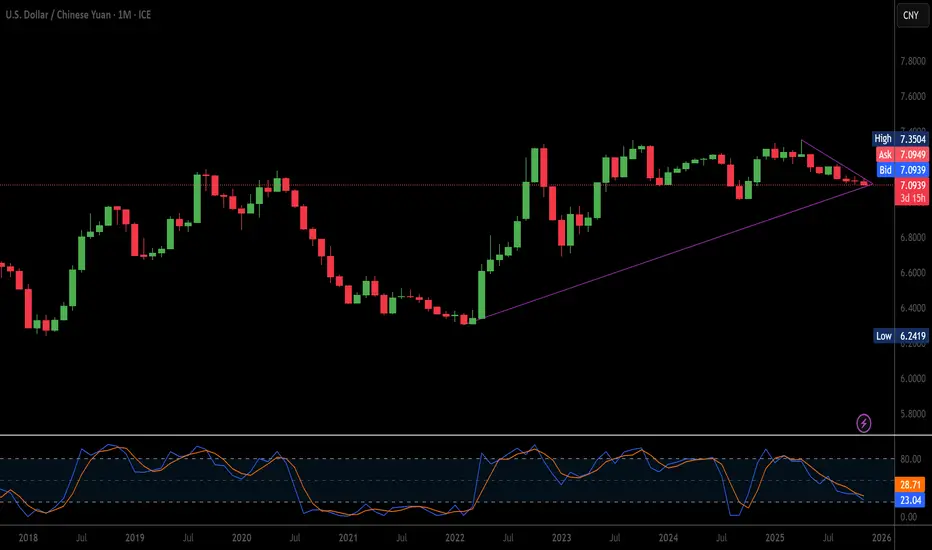
5️⃣ CHINESE YUAN (USDCNY) - FX_IDC:USDCNY
Correlation: Inverse (Negative)
Stronger Yuan = A50 typically gains
Weaker Yuan = Warning signal for weakness
Trade Implication: Monitor USDCNY breaks for A50 confirmation
🔗 CONFLUENCE STRATEGY:
When HSI + CSI300 + A50 all confirm support/resistance = Highest Probability Setup ⭐⭐⭐
───────────────────────────────────────────────────
📊 FUNDAMENTAL & ECONOMIC FACTORS
MACRO BACKDROP (December 2025)
🇨🇳 GDP Growth: +5.2% YoY (Q1-Q3 2025)
On track to meet 5% full-year target
Q3 Growth: +4.8% YoY | +1.1% QoQ
Government support measures active
Risk: External headwinds intensifying
📈 Inflation Dynamics:
CPI (Nov 2025): +0.7% YoY (Up from 0.2% in Oct)
Highest level since February 2024
Food prices: Recovered (+0.2% vs -2.9% Oct)
Core CPI: +1.2% (20-month high)
Impact: Rising inflation may support equities against cash
🏭 Manufacturing PMI (Nov 2025): 49.2
Status: 8th consecutive month in contraction (<50 = contraction)
New Orders: Weak (-48.8)
Foreign Sales: Depressed (-47.6) — U.S. tariff pressure
Concern: Manufacturing weakness pressures corporate earnings
💼 Industrial Production (Jan-Sep 2025): +6.2% YoY
Equipment Manufacturing: +9.7%
High-Tech Manufacturing: +9.6%
Positive for tech-heavy A50 components
Private Enterprises outperforming SOEs
🛍️ Retail Sales (Jan-Sep 2025): +4.5% YoY
Steady recovery from H1
Consumer caution persists
Government trade-in stimulus helping
Risk: Domestic demand still sluggish
🌍 Trade Dynamics:
Q3 Exports: +8.4% YoY
Q3 Imports: +7.5% YoY
Risk: U.S. Tariff Threat (100% tariffs on Chinese goods threatened)
September U.S. exports: -27% YoY
Trade war uncertainty creating volatility
🏛️ Government Policy Support:
✅ Fiscal stimulus active (expanded budget deficit)
✅ Monetary accommodation (Low interest rates + ample liquidity)
✅ New quality productive forces (AI, robotics, green tech)
⚠️ Risk: Real estate sector downturn continues to drag confidence
───────────────────────────────────────────────────
⚡ UPCOMING ECONOMIC EVENTS (Watch These!)
📅 January 2026:
Full-Year 2025 GDP Data Release (Major Market Mover)
New government policy announcements for 15th Five-Year Plan
Spring Festival economic expectations
📅 Risk Factors to Monitor:
U.S. Trade Policy (Tariff announcements)
Fed Rate Decisions (Impact on USD/CNY)
China Property Market Data (Housing Confidence)
Tech Sector Earnings & Policy Changes
───────────────────────────────────────────────────
✅ PRE-TRADE CHECKLIST
Before entering this trade, confirm:
✔️ Hull MA in green (bullish)
✔️ Blue Triangle MA providing support
✔️ Price above key support (15,100)
✔️ Volume increasing on ups
✔️ No major news releases next 4 hours
✔️ HSI/CSI300 in agreement (Confluence)
✔️ Your position size = 1-2% account risk
✔️ Entries planned in advance (No emotion)
───────────────────────────────────────────────────
🎓 RISK MANAGEMENT REMINDERS
The Thief Golden Rules:
Capital Preservation First - Never risk more than 2% per trade
Emotion = Enemy - Use limit orders, avoid panic trading
This Plan is NOT Financial Advice - Make your own decisions
Trade YOUR Plan, Not Mine - Adapt to your strategy
Losses are Normal - Professional traders manage them, don't avoid them
Partial Profits - Don't be greedy at resistance
No FOMO - Wait for your setup, skip bad trades
Journal Everything - Learn from every trade
DISCLAIMER:
This trading idea is for educational & informational purposes only. Not financial/investment advice. Past performance ≠ future results. Trading involves high risk of loss. You may lose your entire investment. Only trade with capital you can afford to lose. Consult a licensed financial advisor before trading.
───────────────────────────────────────────────────
🔔 FINAL NOTES
Why This Setup Works:
Bullish confluence (Moving Averages + Support)
Attractive Risk:Reward Ratio
Multiple entry layers reduce emotional decision-making
Clear stop loss and targets pre-defined
Supported by improving macro backdrop (GDP growth, tech momentum)
Why This Setup Can Fail:
U.S. Tariff escalation (External shock risk)
Manufacturing weakness deepens (PMI sub-50)
Wider China property downturn spreads to equities
Trade war intensification
Corporate earnings misses
Your Edge: Manage risk, scale into winners, protect capital, and repeat.
Good luck, Thief OG's! May your profits exceed your losses! 🚀💰
SUPER MICRO SEMI #SMCI Can bounce hard to $60This stock has been hit hard on prior forecast cuts and underwhelming results.
So after a big derating, a "less bad than feared" can be a classic bullish catalyst.
So after sentiment washed out but secular #AI demand still intact, can encourage dip buying and short covering in this name.
We also have the #ASML rumour of IP leaking and SMCI speeding up their own fabrication technology.
Copper price predictions from Wall Street Citi forecasts copper reaching USD 13,000 per tonne in early 2026, with a potential move to USD 15,000 by the second quarter, driven by energy transition and AI related demand.
ING also expects higher prices, with its outlook targeting USD 12,000 per tonne in the second quarter of next year.
Deutsche Bank points to supply constraints as a key driver, describing 2025 as a highly disrupted year for mining. The bank sees the market in clear deficit, with the tightest conditions in late 2025 and early 2026, and peak prices in the first half of 2026.
J.P. Morgan thinks demand from China will eventually come into play, too, noting signs of growing pressure on smelters to secure raw material. The bank expects prices to reach USD 12,500 per tonne in the second quarter of 2026, averaging around USD 12,075 for the year.
AUD/CNY: Are Rates Hiding a Deeper Revolution?
The Australian Dollar (AUD) has shown remarkable resilience against the Chinese Yuan (CNY) in late 2025, driven by a complex interplay of monetary steadfastness and strategic trade realignments. Following the Reserve Bank of Australia's (RBA) decision to hold the cash rate at 3.6% a "hawkish hold" signaling persistent inflation concerns, the AUD/CNY pair is reacting not just to interest rate differentials, but to deeper structural shifts in the global economy.
Macroeconomics: The Divergence Trade
The primary driver remains the divergence in monetary policy. The RBA’s decision to maintain rates at 3.6% contrasts sharply with the People’s Bank of China (PBOC), which continues to battle deflationary pressures with liquidity injections.
RBA Stance: With inflation easing but "sticky" in service sectors, the RBA refuses to pivot to cuts, effectively setting a floor for the AUD.
China’s Reality: Despite a surprising 5.7% jump in exports in November 2025, China's domestic demand remains tepid. This pushes the PBOC to keep the Yuan relatively loose to support the export engine, inadvertently strengthening the AUD/CNY cross.
Geopolitics & Geostrategy: The "Fragile Thaw"
The geopolitical landscape has shifted from hostility to a pragmatic "fragile thaw." The removal of the final trade barriers on Australian exports, such as rock lobster, has reopened and improved capital flows. However, the strategic environment remains tense.
Strategic hedging: Australia is balancing its largest trading partner (China) with its primary security partner (the USA).
AUKUS Factor: Defense alliances continue to create underlying friction, ensuring that while trade flows, political trust remains low.
Industry Trends & Science: The Green Steel Revolution
A critical driver for the AUD is the transformation of the iron ore trade. It is no longer just about volume; it is about quality suitable for "green steel."
Science of Decarbonization: Low-grade ore is insufficient for hydrogen-based steelmaking. Australia’s high-grade hematite is becoming a premium scientific input for China’s decarbonization targets.
December 2025 MoU: The recent signing of a Memorandum of Understanding on steel decarbonization between Canberra and Beijing highlights this technological interdependence.
High-Tech & Patent Analysis: Critical Minerals
The narrative has shifted from bulk commodities to strategic tech inputs. Australia is not just shipping dirt; it is supplying the inputs for high-tech dominance.
Zirconium & Lithium: These minerals are essential for nuclear energy, hypersonic missile components, and EV batteries.
Patent Implications: As China advances its high-tech patent portfolio in renewable energy, it becomes increasingly dependent on Australian raw materials that meet specific purity standards. This reliance underpins the AUD's value as a "proxy" for global tech supply chains.
Cyber & Technology: Protecting the Supply Chain
With the integration of AI and automation in mining (e.g., Rio Tinto’s autonomous trains), cyber resilience has become a tier-one priority.
IP Protection: Australian mining tech is proprietary. Protecting the data streams of autonomous logistics from state-sponsored cyber espionage is now a board-level issue.
Export Controls: Tighter export controls on "strategic technologies" ensure that while Australia sells the minerals, it protects the processing IP, adding a premium to the Australian mining sector's valuation.
Leadership & Business Models: The ESG Pivot
Australian corporate leadership has pivoted business models from "dig-and-ship" to "value-driven partnerships."
Culture of Compliance: Management teams are prioritizing ESG (Environmental, Social, and Governance) credentials to meet both Western investor demands and Chinese regulatory requirements for lower-carbon inputs.
Innovation: Companies are investing heavily in on-site beneficiation (processing ore to higher grades), fundamentally changing the value proposition and supporting the currency through higher-margin exports.
Conclusion: A Currency of Complexity
The AUD/CNY increase is not a simple story of interest rates. It is the result of Australia successfully navigating a geopolitical tightrope while upgrading its industrial base to meet the scientific demands of a decarbonizing world. Traders must watch not just the RBA, but the flow of high-tech minerals and the evolving diplomatic dance between Beijing and Canberra.
K ey Takeaway: The AUD is evolving from a "risk-on" commodity currency into a "strategic resource" currency. Trade it with an eye on geopolitical headlines as much as economic data.
$CNBOT- China’s Trade Surplus Reaches $1T (November/2025)ECONOMICS:CNBOT
November/2025
source: General Administration of Customs
- China’s trade surplus topped a record of $1 trillion in the first 11 months of the year a deepening slump in shipments to the US.
In November alone, the surplus reached $112 billion,
the third-largest on record and well above expectations,
as exports rebounded 5.9% year-on-year after October’s unexpected drop,
outpacing a 1.9% rise in imports.
COAL for Christmas may be a good present.Key Drivers: Coal Pricing (especially metallurgical coal), steel demand, regulatory and environmental pressure.
If commodity and "Old energy" baskets stay in favour, that risk appetite can provide tailwinds.
Technically we have a bumper Cup and Handle pattern that STILL is yet to breakout on a return move to previous High's after a healthy correction.
China50 rallies continue to attract sellers.CHN50 - 24h expiry
The overnight rally has been sold into and there is scope for further bearish pressure going into this morning.
We are trading at oversold extremes.
Levels close to the 61.8% pullback level of 15226 found sellers.
15239 has been pivotal.
Bespoke resistance is located at 15250.
We look to Sell at 15215 (stop at 15335)
Our profit targets will be 14855 and 14755
Resistance: 15050 / 15212 / 15253
Support: 14978 / 14850 / 14767
Risk Disclaimer
The trade ideas beyond this page are for informational purposes only and do not constitute investment advice or a solicitation to trade. This information is provided by Signal Centre, a third-party unaffiliated with OANDA, and is intended for general circulation only. OANDA does not guarantee the accuracy of this information and assumes no responsibilities for the information provided by the third party. The information does not take into account the specific investment objectives, financial situation, or particular needs of any particular person. You should take into account your specific investment objectives, financial situation, and particular needs before making a commitment to trade, including seeking, under a separate engagement, as you deem fit.
You accept that you assume all risks in independently viewing the contents and selecting a chosen strategy.
Where the research is distributed in Singapore to a person who is not an Accredited Investor, Expert Investor or an Institutional Investor, Oanda Asia Pacific Pte Ltd (“OAP“) accepts legal responsibility for the contents of the report to such persons only to the extent required by law. Singapore customers should contact OAP at 6579 8289 for matters arising from, or in connection with, the information/research distributed.
Is Europe's Industrial Crown Jewel Being Quietly Dismantled?Volkswagen Group, once the symbol of German engineering dominance and post-war European recovery, is experiencing what can only be described as a structural dismantling rather than a cyclical downturn. The company faces a perfect storm of challenges: geopolitical vulnerability exposed by the Nexperia semiconductor crisis, where China demonstrated escalation of dominance over critical supply chains, catastrophic labor cost disadvantages ($3,307 per vehicle in Germany versus $597 in China), and a complete failure of its CARIAD software division that consumed €12 billion with little to show for it. The result is unprecedented: 35,000 German job cuts by 2030, the first factory closures in 87 years, and Golf production moving to Mexico.
The technological surrender is perhaps most revealing. VW is investing $5.8 billion in American startup Rivian and $700 million in Chinese EV maker XPeng—not as strategic partnerships, but as desperate attempts to acquire the software and platform capabilities it failed to develop internally. The company that once provided technology to Chinese joint ventures now buys entire vehicle platforms from a Chinese startup founded in 2014. Meanwhile, its profit engine has collapsed: Porsche's operating profit plummeted 99% to just €40 million in Q3 2024, while VW's China market share eroded from 17% to under 13%, with only 4% share in the critical EV segment.
This isn't just corporate restructuring—it's a fundamental transfer of power. VW's "In China, For China" strategy, which moves 3,000 engineers to Hefei and creates a separate technological ecosystem under Chinese jurisdiction, effectively places the company's intellectual property and future development under the control of a systemic rival. The patent analysis confirms the shift: while BYD has built a moat of 51,000 patents focused on battery and EV technology, much of VW's portfolio protects legacy internal combustion engines—stranded assets in an electric future. What we're witnessing is not Germany adapting to competition, but Europe losing control of its most important manufacturing sector, with the engineering and innovation increasingly done by Chinese hands, on Chinese soil, under Chinese rules.
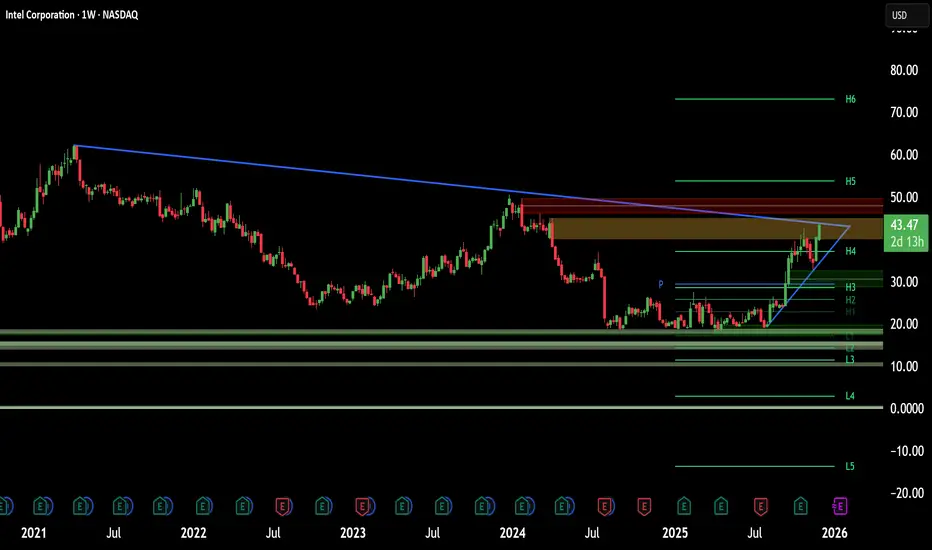
Is Intel’s Apple Deal the Ultimate Pivot?Intel (NASDAQ: INTC) stock soared over 116% this year. Reports suggest Apple may use Intel’s foundry by 2027. We analyze the drivers behind this potential resurrection.
Geopolitics & Geostrategy: The Stability Premium
In a volatile world, Intel offers a "stability premium." TSMC’s concentration in Taiwan risks Western supply chains. The US government now holds a ~10% stake in Intel. This actively incentivizes domestic production to secure the grid. Apple chooses Intel to hedge against geopolitical friction. This move aligns with US strategic interests, treating Intel as a sovereign asset.
Management & Leadership: The Tan Effect
CEO Lip-Bu Tan drives a massive cultural shift. He replaced Pat Gelsinger’s engineering vision with operational discipline. Tan prioritizes customer listening, an area where Intel historically struggled. This pivot is paying off. Securing Apple proves Intel is shedding its "arrogant" legacy. It is becoming a true service-oriented foundry.
Technology & Innovation: The 18A-P Advantage
The deal relies on Intel’s **18A-P process technology**. Apple aims to use this for entry-level M-series chips. This validates Intel's aggressive manufacturing roadmap. Additionally, the Trump administration invested $150 million in xLight. This startup develops next-gen lithography lasers to aid chipmaking. It reinforces the ecosystem surrounding Intel’s manufacturing capabilities.
Business Models: The Foundry Pivot
Intel is transforming from a product company to a hybrid foundry. Analysts estimate the Apple deal could generate ~$1 billion annually. However, the "Apple Seal of Approval" is worth far more. It signals to giants like Qualcomm that Intel is ready. It also creates leverage against TSMC’s pricing power.
Final Verdict: The Apple rumors convert Intel into a legitimate turnaround play. US geopolitical interests align with the new leadership. Validated technology suggests Intel’s worst days are likely over.
Is Boeing's Defense Bet America's New Arsenal?Boeing's recent stock appreciation stems from a fundamental strategic pivot toward defense contracts, driven by intensifying global security tensions. The company has secured major wins, including the F-47 Next Generation Air Dominance (NGAD) fighter contract worth over $20 billion and a $4.7 billion deal to supply AH-64E Apache helicopters to Poland, Egypt, and Kuwait. These contracts position Boeing as central to U.S. military modernization efforts aimed at countering China's rapid expansion of stealth fighters like the J-20, which now rivals American fifth-generation aircraft production rates.
The F-47 program represents Boeing's redemption after losing the Joint Strike Fighter competition two decades ago. Through its Phantom Works division, Boeing developed and flight-tested full-scale prototypes in secret, validating designs through digital engineering methods that dramatically accelerated development timelines. The aircraft features advanced broadband stealth technology and will serve as a command node controlling autonomous drones in combat, fundamentally changing air warfare doctrine. Meanwhile, the modernized Apache helicopter has found renewed relevance in NATO's Eastern flank defense strategy and counter-drone operations, securing production lines through 2032.
However, risks remain in execution. The KC-46 tanker program continues facing technical challenges with its Remote Vision System, now delayed until 2027. The F-47's advanced variable-cycle engines are two years behind schedule due to supply chain constraints. Industrial espionage, including cases where secrets were sold to China, threatens technological advantages. Despite these challenges, Boeing's defense portfolio provides counter-cyclical revenue streams that hedge against commercial aviation volatility, creating long-term financial stability as global rearmament enters what analysts describe as a sustained "super-cycle" driven by great power competition.
The Strategic Rise of the RenminbiAgainst a backdrop of economic headwinds, the Chinese renminbi is defying market logic. We analyze the geopolitical, strategic, and industrial drivers powering the currency’s 2025 ascent.
A Currency Defying Headwinds
In 2025, the **USD/CNY** exchange rate has shifted significantly, with the renminbi posting a nearly 3% annual gain against the dollar. This performance stands in stark contrast to the 5% depreciation seen during the 2018 trade tensions. What makes this valuation remarkable is the severe disconnect from traditional macroeconomic fundamentals. China currently faces weak domestic consumption, record-low interest rates, and a massive $281 billion capital account deficit.
Typically, such indicators would trigger a sell-off. Yet, the currency has appreciated. This divergence points to a singular, powerful causal force: tight, strategic state management by the People’s Bank of China (PBoC). Beijing is prioritizing stability over market freedom to project economic resilience.
Geostrategy: The 15th Five-Year Plan
The controlled rise of the renminbi is not accidental; it is a calculated geostrategic move. The **15th Five-Year Plan**, released in October 2025, signals a major pivot in Beijing's approach to global finance. The document omits previous cautious language like "prudently promote," replacing it with assertive directives for currency internationalization.
Market analysts interpret this as a clear signal: currency strength is now a central policy goal. By engineering a stable rise, China aims to mirror its strategy during the 1998 Asian Financial Crisis. The goal is to establish the renminbi as a regional anchor and a reliable store of value, countering the dominance of the US dollar.
Management & Leadership: The PBoC’s Aggressive Defense
Central bank leadership has deployed a sophisticated "reference rate strategy" to guide the market. Since November 2024, the PBoC has consistently set the daily midpoint rate significantly higher than market forecasts. The average spread between the PBoC’s fix and market expectations has reached 327 basis points—an historically high gap.
This is a masterclass in market signaling. By aggressively managing expectations, leadership creates a one-sided bet that deters speculative short-selling. This proactive management forces market participants to align with state objectives rather than economic fundamentals.
Business Models: State Banks as Market Makers
China’s unique financial business model allows for direct intervention through state-owned banks. These institutions have acted as proxies for the central bank, executing discreet USD sales and CNY purchases to cap volatility. This "engineered calm" has reduced the three-month volatility of the pair to near decade-lows.
The stability has altered corporate behavior. Exporters, previously hoarding dollars, are now unwinding holdings of over $1 trillion stored in domestic banks. This creates a self-reinforcing loop: state intervention stabilizes the price, and corporate flows then validate that price, generating real demand for the renminbi.
Innovation & Industry Trends: The High-Tech Backstop
While financial engineering plays a role, the renminbi’s strength is also underpinned by China’s evolving industrial base. The decline in low-margin manufacturing is being offset by a surge in high-tech exports. Trade competitiveness remains robust despite currency appreciation.
This resilience is rooted in the country's pivot to high-value sectors like electric vehicles, green energy, and advanced machinery. Patent analysis of Chinese firms reveals a massive accumulation of IP in these domains. This technological leverage allows Chinese exporters to absorb exchange rate costs better than their low-tech predecessors, sustaining the trade surplus.
Cyber Finance & Global Adoption
The strategy is yielding tangible results in global markets. Daily trading volume in the CNY–USD pair has surged 60% to $781 billion. The renminbi now accounts for over 8% of global FX turnover.
This growth is driven by institutional investors and central banks diversifying their reserves. China is leveraging this trend by integrating the renminbi into cross-border digital payment systems. This "Cyber Finance" approach bypasses traditional SWIFT rails, further insulating the currency from geopolitical sanctions and US dollar liquidity crunches.
Conclusion: A Political Asset
The 2025 rise of the renminbi is a political project as much as an economic one. It challenges the standard "Impossible Trinity" of economics by maintaining a stable exchange rate and independent monetary policy through strict capital controls. For global investors, the message is clear: the PBoC will prioritize currency strength as a tool of soft power, regardless of domestic economic pain.
VIPS | This Chinese Retailer Will Rise High | LONGVipshop Holdings Ltd. is a holding company, which engages in the provision of online product sales and distributions services. It operates through the following segments: Vip.com, Shan Shan Outlets, and Others. The Others segment includes internet finance, offline shop, and city outlets. The company was founded by Ya Shen and Xiao Bo Hong on August 22, 2008 and is headquartered in Guangzhou, China.
Chinese stocks could hedge US tech crash Chinese stocks broke their loose correlation to US equities in 2021.
US tech stocks may or may not be in a bubble, but if they are Chinese stocks could be attractive.
The 2008 crash in the US was viewed as a major relative leap for China, because their citizens are generally savers (setting aside the reasons for those savings lol). They were able to weather the storm then and guess what, they're all padded with cash again because of the domestic deflationary storm right now.
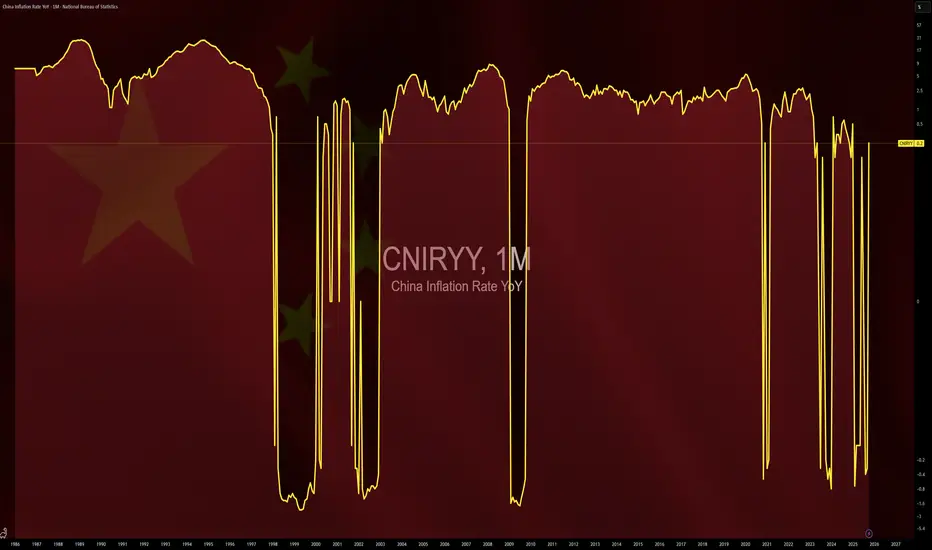
$CNIRYY -China CPI (October/2025)ECONOMICS:CNIRYY +0.2%
October/2025
source: National Bureau of Statistics of China
-China’s consumer prices rose 0.2% yoy in October 2025,
defying expectations for no change and rebounding from a 0.3% decline in the prior month.
It was the first increase in consumer inflation since June and the fastest pace since January.
Non-food inflation accelerated (0.9% vs 0.7% in September), lifted by the expansion of consumer trade-in programs and increased holiday spending during the Golden Week, both of which helped boost domestic demand.
Prices continued to grow for housing (0.1% vs 0.1%), clothing (1.7% vs 1.7%), healthcare (1.4% vs 1.1%), and education (0.9% vs 0.8%).
Meantime, transport costs fell at a slower pace (-1.5% vs -2.0%). On the food side, prices logged the smallest decline in three months (-2.9% vs -4.4%).
Core inflation, which excludes food and energy, rose 1.2% yoy, the highest in 20 months, after September's 1.0% growth. On a monthly basis, consumer prices also increased 0.2%, following a 0.1% gain in September, reaching the highest level in three months. source: National Bureau of Statistics of China
PDD | Temu On The Rise | LONGPDD Holdings, Inc. is a multinational commerce group that owns and operates a portfolio of businesses. The company aims to bring more businesses and people into the digital economy so that local communities and small businesses can benefit from increased productivity and new opportunities. It has built a network of sourcing, logistics, and fulfillment capabilities, that support its underlying businesses. PDD Holdings was founded by Hua Lin Cai and Zheng Huang in 2015 and is headquartered in Dublin, Ireland.
Nvidia Corp.($NVDA) Drops as U.S. Blocks AI Chip Sales to China Nvidia Corp. (Nasdaq: NASDAQ:NVDA ) shares dropped 4.18% to $180.22 on Friday after reports that Washington will block the company’s sales of scaled-down AI chips to China. The decision marks another escalation in U.S. restrictions on advanced semiconductor exports.
According to The Information, the White House informed several federal agencies that Nvidia will not be allowed to sell its new B30A AI chip to Chinese firms. Nvidia had already provided samples to some customers in China before the ban was confirmed.
The B30A was designed to meet U.S. export thresholds while retaining enough computing power for AI training when used in large clusters. However, U.S. officials reportedly concluded that the chip still poses national security risks.
Compounding Nvidia’s challenges, Beijing has issued new guidelines restricting foreign chips in state-backed data centers. Reuters reported that China will require all new projects using government funding to rely solely on domestically developed processors. Data centers less than 30% complete must remove foreign chips, while advanced projects will face case-by-case reviews.
Technical View
The NVDA chart shows a recent rejection from the $212 level, with price sliding toward $180. A further decline toward $160 support is possible before a rebound, as indicated by the yellow curve. Long-term structure remains bullish, but near-term weakness persists under regulatory pressure
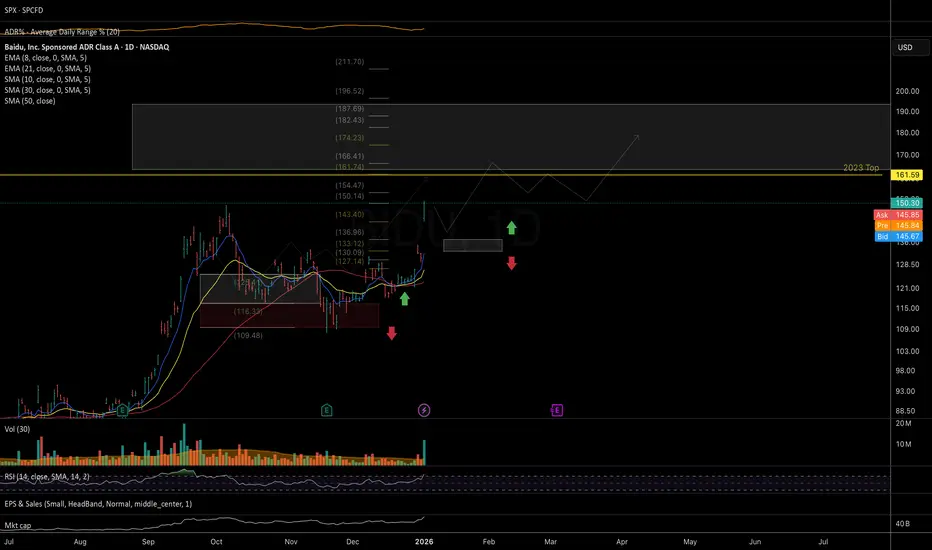
CHINA INTERNET ETF $KWEB to $90Components:
1 ALIBABA GROUP HOLDING LTD 11.02%
2 TENCENT HOLDINGS LTD 10.94%
3 PDD HOLDINGS INC 8.31% #PDD
4 BAIDU INC-CLASS A 5.07%
5 JD.COM INC-CLASS A 4.97%
6 MEITUAN-CLASS B 4.95%
7 JD HEALTH 4.60%
8 KUAISHOU TECHNOLOGY
9 TENCENT MUSI-ADR 4.24% #TME
10 KANZHUN LTD - ADR 4.03% #BZ
Clean Cup and Handle
China stocks can continue their recovery
China50 to find enough buyers at current support?CHN50 - 24h expiry
The overnight dip has been bought into and there is scope for further bullish pressure going into this morning.
15160 has been pivotal.
Previous resistance at 15200 now becomes support.
Daily signals are mildly bullish.
Our outlook is bullish.
We look to Buy at 15185 (stop at 14995)
Our profit targets will be 15755 and 15855
Resistance: 15382 / 15570 / 15774
Support: 15235 / 15080 / 14827
Risk Disclaimer
The trade ideas beyond this page are for informational purposes only and do not constitute investment advice or a solicitation to trade. This information is provided by Signal Centre, a third-party unaffiliated with OANDA, and is intended for general circulation only. OANDA does not guarantee the accuracy of this information and assumes no responsibilities for the information provided by the third party. The information does not take into account the specific investment objectives, financial situation, or particular needs of any particular person. You should take into account your specific investment objectives, financial situation, and particular needs before making a commitment to trade, including seeking, under a separate engagement, as you deem fit.
You accept that you assume all risks in independently viewing the contents and selecting a chosen strategy.
Where the research is distributed in Singapore to a person who is not an Accredited Investor, Expert Investor or an Institutional Investor, Oanda Asia Pacific Pte Ltd (“OAP“) accepts legal responsibility for the contents of the report to such persons only to the extent required by law. Singapore customers should contact OAP at 6579 8289 for matters arising from, or in connection with, the information/research distributed.
NIO | China will Lead the EV BattleNIO, Inc. is a holding company which engages in the design, manufacture, and sale of electric vehicles. Its products include the EP9 supercar and ES8 7-seater SUV. It provides users with home charging, power express valet services, and other power solutions including access to public charging, access to power mobile charging trucks, and battery swapping. It also offers other value-added services such as service package, battery payment arrangement, and vehicle financing and license plate registration. The company was founded by Bin Li and Li Hong Qin on November 28, 2014 and is headquartered in Jiading, China.
VNET | IT Services in China on the Rise | LONGVNET Group, Inc. operates as a carrier- and cloud-neutral internet data center services provider in China. It provides hosting and related services, including IDC services, cloud services, and business VPN services, to improve the reliability, security, and speed of its customers' internet infrastructure. The firm serves numerous industries, ranging from internet companies to government entities, blue-chip enterprises to small- and mid-sized enterprises. VNET Group was founded by Sheng Chen and Jun Zhang in 1999 and is headquartered in Beijing, China.
Bitcoin Daily Analysis – October 30, 2025🚀 Welcome to another Bitcoin analysis!
Yesterday, the interest rate was cut by one step, just as everyone expected — and that’s definitely a positive signal for Bitcoin. 💪💰
But why did we see a drop? 📉
The world is still anxious about the U.S.–China tariff situation, and those concerns intensified after Powell’s comments, suggesting the December rate cut isn’t guaranteed.
Right now, the market is in a fear phase 😨 — meaning both good and bad news can move prices sharply.
Stay calm and patient, and don’t let the candles scare you. 🕯️🧘♂️
Overall, conditions still favor a bullish continuation, and unless major negative news comes from the U.S. or China, we could soon start the final leg of this uptrend. 📈🔥
The $106,000–$102,000 zone is showing strong demand, making it a potential entry area — but always manage your risk and capital wisely. ⚖️
Remember: every decision in this part of the market should follow your predefined scenario — never trade emotionally or react impulsively. 🧠💼
Disclaimer:
This content is for informational purposes only and does not constitute financial or investment advice. © DIBAPRISM
Larry D.Kohn
China Rally Loading? – Markets React to Trump–Xi Trade TruceAfter months of pressure, Chinese equities finally got what they needed: a visible political thaw. The Trump–Xi meeting in Busan marked the first broad trade reset in over two years — with both sides agreeing to suspend or reduce tariffs, reopen commodity flows, and relax export controls on rare earths and semiconductors.
The headline changes are not symbolic. China will halt rare-earth export curbs for one year, the U.S. cuts fentanyl-related tariffs to 10%, and both countries resume agricultural and energy trade — including soybean and oil deals. Beijing also promised to work with Washington on resolving the TikTok issue, while the U.S. temporarily suspends its “50% rule” that targeted Chinese subsidiaries of blacklisted firms.
This combination sends a clear signal: geopolitical pressure is easing, at least for now. The Hang Seng Index has already broken back above the mid-channel trend line, and momentum is building toward the upper resistance zone around 27 000. If the truce holds and follow-through buying continues, a retest of 28 000–29 000 by year-end looks possible.
From a valuation standpoint, Chinese equities remain among the most discounted major markets globally. Industrial, tech-hardware and materials companies trade at forward P/E ratios between 7–10, compared with 20+ for U.S. peers. If rare-earth exports resume and TikTok’s uncertainty is lifted, capital inflows into mainland-linked ETFs could accelerate.
The opportunity lies in the asymmetry: sentiment is still fragile, yet fundamentals are improving. A stable policy backdrop plus renewed U.S. demand for energy and agri-products could set up Chinese indices for an extended relief rally — potentially the strongest since early 2023.
Key levels to watch:
• Hang Seng Index support – 26 000
• Resistance zone – 27 500–28 000
• Break above 28 000 → trend confirmation and rotation toward Chinese cyclicals
Trade logic:
Short-term traders can target a breakout continuation within the rising channel, while longer-term investors may look at selective exposure to resource, industrial and tech-infrastructure names poised to benefit from normalized U.S.–China flows.
If this détente lasts longer than a “subscription diplomacy” cycle, China might be setting up not for a dead-cat bounce — but for the next real rotation story.