SR3 (SOFR 3 Month) Finds Balance After a Multi-Year DowntrendBackground: What is SR3 and what drives it?
SR3 refers to the three month SOFR futures contract. SOFR, or the Secured Overnight Financing Rate, represents the cost of overnight borrowing collateralized by US Treasuries. The three month SOFR future prices in the market’s expectation of average SOFR over a future three month period, making it one of the cleanest instruments for expressing interest rate expectations tied to Federal Reserve policy.
This instrument is primarily used by institutions to hedge short term interest rate exposure and to speculate on the future path of monetary policy. Because of this, SR3 is highly sensitive to macro data, Federal Reserve communication, inflation prints, labor market data, and shifts in risk sentiment. When markets expect easing, SR3 prices tend to rise. When expectations move toward higher for longer policy, prices tend to fall.
Since 2022, the dominant narrative has been centered around aggressive tightening followed by a prolonged restrictive stance. That narrative has kept SR3 in a broader downtrend. More recently, sentiment has shifted toward patience and data dependence rather than urgency in either direction. This has resulted in compression, balance, and range trade as participants wait for clarity on the next policy inflection.
What the Market Has Done
• The market has been in a downtrend since 2022 but has found a base with strong responsive selling at 96.575 and responsive buying at 96.325. This has formed a defined daily range that has contained price since June.
• From August to October, the market traded in a two way rotation with higher highs and higher lows. Buyers stepped up bids and were able to push price marginally higher, but each test of the 96.58 area was met with responsive selling that capped continuation.
• Toward the end of October, buyers failed to defend the higher lows. Price rotated back down into bid block one in the 96.42 to 96.37 area, where buyers successfully held price through mid November, establishing what is now bid block two.
• Sellers gained slight control as they were able to offer prices back down toward the lower end of the range near 96.325.
• The market performed a liquidity check below this level, but responsive buyers quickly stepped in and bid price back up through the daily range.
• Price is currently repairing the October 29 single print and is now trading between the established offer block and bid block two.
What to Expect in the Coming Week
The key level to watch remains 96.52, which sits near the upper portion of the current balance area and acts as a decision point.
Bullish scenario
• If the market is able to accept above the 96.52 area, continuation toward 96.575 becomes likely.
• A further extension toward 96.6125, which marks the October 17 high, is possible.
• Responsive selling is expected in this region.
• Failure to sustain trade above these levels would likely result in rotation back down into the range.
Neutral scenario
• In the absence of a meaningful news catalyst, a two way auction remains the highest probability outcome.
• Price could continue rotating between the offer block and bid block one.
• This rotation would serve to further repair the October 29 single print and the associated low volume area.
Bearish scenario
• If 96.435, which marks the high of bid block two, fails to hold, expect a sweep through bid block two.
• This would open the door for a revisit of the lower range boundary near 96.32.
• Responsive buyers are expected to defend this area based on prior behavior.
Conclusion
SR3 appears to have found a base and shifted from a structural downtrend into a period of sideways accumulation. Price has settled into a well defined range as market participants balance expectations around monetary policy and incoming data. Recent Federal Reserve commentary supports this shift in sentiment. The Fed has delivered multiple rate cuts this year and appears cautious about future moves, signaling a more data dependent approach and a potential pause after the most recent easing cycle, which aligns with range trade rather than directional conviction. Markets are pricing in additional easing but Fed officials have shown clear disagreement on the timing and pace of future cuts, which has dampened strong trend conviction and encouraged balancing action in rate sensitive instruments like SR3. Some officials have publicly indicated that further rate cuts could be warranted if economic conditions soften, while others have urged caution, emphasizing the need for clearer labor market and inflation signals before making additional adjustments. This split messaging has contributed to a neutral market structure where price oscillates within value rather than trending strongly higher or lower.
Interested in how others are mapping Fed communication and data dependency onto this range, and what catalysts you see as capable of breaking this structure. Please drop a comment and give a boost so that more from the community can join in the conversation. Thank you.
Disclaimer: This is not financial advice. Analysis is for educational purposes only; trade your own plan and manage risk.
Federalreserve
3rd Time May Be The Charm For UJ BearsHere on FX:USDJPY price seems to be working into a Consolidation in the form of a Descending Triangle Pattern after making contact with a strong Resistance Level!
Since the High created on Nov. 20th @ 157.893, price has been falling into a Support Level creating Equal Lows with a Lower High formed on Dec. 10th @ 156.937.
This Lower High creates a Falling Resistance that price seems to be having a strong reaction to!
If price continues to rise from the Support level, we can expect a 3rd test of the Falling Resistance.
Fundamentally, with the Federal Reserve having made a 25 basis point Cut to Interest Rates going from 4% to 3.75% and the BOJ looking to potentially Hike Interest Rates from .5% to .75%, this could strengthen the Bearish scenario and the formation of the Descending Triangle.
From QE to QT. Reading the Fed’s Cycle from the ChartQuantitative Easing (QE) is when the Federal Reserve buys large amounts of Treasuries and mortgage‑backed securities to expand its balance sheet, inject liquidity, and push interest rates lower across the curve.
Quantitative Tightening (QT) is the opposite: the Fed allows its bond holdings to roll off or sells securities, shrinking the balance sheet and tightening financial conditions.
QE near zero rates
Historically the Fed has only launched QE when the policy rate was pinned near zero and conventional rate cuts were basically exhausted, as in 2008–2014 and again in 2020–2022.
QT at elevated rates
By contrast, QT has been used only once the Fed had already hiked rates to clearly positive, “elevated” levels and wanted to normalize the balance sheet from those earlier QE waves.
What ending QT in December could imply
QT effectively ended around 1 December, it suggests the Fed may feel comfortable pausing balance‑sheet tightening while rates are still high, opening the door later to cuts if growth or markets weaken.
In that setting, the market could start to price a shift from outright restriction toward neutrality, which often coincides with more two‑sided volatility in risk assets.
Echoes of the QT1 → QE3 window
The period after QT1 and before QE3 saw rates come off their highs and then a major shock (COVID-18 crysis) that helped justify easier policy again.
A similar path is plausible here: a “black swan” type event in the coming year could hit growth or credit, force a rapid drop in rates, and trigger a new QE‑style response that would rhyme with the QT1‑to‑QE3 sequence your chart visually captures.
Fed cuts rates. Where do we go next?Rate cut of 25bps as expected but where do we go from here?
The S&P is attempting to break out into new all time highs but as we’ve seen recently, there doesn’t seem to be enough buy side liquidity or buyer conviction to push the market into a new leg up. Until we see a catalyst to take it higher I would expect more chop.
Bitcoin reaction to FED RATE choices since 2021
It is really very simple
Back in 2021 and 2022, Bitcoin PA did what it was intended to do and rate decisions did not directly inpact Bitcoin at all.
We had the traditional 9-% pull back, as we had had in previous cycle.
The impact in the rising Rates was on companies in the Crypto Sphere, that suffered as rates were increased.
Repaying th eloans became intolerable.
Lets look at this cycle, from late 2022 to current day
Despite Steep Rate rises in late 2022, Early 2023, Bitcoin Price and trading Volume INCREASED.#
In Late 2022, you can see that a steep 75 point increase did not phase BTC from trying to rise but the impact on crypto companies and Banks began scaring people and the next 75 point rise tipped many over
But Bitcoin found a floor and remained there.
Then we had a 50 point rise and PA remained were it was...NO IMPACT>
Then we had a series of 3 x 25 point rises.
Bitcoin Rose through the first of those and fought back in the other 2, dipping slightly as the OverSold MACD cooled off ( this was on lower time frames )......The ONLT reason for the Range to lower prices
Weekly MACD
The Green box shows the period that BTC PA ranged, March to September 2023
THIS was the defining period for BITCOIN
Once it became cheaper to borrow nd ETF's were allowed. off we went.
Is Cheaper borrowing likely to sustain Bitcoins rise ?
OF COURSE
But please remain cautious.
100K -> 110K usdt is the line of possible rejection and has potential to enter Bitcoin into a Deeper Bear.
REMEMBER. BITCOIN is NOT effected by Rates, as we saw in early 2023, and If a BEAR Market is required, then it will happen no matter if Rates are lower.
For Me, I think we will see a rise, a Dip and then, around March next year,we will see the defining moment that will decree where we REALLY go
MACRO events can always accelerate that
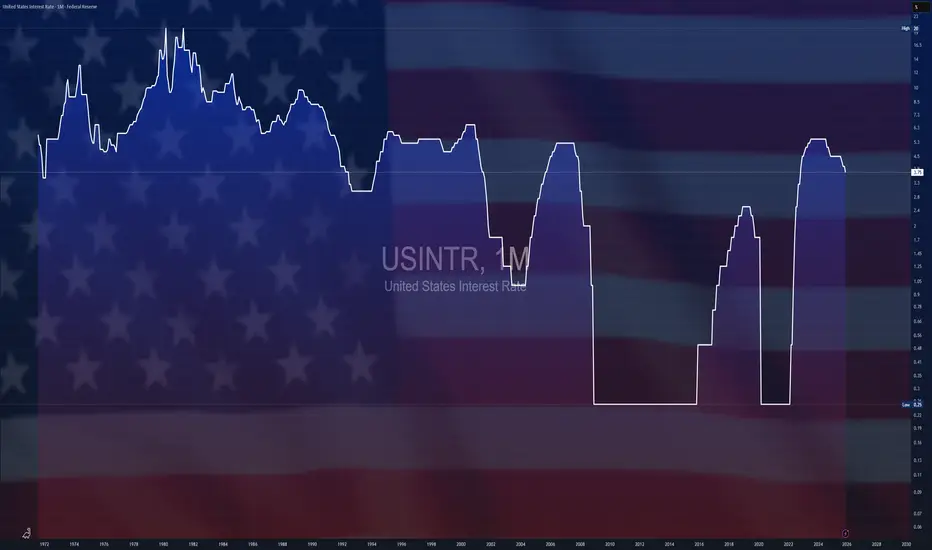
$USINTR - Fed Signals Single Cut in 2026 (December/2025)ECONOMICS:USINTR 3.75%
December/2025 (-0.25%/bps)
source: Federal Reserve
-The Federal Reserve lowered the funds rate by 25bps to 3.5%–3.75%, marking the lowest level since 2022, but signaled a tougher road ahead for further reductions.
The policymakers left their projections unchanged from September, signaling only one 25bps cut in 2026.
Three members of the commitee continued to vote against the cut, which hasn’t happened since September 2019.
Waiting for an Impulse Ahead of the Fed Decision #USDJPYUSDJPY remains in a steady bullish structure and is holding near local highs amid a strong US dollar and the continued accommodative policy of the Bank of Japan. At the same time, the market is entering a waiting phase ahead of the key event of the week — the Federal Reserve decision, which is expected to sharply increase volatility.
The market is pricing in a 0.25% rate cut by the Fed, but the decisive factor for further direction will be the tone of the press conference. Comments on inflation, economic conditions, and the future path of monetary policy will shape the medium-term outlook.
Technically, the pair is consolidating below the resistance zone near recent highs, while maintaining a bullish structure above key moving averages. There is no sign of aggressive selling pressure at this stage.
Key logic
Before the Fed decision — a high probability of range-bound trading and false moves.
After the decision — a breakout from consolidation and the formation of a directional impulse.
The main focus is on the reaction at the upper boundary of the range and volume behavior
Scenarios
Bullish: breakout above local resistance and impulsive continuation higher after Fed signals.
Corrective: pullback toward the nearest support area while preserving the overall bullish structure.
Bearish scenario is only possible in case of a sharp shift in Fed rhetoric and a breakdown of the current structure.
USDJPY is at a decision point, and today’s Fed meeting will be the key trigger for the next directional move in the pair.
NQ Power Range Report with FIB Ext - 12/10/2025 SessionCME_MINI:NQZ2025
- PR High: 25691.50
- PR Low: 25669.50
- NZ Spread: 49.0
Key scheduled economic events:
14:00 | FOMC Economic Projections
- FOMC Statement
- Fed Interest Rate Decision
14:30 | FOMC Press Conference
Session Open Stats (As of 12:25 AM).
- Session Open ATR: 396.33
- Volume: 19K
- Open Int: 313K
- Trend Grade: Long
- From BA ATH: -2.7% (Rounded)
Key Levels (Rounded - Think of these as ranges)
- Long: 26521
- Mid: 25264
- Short: 24008
Keep in mind this is not speculation or a prediction. Only a report of the Power Range with Fib extensions for target hunting. Do your DD! You determine your risk tolerance. You are fully capable of making your own decisions.
BA: Back Adjusted
BuZ/BeZ: Bull Zone / Bear Zone
NZ: Neutral Zone
How the Fed’s Next Move Could Reshape Stocks, Gold and BitcoinPowell’s Big December Decision 🏛️
The December 2025 Fed meeting is a big deal because the US economy is in a tricky spot:
Inflation is still a bit too high 📈
Growth and jobs are starting to weaken 📉
Most traders expect the Fed to cut interest rates by 0.25%, but not everyone at the Fed agrees. If Jerome Powell does something different from what markets expect, we could see either a strong rally in risk assets or a nasty risk‑off move.
What the Fed might do ⚙️
The Fed has three main options:
1. Cut rates and sound “dovish” 🕊️
They cut 0.25% and say they’re ready to help the economy more if needed.
Markets usually like this: cheaper money, easier credit.
2. Cut rates but sound “hawkish” 🦅
They cut, but Powell keeps warning a lot about inflation.
This sends a mixed signal: some good news, some bad news.
3. No cut (a pause) 😐
This would surprise markets because most people expect a cut.
Could scare investors and cause a quick sell‑off in risk assets.
What it could mean for gold and Bitcoin
1. Gold
Loves lower real yields and weaker dollar.
A clear cut with a dovish message could push gold to new highs.
A surprise pause or hawkish tone could trigger a quick pullback.
2. Bitcoin & crypto
Rate cuts usually mean more liquidity and more risk‑taking, which helps crypto.
If the Fed delivers the cut and hints at more easing in 2026, BTC could break out of its correction and start a new leg up.
If Powell disappoints (no cut or very hawkish talk), crypto can dump first as traders de‑risk.
Bottom line ✅
This meeting is important because it sets the tone for 2026:
A friendly, dovish Fed = more chances for a risk‑on environment in stocks, gold and Bitcoin 🚀
A cautious or hawkish Fed = more volatility and possible corrections before any new uptrend 🔁
Traders should watch not just what the Fed does with rates, but also how Powell talks about inflation, growth and future cuts.
Evening Doji Star Forms at Weekly Resistance on UJAn Evening Doji Star is a Bearish Reversal Candlestick Pattern that consists of 3 Candlesticks:
1) Large Bullish Candle
2) Doji Candle
3) Large Bearish Candle
The Doji Candle represents indecision in the markets where the Bulls nor the Bears were able to overcome one another.
The last candle being a bearish one suggests that the Bears have successfully taken over and are looking to push price down!
This Candlestick Pattern itself is a strong indication that price is looking to reverse from this Resistance Level at 158 - 156 formed at the end of last year/beginning of this year, but what will also add "fuel to the fire" is if the next candle, being the Confirmation Candle of the pattern turns out to be a bearish one!
If so, I am looking for FX:USDJPY to continue this bearish push down in price to the next Area of Value being at 151 - 148 with a stronger Support Level down at the 141 - 139 where price last visited in April this year.
Fundamentally, USD has a heavily news filled week with Sept. and Oct. JOLTS Job Opening being released, Unemployment Claims, ADP Weekly Employment Change and the Federal Reserve with an 86% chance of Cutting Interest Rates on the 10th.
BOJ is set to Hike Interest Rates the following week, and this, fundamentally, could be the catalyst for the Bearish Reversal we see setting up in technical terms on the charts!
NEXT WEEK INSIGHTS [15-19TH DECEMBER]In this video, we break down what to expect from the upcoming week’s monetary-policy decisions, particularly from Federal Reserve (the Fed), and why it could matter for global markets, investors, and ordinary people alike. We analyze the most recent data — inflation, employment, bond yields — and explain the market’s growing anticipation that the Fed might announce a rate cut around mid-December. 📉
We also explore the potential ripple effects: how changes to interest rates could influence stock markets, borrowing costs, and economic growth. Plus — if the Fed does cut rates — what that could mean for everyday savers, borrowers, and investors.
Whether you’re a finance-savvy watcher or simply curious about what’s going on with global economics, this video aims to give you the facts in a clear, straightforward way — and show why the next few days could be pivotal.
Is the Aussie Awakening a Mirage?The Australian Dollar is staging a formidable recovery, driven by a stark divergence in central bank leadership and shifting geopolitical tides. As the pair approaches the critical 0.6600 resistance, we analyze the multi-domain factors fueling this ascent.
Geopolitics & Geostrategy: The Stability Premium
Global capital is currently re-evaluating the "safety" premium. The US grapples with political gridlock and government shutdown threats. Meanwhile, Australia presents a geostrategic anchor in the Asia-Pacific. The AUD is benefiting from a "stability premium" as investors rotate out of the uncertainty plaguing the US Dollar. Furthermore, renewed hopes for European peace deals have buoyed global risk sentiment. This shift disproportionately benefits high-beta currencies like the AUD over the safe-haven USD.
Management & Leadership: Bullock vs. Powell
The divergence in governance between the Reserve Bank of Australia (RBA) and the Federal Reserve drives this trend. RBA Governor Michele Bullock displays assertive leadership, maintaining a hawkish stance to combat sticky inflation. In contrast, the Federal Reserve appears reactive, with markets pricing in a high chance of a December rate cut. This leadership contrast—steadfastness versus capitulation is steering capital flows toward the AUD.
Industry Trends & Innovation: The Infrastructure Boom
A hidden driver of the AUD’s resilience is a surge in high-tech infrastructure. Q3 GDP data revealed that while household consumption slowed, private investment surged 2.9%. This growth relies heavily on machinery, equipment, and renewable energy projects. This is not just a mining story anymore; it is an infrastructure evolution. Tangible capital expenditure in technology sectors provides a structural floor for the currency that speculative flows cannot match.
Macroeconomics: The Two-Speed Economy
Australia currently exhibits a classic "two-speed" economy. The consumer sector softens under the weight of cost-of-living pressures, yet the business sector aggressively expands capacity. The 0.4% GDP growth missed forecasts, yet the currency rallied. The reason is simple: sticky inflation forces the RBA to keep rates higher for longer. In a world where the US cuts rates, Australia’s high-yield status acts as a powerful magnet.
Business Models: Intellectual Property of Policy
Metaphorically, the RBA holds the "patent" on credible inflation targeting in 2025. Other central banks pivot prematurely, but the RBA’s refusal to cut rates preserves the integrity of their monetary policy. This adherence to mandate over market pressure creates a predictable business environment for foreign investors. It distinguishes the AUD as a currency of yield and integrity in a volatile G10 landscape.
Technical Analysis: The Battle Lines
The AUD/USD has executed a V-shaped recovery, bouncing from key support. The pair is now confronting the 2022 trendline at 0.6592/98.
* Bullish Case: A weekly close above 0.6598 invalidates the bearish trend. This opens the door to 0.6651 * and 0.6723 .
* Bearish Case: Failure here triggers a potential "Head and Shoulders" pattern. This targets a retest of 0.6453 .
* Algorithmic Insight: High-frequency traders likely target this specific trendline collision. Expect volatility as human conviction battles automated resistance.
Final Verdict: The fundamental backdrop favors the bulls due to the RBA/Fed policy divergence. However, the technical barrier at 0.6600 is formidable. Traders must watch for a confirmed breakout before chasing this rally further.
The Era of Gentle Money (QE)- This chart features labels for all key dates, offering a clear and comprehensive overview, including trillions in money creation, QT and QE phases, crises, and flash printing events.
- To truly understand stocks, cryptocurrencies, or precious metals, you first need to understand the monetary system and how it drives inflation.
- The market has been heavily suppressed since June 2022, when the Fed began its Quantitative Tightening (QT), the Fed kicked off a new QE phase on December 1, 2025.
- This is the primary driver behind yesterday’s BTC market surge.
- To complement this, we will soon have a new Fed President, Most likely, they will continue cutting rates, printing more money, and Banks will increase lending, encouraging people to take more risks, which could drive markets higher. Bearish sentiment is premature at this stage.
The heart of truth beats in the printer and in the river of liquidity !
Happy Tr4Ding !
Gold softens after Fed minutes as smokestacks cap every rally Is there any way we can get a December rate cut now?
Gold has softened after the release of the minutes from the Federal Reserve's last interest rate decision.
The minutes show there’s no unified push toward cutting, which could make a December move unlikely.
Several Federal Reserve officials supported lowering rates in October, but others preferred keeping policy unchanged, and some pushed back firmly against easing.
Technically, XAUUSD continues to form smokestacks, printing repeated double-top structures. The price is now hovering around 4,070, sitting under possible short-term resistance at 4,150. XAUUSD losing the 50-day MA further could shift bias more decisively lower.
GBPUSD OUTLOOK 17 - 21 NOV 2025Last week we saw UK Claimant count come in higher than expected indicating a slowing down of the labor market. This Wednesday we have a forecast of 3.6% CPI which is lower than the previous 3.8%. If CPI comes in as expected that will be bearish on the the Pound and more so if it is lower than expected.
With lower CPI and higher unemployment the logical outcome should be for interest rates being reduced which is bearish for GBP.
On the dollar we have sticky inflation which came in at 3%. Lower than the expected 3.1% however higher than the previous reading of 2.9%. This week we have FOMC minutes on Wednesday and NFP on Thursday. NFP forecast is 58K which is much higher than the previous 28K. NFP coming in as expected or better yet higher would support my GBPUSD short idea as the FED should consider the risk to inflation more. Powell also said that a cut in December is not locked in and they will also be looking at the data for inflation and the labor market to make their final decision.
This analysis outlines everything I want to see for a high probability short on this pair both fundamentally and technically. For a bullish scenario all figures would be the opposite of what I want to see.
Trade safe and don't get margin called.
DXY — Sunday War MapThe U.S. government has reopened after a 43-day shutdown, but the gap in economic data remains.
Several key datasets were not collected during the closure, and the missing information cannot be reconstructed.
As a result, the Dollar is now trading on partial visibility rather than complete fundamentals.
Macro Overview
The most recent complete inflation report is September CPI at 3.0%, with core inflation also at 3.0%.
Earlier in the month, the U.S. Dollar Index (DXY) briefly moved above 100.
It then retreated toward 99 after consumer sentiment fell to a three-year low.
Last week’s muted behavior reflects uncertainty, not a structural shift.
When information is missing, liquidity becomes cautious and price action compresses.
Key Events This Week (Nov 17–21)
FOMC Minutes — Wednesday, Nov. 20
This release provides the first reliable view into Federal Reserve discussions since the shutdown.
Markets will look for whether policymakers supported multiple rate cuts or expressed hesitation.
Consumer Sentiment — Friday, Nov. 22
Last month saw a more than 30% year-over-year decline.
Another weak reading will influence Dollar positioning.
Delayed Data Returns
Housing, industrial production, and jobless claims will re-appear gradually this week.
These incomplete releases still matter ahead of the December 9–10 Federal Reserve meeting.
The Dollar is currently driven more by data absence than by clear economic direction.
MSM — Market Structure Mapping
DXY remains inside a major daily bullish range:
Range Low: 97.672
Range High: 99.985
Price sits near the 50% geometric midpoint.
Last week closed at 98.776, maintaining structural balance and preserving the broader bullish framework.
VFA — Volume Flow Analytics
Price continues to hold on the 98.725 bullish volume node, a level typically used for quiet accumulation.
This suggests ongoing absorption of buy-side orders at discount levels ahead of potential volatility expansion.
OFD — Order Flow Dynamics
Liquidity remains concentrated around two notable participation zones:
Aggressive buyers: 98.243
Aggressive sellers: 99.225
These zones are often retested early in the week to assess participation or clear weak inventory before direction establishes.
PEM — Precision Execution Modeling
Mid-range conditions are typically used to clear stops on both sides before intent forms.
Execution criteria for the week:
Respect higher-timeframe direction
Wait for confirmation
Avoid mid-range noise
Act only when structure, flow, and behavior align
High-quality setups generally appear after liquidity sweeps, not before.
Psychological Frame
The major risk this week is acting on incomplete data.
The shutdown left a statistical gap that has not yet been resolved.
Professionals avoid committing capital until visibility improves.
The appropriate approach for the week is simple: observe first, act later.
— CORE5DAN
Institutional Logic. Modern Technology. Real Freedom.
FED FUNDS Rate Inflation Adjusted Remains TightFED FUNDS Rate Inflation Adjusted for core inflation remains in the tightening area. As inflation rises over the next few months, thanks to Trump's liberating all Americans with higher taxes and less discretionary income to spend.
I expect this chart to drop as inflation rises and Fed holds rates steady. Alternatively, FED lowers rates bc we will be in a recession, and it is trying to make private money creation cheaper to pump the economy.
Which of the two will occur first, I could not tell you. However, it is important to keep a close eye on this chart in the months ahead.
Click like, follow, subscribe.
DXY(Dollar Index): This up wave will not last long.For TVC:DXY , don't be trapped with this up wave, it should not last long. What is happening now is only manipulation based on what we see.
Fed will continue to cut rates if not this year, next year and they are printing money, ending the QT and also things are not okay. Based on that, on the fundamental part of things and We Trade Waves wave analysis concept. Any sell setup we get for DXY we will go for it BUT:
Always remember WTW 4 Golder Rules:
1) Do not jump in
2) Do not over risk/trade
3) Do not trade without Stop Loss
4) Never ever add to a losing position!
Trade with care
We Trade Waves
WTW Team
Disclosure: We are part of Trade Nation's Influencer program and receive a monthly fee for using their TradingView charts in our analysis.
DXY Has 99 Problems, Getting Above 100 Is One!Here we have TVC:DXY on the Weekly Chart.
Now clearly outlined we can see there is a very valuable level here @ 99-100 that the USD:
- Used as Resistance from 2015 til the Bullish Breakout in April 2020
- Used as Support from 2023 til the Bearish Breakdown in April 2025
Fundamentally is a very sketchy scenario because with the Shutdown causing lack of important data needed, The Federal Reserve is making Interest Rate cuts. This weakens the Dollar because it makes it less favorable to Foreign Investing.
On the flip side, Consumers Dollars are able to stretch further allowing them to purchase more but unfortunately we still combat the inflated prices on goods. Companies have the ability to get there raw ingredients cheaper, resume hiring processes, etc.
The slow creeping rise in Inflation has the Federal Reserve in a position to want to be ready to potentially Hike Rates when the Inflation, they believe, from the Tariffs will hit but as of yet, the recent CPI numbers came out not as hot as they thought, possibly playing into the reason for making the latest cut.
Nevertheless, by the last FOMC meeting, it would seem that there is a chance that was the last cut this year that may be made, if:
- Inflation continues to rise
or
- Continued softening labor market
BTCUSDT – Hawkish Fed Sends Bitcoin to Test Its 200‑Day LineBitcoin extended losses this week as Fed Chair Jerome Powell’s hawkish tone cooled expectations for another rate cut. The move left traders torn between short-term risk-off signals and long-term technical support.
The Fed’s second straight 25-basis-point cut was widely expected, but Powell’s comments hinted that the central bank may pause before easing further. That shift strengthened the dollar and Treasury yields, weighing on crypto and risk assets. Bitcoin slipped around 3% to below $108 000 before finding temporary footing.
🔹 Macro & Sentiment
Powell’s message was clear: the committee remains divided, and caution may prevail into year-end. That triggered profit-taking across risk markets. Meanwhile, Trump’s “amazing” meeting with Xi Jinping and a new trade truce added volatility, but digital assets lagged the optimism seen in equities — a sign of hesitation among crypto traders.
🔹 Chart & Levels
BTC is now testing its 200-day moving average near $110 000, a level that has defined the broader uptrend since summer. Below that, key support sits at $107 000 and $100 000. Resistance remains around $120 000–$127 000. A clean bounce from the 200-day line could restore bullish momentum, while a break beneath it would expose the lower range.
As long as $110 k holds, bias stays cautiously bullish toward $120 k+. Below $110 k, the outlook turns more corrective.
🧾 The Takeaway
Fed caution has slowed Bitcoin’s momentum but not yet reversed its trend. The next major move depends on whether the 200-day line can hold under the pressure of a stronger dollar and shifting rate expectations.
Off to you: Will Bitcoin COINBASE:BTCUSD defend its 200-day support or roll over for a deeper correction?
Gold peaks once the Fed's cutting cycle is over...As the cutting cycle ends and rates remain relatively low, that is when the gold price tends to peak. This suggests that we are not yet near a gold price top, as the cutting cycle has not been ended by Chairman Powell. With poor economy or jobs data, or via a dovish Trump candidate for Fed Chair next year, rates will drop further. History tells us that once the cutting is over, the gold price will stall.