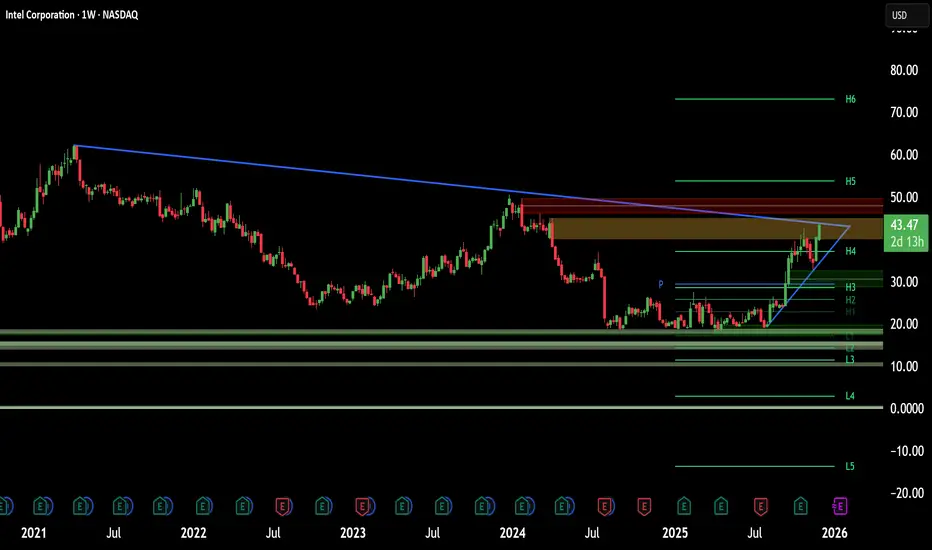
Is Intel’s Apple Deal the Ultimate Pivot?Intel (NASDAQ: INTC) stock soared over 116% this year. Reports suggest Apple may use Intel’s foundry by 2027. We analyze the drivers behind this potential resurrection.
Geopolitics & Geostrategy: The Stability Premium
In a volatile world, Intel offers a "stability premium." TSMC’s concentration in Taiwan risks Western supply chains. The US government now holds a ~10% stake in Intel. This actively incentivizes domestic production to secure the grid. Apple chooses Intel to hedge against geopolitical friction. This move aligns with US strategic interests, treating Intel as a sovereign asset.
Management & Leadership: The Tan Effect
CEO Lip-Bu Tan drives a massive cultural shift. He replaced Pat Gelsinger’s engineering vision with operational discipline. Tan prioritizes customer listening, an area where Intel historically struggled. This pivot is paying off. Securing Apple proves Intel is shedding its "arrogant" legacy. It is becoming a true service-oriented foundry.
Technology & Innovation: The 18A-P Advantage
The deal relies on Intel’s **18A-P process technology**. Apple aims to use this for entry-level M-series chips. This validates Intel's aggressive manufacturing roadmap. Additionally, the Trump administration invested $150 million in xLight. This startup develops next-gen lithography lasers to aid chipmaking. It reinforces the ecosystem surrounding Intel’s manufacturing capabilities.
Business Models: The Foundry Pivot
Intel is transforming from a product company to a hybrid foundry. Analysts estimate the Apple deal could generate ~$1 billion annually. However, the "Apple Seal of Approval" is worth far more. It signals to giants like Qualcomm that Intel is ready. It also creates leverage against TSMC’s pricing power.
Final Verdict: The Apple rumors convert Intel into a legitimate turnaround play. US geopolitical interests align with the new leadership. Validated technology suggests Intel’s worst days are likely over.
US-CHINA
Is Boeing's Defense Bet America's New Arsenal?Boeing's recent stock appreciation stems from a fundamental strategic pivot toward defense contracts, driven by intensifying global security tensions. The company has secured major wins, including the F-47 Next Generation Air Dominance (NGAD) fighter contract worth over $20 billion and a $4.7 billion deal to supply AH-64E Apache helicopters to Poland, Egypt, and Kuwait. These contracts position Boeing as central to U.S. military modernization efforts aimed at countering China's rapid expansion of stealth fighters like the J-20, which now rivals American fifth-generation aircraft production rates.
The F-47 program represents Boeing's redemption after losing the Joint Strike Fighter competition two decades ago. Through its Phantom Works division, Boeing developed and flight-tested full-scale prototypes in secret, validating designs through digital engineering methods that dramatically accelerated development timelines. The aircraft features advanced broadband stealth technology and will serve as a command node controlling autonomous drones in combat, fundamentally changing air warfare doctrine. Meanwhile, the modernized Apache helicopter has found renewed relevance in NATO's Eastern flank defense strategy and counter-drone operations, securing production lines through 2032.
However, risks remain in execution. The KC-46 tanker program continues facing technical challenges with its Remote Vision System, now delayed until 2027. The F-47's advanced variable-cycle engines are two years behind schedule due to supply chain constraints. Industrial espionage, including cases where secrets were sold to China, threatens technological advantages. Despite these challenges, Boeing's defense portfolio provides counter-cyclical revenue streams that hedge against commercial aviation volatility, creating long-term financial stability as global rearmament enters what analysts describe as a sustained "super-cycle" driven by great power competition.
Gold facing pressure ahead of US - China meetingChina's purchase of its first US soybean cargo this year, ahead of a meeting with the US, signals expectations for a constructive dialogue and a positive outcome on the sidelines of the APEC summit.
Optimism over a potential trade breakthrough may continue to pressure gold prices.
However, the ongoing data blackout leaves the Fed cautious, heightening volatility in the near term.
XAUUSD failed to breach the EMA, but the higher swing low signaled diminishing bearish momentum. If XAUUSD holds above 3900, the price may retest the resistance at 4020.
Conversely, if XAUUSD closes above 4020, the price may retest the next resistance at 4150 and reverse the trend.
By Van Ha Trinh - Financial Market Strategist at Exness.
Gold facing pressure but still open for further surgeFollowing a recent rally, the gold price met significant profit-taking pressure. Prices reached a record high of 4381, signaling an easing of US-China trade tensions.
China confirmed trade talks with the US will occur tomorrow in Malaysia alongside the ASEAN summit. However, both sides are escalating tensions pre-talks to gain bargaining power, potentially complicating a final agreement.
Meanwhile, the prolonged US government shutdown, combined with a weakened Labor Market and a lack of data, has obscured the Labor Market's current situation. This uncertainty fueled market concern and drove investors toward safe-haven assets.
Concurrently, expectations place the US CPI at 3.1% YoY, accelerating from 2.9%. This increase raises stagflation concerns in the US economy, further supporting the gold price.
Technically, XAUUSD hovers slightly above the EMA78. Both EMAs are consolidating, signaling continued flattening momentum.
However, the long-term trend remains to the upside, suggesting investors may buy the dips amid the remaining uncertainty.
Can One Company Break China's Rare Earth Stranglehold?Lynas Rare Earths Limited (OTCPK: LYSCF / ASX: LYC) has emerged as the Western world's strategic counterweight to Chinese dominance in rare earth minerals, positioning itself as critical infrastructure rather than merely a mining company. As the only significant producer of separated rare earths outside Chinese control, Lynas supplies materials essential for advanced defense systems, electric vehicles, and clean energy technologies. The company's transformation reflects an urgent geopolitical imperative: Western nations can no longer tolerate dependence on China, which controls nearly 90% of global rare earth refining capacity and previously held 99% of heavy rare earth processing. This monopoly has enabled Beijing to weaponize critical minerals as diplomatic leverage, prompting the U.S., Japan, and Australia to intervene with unprecedented financial backing and strategic partnerships.
The confluence of government support validates Lynas's indispensable role in allied supply chain security. The U.S. Department of Defense awarded a $120 million contract for domestic heavy rare earth separation capability in Texas, while Japan's government provided A$200 million in financing to secure priority NdPr supply through 2038. Australia committed A$1.2 billion to a Critical Minerals Reserve, and U.S. officials are exploring equity stakes in strategic projects. This state-backed capital fundamentally alters Lynas's risk profile, stabilizing revenue through defense contracts and sovereign agreements that transcend traditional commodity market volatility. The company's recent A$750 million equity placement demonstrates investor confidence that geopolitical alignment overrides cyclical price concerns.
Lynas's technical achievements cement its strategic moat. The company successfully achieved the first production of separated heavy rare earth oxides—dysprosium and terbium—outside China, eliminating the West's most critical military supply vulnerability. Its proprietary HREE separation circuit can produce up to 1,500 tonnes annually, while the high-grade Mt Weld deposit provides exceptional cost advantages. The October 2025 partnership with U.S.-based Noveon Magnetics creates a complete mine-to-magnet supply chain using verified non-Chinese materials, addressing downstream bottlenecks where China also dominates magnet manufacturing. Geographic diversification across Australia, Malaysia, and Texas provides operational redundancy, though permitting challenges at the Seadrift facility reveal the friction inherent in forcing rapid industrial development onto allied soil.
The company's strategic significance is perhaps most starkly demonstrated by its targeting in the DRAGONBRIDGE influence operation, a Chinese state-aligned disinformation campaign using thousands of fake social media accounts to spread negative narratives about Lynas facilities. The U.S. Department of Defense publicly acknowledged this threat, confirming Lynas's status as a national defense proxy. This adversarial attention, combined with robust intellectual property protections and government commitments to defend operational stability, suggests that Lynas's valuation must account for factors beyond traditional mining metrics—it represents the West's collective bet on achieving mineral independence from an increasingly assertive China.
Silvers reached a fresh record high due to the short squeezeSilver prices reached an all-time high of over 53 USD/ounce, driven by a significant short squeeze in London. This rally was further fueled by safe-haven demand following the resumption of US-China trade tensions.
US President Trump expressed openness to negotiations after announcing an additional 100% tariff on Chinese goods, but China has not responded. Meanwhile, China's Sep exports surprisingly increased by 8.3% YoY, the fastest pace in six months, driven by demand from countries other than the US. Exports to the US fell 27% YoY due to tariff pressures. This indicates that the additional threat from Trump may not significantly impact China, especially given its crucial role in the AI value chain and its dominance in rare earth production. These elevated tensions could continue to drive markets toward safe-haven assets amid global instability.
On the supply side, the London Bullion Market Association, as reported by Bloomberg, confirmed that it is “aware of tightness in the silver market and is actively monitoring the situation.” Mine production has remained below demand since 2021, primarily due to electrical and electricity demand, especially from photovoltaics, where China is a dominant force. The ongoing supply shortage could continue to support silver prices.
Technically, XAGUSD is showing strong bullish momentum after breaking its previous record high, with both EMAs diverging and extending.
XAGUSD could continue to rise and test the 227.2% Fibonacci extension at 60.
Conversely, price could face take profit pressure after a long rally with the RSI indicates the overbought level (over 88). If the bullish momentum weakens, XAGUSD could test the resistance level at 47.88.
By Van Ha Trinh - Financial Market Strategist at Exness
US-China Rift: India's Golden Hour?Heightened trade tensions between the United States and China, characterized by substantial US tariffs on Chinese goods, inadvertently create a favorable environment for India. The significant difference in tariff rates—considerably lower for Indian imports than Chinese ones—positions India as an attractive alternative manufacturing base for corporations seeking to mitigate costs and geopolitical risks when supplying the US market. This tariff advantage presents a unique strategic opening for the Indian economy.
Evidence of this shift is already apparent, with major players like Apple reportedly exploring increased iPhone imports from India and even accelerating shipments ahead of tariff deadlines. This trend extends beyond Apple, as other global electronics manufacturers, including Samsung and potentially even some Chinese firms, evaluate shifting production or export routes through India. Such moves stand to significantly bolster India's "Make in India" initiative and enhance its role within global electronics value chains.
The potential influx of manufacturing activity, investment, and exports translates into substantial tailwinds for India's benchmark Nifty 50 index. Increased economic growth, higher corporate earnings for constituent companies (especially in manufacturing and logistics), greater foreign investment, and positive market sentiment are all likely outcomes. However, realizing this potential requires India to address persistent challenges related to infrastructure, policy stability, and ease of doing business, while also navigating competition from other low-tariff nations and seeking favorable terms in ongoing trade negotiations with the US.
Can Soybeans Survive the Global Trade Chessboard?In the intricate game of international trade politics, soybeans have emerged as pivotal pieces on the global economic chessboard. The soybean industry faces a critical juncture as nations like the European Union and China implement protectionist strategies in response to US policies. This article delves into how these geopolitical moves are reshaping the future of one of America's most significant agricultural exports, challenging readers to consider the resilience and adaptability required in today's volatile trade environment.
The European Union's decision to restrict US soybean imports due to the use of banned pesticides highlights a growing trend towards sustainability and consumer health in global trade. This move impacts American farmers and invites us to ponder the broader implications of agricultural practices on international commerce. As we witness these shifts, the question arises: How can the soybean industry innovate to meet global standards while maintaining its economic stronghold?
China's strategic response, which targets influential American companies like PVH Corp., adds complexity to the global trade narrative. The placement of a major U.S. brand on China's 'unreliable entity' list highlights the power dynamics involved in international commerce. This situation prompts us to consider the interconnectedness of economies and the potential for unforeseen alliances or conflicts. What strategies can businesses implement to navigate these challenging circumstances?
Ultimately, the soybean saga is more than a tale of trade disputes; it's a call to action for innovation, sustainability, and strategic foresight in the agricultural sector. As we watch this unfold, we are inspired to question not just the survival of soybeans but the very nature of global economic relationships in an era where every move on the trade chessboard can alter the game. How will the soybean industry, and indeed, international trade, evolve in response to these challenges?
Can the Yuan Dance to a New Tune?In the intricate ballet of global finance, the Chinese yuan performs a delicate maneuver. As Donald Trump's presidency introduces new variables with potential tariff hikes, the yuan faces depreciation pressures against a strengthening U.S. dollar. This dynamic challenges Beijing's economic strategists, who must balance the benefits of a weaker currency for exports against the risks of domestic economic instability and inflation.
The People's Bank of China (PBOC) is navigating this complex scenario with a focus on maintaining currency stability rather than aggressively stimulating growth through monetary policy easing. This cautious approach reflects a broader strategy to manage expectations and market reactions in an era where geopolitical shifts could dictate economic outcomes. The PBOC's recent moves, like suspending bond purchases and issuing warnings against speculative trades, illustrate a proactive stance in controlling the yuan's descent, aiming for an orderly adjustment rather than a chaotic fall.
This situation provokes thought on the resilience and adaptability of China's economic framework. How will Beijing reconcile its growth ambitions with the currency's stability, especially under the looming shadow of U.S. trade policies? The interplay between these two economic giants will shape their bilateral relations and influence global trade patterns, investment flows, and perhaps even the future of monetary policy worldwide. As we watch this economic dance unfold, one must ponder the implications for international markets and the strategic responses from other global players.
XAUUSD | Market outlookGold Reserve Diversification: At the LBMA conference, central bank representatives shared that gold purchases are driven by financial and strategic goals.
US Election Impact:
Uncertainty over the upcoming presidential elections, with Trump and Harris closely tied in polls, is prompting banks to hedge risks.
Geopolitical Risks: Tensions in the Middle East are also boosting gold, with Israel expressing readiness to target Iran's military infrastructure.
Price Trends:
Long-term trend: Upward, aiming to break the historical high of 2685.00 . Potential targets: 2750.00 and 2810.00 if consolidation succeeds.
Support and Correction: If the price drops to 2602.00 , long positions toward 2685.00 are favourable. A breakout below 2602.00 could trigger a correction targeting 2546.00 and 2471.00 .
Medium-term trend:
Correction: Last week’s correction did not reach key support at 2575.61–2564.61 . If a reversal occurs, the price could rise to 2685.61 and potentially 2712.70–2701.70 .
Correction Scenario: If another correction develops, the price may revisit 2575.61–2564.61 , followed by growth toward 2625.00 and 2685.00 .
Heavy Exports Weighing Down SoybeansSoybean is among the world’s most traded crop. It is used in various industries. Soybean drives global food prices. It can tilt trade balances of an entire nation.
This paper describes the importance of Soybean. It lists key producers, consumer and maps the harvesting cycle across the calendar by top producing countries.
Given rising Brazilian exports, higher US planting, and asset manager’s positioning, this paper articulates a case study for a short position in CME Soybeans Futures delivering a 1.3x reward to risk with entry at USc 1,452.5/bushel and target of USc 1,350/bushel hedged by a stop at USc 1,530/bushel.
SOYBEAN IS THE WORLD’S MOST TRADED GRAIN
Soybean is high in protein. Hence, it is a key component of livestock feed for meat & dairy production. Rising consumption of the latter two continues to push Soybeans demand.
Two-thirds of Soybean is used for crushing into oil and meal. Soybean oil is among the most widely used vegetable oils. It is also used as biodiesel.
The two American continents form 80% of global production. Brazil (42%) and the US (31%) are the two largest producers of Soybeans. Argentina is a distant third (7%).
China drives demand. It is the largest importer of Soybeans. It comprises 60% of global imports. Soybeans is
used to feed China’s massive livestock.
Soybean prices are cyclical and prone to price shocks.
HARVESTING CYCLE, WEATHER & TRADE POLICY HUGELY INFLUENCES PRICES
Prices vary through the year. It is lowest at harvest. Increases during the year with rising inventory holding costs.
Harvest seasons are spread differently across North & South America. US harvest is from September to November. While the Brazil & Argentina harvest from March until June.
Not surprisingly, Brazilian and US harvest has an enormous impact on Soybean prices. Actual production deviating from expectations in these two majors can send prices surging or tumbling.
Soybean prices since 2015 is visualised below. Prices have structurally moved up. Prices have surged driven by robust demand since 2020.
Soybean prices on average have ranged 14% from its lowest to the highest over the last eight years with large price gyrations in 2016 and 2020.
Price behaviour during and post-harvest since 2015 is visually described in the heatmap below. All things being equal, Soybean prices trend lower during harvesting followed by price recovery post-harvest.
However, each year presents idiosyncratic conditions related to weather, trade policy, yield and output, causing price fluctuation.
Beyond the harvest cycle, climate has a significant impact. North and South America is heavily affected by El Niño-Southern Oscillation which is a natural climate pattern causing hotter/dryer climate every three to seven years. El- Niño also elevates the chances of droughts and floods.
Demand for Soybean Oil is also impacted by supply and demand of other vegetable oils like Palm Oil due to substitution effect.
Global trade policy has a considerable influence too. Trade restrictions can disrupt global supply-demand balance, resulting in increased volatility.
HIGHER PLANTING IN US, RISING BRAZILIAN EXPORTS, AND FALLING YIELDS IN ARGENTINA
USA : In its recent Market Outlook, the USDA reported that US farmers were planning to plant marginally higher than last year but below market expectations. As per National Oilseed Processors Association (NOPA), soybean crushing spiked to a 15-month high and the second highest level for any month on record in March. The crushing pace jumped as processors bounce back from maintenance related downtime.
Brazil : Soybean exports from Brazil surged 42.5% YoY during the first half of April. Bean prices have trended lower on larger than expected supply.
Argentina : USDA reduced its forecast of Argentina’s soybean crop to twenty-seven million metric tons down from thirty-three million metric tons last month.
Argentina’s soybean yields sunk to historical lows last week as per Buenos Aires Grains Exchange’s (BAGE) weekly report. BAGE warned that its projection, currently at twenty-five million metric tons, could be reduced if yield remains suppressed.
COMMITMENT OF TRADERS REPORT
Two-thirds of soybean crop is crushed into oil and meal. The crush spread, also sometimes referred to as simply the crush, refers to the difference between the value of soybean meal and oil and the price of soybeans. The “crush” is gross processing margin from crushing soybeans.
As such, these three products are deeply intertwined.
Asset managers have reduced net longs in all three contracts since the start of 2023. Intriguingly, asset managers have reduced net longs much more sharply for Oil and Meal relative to Soybeans.
TRADE SET UP
Four key drivers at play. First, rising supply from Brazil. Second, higher planting by US farmers. Third, bearish asset manager positioning. Finally, first three offset by marginal impact of lower yields in Argentina.
In forming a holistic view, this paper posits a short position in CME Soybeans July contract. Each lot provides exposure to 5,000 bushels (~136 tons).
Prices are quoted in U.S. cents per bushel. Minimum price fluctuation (tick) is one-fourth of one-cent. Therefore, every tick represents a change of USD 12.50 per lot.
● Entry: USc 1,452.5
● Target: USc 1,350
● Stop: USc 1,530
● Profit at target: USD 5,125
● Loss at stop: USD 3,875
● Reward-to-risk: 1.3x
MARKET DATA
CME Real-time Market Data helps identify trading set-ups and express market views better. If you have futures in your trading portfolio, you can check out on CME Group data plans available that suit your trading needs www.tradingview.com
DISCLAIMER
This case study is for educational purposes only and does not constitute investment recommendations or advice. Nor are they used to promote any specific products, or services.
Trading or investment ideas cited here are for illustration only, as an integral part of a case study to demonstrate the fundamental concepts in risk management or trading under the market scenarios being discussed. Please read the FULL DISCLAIMER the link to which is provided in our profile description.
comparison between PSTG (pure storage) and NIO (nio).on the right we have nio, trying today to break over the MA 50 dynamic resistance, and on the left we have pure storage, trying to bounce off the MA 200.
as you can see, both of them bounced off the MA 200, but while nio did jump high today, pure storage didn't yet.
because of that, I believe we will see a jump within 2 weeks in pure storage too, not a big %, but yet not a trash can.
anyway, rejecting the MA 200 4 times is an amazing thing, and if the price can start to climb again, we may see it reaching a new high in both nio and pstg.
lastly, I would suggest you to check nio and compare it to pstg whenever it is possible, as long as the correlation between the 2 remains.
logarithmic chart
basic chart
WTI LONG Trade Idea Latest Updated By Hydra 2020I appreciate your coming to see my Idea .
please Comment, Like and Follow to encourage me.
THANKS
if You Need Trading guide, ANY Notes about trading Feel free to message me.
Forex Trading are leveraged product & can result in the loss of your entire capital.
Please ensure you fully understand the Risks involved.
AUD/USD: Bulls Take Control in Short Term Technically bullish - currently overbought, AUD/USD should make a break above 0.70000 price level after some slight consolidation/ pullback.
US-China Trade developments will continue to take the spotlight for AUD pairs in 2020; With Phase 1 Deal to be signed sometime in January, (which includes Tariff reductions) AU bulls should temporarily take control..and then we move into Phase 2 of 3..
RBA expected to cut cash rate at their February meeting in order to further support growth for small businesses in particular.
FED expected to stay on hold.
Support levels: 0.6940 0.6900 0.6865
Resistance levels: 0.7000 0.7035 0.7070
*Trade at you own risk off of your own analysis ;)
-Krecioch
My paradoxical impeachment trade deal tradeReasons for the paradox in this trade:
Trump's impeachment is uneventful at this moment in time
Yet this impeachment may cost him his re-election creating a possibility for easier trade negotiations
With AUD off to the highs especially with there being good data today, let's see how far this thing goes
AUDEURDespite the RBA setting a dovish when it comes to all things $AUD this spike in price action has caught my eye, enough for me to justify a pre-emptive move in the name of $AUD strength.
Trump's impeachment at the house will not have an impact because the senate where Republicans hold the majority will not vote against their own political leader (well at least that is what the general consensus is); however this does not make Trump look good in the public eye and with elections around the corner this threatens his re-election prospects.
Which is enough to garner a few smiles across the pacific in China, where a scenario of Trump not in office would surely improve Chinas seat at the table of negotiations.
Coffee is on a rise! It must be the caffeine I have just closed out a +8% trade and I am going long again.
The initial fundamentals where:
Brazillian drought
US-China trade war increasing agriculture exports out of Brazil
Weak $BRLUSD
Although some of these fundamentals are starting to wane, the technicals continue to show that Coffee has more to go
Trump and US-China Deal Attract the AttentionIt was risk-on mood after yesterday Trump teased traders with hope of a US-China trade deal by tweeting “Getting VERY close to a BIG DEAL with China. They want it, and so do we!”
If the both sides can’t reach an agreement within the next few days, additional tariffs will be imposed on imported Chinese goods on Sunday, December 15th. If a deal is reached before Sunday, the tariffs will likely not be imposed, and current tariffs may be rolled back. The big question that remains is, “How much of the existing tariffs will be rolled back?” We saw following reports by the Wall Street Journal that U.S. negotiators offered to cut tariffs by 50%. But until Trump makes an official announcement, which must occur before December 15, the tariffs could still be imposed.
The Dow Jones index has touched new record highs yesterday at $28,225. At this point in time it’s likely that we will continue to see pullbacks as buying opportunities. If the price break above the yesterday's high we could expect the bulls to extend the upside momentum towards 28,250 (the upper line of Bollinger Bands).
But we wouldn’t be surprised at all that if by the end of the day Friday we don’t get any hint of a delay of the tariffs by Donald Trump and than the stock market pulls back significantly. The first support of course is the psychological 28,000 level. The 50-day SMA follow it, which has risen to 27,374. A clear break here could send DJIA 30 to retest the Dec. low at 27,325. If the tariffs do in fact go into effect, it’s likely that this market will gap down on Monday, so at this point it’s probably best to stay aside.
All things being equal, but we think that the next 24 hours or so could be a bit dicey. In the next trading day you can throw out technicals of the window and it's possible to see "Buy the rumor, sell the fact" trading. Don’t forget the “Santa Claus rally” either.
AU: Focus on TradeFundamental:
RBA statement seemed "hawkish" on growth but expected persistently low rates through Q2 2020...GDP and Retail Sales confirmed continued slow growth.
USD is heading into NFP with a weak stance after a big miss on ADP employment.
Q3 GDP still outperforming other major economies at 2.1%.
NFP should have a short-term affect on markets with a small sell-off of greenback - and then attention towards Trade as we inch closer to tariff increase on the 15th, and still no Phase 1 deal.
Increase of tariffs will put significant pressure on AUD as its caught in the crossfire.
Technical:
*Fib levels
Support levels: 0.6800 0.6770 0.6730
Resistance levels: 0.6865 0.6890 0.6920
**Trade invalid on a break below 0.68000
-Krecioch
GOLD - Descending Channel (Long Opportunity)The price of Gold Futures is possibly moving in descending channel on the 1-day chart.
After todays strong downwards movement, we're almost at the support line of the channel.
I'm expecting another drop tomorrow, from where we will consider to open our position as follows
Open Position (Long): 1446.00 or below
Target: 1490.00 or above (Key Zone)
Please wait for a confirmation first.
I will keep you updated !
What is your trading plan for the next days? Feel free to share your ideas in the comments section.
You can also support me on Patreon and enjoy some great benefits.
Disclaimer:
Any opinions, chats, messages, news, research, analyses, prices, or other information contained in this Idea are provided as general market information for educational and entertainment purposes only
ORBEX:SPX,DXY -Tradewar Deal Next Month! Brexit Today, Tomorrow?In today's #marketinsights video recording I analyse #SPX and #DXY #Indices!
Equities and Cash Indices are both affected by growing confidence surrounding #tradewars, #Brexit and of course, the upbeat US earning reports that keep coming out!
With Mr Trump expecting a #tradewar deal by the middle of next month and BoJo willing to push through his latest EU-agreed deal through parliament today or tomorrow, it's going to be an interesting start to the week.
Meanwhile, the economic calendar is light today, Monday, making headline news a good market mover!
Stavros Tousios
Head of Investment Research
Orbex
This analysis is provided as general market commentary and does not constitute investment advice
Swing-Low, Sweet Kiwi.....Trade war truce has come to carry you home?!
Swing-Lo, Sell Kiwi, China-Us talks will carry you home.
NZD and AUD have thrived in the past weeks on a weak dollar and more business with China, now the Big-Bully is back!! And he wants a big chunk of the cake....or else!!!
The S&P 500 got some ticks on Friday night at trade closure due to that Trump-Xi deal announcement.
Don't listen to the skeptics.
Have fun :)
OANDA:NZDUSD