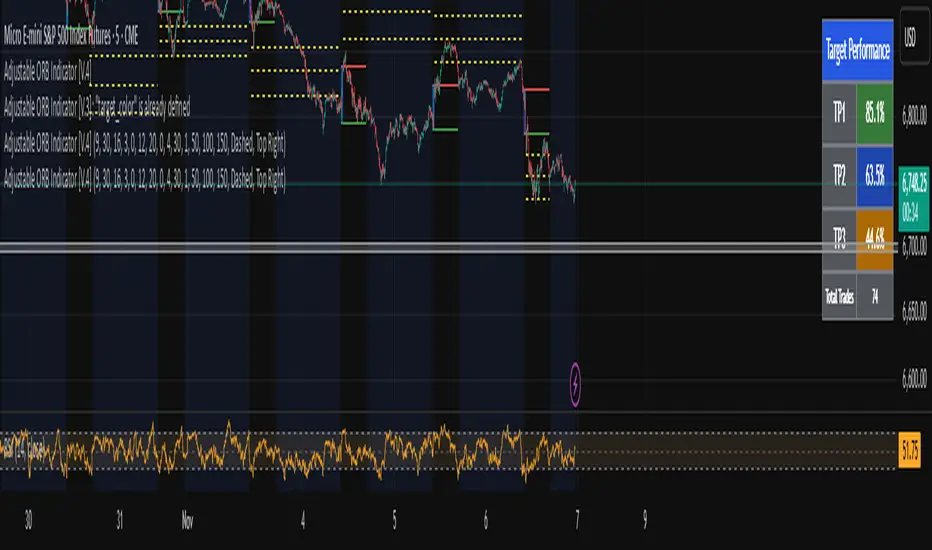
Adjustable ORB Indicator [V.4]A customizable opening range indicator. Adjust the following using this indicator; ~ Sessions ~ OR time settings ~ Colors ~ And more to come.Pine Script® indicatorby JfaustV224
FVG / FRACTALS HELPERTG: imjustdanya Индикатор автоматически находит фракталы/имбалансы на выбранных таймфреймах Можно настраивать всё,от внешнего вида, до количества отображаемых объектов Экономит много времени,и очень эффективен при интрадей торговле в стратегии Price Action The indicator automatically detects fractals and imbalances on selected timeframes. You can customize everything — from appearance to the number of displayed objects. It saves a lot of time and is highly effective for intraday trading within a Price Action strategy. Pine Script® indicatorby imjustdanyaUpdated 8
S&P500 Earnings Dashboard (automiamo.com)Hello everyone, this is the table I use to track the earnings performance of the top 40 companies in the S&P 500. I am using this simple method in Pinescript to extract data. Example for Apple's earnings: = request.security("ESD_FACTSET:" + "NASDAQ" + ";" + "AAPL" + ";EARNINGS", "D", ) You can see aggregated data on TradingView in a table and then I send a further short synthesis (like overall percentage of companies that beat analyst estimates) to my website with a TradingView alertPine Script® indicatorby automiamo1
WM & HS Radar (Block-Free)The W/M + H&S Radar automatically scans for double-top/double-bottom (M and W) and head-and-shoulders style reversal structures across any timeframe. How it works: Detects repeating pivot formations that resemble W (double bottom) or M (double top) structures. Draws neckline levels for each pattern and highlights potential breakout points. Confirms breakout validity when price closes beyond the neckline (optionally requiring a 1.2× volume surge). Generates alerts when a valid W Long or M Short trigger occurs. Best used on: 15m, 1h, or 4h charts to identify medium-term reversal entries. Recommended companion: Orion Daily HL + Volume indicator for higher-timeframe context. Alert Options: “W Long Trigger” → Bullish reversal breakout. “M Short Trigger” → Bearish reversal breakout. Usage Tip: Combine with your support/resistance zones and ATR-based stop sizing from your Money Momentum Tracker to validate A-setups only.Pine Script® indicatorby matthews86rx8
IRONBULL FX AMD📌 Power Of 3 ICT 01 – AMD ICT & SMC Accumulations Overview: The Power Of 3 ICT 01 indicator by TradingFinder is designed to visually map out the classic Accumulation–Manipulation–Distribution (AMD) phases of price behavior, based on ICT (Inner Circle Trader) and Smart Money Concepts (SMC) principles. It helps traders recognize the underlying structure of the trading day using session-based detection aligned to the New York timezone. 🔍 Core Logic: This script divides each trading day into three logical phases: Accumulation (19:00–01:00 EST) The period when institutions quietly build positions within a tight range. Manipulation (01:00–07:00 EST) False moves designed to induce retail participation in the wrong direction. Distribution (07:00–13:00 EST) The actual directional move after trapping liquidity. These zones are visually marked on the chart using colored transparent boxes, with labels for clear identification. 🛠️ Key Features: Session-Based Detection: Uses Pine Script’s time() function to identify when the chart time falls within each of the defined AMD sessions. Automatic High/Low Range Detection: For each phase, the indicator tracks the highest high and lowest low within the session window to draw a price range box. Visual Markers: Distinct labels and shaded boxes are plotted for each zone: 🔹 Accumulation → Blue 🔸 Manipulation → Orange 🟢 Distribution → Cyan Fully Customizable Settings: Each phase’s visibility, session time, and color can be adjusted from the input panel. 📈 Ideal Use Case: For traders following ICT/SMC methodology For intraday structure mapping To combine with other tools like Order Blocks, FVGs, or session breakouts ⚙️ Customization Options: ✅ Toggle visibility for each phase independently 🕒 Modify session start/end times 🎨 Choose custom colors for phase boxes and labels ⚠️ Note: Best used on intraday timeframes (60 min or lower). The indicator is optimized for charts set to the America/New_York timezone.Pine Script® indicatorby Mr_IB202568
CB Spot v BN Futs Premium by Chop324Coinbase Spot vs Binance Futures Premium Tracker What This Indicator Does: This indicator automatically tracks the price premium or discount between Coinbase spot prices and Binance perpetual futures for any cryptocurrency you're viewing. It works dynamically with whatever ticker you load it on - no manual configuration needed. How It Works: The script extracts the base currency from your current chart (BTC, ETH, SOL, etc.) and automatically constructs the corresponding tickers: Coinbase Spot: COINBASE: USD Binance Perpetual Futures: BINANCE: USDT.P It then calculates the simple price difference: Coinbase Spot - Binance Futures Visual Display: The premium/discount is plotted as a histogram: Green columns: Coinbase trading at a premium (higher than Binance) Red columns: Coinbase trading at a discount (lower than Binance) Baseline at 0: Represents price parity between exchanges Why This Matters: Coinbase premium is a useful market sentiment indicator, particularly for institutional/US retail activity: Positive premium: Often indicates strong US-based buying pressure Negative premium: May suggest selling pressure or capital flowing to offshore exchanges Extreme deviations: Can signal localized supply/demand imbalances or arbitrage opportunities Usage: Simply load the indicator on any crypto chart (BTCUSDT, ETHUSDT, SOLUSDT, etc.) and it will automatically display the premium/discount for that asset. Note: Requires both Coinbase spot and Binance perpetual futures data to be available for the symbol you're viewing.Pine Script® indicatorby EVMaximalist8
Ethereum Sleepy Wallets – 6-Month DormancyWhat This Indicator Does It measures how many Ethereum addresses have been completely inactive for at least 6 months (≥ 180 days) — using official Glassnode and CryptoQuant on-chain metrics. This reveals deep conviction among long-term ETH holders Core Concept: Direct 6-Month Dormancy The indicator uses two precise on-chain signals: Total Unique ETH Addresses From GLASSNODE:ETH_ADDRESSES or CRYPTOQUANT:ETH_TOTAL_ADDRESSES Counts every address ever used on Ethereum Addresses Inactive ≥ 180 Days From GLASSNODE:ETH_ADDRESSES_GREATER_THAN_180_DAYS Counts every address that has not sent or received ETH in 6+ months Sleepy ETH = Dormant ≥ 180 Days Sleepy Ratio % = (Sleepy / Total) × 100 This is not an estimate — it’s direct, real dormancy. Why 6-Month Dormancy Matters Short-term activity (7-day) = noise from DeFi, NFTs, trading 180-day inactivity = true HODLing — coins untouched through entire market cycles Historically: Rising dormancy → supply drying up → bullish pressure Falling dormancy → long-term holders selling → bearish warning How It Works (Step-by-Step) Fetches daily data from Glassnode (Pro+) or CryptoQuant (free) Selects real data if available; otherwise uses robust fallback Calculates raw sleepy wallets = addresses inactive ≥ 180 days Smooths the signal with a 21-day simple moving average (SMA) to filter noise Computes Sleepy Ratio % for instant conviction reading Displays live info table with exact values on every bar How to Use It Signal Interpretation Suggested Action Sleepy Ratio > 75% and rising Extreme long-term HODLing Strong accumulation — buy/hold Smooth Sleepy trending up Dormancy growing over 21 days Bullish supply shock forming Sleepy Ratio < 68% and falling Long-term coins re-entering circulation Caution — possible distribution Smooth Sleepy dropping fast HODLers breaking after 6+ months Bearish warning — consider exits Use on Daily (D) or Weekly (W) charts for clean, reliable signals. Pro+ vs Free Mode Mode Data Source Accuracy Pro+ (Glassnode ON) Real 180-day dormancy metric 100% precise Free (Glassnode OFF) CryptoQuant + price-scaled estimate ~80% historical correlation Toggle in settings: Use Glassnode Data What Makes This Indicator Original First open-source script to directly plot Ethereum’s 6-month dormancy using official ADDRESSES_GREATER_THAN_180_DAYS No fake math — uses true inactivity, not active address subtraction Dual-source logic ensures usability on any TradingView plan Dual output: raw sleepy count + 21-day SMA for precision and trend Live info table shows real-time values and data sourcePine Script® indicatorby bristleconewealth5
Earnings CountdownAdd to a chart to show a text box with how long to next earnings. Being updated to add functionality from original open source Pine scriptPine Script® indicatorby RotorDaz2
R Dominant Range [CRT] by Sergi SernaR Dominant Range identifies the most influential R range located to the left of the current price action. It highlights the dominant zone that still impacts market behavior, helping traders understand which range is controlling the current structure.Pine Script® indicatorby sergiign11128
PipGuard RollerPipPipGuard RollerPip – Confirmed Swing (H/L) Detector with Visual Guidance Indicator published by PipGuard. PipGuard RollerPip is a confirmed swing detector that plots H (swing high) and L (swing low) labels directly on the chart. It includes horizontal guides extending to the current candle and a compact legend showing the latest detected swing. The logic is designed to identify true structural swings , filtering out market noise and ignoring minor fluctuations that lack technical relevance. How it Works • Detection Method (Non-Classical): Unlike traditional 3-candle or fractal models (e.g., ICT-style structures), RollerPip employs a more refined process. It combines trend dynamics , movement amplitude , volume intensity , and closing behavior within a dynamic bar range . This approach allows it to detect genuine structural swings moments where price exhaustion or continuation is confirmed while drastically reducing false signals. • Labels and Guides: Each confirmed swing generates an H (High) or L (Low) label with a progressive effect that softens over time. Optional horizontal guides extend the swing level to the current candle, offering a clear visual anchor for ongoing analysis. • Dynamic Legend: A mini-legend updates in real-time, showing the most recent swing (H or L) for immediate context of the current market phase. • Built-in Alerts (Focus): Alerts trigger only on candle close when a new confirmed swing High or Low is detected. Notifications automatically include symbol and timeframe , ensuring you never miss a key structural move , even when away from the chart. How to Use 1. Add the script to your chart. 2. Observe the H/L labels to identify confirmed swing points. 3. Use the guides to maintain a visual reference up to the current bar. 4. Enable alerts (New Swing HIGH / LOW) to receive automatic notifications whenever a new swing is confirmed. 5. Integrate this information into your own technical workflow and risk management system. EXAMPLE OF USE EXAMPLE OF USE Settings • `Label Size` → Controls the size of H/L markers. • `Swing → Current Candle Guides` → Enables or disables guide lines. • `Maximum Guide Length (bars)` → Sets the extension of the visual reference. • `Dashed Style` → Toggles between solid or dashed line style. • Integrated Alerts: Two ready-to-use conditions ( New Swing HIGH / LOW ) with formatted messages (ticker + timeframe). • All visual parameters are preconfigured to ensure a clean, consistent, and professional display. Limitations • Swings are confirmed on bar close they validate turning points but do not anticipate them. • In low-volatility or sideways phases, more frequent swings may appear. • Past performance does not guarantee future results . Access This script is available under invite-only access . To request access, use the link provided in our Signature below this publication. Note: This is a technical analysis tool designed to study price structure and movement. It does not constitute investment advice or imply guaranteed outcomes. Indicator published by PipGuard.Pine Script® indicatorby PipGuard8
Roboquant RP Profits NY Open Retest StrategyRoboquant RP Profits NY Open Retest Strategy A good strategy for CLPine Script® strategyby semorrickj44
10 Moving Average ExponentialHaving the possibility to add multiple Moving Average Exponential up to 10 with one indicatorPine Script® indicatorby jollythecorgi2
Macro Valuation Oscillator (MVO)Macro Valuation Oscillator (MVO) is a macro-relative-strength indicator that compares the current valuation of an asset against three key benchmarks: Gold, USD, and Bond. It helps visualize how the asset performs in relative macro terms over time. When the MVO line for Gold (yellow) moves below the neutral zone (0), it reflects relative weakness against gold. When it rises above +80, it indicates relative strength or potential overheating compared to gold. The same concept applies to USD (blue) and Bond (purple) lines. The indicator highlights macro-rotation behavior, showing periods when assets outperform (green) or underperform (red) in relative value. It is mainly intended for daily charts, providing a clear visual framework for assessing long-term macro relationships and timing within broader market cycles.Pine Script® indicatorby Uttaya14
Sector Analysis [SS]Introducing the most powerful sector analysis tool/indicator available, to date, in Pine! This is a whopper indicator, so be sure to read carefully to ensure you understand its applications and uses! First of all, because this is a whopper, let's go over the key functional points of the indicator. The indicator compares the 11 main sector ETFs against whichever ticker you are looking at. The functions include the following: Ability to pull technicals from the sectors, such as RSI, Stochastic and Z-Score; Ability to look at the correlation of the sector ETF to the current ticker you are looking at. Ability to calculate the R2 value between the ticker you are looking at and each sector. The ability to run a Two Tailed T-Test against the log returns of the Ticker of interest and the Sector (to analyze statistically significant returns between sectors/tickers). The ability to analyze the distribution of returns across all sector ETFs. The ability to pull buying and selling volume across all sector ETFs. The ability to create an integrated moving average using a sector ETF to predict the expected close range of a ticker of interest. These are the highlight functions. Below, I will go more into them, what they mean and how to use them. Pulling Technicals This is pretty straight forward. You can pull technicals, such as RSI, Stochastic and Z-Score from all the sector ETFs and view them in a table. See below for the example: Pulling Correlation In order to see which sector your ticker of interest follows more closely, we need to look first at correlation and then at R2. The correlation will look at the immediate relationship over a specified time. A highly positive value, indicates a strong, symbiotic relationship, which the sector and the ticker follow each other. This would be represented by a correlation of 0.8 or higher. A strong negative correlation, such as -0.8 or lower, indicates that the sector and the ticker are completely opposite. When one goes up, the other goes down and vice versa. You can adjust your correlation assessment length directly in the settings menu: If you want to use a sector ETF to find the expected range for a ticker of interest, it is important to locate the highest, POSITIVE, correlation value. Here are the results for MSFT at a correlation lookback of 200: In this example, we can see the best relationship is with the ETF XLK. Analysis of R2 R2 is an important metric. It essentially measures how much of the variance between 2 tickers are explained by a simple, linear relationship. A high R2 means that a huge degree of variance can be explained between the 2 tickers. A low R2 means that it cannot and that the 2 tickers are likely not integrated or closely related. In general, if you want to use the sector ETF to find the mean and trading range and identify over-valuation/over-extension and under-extension statistically, you need to see both a high correlation and a high R-Squared. These 2 metrics should be analyzed together. Let's take a look at MSFT: Here, despite the correlation implying that XLK was the ticker we should use to analyze, when we look at the R Squared, we see actually, we should be using XLI. XLI has a strong positive relationship with MSFT, albeit a bit less than XLK, but the R2 is solid, > 0.9, indicating the XLI explains much of MSFT's variance. Two Tailed T-Test A two tailed T-test analyzes whether there is a statistically significant difference between 2 different groups, or in our case, tickers. The T-Test is conducted on the log returns of the ticker of interest and the sector. You then can see the P value results, whether it is significant or not. Let's look at MSFT again: Looking at this, we can see there is no statistically significant difference in returns between MSFT and any of the sectors. We can also see the SMA of the log returns for more detailed comparison. If we were to observe a significant finding on the T-Test metrics, this would indicate that one sector either outperforms or underperforms your ticker to a statistically significant degree! If you stumble upon this, you would check the average log returns to compare against the average returns of your ticker of interest, to see whether there is better performance or worse performance from the sector ETF vs. your ticker of interest. Analyzing the Distribution The indicator will also analyze the distribution of returns. This is an interesting option as it can help you ascertain risk. Normally distributed returns imply mean reverting behavviour. Deviations from that imply trending behaviour with higher risk expectancy. If we look at the distribution statistics currently over the last 200 trading days, here are the results: Here, we can see all show signs of trending, as none of the returns are normally distributed. The highest risk sectors are XLK and XLY. Why are they the highest risk? Because the indicator has found a heavy right tailed distribution, indicated sudden and erratic mean reversion/losses are possible. Creating an MA Now for the big bonus of the indicator! The indicator can actually create a regression based range from closely correlated sectors, so you can see, in sectors that are strongly correlated to your ticker, whether your ticker is over-bought, oversold or has mean reverted. Let's look at MSFT using XLI, our previously identified sector with a high correlation and high R2 value: The results are pretty impressive. You can see that MSFT has rode the mean of the sector on the daily timeframe for quite some time. Each time it over extended itself above the sector implied range, it mean reverted. Currently, if you were to trade based on Pairs or statistics, MSFT is no trade as it is currently trading at its sector mean. If you are a visual person, you can have the indicator plot the mean reversion points directly: Green represents a bullish mean reversion and red a bearish mean reversion. Concluding Remarks If you like pair trading, following the link between sectors and tickers or want a more objective way to determine whether a ticker is over-bought or oversold, this indicator can help you. In addition to doing this, the indicator can provide risk insights into different sectors by looking at the distribution, as well as identify under-performing sectors or tickers. It can also shed light on sectors that may be technically over-bought or oversold by looking at Z-Score, stochastics and RSI. Its a whopper and I really hope you find it helpful and useful! Thanks everyone for reading and checking this out! Safe trades! Pine Script® indicatorby Steversteves1144
RTPL(lite)RTPL(lite) — Free Simple, powerful, no cost. • Auto-detects Wave 5 • Shows TP target • 400D EMA line • Golden Cross alert • Gaussian channel Works on any chart. No subscription needed. Full version ($109) → rtpl.gumroad.com/l/rtpl-plusPine Script® indicatorby E3investing2
Sesiones Globales 🌍 Londres / Wall Street / Tokio / SydneyA clean visualization of the four main trading sessions — all shown in Argentina time (UTC−3) for easier global market tracking. 🕒 Sessions covered: London 🇬🇧 — 05:00 to 13:30 Wall Street 🇺🇸 — 11:30 to 18:00 Tokyo 🇯🇵 — 21:00 to 03:00 Sydney 🇦🇺 — 20:00 to 02:00 ✨ Features: Soft background colors for each market session (non-intrusive and chart-friendly) “OPEN” and “CLOSE” labels in matching session colors Correct weekend handling — Tokyo and Sydney extend into early Saturday mornings (no false sessions shown) Works on any asset — BTC, SP500, FX, or indices Designed for dark charts and visual clarity 🎯 Why use it: See where global liquidity overlaps, detect volatility zones, and plan your trades around real session activity — especially helpful for BTC and SP500 traders following institutional flow. 💡 Tip: All times are set to Argentina (UTC−3) by default. Adjust manually if you prefer another timezone.Pine Script® indicatorby ktrimboli9419
VOODOORFVGS v1.1Voodoo Doors - Multi-Timeframe FVG & Range Analysis Voodoo Doors is a comprehensive trading indicator designed to identify and track critical Fair Value Gaps (FVGs) and price ranges across multiple timeframes. This powerful tool combines time-based FVG detection with Opening/Closing Range analysis to highlight high-probability trading zones. Key Features: 🚪 First Presented FVGs (FPVG) Track up to 3 customizable FVGs that occur at specific times throughout the trading day: - FPVG 1 (Default: 9:31 AM) - Early session gap detection - FPVG 2 (Default: 1:31 PM) - Midday reversal zones - FPVG 3 (Default: 6:15 AM) - Pre-market opportunities Each FPVG includes: - Historical tracking (up to 30 days) - Age labels showing gap freshness - Customizable fill colors, borders, and mid-lines - Auto-extension to current bar - Progressive transparency for older gaps ⚡ 15-Second Lower Timeframe FVGs Precision intraday analysis during critical hours: - 10am FVG - Morning volatility capture - 11am FVG - Late morning momentum shifts - Real-time detection using 15-second data - Directional labels (↑/↓) for quick identification 📊 Opening Range (OR) 30-second precision Opening Range levels: - Default: 9:30 AM market open - High/Low and Equilibrium (EQ) levels - Configurable historical tracking (up to 5 sessions) - Price touch alerts available - Extended or fixed-length projection 🔴 Closing Range (CR) End-of-day price action analysis: - Default: 3:59 PM (15:59) - Captures final market positioning - Independent styling from OR levels - Optional extension into next session 🎯 Custom Range (CUR) Flexible user-defined range detection: - Any time, any timeframe - Perfect for capturing specific news events - Fully customizable colors and styles - Alert functionality for level touches Visual Customization: Every element is fully customizable: - Line styles: Solid, Dashed, Dotted - Individual color controls for fills, borders, and mid-lines - Adjustable transparency (0-100%) - Line width controls - Historical opacity settings Professional Features: ✅ Non-repainting - all signals are final✅ Multi-timeframe support with automatic detection✅ Efficient array management for historical data✅ Market session awareness (excludes weekends)✅ Optional information table showing global market open times✅ Alert system for price touching key levels✅ Up to 500 drawing objects supported Best Used For: - ICT trading methodology (FVG mitigation) - Range breakout/breakdown strategies - Session transition trading - Multi-timeframe confluence analysis - Smart money tracking Timezone: Default UTC-4 (New York time) - fully adjustable in settings Recommended Timeframes: --- Note: This indicator uses lower timeframe data requests and requires TradingView Premium/Pro+ for full functionality. Pine Script® indicatorby Voodoo_Dreamz19
Multi-Day SMAmade this script due to the frustration of not having the 5 day SMA added with the 10 20 and 50. I need the 5 SMA for my type of trading to determine when to sell with stocks showing exponential growth. so heres this: Multi SMA 5 day SMA pink 10 day SMA white 20 day SMA blue 50 day SMA red 200 day SMA greenPine Script® indicatorby Nolimityit2
Crypto Futures Basis Tracker (Annualized)🧩 What is Basis Arbitrage Basis arbitrage is a market-neutral trading strategy that exploits the price difference between a cryptocurrency’s spot and its futures markets. When futures trade above spot (called contango), traders can buy spot and short futures, locking in a potential yield. When futures trade below spot (backwardation), the reverse applies — short spot and go long futures. The yield earned (or cost paid) by holding this position until expiry is called the basis. Expressing it as an annualized percentage allows comparison across different contract maturities. ⚙️ How the Indicator Works This tool calculates the annualized basis for up to 10 cryptocurrency futures against a chosen spot price. You select one spot symbol (e.g., BITSTAMP:BTCUSD) and up to 10 futures symbols (e.g., DERIBIT:BTCUSD07X2025, DERIBIT:BTCUSD14X2025, etc.). The script automatically computes the days-to-expiry (DTE) and the annualized basis for each future. A table displays for each contract: symbol, expiry date, DTE, last price, and annualized basis (%) — making it easy to compare the forward curve across maturities. ⚠️ Risks and Limitations While basis arbitrage is often considered low-risk, it’s not risk-free: Funding and financing costs can erode returns, especially when borrowing or using leverage. Exchange or counterparty risk — if one leg of the trade fails (e.g., exchange default, margin liquidation), the hedge breaks. Execution and timing risk — the basis can tighten or invert before both legs are opened. Liquidity differences — thin futures may have large bid-ask spreads or slippage. Use this indicator for analysis and monitoring, not as an automated trading signal. Disclaimer: Please remember that past performance may not be indicative of future results. Due to various factors, including changing market conditions, the strategy may no longer perform as well as in historical backtesting. This post and the script don't provide any financial advice. Pine Script® indicatorby QuantNomad109
Combined Trading IndicatorsThis indicator is a combination of EMAs (4 Editable EMAs), Quarterly Earnings, OOPs Reversal day, Burst Power Indicator, RS Rating, ADR% Settings and a few more to come. Basically it is designed for swing traders who are using TradingView's Basic or Essential Program. Please ignore the %Chg data in QE Table.Pine Script® indicatorby raagr542020813
Kubera - ScorecardKubera - Scorecard helps you quickly assess a company’s financial strength and investment potential. It combines key fundamental metrics — ROCE, ROE, ROIC, Debt-to-Equity, and WACC — to judge profitability, efficiency, and risk, presenting them with intuitive color-coded ratings and a final verdict. The indicator also includes an RSI band and table for momentum insight, helping you spot fundamentally strong stocks with healthy technical setups. Ideal for swing traders, investors, and beginners who want to identify quality companies at a glance.Pine Script® indicatorby balachandran_kannanUpdated 3392
Purchasing Power vs Gold, Stocks, Real Estate, BTC (1971 = 100)Visual comparison of U.S. dollar purchasing power versus major assets since 1971, when the U.S. ended the gold standard. Each asset is normalized to 100 in 1971, showing how real value has shifted across gold, real estate, stocks, and Bitcoin over time. Source: FRED (CPIAUCSL, SP500, MSPUS) • OANDA (XAUUSD) • TradingView (INDEX:BTCUSD/BLX) Visualization by 3xplainPine Script® indicatorby x3plain19
Stablecoin Liquidity Delta v2 (Aggregate Market Cap Flow)Updated version of Stablecoin Liquidity Delta (Aggregate Market Cap Flow). Hi All, This indicator visualizes the bar-to-bar change in the aggregate market capitalization of major stablecoins, including USDT, USDC, DAI, and others. It serves as a proxy for monitoring on-chain liquidity and measuring capital inflows or outflows across the crypto market. Stablecoins are the primary liquidity layer of the crypto economy. Their combined market capitalization acts as a mirror of the available fiat-denominated liquidity in digital markets: 🟩 An increase in the total stablecoin market capitalization indicates new issuance (capital entering the market). 🟥 A decrease reflects redemption or burning (liquidity exiting the system). Tracking these flows helps anticipate macro-level liquidity trends that often lead overall market direction, providing context for broader price movements. All values are derived from TradingView’s public CRYPTOCAP tickers, which represent the market capitalization of each stablecoin. While minor deviations can occur due to small price fluctuations around the $1 peg, these figures serve as a proxy for circulating supply and net issuance across the stablecoin ecosystem.Pine Script® indicatorby steenman8