Usage of an enhanced RSI indicator to spot turnsThe following chart shows the enhanced RSI indicator in with the settings of the current dominant market cycle. The cyclic-smoothed (cRSI) indicator is able to indicate price turns analog to indicator turns above/below the cyclic lower/upper much clearer than the basic RSI.
The indicator is available for usage in TradingView:
Oscillators
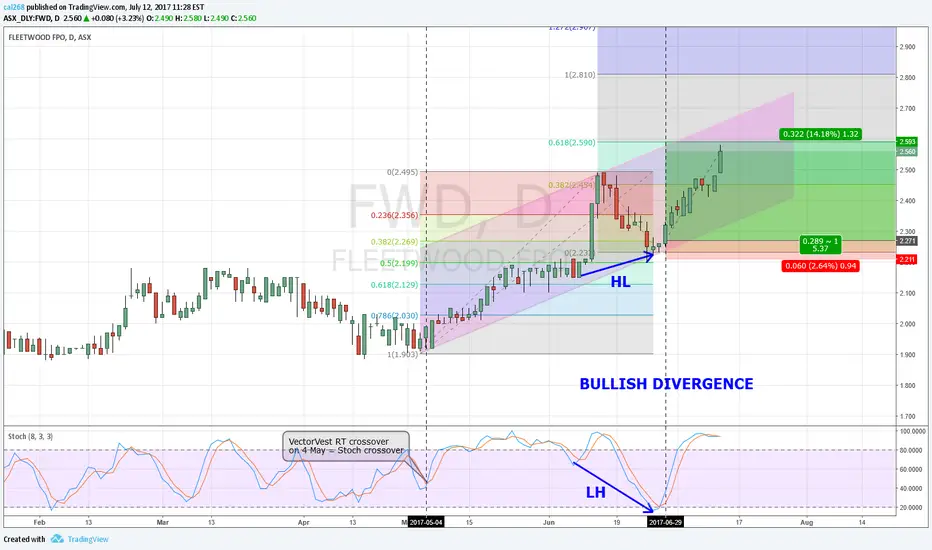
Trend Base Analysis & DivergenceToday, I show this example for you to understand why bullish divergence is important for an entry order.
FWD.AX is selected because VectorVest indicator RT crossover occurred on 4 May which is the same day that Stochastic (8,3,3) crossover occurred
Value of RT changed from 0.97 (3 May) to 1.03 (4 May)
Value of RT yesterday was 1.53
If you hold this stock since the crossovers occurred on 4 May, you gain 30% return so far.
For beginners, you may also try the second entry on 29 July. Why? It is simply because of the bullish divergence. And also, the price actions struggled at the Fib Ret. 38.2% as well.
Your homework is to analyse JIN.AX, using the same strategies above and the markups on the graph. Show me why JIN.AX gained 10% in one day on 11 July.
Super Easy MACD & Stochastics Trading TechniqueI am fairly new to this but have been testing out this technique with stochastics and MACD and it works well for me.
Once stoch goes bullish from oversold, wait for MACD to cross and confirm a bullish trend is emerging and buy.
When we have reached a peak and it's time to sell - stoch will cross to bearish from overbought followed by MACD.
This works well with any time frame and trading pair!
Happy trading and if my technique helped you profit - feel free to donate some BTC: 17CmGuFs55TVFSC3BZbWoYkVHLMm5ko5Yg
Trading Applications: How To Use Oscillators Correctly! You need to read the tutorial first before this post. Here is the tutorial :
This is an example of how to apply the concepts I explained in the oscillators tutorials.
I have numbered the text boxes so that you read them in the correct sequence. Start from the left hand side and move along the chart. In this example we have applied some basic concepts like support and resistance and candlestick patterns as an additional tools to the oscillators. It is always important to use more tools to support your view (but not too many).
Also it's always important to put things in context of the the price action. Whether it is trending up or down or sideways. In addition, remember to look at the bigger picture, as an uptrend on the daily chart , might be merely an upwave in a sideways market on the weekly or monthly chart.
Best
Technician
Trading Fundamentals: How To Use Oscillators Correctly!Note: A prerequisite tutorial about trends is posted in the related links below.
Oscillators can be a very useful indicators in trading if used correctly. However misusing them will only return disappointing results.
Some of the most popular examples of oscillators are the stochastics, and relative strength index . I will use stochastic in this tutorial, but the same logic applies to most other oscillators.
Definitions:
What are oscillators:
Oscillators are indicators that derive their value from the price . The price is an input for the oscillator formula. The formula is usually a simple calculation that compares the latest close value for the price to a the range of price over a specific period of time( u can change this period in the oscillators settings). Then give the result in a percentage format(0 to 100). The main purpose of this calculation is to show whether the price is overbought or oversold compared to that period range. For example: if stochastic reading is at 80% or above, its said to be overbought. And if at 20% below it is oversold.
Divergence:
When the price is making new highs and the oscillator fails to make a new high, this is called a bearish divergence. The opposite is true, when the price is making new lows and the oscillator fails to make new lows this is called a bullish divergence. Bullish divergence is a buy signal and bearish divergence is sell signal.
If you follow the overbought and oversold signals and divergences as a sell and buy signals without taking in consideration the price trend, the results will be catastrophic. ill explain why shortly
How to use oscillators to maximize your chances:
1) In TRENDING MARKETS
Rule #1: Oversold signals in uptrending market is a reliable buy signal.
Overbought signals in downtrending market is reliable sell signal.
Look at the chart, start from the left, you can see that the price broke above the latest swing high for the prior down trend, And that signalled a potential reversal. Accordingly, a trader should had looked to buy new oversold signals on stochastic. Afterwards, every time the stoch. was oversold in this uptrending market, we witnessed a rebound and resumption of the uptrend.
Same logic should be applied to downtrending market.
Rule #2: Overbought doesn't mean sell if occurs in an uptrend, and oversold doesn't mean buy if in downtrend.
Rule #3 : Bearish divergence doesn't mean sell if occurs in an uptrend, and bullish divergence doesn't mean buy if occurs in a downtrend.
This might be counter intuitive, but the chart above gives a clear example:
As you can see on the chart, when the market is up-trending, overbought, and bearish divergences signals are very common due to the fact that there is a strong demand. Therefore these signals are NOT RELIABLE and should be ignored. UNLESS there are other major multiple technical indications of reversal such as a major resistance level, and a bearish candlestick formation, or trend structure break. Same logic goes for down-trending market, where you should ignore oversold signals and bullish divergences.
At the end of the chart, another example of a bearish breakout below the uptrend structure. That was an early signal of a new downtrend. After that breakout, traders should look to sell new OB signals on stochastic.
2) In SIDEWAYS MARKETS
Overbought and oversold are reliable on a sideways market. Have a look at the image below
If you spot a side-ways market, look to buy oversold signals and sell overbought signals. As the price tends to reverse direction near the top and bottom of the range. If the range is broken, you should exit your trade and stop applying the the logic of sideways market. instead look to apply the logic of the trending market explained above.
Hope this will help you trade better
Best
Tech
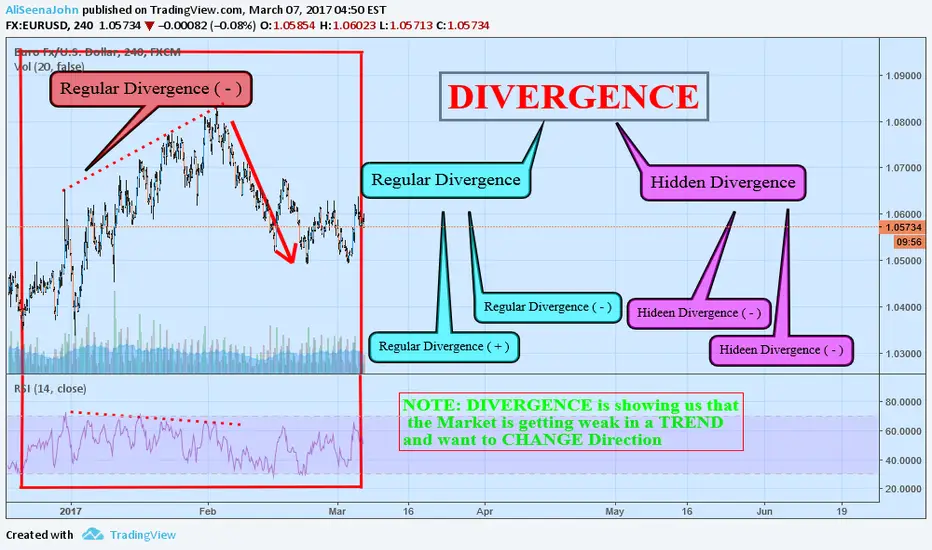
(EDUCATIONAL) DivergenceHello Trader:
Although Divergence is same in MACD and RSI or any OSCILLATOR like this, shows Divergence.
if this Chart is EDUCATIONAL then:
If you wanna Learn more about Divergence then follow me to LEARN MORE...
and please like for other TRADERS to give them the chance that the could also see this CHART and they learn too, something less from Market Behavior
GOOD LUCK
:::PEACE:::
(Education) EURJPY - How to trade this RSI Bamm on EURJPY?Hey guys, this is an update to the EURJPY setup I posted last week.
We are right there at the bottom of the triangle.
What is interesting to me is the formation of an RSI bamm at Friday's closing price.
Pattern Identification
RSI Bamm at bottom of triangle.
RSI Bamm is the formation of a W/M structure at RSI oversold/overbought where this is considered a prelude to a potential end of trend.
A W/M structure, followed by a retracement to the 50% level of the RSI indicator and a final retest at oversold/overbought will be considered a potential buy/sell opportunity.
Trade Execution
Next week, I will watch out for a move up out of the RSI oversold zone for EURJPY to initiate a buy.
SL will be below the low of Friday.
I am aiming at 119.50 for TP where the higher boundary of the triangle is at.
If EURJPY continues lower on Monday, this trade trade will be invalid and we will look for other opportunities to trade this pair.
Using Multiple Timeframes to Enter a TradeHello Traders!
As many of you know, I use the Stoch RSI as my main cycle indicator. As an indicator of an indicator, it normalizes the RSI indicator itself and provides excellent guidance on the price cycles of Gold. And while I base my daily analysis on the Daily time frame, I use 2 shorter time frames to enter my positions. These time frames are 30 minutes and 60 minutes.
Let me give you a real life example from yesterday of how I added to an existing short position.
Last week ended with a beautiful down candle on the daily chart. Long upper wick and a full body that closed just a few points above the bottom of our wedge. With plenty of room left on the Stoch RSI before it crossed the 20 line, I wanted to add another position to my existing short. But I new that I didn't want to jump in at Friday's closing price. So how could I gauge any potential pullback and set an entry price?
The first thing I did was to look at the 30 and 60 min charts, specifically to find where price was on those charts in relation to the overall down cycle.
Here is the 30 min chart on Sunday night at 11 pm PST. It's clear from the Stoch RSI that price was at the bottom of it's cycle. Not an ideal time to enter a trade. And the same was true on the 60 min chart (bottom chart). Therefore, I wanted the Stoch RSI to cycle up to get the best possible entry price. Looking at the BB, I placed a limit order at the inner BB (1.0 Std. Dev) @ 1321, thinking that would give both Stoch RSIs enough time to complete an up cycle. Turns out that was pretty close to the high of the day!
I have had the best entries when I wait for the cycle indicators across multiple time frames to get in sync. Waiting for harmony across multiple time frames is a great way to create a repeatable system for entries and really helps to remove emotions from your trading.
I would love to hear if this technique is helpful!
Safe Trading and Protect Your Profits!
AUDNZD: An example of a high probability trade #forex #audA simple trade using a harmonic three drive and RSI. Entry for the trade has already gone. But it could be useful to point to the setups and conditions around it, because it provide a great example of combining high probability technicals to initiate a trade.
The price provided a great shorting opportunity after completing a three drives pattern around 1.0770 level. A long upper wick was formed at that level confirming a high chance reversal. Meantime, RSI Divergence supported the short scenario.
Also, If you take a look at the daily chart, you will see a clear rejection and long upper wicks candles for the past two days.
All my ideas are just my personal view. Trade Your own view.
I have no incentive to post if i don't get enough support from you. Likes and comment.
You can SKYPE me at : Technician - The Forex Channel
My Regards,
Technican
RSI Is Your Friend - What Non-Price Analysis Can Tell You #ForexFriends,
Let me just start by making this statement, which has caused more reaction than I have ever cared, but it simply is true:
1 - RSI's bearish divergences do NOT foretell an impending decline in price. Instead, they are associated with sustained rise in price.
Conversely:
2 - RSI's bullish divergences do NOT foretell an impending rise in price. Instead, they are associated with a sustained decline in price.
Yes, I know. You have been told, taught and even paid for statements that come in direct contradiction to this, but let me tell you right now: Put your gun down, Google Positive Divergence in RSI (not Bullish Divergence) for instance, and you would be more apt to find a RSI signal associated with a consistent premonition in terms of signal than any of that bearish/bullish divergence.
I have given multiple lessons to private individuals or public audiences demonstrating that before any reversal, there are multiple bearish/bullish divergences, and that the reversal only comes true after a sustained numbers of the said divergences.
In contrast, a Positive/Negative Divergence in RSI only comes in a great while, and is typically associated with a deeper retracement, if not a reversal.
I continue to be dismayed that even professional traders keep on pointing at bearish/bullish divergences. I have to explain here that the trader is NOT completely wrong to point these out, but remember that these divergences are associated with a contrarian trend (i.e.: bullish with decline and bearish with rising prices for the most part).
As a predictive analyst/forecaster, and having worked, decorticated and peeled RSI studies for many years (I started in 1997, the year I entered medical school), I soon learned that RSI is and continues to be erroneously taught.
Another feature of my trading is that I do NOT trade off of price. As many of you might have heard from me: "Price is the dangling carrot at the end of the stick held by institutional hands". The institutional traders know every stop-losses, every positions and can decide to move a M5, M15, H1 or even a H4 chart against a widely held position of retail traders, wide the screen clean of these SLs and yet not impart much changes at the daily/weekly levels at which they trade for their liquid providers/banking clients. So, keep that in mind as well.
So, best is to use certain indicators. I use the RSI-14 set at HLC/3. Here is an old method I used to decide on entries:
Take a look at the bottom of the chart. See a trend? Do you also realize that all the lines are perfect parralels to one another (there are one steep and one soft-sloped). See how they keep on failing while price remains (recently) in a downward trend?
Now, of late, RSI is approaching its upper steep-TL boundary. Do you see the association with the price's own TL?
My point here is to use an indicator in the most discreet and alternative way. After so many years of doing research on RSi (lots of backtesting in several RSI values, and across many TF and markets), RSI can definitely be one of your best trading buddy.
By the way, the author of RSI himself has a few residual students who are now teaching. These students are teaching the first rule I mentioned above, so this is not something I made up, but something that comes right from the RSI author himself - Question is: Why do institutional trading firms continue to erroneously teach RSI and offer you to open an account there? Is this a misleading attempt, or simply a developing case of the blind leading the clueless?
Cheers,
David Alcindor
Predictive Analysis & Forecasting