USDMXN Carry Trade Positive Swap for shortsKeep a look out here, Would prefer a higher pullback into Supply ZoneShortby MiWealth111
EURTRY weekly bearish bat and shooting star combination shortEURTRY has been approaching its all time high and hit into the bearish bat. Here we got a weekly shooting star broke to the downside, I would kinda love to take some short this week. Tiny position would be fine to try to hold as long as possible as a carry trade. Let's see how it goes yo!Shortby Trader_Joe_LeeUpdated 9
The Secrets to Forex & Seasons GreedingsThis section is on seasonality and follows the prior section on carry trading conditions. I strongly recommend reading the prior parts for full value. This is (pt. 5) in chronological order. And yes, this will be on the test. ----------------------- You probably have someone in the immediate or extended family that considers herself (let's be honest) an expert shopper. The coupons, the early trips, the economy size containers, the 2 for 1 dealerinos, etc. Gets the seasonal produce or vegetables because they're cheap. Skips Black Friday, shops Cyber Monday. Didn't run out of toilet paper during the pandemic, etc. Gets all the Christmas gifts shortly after Thanksgiving, or in early December. And this expert shopper will repeat many of these decisions each year around similar times or with similar products. Doesn't matter what holiday, culture, or country involved, the behavior is parallel. I'll cut the music and get to the important stuff: Shopping is where the average normie experiences the pricing influences of seasonality. Not everything is 'worth' the same price all year round, not everything can be produced on any given day of the year, and not everything is consumed on any given day of the year. There are private and public laws and behavioral standards tied in as well. Everyone knows this as they experience it in their general robotic lives. But retail traders tend to forget this when it comes to trading and investing. So what's the difference between seasonality and similar-sounding concepts like cyclical trading or using historical models? Part 1: Solar Calendars Seasonality is a kind of factor (like in factor investing), it's a more rigid concept derived from historical data. It tends to be cyclical, but the timing is not arbitrary, it's formatted into the gregorian calendar . This calendar is based on solar timings and their effects. Solar timings were once one of the great wisdoms coveted by our ancient ancestors, building incredible structures to predict these seasonal events. They didn't do this for fun. In our current era of surplus, we can tik tok our way to prosperity, but in earlier eras, maximizing food and shelter was a life or death strategy. The solar calendar predicts these events with relatively decent scientific accuracy. It offers certain outcomes. Think about trading and its challenges. Uncertainty is the norm, so anything certain is inherently valuable. Now, how does that fit into currency exchange? Businesses, major exchanges, and governments all rely on this calendar for their standard operating procedures and for risk management. What do those three things have in common? They involve people, and they involve lots and lots of money. They all share the same green destiny. Part 2: Are These Titles Useful? I said this a million different ways in the first 2 parts. Look, there are certain psychological biases that greedy people at the top share, due to their upbringing, income bracket, and nationality, among things. Those biases help make seasonality matter, largely due to vacation timing, consumption season, and tax events these wealthy people will into relevance out of thin air, like a magician. This is why seasonality can still generate an edge for you, the pitiful retail trader. Now, as mentioned in pt. 3, we are still focused on long-term trades, traders that hold for many days, weeks, or months. Does seasonality have big changes for intra-day traders (who play on nightmare difficulty)? I'm not going to write a book here and detail every answer, you need to do your own research. Or you can just wait for me to write the section on intra-day trading. Or you could spend your whole life serving coffee. Please remember to follow me so I don't have to see your awful latte art. Part 3: Dead Presidents Okay, here are some secrets from the money magicians: There are seasons for all securities. It's important to understand that seasons for stocks and commodities affect currencies. I had to check google to make sure this is up to date but it appears you still need cash to buy or own things. And we're in the cash game. Ever wonder why dead presidents or national heros are always on the faces of fiat currency? As described in the last part, they are country-level assets, created for tax and liquidity purposes. Those faces are reminders of your most sacred civic duty: paying taxes. Did you know that all people have to pay taxes? Including wealthy people? The most powerful person on earth (probably) pays taxes. And, based on nationality, have to pay taxes at the same time each year? That is a rare form of certainty related to markets. Part 4: The Spice Must Flow Tax season, especially the US tax season, is big because lots of cash (usually over 80%) flows through forex as USD. Most of the wealthiest people in the world hold a lot of USD. And a majority of them live in the US, as tax residents or as citizens. As a result, it has an effect on USD rates towards the end of the year, when investment portfolios are rebalanced to try and take advantage of the tax system with whatever strategy is legally available. Indeed, it can be complicated, and I recommend doing your own research, something you will have to be competent at if you want to make a living for decades into the future. The net assessment is that if you are trading towards the end of the year, you need to be mindful of how the US tax season will affect your potential positions, and fit that into your risk management evaluation. Variables like earnings seasons, and other business or industry dependent factors serve as strong influences. After all, they are the ones using most of the money... currency isn't just there to collect for rent and spend on groceries, it's to create and capture value, the mission of all corpos. The money must flow. JUST THE TIP: When looking at seasonality, or any other global macro like news or fundamentals, it's important to think in terms of DEMAND. Does xyz increase demand for a currency (relative to the pair)? The supply does matter, but where many retail traders (and especially cryptocoinies) tend to get pink in the face, is when they focus almost entirely on supply in the evaluation of a currency. Demand is principally important to currency, and is the primary reason why consensual pegging agreements and the gold standard failed last century. Instead of reading a book on it, just read this: the demand for the currency of a few key nations is consistently strong due to loosening international finance standards that allow the newly minted wealth of developing world investors to gravitate towards developed country assets to hedge against local economic turbulence. Oh yeah and the petrodollar. Part 5: Commodifying Seasons Looking at commodities as futures contracts, because they deserve special attention. Especially useful in recent months. A lot of bag holders suffered big time in the oil contract bogmarket. The Bogdanoff's made a call, and prices on a few different oil contracts fell below zero. The behavior is so significant it is having effects on USD and global economic sentiment. Thank god we smart kids trade forex right? No zeros in forex, just infinities. There are plenty of articles online explaining how that happened, but let me tie in FNDs and explain the intersect with currency. The First Notice Day on futures products usually represents the peak of a trend if a trend was recently present. For example, the trend would occur over the prior 2 weeks or more to the FND date. You would want to look for positive open interest changes to support that trend. The FND could represent a definitive exhaustion point and signal a reversal or retracement. For risk management, these can be useful to look at if you trade a safe haven currency against a commodity or emerging currency. That means JPY & CHF (and now USD & EUR) against AUD, CAD, and sometimes NZD. Overall, most non-safe havens will have commodity performance attached to their currency performance. A quantitative or qualitative (ya eyeball it) composite of the performance of these commodities can help identify your center of price gravity (and its shift, is it being pulled up or down). I will come back to commodity futures and how they affect commodity currencies in the next part, so don't panic. In sum, I suggest googling the first notice days for commodity contracts (and you should also make note of currency contracts as well), taking a look at their chart development, and being mindful of a likely reversal occurring on those dates. This is an excellent way of finding extremes on the related pairs and can serve as 'risk mindful' price levels for entering into a long term trade. For example, not to get too far ahead of my risk management articles here, but let me briefly spoil with a more intermediate level trade: Relevant commodity futures contracts are rising in confluence with seasonal data and your currency (AUD/JPY) is rising in tandem. Your center of price gravity is accurately reflected as the current price of AUD/JPY at market, and you bought at the start of the month based on prior research, so you are in profit. Shortly before FND, interest rates on AUD are cut and the AUD/JPY trend flatlines. However, at the FND, the contracts make an extreme bullish move, and price action on AUD/JPY jumps as well (but in a smaller %). You have found an extreme, and can now close your long position or open a reversal position and wait for PA to retrace. Now, I could write a Chinese novel on all the specific things that should also happen with that trade, but that example is a framework you should familiarize yourself with. Part 6: That Time of the Month Your eyes are probably glazing over at this point. That's alright, everyone has a limit to what they can read and learn. Just like everyone has a limit to their net worth. Wonder if there is a relationship between the two. Let me make this a little easier by explaining just how complicated seasonality can be. As mentioned earlier, seasonality tends to work simply because there is an underlying calendar structure within highly regulated wealthy markets. These structures are created by the rules and standard practices of individuals and institutions, and more. These are effectively factors (factor investing) that shape price mechanics. Money moves in and out based on these regulations or standards (controlled timing), IE: tax obligations (end of year), holiday spending (consumer nations benefit), commodity contracts (exchange rules), and vacation months (volatility dynamics), and more. Global weather patterns influence shipping and availability of ports, temperatures and Ninos influence the price of agribusiness commodities normally tied to season... But it doesn't have to be that complicated for you, my small headed friend. I wanted to highlight the harder route first if you so choose to follow it, but the easy route is also available. Most of the forex market is USD, the remaining minority is EUR and JPY, and the rest is just a twinkle in some greedy fatcats eye. Why not just look at the seasonal or monthly performance of those currencies? Review the conditions from the peak, instead of the ground floor? Part 7: Started at the Top Firstly, if you prefer averages, you can average past 3 years, past 5 years, past 25 years, etc. You can find these indicators on TV by searching 'seasonality.' You can find them as free or paid indicators on the mt4 marketplace. You can also find them in various forms on other sites, some of them premium. Now, it gets even easier. Some pairs tend to close higher on some months versus others, this can be a useful unit of analysis when you attempt to fit seasonality into any overall model. If a pair like the USDJPY has 65% of closing higher in October but a sub 35% of closing higher in August, then you can evaluate risk by aligning yourself with history. You will know based on the MoM shift of probabilities. If you don't know this, then you need to return to the zoo, they are probably looking for you. Likewise, anything between 45-55% is likely noise, and not subject to the psychological intersect present in seasonality that I find significant. Again, we're still operating under a long-term trade frame of reference; intra-day traders will have their own sections in the future. To stay on target, long term traders with limited time to do additional research will want to focus on monthly seasonality performance at minimum. You don't necessarily need to be going through futures contracts, seasonal consumer spending, tax season dynamics, or weather patterns for perfect market timing opportunities; but know that the institutions do, and they have the money, they make the markets, and they intimately follow (or create) business and client trends. As I explained in part 1, what they think is the only thing that matters, even if it seems overly complicated or stupidly simple. Spending a little less time with your gann wave analysis and more time mimicking their research efforts will improve your survivability and your probability of accurately finding that center of price gravity. What about carry conditions? So let's return to the carry condition question. How can you use seasonality to find the center of price gravity, the resilient value, for long term positions? Alone, it is not sufficient, but it necessary to consider, especially in months where seasonality dictates a 65% or higher chance of a positive or negative month. For instance, you decide to plan a 3-month trade on the USDJPY, from August through October. You will know based on seasonal monthly performance, that the center of price gravity is moving from a lower to a higher price point. UJ has a 32% of closing HIGHER than it opened in August, a coinflip 53% in September, and 68% of closing higher than it opened in October. This instructs your risk management approach. You take additional risk holding a 3 month short in that period. And adding carry conditions, you pay a daily fee to make that trade as well. Personally, I feel sick just thinking about that trade. I had coronavirus last month, but that trade is worse. Now, that doesn't give you much guidance on when to open your position, which further sections will help elucidate. If you got this far, congratulations. Your mom and I are very impressed. More on fundamentals, commodities, and global macro in general next time. If you're someone that obsesses over the medieval metals or boomer rocks, then you will really enjoy the next section. Still lost and confused? Don't worry, it's already priced in. Educationby CountofCoins117
The Secrets to Forex & Protecting Your CarryYou must read the prior articles first. If this was a video game you would probably be trying to skip the conversation boxes at this point. Don't try to speedrun this, you'll die at the boss. --------------------------------------- I'm sure you're tired of all the poetry and want to get straight to the money. Money, after all, is the best form of entertainment. Now, last time we left off with timeframes and carry conditions, key components of the overall risk management message I want to get across. I figured that most retail traders operate on multiday/multiweek positions. Most know next to nothing about carry risk or other unique risks present only for non-intraday traders. If you intend to hold positions across several weeks/months (see pt. 3 for the definition), then this section is the most important of all the articles to come. In addition, I recommend doing additional research, especially if you have a job, are in schooling, or other responsibilities; because understanding this risk (and potential reward) can be very beneficial for those with limited time to spend. Part 1: Country-level Assets All wealthy people own assets. Assets can appreciate. If you 'own' a lot, you are, by default, wealthy. At least, for a brief moment in time. When you trade in forex, you are investing in a type of asset underwritten by a 'country' and paired with a similar underlying. The country creates the supply, and sets minimum standards in demand via tax law. Like businesses with stocks, countries with currencies and bonds can default, and flatline, leading to a breadline utopia. Inversely, they can also grow, and produce something of market value; and then provide returns to everyone that bet something on them. Some countries are flailing about, some countries are stable, and some are growing with seemingly no obstacles in sight. Which one would you want to invest in? Remember the dividend question? Before some median-salary economist gets in a huff, yes it's not always as simple as 'growing country = growing interest rates.' But here's what's important for retail traders: Central banks manage these 'country-level' assets with an evolving toolbox to variable acclaim. I recommend doing your own research into that topic, because it's too far outside the scope of these articles, and there are no unified verdicts on the 'science' behind any of it. The important thing to understand is that when you invest in these country-level assets, some countries demand a fee rate, and some offer a dividend rate. THAT'S IT. Room temperature or higher IQs will get this. Part 2: Free to Play vs Fees to Play You can find these rates by googling: 'central bank interest rates.' Those negative rates are FEES TO PLAY. Zero or higher is FREE TO PLAY. If you hold currency at a broker, these rates are realized and charged or credited to your market position at the daily rollover event. This occurs at the end of the 24hr cycle set to City time. So if you hold positions over 24hr cycles, you will be charged or credited REAL MONEY (no delivery gimmicks). Now, you can't trade currency in isolation in forex, it's always in the form of a pair. In case you haven't figured this out yet, the forex trader is the type of player these articles are designed for. This means, in lazy phrasing, that you are betting on the demand for the money (investor appeal) of one country AGAINST another. If you want to invest in a country as is, you can opt for national or municipal bonds, but note they do have slightly different carry conditions. But to stay on target, what do you think happens when you match a higher rate with a lower rate? The USD is a higher rate than the JPY. The USD is free to play, the JPY charges a fee to play. When you open a position in the market, you are FUNDING one of those currencies (basically against the other). This means you are liable to the interest rate gap. Brokers have an unnecessarily complicated explanation for why they HAVE to pay you money (or take your money) even though price action may not technically move from 23:59 to 00:01. They want to balance the books in a way they are comfortable with, because they have lots of liabilities with major liquidity providers. The net takeaway is that most brokers will generally charge or credit based on the interest rate gap between the currencies in your selected pair. So carry conditions are relevant accross most brokers unless you have a based Islamic account. Note that most brokers have a separate fee (usually .25%), which means if the interest rates are equal then you still get charged at rollover. There are other subtractions brokers will make as well (never in your favor), sometimes cutting deep in the rate gap. Unsurprisingly, they want to pay you as little as possible; in some cases, you can be charged on rollover regardless of gap or position direction. This is why you need to check the 'specification' of the pair in your MT4 to see the swap (or use a calculator provided by your broker.) Some brokers have special rules for emerging currencies with high rates like 8%, other brokers may offer advantages for trading these depending on their business structure. Wed to Thurs rollover is a x3 event , basically to make up for the lack of a rollover event on Sat and Sun night. You're probably wondering why these 'small percents' matter. After all, you're in forex to make highly leveraged internet magic money, not some quarterly dividend payment like your boomer parents. Part 3: Make America Think Again But it's just pennies a day right, who cares? Carry conditions can cost or credit you pennies a day or thousands of dollars a day, depending on the size of your position or the pair in play. On some pairs, you can make 15~ USD a day with just 1 lot in the market. That's over 5k a year USD. That's the equivalent of 540 pips a year, WITH 1 LOT ON 1 PAIR. And all you have to do, is fund a high rate currency bet against a low rate currency on a popular broker. That's it. No technical moonworshipping required. No stalking some coin startups social media for pump and dump schemes. No staying up all night worrying about the West going to war with Iran because you longed the Euro before dinner. It's the opposite of the coin flip, its coin printing. Many retail traders are from developing and emerging countries, it can be an excellent opportunity for men and women of all ages. Its like working at Wall Street and sending the remittances back, all from the ease of your home; without any political, religious, cultural, or economic barriers to get in your way. Sure it's not really that convenient. But the analogy would've been really cool if it worked. So what can happen, for example. At .40 lots for a full position, you would net 1.80 USD a day. Assuming 2 weeks to fill a position at optimal entry points (we'll talk about this later), and a remaining 2.5 month duration (5 fortnites), you net about 130 from carry credit payments during that trade period (1/4 a year), and be able to close with a very profitable or at least at a net-positive price level. Keep in mind, the average yearly takehome is anywhere from 2k-10k in developing countries. 1.8 a day can represent significant supplimentary income, and you only need 100-250 (in USD equivalent value) to support margin at most brokers. You could reinvest those winnings over the course of the first year and start the next year earning 7-8 USD a day. Now some of you might have more cash to waste. With a career in a developed country, maybe you have 25-50k to responsibly throw around in your 20s, no family, STEM job, good rent contract, little student debt, etc. We can upgrade that position size to 4 to 8 lots. 18-37 USD per day. You'll be doubling (before tax) your initial capital every 4 years. Part 4: Fields of Pink But wait, what if you have the opposite position? You fund a low rate currency against a high rate currency, or your trash broker demands fees on both. Your inverted head and shoulders 4h pattern looks (and smells) great, and you're ready to long the EURUSD. You plan to hold this one for a month at least, until it hits some absolute number like 1.200 (because it's the fifth wave in some model a statistician invented 40 years ago), and therefore, must happen. You decided your 'RR' would be 3 to 1, a 150 pip stop loss and a 450 take profit. You're already taking a tendie loan out at KFC in anticipation of a big win down the line. Meanwhile, you're losing 13 dollars a day (or let's say 0.5-2 pips worth of loss), guaranteed. Because you're paying a fee to play, while taking a bet that fails at a near 50% rate (much higher for retail), while throwing away weeks/months of time in anticipation of a result/delivery (capital opportunity cost). Now, if you had ten thousand years of nutritionally deficient ancestors, I can't blame you for this decision-making. But most of us haven't. So here it is, another forex secret: Quite simply, there are pairs the vast majority of you shouldn't be trading, and that includes majors with poor carry conditions (losers both ways with rollover). Pairs like CHFJPY, or any pair that has you longing the JPY or CHF (and usually EUR). Betting against the USD is another insured risk, when looking at majors. It doesn't mean you should never fund a low rate against a high rate, but you need to think in terms of FEES. Is it worth paying a daily fee to make this trade? Now, for the greedy. You'll need to do your own research, to decide if hunting extremely high rates on emerging/exotic currencies is the best course for you and your margin, of if settling with minimal (but not negative) rates on crosses or other majors is good enough for your strategy. My guidance is to look into emerging currencies if you don't have much time to trade daily (someone with a full-time job or family) or you don't intend to sink 1,000s of hours into mastering the intra-day trade (nightmare mode). Part 5: Washington Consensus Trading with carry conditions in mind can even be advantageous compared to other asset classes (like stocks or corporate bonds). It's like trading a high yield junk bond, only you have far less risk from defaults. What's a safer institution? Some 5 month-old, toothbrush-sharing, 10 slide company with 8 employees, or the full might of a nationstate? Sure, a few nationstates have defaulted in modern history. The upside is you usually have lots of heads-up, because default tends to be political in nature. That is, if you're a nation in need of cash, you can always get a loan. It's simply a matter of if the terms are politically acceptable for your faction. This all factors into the 'heads-up' period, alerting you to pull out or reverse your position. The US tends to sanction them beforehand (conveniently) kicking you out of those markets ahead of total economic disaster. The complete opposite occurs with some shady junk bond at 15%, where the company disappears overnight. Companies fail for the smallest things, they fail all the time, and the world goes on. A country failing is always geopolitical in nature and market rules about fair play are thrown out the window. This is an intrinsic advantage to forex and global macro tradables in general. I'll talk more about the future risk of national defaults and the utility and primacy of forex as an asset class in the final article. So beyond the obvious consideration, which is to fund a high rate currency against a low rate; what pairs should you trade and how else could you mind carry conditions while holding a long term position? Should you stick to emerging (exotic) currencies against safe-haven currencies? IE, you only short the EURMXN or fund against the CHF? And what indicators/models (from article pt.2) should you use to achieve the safest average price entry? Part 6: Not All Edges are Sharpe Forex is highly volatile, so you may have an advantage in the carry conditions, but suffer a net loss from a poor initial position when you decide to close. A currency with a negative rate could move against you, bigly. Remember, the future holds unlimited risk. But the distinction here (as mentioned in the prior article), is the resilient value in understanding that contracts can have insured risk outcomes. Cost/benefits that are legally settled (from the past) at the point of opening position and at the rollover event, even if brokers tinker with the point payouts, the 'deal' is still there in some form. Here's a poorly kept institutional secret, greed often drives the price in the direction of the higher interest rate currency in a pair over multi-month periods, so this doesn't really matter. Wealthy investors are greedy for higher payouts from emerging countries: where labor is cheaper, new factories spring up all the time, and real estate can be opportune. Part 7: Bat Soup vs the Fortune 500 Old school risk theory in markets argues that high volatility = high risk, but in recent years it has evolved beyond such mathematical explanations, especially as consecutive market challenges broke paradigms. Boomers are slow learners, but they adapt quickly when they start losing money. The subprime crisis cost them big time. And it's true today for our sniffle pandemic. It's simple: On high timeframes across longer-term positions, macroeconomics and geopolitics reign supreme. This isn't just a forex rule. This has been true since the dawn of markets in human society, it is true today, and it will be true in the end. Regulation and interest rates are variables that follow those leaders (not precede). That is, their behavior is shaped by the first two; macro and geopolitics. Think about COVID-19. Look what a few bats and one strange wet market did this world. Macroeconomics and geopolitics produce basic patterns in the human brain that propagate through our societies as two different frequencies: the short wavelength called fear or the long wavelength called security (interpreted in complex ways by players in markets). These are filtered by timezones, languages, civilizational and organizational biases, technology, individual upbringings, and the incumbency of delusion and greed. Nanoseconds, or years later, this all gets represented as a market outcome on a chart. Amazing that people spend so much time analyzing the chaotic patterns of some shit on a floor instead of what was on the menu last night, when they try to understand what went wrong. So if you can understand markets during these strong periods of psychological stress, and during soft periods of algorithm auctioning and market making (call it ranging), then you can sail all the seas and survive all the storms. This is where concepts like seasonality, ATR, regressions, psychological origination, hedging, news trading, major moving averages, and others come into play. In the coming weeks, I'll start to break down the major components of those, and where the center of price gravity and extremes are for these higher timeframe, longer-term positions. So you can find the optimal entry opportunities for longer-term trades, while also taking advantage or hedging against carry conditions. It's time to start charting the course. Educationby CountofCoins12
GBPJPY Long Term Carry Trade *BACK BORIS*I am now entered into a long term buy & hold position on GBPJPY. Price has broken out through multiple resistance levels last week on the back of the new conservative majority. Thursday/Friday saw the fast money come in to the markets with heavy short term buying. Price is now consolidating probably caused by profit taking on the speculation trades and the bigger buyers waiting to buy in to the continuation. I am long GBPJPY from 146.00 with a large stop loss and multiple targets. You can see the consolidation on the 4hr timeframe chart with price being held up by the daily pivot level, fib 0.382 and lower timeframe 50EMA. I believe we could see GBPJPY at 155.00 by June 2020. Why GJ? GBPJPY benefits from positive swap fees with GBP having an above zero interest rate and the Yen having negative interest. There for it pays to hold this trade with daily swaps being paid by my broker to me.Longby UnknownUnicorn772665Updated 116
Long Idea on USDCHFI make a trade today on this pair. USD have fundamental source to getting stronger, crossing MA gives the signal to BUY and the double bottom confirm the forecast. And the Long move give me carryprofit too. Longby peakbrokerUpdated 5
USDTRY: Keep short and sell rallies!USDTRY continues to grind lower and looks like it will soon test below the weekly Ichimoku cloud. Keep short and sell rallies!Shortby TrackRecordTrading2
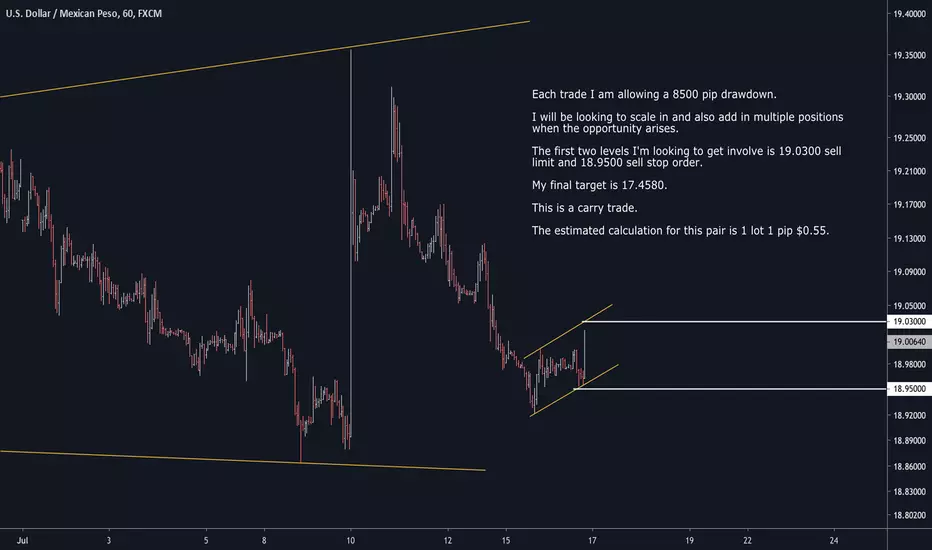
USDMXN - The Carry Trade for 2019Each trade I am allowing an 8,500-pip drawdown. I will be looking to scale in and also add in multiple positions when the opportunity arises. The first two levels I'm looking to get involved is 19.0300 sell limit and 18.9500 sell stop order. My final target is 17.4580. This is a carry trade. The estimated calculation for this pair is 1 lot 1 pip $0.55. *Disclaimer - This analysis alone DOES NOT warrant a buy or sell trade immediately. Before you enter any trade in the financial market, it is very important that you have a proper trading plan and risk management approach. The sharing of this idea is neither necessarily indicative of nor a guarantee of future performance or success.Shortby KarYong225
USDZAR - D1 short setupFundamentally: - A divergence between eco surprise indices (US negative, ZAR positive) - Fed holding rates, interest rate differential does not shrink - Gold price edging higher XAUUSD already above $1340 Technically: Daily 32.8 Fib + descending channel tested Fake out candle -> short entry opportunity Trade : Enter short position, S/L slightly above fake-out tail. Exit: H4 retracements 50% or 61% Shortby RobertSoos2
EURHUF - strong Hun eco data + carry effectFundamentals - Hun core inflation above MNB target -> rate increase probably in March - wage growth steadily above 10% - GDP growth above expectation, 5% yoy The eco picture resembles scenario the Czech case from 2017 where the central bank started raising rates (wage pressure, inflation, housing prices) and the korona strengthened 6-7%. Technical - EURHUF short trend - 318 resistance tested, move above rejected -> next support weekly 200 DMA @ 313 Trade plan - EURHUF short opened, carry in favor - Be patient, next rate decision 26th FebShortby RobertSoos1
The Ruble Carry TradeThe Russian currency has gained 5.7% against the Dollar thus far this year, following a large depreciation in December, resulting from an anticipation of more Western sanctions. The Ruble regained its strength in January though as the continuation of the US government shutdown and expectations of a global slowdown made the currency look more attractive. Most importantly, expectations of higher growth in the country came true as Russia grew by 2.3% in 2018, compared to forecasts of 1.8% growth. Not least, the 5.5% interest rate differential also assisted in attracting foreign money to gain from the carry trade and thus pull the rate higher. The positive carry trade potential would mean that someone in a short position would be able to earn a 99-pip positive overnight swap rate. Over January 2019, this would have amounted to approximately 2,200 pips, increasing the investor’s profit to 6.1%, in just one month. To put that in perspective, a trader shorting one standard lot of $100,000 would earn $6,100 in January. As with all things in life, things are not as simple as they seem. In this case, the caveat relates to the state of the Russian economy. In particular, the Russian economy appears to be following the rest of the world in a global slowdown, as a Reuters poll of economists suggested a consensus forecast of 1.4% in 2019, compared to 1.7% in 2018. High inflation and lending rates are expected to take their toll on the Russian economy, despite the improvement a value added tax reduction could potentially have. Most importantly, Russian Central Bank’s decision to purchase foreign currency in order to increase its reserves is likely to have a strong effect on the Ruble. Overall, the above suggests that the Ruble has the potential for carry trade gains over the year but also has the potential for a currency depreciation which could eclipse any profits from the interest rate differential. Naturally, the possibility for rate increases in the case that inflation rises more than expected also holds which would also provide a boost to the currency. However, the situation for the Russian economy will, out of all things, highly depend on the price of Oil and this is what potential traders need to focus upon. Come join us today at HotForex Disclaimer: This material is provided as a general marketing communication for information purposes only and does not constitute an independent investment research. Nothing in this communication contains, or should be considered as containing, an investment advice or an investment recommendation or a solicitation for the purpose of buying or selling of any financial instrument. All information provided is gathered from reputable sources and any information containing an indication of past performance is not a guarantee or reliable indicator of future performance. Users acknowledge that any investment in FX and CFDs products is characterized by a certain degree of uncertainty and that any investment of this nature involves a high level of risk for which the users are solely responsible and liable. We assume no liability for any loss arising from any investment made based on the information provided in this communication. This communication must not be reproduced or further distributed without our prior written permission.Shortby HotForex45
Wherever you break, I gotta take short! (BGM: Yesterday once more) This pair is a very good vehicle for carry trade, but in terms of carry trade, of course we still need stop loss and appropriate profit taking. "Every trade should have an entry and an out" If carry trade works, we can earn interest at the same time; if it fails, the interests could recover some of the risk. That's totally different from long Lira without stop loss!! Here we got this inside day and inside week! I would very love to take the breakdown short! Even if it breaks to the upside, I would also pay attention to the 5.44 spot supply zone short. In short, wherever the inside day breaks, only want to take the short!! Let's see how it goes! -- By far my best trade in TradingView is also this pair lol.Shortby Trader_Joe_LeeUpdated 227
USD/HUF - 295 next potential targetUSD/HUF reversed like in the textbooks (XABCD) till 161.8 Fib. The bullish trend still has rate differential support with Fed not being afraid to hike further despite Trump rhetoric. Next level is 295 previous high.Longby RobertSoosUpdated 1
CARRY TRADE CYCLES Carry Trade is the one of the most stylish trading system.Example on 1 years : UK interest rates = 0,74 Turkey interest rates = 23 If i lend money with GBP and if i invest in Turkey 2Y bonds my real income is : 23 - 0,74 = 22,26 (%) (yearly) Because of i invested with hot money , Turkish lira will get high and i can buy more Pounds if i want to get interest yield again. If im a good trader or a investment bank , my risk is so so low . Otherwise i can buy a lot of pounds with strong Turkish Lira and get high interest rate when i sell my Turkish lira, Turkish lira gets cheap and this time i can get a lot of Turkish lira again. This cycle is so profitable and suitable for community trading psychology. So carry traders transform market makers and every movements have affect for market making and it is more profitable and secure. But for an English invester, if Turkish economy get worse, even Turkish lira getting cheap and interests are not incresing or devaluations like Turkish lira got a few days ago or interests rates in dangerous places (%23 - %25 means %100 ROE in 4 years) everything getting more worse with double affect, fiat and interest rates opposite correlation lost and everything getting so much risky. This is an example on historical data. I choosed Pound because UK's interest rates are more lower than USA.This idea will show why last year :GBPTRY drops a lot and this year is different. Let's see Turkish Lira's different between market conditions conveinent for Carry Trading or opposite.Best regards.Educationby Noldo2
EURTRY Carry Trade opportunityThere is a big opportunity to make profits using carry trading strategy. If you open short position on EURTRY and hold it for a year, you will gain 15.9% on swaps.(usd account) Example: short position eurtry. volume 100k - 1 standard lot. 49.67$ will be paid to your account every time you hold your position overnight. (3 times over weekend). In one year you will gain 18130$ on swaps. If you use leverage 1:20. you will gain 218% on your margin (5700$). Problems with trading EURTRY: 1) huge spread between ask and bid price. 2) market condition. there is a big challenge to find selling point now. What is 'Carry Trade' Carry trade is a trading strategy that involves borrowing at a low interest rate and investing in an asset that provides a higher rate of return. A carry trade is typically based on borrowing in a low-interest rate currency and converting the borrowed amount into another currency, with proceeds placed on deposit in the second currency if it offers a higher rate of interest or deploying proceeds into assets – such as stocks, commodities, bonds, or real estate – that are denominated in the second currency. - Investopedia article by OleksandrSnitkoUpdated 2
Since intervention, TRY speculation is less attractivePros REER based TRY undervaluation: 47% National Bank stepped in to protect TRY Key to this position: limited market volatility and risk-on sentiment It is relatively expensive to short the TRY Cons Long-term fundamentals gloomy for Turkey Shortby RobertSoosUpdated 3
Weekly EURNOK - Potential Carry Trade IdeaEURNOK is setting up a low volatility breakout on the weekly chart. This may be longer-term carry trading idea, but be sure to check your rollover and spreads because it's an expensive pair to trade and the volatility alone makes it troublesome.by Sam_Eder1
USDJPY Daily Just Getting in GreenUSDJPY Daily Just Getting in Green - As SPX heads toward 3100 - UJ ralliesLongby raypc113
AUDJPY - Going Contrarian to News & Media?We have been hearing some negative sentiment in the market, about how the next recession is near and coming... The thing here is you need to realize where you are 'hearing' such news from. Ahem... most of the time, likely from the news or media. The question here is are they really that reliable? Well... based on our analysis (not the AUDJPY of course), we are unlikely going to see the next recession in the coming 6 to 12 months. That being said, if the macro analysis tells us that we are unlikely to see a recession so soon, will we then be transiting back into a risk-on environment? If that's the case, then the analysis here on AUDJPY will be good opportunity as a potential carry trade :) Disclaimer - this is not a trade recommendation. Ensure you have proper trading and risk management plan before you execute any trades.Longby KarYong114
Long UJ to 107.60Long UJ on 4hr Chart to 107.60 level + Carry trade for the weekend.Longby SkylordAFK0
Long squeeze in TRY/JPY After clearing the stops of the most vulnerable long traders the paths to the north is cleared.Longby auroraspot1
My Next Long Term Position TRYJPY LongI am slowly building a big long position in TRY/JPY pair. Turkish Lira is quite under-valuated at these levels and despite the recent strength of Japanese Yen I think in the long run JPY will weaken across the board. This is a carry trade position which will bring lot of interest while running. At 8.5% current interest rate of Turkish Lira outperform almost all peers in the world and with inflation and demographics of Turkey slowly going down I think soon we will see a major trend reversal here with significant strengthening of the Lira by more than 10-15%.Longby auroraspot1