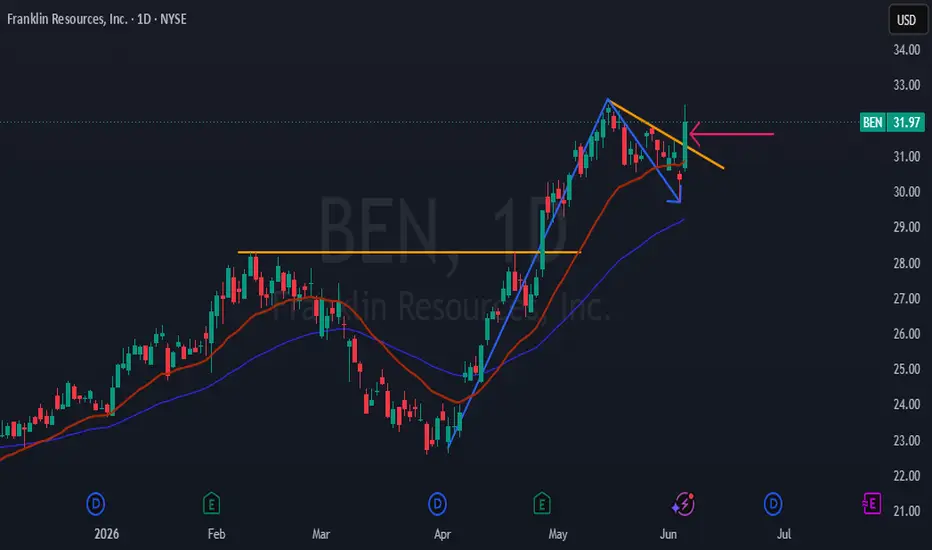
Franklin Resources Inc. (BEN) — Buy SetupFranklin Resources Inc. (NYSE: BEN) is presenting a constructive bullish setup, with the current technical structure supporting a buy-side trade idea. Buyers are gradually gaining control, while the broader structure continues to favor an upside move toward the identified target zones.
The setup is
Peers for comparison
1.47 USD
471.70 M USD
8.73 B USD
267.84 M
Last report date
—
Report period
—
EPS
—
Revenue
—
Earnings release details
FY26 delivered $84.1B of long-term inflows and 23% growth in adjusted operating income. Higher FY29 targets reflect momentum in private markets, ETFs and Canvas, alongside a raised 35% adjusted-margin goal.
Company info
Sector
Industry
CEO
Jennifer M. Johnson
Website
Headquarters
San Mateo
Founded
1947
IPO date
Dec 5, 1986
ISIN
US3546131018
CUSIP
354613101
FIGI
BBG000BD0TF8
Identifiers
ISIN US3546131018
Franklin Templeton, Inc. is a holding company, which engages in the provision of investment management and related services. The firm offers services and products under various distinct brand names, including, but not limited to, Franklin, Templeton, Legg Mason, Benefit Street Partners, Brandywine Global Investment Management, Clarion Partners, ClearBridge Investments, Fiduciary Trust Company International, Franklin Mutual Series, K2 Advisors, Lexington Partners, Putnam Investments, Alcentra, Royce Investment Partners and Western Asset Management Company. It provides investment management and related services to retail, institutional and high-net-worth investors in jurisdictions worldwide. The company was founded by Rupert H. Johnson, Sr. in 1947 and is headquartered in San Mateo, CA.
Franklin Resources Pullback Signals Potential Buying OpportunityFranklin Resources (BEN) is attracting buying interest after retracing to its 20- and 50-day moving averages, presenting a potential entry opportunity. The stock remains in a well-established uptrend, continuing to make higher highs and higher lows while trading above well-aligned 20- and 50-day mov
BEN - Resistance Break and 50 SMA Support Retest💡 Swing setup idea
50 SMA support retest
🔎 Analysis summary:
The stock broke above resistance and came back to retest the 50 SMA as support. Buyers are also starting to step in, which keeps this setup constructive.
👀 Levels to watch:
Entry trigger: Break above $32.35
Target: $34.92
Stop: Und
Franklin Resources Attracts Buyers as Uptrend Remains IntactBEN is attracting buying interest following a recent retracement, with the stock continuing to exhibit a constructive technical setup. Shares remain in a well-defined uptrend, characterized by higher highs and higher lows, while trading above both the 20-day and 50-day moving averages, signaling sus
Strengthening Consolidation phaseBen broke through its bearish trend and is consolidating just below the local volume area high which lines up with the last bullish volume area low.
If Ben can reclaim 29.32 I see a path to 42.50.... if we reject we might see a full rotation of the value area at 19.39 and a potential retest of the b
BEN Stock Going UP, Confirmed Monday 6/30/25Hello,
Ayrfolio trade ideas are based on weekly charts and momentum, so remember to be patient! No day trades here unless the stock soars up intraday. Today we’re covering:
COMPANY: Franklin Resources, Inc.
STOCK SYMBOL: BEN
POSITION: Long
TP1 Risk-Reward Ratio: 2.26
TP2 Risk-Reward Ratio: 4.52
BEN attacking major resistance area, jumps over 30d MABEN (Franklin Resources) in early trading today has jumped over its 30 day SMA, for the first time since late March. A 3.5% rise in the stock also bring it to a major resistance zone between 23.30 and 23.85. Currently trading slightly below at 23.22, but with a lot of momentum, it is possible we'll
Franklin Resources, Inc. Posts Weak Q2 ResultsFranklin Resources, Inc. (NYSE: NYSE:BEN ) unveils its second-quarter financial performance, showcasing resilience and strategic prowess amidst evolving market dynamics. With a nuanced approach to financial management and a focus on innovation, the company navigates challenges while charting a path
See all ideas
Summarizing what the indicators are suggesting.
Neutral
Neutral
Neutral
An aggregate view of professional's ratings.
Neutral
Neutral
Neutral
Displays a symbol's price movements over previous years to identify recurring trends.
Maturity dateJan 15, 2044
Coupon5.63% (Fixed)
Maturity dateAug 10, 2036
Coupon5.50% (Fixed)
Maturity dateOct 30, 2030
Coupon1.60% (Fixed)
See all BEN bonds
Frequently asked questions
Today, BEN trades at 33.73 USD.
For broader market analysis, dive into the technicals on the Franklin Templeton, Inc. stock price chart and read the latest BEN news:
– Financials Earnings Scorecard: 87% beat EPS estimates; Y/Y earnings growth mixed
– Franklin Resources Q4 Earnings Call Highlights
– BEN: FY26 growth lifts FY29 targets for private markets, ETFs, Canvas and adjusted margin
For broader market analysis, dive into the technicals on the Franklin Templeton, Inc. stock price chart and read the latest BEN news:
– Financials Earnings Scorecard: 87% beat EPS estimates; Y/Y earnings growth mixed
– Franklin Resources Q4 Earnings Call Highlights
– BEN: FY26 growth lifts FY29 targets for private markets, ETFs, Canvas and adjusted margin
Markets don't sleep, here's what's going on with BEN at the moment:
– Financials Earnings Scorecard: 87% beat EPS estimates; Y/Y earnings growth mixed
– Franklin Resources Q4 Earnings Call Highlights
– BEN: FY26 growth lifts FY29 targets for private markets, ETFs, Canvas and adjusted margin
See more updates in real-time with our News Flow.
– Financials Earnings Scorecard: 87% beat EPS estimates; Y/Y earnings growth mixed
– Franklin Resources Q4 Earnings Call Highlights
– BEN: FY26 growth lifts FY29 targets for private markets, ETFs, Canvas and adjusted margin
See more updates in real-time with our News Flow.
Franklin Templeton, Inc. is scheduled to release its next earnings report on Feb 1, 2027.
Why it matters:
– Key event: Earnings often drive significant price moves
– Market expectations: Traders watch revenue, EPS, and guidance vs forecasts
– Volatility spike: Price swings can increase before and after the release
How to use it:
– Track upcoming reports in the Earnings Calendar
– Compare actual results with analyst estimates
– Monitor price reaction and volume on Supercharts
Why it matters:
– Key event: Earnings often drive significant price moves
– Market expectations: Traders watch revenue, EPS, and guidance vs forecasts
– Volatility spike: Price swings can increase before and after the release
How to use it:
– Track upcoming reports in the Earnings Calendar
– Compare actual results with analyst estimates
– Monitor price reaction and volume on Supercharts
BEN stock is 7.86% volatile and has beta coefficient of 1.23.
What it means:
– Volatility: Shows how much the price fluctuates over time
– Beta > 1: More volatile than the market
– Beta < 1: Less volatile, more stable
Important to know:
– Volatility can increase during earnings, news events, or market stress
– Large-cap stocks like BEN are typically less volatile than smaller companies
Track every detail on Franklin Templeton, Inc. stock chart and check out the list of the most volatile stocks — is Franklin Templeton, Inc. there?
What it means:
– Volatility: Shows how much the price fluctuates over time
– Beta > 1: More volatile than the market
– Beta < 1: Less volatile, more stable
Important to know:
– Volatility can increase during earnings, news events, or market stress
– Large-cap stocks like BEN are typically less volatile than smaller companies
Track every detail on Franklin Templeton, Inc. stock chart and check out the list of the most volatile stocks — is Franklin Templeton, Inc. there?
To understand the BEN stock performance, it's worth checking price changes for various periods to get the full picture:
– 1 day — +4.72%
– 1 week — +5.41%
– 1 month — +5.18%
BEN all-time low was 0.05 USD (Dec 31, 1984), and its highest price is 59.43 USD (Dec 8, 2014). Find more dynamics in the Stock Heatmap and on the Franklin Templeton, Inc. stock chart.
– 1 day — +4.72%
– 1 week — +5.41%
– 1 month — +5.18%
BEN all-time low was 0.05 USD (Dec 31, 1984), and its highest price is 59.43 USD (Dec 8, 2014). Find more dynamics in the Stock Heatmap and on the Franklin Templeton, Inc. stock chart.
Franklin Templeton, Inc. market capitalization is 17.21 B, representing the total value of all its outstanding shares (price × shares outstanding).
What it means:
– Market cap is one of the key ways to classify companies (large-cap, mid-cap, etc.)
– It reflects how investors value the company today
– It changes constantly with stock price movements
What to look at next:
– Market cap trends: Rising cap may signal growth and investor confidence; falling cap can reflect risk or downturns
– Price vs shares: Changes can come from Franklin Templeton, Inc. stock price moves or share count (buybacks, issuance)
– Valuation ratios: Compare market cap with revenue and earnings
– Peer comparison: See how Franklin Templeton, Inc. stacks up against other companies
What it means:
– Market cap is one of the key ways to classify companies (large-cap, mid-cap, etc.)
– It reflects how investors value the company today
– It changes constantly with stock price movements
What to look at next:
– Market cap trends: Rising cap may signal growth and investor confidence; falling cap can reflect risk or downturns
– Price vs shares: Changes can come from Franklin Templeton, Inc. stock price moves or share count (buybacks, issuance)
– Valuation ratios: Compare market cap with revenue and earnings
– Peer comparison: See how Franklin Templeton, Inc. stacks up against other companies
The safest way to buy Franklin Templeton, Inc. stocks is through a reliable broker. Create an account, fund it, and place a buy order.
You can trade BEN directly from TradingView:
– Choose a broker: Explore our supported trading partners and pick one that fits your needs
– Compare options: View available brokers side by side to evaluate fees and features
– Connect your account: Open Supercharts, click “Trade”, select your broker, and log in
– Start trading: Place orders without leaving the chart
Tip: If you’re new to trading, try paper trading first — it lets you practice strategies in real market conditions without risking funds.
You can trade BEN directly from TradingView:
– Choose a broker: Explore our supported trading partners and pick one that fits your needs
– Compare options: View available brokers side by side to evaluate fees and features
– Connect your account: Open Supercharts, click “Trade”, select your broker, and log in
– Start trading: Place orders without leaving the chart
Tip: If you’re new to trading, try paper trading first — it lets you practice strategies in real market conditions without risking funds.
As of Nov 9, 2026, the company has 9.8 K employees.
Why traders follow this data:
– Company scale: Employee count reflects the size and global reach of the business
– Operational footprint: Higher headcount often indicates broader product lines, retail presence, or services
– Trend signal: Changes over time can reflect hiring growth, restructuring, or efficiency improvements
See our rating of the largest employers to find more opportunities.
Why traders follow this data:
– Company scale: Employee count reflects the size and global reach of the business
– Operational footprint: Higher headcount often indicates broader product lines, retail presence, or services
– Trend signal: Changes over time can reflect hiring growth, restructuring, or efficiency improvements
See our rating of the largest employers to find more opportunities.
Franklin Templeton, Inc. pays dividends, but whether it is a “good” dividend stock depends on its yield and stability rather than dividends alone.
Its recent dividend yield was around 5.53%, with a payout ratio of 140.40%, compared to 6.15% and 146.40% in the previous period.
What to look at when looking for good dividend stocks:
– Dividend yield: Income potential relative to price
– Payout ratio: Sustainability of dividend payments
– Dividend history: Consistency and growth over time
– Earnings strength: Dividends are more reliable when supported by stable profits
– Total return: Combines dividends with stock price performance
Explore all this in Franklin Templeton, Inc. financials.
Its recent dividend yield was around 5.53%, with a payout ratio of 140.40%, compared to 6.15% and 146.40% in the previous period.
What to look at when looking for good dividend stocks:
– Dividend yield: Income potential relative to price
– Payout ratio: Sustainability of dividend payments
– Dividend history: Consistency and growth over time
– Earnings strength: Dividends are more reliable when supported by stable profits
– Total return: Combines dividends with stock price performance
Explore all this in Franklin Templeton, Inc. financials.
Investing in Franklin Templeton, Inc. depends on your goals, risk tolerance, and market conditions. It’s essential to analyze the stock before making a decision.
First, study Franklin Templeton, Inc. financials and track their dynamics on the Fundamental Graphs:
– Business fundamentals: Revenue, earnings, and growth trends
– Valuation: P/E ratio, market cap, and how it compares to peers
– Profitability: Margins, return on equity, and cash flow
– Dividends (if any): Yield, payout ratio, and consistency
Then explore our BEN technicals – signals based on essential indicators calculations:
– Today — strong buy
– 1-week — strong buy
– 1-month — buy
Combine fundamental and technical analysis for better results.
First, study Franklin Templeton, Inc. financials and track their dynamics on the Fundamental Graphs:
– Business fundamentals: Revenue, earnings, and growth trends
– Valuation: P/E ratio, market cap, and how it compares to peers
– Profitability: Margins, return on equity, and cash flow
– Dividends (if any): Yield, payout ratio, and consistency
Then explore our BEN technicals – signals based on essential indicators calculations:
– Today — strong buy
– 1-week — strong buy
– 1-month — buy
Combine fundamental and technical analysis for better results.
Franklin Templeton, Inc. stock ticker depends on the exchange where it’s listed. On the NYSE, its primary exchange, Franklin Templeton, Inc. stocks trade under the symbol BEN.
About tickers:
– Unique identifiers: A ticker is a short code used to find and trade a stock
– Exchange-specific: The same company may have different tickers across exchanges
– Search shortcut: Used on trading platforms, charts, and screeners
Remember:
– Some companies have multiple listings
– Always check the exchange prefix to avoid confusion
Learn how to find your desired assets in our Symbol Search.
About tickers:
– Unique identifiers: A ticker is a short code used to find and trade a stock
– Exchange-specific: The same company may have different tickers across exchanges
– Search shortcut: Used on trading platforms, charts, and screeners
Remember:
– Some companies have multiple listings
– Always check the exchange prefix to avoid confusion
Learn how to find your desired assets in our Symbol Search.
BEN earnings for the last quarter are 0.94 USD per share, whereas the estimation was 0.77 USD, resulting in a 22.03% surprise. The estimated earnings for the next quarter are 0.74 USD per share.
How to read financials:
– Compare actual vs estimates: Earnings beats or misses often drive price moves
– Watch market reaction: Price response matters as much as the numbers
– Look at forward guidance: Future estimates signal expected growth
– Track trends: Analyze results across multiple quarters, not just one
Follow other essential metrics in Franklin Templeton, Inc. financials:
– Revenue growth: Shows business expansion
– Margins (operating, net): Reflect profitability and efficiency
– Free cash flow: Indicates real cash generation
– Debt levels: Impacts financial stability and risk
How to read financials:
– Compare actual vs estimates: Earnings beats or misses often drive price moves
– Watch market reaction: Price response matters as much as the numbers
– Look at forward guidance: Future estimates signal expected growth
– Track trends: Analyze results across multiple quarters, not just one
Follow other essential metrics in Franklin Templeton, Inc. financials:
– Revenue growth: Shows business expansion
– Margins (operating, net): Reflect profitability and efficiency
– Free cash flow: Indicates real cash generation
– Debt levels: Impacts financial stability and risk
Franklin Templeton, Inc. revenue for the last quarter amounts to 2.43 B USD despite the estimated figure of 1.86 B USD. In the next quarter revenue is expected to reach 1.88 B USD.
How to read this data:
– Compare actual vs estimates: Revenue beats or misses can move the stock
– Watch market reaction: Price response shows how investors interpret results
– Look at growth: Compare with previous quarters and year-over-year data
– Track trends: One quarter matters less than consistent performance
Follow other essential metrics in Franklin Templeton, Inc. financials:
– Earnings (EPS): Profitability per share
– Margins (gross, operating): Efficiency and cost control
– Free cash flow: Cash available after expenses
How to read this data:
– Compare actual vs estimates: Revenue beats or misses can move the stock
– Watch market reaction: Price response shows how investors interpret results
– Look at growth: Compare with previous quarters and year-over-year data
– Track trends: One quarter matters less than consistent performance
Follow other essential metrics in Franklin Templeton, Inc. financials:
– Earnings (EPS): Profitability per share
– Margins (gross, operating): Efficiency and cost control
– Free cash flow: Cash available after expenses
Yes, you can track Franklin Templeton, Inc. financials in yearly and quarterly reports right on TradingView.
Use our Earnings Calendar to never miss important releases and spot opportunities early.
BEN net income for the last quarter is 160.40 M USD, while the quarter before that showed 251.90 M USD of net income which accounts for −36.32% change.
How to read this data:
– Track changes: Compare net income across quarters to spot trends
– Watch expectations: Compare with estimates to gauge performance
– Check margins: Net income reflects profitability after all expenses
– Look beyond one quarter: Consistency matters more than a single result
Follow other essential metrics in Franklin Templeton, Inc. financials:
– Revenue: Overall business growth
– Earnings per share: Rising EPS over time often points to improving business performance
– Margins (gross, operating): Efficiency and cost control
How to read this data:
– Track changes: Compare net income across quarters to spot trends
– Watch expectations: Compare with estimates to gauge performance
– Check margins: Net income reflects profitability after all expenses
– Look beyond one quarter: Consistency matters more than a single result
Follow other essential metrics in Franklin Templeton, Inc. financials:
– Revenue: Overall business growth
– Earnings per share: Rising EPS over time often points to improving business performance
– Margins (gross, operating): Efficiency and cost control
Franklin Templeton, Inc. does pay dividends, which are distributed quarterly. The most recent dividend per share was 0.33 USD, with a trailing twelve-month (TTM) dividend yield of 3.90%.
Explore more details on Franklin Templeton, Inc. dividends, look at:
– Dividend history: Check whether payouts are growing, stable, or declining
– Payout ratio: How much of earnings are paid out as dividends
– Total return: Combine price growth + dividends for full performance view
Explore more details on Franklin Templeton, Inc. dividends, look at:
– Dividend history: Check whether payouts are growing, stable, or declining
– Payout ratio: How much of earnings are paid out as dividends
– Total return: Combine price growth + dividends for full performance view
BEN reached its all-time high of 59.43 USD on Dec 8, 2014. Its all-time low was 0.05 USD and was reached on Dec 31, 1984.
Explore the Franklin Templeton, Inc. stock price chart to see more price history, and discover companies reaching new all-time highs and lows.
Franklin Templeton, Inc. EBITDA is 1.79 B USD, with an EBITDA margin of 19.05%.
EBITDA is a measure of core operating performance, showing how much profit the company generates from its main business activities before accounting for financing and accounting-related costs.
What it means:
– Operating strength: Helps assess profitability from core operations
– Efficiency signal: Rising EBITDA often reflects improving business performance
– Comparability: Useful for comparing companies with different capital structures
What to look at next in Franklin Templeton, Inc. statements:
– Revenue growth: Shows whether the business is expanding
– Net income: Captures full profitability after all expenses
– Free cash flow: Shows actual cash generated
– Debt levels: Important when evaluating earnings quality
EBITDA is a measure of core operating performance, showing how much profit the company generates from its main business activities before accounting for financing and accounting-related costs.
What it means:
– Operating strength: Helps assess profitability from core operations
– Efficiency signal: Rising EBITDA often reflects improving business performance
– Comparability: Useful for comparing companies with different capital structures
What to look at next in Franklin Templeton, Inc. statements:
– Revenue growth: Shows whether the business is expanding
– Net income: Captures full profitability after all expenses
– Free cash flow: Shows actual cash generated
– Debt levels: Important when evaluating earnings quality
Analyst forecasts suggest a price range between 26.00 USD and 40.00 USD for BEN, based on current estimates.
Remember:
– Forecasts show possible scenarios, not guaranteed outcomes
– They're based on multiple analysts’ models and assumptions
– Target prices change with earnings, news, and market conditions
Don't rely on analysts' opinions alone:
– Use technical analysis: Trend, support/resistance, momentum
– Study fundamentals: Revenue, earnings, margins
– Account for market context: News, macro trends, sector performance
Remember:
– Forecasts show possible scenarios, not guaranteed outcomes
– They're based on multiple analysts’ models and assumptions
– Target prices change with earnings, news, and market conditions
Don't rely on analysts' opinions alone:
– Use technical analysis: Trend, support/resistance, momentum
– Study fundamentals: Revenue, earnings, margins
– Account for market context: News, macro trends, sector performance