$BTC Reaction to TGA Drain vs ISM ExpansionWhy aren't any of the macro gurus talking about how the Treasury General Account has risen ~33% in the past couple weeks due to tax season?
This is supposed to be a liquidity DRAIN on markets.
Is everyone fixated on the ISM Manufacturing PMI being in expansion the past 4 months, so liquidity does not matter as much anymore?
asking for a friend 🥸
Seasonality
LI Back at Support as Historical Cycles Come Into PlayLi Auto is one of those names where price action alone doesn’t tell the full story—you need to overlay seasonality to really understand what’s going on.
Looking at the broader structure, LI has been trading in a well-defined range for quite some time. The chart clearly shows repeated reactions between a lower demand zone (around current levels) and an upper supply zone near the 30–40 area. Right now, price is once again sitting near that lower boundary, which already makes it technically interesting.
But the real edge here comes from the seasonality data—and it’s honestly brutal (in a good way).
Historically, Li Auto tends to show:
Strong rebounds after weak starts to the year
Noticeable upside periods following consolidation at lows
Explosive months scattered throughout the calendar (especially after drawdowns)
You can clearly see that certain months consistently outperform, while others tend to be weak. This kind of repeatable behavior is exactly what traders look for—it adds a probabilistic layer on top of the technical setup.
So what’s the idea here?
We’re combining two things:
Strong support zone (price has reacted here multiple times)
Seasonal tendency for upside after periods of weakness
That creates a solid case for a potential bounce.
The drawn scenario on your chart reflects a classic range play:
Accumulation at support
Gradual push higher
Move back toward the mid-range / resistance zone (~30 area)
If momentum builds and the sector (EV / China tech) starts catching bids, this move can accelerate quickly.
Why this setup stands out:
Clean range structure → easy to define risk
Multiple historical bounces from this zone
Seasonality aligns with potential upside
Sentiment has been weak → room for reversal
Of course, like any range trade, this only works as long as support holds. A breakdown below this zone would invalidate the idea and likely open the door for further downside.
But as it stands, this is one of those setups where:
You’re not chasing strength—you’re positioning at a level where reactions have historically happened.
Bottom line:
LI is sitting at a key level, and when you combine that with its strong seasonal tendencies, it becomes a high-interest setup for a potential long—especially if price starts confirming with higher lows and momentum.
S&P 500 - Sell in May, Return Another Day. The Truth. 2026
SYMBOL: SP:SPX | DIRECTION: Educational / Long-biased | TIMEFRAME: Monthly
Published: April 2026
This idea has been published yearly since 2024. Every year the data is updated. Every year
the conclusion is the same. Every year the crowd ignores it and sells in May anyway. Here we
are again.
No doubt everyone reading this has encountered some version of the phrase "Sell in May
and go away." It appears in newspapers, on financial television, in the comments section of
every S&P 500 idea published in late April. It is stated with authority. It is repeated with
confidence. It is, based on the data, almost entirely wrong.
Almost every publisher on the S&P 500 here on tradingview is bearish.
, except Ww of course.
A quick clarification before the data: the saying refers to the May through October period
historically underperforming the November through April period. That part is broadly true,
November to April has, on balance, delivered stronger returns. What the saying implies is that
May to October loses money and that selling is therefore the rational response. That is where
things fall apart entirely. The record. Unedited. Thirteen years of evidence:
Year Period S&P 500 Return Sell in May verdict
2013 May – Oct +11% WRONG
2014 May – Oct +8% WRONG
2015 May – Oct -15% CORRECT
2016 May – Oct +8% WRONG
2017 May – Oct +11% WRONG
2018 May – Oct +11% WRONG
2019 May – Oct +18% WRONG
2020 May – Oct +55% WRONG
2021 May – Oct +13% WRONG
2022 May – Oct -15% CORRECT
2023 May – Oct +11% WRONG
2024 May – Oct +17% WRONG
2025 May – Oct +23% WRONG
Eleven wrong. Two correct.
That is not a trading strategy. That is a coin flip with worse odds.
The two years it worked, 2015 and 2022, are worth examining. Both involved genuine
macro shocks: the 2015 China currency devaluation scare and the 2022 Federal Reserve rate
hiking cycle. In both cases, the market would have fallen regardless of what month it was.
Selling in May did not cause the decline. Selling in May simply happened to coincide with it. The
distinction matters. In fact, go back far enough and you'll be able to wrap an narrative around any bearish period that followed a red May. The herd are betting on such a scenario right now. But, as usual, they're wrong.
The 2026 context
The S&P 500 begins May 2026 with one of the largest single-session gains in recent history
a 9.32% move on the final trading days of April. The monthly chart shows price confirming
support on the ascending trend line (annotated in blue) as a bullish engulfing candle prints. The yellow arrows mark the double retest of that support and the subsequent recovery. The setup, from a purely technical standpoint, does not resemble the two years in which selling in May was correct. It resembles every other year in which it was wrong.
The crowd will still sell. Crash and recession is all they'll talk about. All will miss the next 11%, 17%, or 23% gain trying to avoid a drawdown that, based on the above table, has a roughly 15% probability of actually arriving when reviewing the last 50 years.
A note on the support line
The ascending support line visible on the chart, in place since the 2022 lows, has been
tested and held. A monthly close below this support would be the first material bearish signal on
the monthly timeframe. Until that occurs, the primary trend remains up, the seasonal data
remains unfavourable to the bears, and the case for staying invested remains statistically
stronger than the case for leaving.
Sell in May if you want to. The table will be updated in November.
Good luck.
Ww
Prior editions:
2025 idea.
2024 idea
===================================================
Disclaimer :
This idea is for educational and informational purposes only. It is not financial advice. Past performance is not indicative of future results. Always do your own research and consult a qualified financial adviser before making any investment decisions.
Microsoft MSFT Daily Demand Zone Entry $415 to $432Microsoft has corrected 22% from its late 2024 all time high near $539, bringing price back into a strong daily demand zone between $415 and $432. Current price around $427 sits directly inside the entry window.
Entry Zone: $415 to $432
Stop Loss: $390
TP1: $455 (R:R 1:1)
TP2: $490 (R:R 1:2)
TP3: $522 (R:R 1:3)
Technical Context:
The $415 to $432 band was the consolidation base that launched the 2024 bull run to ATH. Price returning here is a first fresh test of this demand zone. Sellers are losing momentum over recent sessions with lower wicks and closes near mid range, pointing to absorption.
COT Analysis:
Latest Commitments of Traders data shows institutional equity exposure repositioning to the long side. USD long positions trimmed approximately 17% over recent weeks, historically a supportive signal for US equities and particularly tech. Large speculators are reducing net short exposure across the Nasdaq.
Valuation:
After a 22% correction MSFT is approaching fair value territory. Treasury yields (ZN and ZB) are rising, signaling falling rate expectations ahead of FOMC this week. Historically a falling rate environment expands multiples for high quality growth names like Microsoft. Azure continues double digit cloud growth and Copilot AI monetization is just beginning to appear in revenue.
Seasonality:
May seasonality for MSFT is mixed on a raw basis but the current AI investment cycle overrides the seasonal average. Q2 earnings window has historically been favorable, with MSFT posting gains in roughly 7 of the last 10 years during this period.
Risk Management:
Stop at $390 below the swing low. Daily close below $415 is an early warning. Daily close below $390 invalidates the setup. Scale out at each TP to lock in profits progressively.
Not financial advice. Always manage your own risk.
Gold Inside Day Signal - Backside of the Month Reversal Idea
Gold gave us an inside day on Monday (opening range). Price is hovering over last week's low of the week (4658) and the low of the week before on April 10 (4644). If an opportunity presents during the NYSE open (9:30 AM EST), we'll look for a quick move towards the lowss that breaks all 3 (1) yesterday's LOD (Inside low) at 4668 (2) last week's low at 4658, and (3) April 10 low at 4644) triggering short sellers and breakout traders in the process as well as potentially hunting higher timeframe (HTF) trader's long stops.
From there, our best trade setup BTS would be a quick rebound and close above the 20 EMA on the 1 or 5 minute timeframe for a reversal long towards yesterday's inside day high as TP1 (4730). Depending on our entry, our stop can be below the most recent low when price closes above the 20EMA.
Our second favorable setup after squeezing all lows would be a continuation trend, inline with the backside of the month (week 4). Method of entry would only be if price breaks and closes below 4644 with an entry on the rejection of the 20EMA on the same 1 or 5 minute timeframe.
If the market moves during the London Session or if those 3 extremes are not tapped during the first opening hour of the NYSE, there will be no trade and the idea is deemed invalid.
Best Time To TradeMost traders think the market is only about levels, zones, and entry patterns. But there is another factor that directly affects price movement — time.
And if you still struggle to trade consistently, this material can become the boost that takes your trading to the next level.
The market does not move randomly.
It moves during specific hours, when liquidity enters the market.
This concept is known as time theory.
The idea is simple:
not all time periods are equally important for trading.
There are periods when the market is less active, movements are less technical, and trading becomes more chaotic. And there are periods when real movement begins.
These periods coincide with trading sessions.
Price formation in liquid assets does not happen randomly and is not driven by individual retail participants. The primary role in price movement belongs to institutional participants — banks, funds, and large financial organizations that operate with significant amounts of capital.
Unlike retail traders, these participants operate within clearly defined working schedules. They function within their time zones, according to the working hours of financial centers and internal regulations.
This is why the market is not equally active throughout the day. Market activity changes depending on which financial centers are open and actively participating in trading.
From this, we arrive at an important conclusion:
every liquid asset has its most favorable trading time.
This is because different assets have different geographical exposure and different participant structures.
For example, an asset may demonstrate strong activity during Asian hours, when Asian financial centers are active, while remaining relatively calm during U.S. or European hours.
Conversely, some instruments show their primary impulsive movements specifically during London or New York hours, when the largest volumes of liquidity enter the market.
Thus, time becomes a key factor in price formation, since during specific hours the market contains the highest concentration of participants and trading volume.
Understanding when a particular asset is most actively traded allows a trader to operate during periods of maximum market efficiency, avoiding low-liquidity phases where the probability of random movement and inefficient entries is significantly higher.
If we understand that market activity depends on institutional participation, the next step is understanding trading sessions.
Trading sessions are time periods during which the key global financial centers are open.
It is during these periods that the main liquidity flows enter the market, directly affecting volatility and the nature of price movement.
Traditionally, three main trading sessions are identified:
Asian
European (London)
American (New York)
Forex Session Schedule
Tokyo (Asia): 00:00 – 08:00 GMT
London (Europe): 07:00 – 16:00 GMT
New York (U.S.): 12:00 – 21:00 GMT
Stock Market Session Schedule
Tokyo (Asia): 00:00 – 06:30 GMT
London (Europe): 07:00 – 15:30 GMT
New York (U.S.): 13:30 – 20:00 GMT
Each session plays its own role in shaping intraday price movement.
Asian Session — Range Formation
The Asian session typically features calmer price movement, especially when we are talking about instruments that are less characteristic for Asian hours — such as EUR|USD or NAS100.
During this period, the market often forms a range, where liquidity accumulation takes place.
Price may move up and down without a clear direction, forming local highs and lows. These levels later become areas of interest for subsequent sessions.
The primary objective of the Asian session is to create liquidity that will later be used by more active market participants.
That is why the Asian range often becomes an important reference point for further analysis.
However, it is important to understand that some assets show active and liquid movement during Asian hours — for example, XAU or Nikkei 225.
London Session — Beginning of Active Movement
With the opening of European markets, liquidity increases sharply. London is one of the largest financial centers in the world, and its open is often accompanied by a rise in volatility.
During this period, the market begins actively interacting with the liquidity formed earlier.
During the London session, we often observe:
liquidity taken from Asian highs or lows
false breakouts of the range
formation of the first directional move of the day
impulsive movements that define market structure
For many instruments, London becomes the starting point of the intraday move.
Examples of instruments strongly influenced by this session include:
GER40
UK100
EUR|USD
GBP|USD
New York Session — Continuation or Reversal
With the opening of U.S. markets, liquidity reaches one of its highest levels of the day.
A particularly important period is when London and New York overlap. This time is characterized by the highest volume and increased volatility.
During the New York session, the market may:
continue the movement initiated in London
perform a final liquidity sweep
form a reversal after reaching key levels
New York — continuation or reversal?
To answer this question, we do not analyze New York in isolation. We always evaluate the context of London and the higher-timeframe range.
There are several key factors that help determine this.
The first thing we look at is London’s behavior.
There are two primary scenarios.
If London:
swept Asian liquidity
formed an impulse in one direction
did not reach key higher-timeframe levels
then the probability increases that New York will continue the movement.
In this case, the market remains in the delivery phase.
If London:
swept liquidity on both sides of the range
reached a key higher-timeframe level (HTF liquidity / POI)
formed an impulsive expansion without structural continuation
then the probability of a reversal in New York increases.
In this case, London often acts as a manipulation phase before a directional shift.
The next important filter is the higher-timeframe context.
We ask ourselves:
Has the market reached an important liquidity zone?
This may include:
previous daily high / low
weekly high / low
premium / discount zone
key order block
If the level has not been reached,
the market usually has room to continue — meaning New York is more likely to be a continuation phase.
If the level has been reached,
the market has already “completed its objective,”
and the probability of reversal or correction increases.
Killzones
However, it is important to understand:
not every part of a session is equally effective for trading.
Even within a single session, there are periods when activity reaches its peak. These periods are called Killzones.
A Killzone is a specific time window within trading sessions when the probability of strong price movement significantly increases.
These are the moments when the largest number of orders, liquidity, and trading decisions enter the market simultaneously.
Asian Killzone
The Asian Killzone refers to the beginning of the Asian session (the first two hours of the session).
During this time, the initial daily range is formed. Price begins creating the first liquidity levels that will later be utilized by London.
In most cases, this period is not used for aggressive trading, but it is extremely important for analysis.
This is where the Asian range is formed, which later becomes a reference point for liquidity targeting.
London Killzone — One of the Most Important
The London Killzone is considered one of the most important periods for intraday trading.
It represents the opening of the London session (the first two hours), when liquidity sharply increases and the market begins actively interacting with the range formed during Asia.
During the London Killzone, we often observe:
false breakouts of the Asian range
liquidity sweeps
formation of directional impulses
emergence of the first high-quality entry opportunities
For many intraday strategies, this period becomes the primary trading window.
New York Killzone — Movement Confirmation
The New York Killzone refers to the opening of the U.S. session (the first two hours after the stock market open).
This moment is often accompanied by a sharp increase in volume and volatility.
During this period, the market may:
confirm London’s direction
accelerate an already established move
form a reversal after interacting with key levels
It is also during this period that major macroeconomic news releases frequently occur, further amplifying price movement.
☝️☝️☝️Visit my profile for more information☝️☝️☝️
Enjoy!
The Only 3 Market Conditions That MatterThe Only 3 Market Conditions That Matter (And What to Trade in Each)
Most traders are not losing because of bad strategies.
They’re losing because they’re using the right strategy in the wrong market condition.
If you understand this, your results change immediately.
1. Trending Market — Ride Strength, Don’t Fight It
This is when price is moving clearly in one direction (higher highs / higher lows or the opposite).
What works:
• Breakouts
• Pullbacks to trend (EMA, support/resistance)
• Trend-following systems
What fails:
• Mean reversion
• Trying to “call the top or bottom”
In a trend, strength tends to continue longer than you expect.
If you keep shorting a strong trend, you’re not “early”—you’re just wrong.
2. Ranging Market — Fade Extremes
This is where most traders get chopped up.
Price moves sideways, fakes breakouts, and reverses quickly.
What works:
• Mean reversion
• Buying support, selling resistance
• Oscillators (RSI, Stochastics)
What fails:
• Breakout strategies
• Trend-following systems
Trends die in ranges. If you keep trading breakouts here, you’re feeding the market.
3. Transition Phase — Do Nothing (Yes, Really)
This is the most dangerous phase—and the most ignored.
It’s the shift between trend and range:
• Momentum weakens
• Structure becomes unclear
• Signals conflict
What works:
• Patience
What fails:
• Almost everything else
The best trade here is often no trade. Professionals protect capital. Amateurs try to “figure it out.”
The Real Problem
Most traders:
• Use one strategy for all conditions
• Force trades when there’s no edge
• Ignore market context
That’s why results feel random.
What You Should Do Instead
Before every trade, ask one question:
“What type of market am I in?”
Then match your strategy:
• Trend → trend-follow
• Range → mean reversion
• Transition → sit out
That’s it. Simple—but powerful.
Your edge is not just how you trade. It’s when you choose to trade. If it feels confusing, it’s probably not the time to be in the market.
My Ideas are only for educational purposes!
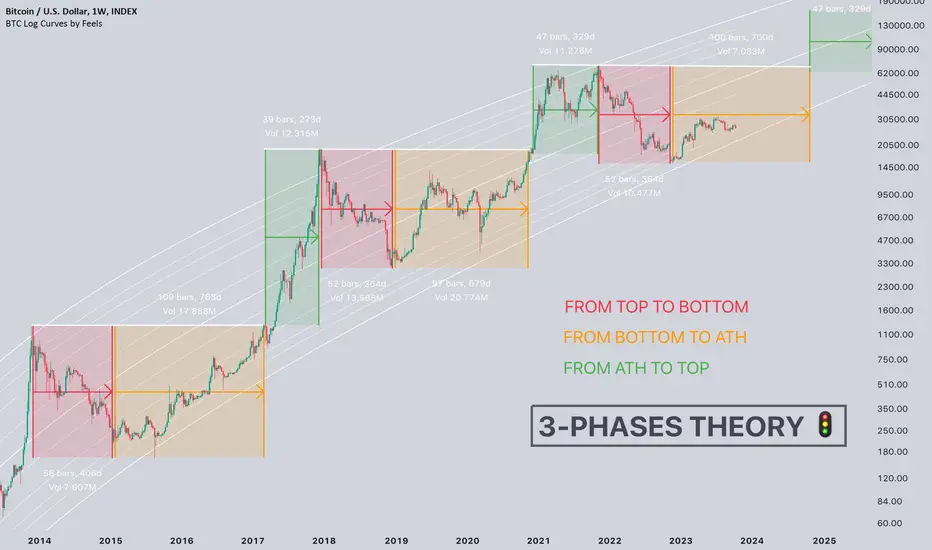
Bitcoin | Bear Market Will Be Until Approximately September 2026Well, seems like timing is everything with each cycle where this time the bull market
Swallow Academy +/- 500 days, just as for the last 2 bull markets. And if we look at the previous bear markets, we had them for +/- 300 days, which gives us at least 5 more months of bloody markets, or as we would recall them, "a discount zone most traders will miss most probably."
So this is what it is all about, a reminder: there are times when it is best to buy something and there are times when it is best to sell something...History usually likes to repeat itself, as history is driven by people and their emotions...and people are pretty predictable.
5 more months to load up the bags; that's what we say
Swallow Academy
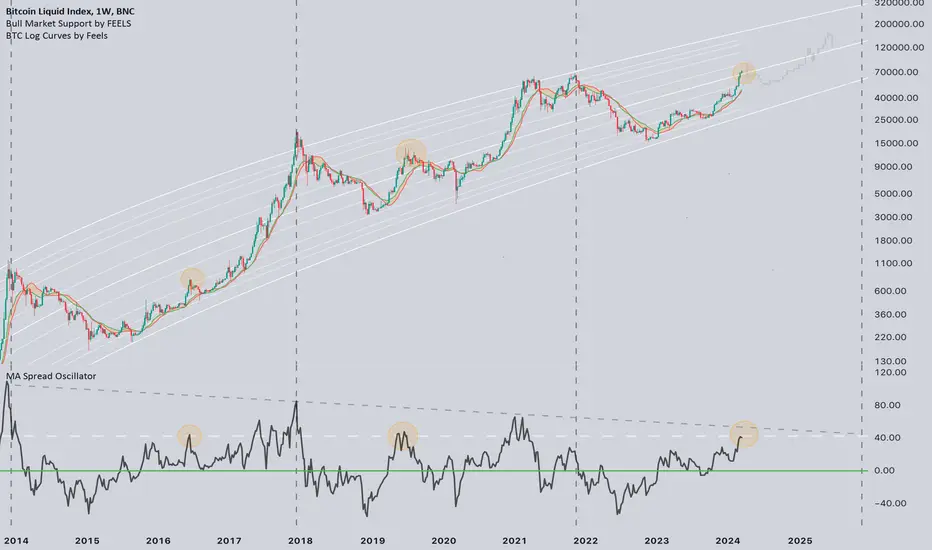
I think BTC rejects hereMy script that is public along with the Bull market support bands lays roughly 77-79k. During this time of the cycle, BTC rarely ever exceeds the resistance top and bull market support band. 2 major macro scripts point towards a rejection coming up, based on historical price action, and math.
We are in a bear market, that was made clear in Q4 last year. If BTC does break out of these indicators, I think that integrity of the 4 year cycle will be challenged.
Based on major indicaotrs that I've posted, I think BTC has roughly and 80% chance of being rejected and going lower into 2026.
Use my script as well for this chart! Shows potential rejection in the same area!
Let me know your thoughts, thanks for reading!
Gold Long Bias – 80% ProbabilityPrice action has been trending to the upside, consistently respecting lower timeframe market structure.
It is currently trading above all higher timeframe EMAs, while sweeping lower timeframe liquidity and forming a sequence of higher highs and higher lows.
If price continues to push higher from this level, it will print a new daily candle with both a higher high and a higher low relative to the previous day, reinforcing bullish momentum
How New EU Rules Transformed the Crypto Exchange Market MiCA in Action: How New EU Rules Transformed the Crypto Exchange Market from July 1, 2026
July 1, 2026, went down in history as " Day X " for the European crypto market. The MiCA (Markets in Crypto-Assets) regulation has officially entered into full force, concluding the transition period. Trading digital assets in the EU is no longer a "grey zone" but a strictly regulated industry comparable in transparency to the banking sector. For traders, this marks the end of the anonymous altcoin era and the beginning of institutional-grade security.
What is MiCA and Why It Matters in 2026?
MiCA is the world's first comprehensive set of rules that unified 27 EU countries into a single legal field. By 2026, its influence has expanded far beyond Europe: global exchanges are forced to adapt to these standards to maintain access to EU capital.
The primary goal is investor protection. Now, any Crypto-Asset Service Provider (CASP) bears legal responsibility for the safety of your funds. Under MiCA, if an exchange suffers a hack due to negligence, it is legally obligated to compensate users for their losses. This fundamentally shifts the level of trust within the industry.
Top 7 MiCA-Compliant Crypto Exchanges (CASPs)
In the Q3 2026 market, the "Licensed CASP" status has become the ultimate filter for choosing a platform. Here are the leaders that have successfully passed audits and earned the right to operate in the EU:
Bitstamp (Luxembourg): The oldest licensed platform and the gold standard for reliability.
Coinbase Ireland (Ireland): The premier interface for handling fiat Euro transactions.
Kraken (Germany/Italy): Offers deep liquidity in EUR trading pairs.
Binance France (France): Provides the widest selection of MiCA-verified tokens.
Bitpanda (Austria): Direct access to diversified portfolios, including tokenized stocks and metals.
Société Générale FORGE (France): A specialized platform for institutional RWA (Real World Assets) tokens.
Luno (Multi-license): Streamlined trading for beginners backed by rigorous compliance.
Selection Criteria for Licensed Platforms
To make this list, exchanges implemented real-time Proof of Reserves systems, strictly segregated corporate operating accounts from client deposits, and appointed official representatives in every country of operation.
The New Status of Stablecoins: What Investors Need to Know
Stablecoins have faced the strictest oversight. MiCA categorizes them into Electronic Money Tokens (EMT) and Asset-Referenced Tokens (ART). Since July 2026, issuers must hold a banking license and maintain a 1:1 liquid reserve.
Why Some USDT Pairs Are Being Delisted?
The popular USDT faced significant hurdles due to MiCA's daily transaction limits (no more than 200 million EUR for "unauthorized" tokens). Consequently, many exchanges delisted USDT pairs for EU residents, offering USDC (by Circle) and EURC instead, as they fully comply with the new standards.
Impact on Users from CIS and Non-EU Countries
For citizens of the CIS and other non-EU regions, the situation is twofold. While using licensed exchanges is now safer, access requirements have tightened significantly.
The Concept of Reverse Solicitation
A key term for 2026 is Reverse Solicitation . EU-licensed exchanges are strictly prohibited from marketing their services outside the Union. If you live in the CIS, you can only trade on a European platform if you initiated the registration yourself. Russian-language support and local marketing campaigns on such platforms have virtually disappeared.
COPPER - If history repeats then copper is topping here.There is a risk of copper to top here around these levels. Its possible that we go up and make a new ATH and test the upper trendline, if we break above it and hold there is likely more upside to come, But if history repeats then we years of downside coming for copper which is very likely due to the 18.6 year cycle is in its last phase right now.
Evolution of Decentralized Exchange InfrastructureDecentralized exchange architecture is undergoing a gradual transformation from static automated market makers toward more modular and programmable liquidity systems. The introduction of extensible execution logic at the protocol level enables more complex interactions between liquidity providers, routing systems, and external execution layers.
This evolution shifts the role of exchanges from passive liquidity venues to active infrastructure layers capable of supporting diverse execution strategies. Liquidity is no longer purely a function of capital distribution but also of behavioral design embedded within protocol mechanics.
As a result, market structure becomes increasingly sensitive to how liquidity is shaped rather than simply how much liquidity is present. This introduces a new dimension of competition at the protocol level, where execution efficiency and adaptability matter as much as depth of liquidity itself.
US2000 :Long journeyThis is a continuation of the previous chart analysis. It’s a long journey—almost like a field trip.
The Russell 2000 Index is currently at a year-to-date level of +6.53%.
Now then, according to geometric delta analysis, with a remaining time of approximately 1,327 days, the level along the trajectory defined by the golden ratio (1.618) is 3,041 points.
This reflects the typical relationship between U.S. presidential election timing and equity market behavior. Given that the Russell 2000 consists of small- and mid-cap stocks, it tends to enter an upward trend roughly one year prior to a U.S. presidential election.
Yellow :Presidential election day
$NQ - Very tough to gaugeEither Option 1 happens.
I.e Next week forms a lower high and continue down
Or
Goes to ATH, completes the business cycle and goes to standard deviation level of -4 and then we get a major correction after Open AI and Anthropic gets its IPO
Who knows. Just trade what the market gives you.
GBP/AUDThe key focus for GBP/AUD is simply how much the pound can rebound from the recent highs. This is because the geopolitical importance of the resource-rich nation, Australia, is increasing day by day. From a chart perspective, the setup suggests we are in the final phase of an Elliott Wave structure—reflecting a prolonged period of Australian dollar strength and its resulting backlash.
Beloved US Crude OutlookWTI crude oil prices plunged sharply.
The key focus is geometric delta analysis in options trading.
The sharp decline, driven by rising expectations of an early ceasefire agreement with Iran, has significantly altered the scenario.
According to geometric delta analysis,
the estimated remaining time is around 60 days, which corresponds to approximately June 3, 2026.
The estimated strike price is about $135.50 per barrel.
Such a price level is not entirely unrealistic.
“The second act begins—stay tuned.”
NASDAQ100 - Historical Pattern in PlayLast year, NESDA100 made a double top at 22270 area. Later it fell below daily EMA200 in March, and correction continued to 0.5 Fib levels, till 16420 area.
NASDAQ100 is following exact same pattern so far this year. It did hit double top near 26290 area and it just closed below EMA200 on daily TF, and that too in Month of March (some seasonality in play?). I'd expect correction (call it a fall). A daily close below EMA 200 is already a strong bearish sign but still it closed above psychological support of 24000. If it doesn't reverse from here, I'd expect a prolonged correction towards 21300 area, with some intermediate support around 23000.
NZDUSD - Short at Resistance in a RangeHello Trading Fam! 👋
The market is moving sideways (range-bound) between a lower support zone and an upper resistance zone.
The highlighted orange upper area = resistance where price has repeatedly failed.
Price has now returned to that resistance zone again.
Expect price to reject this area and move down.
Don’t forget to like and share your thoughts in the comments! ❤️
Bitcoin enters weekly Gaussian channel - November 2025And the Bulls have until November 17th to undo that, or else…
An alarm recently triggered, an alarm that had been completely forgotten about. That alarm has a message written to myself:
“Bitcoin price action enters weekly Gaussian channel. Look left - DO NOT IGNORE”
We look left, and pause, “ well isn’t that interesting ”, says the little voice of reason. I tell it to shut up as I convince myself this time is different.
The technicals:
Each candle circled from 2014 through until 2021 is the first candle to enter the weekly Gaussian channel following the market top. Now whether you believe the market top is in or not, that is not relevant. We’re only interested in facts. The facts are:
Price action corrected -60% minimum upon entering the channel AFTER confirmation. Price action has until November 17th to confirm. That would result in a market bottom of $43k to $57k, Saylor’s fund would be wiped out.
Price action would remain in a bear market condition for at least 18 months. Therefore no recovery until mid 2027.
Closer Clarice
What needs to happen to remain in a bull market?
Price action must close above $110k, while technically speaking $105k is outside the channel, that would be a weak close. A weak close as the previous bar engulfs the print.
Conclusions
So here we are again, Bitcoin’s entered the weekly Gaussian channel, that green noodle of doom. Every time it happens, people scream “buy the dip!” as if chanting it makes the red candles go away. Look left, seriously, just look. Every single time price action’s wandered into that channel since 2014, it’s been the start of an 18-month spa retreat for the bears. “This time is different,” they say.
In each cycle Bitcoin entered the Gaussian channel price dropped roughly -60 % and stayed miserable for over a year. And 2025 has been glorious right?, all Bitcoin maxis ever wanted was a fiat replacement. Congratulations, price action is the same as it was this time last year and look set to continue the trend! Why the long faces?! Isn't this what you wanted? Was never about more dollars was it? 1 Bitcoin still = 1 Bitcoin after all.
Now the bulls have got until November 17th to prove this isn’t another replay. If the bulls can’t push price back above $110 k (and hold it), it’s curtains. $43k – $57k becomes the new meditation zone while Saylor and the laser-eye crew quietly delete their tweets.
Ww
Disclaimer
=============================================================
This isn’t financial advice. It’s a bloke on the internet pointing at a rainbow-coloured curve saying “that’s bad.” If you mortgage your house because you think I’ve uncovered the secret code of the Gaussian gods, that’s on you. If it pumps, you’ll call yourself a genius.
If it dumps, you’ll say the whales manipulated it. Either way, I’ll still be here, laughing at the comments section.
So yes, DO NOT IGNORE the channel. But also, don’t sell your kidneys because a stranger on TradingView drew some squiggly lines.